List of Peptides and What They Do: The Complete Research Guide
What do peptides do?
Peptides are short chains of amino acids, the same building blocks that make up larger proteins, just fewer of them strung together. In the body, many peptides act as signaling molecules, carrying information between cells and tissues the way a hormone does: insulin and glucagon are both peptides, and so are the growth-hormone-releasing and appetite-related peptides now widely discussed in metabolic research. Because a short amino acid sequence can be synthesized and studied on its own, peptides have become one of the most active areas of laboratory research for questions about tissue repair, metabolic signaling, immune activity, and neurological function. What any individual peptide does depends entirely on its specific sequence: research peptides are not interchangeable, and a finding about one compound does not transfer to a different peptide with a similar name or category. This list of peptides and what they do covers the research peptides people search for most, grouped by the type of biology each one is studied in, along with what the published research actually shows, and does not show, for each one.
Types of peptides on this list
Research peptides are usually grouped into a handful of broad types based on the biology they are studied in: GLP-1 and metabolic peptides, growth-hormone-axis peptides, healing and regenerative peptides, mitochondrial and longevity peptides, and nootropic or cognitive peptides, plus a catch-all group of related compounds that are not always peptides at all. This list is organized by those types for that reason, so compounds studied in similar biology sit next to each other.
How to use this list
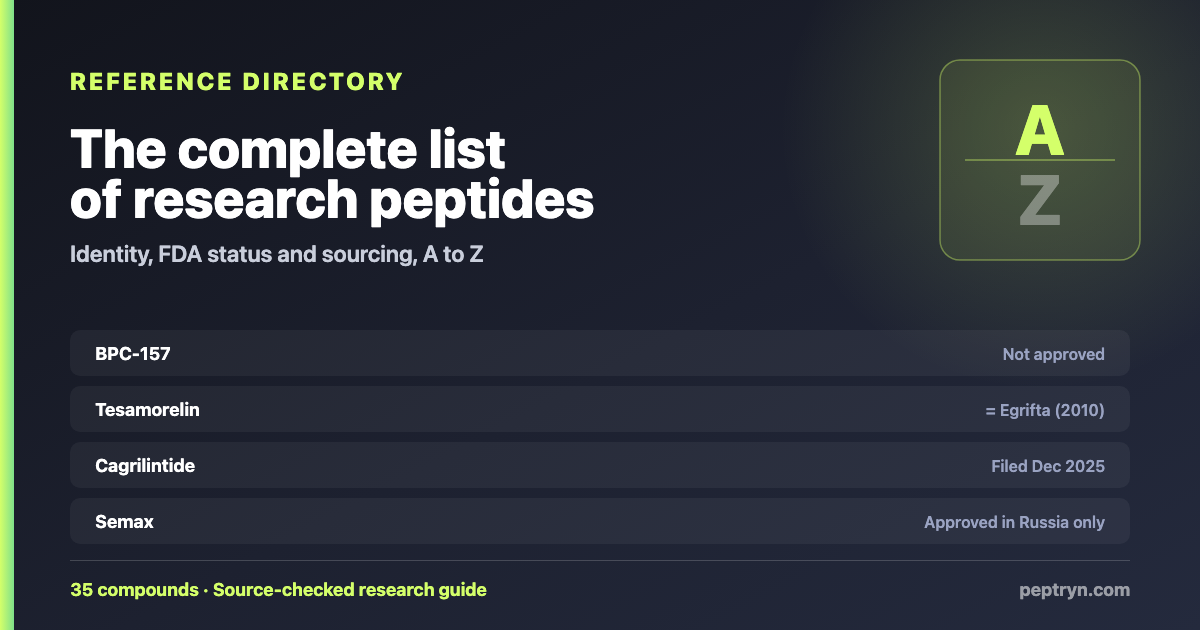
This is an alphabetical-by-category reference for the research peptides and related compounds people search for most, including several Peptryn does not sell. Each entry gives a one-line identity, a longer summary of what the published research shows it does, its current FDA status, and a link to Peptryn’s own guide or product page where one exists. Nothing here is dosing information. For how a certificate of analysis works, see what is a COA; for how research-use sales are treated, see our peptide legality guide; for a ranking of the most-searched compounds by volume, see popular peptides. FDA status is checked against public agency sources as of this writing and can change; verify before relying on it.
GLP-1 and metabolic peptides
This category covers peptides studied for their effect on appetite signaling, blood sugar regulation, and body weight, the most commercially active area of peptide research right now.
| Compound | Identity | FDA status | Peptryn |
|---|---|---|---|
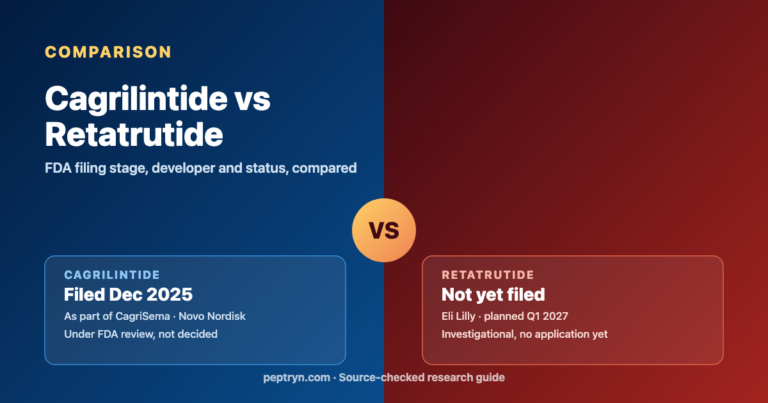
| Cagrilintide | Long-acting analogue of human amylin, developed by Novo Nordisk | Not approved on its own; filed Dec 2025 as part of the CagriSema combination, under review | Sold. Guide |
| Retatrutide | Investigational peptide (LY3437943), developed by Eli Lilly | Not approved; not yet filed, Lilly has said it plans to file in Q1 2027 | Sold. Guide |
| Semaglutide | Injectable, developed by Novo Nordisk | Approved as Ozempic (Dec 2017) and Wegovy (Jun 2021) | Not sold by Peptryn |
| Survodutide | Investigational peptide, licensed by Zealand Pharma to Boehringer Ingelheim | Not approved; FDA granted Breakthrough Therapy designation in Sept 2024, still in Phase 3 | Not sold by Peptryn |
| Tirzepatide | Injectable dual-incretin analogue, developed by Eli Lilly | The active compound in Mounjaro (May 2022) and Zepbound (Nov 2023) | Sold. Product page |
Cagrilintide: what the research shows
Cagrilintide is a long-acting synthetic analogue of human amylin, a hormone the pancreas releases alongside insulin. Published research has studied it mainly for its effect on appetite signaling and body weight when paired with a GLP-1 pathway peptide, most notably in Novo Nordisk’s CagriSema combination, which was filed with the FDA in December 2025. Cagrilintide has not been filed or approved as a standalone drug. See our full Cagrilintide guide.
Retatrutide: what the research shows
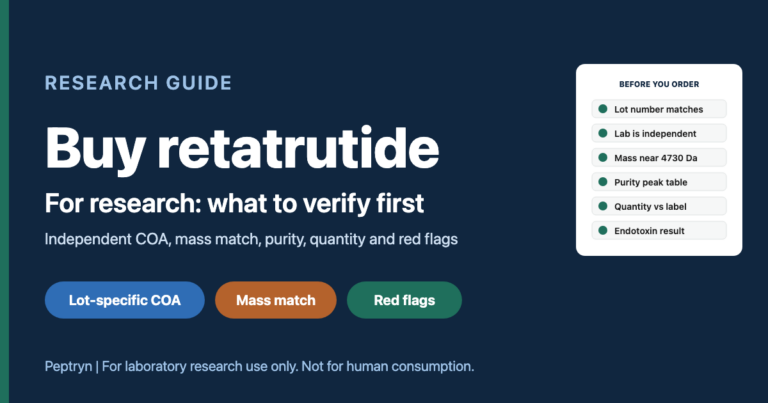
Retatrutide (LY3437943) is Eli Lilly’s investigational triple-pathway peptide, studied in Phase 3 trials for its effect on body weight and metabolic markers. It has not been filed with or approved by the FDA; Lilly has indicated it plans to file in the first quarter of 2027. See our Retatrutide guide and how it compares to cagrilintide in our comparison guide.
Semaglutide: what the research shows
Semaglutide is a synthetic peptide that mimics the incretin hormone GLP-1 and is the active compound in two FDA-approved branded drugs: Ozempic, approved December 2017 for glycemic control in type 2 diabetes, and Wegovy, approved June 2021 for chronic body-weight management. The pivotal STEP 1 trial followed nearly 2,000 adults without diabetes and found a mean body-weight change of roughly -14.9% in the semaglutide group versus -2.4% with placebo (Wilding et al., 2021, New England Journal of Medicine, PMID 33567185). Approved indications have since expanded, including a March 2024 approval for reducing cardiovascular risk in adults with obesity and established cardiovascular disease. Semaglutide is included here strictly as background context on a widely referenced GLP-1 pathway peptide; Peptryn does not sell semaglutide in any form.
Survodutide: what the research shows
Survodutide (BI 456906) is an investigational peptide designed to engage both glucagon and GLP-1 signaling pathways at once, developed by Zealand Pharma and licensed to Boehringer Ingelheim. A Phase 2 study in metabolic dysfunction-associated steatohepatitis, presented at the EASL Congress in June 2024, reported histologic improvement without worsening of fibrosis in up to 83% of participants who received it. In September 2024, the FDA granted survodutide Breakthrough Therapy designation for that same liver condition, and two Phase 3 trials began shortly after. As of this writing, survodutide has not completed Phase 3 development or received FDA approval for any indication.
Tirzepatide: what the research shows
Tirzepatide is a synthetic 39-amino-acid dual-pathway peptide developed by Eli Lilly. It is the active compound behind two FDA-approved drugs, Mounjaro (approved May 2022) and Zepbound (approved November 2023). Peptryn sells the lyophilized research-grade peptide only, not the approved injectable drug product. See our Tirzepatide product page.
Growth hormone axis peptides
This category covers peptides studied for their effect on the body’s own growth hormone signaling, rather than growth hormone itself.
| Compound | Identity | FDA status | Peptryn |
|---|---|---|---|
| CJC-1295 (no DAC) | Synthetic 29-amino-acid GHRH analogue (Modified GRF 1-29), about 3,368 Da | Not an approved drug | Sold. Guide |
| GHRP-6 | Growth hormone releasing hexapeptide | Not an approved drug in any major market; WADA-prohibited | Not sold by Peptryn |
| Ipamorelin | Synthetic pentapeptide, 711.85 Da, classed as a growth hormone secretagogue | Not an approved drug | Sold. Guide |
| Sermorelin | 29-amino-acid fragment of human GHRH, about 3,358 Da | Not currently approved; previously marketed as Geref, discontinued | Sold. Guide |
| Tesamorelin | Synthetic 44-amino-acid GHRH analogue, about 5,136 Da | The active compound in Egrifta, approved since 2010 | Sold. Guide |
CJC-1295 and ipamorelin are also sold and discussed together; see our CJC-1295 and ipamorelin guide.
CJC-1295: what the research shows
CJC-1295 is a synthetic 29-amino-acid analogue of growth hormone-releasing hormone. Most of the rigorous human pharmacology data for this peptide class comes from a 2006 trial (Teichman et al., Journal of Clinical Endocrinology and Metabolism, PMID 16352683) that tested a longer-acting, drug-affinity-complex (DAC) version and found it raised growth hormone and IGF-1 for several days after a single injection. That trial used the DAC-linked form, not the shorter-acting “no DAC” version (also called Modified GRF 1-29) that Peptryn sells, and independent human data specific to the no-DAC version are limited. See our full CJC-1295 research guide.
GHRP-6: what the research shows
GHRP-6 is a synthetic hexapeptide first characterized by Bowers and colleagues in 1984, who reported it released growth hormone from the pituitary in a dose-dependent way across several species, working through the ghrelin signaling pathway rather than through GHRH signaling. Later research also documented an appetite-stimulating effect tied to that same signaling pathway, separate from its effect on hormone release, and a smaller line of preclinical research has examined cell-protective effects in animal injury models. GHRP-6 is not an approved drug in any major market and is prohibited by the World Anti-Doping Agency.
Ipamorelin: what the research shows
Ipamorelin was introduced in a 1998 study (Raun et al., European Journal of Endocrinology, PMID 9849822) using rat pituitary cells, anesthetized rats, and pigs, all preclinical models. The study reported that ipamorelin released growth hormone with potency similar to GHRP-6, but unlike GHRP-6 and older growth-hormone secretagogues, it did not meaningfully raise cortisol even at doses far above its growth-hormone-releasing dose, a selectivity the authors highlighted as distinguishing it within its peptide class. Because this evidence is preclinical, claims about that selectivity in humans are an extrapolation from animal data rather than an established human finding. See our full Ipamorelin research guide.
Sermorelin: what the research shows
Sermorelin is the synthetic acetate salt of the first 29 amino acids of human growth hormone-releasing hormone. It was previously marketed as Geref, an FDA-approved drug used to evaluate pituitary growth hormone secretion, before the manufacturer voluntarily discontinued it in 2008 for commercial and manufacturing reasons unrelated to safety, according to a 2013 Federal Register determination. No FDA-approved finished-drug version of sermorelin currently exists in the US; Peptryn’s sermorelin is sold strictly as a research-use-only reference compound. See our full Sermorelin research guide.
Tesamorelin: what the research shows
Tesamorelin is a stabilized GHRH analogue and the active compound in Egrifta, which the FDA approved in November 2010 to reduce excess visceral abdominal fat in HIV-associated lipodystrophy, the first approved therapy for that indication. The pivotal trial (Falutz et al., 2007, New England Journal of Medicine, PMID 18057338) was a 26-week, randomized, placebo-controlled study that found a selective reduction in visceral fat along with improved triglycerides and cholesterol, confirmed in a later pooled analysis of two phase 3 trials. Egrifta is an FDA-approved branded drug for this specific indication; Peptryn sells research-grade tesamorelin peptide only, not the approved pharmaceutical product. See our full Tesamorelin research guide.
Healing and regenerative peptides
This category covers peptides studied for tissue repair, wound healing, and gut-lining research, including Peptryn’s multi-compound research blends.
| Compound | Identity | FDA status | Peptryn |
|---|---|---|---|
| AHK-Cu | Copper complex of the tripeptide Ala-His-Lys, about 354 Da as the peptide | Not an approved drug | Sold. Product page |
| BPC-157 | Synthetic 15-amino-acid peptide, 1,419.53 Da | Not an approved drug; WADA-prohibited (S0) | Sold. Guide |
| Glow Blend | Three-compound research blend: TB-500, BPC-157 and GHK-Cu | Not an approved drug; no component is approved for this use | Sold. Guide |
| GHK-Cu | Copper complex of the tripeptide Gly-His-Lys, about 340 Da as the peptide | Not an approved drug | Sold. Product page |
| Klow80 Blend | Four-compound research blend: TB-500, BPC-157, GHK-Cu and KPV | Not an approved drug; no component is approved for this use | Sold. Guide |
| KPV | Tripeptide Lys-Pro-Val, matching residues 11-13 of alpha-MSH, 342.44 Da | Not an approved drug | Sold. Product page |
| TB-500 | Full-length thymosin beta-4 acetate, 4,963.44 Da (the name is also used for a shorter fragment; check the certificate) | Not an approved drug; WADA S2 class | Sold. Guide |
| Wolverine Blend | Two-compound research blend: BPC-157 and TB-500 | Not an approved drug; no component is approved for this use | Sold. Guide |
For how these three blends actually differ, see any of the three guides above, each of which includes a component comparison table.
AHK-Cu: what the research shows
AHK-Cu is a copper complex of the tripeptide Ala-His-Lys, studied in a 2007 laboratory paper (Pyo et al., Archives of Pharmacal Research, PMID 17703734) using cultured human hair follicles and dermal papilla cells taken from tissue, not a human clinical trial. The study reported that low concentrations of AHK-Cu extended follicle growth and increased cell proliferation in that isolated tissue-culture system, alongside changes in cell-survival-related markers. These findings have not been confirmed in a published human trial for AHK-Cu itself, and should not be confused with the separate, larger research literature on the related compound GHK-Cu. See our AHK-Cu product page.
BPC-157: what the research shows
BPC-157 is a synthetic 15-amino-acid peptide derived from a partial sequence found in human gastric juice. It has been studied mainly in rodent models for tissue repair, tendon and ligament healing, and gastrointestinal-lining research, with a much smaller and less consistent body of published human data. BPC-157 is prohibited by the World Anti-Doping Agency under its S0 class, and it was one of the compounds covered by the FDA’s July 2026 Pharmacy Compounding Advisory Committee vote (8-6 in favor of considering it for a compounding list, which is not an approval). See our BPC-157 research guide.
GHK-Cu: what the research shows
GHK-Cu is a naturally occurring copper-binding tripeptide (Gly-His-Lys) first isolated from human plasma in 1973, with plasma levels reported to decline with age in some studies. Preclinical and cell-based work has linked GHK-Cu to collagen and elastin synthesis, new blood-vessel formation, and inflammatory-signaling changes in skin and connective-tissue models (Pickart and Margolina, 2018, International Journal of Molecular Sciences). A small number of controlled human skin studies, generally involving several dozen participants, have reported measurable increases in skin firmness and collagen density associated with GHK-Cu formulations compared with control, though independent large-scale replication is limited. Most of the foundational tissue-repair evidence for GHK-Cu comes from cell-culture and animal research rather than large human trials. See our GHK-Cu product page.
KPV: what the research shows
KPV is a tripeptide fragment of alpha-MSH studied since Dalmasso and colleagues’ 2007 paper in Gastroenterology, which reported that KPV is taken up through the PepT1 transporter and reduced markers of intestinal inflammation in mouse models of colitis. No published human trial has tested KPV as of this writing. See our full KPV research guide.
TB-500: what the research shows
TB-500 refers to thymosin beta-4 acetate, a naturally occurring peptide studied in animal models for tissue repair and cell migration, most often in combination with BPC-157 in research contexts. Its name is also used commercially for a shorter synthetic fragment sold under the same label by some vendors, so a specification sheet should always be checked against its certificate of analysis. TB-500 falls under the World Anti-Doping Agency’s S2 class. See our Wolverine guide.
Wolverine Blend, Klow80 Blend, and Glow Blend: what the research shows
Peptryn’s three multi-compound blends combine individually studied peptides in a single vial for combined research use. Wolverine Blend pairs BPC-157 and TB-500; Glow Blend adds GHK-Cu to that same pairing; Klow80 Blend combines all of those with KPV. Each blend draws on its components’ separate research histories in tissue repair, copper-peptide, and anti-inflammatory research; no blend as a combination has itself been studied in a published trial. See the Wolverine guide, Glow guide, and Klow80 guide for a full component comparison in each.
Mitochondrial and longevity peptides
This category covers peptides studied for cellular energy production and age-related biological processes.
| Compound | Identity | FDA status | Peptryn |
|---|---|---|---|
| Epitalon (Epithalon) | Synthetic tetrapeptide (Ala-Glu-Asp-Gly), developed at the Khavinson laboratory in St. Petersburg | Not an approved drug; a July 2026 FDA advisory committee recommended it for a compounding list, which is not approval | Not sold by Peptryn |
| MOTS-c | 16-amino-acid peptide encoded in mitochondrial DNA, about 2,175 Da | Not an approved drug | Sold. Guide |
| Pinealon | Synthetic tripeptide Glu-Asp-Arg, 418.40 Da, from the Khavinson bioregulator series | Not an approved drug | Sold. Product page |
| SS-31 (Elamipretide) | Synthetic tetrapeptide, 639.8 Da as the free base | The active compound in Forzinity, approved Sept 2025 | Sold. Guide |
Epitalon: what the research shows
Epitalon is a synthetic tetrapeptide (Ala-Glu-Asp-Gly) modeled on Epithalamin, a bovine pineal-gland extract studied by Vladimir Khavinson’s laboratory; the peptide has since been confirmed to occur naturally in human pineal tissue. Its foundational finding, published in 2003 (Khavinson et al., PMID 12937682), reported that Epitalon increased telomerase activity and extended the replicative lifespan of cultured human skin cells, a cell-culture result rather than a human aging outcome. A 2025 review in the International Journal of Molecular Sciences summarizes additional lifespan-related findings in mice and fruit flies, alongside a small number of older, limited-scale human studies, and states plainly that human safety and effectiveness data overall remain limited. Peptryn does not currently sell Epitalon.
MOTS-c: what the research shows
MOTS-c is a 16-amino-acid peptide encoded within mitochondrial DNA, identified in a 2015 Cell Metabolism paper (Lee et al., PMID 25738459) that found it prevented diet-induced obesity and insulin resistance in mice, all findings from rodent rather than human experiments. A 2018 follow-up in the same journal reported that under metabolic stress, MOTS-c moves into the cell nucleus and regulates gene expression there, extending its proposed role beyond a simple circulating signal. Most published human research on MOTS-c has measured naturally circulating levels in relation to exercise and metabolic status rather than testing the peptide itself as a research intervention. See our full MOTS-c research guide.
Pinealon: what the research shows
Pinealon is a Khavinson-lab tripeptide (Glu-Asp-Arg) studied almost exclusively in Russian-language rodent and cell research, including a frequently cited study on prenatal hyperhomocysteinemia in rats (Arutjunyan et al., 2012). No completed human trial has been published for Pinealon. See our full Pinealon research guide.
SS-31 (Elamipretide): what the research shows
SS-31 belongs to a family of mitochondria-targeted peptides first described by Szeto and Schiller, studied for their interaction with cardiolipin, a lipid in the inner mitochondrial membrane. Under the name elamipretide, it has been studied preclinically in models of mitochondrial dysfunction, including kidney disease and a mouse model of Barth syndrome that reported improved cardiac mitochondrial structure. In September 2025, the FDA granted accelerated approval to elamipretide, branded Forzinity, for improving muscle strength in Barth syndrome patients based on phase 3 and expanded-access data, the first approval for any Barth syndrome therapy. Forzinity is an FDA-approved branded drug for this specific, ultra-rare pediatric indication; Peptryn sells research-grade SS-31 peptide only, not the approved pharmaceutical. See our full SS-31 research guide.
Nootropic and cognitive peptides
This category covers peptides studied for cognitive or neurological outcomes, most of them originating from Russian research programs.
| Compound | Identity | FDA status | Peptryn |
|---|---|---|---|
| Dihexa | Small-molecule peptidomimetic derived from angiotensin IV, developed at Washington State University | Not an approved drug; no published human trial, and its foundational papers were retracted in 2025 | Not sold by Peptryn |
| Selank | Synthetic heptapeptide (Thr-Lys-Pro-Arg-Pro-Gly-Pro), tuftsin-derived, 751.9 Da | Not FDA-approved; approved as a prescription nasal spray in Russia since 2011 | Sold. Guide |
| Semax | Synthetic heptapeptide derived from ACTH(4-7) | Not FDA-approved; approved in Russia since 1994; a July 2026 FDA advisory committee recommended it for a compounding list, which is not approval | Not sold by Peptryn |
Dihexa: what the research shows
Dihexa is an angiotensin-IV-derived peptidomimetic studied preclinically in rodents for effects on synaptic connections and cognitive performance, with its core 2013 discovery paper reporting oral effects in rats. That founding paper currently carries an active Expression of Concern issued in 2021, and three related papers from the same research group describing the proposed biological pathway were formally retracted in April 2025 after image manipulation was found, involving a co-author who was also the CEO of the company developing related compounds. No published human clinical trial data exist for Dihexa as of this writing, and the retractions substantially weaken the evidence behind its proposed pathway. Peptryn does not currently sell Dihexa.
Selank: what the research shows
Selank is a synthetic heptapeptide derived from tuftsin, studied in a small body of Russian and English-language literature for behavioral and immune-related effects in animal research and limited human studies (Kolyasnikova et al., 2008; Zozulya et al., 2001, both indexed on PubMed). It has been an approved prescription nasal spray in Russia since 2011 but has no FDA approval in the United States. See our full Selank research guide.
Semax: what the research shows
Semax is a synthetic heptapeptide derived from a fragment of ACTH, studied in Russian clinical research since the 1990s, most extensively in stroke-recovery and cognitive-outcome contexts. It has been an approved prescription medicine in Russia since 1994 but has no FDA approval, and a July 2026 FDA Pharmacy Compounding Advisory Committee vote recommended considering it for a compounding list, which is not an approval. Peptryn does not currently sell Semax.
Other compounds
This category covers compounds that are frequently searched alongside research peptides, several of which are not technically peptides at all.
| Compound | Identity | FDA status | Peptryn |
|---|---|---|---|
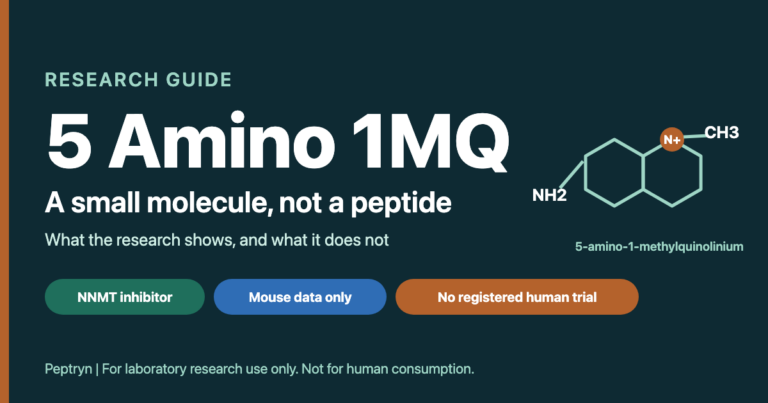
| 5-Amino-1MQ | Small molecule, not a peptide, 159.21 Da as the cation | Not an approved drug | Sold. Guide |
| AOD-9604 | Fragment of human growth hormone (176-191), developed in the 1990s in Australia | Not an approved drug; obesity trials failed their primary endpoint and development was discontinued in 2007 | Not sold by Peptryn |
| Glutathione | Tripeptide gamma-Glu-Cys-Gly, about 307 Da, present in most cells | Not an approved drug in this lyophilized research form | Sold. Guide |
| Kisspeptin-10 | C-terminal decapeptide of kisspeptin, a product of the KISS1 gene, about 1,302 Da | Not an approved drug | Sold. Product page |
| Melanotan-2 | Synthetic analogue of alpha-MSH | Not approved for any use anywhere; the FDA has issued warning letters against sellers since 2007 | Not sold by Peptryn |
| NAD+ | A dinucleotide coenzyme, not a peptide | Not an approved drug in injectable or research form | Not sold by Peptryn |
| PT-141 | Bremelanotide, an analogue derived from melanotan research | Approved as Vyleesi (2019) for hypoactive sexual desire disorder in premenopausal women | Not sold by Peptryn |
| Thymosin Alpha-1 | 28-amino-acid thymic peptide | Not FDA-approved; approved as Zadaxin in more than 35 countries | Not sold by Peptryn |
5-Amino-1MQ: what the research shows
5-Amino-1MQ is a small-molecule quinolinium compound, not a peptide, that inhibits the enzyme nicotinamide N-methyltransferase (NNMT). In diet-induced obese mice, it reduced body weight and adipose tissue mass and improved glucose-handling markers compared with untreated controls (Neelakantan et al., 2018, Biochemical Pharmacology). Separate cell-culture research found it slowed proliferation of a cervical cancer cell line in a concentration- and time-dependent manner. No published human clinical trials of 5-Amino-1MQ were identified; all available evidence is from rodent and cell models. See our full 5-Amino-1MQ research guide.
AOD-9604: what the research shows
AOD-9604 is a synthetic 15-amino-acid fragment of human growth hormone (residues 176-191), developed in Australia as a candidate for reducing body fat without the broader hormonal effects of full-length growth hormone. Preclinical work reported that it stimulated fat breakdown and reduced weight gain in obese mice (Heffernan et al., 2001, Endocrinology, PMID 11713213). A Phase IIb human trial of several hundred obese adults, disclosed by developer Metabolic Pharmaceuticals in February 2007, did not separate from placebo on its primary efficacy endpoint, and clinical development for that use was discontinued the same year. AOD-9604 has never received FDA or other regulatory approval for any human indication.
Glutathione: what the research shows
Glutathione is a tripeptide the body synthesizes naturally in nearly all cells from glutamate, cysteine and glycine, and it functions as one of the body’s principal antioxidants. Its reactive sulfhydryl group allows it to neutralize reactive oxygen species and serve as a cofactor for detoxification enzymes including glutathione peroxidase. Depleted glutathione status has been associated in the research literature with oxidative-stress states across a range of conditions, though its basic biochemistry as an endogenous compound is far better characterized than the outcomes of any externally administered form. See our full Glutathione research guide.
Kisspeptin-10: what the research shows
Kisspeptin-10 is the C-terminal decapeptide of kisspeptin, and unlike most compounds on this list it has real published human clinical research behind it, from Imperial College London (Jayasena et al., 2011; George et al., 2011, both in the Journal of Clinical Endocrinology and Metabolism). Those studies gave kisspeptin-10 intravenously under supervised research conditions and measured its effect on reproductive hormone release; a longer related peptide, kisspeptin-54, has separately been studied as an IVF trigger. See our full Kisspeptin-10 research guide.
Melanotan-2: what the research shows
Melanotan-2 is a synthetic cyclic analogue of alpha-MSH, originally developed at the University of Arizona as a candidate sunless-tanning compound. An early human pilot study found it increased skin pigmentation in some subjects and produced an unexpected secondary effect on sexual arousal (Dorr et al., 1996, Life Sciences), a finding that later contributed to separate research eventually leading to the unrelated, FDA-approved compound bremelanotide. Melanotan-2 itself was never advanced through FDA approval for any indication, and the FDA has issued warning letters against unauthorized US sellers since at least 2007, on the basis that it is an unapproved new drug not legally marketed for human use in any form. Peptryn does not sell Melanotan-2.
NAD+: what the research shows
NAD+ (nicotinamide adenine dinucleotide) is a small dinucleotide coenzyme, not a peptide, essential to core cellular metabolism as an electron carrier in mitochondrial energy production and as a required cofactor for enzymes including sirtuins and PARPs. Cellular NAD+ levels are maintained through several overlapping biosynthetic pathways and have been observed to decline with age in multiple tissues in preclinical models (Covarrubias et al., 2021, Nature Reviews Molecular Cell Biology). Because of its role in energy metabolism and DNA repair, NAD+ biology is an active preclinical research target, though much of the published human outcome literature concerns NAD+ precursor compounds rather than NAD+ itself, and that evidence is still developing. Peptryn does not sell NAD+.
PT-141: what the research shows
PT-141, also known as bremelanotide, is a synthetic peptide derived from alpha-MSH that acts on melanocortin signaling pathways, including in the central nervous system. It received FDA approval in June 2019 under the brand name Vyleesi for acquired, generalized hypoactive sexual desire disorder in premenopausal women, based on two Phase 3 trials that found statistically significant improvements in desire-related scores compared with placebo (Kingsberg et al., 2019, Obstetrics and Gynecology, PMID 31599840). Because Vyleesi is an FDA-approved prescription drug for this specific, narrow indication, Peptryn does not sell bremelanotide in any form; it is discussed here for background context only.
Thymosin Alpha-1: what the research shows
Thymosin Alpha-1 is a naturally occurring 28-amino-acid peptide first isolated from calf thymus tissue and sequenced in 1977, where it was shown to support immune-signaling activity in cell studies. It is approved as a prescription drug under the brand name Zadaxin in more than 35 countries, including China and Italy, for chronic hepatitis B, though it has no FDA approval in the United States. A Phase 3 human trial reported sustained loss of detectable hepatitis B virus DNA in about one in four treated patients compared with roughly one in eight on placebo over extended follow-up. It has also been studied more broadly as an immune-modulating peptide in oncology and infectious-disease research, including observational COVID-19 cohort work, though that broader evidence is preliminary. Peptryn does not currently sell Thymosin Alpha-1.
How FDA status is grouped on this page
Three different situations get compressed into “not approved” online, and this list tries to keep them separate. Some compounds, like BPC-157, TB-500 and GHRP-6, have never been approved as a drug anywhere. Others, like tesamorelin and SS-31, are the identical active compound behind a separate, already-approved US drug sold under its own brand name. A few, like Selank, Semax and thymosin alpha-1, are approved prescription medicines in another country but have no FDA approval. An FDA advisory committee recommendation, like the one covering BPC-157, TB-500, KPV, Semax and Epitalon in July 2026, is a vote to consider adding a compound to a pharmacy-compounding list; it is not a drug approval, and the FDA is not bound by it.
What this means for research use
Peptryn supplies the compounds marked “Sold” above as lyophilized laboratory research materials only, not as the approved drugs, foreign-market products or combination products referenced in the FDA status column. We do not sell the compounds marked “Not sold by Peptryn,” and nothing on this page is dosing or administration guidance. See our guide to peptide legality for how research-use sales are treated, and what is a COA for how to check a lot before you order.
Common questions
What do peptides do in the body?
Peptides act mainly as signaling molecules, carrying information between cells much like hormones do. Insulin, glucagon, and growth-hormone-releasing peptides are all examples. What a specific peptide does depends entirely on its amino acid sequence, so no general answer applies to every compound on this list.
Which research peptides have real published human trial data?
Most research peptides discussed online, including BPC-157, TB-500, Pinealon and KPV, have only animal or cell data. Kisspeptin-10 is a notable exception, with published human studies from Imperial College London. Tesamorelin and SS-31 also have human trial data, but as the active compounds in already-approved drugs (Egrifta and Forzinity), not as the research-grade peptide sold for laboratory use.
Is this list complete?
No list of research peptides is ever complete; new compounds enter the research market regularly. This page covers the compounds most commonly searched for, verified against public sources at the time of writing, and it will be updated as facts change.
Does an FDA advisory committee recommendation mean a peptide is legal?
No. A recommendation to add a compound to a pharmacy-compounding list is advisory. It does not approve the compound as a drug, and it does not change how Peptryn or any other research supplier can sell it. See our peptide legality guide.
Why do some peptides show a different molecular weight elsewhere?
Several names on this list, most often “TB-500,” are used for more than one molecule by different sellers. Always check a listing’s own specification table and certificate of analysis rather than assuming a name means one fixed structure.
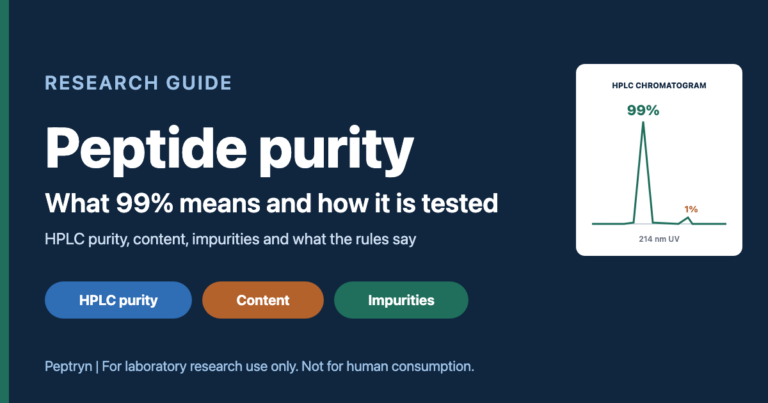
Related: Popular peptides by search volume · What is a COA? · Are peptides legal? · Peptide purity
For laboratory research use only. Not for human or veterinary use, and not a drug, food, dietary supplement or cosmetic. You must be 21 or older to buy.