Ipamorelin Peptide: How It Works, How It Compares With CJC-1295, Sermorelin and Tesamorelin, and What the Research Shows
Research use only. Peptides supplied by Peptryn are sold strictly for in vitro and preclinical laboratory research. They are not approved by the FDA for human or veterinary use, and nothing here is medical advice, a dosing recommendation, or an instruction for self-administration. This guide summarizes published research on ipamorelin and explains how to read a certificate of analysis.
Quick answer: what is ipamorelin?
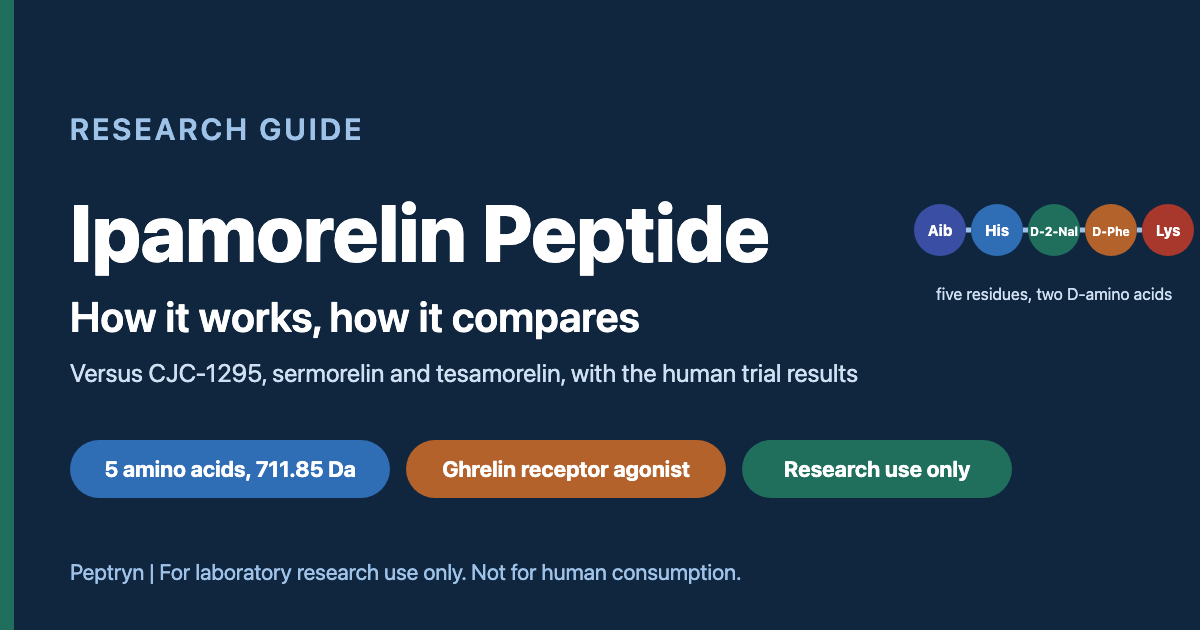
Ipamorelin is a synthetic pentapeptide (Aib-His-D-2-Nal-D-Phe-Lys-NH2) that triggers growth hormone (GH) release by acting on the ghrelin receptor, also called the GH secretagogue receptor (GHS-R1a). It belongs to the growth hormone-releasing peptide (GHRP) family. Raun and colleagues described it in 1998 as the first GHRP-receptor agonist with a selectivity for GH release similar to that of GHRH: in swine it did not raise ACTH or cortisol, while the older GHRP-6 and GHRP-2 did.
In healthy male volunteers, a dose of ipamorelin produced a single episode of GH release, and its terminal half-life was about 2 hours. Its human clinical testing since then has centered on postoperative ileus, where the published phase 2 trial found no significant difference from placebo on the main endpoint. Peptryn sells ipamorelin for laboratory research only.
Ipamorelin at a glance
| Item | Detail |
|---|---|
| Structure | Aib-His-D-2-Nal-D-Phe-Lys-NH2, five amino acids including unnatural residues |
| Formula and weight | C38H49N9O5, 711.85 Da |
| CAS number | 170851-70-4 |
| Target | Ghrelin receptor (GHS-R1a) on pituitary cells |
| Human half-life | About 2 hours (healthy men, intravenous infusion study) |
| Peptryn listing | 10 mg vial, lyophilized, store at -20°C, research use only |
| Status | FDA Category 2 for compounding. Prohibited by WADA |
Table of contents
- What ipamorelin is
- The selectivity result
- What human studies exist
- Ipamorelin vs CJC-1295
- Ipamorelin vs sermorelin vs tesamorelin
- Ipamorelin vs GHRP-6 and GHRP-2
- Ipamorelin doses: why there is no established one
- Ipamorelin safety and side effects
- Regulatory and sport status
- How to evaluate an ipamorelin vial
- Frequently asked questions
- Final take
What ipamorelin is
Raun and colleagues built ipamorelin from a chemistry program on the GHRP-1 series, keeping the compounds that lacked GHRP-1’s central Ala-Trp dipeptide. The result has five amino acids, including two D-amino acids (D-2-Nal and D-Phe) and the unnatural residue Aib, the kind of residue FDA cites when it says unnatural amino acids complicate characterization. In rat pituitary cells it released GH with potency and efficacy similar to GHRP-6 (EC50 1.3 versus 2.2 nmol/l). In anesthetized rats and conscious swine the potencies were also close to GHRP-6, and GHRP-2 was more potent but less efficacious.
Antagonist experiments showed that ipamorelin, like GHRP-6, acts through a GHRP-like receptor and not through the GHRH receptor. That is the mechanistic split from CJC-1295, sermorelin and tesamorelin, which are GHRH analogs.
The selectivity result
Selectivity is the reason ipamorelin has its reputation. In swine, none of the secretagogues tested changed FSH, LH, prolactin or TSH. GHRP-6 and GHRP-2 raised ACTH and cortisol. Ipamorelin did not raise them beyond the levels seen after GHRH stimulation, even at doses more than 200 times its ED50 for GH release.
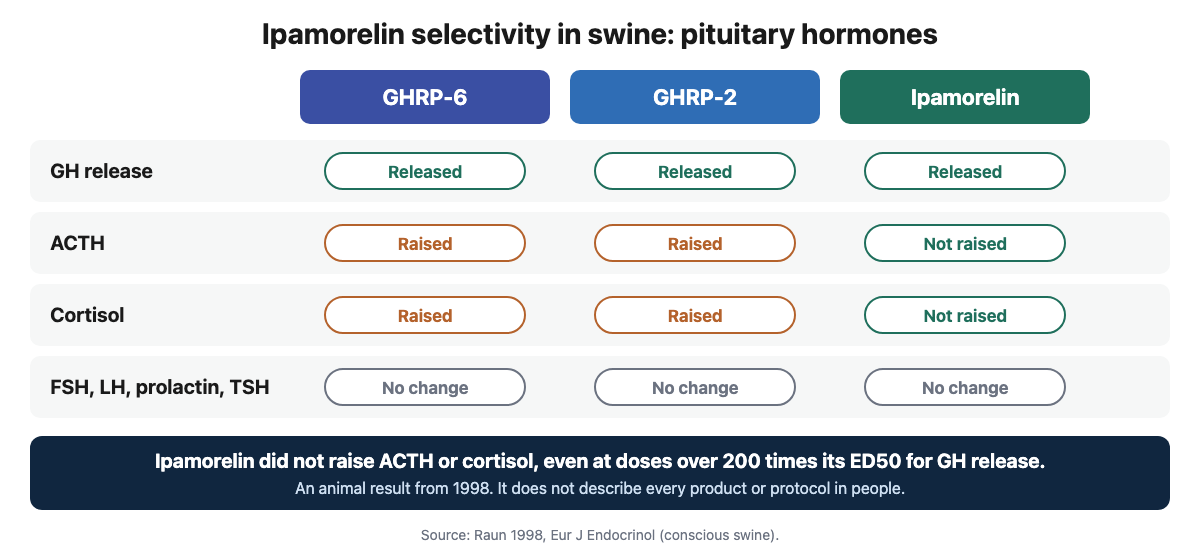
This is a 1998 animal result. It supports a claim about selectivity in swine at the doses tested, and it has been repeated widely as a claim about people. The 2026 Frontiers review of this drug class lists prolactin and cortisol elevations among the adverse effects reported across GH-axis peptides in clinical practice, and notes the uncertainty around product composition, dose and stacking in unregulated supply, so cleanliness in a controlled animal study does not carry over to every product or protocol.
What human studies exist
Gobburu and colleagues (1999) gave eight healthy men each of five escalating infusion rates over 15 minutes. Pharmacokinetics were dose-proportional with a terminal half-life of 2 hours, and each dose produced a single episode of GH release peaking at 0.67 hours before returning to negligible levels. That is the basic human pharmacology.
Ipamorelin was later tested for postoperative ileus after bowel surgery. Beck and colleagues (2014) randomized 117 patients to intravenous ipamorelin or placebo twice daily for up to 7 days. The median time to tolerating a solid meal was 25.3 hours with ipamorelin and 32.6 hours with placebo (p = 0.15). Treatment-emergent adverse events occurred in 87.5% of the ipamorelin group and 94.8% of the placebo group. The authors concluded that it was well tolerated and that there were no significant efficacy differences. A second phase 2 dose-finding study (NCT01280344, 320 enrolled, sponsor Helsinn) is registered as completed in May 2014. We did not find its results in the published literature.
Animal work is broader. Ipamorelin improved gut motility in rodent models of postoperative ileus, and a 2024 ferret study found that ipamorelin and anamorelin inhibited cisplatin-induced weight loss. None of this is a human result.
Ipamorelin vs CJC-1295
The two act on different receptors. Ipamorelin stimulates the ghrelin receptor. CJC-1295 stimulates the GHRH receptor. Their human data also look different.
| Ipamorelin | CJC-1295 (with DAC) | CJC-1295 without DAC | |
|---|---|---|---|
| Class | GH secretagogue, ghrelin receptor agonist | GHRH analog | GHRH analog |
| Size | 5 amino acids, 711.85 Da | 29 amino acids plus albumin-binding linker | 29 amino acids, about 3,368 Da |
| Human half-life | About 2 hours | 5.8 to 8.1 days | No published human figure found |
| GH pattern in humans | One GH episode per dose, peak at about 0.67 hours | Raised baseline between pulses, pulses preserved | Not reported |
| Human trials | PK study in healthy men, two phase 2 ileus trials | Two randomized trials in healthy adults, one terminated phase 2 | None found under this name |
Our CJC-1295 guide covers the DAC question in detail, and the CJC-1295 and ipamorelin guide covers the pairing.
Ipamorelin vs sermorelin vs tesamorelin
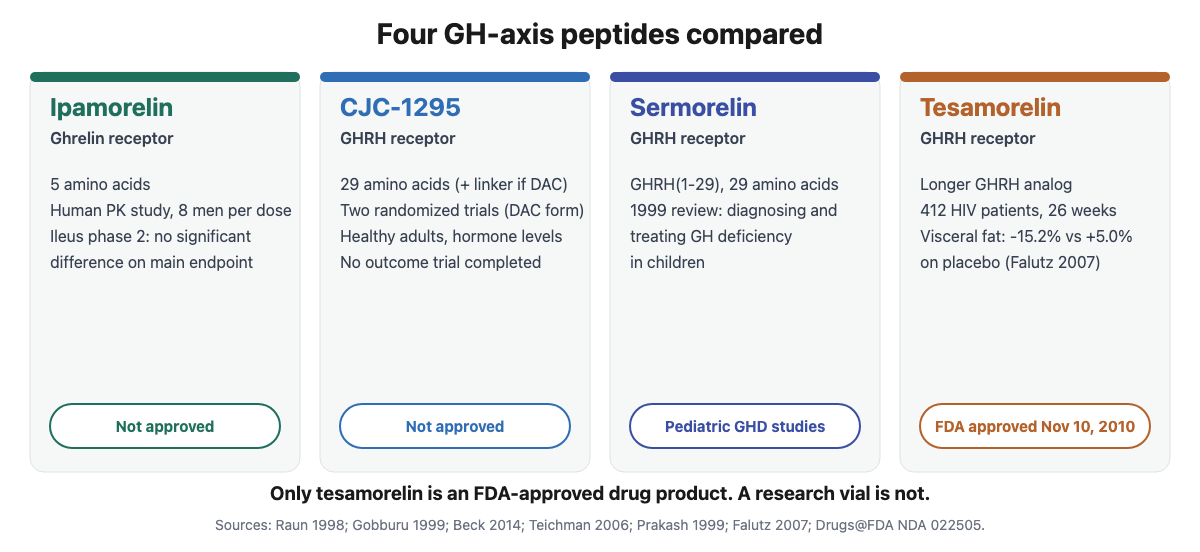
Sermorelin and tesamorelin are GHRH analogs, so they act on the GHRH receptor and not on ipamorelin’s ghrelin receptor. Sermorelin is GHRH(1-29). A 1999 review describes its use for diagnosing and treating children with idiopathic growth hormone deficiency, and our sermorelin guide covers its FDA history. Tesamorelin has the strongest clinical record of the group. In a 26-week randomized trial of 412 HIV patients with abdominal fat accumulation, visceral fat fell 15.2% on tesamorelin and rose 5.0% on placebo (Falutz 2007). FDA approved it as Egrifta on November 10, 2010. Ipamorelin has no approval and no positive efficacy trial.
The practical comparison for a laboratory is mechanism. Ipamorelin engages the ghrelin receptor, and the three GHRH analogs engage the GHRH receptor. That matters when you design an experiment around one pathway.
Ipamorelin vs GHRP-6 and GHRP-2
All three are ghrelin receptor agonists. In the swine work, ipamorelin matched GHRP-6 on GH potency and efficacy, GHRP-2 was more potent with lower efficacy, and only ipamorelin left ACTH and cortisol alone. That difference is the reason ipamorelin is described as the more selective one.
Ipamorelin doses: why there is no established one
“Ipamorelin doses” is the largest search cluster on this topic (6,600 a month), and no dose has been established for a research vial. The doses in the published human work were weight-based intravenous infusions in a pharmacology study and in surgical patients, none of which describes a vial or a protocol. Online charts borrow from those studies, from rodent work, and from clinic marketing, and they disagree. Peptryn does not publish a dose for any product, and this guide does not either.
Ipamorelin safety and side effects
FDA lists ipamorelin acetate in Category 2 of the bulk substances nominated for compounding (a 503B entry dated September 29, 2023 on its page, current as of 04/22/2026). FDA says compounded drugs containing it may pose a risk of immunogenicity for certain routes of administration because of the potential for aggregation or peptide-related impurities, and that its unnatural amino acids add complexity to peptide characterization. FDA also states that a study published in the literature identified serious adverse events including death when ipamorelin was administered intravenously for improving gastric motility, and that it has not identified safety-related information for certain other injectable routes, so it lacks sufficient information to know whether harm would result.
That FDA statement and the 2014 randomized trial describe very different pictures, and this guide cannot tell you which study FDA means. Both are on record, and neither tests a research vial. The 2026 Frontiers review lists appetite changes, dysglycemia, fluid retention, muscle and joint symptoms and injection-site reactions among effects reported across the class.
Regulatory and sport status
Ipamorelin is in FDA’s Category 2 as described above. The World Anti-Doping Agency prohibits it at all times, listing ipamorelin as an example of a growth hormone secretagogue under S2. See our legal guide for how research-use-only sales are treated.
How to evaluate an ipamorelin vial
Peptryn’s ipamorelin COA page links to the MZ Biolabs report for lot 2026-08-05, which makes a clean worked example.
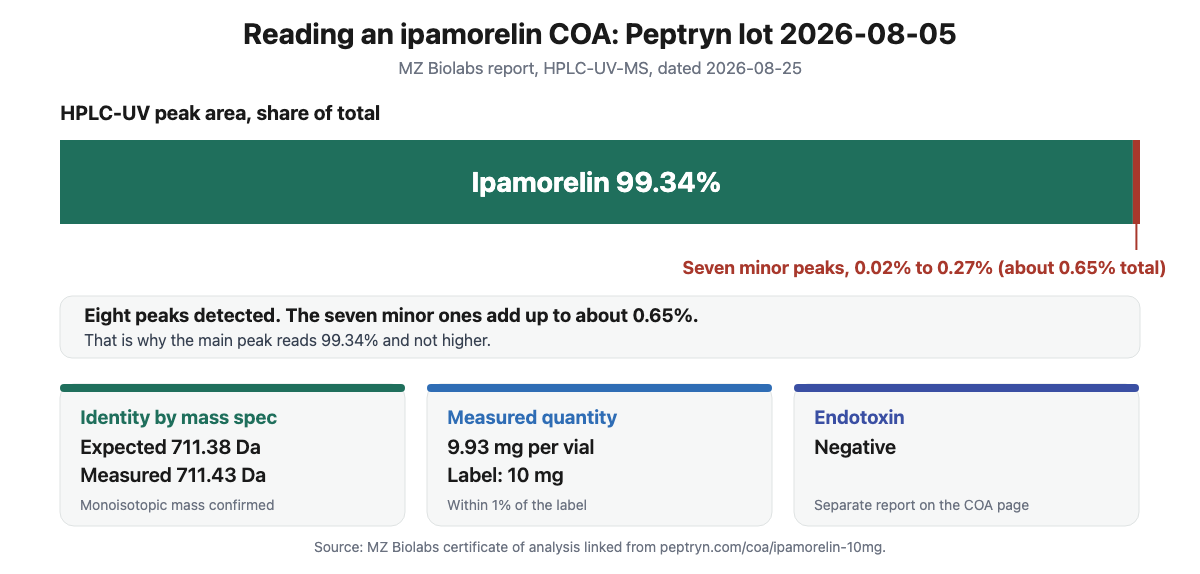
| COA field | What the report shows |
|---|---|
| Lot and method | 2026-08-05, HPLC-UV-MS, report dated 2026-08-25 |
| Main peak | 99.34% of peak area, with seven minor peaks between 0.02% and 0.27% |
| Identity by mass spec | Expected monoisotopic mass 711.38 Da, measured 711.43 Da |
| Measured quantity | 9.93 mg per vial (label: 10 mg) |
| Endotoxin | Negative, per the separate report on the COA page |
The seven minor peaks add up to about 0.65%, which is why the main peak sits at 99.34% and not higher. The quantity is within 1% of the label. See our guide to how to read a certificate of analysis.
Frequently asked questions
Is ipamorelin a peptide?
Yes. It is a synthetic pentapeptide that includes unnatural amino acids.
How does ipamorelin work?
It binds the ghrelin receptor (GHS-R1a) and triggers a pulse of GH release from the pituitary, through a receptor pathway that is separate from the GHRH receptor.
What is the difference between ipamorelin and CJC-1295?
Ipamorelin acts on the ghrelin receptor and CJC-1295 acts on the GHRH receptor. Ipamorelin’s human half-life is about 2 hours. CJC-1295 with DAC has a half-life of days.
Is ipamorelin better than sermorelin?
We found no head-to-head study, so no ranking is possible. They act on different receptors, and sermorelin has a documented use in diagnosing GH deficiency in children.
Does ipamorelin work?
It releases GH in healthy volunteers. Its one clinical-outcome program, postoperative ileus, found no significant difference from placebo on the main endpoint in the published 117-patient trial.
What are the side effects of ipamorelin?
The published phase 2 trial reported similar adverse event rates on ipamorelin and placebo. FDA cites a study with serious adverse events including death with intravenous use. This summarizes sources and is not medical advice.
Is ipamorelin legal?
FDA lists it in Category 2 for compounding, and WADA prohibits it in sport. See our legal guide.
Final take
Ipamorelin is well characterized at the pharmacology level: a five-amino-acid ghrelin receptor agonist with a 2-hour half-life in people and a selectivity result in swine that separates it from GHRP-6 and GHRP-2. Its human efficacy record is one negative-on-primary-endpoint phase 2 trial in postoperative ileus. For a laboratory, the useful checks are the mass, the peak table and the measured quantity. On Peptryn’s lot 2026-08-05 the main peak is 99.34%, the mass matches, and the measured quantity is 9.93 mg per 10 mg vial.
See ipamorelin with its batch COA · Browse GH secretagogue research peptides
Related guides: Sermorelin peptide guide · CJC-1295 peptide guide · CJC-1295 and ipamorelin · How to read a certificate of analysis · Are peptides legal? · Tesamorelin peptide guide · What is a COA? · Peptide purity · Peptide testing · Popular peptides
Editorial note: Peptryn sells the research peptides discussed in this guide for laboratory use only. This guide is informational and is not medical advice. Sources are listed below. To report an error, email [email protected].
Sources
- Raun K, Hansen BS, Johansen NL, et al. Ipamorelin, the first selective growth hormone secretagogue. Eur J Endocrinol, 1998. pubmed.ncbi.nlm.nih.gov
- Gobburu JV, Agersø H, Jusko WJ, Ynddal L. Pharmacokinetic-pharmacodynamic modeling of ipamorelin, a growth hormone releasing peptide, in human volunteers. Pharm Res, 1999. pubmed.ncbi.nlm.nih.gov
- Beck DE, Sweeney WB, McCarter MD; Ipamorelin 201 Study Group. Prospective, randomized, controlled, proof-of-concept study of the ghrelin mimetic ipamorelin for the management of postoperative ileus in bowel resection patients. Int J Colorectal Dis, 2014. pubmed.ncbi.nlm.nih.gov
- Venkova K, Mann W, Nelson R, Greenwood-Van Meerveld B. Efficacy of ipamorelin, a novel ghrelin mimetic, in a rodent model of postoperative ileus. J Pharmacol Exp Ther, 2009. pubmed.ncbi.nlm.nih.gov
- Lu Z, Ngan MP, Liu JYH, et al. The growth hormone secretagogue receptor 1a agonists, anamorelin and ipamorelin, inhibit cisplatin-induced weight loss in ferrets. 2024. pubmed.ncbi.nlm.nih.gov
- Dominikowski A, Rękoś Z, Olejarz M, et al. The emerging landscape of performance-enhancing peptides modulating GH-IGF1 axis. Front Endocrinol, 2026. pmc.ncbi.nlm.nih.gov
- Prakash A, Goa KL. Sermorelin: a review of its use in the diagnosis and treatment of children with idiopathic growth hormone deficiency. BioDrugs, 1999. pubmed.ncbi.nlm.nih.gov
- Falutz J, Allas S, Blot K, et al. Metabolic effects of a growth hormone-releasing factor in patients with HIV. N Engl J Med, 2007. pubmed.ncbi.nlm.nih.gov
- Teichman SL, Neale A, Lawrence B, et al. Prolonged stimulation of growth hormone and insulin-like growth factor I secretion by CJC-1295. J Clin Endocrinol Metab, 2006. pubmed.ncbi.nlm.nih.gov
- U.S. Food and Drug Administration. Certain Bulk Drug Substances for Use in Compounding that May Present Significant Safety Risks (content current as of 04/22/2026). fda.gov
- U.S. FDA, Drugs@FDA: Egrifta (tesamorelin acetate), application 022505, original approval November 10, 2010. accessdata.fda.gov
- World Anti-Doping Agency. The Prohibited List, section S2. wada-ama.org
- ClinicalTrials.gov: NCT00672074 and NCT01280344 (ipamorelin, postoperative ileus).
- MZ Biolabs certificate of analysis, ipamorelin 10 mg, lot 2026-08-05, via peptryn.com/coa/ipamorelin-10mg.
All products on peptryn.com are intended for laboratory research purposes only. Not for human consumption, self-administration, or veterinary use. The information on this page has not been evaluated by the U.S. Food and Drug Administration and is not intended to diagnose, treat, cure, or prevent any disease.