How to Read a Certificate of Analysis (COA)
How to Read a Certificate of Analysis (COA)
A Certificate of Analysis, or COA, is the document that turns a claim of purity into a verifiable fact. Every batch we sell is tested by an independent third-party lab, and the resulting COA is published in our COA Library. New to the term? See what is a COA first. For the purity figure in particular, see peptide purity. To check a lot with an independent lab, see peptide testing. For retatrutide specifically, see buying retatrutide for research. Here’s how to actually read one.
Lot number and date
Every COA is tied to a specific lot number, not just a product name. Before relying on a report, confirm the lot number on the certificate matches the lot number on your vial’s label. A COA for a different lot tells you nothing about the vial in your hand.
Identity testing
Identity testing, typically done by mass spectrometry, confirms that the vial actually contains the compound it claims to contain, not a substitute or a different molecule with a similar name. This is listed as a pass/fail result or a measured mass matched against the expected molecular weight.
Purity (HPLC)
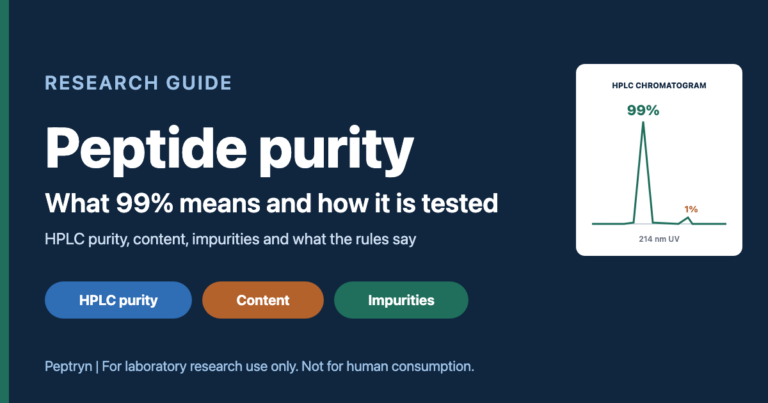
High-performance liquid chromatography (HPLC) purity is usually the headline number, expressed as a percentage. It tells you how much of the sample is the target compound versus related impurities, byproducts, or degradation. Reputable research suppliers publish this number rather than a vague “high purity” claim.
Endotoxin and sterility
For lab use, especially in cell culture work, endotoxin levels matter. This is usually reported in EU/mg (endotoxin units per milligram). Lower is better, and a well-run lab will report an actual measured value rather than omitting the test entirely.
Reading between the lines
A trustworthy COA names the testing lab, includes raw or clearly summarized data rather than only a pass/fail stamp, and is dated close to when the batch was manufactured. If a supplier can’t produce a lot-matched COA on request, treat that as a red flag.
For worked examples of checking identity and formulas against a COA, see our SS-31 guide (approved drug versus research vial), our MOTS-c guide and our Wolverine peptide guide (how to evaluate a blend).
All Peptryn products are sold strictly for laboratory research use. Products are not intended for human or veterinary consumption.
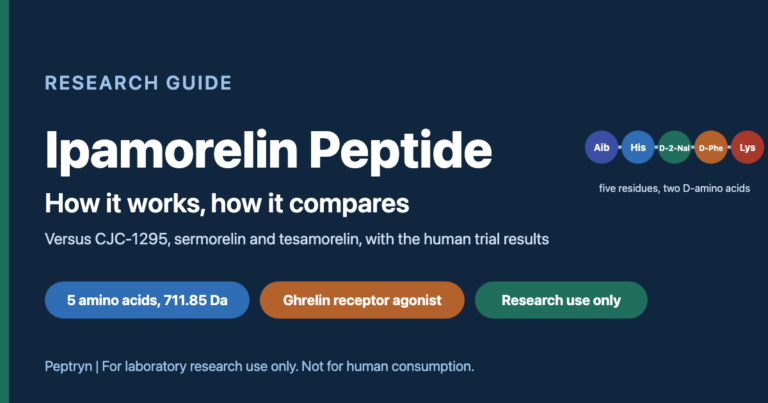
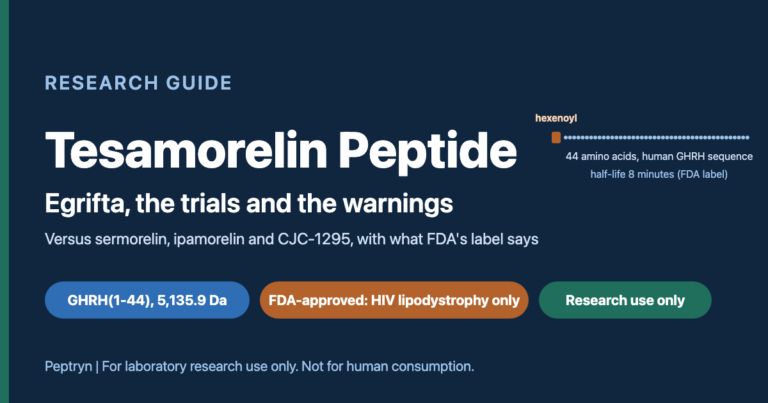
Worked examples of reading a real batch certificate of analysis are in our glutathione, CJC-1295, ipamorelin, sermorelin and tesamorelin guides.