Third-Party Tested Peptides: What the Label Proves and How to Check It
Research use only. Peptides supplied by Peptryn are sold strictly for in vitro and preclinical laboratory research. They are not approved by the FDA for human or veterinary use, and nothing here is medical advice, a dosing recommendation, or an instruction for self-administration. This guide explains how to judge a seller’s testing claim, including our own.
Quick answer: “Third-party tested” has no legal definition for research peptides. The phrase can describe anything from a bare sentence to an independent test of a vial bought on the open market. A claim is worth relying on when three things are true: an independent lab ran the test, the report names your batch, and you can open the report on the lab’s own site. This guide sorts the claim into five levels, gives a ten-minute check for any listing, and shows where Peptryn’s own certificates fall, including what they leave out.
Peptryn sells research peptides, so we are a seller describing testing. We apply the same checks to ourselves below.
Key takeaways
- “Third-party tested” runs across five levels, from a sentence you cannot check to a purchase test by a stranger. Claims at levels 1 and 2 are easy to make and hard to check.
- A report supports a claim only for the batch it names, so match the lot on the vial to the lot on the report.
- Purity and quantity are separate results. A 99% purity figure does not say how much peptide is in the vial.
- Peptryn’s 19 published certificates come from MZ Biolabs. The purity and identity records sit at level 3, the endotoxin reports at level 2, and Peptryn is the client that orders the tests.
Last verified October 12, 2026. Counts and figures come from Peptryn’s COA Library on that date and change as certificates are added. Sources are listed at the end. For laboratory and research use only. Nothing here is medical or legal advice.
What “third-party tested” can mean: five levels
We found no US statute, FDA rule or FTC document that defines “third-party tested” for research peptides. It is an advertising claim, and the evidence behind it varies a great deal. In July 2026 the Justice Department announced the sentencing of the owner of Paradigm Peptides. Its release says he and his employees falsely said the products were tested, and that he did not test them. CBS News reported on July 2, 2026 that a peptide brand’s site claimed third-party testing while the lab named on its certificate said it had not issued the documents.
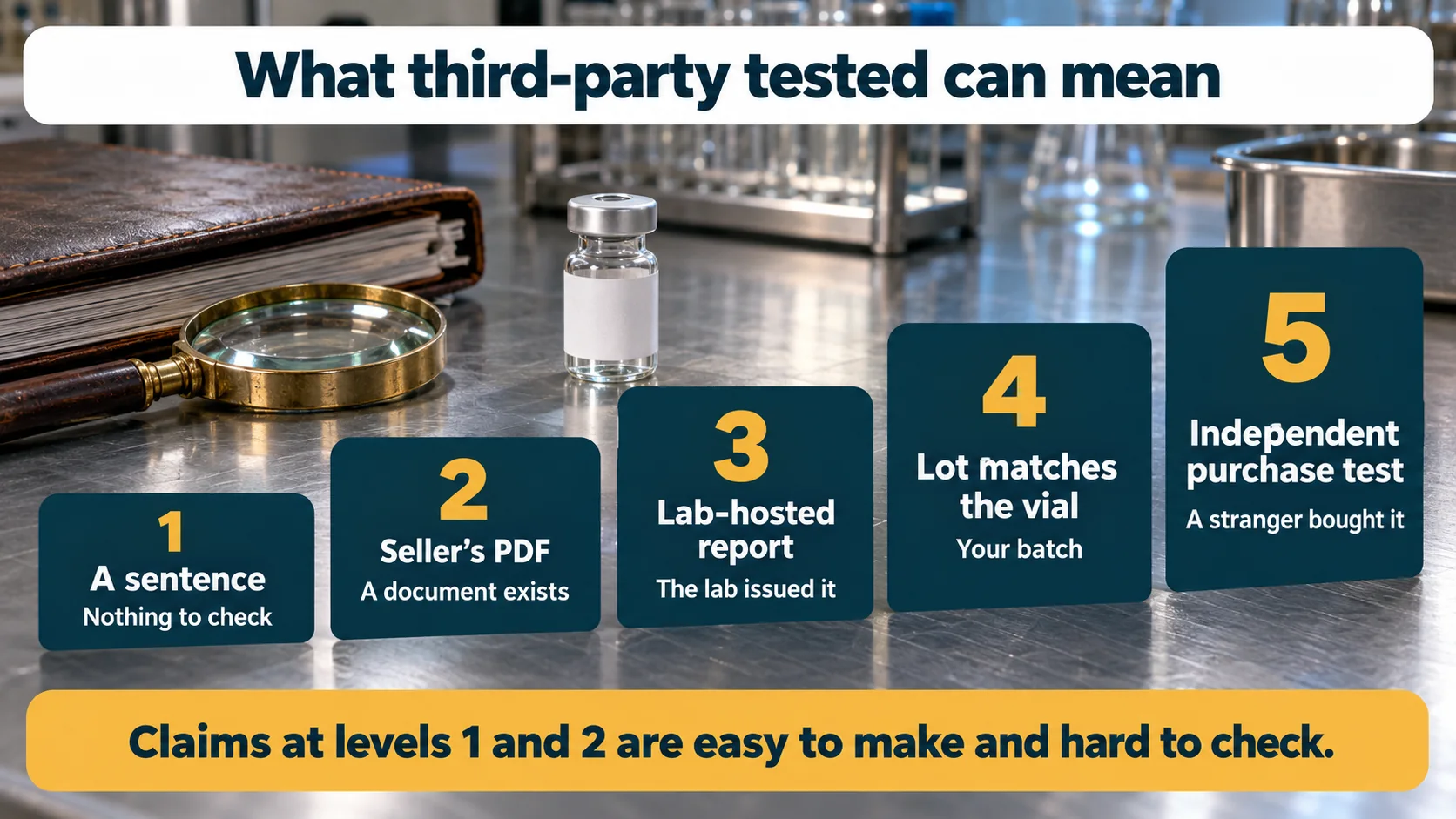
| Level | What the listing shows | What it supports | What to ask for |
|---|---|---|---|
| 1. A sentence | “Third-party tested” with no report | Nothing you can check | The report |
| 2. A seller-uploaded report | A PDF or screenshot with no lab-side copy | That a document exists | The lab’s own copy of it |
| 3. A lab-hosted report | A record on the lab’s site, for a sample the seller submitted | That the lab issued these numbers for the sample it received | Proof the sample matches your vial |
| 4. A batch-linked report | Level 3 where the lot on the vial matches the lot on the report | That the tested sample carried your batch identifier | A test of a purchased vial |
| 5. An independent purchase test | A third party buys on the open market and tests | What a customer could have received on that purchase | More purchases over time |
Our Janoshik guide lays out the evidence behind each level and how a customer-typed batch field can weaken level 4. The Finnrick guide covers a rating service whose samples are mostly bought or mailed in by the public, which sits closer to level 5.
A ten-minute check for any listing
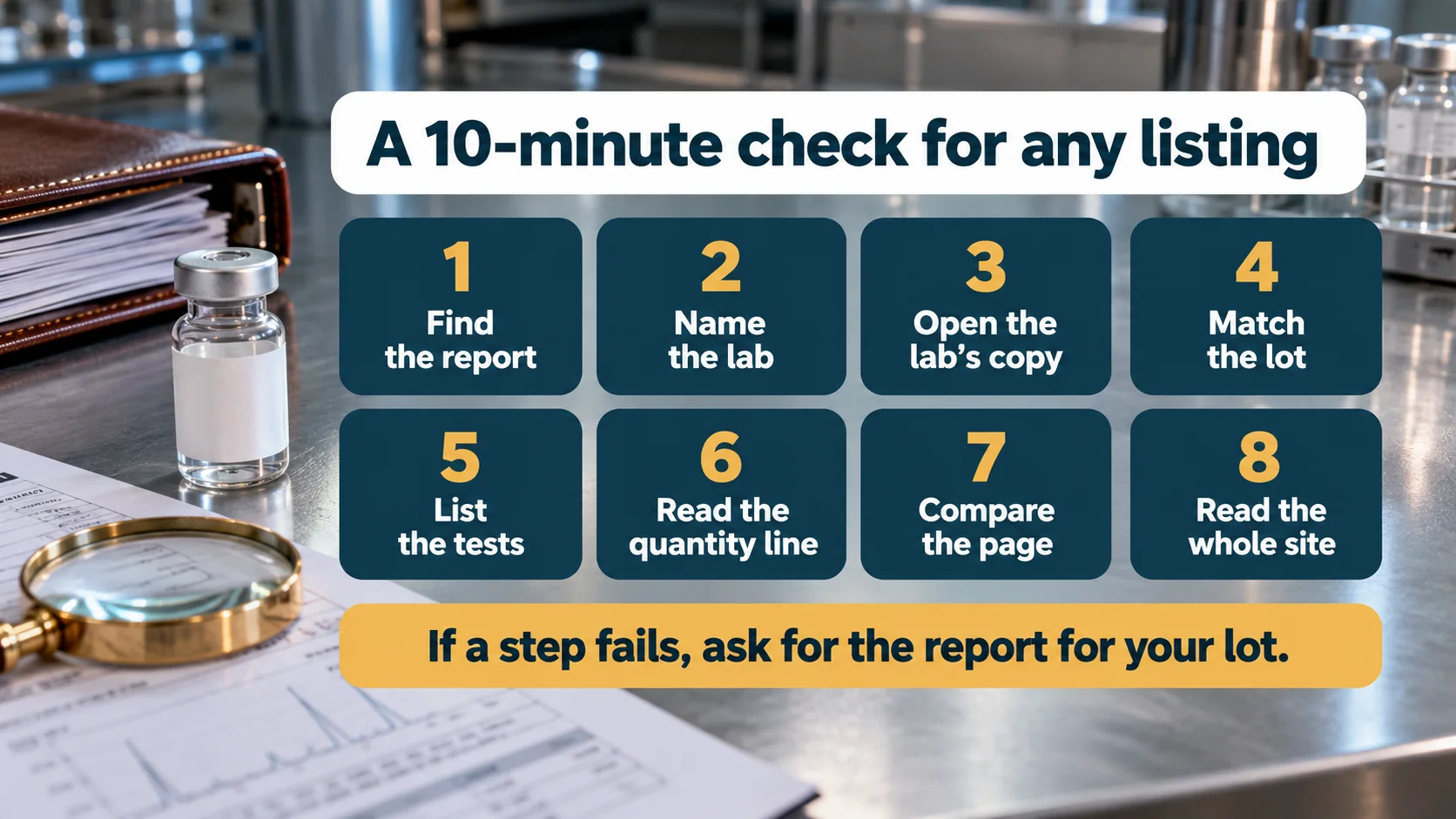
- Find the report. If the product page links to no report, the claim sits at level 1. Treat it as marketing until you see a document.
- Name the lab. A real report names the lab that ran it, and the lab has a website you can find on your own. A lab name you cannot look up is a reason to stop.
- Open the lab’s copy. Use a link or QR code that leads to the lab’s own site. A PDF that lives only on the seller’s server is level 2, however good it looks.
- Match the lot. Compare the lot on your vial with the lot on the report, and check that the analysis date fits the lot date. A report with no batch says nothing about the vial you hold.
- List the tests. Identity by mass spectrometry, purity by HPLC, endotoxin and quantity are different tests. Each one missing from the report is a gap. Our peptide testing guide explains what each test can and cannot show.
- Read the quantity line on its own. Purity is the main peak’s share of all detected peaks. It does not measure how much peptide the vial holds. Quantity is a separate result.
- Compare the seller’s page with the report. A purity figure on the product page should match the lab’s figure. Our certificate guide walks through a real report line by line.
- Read the rest of the site. Dosing charts, protocols or instructions for use on people show how a seller markets the product. FDA judges intended use from that marketing, and a test report does not change it. See are peptides legal? for background.
If any step fails, ask the seller for the report for your lot. A seller who cannot produce one has answered the question.
What a third-party report cannot tell you
- It describes one lot. A good report for last month’s batch says nothing about the next one.
- It describes the sample that was tested. A lab can only report on what it received.
- It does not prove safety. A panel covers the tests in it. Our peptide testing guide lists tests a basic panel leaves out, such as sterility and heavy metals.
- It does not make a product approved. A research peptide with a perfect report is still not an approved drug.
Seller-ordered tests and independent testing services
Two models sit behind most testing claims. In the first, the seller orders tests from a lab and publishes the results. That is how Peptryn works with MZ Biolabs. The lab is a third party to the product, and the seller is its client. In the second, an independent service tests samples and publishes results on its own. Janoshik tests samples that customers submit, and the client, sample, manufacturer and batch fields on its reports are typed by the customer. Finnrick collects samples, mostly mailed in by the public, removes the seller’s name and publishes ratings.
Neither model removes the lot check. A seller-ordered report ties to a batch the seller chose, and an independent test ties to the sample someone sent in.
A worked example: where Peptryn’s certificates fall
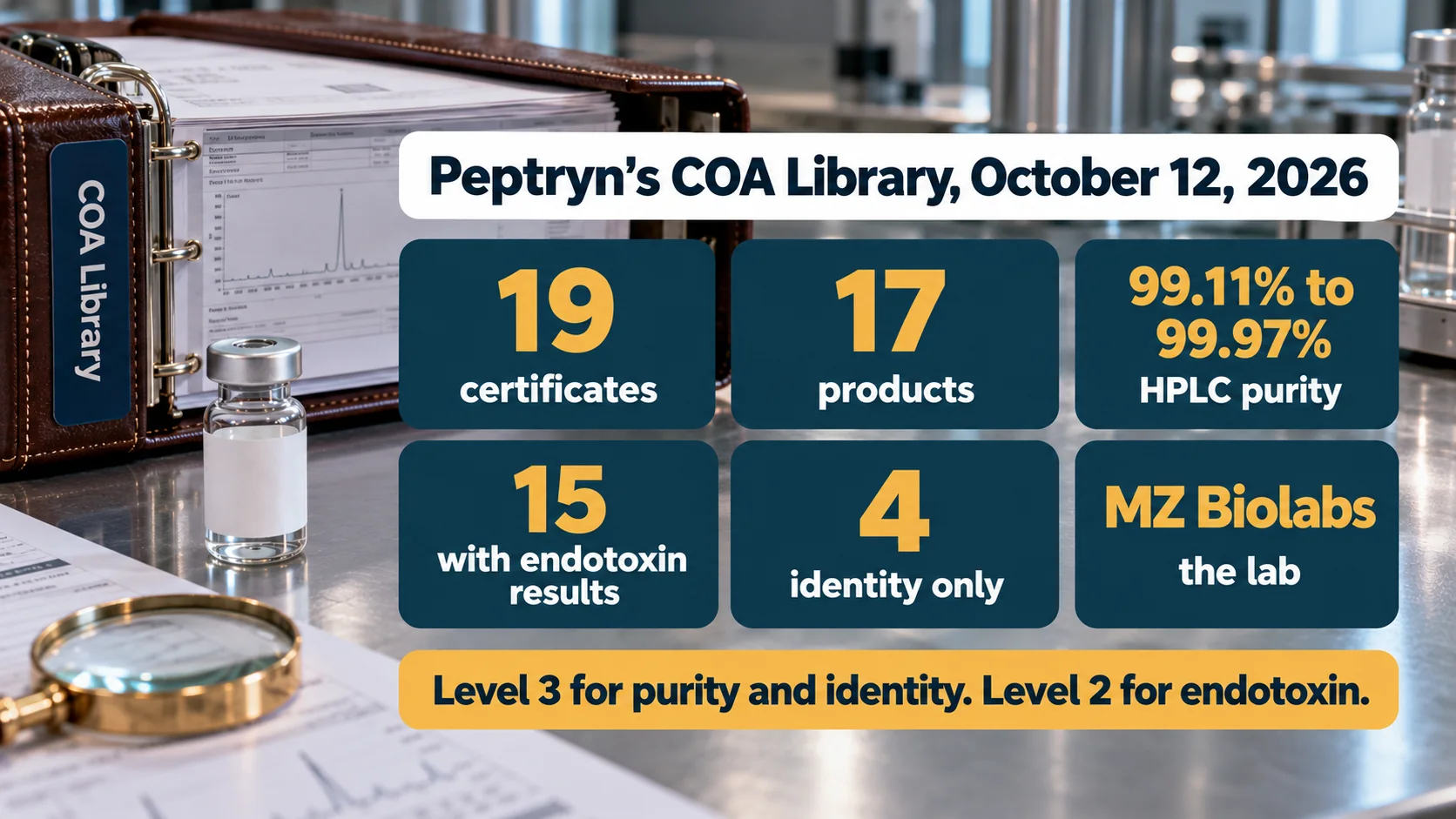
Peptryn’s COA Library lists 19 certificates for 17 products, all from MZ Biolabs in Tucson, Arizona. The method on every certificate is HPLC-UV-MS.
| Question | What the library shows |
|---|---|
| Purity range | 99.11% (CJC-1295 no DAC) to 99.97% (Tesamorelin and Tirzepatide 30 mg) |
| Endotoxin | 15 of 19 certificates have an endotoxin result, all negative |
| Identity only | Retatrutide 30 mg, KPV 5 mg, KPV 10 mg and Tirzepatide 30 mg |
| Where the record sits | Each purity and identity certificate links to a report on MZ Biolabs’ own site and carries a QR code. Endotoxin reports are PDFs shown on the certificate page |
| Who orders the tests | Peptryn is the client on the certificates |
On the five-level ladder, the purity and identity records sit at level 3 and the endotoxin reports at level 2. A certificate reaches level 4 only when the lot on your vial matches the lot on the certificate. Peptryn’s certificates are not independent purchase tests, and we found no Finnrick rating for Peptryn in the pages we could read on October 11, 2026.
The figures behind the certificates have limits. In our September 2026 data report, purity on each Peptryn certificate page matched the lab’s report for all 15 lots we checked. Measured quantity differed from the label by a median of +16.4% across 21 labeled components, from -8.6% to +36.5%. That report covers one lot per product from one laboratory, without a stated assay uncertainty, so it describes those lots and not every batch. The same checks apply here as anywhere else: match the lot, open the lab’s copy, and read the quantity line.
Common questions
What does third-party tested mean for peptides?
It means a laboratory other than the seller tested a sample. It has no legal definition for research peptides, so it covers everything from a bare claim to an independent purchase test. The five levels above show what each version supports.
Is third-party tested the same as lab tested?
Not necessarily. “Lab tested” can mean the seller’s own lab. “Third-party tested” should mean an independent lab, which a named lab and a report on that lab’s own site let you confirm.
How do I verify a third-party test?
Find the report, name the lab, open the lab’s own copy through a link or QR code, and match the lot to your vial. Then read which tests are on the report, including quantity.
Does third-party tested mean a peptide is safe?
No. A report covers the tests in it for the sample tested. It does not establish safety or approval.
Are Peptryn’s peptides third-party tested?
The 19 lots in the COA Library were tested by MZ Biolabs. The purity and identity reports are on the lab’s own site, and Peptryn is the client that ordered the tests. Products without a certificate in the library have no published report yet, and you can email us with your order number for the report on file.
What is the difference between a COA and a third-party test?
A certificate of analysis is the document. A third-party test is a claim about who produced it. A COA the seller made or edited does not support the claim, while a record on the lab’s own site does.
Can a COA be faked?
A PDF can be edited, which is why the lab’s own copy matters. CBS reported that a lab named on one brand’s certificate said it had not issued it.
Which tests should a third-party panel include?
At minimum, identity and purity. Quantity and endotoxin add to that, and sterility and heavy metals appear on fuller panels. Our peptide testing guide explains each one.
Related: Janoshik peptide testing · Finnrick peptide testing · Peptide testing · COA Library · How to read a certificate of analysis · Peptide purity · Best place to buy peptides online
Sources
All pages were read on October 11 and 12, 2026 unless noted.
- Peptryn. COA Library; Peptide COA data report, September 26, 2026; Janoshik guide; Finnrick guide; Peptide testing.
- U.S. Department of Justice, Northern District of Indiana. Sentencing release. July 30, 2026.
- CBS News. What a Brooklyn bodega reveals about the craze for an experimental weight-loss drug. July 2, 2026.
Editorial note: Peptryn sells the research peptides discussed on this site for laboratory use only. This guide is informational and is not medical advice. To report an error, use the contact page.
All products on peptryn.com are intended for laboratory research purposes only. They are not drugs, foods, dietary supplements or cosmetics, and they are not for human consumption, self-administration, or veterinary use. You must be 21 or older to buy. The information on this page has not been evaluated by the U.S. Food and Drug Administration and is not intended to diagnose, treat, cure, or prevent any disease.