Eloralintide Side Effects: What the Phase 1 and Phase 2 Trials Reported (2026)
Research use only. This guide is education, not medical advice. Eloralintide is an investigational drug with no approved label, no approved dose and no list of contraindications. Nothing here tells anyone how to use it, and Peptryn gives no dosing or administration guidance. Anyone with a medical question should talk to a clinician.
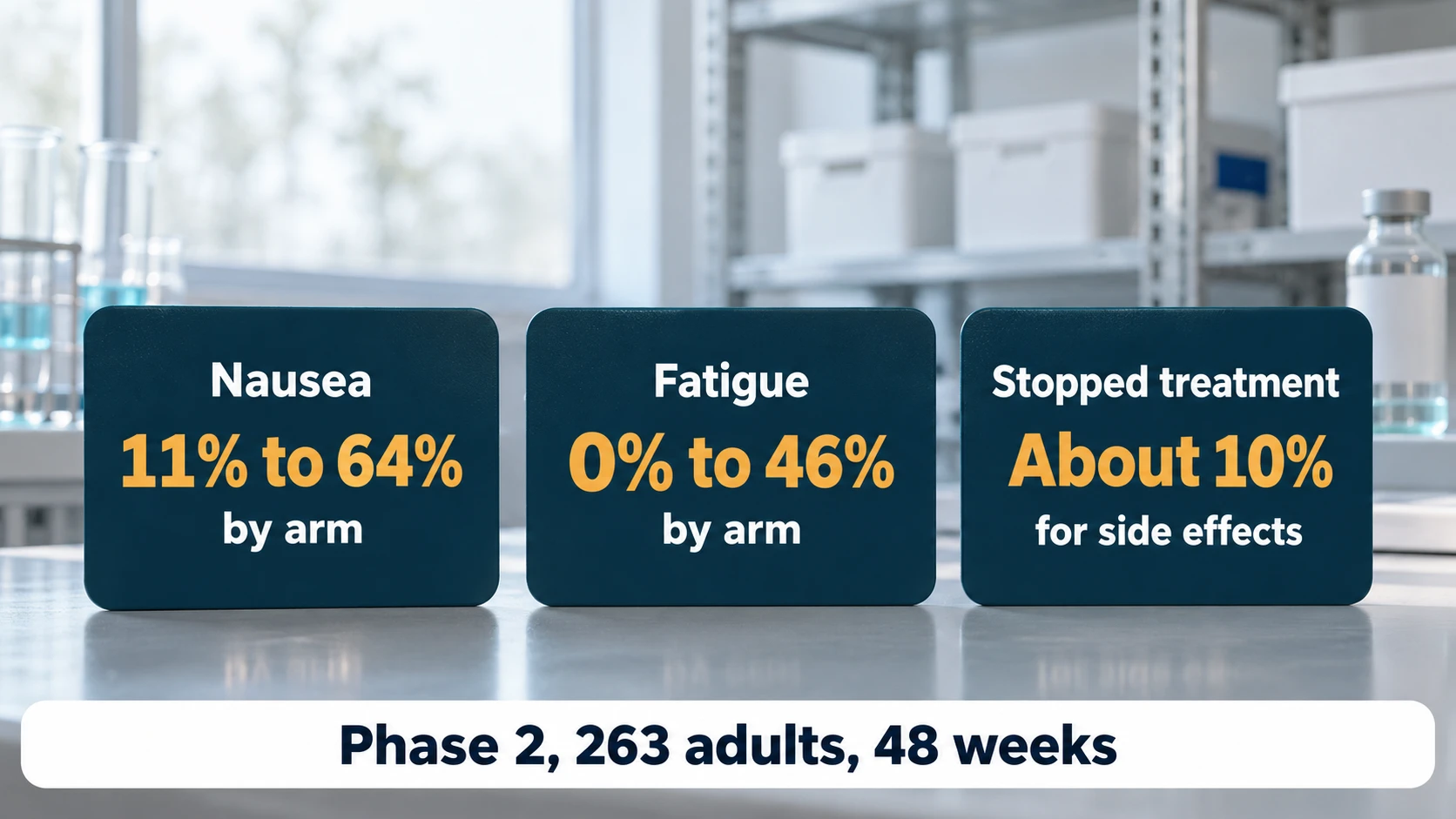
Short answer: In Eli Lilly’s trials, the most common eloralintide side effects were nausea and fatigue, followed by decreased appetite, headache, diarrhoea, constipation, vomiting and injection site reactions. Stomach symptoms and fatigue rose with the dose and with a fast start, and a slower escalation reduced them. Most events were mild to moderate. About 10% of phase 2 participants stopped treatment because of an adverse event. A phase 1b study also recorded a few mood-related events at the higher doses. Safety data cover 48 weeks at most, and no regulator has reviewed them.
Key takeaways
- Phase 2 (263 adults, 48 weeks): nausea ranged from 11% to 64% by arm against 14% on placebo, and fatigue from 0% to 46% against 12%.
- Starting low mattered more than the final dose. The 3 mg start with escalation to 9 mg had 25% nausea, while the 6 mg fixed arm had 64%.
- Secondary reports list any adverse event in 81% on eloralintide versus 71% on placebo, 14 serious events with none judged treatment-related, and no pancreatitis, gallbladder inflammation or deaths.
- Phase 1b found a dose-related drop in pulse rate (-14.4 beats per minute at 12 mg versus -3.4 on placebo) and four mood-related events at 6 mg or 12 mg.
- When Lilly combined eloralintide with tirzepatide, 10.8% to 27.0% of participants stopped treatment because of an adverse event.
- Unknowns include long-term safety, lean-mass effects, bone and calcitonin-related effects, and immune responses to the drug. Eloralintide is not approved, so no one can call it safe.
Last verified October 15, 2026. Sources are listed at the end. For laboratory and research use only. Nothing here is medical or legal advice.
Contents
- Where the safety data come from
- Phase 2: nausea and fatigue by dose arm
- Phase 1b: the broader adverse event list
- Phase 1 single dose
- EloraTZP: what adding tirzepatide did
- How eloralintide’s side effects compare with similar drugs
- How to read an adverse event table
- Why the escalation schedule matters so much
- What has not been reported
- The gray-market risk is separate from the trial risk
- Common questions
Where the safety data come from
Every figure on this page comes from one of four sets of published or reported results. Each has a different size, length and dose range, so figures from different rows should not be merged.
| Study | Who | Size | Length | Source |
|---|---|---|---|---|
| Phase 1, single dose (NCT05295940) | Healthy adults, mean BMI 27.5 | 48 (36 on eloralintide) | One dose, 29 days of follow-up reported | Molecular Metabolism 2025 |
| Phase 1b, multiple dose (second part of NCT05295940) | Adults with obesity or overweight | 100 (73 on eloralintide) | 12 weeks of weekly dosing, about 22 weeks in the study | Diabetes, Obesity and Metabolism 2026 |
| Phase 2 (NCT06230523) | Adults with obesity or overweight, no type 2 diabetes | 263 (210 on eloralintide) | 48 weeks | The Lancet 2025 |
| Phase 2b, EloraTZP (NCT06603571) | Adults with obesity or overweight and type 2 diabetes | 367 | 48 weeks | Lilly release, September 30, 2026 |
All four were sponsored by Eli Lilly. The phase 3 ENLIGHTEN studies will add thousands of participants, but their primary completion dates are in 2028.
Phase 2: nausea and fatigue by dose arm
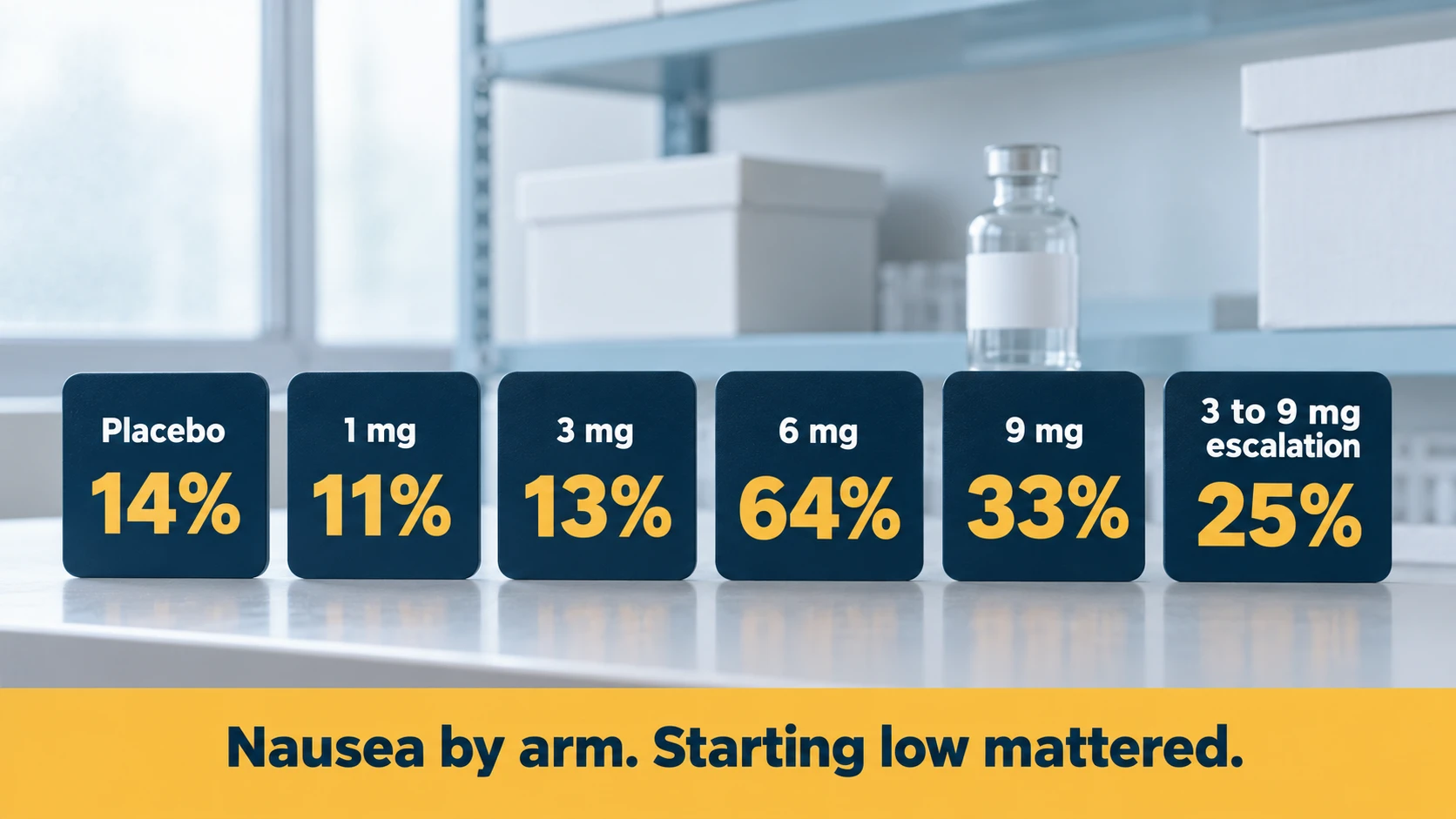
The Lancet paper’s abstract names nausea and fatigue as the most common adverse events and gives the rate for each arm.
| Arm | Participants | Nausea | Fatigue |
|---|---|---|---|
| Placebo | 53 | 14% | 12% |
| 1 mg weekly | 28 | 11% | 0% |
| 3 mg weekly | 24 | 13% | 13% |
| 6 mg weekly | 28 | 64% | 29% |
| 9 mg weekly | 54 | 33% | 43% |
| Escalation 6 to 9 mg | 24 | 54% | 46% |
| Escalation 3 to 9 mg | 52 | 25% | 21% |
These are regimens tested in a clinical trial. They are not guidance.
Four things follow from the table.
- The low doses looked like placebo for nausea. The 1 mg and 3 mg arms sat at 11% and 13%, close to the 14% placebo rate. Those arms also lost the least weight (-9% and -12%).
- Nausea did not climb in a straight line. The 6 mg arm (64%) was worse than the 9 mg arm (33%). With only 24 to 28 people in a fixed-dose arm, a few extra cases moves a percentage by ten points or more, and the trial was not designed to explain the difference between arms.
- Starting low helped. The 3 to 9 mg escalation arm reached the same top dose as the 9 mg arm and had less nausea (25% versus 33%) and much less fatigue (21% versus 43%). The authors say beginning at 3 mg and escalating reduced stomach symptoms and fatigue compared with starting at 6 or 9 mg.
- Fatigue was frequent at the higher doses. It reached 43% to 46% in the 9 mg and 6 to 9 mg arms, which makes it a symptom to watch in phase 3.
What secondary reports add
I could not read the full paper, so the figures below come from news and medical-press summaries of it. Read them as reported and not verified against the tables.
| Item | Reported figure |
|---|---|
| Any adverse event | 81% on eloralintide, 71% on placebo |
| Nausea, all eloralintide arms combined | 32.7% versus 13.5% on placebo |
| Vomiting, all eloralintide arms combined | 8.2%; none in the placebo, 1 mg and 3 mg arms |
| Constipation and diarrhoea | About 15% each on eloralintide, versus 5.8% and 9.6% on placebo |
| Serious adverse events | 14 participants overall; none judged related to treatment by investigators and sponsor |
| Pancreatitis, gallbladder inflammation, deaths | None reported |
| Stopped treatment because of an adverse event | About 10% overall; one report gives 21% in the 6 mg arm against 8% on placebo |
Medscape quoted a commentator who said the discontinuation rate was higher than expected for a trial of this type. That fits the 21% figure for the 6 mg arm and the fact that nausea was highest there.
Phase 1b: the broader adverse event list
The 12-week multiple-dose study is the most detailed safety table available, because its paper reports every event and its time course. It gave weekly doses of 1.2, 3, 6 and 12 mg without escalation, which is a harsher start than the phase 2 escalation arms.
| Event | Eloralintide (n=73) | Placebo (n=27) |
|---|---|---|
| Decreased appetite | 19.2% | 3.7% |
| Headache | 12.3% | 3.7% |
| COVID-19 | 11.0% | 18.5% |
| Fatigue | 11.0% | 0% |
| Diarrhoea | 9.6% | 0% |
| Injection site reaction | 9.6% | 3.7% |
| Nausea | 8.2% | 0% |
| Abdominal pain | 4.1% | 0% |
| Depressed mood | 4.1% | 0% |
| Vomiting | 4.1% | 0% |
Across all 100 participants, 59% reported at least one adverse event, including 55.6% of those on placebo. Most events were mild.
Injection site reactions were common at the low and middle doses (33.3% at 3 mg, 21.7% at 6 mg, 13.9% at 12 mg, against 3.7% on placebo) and were mostly mild.
Nausea, vomiting and diarrhoea were infrequent in this study, even though it had no escalation. No one stopped treatment because of nausea, vomiting or diarrhoea. That contrasts with the phase 2 nausea rates and illustrates how much the participant group, the dose and the study design change the result.
Mood-related events. Four participants had mood-related events: three with depressed mood and one with persistent depressive disorder. All four were at the 6 mg or 12 mg doses. The three at 12 mg stopped treatment, and the events resolved in two to four days. These are small numbers from one study with a placebo group of 27, and the paper does not claim a causal link. They are part of the record, and later trials will show whether the signal holds up.
Serious events. There were two in the whole study: a road traffic accident on placebo and an acute kidney injury at 6 mg that the investigator judged unrelated. There were no deaths.
Heart rate, blood pressure and other measures
| Measure at week 12 | Placebo | 3 mg | 6 mg | 12 mg |
|---|---|---|---|---|
| Pulse rate change (beats per minute) | -3.4 | -7.1 | -8.3 | -14.4 |
| Systolic blood pressure change (mmHg) | +3.4 | +7.7 | +1.0 | +2.2 |
| Diastolic blood pressure change (mmHg) | +2.4 | +5.0 | +2.3 | +1.3 |
Pulse fell with dose, with no symptomatic bradycardia reported. Blood pressure showed no clear relationship to dose. Cholesterol, LDL, HDL and triglycerides did not change significantly, and fasting glucose was unchanged. The study reported no cardiac safety events on ECG. A lower pulse is the opposite of what retatrutide showed in its phase 2 (dose-dependent heart rate increases that peaked at 24 weeks).
Gastric emptying
A paracetamol absorption test (a standard way to measure how fast the stomach empties) showed a dose-related slowing on day 3, and a dose-related speeding on day 80, compared with placebo. The pattern is consistent with the stomach adapting to the drug over weeks, but the study does not test that, and I would not read more into it than that.
Phase 1 single dose
Forty-eight healthy adults received one dose from 0.04 mg to 12 mg, or placebo. There were 17 treatment-emergent events in 10 participants, only one of them on placebo, and all but one were mild. Two participants had four gastrointestinal events between them, including one moderate vomiting episode at 12 mg. There were no serious events and no discontinuations. A single-dose study cannot show what repeated weekly exposure does, which is why phases 1b and 2 matter more.
EloraTZP: what adding tirzepatide did
On September 30, 2026, Lilly reported the phase 2b trial of eloralintide with tirzepatide in 367 adults with type 2 diabetes. Lilly’s release gives discontinuation rates but not per-arm nausea, vomiting or serious events.
| Group | Stopped treatment because of an adverse event |
|---|---|
| Eloralintide plus tirzepatide | 10.8% to 27.0% |
| Eloralintide alone | 0% to 10.8% |
| Tirzepatide alone | 2.9% |
| Placebo | 16.7% |
Lilly said the adverse events were mostly gastrointestinal, mostly mild or moderate, clustered in the dose-escalation period, and more frequent in the combination arms than with either drug alone. The 16.7% on placebo is unusual and unexplained in the release. Coverage of the presentation quotes the lead author saying the combination arms held fewer than 100 people each, so the percentages are imprecise.
The combination was given as two separate injections in this study. Lilly plans to move to a single co-formulation with an optimized escalation schedule in phase 3, which reads as a response to the tolerability data.
How eloralintide’s side effects compare with similar drugs
A 2026 review in Diabetes, Obesity and Metabolism tabulated tolerability across the amylin class. These are reviewer-compiled ranges from different trials, so they illustrate the range and do not rank the drugs.
| Drug | Nausea | Vomiting | Stopped for adverse events |
|---|---|---|---|
| Pramlintide | 9% to 29% | Not reported | 3% to 16% |
| Cagrilintide (68 weeks) | 23.8% | 7.0% | About 1% to 2.6% |
| Eloralintide (phase 2) | 25% to 64% | 4% to 8.3% | 8% to 21% in the table; about 10% in the text |
| Petrelintide | 16.7% to 33.3% | 2.8% | 2.8% to 4.8% |
| Amycretin (36 weeks) | 50% to 82% | 25% to 53% | 0% to 35% |
| CagriSema (68 weeks) | 55% | 26.1% | 5.9% |
On these figures, eloralintide’s nausea sits above cagrilintide alone and below the combination drugs, and its vomiting is low. The review’s table and text disagree on eloralintide’s discontinuation rate, which is why the table shows both.
How to read an adverse event table
Tables of adverse events look precise and are easy to misread. Five rules help.
- Placebo has side effects too. 14% of the phase 2 placebo group reported nausea, and 12% reported fatigue. Only the gap between drug and placebo points to the drug.
- “Treatment-emergent” is not “caused by”. A treatment-emergent event is one that began after treatment started. COVID-19 was among the most frequent events in the phase 1b table, and it was more common on placebo (18.5%) than on eloralintide (11.0%).
- Small arms swing. An arm of 24 people moves four percentage points for every single person who reports an event.
- Denominators differ. The phase 1b abstract and its tables use different denominators for the same events (for example, diarrhoea is 10% in the abstract and 9.6% in the table), so cite the table.
- An event is not a discontinuation. Many people have nausea and stay on treatment. The discontinuation rate shows the events that mattered enough to stop.
Why the escalation schedule matters so much
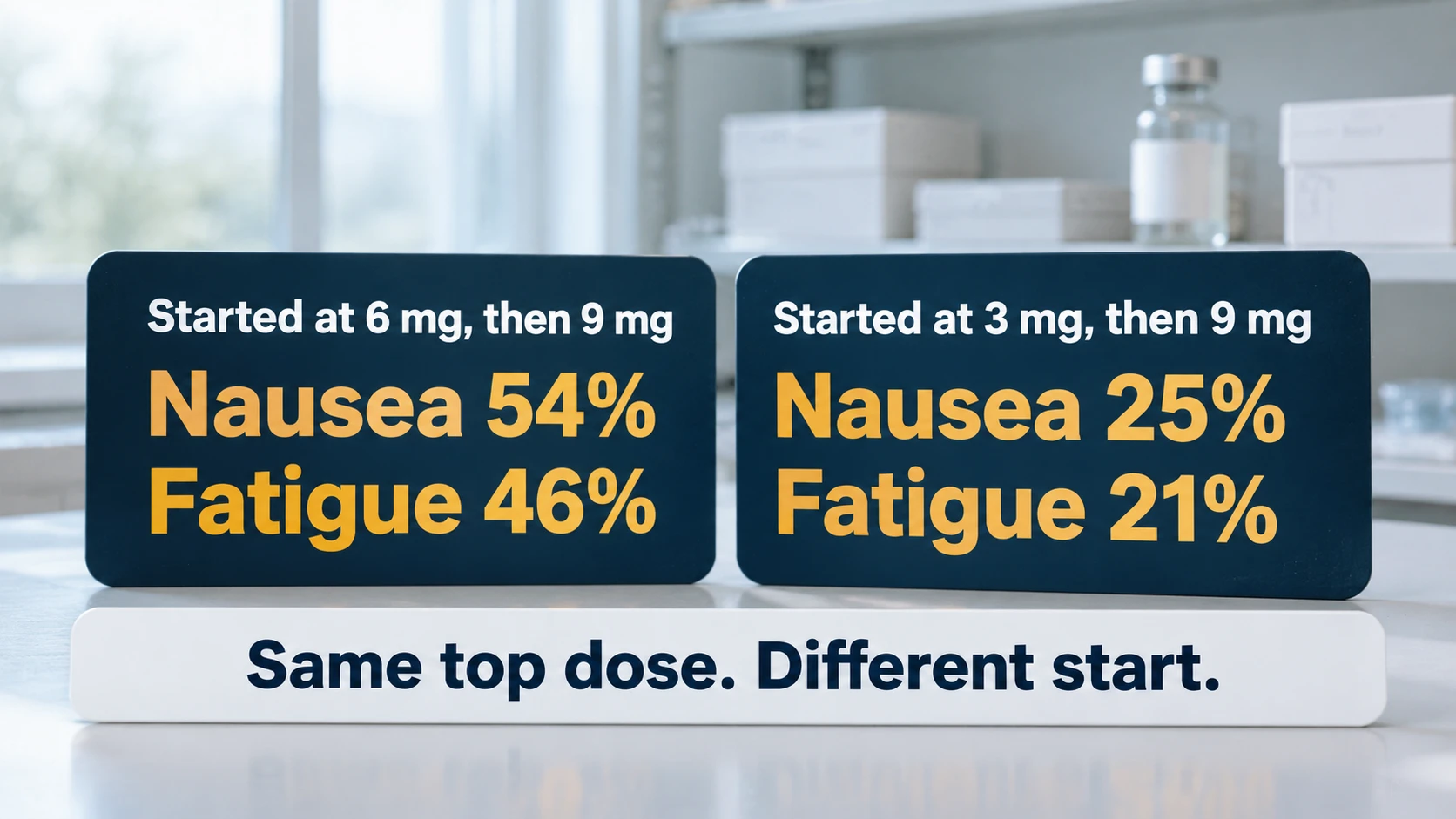
The pattern that runs through every trial of this drug class is that the first doses decide most of the stomach side effects. Eloralintide’s phase 2 shows it: the arm that reached 9 mg through a 3 mg start had half the fatigue of the arm that began at 9 mg. In the EloraTZP trial, the stomach events clustered in the escalation period.
Phase 3 will use fixed escalation schedules chosen from these results. Until those data exist, any online “protocol” for eloralintide is guesswork built from phase 2 arms, and the trial arms are not meant to be copied. See how a research vial differs from a trial drug.
What has not been reported
The published sources I read do not give an answer to these questions:
- Long-term safety. The longest exposure is 48 weeks.
- Lean mass and bone. I found no human body-composition data. In rats, fat made up a larger share of the weight lost with eloralintide than with cagrilintide.
- Calcitonin receptor effects. The molecule is designed to be weaker at the calcitonin receptor, and the phase 1b paper reports calcium and bone-turnover markers but not calcitonin or lipase.
- Immune response. Neither the phase 1b article nor the abstracts I read report anti-drug antibodies.
- Mood and mental health. The four phase 1b events need follow-up in larger trials with structured mood scales.
- Heart and kidney outcomes. No trial has measured them.
- Pregnancy, children and older adults. Phase 2 enrolled adults aged 18 to 75, mostly middle-aged.
- Stopping the drug. No eloralintide data show what happens to weight or symptoms after discontinuation.
The gray-market risk is separate from the trial risk
Everything above describes Lilly’s pharmaceutical-grade product given under medical supervision. A vial bought from a research-chemical website is a different thing. Its contents may differ from its label in amount, identity and purity, and it may carry contaminants such as endotoxin. The FDA has repeatedly said that products sold as “research use only” for human use are unapproved drugs, and in August 2026 Lilly sued six sellers of unapproved retatrutide. I found no action naming eloralintide as of October 15, 2026. Our guide on reading a certificate of analysis explains what a lab report does and does not prove.
Common questions
What are the most common side effects of eloralintide?
In the phase 2 trial, nausea (11% to 64% by arm) and fatigue (0% to 46%). The phase 1b study also reported decreased appetite (19.2%), headache (12.3%), diarrhoea (9.6%), injection site reactions (9.6%) and vomiting (4.1%). Most events were mild to moderate.
Does eloralintide cause nausea?
Yes, in a dose-dependent way. Phase 2 nausea was 11% to 13% in the lowest two arms, 33% at 9 mg and 64% in the 6 mg arm, against 14% on placebo. A slower escalation lowered it.
Does eloralintide cause vomiting?
Less often than nausea. Secondary reports put vomiting at 8.2% across the eloralintide arms in phase 2 and none in the placebo, 1 mg and 3 mg arms. In phase 1b it was 4.1%.
Is eloralintide safe?
No one can say yet. Trials report mostly mild to moderate stomach side effects and fatigue, with about 10% stopping treatment for adverse events in phase 2. The safety record covers 48 weeks, and no regulator has reviewed it. Eloralintide is not approved.
Does eloralintide cause depression or mood changes?
Phase 1b recorded four mood-related events (three depressed mood, one persistent depressive disorder) at 6 mg or 12 mg, and the three at 12 mg stopped treatment. The numbers are small and the paper does not claim a causal link. Larger trials will show whether it is a real signal.
Does eloralintide cause muscle loss?
No human data on lean mass are available from the sources I read. In rats, weight change on eloralintide was mostly fat (86% to 91% at the low and middle doses), and lean-mass loss was lower than with cagrilintide.
Does eloralintide affect heart rate?
In phase 1b, pulse rate fell with dose: -3.4 beats per minute on placebo, -7.1 at 3 mg, -8.3 at 6 mg and -14.4 at 12 mg. There was no symptomatic bradycardia. Retatrutide’s phase 2 showed the opposite pattern, with dose-dependent heart rate increases.
How do eloralintide’s side effects compare with cagrilintide?
Cagrilintide alone had nausea of 23.8% and vomiting of 7.0% over 68 weeks, according to a 2026 review. Eloralintide’s phase 2 nausea ranged from 11% to 64% by arm and vomiting was about 8% overall. The trials differ, so the comparison is rough.
Are there serious side effects?
Phase 2 reported 14 serious adverse events across the trial, none judged related to treatment by the investigators and sponsor, and no pancreatitis, gallbladder inflammation or deaths. Phase 1b had two serious events, both judged unrelated. Rarer events cannot be excluded in trials this size.
What are the side effects of eloralintide with tirzepatide?
Lilly said the events were mostly gastrointestinal, mostly mild or moderate, and more frequent in the combination arms. Between 10.8% and 27.0% of combination participants stopped treatment because of an adverse event, against 2.9% on tirzepatide alone.
Can side effects be avoided by starting at a lower dose?
In phase 2, the arm that started at 3 mg and escalated had less nausea and fatigue than arms that started at 6 or 9 mg. That is a trial result for Lilly’s product under medical supervision, and it is not guidance for any other use.
Related: What is eloralintide? · Eloralintide weight change results · How does eloralintide work? · Eloralintide dosage · EloraTZP · Eloralintide myths and facts · Eloralintide vs cagrilintide · Eloralintide approval status · Third-party tested peptides · Are peptides legal?
Sources
All pages read October 14 to 15, 2026. Items marked secondary are news or review summaries that were not checked against the full paper.
- Billings LK, et al. Eloralintide phase 2. The Lancet 2025; DOI 10.1016/S0140-6736(25)02155-5; NCT06230523. Nausea and fatigue by arm are from the abstract.
- Bhattachar S, et al. Eloralintide phase 1 proof of concept (multiple ascending dose). Diabetes, Obesity and Metabolism 2026; PMC12992164.
- Briere DA, et al. Eloralintide: from discovery to clinical proof of concept (single ascending dose). Molecular Metabolism 2025; PMC12640043.
- Eli Lilly. EloraTZP phase 2b results, September 30, 2026: PR Newswire.
- Secondary coverage of the phase 2 trial: Medical Xpress, HCPLive, and Medscape’s report on the trial (secondary; paywalled, read through search summaries).
- Amylin analogs: the next major class of weight loss therapy. Diabetes, Obesity and Metabolism 2026; PMC13588232.
- Jastreboff AM, et al. Retatrutide phase 2. New England Journal of Medicine 2023; PubMed 37366315.
- NPR. Eli Lilly files six lawsuits against sellers of unapproved retatrutide, August 13, 2026: npr.org.
Editorial note: Peptryn sells research materials for laboratory use only. This guide is informational and is not medical advice. To report an error, use the contact page.
All products on peptryn.com are intended for laboratory research purposes only. They are not drugs, foods, dietary supplements or cosmetics, and they are not for human consumption, self-administration, or veterinary use. You must be 21 or older to buy. The information on this page has not been evaluated by the U.S. Food and Drug Administration and is not intended to diagnose, treat, cure, or prevent any disease.