How Does Eloralintide Work? Mechanism of Action of Lilly’s Amylin Receptor Agonist (2026)
Research use only. This guide is education, not medical advice. Eloralintide is an investigational drug that no regulator has approved. Nothing here describes how anyone should use it, and Peptryn gives no dosing or administration guidance.
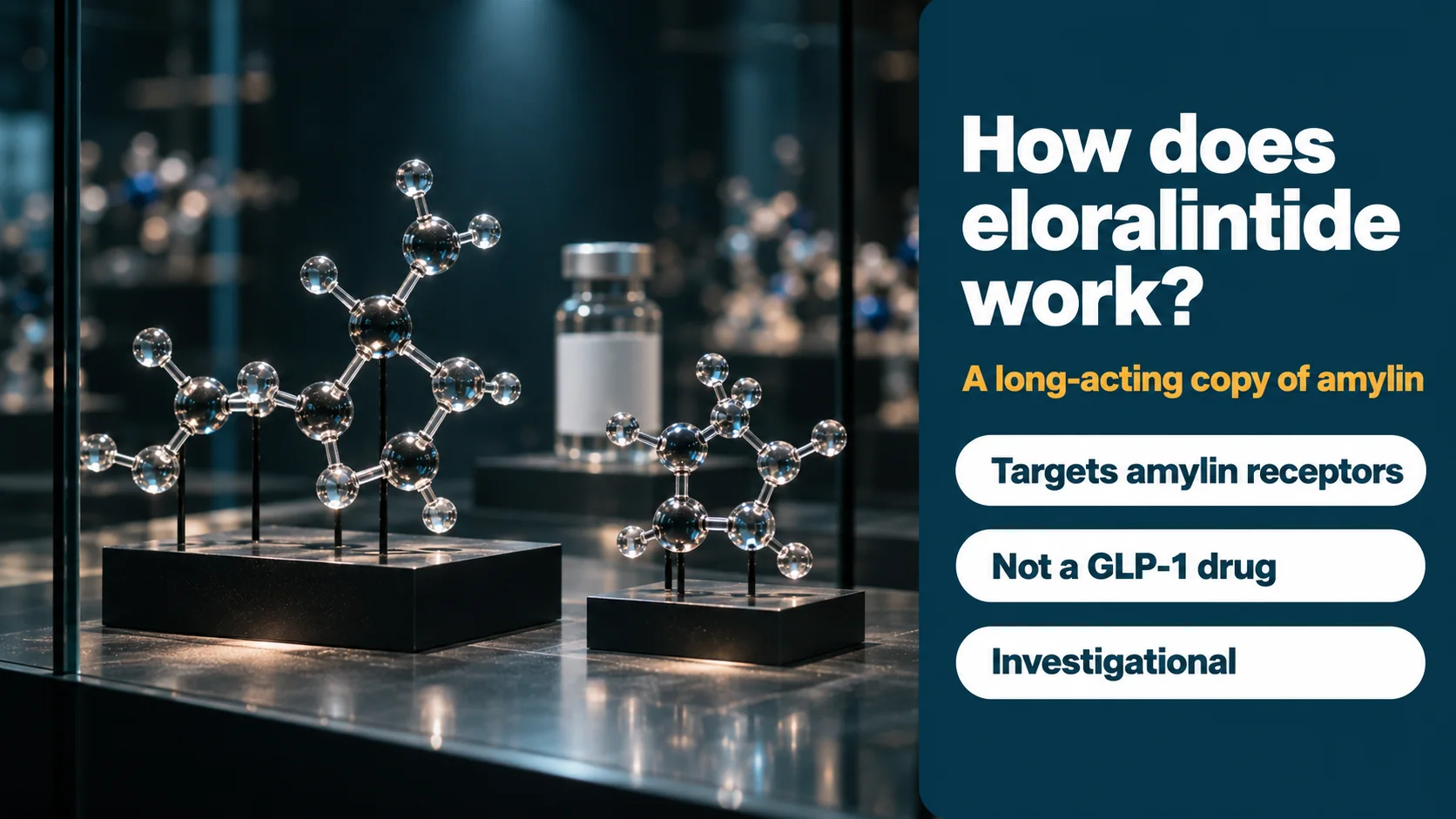
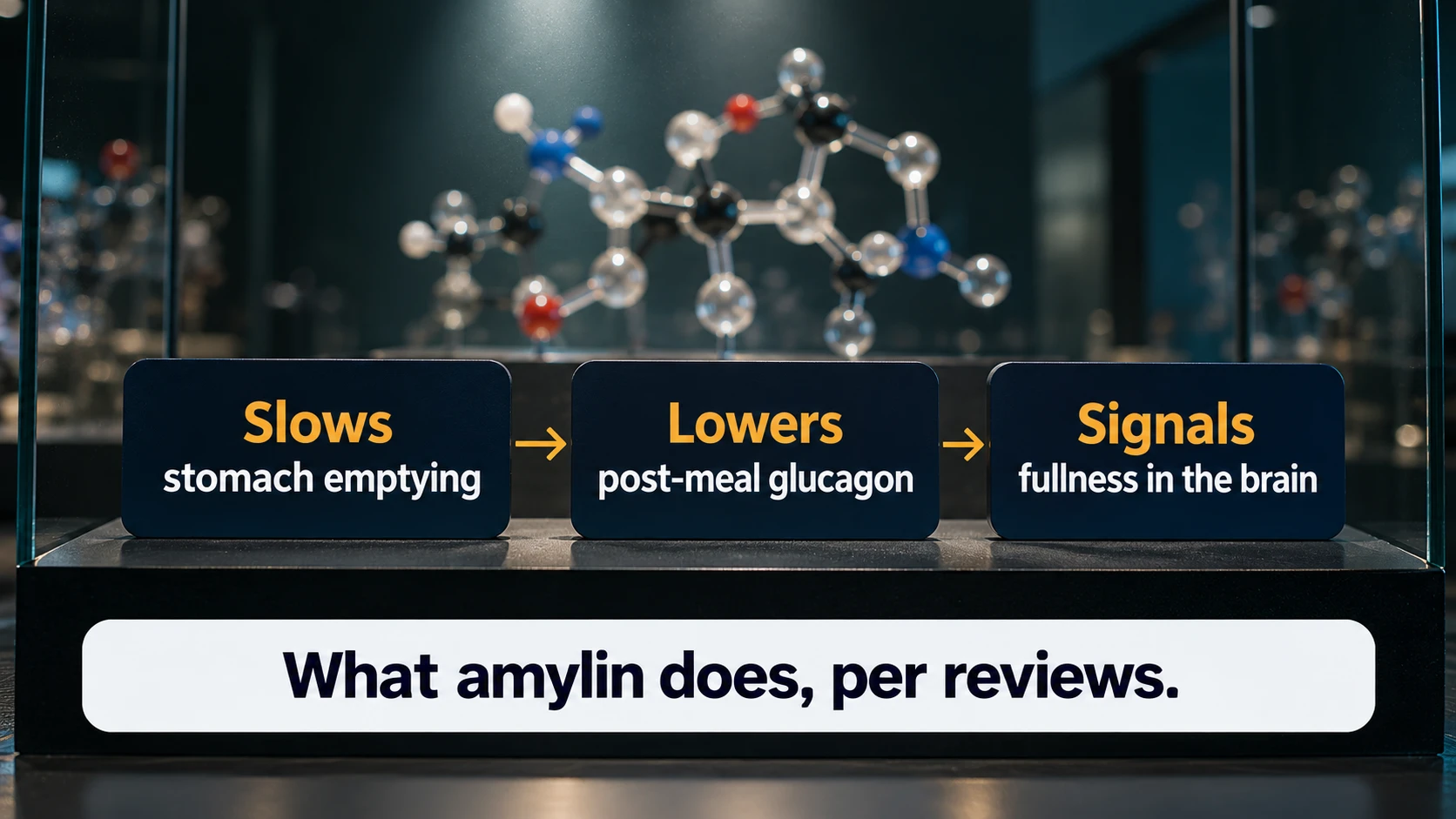
Short answer: Eloralintide is a long-acting copy of amylin, a hormone the pancreas releases with insulin after a meal. It binds amylin receptors, which are made of the calcitonin receptor paired with a helper protein called a RAMP. Reviews describe amylin as slowing stomach emptying, lowering the post-meal glucagon surge and signalling fullness through the brain. Lilly says eloralintide has the potential to cut calorie intake, likely by affecting satiety. Eloralintide is built to favour one amylin receptor (AMY1R) over the calcitonin receptor, which its developers hope will keep the appetite effect while reducing nausea.
Key takeaways
- Eloralintide acts on the amylin system, not on GLP-1, GIP or glucagon receptors.
- In human cell assays it activated AMY1R at 23.9 picomolar, versus 291.0 for the calcitonin receptor (about 12 times weaker) and 253.8 for AMY3R (about 11 times weaker).
- Its C20 fatty diacid binds albumin in blood, which gives a half-life of about two weeks and allows weekly dosing in trials.
- Human measurements from the phase 1b study show dose-related changes in stomach emptying, a fall in pulse rate and little change in blood glucose or lipids.
- Most of what is known about where the drug acts in the brain comes from rodent work on natural amylin. How much applies to eloralintide in people is not settled.
- Whether receptor selectivity improves tolerability in people is a design hypothesis, not a proven result.
Last verified October 15, 2026. Sources are listed at the end. For laboratory and research use only. Nothing here is medical or legal advice.
Contents
- The mechanism in one table
- Amylin: the hormone eloralintide copies
- The receptor family: calcitonin receptor plus a helper
- What eloralintide does at the receptor
- The brain: where the satiety signal is processed
- What human measurements show
- What the animal data say about body composition
- Why selectivity might matter, and why it might not
- How the mechanism differs from GLP-1, GIP and glucagon drugs
- What the mechanism does not explain
- Common questions
The mechanism in one table
| Step | What happens | How well supported |
|---|---|---|
| 1 | Amylin is released from pancreatic beta cells together with insulin after a meal | Established physiology |
| 2 | It binds receptors built from the calcitonin receptor plus a RAMP helper protein (AMY1R, AMY2R, AMY3R) | Established receptor biology |
| 3 | Eloralintide, a stabilized amylin analogue, binds these receptors, most strongly AMY1R in human cell assays | Cell data, Molecular Metabolism 2025 |
| 4 | Signals reach the brain, where appetite is reduced and the sense of fullness is increased | Rodent studies and drug-class reviews |
| 5 | Stomach emptying slows and the post-meal glucagon rise is blunted | Reviews of amylin physiology; partial human data for eloralintide |
| 6 | Calorie intake falls and body weight drops, mostly from fat in animal studies | Rat data; human weight data from phase 1 and 2 |
Steps 1 and 2 are textbook. Steps 3 and 6 have eloralintide-specific data. Steps 4 and 5 rest mainly on natural amylin and on related drugs, so they are the least certain for this molecule.
Amylin: the hormone eloralintide copies
Amylin, also called islet amyloid polypeptide, is a pancreatic hormone co-secreted with insulin. Two reviews published in 2026 summarise what it does after a meal:
- It slows gastric emptying, so food leaves the stomach more gradually.
- It suppresses glucagon, the hormone that tells the liver to release sugar, which helps keep blood glucose from spiking.
- It promotes satiation through actions in the central nervous system, which helps end a meal.
Natural human amylin is not a usable drug. It clumps into fibrils and does not last in the blood. Pramlintide, the first approved amylin drug, was based on the non-clumping rat sequence and was limited by modest effect and frequent dosing. Long-acting analogues such as eloralintide and cagrilintide fix both problems by changing the amino acid chain and adding a fatty acid that binds albumin. Our guide to eloralintide’s structure and half-life covers those edits.
The receptor family: calcitonin receptor plus a helper
An amylin receptor is not a single protein. It is the calcitonin receptor (CTR) paired with one of three receptor activity-modifying proteins, RAMP1, RAMP2 or RAMP3, giving AMY1R, AMY2R and AMY3R. A 2026 review in Peptides credits advances in understanding this paired structure with helping the design of the second generation of non-clumping, long-acting amylin analogues.
The CTR on its own responds to calcitonin, a hormone involved in calcium handling. A drug that activates the bare CTR can therefore produce calcitonin-like effects. This is the basis of the two drug classes:
- Dual amylin and calcitonin receptor agonists (DACRAs) activate AMY receptors and the CTR. Cagrilintide and petrelintide are in this group.
- Selective amylin receptor agonists (SARAs) are designed to favour AMY receptors. Eloralintide is the lead example.
What eloralintide does at the receptor
The discovery paper (Briere and colleagues, Molecular Metabolism, 2025) measured how strongly eloralintide activated each receptor in cell assays. The numbers are concentrations that give half the maximum signal, so lower means more potent.
| Receptor | Human cells (picomolar) | Rat cells (picomolar) |
|---|---|---|
| AMY1R | 23.9 | 5.4 |
| AMY3R | 253.8 (about 11 times weaker) | 13.8 |
| Calcitonin receptor | 291.0 (about 12 times weaker) | 243.2 (about 45 times weaker than AMY1R) |
Binding data point the same direction: in human cells the binding constant was 478.1 picomolar at AMY1R and about 8-fold weaker at the other two. The authors describe eloralintide as AMY1R-selective in human assays. In rats both AMY1R and AMY3R responded strongly. That species difference matters, because most of the animal studies were done in rats, and human receptors do not behave identically. A 2026 review in Diabetes Therapy describes it as mostly an AMY1R agonist.
The brain: where the satiety signal is processed
Eloralintide is injected and circulates in the blood. How a circulating amylin signal reaches the brain is described mainly from work on natural amylin and rodents.
A 2026 review of brain amylin signalling notes that research first focused on hindbrain sites and has since found other central nuclei where amylin influences food intake and food reward, including mesolimbic structures involved in the reward value of palatable food. A separate 2026 rodent study in Molecular Metabolism found that neurons in the locus coeruleus (a noradrenergic nucleus) carry calcitonin receptors that amylin can activate to suppress eating, without the nausea-like effects seen at some other sites.
Two cautions follow. First, these are animal findings, mostly about natural amylin or related peptides, and they have not been mapped for eloralintide in people. Second, the same reviews stress that the circuits for fullness and for nausea overlap. A Pharmacological Research review (2026) argues that receptor pharmacology, exposure kinetics and the recruitment of hindbrain and parabrachial circuits may decide whether eating less reflects physiological satiation or an aversive signal. That is the logic behind building a drug that favours AMY1R and spares the CTR.
What human measurements show
The best human mechanism data for eloralintide come from the 12-week multiple-dose study (Bhattachar and colleagues, 2026).
| Measure | Result |
|---|---|
| Gastric emptying (acetaminophen absorption test) | Dose-related slowing on day 3, then a dose-related speeding on day 80, against placebo |
| Appetite scores (visual analogue scale) | Non-significant trend toward lower fasting appetite; after-meal measures variable |
| Fasting glucagon | Non-significantly lower |
| Glucose during a glucose tolerance test | No treatment-related change |
| Insulin and C-peptide response | Nominal increases at higher doses, with high variability |
| Fasting glucose | Unchanged |
| Pulse rate at week 12 | -3.4 beats per minute on placebo, -7.1 at 3 mg, -8.3 at 6 mg, -14.4 at 12 mg |
| Blood pressure | No clear dose relationship |
| Cholesterol, LDL, HDL, triglycerides | No significant changes |
| Body weight at week 12 | +0.2% on placebo; -2.6%, -8.9%, -8.5% and -11.3% on 1.2, 3, 6 and 12 mg |
The stomach finding fits amylin’s reputation, with a twist. The slowing was clear on day 3 and reversed by day 80. That pattern is consistent with the stomach adapting to the drug over weeks, but the study did not test it. The pulse finding is useful for comparison: a 2026 cardiology review notes that the fall in pulse rate with eloralintide contrasts with the heart rate increase associated with GLP-1 receptor agonists, and our retatrutide comparison shows the same contrast with retatrutide’s phase 2.
The small glucose effects are what you would expect in a trial of people without diabetes. The type 2 diabetes data come from the combination trial, where HbA1c fell 1.1 to 1.4 points on eloralintide alone (see our EloraTZP guide).
What the animal data say about body composition
In diet-induced obese rats, eloralintide lowered food intake and body weight dose-dependently. Fat accounted for 86%, 91% and 80% of the weight lost at 1, 10 and 100 nmol/kg, against 63% for cagrilintide at 100 nmol/kg, and lean mass loss was significantly lower with eloralintide (p = 0.0101). A 2026 cardiology review lists preferential fat mass loss among eloralintide’s early features. I found no human body-composition data, so this is an animal finding. Our results guide covers the human weight numbers.
Why selectivity might matter, and why it might not
The developers’ argument is that sparing the calcitonin receptor reduces effects that look like calcitonin signalling, and that favouring AMY1R keeps appetite suppression. Evidence for it today:
- For: in lean rats, eloralintide caused less conditioned taste avoidance than cagrilintide (ED50 8.9 versus 4.2 nmol/kg), and a separate rodent finding shows CTR signalling in the locus coeruleus can suppress eating without nausea. Human phase 1b nausea was only 8.2%.
- Against or unresolved: in the phase 2 trial, nausea reached 64% in one arm, and fatigue was frequent at the higher doses. Whether that reflects the molecule, the dose escalation or chance is not known. Cagrilintide, a dual agonist, has its own tolerability record. A 2026 review adds that the broader class often has nausea during initiation that mostly resolves with continued use.
The honest summary is that selectivity is a rational design choice with supportive animal data and no clean human proof.
How the mechanism differs from GLP-1, GIP and glucagon drugs
| Hormone system | Drugs | Where the signal starts | Textbook effects |
|---|---|---|---|
| Amylin | Eloralintide, cagrilintide | Amylin receptors (CTR plus RAMP) | Slower stomach emptying, less post-meal glucagon, fullness |
| GLP-1 | Semaglutide, tirzepatide (partly), retatrutide (partly) | GLP-1 receptor | Insulin release, slower stomach emptying, fullness |
| GIP | Tirzepatide, retatrutide | GIP receptor | Insulin release and additional effects on appetite and fat tissue |
| Glucagon | Retatrutide | Glucagon receptor | Thought to increase energy expenditure |
Because the pathways differ, combining them is plausible, which is why Lilly tests eloralintide with tirzepatide and why Novo Nordisk tests cagrilintide with semaglutide. Early reviews also raise the possibility that amylin agonists may help in fatty liver disease, diabetes-related kidney disease and resistant hypertension. Those are hypotheses, with no eloralintide outcome data behind them.
What the mechanism does not explain
- Why the effect plateaus. Weight change on eloralintide in phase 2 flattened at the higher doses, and the reasons are not published.
- Why some arms had much more nausea. Dose, escalation speed and trial size all contribute.
- How it changes the reward value of food. Rodent work suggests an effect on mesolimbic circuits; human data for eloralintide are not published.
- What happens after stopping. No eloralintide data cover regain.
- Whether lean mass is spared in people. Only rat data exist.
Common questions
How does eloralintide work?
It mimics amylin, a hormone released from the pancreas with insulin, by activating amylin receptors. Reviews describe amylin as slowing stomach emptying, lowering post-meal glucagon and promoting fullness through the brain. Lilly says eloralintide has the potential to reduce calorie intake, likely through satiety.
What is the mechanism of action of eloralintide?
It is a selective amylin receptor agonist. In human cell assays it is most potent at the AMY1 receptor and about 11 to 12 times weaker at AMY3R and the calcitonin receptor. A C20 fatty diacid binds albumin to give a half-life of about two weeks.
Does eloralintide work like Ozempic?
No. Ozempic (semaglutide) activates the GLP-1 receptor. Eloralintide activates amylin receptors. The two are different hormone systems, although both can slow stomach emptying and both can cause nausea.
What receptors does eloralintide act on?
Amylin receptors: the calcitonin receptor paired with RAMP1 (AMY1R), RAMP2 (AMY2R) or RAMP3 (AMY3R). It favours AMY1R in human assays and has weaker activity at the calcitonin receptor alone.
Does eloralintide slow stomach emptying?
In the 12-week phase 1b study, a stomach emptying test showed a dose-related slowing on day 3 that reversed to a dose-related speeding by day 80, compared with placebo.
Does eloralintide act on the brain?
Amylin’s appetite effects are described as acting through the brain, including hindbrain and reward-related areas, based mostly on rodent work with natural amylin. Eloralintide-specific brain studies in people have not been published.
Is eloralintide a GLP-1 receptor agonist?
No. It does not activate the GLP-1 receptor.
Why is eloralintide called selective?
Because it was designed to favour amylin receptors (AMY1R in particular) over the calcitonin receptor. Cagrilintide, by contrast, activates both and is called a dual agonist.
Does eloralintide lower blood sugar?
In people without diabetes it caused no meaningful change in fasting glucose in phase 1b. In adults with type 2 diabetes, HbA1c fell 1.1 to 1.4 points on eloralintide alone in the phase 2b combination trial.
Why does eloralintide lower heart rate?
The reason is not established. Phase 1b measured a dose-related fall in pulse rate (-14.4 beats per minute at 12 mg versus -3.4 on placebo) with no symptomatic bradycardia. A review notes this contrasts with the heart rate increase seen with GLP-1 drugs.
Related: What is eloralintide? · Eloralintide structure and half-life · Eloralintide trial results · Amylin analogs: every drug in development · Eloralintide vs cagrilintide · Eloralintide side effects · All eloralintide guides
Sources
All pages read October 14 to 15, 2026.
- Briere DA, et al. Eloralintide (LY3841136), a novel amylin receptor agonist: from discovery to clinical proof of concept. Molecular Metabolism 2025; PMC12640043.
- Bhattachar S, et al. Eloralintide, a selective, long-acting amylin receptor agonist: phase 1 proof of concept. Diabetes, Obesity and Metabolism 2026; PMC12992164.
- Beyond GLP-1: amylin-based pharmacotherapy and the search for better-tolerated weight-loss drugs. Pharmacological Research 2026; PubMed 42586227.
- Long-acting amylin-related peptides as therapies for obesity and type 2 diabetes. Peptides 2026; PubMed 41747885.
- Brain amylin signaling, feeding, and reward. Comprehensive Physiology 2026; PubMed 41793055.
- The locus coeruleus calcitonin receptor can be engaged by amylin and CGRP to suppress feeding. Molecular Metabolism 2026; PubMed 42521122.
- Cardiometabolic risk reduction through selective amylin receptor agonism: emerging cardiovascular implications of eloralintide. Cardiology in Review 2026; PubMed 42745233.
- New amylin-based agonists for the treatment of obesity and type 2 diabetes mellitus. Diabetes Therapy 2026; PubMed 42803913.
- Amylin analogs: the next major class of weight loss therapy. Diabetes, Obesity and Metabolism 2026; PMC13588232.
- Eli Lilly. EloraTZP phase 2b release, September 30, 2026: PR Newswire (mechanism statement and type 2 diabetes results).
Editorial note: Peptryn sells research materials for laboratory use only. This guide is informational and is not medical advice. To report an error, use the contact page.
All products on peptryn.com are intended for laboratory research purposes only. They are not drugs, foods, dietary supplements or cosmetics, and they are not for human consumption, self-administration, or veterinary use. You must be 21 or older to buy. The information on this page has not been evaluated by the U.S. Food and Drug Administration and is not intended to diagnose, treat, cure, or prevent any disease.