Eloralintide Trial Results: Every Reported Number, Explained (2026)
Research use only. This guide is education, not medical advice. Eloralintide is an investigational drug that no regulator has approved for any use. The results below are what Eli Lilly’s trials reported for Lilly’s own formulation under medical supervision. They are not a promise of benefit, and Peptryn makes no health claim for any research material.
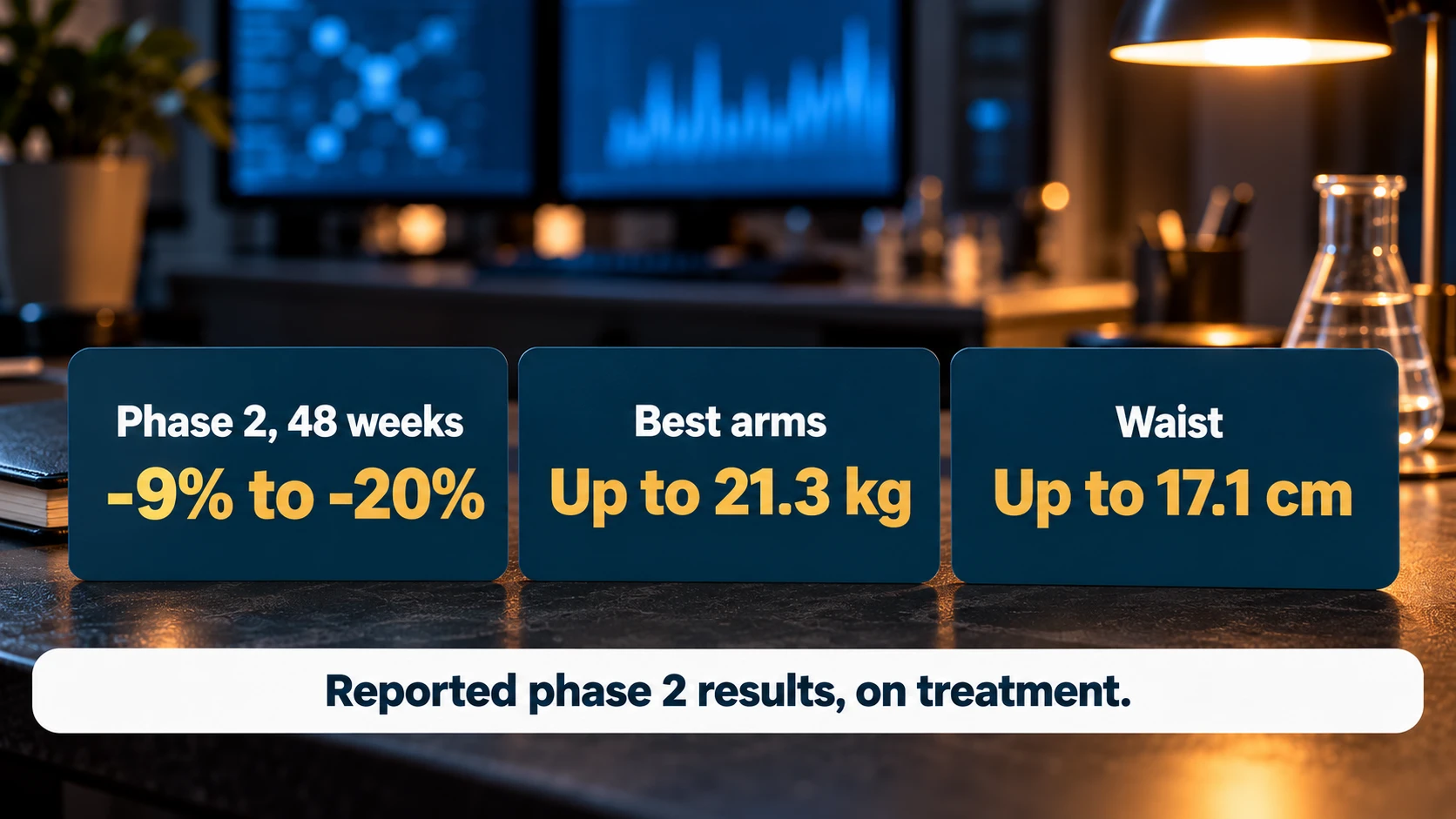
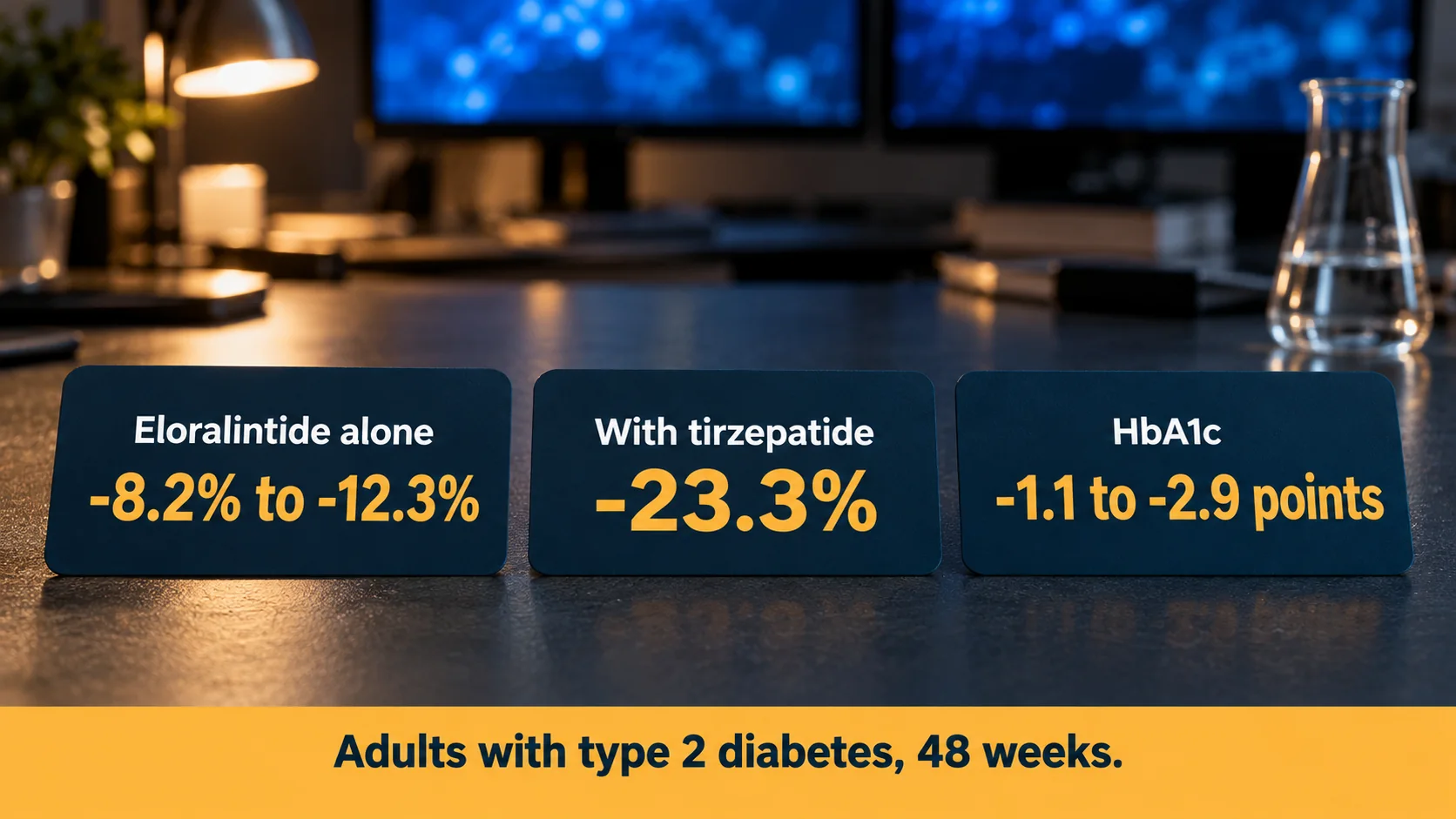
Short answer: In Eli Lilly’s 48-week phase 2 trial of 263 adults without diabetes, average weight change on eloralintide ranged from -9% (lowest dose) to -20% (highest doses), against -0.4% on placebo. The best arms lost up to 21.3 kg and 17.1 cm of waist circumference. In adults with type 2 diabetes, eloralintide alone averaged -8.2% to -12.3% at 48 weeks, and combined with tirzepatide it reached -23.3%. All figures are on-treatment results from phase 2 or earlier, and no phase 3 result exists yet.
Key takeaways
- Phase 2, no diabetes, 48 weeks: -9%, -12%, -18%, -20%, -20% and -16% across six regimens, against -0.4% on placebo.
- For the average participant (109.1 kg), a -20% change is about 22 kg. The reported maximum was 21.3 kg.
- With type 2 diabetes, eloralintide alone gave -8.2%, -12.3% and -11.1% at three dose levels, with HbA1c falling 1.1 to 1.4 points.
- Weight fell quickly: in a 12-week study the highest dose reached -11.3%, and the single-dose study showed -4.4% four weeks after one dose.
- Reviews report early improvements in pulse rate, blood pressure, inflammatory markers and lipids, but the evidence is short and small, and no outcomes trial exists.
- These are phase 2 on-treatment numbers. Phase 3 results counting everyone randomized will be lower, and they are due from 2028.
Last verified October 15, 2026. Sources are listed at the end. For laboratory and research use only. Nothing here is medical or legal advice.
Contents
- Every reported result at a glance
- Phase 2: the main result
- How fast the weight came off
- Type 2 diabetes: weight and blood sugar
- Other measures reported or reviewed
- Is -20% a lot?
- What might change in phase 3
- What the numbers do not say
- Common questions
Every reported result at a glance
| Study | Population | Length | Result on eloralintide | Placebo |
|---|---|---|---|---|
| Single dose (phase 1) | 48 healthy adults, BMI 27.5 | 29 days | -2.5% (4 mg), -4.4% (12 mg) | +0.6% |
| 12-week study (phase 1b) | 100 adults with obesity or overweight, BMI 32.6 | 12 weeks | -2.6% to -11.3% across four weekly doses | +0.2% |
| Phase 2 (The Lancet) | 263 adults, BMI 39.1, no diabetes | 48 weeks | -9% to -20% across six regimens | -0.4% |
| Phase 2b alone arms | 367 adults with type 2 diabetes | 48 weeks | -8.2% to -12.3% across three doses | -3.0% |
| Phase 2b with tirzepatide | Same trial | 48 weeks | -13.2% to -23.3% across four combinations | -3.0% |
| Phase 3 | Thousands, five ENLIGHTEN studies | To 2028 and beyond | Not reported |
Phase 2: the main result
| Regimen | Participants | Mean change in body weight (efficacy estimand) | 95% confidence interval |
|---|---|---|---|
| Placebo | 53 | -0.4% | -2.2 to 1.4 |
| 1 mg weekly | 28 | -9% | -12.6 to -6.3 |
| 3 mg weekly | 24 | -12% | -14.9 to -9.8 |
| 6 mg weekly | 28 | -18% | -20.7 to -14.5 |
| 9 mg weekly | 54 | -20% | -22.7 to -17.5 |
| 6 to 9 mg stepped | 24 | -20% | -22.7 to -17.0 |
| 3 to 9 mg stepped | 52 | -16% | -18.6 to -14.1 |
These are regimens tested in a clinical trial. They are not guidance.
Lilly summarised the range as 9.5% to 20.1% on eloralintide against 0.4% on placebo. The participants averaged 49.0 years of age, 109.1 kg and a BMI of 39.1; 78% were women and 78% were White, and the trial ran at 46 US sites.
Beyond the percentage
Secondary coverage of the paper adds three absolute measures for the best arms (the 9 mg and stepped groups):
| Measure | Up to |
|---|---|
| Weight lost | 21.3 kg |
| Waist circumference | 17.1 cm |
| Body mass index | 7.8 points |
A -20% change in a 109.1 kg person is about 21.8 kg, so the reported 21.3 kg maximum fits. Weight loss in kilograms depends on starting weight: the same percentage in someone at 90 kg would be 18 kg.
How many people hit the big thresholds
A larger share of eloralintide participants than placebo participants lost at least 5%, 10%, 15% and 20% of body weight, and the 9 mg and 6 to 9 mg groups were the most likely to reach 25% or 30%. The exact percentages are not in the abstract or the secondary reports I could read. When they are published, they will be the most useful number for comparing with tirzepatide (57% reached 20% or more at the 15 mg dose in SURMOUNT-1) and semaglutide (50.5% reached 15% or more in STEP 1).
What the average hides
Averages hide spread. The confidence intervals above show the uncertainty around each arm’s mean, not how much individual participants differed. No individual response data (the best and worst responders) have been published for eloralintide that I could find. Weight loss on every obesity drug varies widely between people.
How fast the weight came off
Phase 1b gave a view of the early course. In 12 weeks of weekly dosing without escalation, the average change was -2.6% at the lowest dose (1.2 mg), -8.9% at 3 mg, -8.5% at 6 mg and -11.3% at 12 mg, against +0.2% on placebo. Even a single dose moved weight: four weeks after one dose in healthy adults, weight was 2.5% lower at 4 mg and 4.4% lower at 12 mg than placebo.
Those are short, small studies, and early weight loss includes fluid and reduced food intake. The 48-week phase 2 trial is the better guide to how far the effect goes, but the published sources do not show the curve week by week. I found no eloralintide data on when the effect plateaus or what happens after stopping.
Type 2 diabetes: weight and blood sugar
In the 48-week EloraTZP trial (367 adults with obesity or overweight and type 2 diabetes), eloralintide on its own produced smaller weight changes than in people without diabetes, which is usual for obesity drugs.
| Arm | Weight change | HbA1c change |
|---|---|---|
| Eloralintide 3 mg alone | -8.2% | -1.1 points |
| Eloralintide 6 mg alone | -12.3% | -1.4 points |
| Eloralintide 9 mg alone | -11.1% | -1.3 points |
| Tirzepatide 15 mg alone | -14.8% | -2.4 points |
| Eloralintide 9 mg + tirzepatide 15 mg | -23.3% | -2.9 points |
| Placebo | -3.0% | -0.3 points |
Baseline weight was 105.4 kg and baseline HbA1c was 8.1%. On the combination, HbA1c fell by up to 2.9 points. Our EloraTZP guide covers that trial in detail.
Other measures reported or reviewed
Weight is not the only thing trials measure. A 2026 review in Cardiology in Review summarised early studies of eloralintide and reported reductions in pulse rate, blood pressure, inflammatory markers and lipid parameters, plus preferential fat-mass loss. It stresses that the evidence is limited to preclinical, phase 1 and phase 2 studies with small samples and short durations, and that no amylin agonist has been tested in a cardiovascular outcomes trial.
What I could verify directly:
- Pulse rate. In the 12-week study, pulse fell by 14.4 beats per minute at 12 mg against 3.4 on placebo, with no symptomatic bradycardia.
- Blood pressure and lipids in that 12-week study. No clear dose relationship for blood pressure and no significant lipid changes. The review’s lipid and inflammatory-marker findings therefore most likely come from the longer 48-week trial, whose full tables I could not read, and that is my inference.
- Fat versus lean mass. Rat data show fat made up 86% to 91% of the weight lost at the low and middle doses. I found no published human body-composition data.
- Sleep apnea and knee pain. Not yet reported. They are the extra primary endpoints in ENLIGHTEN-3 and ENLIGHTEN-4, due after March 2028.
Is -20% a lot?
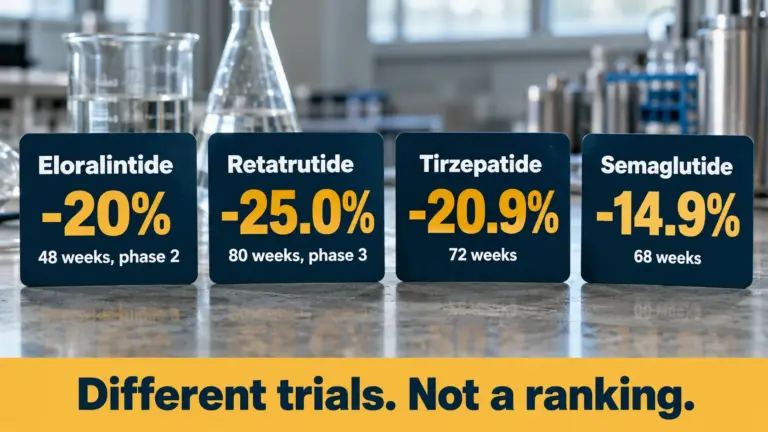
It depends on who is being compared and how the number was counted. The headline figures for the established drugs below count everyone randomized. Eloralintide’s headline counts weight change while on treatment, which is more favourable.
| Drug | Trial | Length | Mean change |
|---|---|---|---|
| Semaglutide 2.4 mg | STEP 1 | 68 weeks | -14.9% |
| Tirzepatide 15 mg | SURMOUNT-1 | 72 weeks | -20.9% |
| CagriSema | REDEFINE 1 | 68 weeks | -20.4% |
| Retatrutide 12 mg | TRIUMPH-1 | 80 weeks | -25.0% |
| Eloralintide (9 mg arms) | Phase 2, on treatment | 48 weeks | -20% |
A network meta-analysis in 2026 pooled six amylin-class trials and ranked high-dose eloralintide at -18.0% against placebo, next to high-dose CagriSema (-17.2%) and above semaglutide 2.4 mg (-11.5%), and called the findings preliminary. Our guides on eloralintide vs tirzepatide and semaglutide and eloralintide vs retatrutide explain why those lines cannot be ranked.
What might change in phase 3
- The estimand. The phase 3 headline will count everyone randomized, so it will be lower than the on-treatment figure.
- Duration. Phase 3 runs longer than 48 weeks. Weight loss on these drugs often keeps falling for a year or more before it plateaus.
- Dose. Four dose arms will show whether eloralintide’s effect keeps rising above 9 mg or flattens.
- Population. ENLIGHTEN-1 enrolls about 1,980 adults without diabetes from more sites, and results typically narrow as trials broaden.
- Dropout. About 10% stopped treatment for adverse events in phase 2. Higher dropout lowers the all-randomized average.
What the numbers do not say
- They do not establish that weight loss on eloralintide improves heart attacks, strokes, kidney disease or survival.
- They do not describe what happens after stopping.
- They do not prove the weight lost is mostly fat in people.
- They are not a prediction for anyone who might use a research product, whose contents are unverified.
Common questions
How much weight can you lose on eloralintide?
In the phase 2 trial in adults without diabetes, the average change on treatment was -9% to -20% at 48 weeks, against -0.4% on placebo, and the best arms lost up to 21.3 kg. Individual results vary, and phase 3 results will be lower on an all-randomized basis.
Does eloralintide work for weight loss?
In phase 2 it produced clinically meaningful, dose-dependent weight reductions with generally manageable side effects, according to the Lancet paper. It is not approved, and its effect has not been confirmed in phase 3.
How fast does eloralintide work?
In a 12-week study, the highest weekly dose reached -11.3%, and four weeks after a single dose weight was 2.5% to 4.4% below placebo. The 48-week trial shows the longer result. Week-by-week curves have not been published in the sources I read.
What are the benefits of eloralintide?
No benefit has been established, because eloralintide is not approved. Trials measured weight, waist circumference and, in type 2 diabetes, HbA1c. Phase 3 will measure sleep apnea severity and knee osteoarthritis pain. Peptryn makes no claim of benefit for any research material.
What was the average weight loss in kilograms?
For the best arms, up to 21.3 kg at an average starting weight of 109.1 kg. The percentage depends on starting weight.
Is eloralintide better than semaglutide for weight loss?
Eloralintide’s phase 2 arms averaged -9% to -20% at 48 weeks on treatment, and semaglutide 2.4 mg averaged -14.9% at 68 weeks for everyone randomized in STEP 1. No head-to-head trial exists. A network meta-analysis put high-dose eloralintide about 6.6 points ahead of semaglutide against placebo, with low certainty.
Does eloralintide lower blood sugar?
In adults with type 2 diabetes it lowered HbA1c by 1.1 to 1.4 points on its own and up to 2.9 points with tirzepatide, from a baseline of 8.1%. In people without diabetes, fasting glucose did not change.
Does eloralintide cause muscle loss?
No human data on lean mass are available in the sources I read. In rats, weight loss was mostly fat and lean-mass loss was lower than with cagrilintide.
What happens when you stop eloralintide?
Unknown. No published eloralintide data describe weight regain after stopping.
Will eloralintide phase 3 show the same results?
Phase 3 results usually come in lower than phase 2 on a comparable basis, and they count everyone randomized. Nobody can say where eloralintide will land. The first readouts are estimated for January 2028.
Related: What is eloralintide? · Eloralintide side effects · How does eloralintide work? · EloraTZP · Eloralintide clinical trials · Peptides for weight loss: what the evidence shows · All eloralintide guides
Sources
All pages read October 14 to 15, 2026. Items marked secondary are news or review summaries.
- Billings LK, et al. Eloralintide phase 2. The Lancet 2025; DOI 10.1016/S0140-6736(25)02155-5; PubMed 41207310; NCT06230523.
- Secondary coverage of phase 2 (absolute weight, waist and BMI figures): Medical Xpress, HCPLive, Drug Topics.
- Briere DA, et al. Eloralintide: from discovery to clinical proof of concept. Molecular Metabolism 2025; PMC12640043.
- Bhattachar S, et al. Eloralintide phase 1 proof of concept. Diabetes, Obesity and Metabolism 2026; PMC12992164.
- Eli Lilly. EloraTZP phase 2b results, September 30, 2026: PR Newswire.
- Cardiometabolic risk reduction through selective amylin receptor agonism: eloralintide. Cardiology in Review 2026; PubMed 42745233.
- Novel amylin-based therapies for weight management: a network meta-analysis. Endocrinology, Diabetes and Metabolism 2026; PMC13240113.
- Jastreboff AM, et al. SURMOUNT-1. NEJM 2022; PubMed 35658024. Wilding JPH, et al. STEP 1. NEJM 2021; PubMed 33567185. Garvey WT, et al. REDEFINE 1. NEJM 2025; PubMed 40544433. TRIUMPH-1. NEJM 2026; PubMed 42814954.
Editorial note: Peptryn sells research materials for laboratory use only. This guide is informational and is not medical advice. To report an error, use the contact page.
All products on peptryn.com are intended for laboratory research purposes only. They are not drugs, foods, dietary supplements or cosmetics, and they are not for human consumption, self-administration, or veterinary use. You must be 21 or older to buy. The information on this page has not been evaluated by the U.S. Food and Drug Administration and is not intended to diagnose, treat, cure, or prevent any disease.