Eloralintide vs Retatrutide vs Tirzepatide vs Semaglutide: What the Trials Show (2026)
Research use only. This comparison is education, not medical advice. Eloralintide and retatrutide are investigational and not approved anywhere. Tirzepatide and semaglutide are prescription drugs that should be used only under a clinician’s care. Nothing here is a dosing recommendation or an instruction for self-administration, and Peptryn gives none.
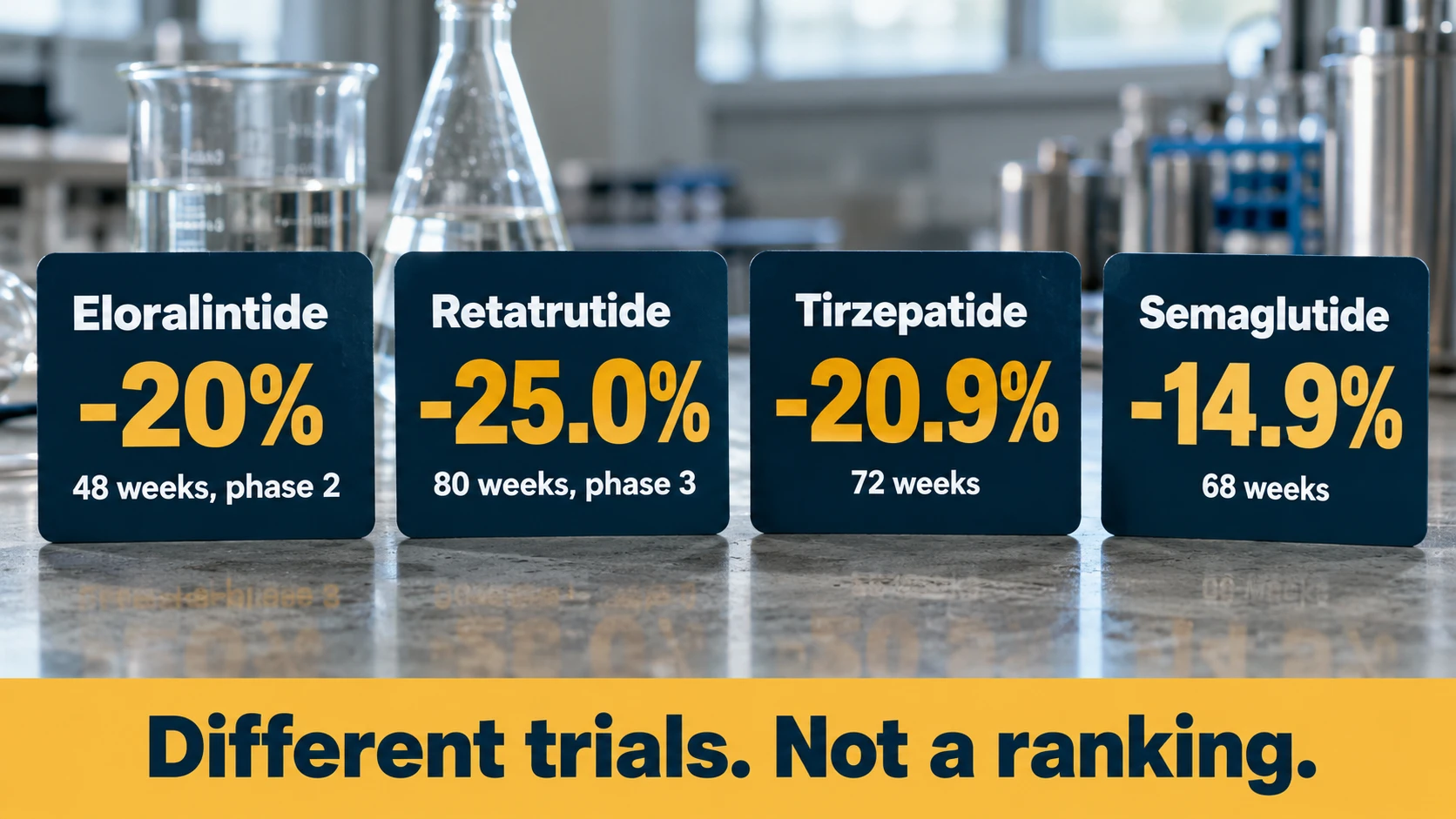
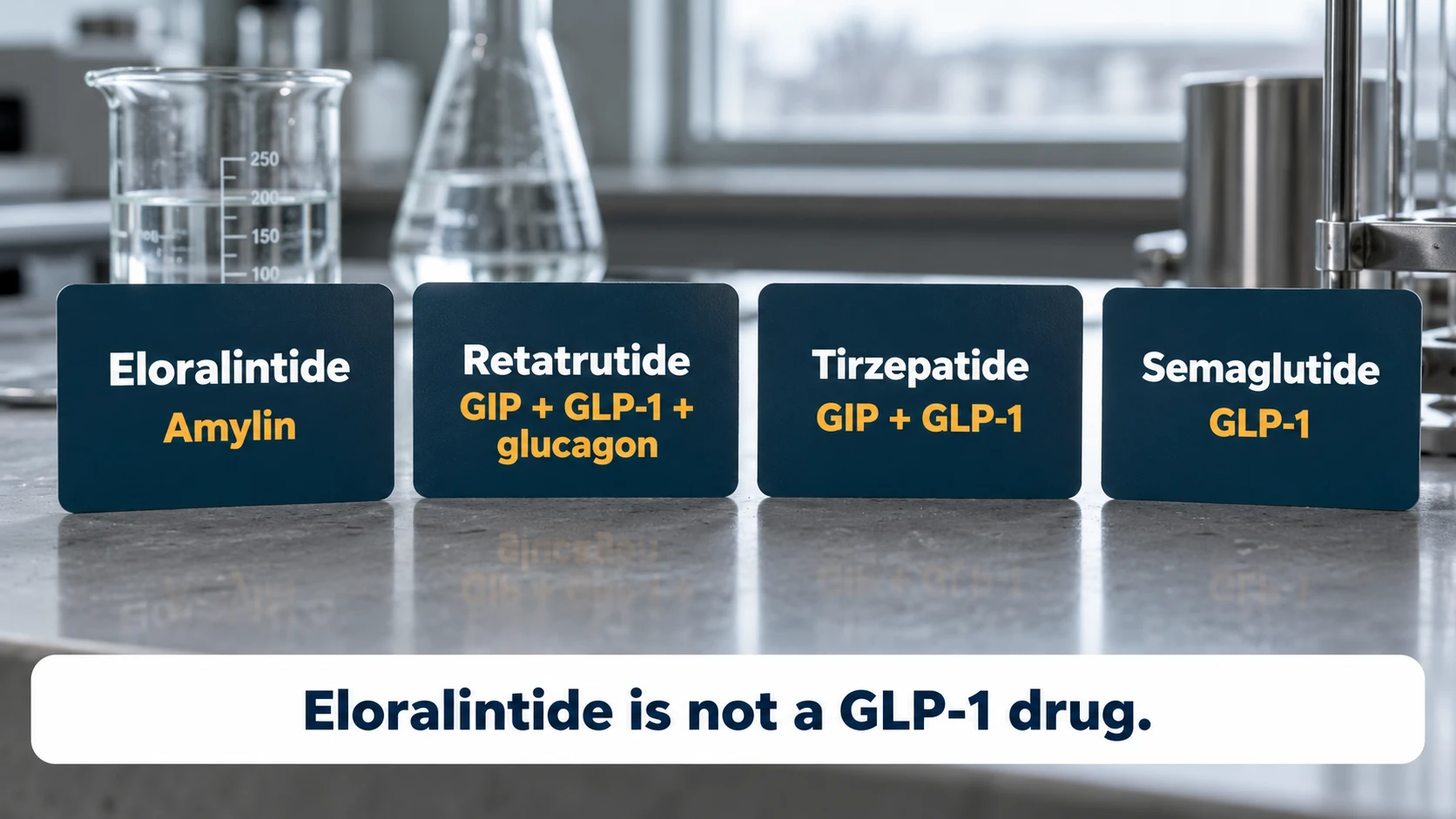
Short answer: These four drugs work through different hormone systems. Eloralintide targets amylin. Retatrutide activates three receptors (GIP, GLP-1 and glucagon). Tirzepatide activates two (GIP and GLP-1), and semaglutide activates one (GLP-1). In trials, average weight change was about -20% for eloralintide at 48 weeks (phase 2), -24% for retatrutide at 48 weeks (phase 2) and -25% at 80 weeks (phase 3), -20.9% for tirzepatide at 72 weeks and -14.9% for semaglutide at 68 weeks. Those trials differ in length, size and analysis method, so the numbers rank the drugs only roughly. Semaglutide and tirzepatide are approved. Retatrutide and eloralintide are not.
Key takeaways
- Eloralintide is not a GLP-1 drug. It is an amylin analogue, so its overlap with the other three is in the side effects and the goal, not the mechanism.
- At the same 48-week mark in phase 2, retatrutide 12 mg averaged -24.2% and eloralintide 9 mg about -20%. Each trial had small arms and a different population.
- The retatrutide phase 3, tirzepatide and semaglutide headline numbers count everyone randomized. Eloralintide’s headline numbers count weight change on treatment only, which flatters eloralintide when the two are put side by side.
- Lilly is not treating eloralintide and retatrutide as rivals. It is testing eloralintide as an add-on to tirzepatide (EloraTZP) and in people whose weight has plateaued on a weekly incretin drug (ENLIGHTEN-6).
- Approval status: semaglutide and tirzepatide approved; retatrutide filing planned for the first quarter of 2027; eloralintide in phase 3 with no filing announced.
Last verified October 15, 2026. Sources are listed at the end. For laboratory and research use only. Nothing here is medical or legal advice.
Contents
- The four drugs at a glance
- How each one is thought to work
- Weight change compared: what each trial reported
- What head-to-head evidence exists
- Safety and tolerability compared
- What TRIUMPH-1 adds beyond weight
- Combination and add-on strategies
- Approval status and timeline
- Cost and availability
- Five questions to ask of any weight-loss number
- Which one is “better”?
- Common questions
The four drugs at a glance
| Eloralintide | Retatrutide | Tirzepatide | Semaglutide | |
|---|---|---|---|---|
| Company | Eli Lilly | Eli Lilly | Eli Lilly | Novo Nordisk |
| Class | Selective amylin receptor agonist | GIP, GLP-1 and glucagon receptor triple agonist | GIP and GLP-1 receptor dual agonist | GLP-1 receptor agonist |
| Brand names | None | None | Mounjaro, Zepbound | Ozempic, Wegovy |
| Schedule studied | Once weekly | Once weekly | Once weekly | Once weekly |
| Status | Phase 3 (ENLIGHTEN). No filing found | Phase 3 done; filing planned Q1 2027 | Approved (May 2022, November 2023) | Approved (December 2017, June 2021) |
| Largest obesity trial | Phase 2, 263 adults, 48 weeks | TRIUMPH-1, 2,339 adults, 80 weeks | SURMOUNT-1, 2,539 adults, 72 weeks | STEP 1, 1,961 adults, 68 weeks |
How each one is thought to work
Obesity drugs in this group act on the gut-brain signals that control appetite and on how fast the stomach empties.
- Semaglutide mimics GLP-1, a gut hormone released after eating that signals fullness and slows stomach emptying.
- Tirzepatide adds GIP, a second gut hormone, in one molecule.
- Retatrutide adds glucagon receptor activity on top, which is generally thought to raise energy expenditure. The 2023 New England Journal of Medicine paper calls it a triple-hormone-receptor agonist.
- Eloralintide is a different kind of drug. It copies amylin, a pancreatic hormone released with insulin, and acts at amylin receptors. Reviews describe amylin as slowing gastric emptying, lowering post-meal glucagon and promoting satiety through the brain.
The first three share the incretin pathway, so their side effects overlap. Eloralintide’s route is independent, which is why Lilly can add it to tirzepatide and why a patient who has plateaued on an incretin drug is a plausible user in the future. Our guide to what eloralintide is covers its structure.
Weight change compared: what each trial reported
| Drug and regimen | Trial | Participants | Duration | Analysis | Mean weight change | Placebo |
|---|---|---|---|---|---|---|
| Eloralintide 1 to 9 mg | Phase 2 (Lancet 2025) | 263 | 48 weeks | Efficacy estimand (on treatment) | -9% to -20% | -0.4% |
| Retatrutide 1 to 12 mg | Phase 2 (NEJM 2023) | 338 | 48 weeks | As reported in the paper | -8.7% (1 mg) to -24.2% (12 mg) | -2.1% |
| Retatrutide 4, 9, 12 mg | TRIUMPH-1 (NEJM 2026) | 2,339 | 80 weeks | Treatment-regimen (all randomized) | -17.6%, -23.7%, -25.0% | -3.9% |
| Tirzepatide 5, 10, 15 mg | SURMOUNT-1 (NEJM 2022) | 2,539 | 72 weeks | Treatment-regimen (all randomized) | -15.0%, -19.5%, -20.9% | -3.1% |
| Semaglutide 2.4 mg | STEP 1 (NEJM 2021) | 1,961 | 68 weeks | Regardless of treatment discontinuation | -14.9% | -2.4% |
These are regimens tested in clinical trials. They are not guidance, and no dose has been established for any research material.
Three comparisons the table supports, with their limits:
- At 48 weeks in phase 2. Retatrutide 12 mg averaged -24.2% and eloralintide’s best arms about -20%. These are the closest-matched numbers (same duration, same phase), but the two trials had different populations and different dose ranges, and the arms were small.
- Retatrutide’s phase 3 result held up. The 12 mg arm averaged -25.0% at 80 weeks in TRIUMPH-1 against -3.9% on placebo. That is the all-randomized number, so it is a conservative figure compared with an on-treatment one.
- Tirzepatide and semaglutide have the largest, longest records. SURMOUNT-1 reported -20.9% at 72 weeks on the 15 mg dose, with 57% of participants losing 20% or more of body weight, against 3% on placebo. STEP 1 reported -14.9% at 68 weeks, with 50.5% losing 15% or more.
Eloralintide has no phase 3 number yet. Its phase 3 program (ENLIGHTEN) is designed to produce the same kind of all-randomized figure in 2028.
Why the estimand matters
An “estimand” is the precise question a trial’s number answers.
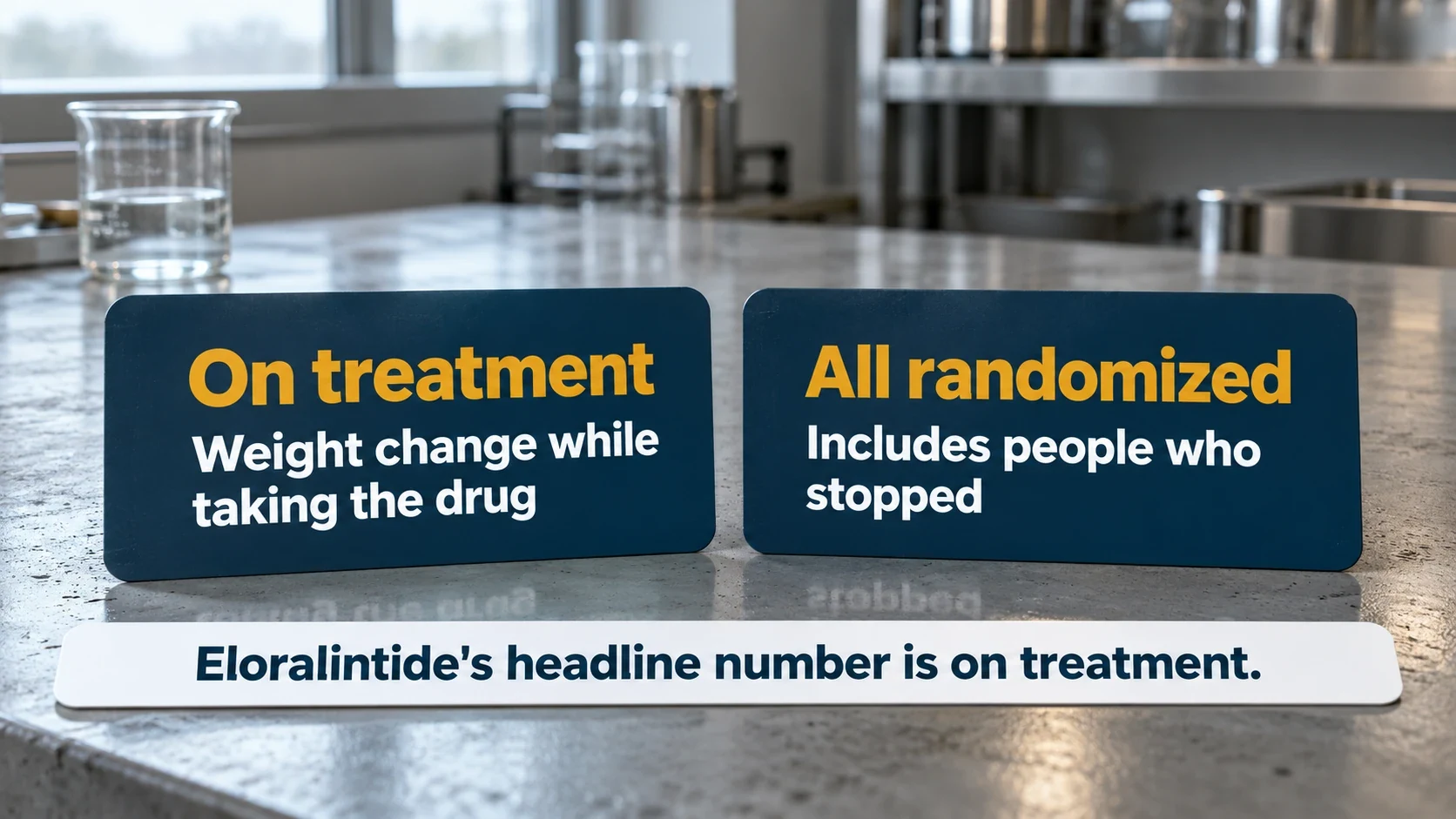
- Efficacy estimand (on-treatment): what happened to weight while people were taking the drug. People who stopped are not counted after they stop. It shows what the drug can do, and it is larger.
- Treatment-regimen (treatment-policy, intention-to-treat): what happened to everyone randomized, including people who stopped or switched. It shows what happens to a group offered the drug, and it is smaller.
The Lancet paper’s headline for eloralintide is the efficacy estimand. The headline numbers for retatrutide in TRIUMPH-1, tirzepatide in SURMOUNT-1 and semaglutide in STEP 1 are treatment-regimen numbers. A phase 3 trial of eloralintide will report both, and the second will be lower than -20%. The same trial design gives retatrutide a stronger on-treatment figure too: Lilly’s topline release quoted a higher on-treatment number than the -25.0% in the journal.
What head-to-head evidence exists
Cross-trial comparisons are weak because different trials ask different questions. Direct comparisons are the strong evidence, and so far they are few.
| Comparison | Trial | Result |
|---|---|---|
| Tirzepatide vs semaglutide | SURMOUNT-5 (NEJM 2025, 751 adults, 72 weeks) | -20.2% vs -13.7% (P<0.001). Waist circumference -18.4 cm vs -13.0 cm. Gastrointestinal events most common in both |
| CagriSema vs tirzepatide | REDEFINE 4 (809 adults, open-label, 84 weeks) | CagriSema did not meet non-inferiority: -20.2% vs -23.6% for tirzepatide 15 mg (treatment-regimen), as reported by Novo and trade press |
| Retatrutide vs semaglutide | TRANSCEND-T2D-2 (registered, type 2 diabetes) | Registered; I did not find a published result |
| Eloralintide vs any other drug | None | Every registered eloralintide study I found uses a placebo arm, or tirzepatide alone as the active arm in the combination trials |
That last row is the important one. All the pages online that rank eloralintide against retatrutide, tirzepatide or semaglutide are comparing numbers from separate studies. The ENLIGHTEN-6 add-on study and the EloraTZP program do not compare eloralintide with the other drugs either: they ask whether eloralintide adds to an incretin drug.
Safety and tolerability compared
The common thread is stomach symptoms, especially during dose escalation. The published figures do not line up neatly, so this table shows only what each source reports.
| Drug | Most common adverse events | Stopped treatment because of an adverse event |
|---|---|---|
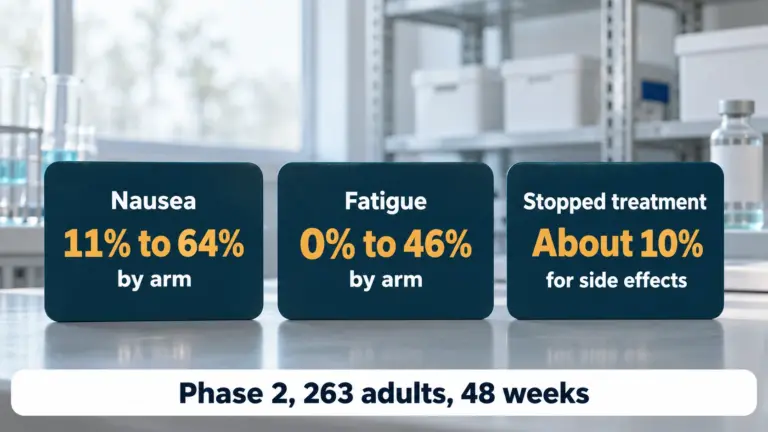
| Eloralintide (phase 2) | Nausea (11% to 64% by arm) and fatigue (0% to 46%) | About 10% overall; one report puts the 6 mg arm at 21% against 8% on placebo |
| Retatrutide (phase 2, 2023) | Gastrointestinal, dose-related, reduced by a lower starting dose; dose-dependent heart rate increase peaking at 24 weeks | Not stated in the abstract |
| Retatrutide (TRIUMPH-1) | Gastrointestinal | Not stated in the abstract |
| Tirzepatide (SURMOUNT-1) | Gastrointestinal, mostly mild to moderate and during escalation | 4.3% (5 mg), 7.1% (10 mg), 6.2% (15 mg) vs 2.6% on placebo |
| Semaglutide (STEP 1) | Nausea and diarrhoea, transient and mild to moderate | GI-related discontinuation 4.5% vs 0.8% on placebo |
Two things stand out. Eloralintide’s tolerability depended heavily on how fast the dose rose, and its discontinuation rate in phase 2 sat above the approved drugs’ pivotal-trial rates, though phase 2 arms are small and the comparison is rough. And retatrutide has a heart-rate signal that eloralintide does not appear to share: in eloralintide’s 12-week phase 1b study, pulse fell by 14.4 beats per minute at 12 mg compared with 3.4 on placebo. Our eloralintide side effects guide covers the full set.
What TRIUMPH-1 adds beyond weight
Retatrutide’s phase 3 paper included two sub-studies that eloralintide’s program now mirrors. In TRIUMPH-1, adults with knee osteoarthritis (574 participants) had a pain score fall by 1.6 points (9 mg) and 1.8 points (12 mg) more than placebo on the hybrid estimand, and adults with moderate to severe obstructive sleep apnea (243 participants) had 24.4 and 21.9 fewer breathing events per hour than placebo.
Lilly’s ENLIGHTEN-3 (sleep apnea, 800 planned participants) and ENLIGHTEN-4 (knee osteoarthritis pain, 900) use the same endpoints for eloralintide, which makes them the first real test of whether an amylin drug can match an incretin-based drug on conditions linked to excess weight. Those results are due after primary completion in March 2028.
Combination and add-on strategies
Lilly’s most interesting move is to combine rather than to pick a winner.
- EloraTZP (eloralintide plus tirzepatide): In a 48-week phase 2b trial in 367 adults with type 2 diabetes, the highest combination averaged -23.3% against -14.8% on tirzepatide 15 mg alone, with HbA1c falling 2.9 points. Treatment stopped for adverse events in 10.8% to 27.0% of combination participants. Lilly plans a phase 3 of a co-formulation by the end of 2026.
- ENLIGHTEN-6 (eloralintide as an add-on): a 900-person phase 3 study in people whose obesity persists despite a weekly incretin drug.
- Macupatide plus eloralintide: two phase 2 studies (NCT07215559 in type 2 diabetes and NCT07589608 in people without diabetes) test this pair, which I could not describe further from public sources.
- Retatrutide is on its own path to a first filing, planned for the first quarter of 2027.
For readers asking “will eloralintide replace retatrutide?”, the pipeline suggests that Lilly sees the two as complementary, with the amylin drug as a possible partner for an incretin drug and not a replacement. That is an interpretation of the trial design and not a company statement.
Approval status and timeline
| Drug | Status as of October 15, 2026 | Next milestone |
|---|---|---|
| Semaglutide | Approved (Ozempic, December 2017; Wegovy, June 2021) | Already marketed |
| Tirzepatide | Approved (Mounjaro, May 2022; Zepbound, November 2023) | Already marketed |
| Retatrutide | Investigational; phase 3 results published in 2026 | Lilly plans to file in the first quarter of 2027; a standard review runs about 10 to 12 months |
| Eloralintide | Investigational; phase 3 enrolling | Primary completion of ENLIGHTEN studies estimated January to June 2028 |
Read our retatrutide approval status page and our eloralintide approval status guide for the timelines in detail.
Cost and availability
Semaglutide and tirzepatide are prescription drugs with list prices that vary by product, dose, insurer and cash-pay program. We do not quote a price here, because the figures change often and depend on how a patient buys them. Our retatrutide vs tirzepatide guide sets the numbers we verified beside each other.
Retatrutide and eloralintide have no approved price, because no pharmacy can lawfully dispense them. The only lawful route to either is a clinical trial. Vendors do list both as research materials, and a research label does not show what is in a vial. In August 2026 Lilly sued six US sellers of unapproved retatrutide, and the FDA sent warning letters to vendors selling it as “research use only.” I found no equivalent action naming eloralintide as of October 15. See our guide on how to evaluate an eloralintide research listing.
Five questions to ask of any weight-loss number
- Which estimand? On-treatment numbers are larger than all-randomized numbers.
- How long? A 48-week result and an 80-week result are not the same measurement.
- Who was enrolled? People with type 2 diabetes usually lose less weight than people without it, so a type 2 diabetes trial cannot be set against a non-diabetes trial.
- How many stopped? A drug that many people quit looks better on-treatment than for the group that was offered it.
- What did placebo do? Placebo groups ranged from -0.4% (eloralintide phase 2) to -3.9% (TRIUMPH-1) in the trials above. A higher placebo response shrinks the gap even when the drug effect is the same.
Which one is “better”?
That depends on a question the trials do not answer, and the honest answer is that no one has run the head-to-head. A fair framing:
- Largest effect on paper: retatrutide, based on its 80-week phase 3 result and its 48-week phase 2 result.
- Longest and best-documented record: semaglutide and tirzepatide, with years of use and outcome data.
- Newest mechanism with an unproven but interesting profile: eloralintide, which adds amylin biology and could pair with the others.
- Not yet answerable: safety over years, effects on lean mass and heart outcomes for the two investigational drugs, and cost.
For a consumer, none of this changes the access picture. Approved drugs are available through a prescriber, and the two investigational ones are not.
Common questions
Is eloralintide stronger than retatrutide?
On the numbers published so far, no. Retatrutide 12 mg averaged -24.2% at 48 weeks in phase 2 and -25.0% at 80 weeks in phase 3, while eloralintide’s best phase 2 arms averaged about -20% at 48 weeks on-treatment. Different trials, populations and analysis methods apply, and no head-to-head trial exists.
Is eloralintide a GLP-1 drug like semaglutide or tirzepatide?
No. Eloralintide acts on amylin receptors. Semaglutide acts on GLP-1 receptors, and tirzepatide acts on GLP-1 and GIP receptors. Lilly is testing eloralintide together with tirzepatide.
What is the difference between eloralintide and retatrutide?
Eloralintide is a once-weekly amylin analogue. Retatrutide is a once-weekly triple agonist of the GIP, GLP-1 and glucagon receptors. Both are Lilly drugs and both are investigational. Retatrutide’s phase 3 program is complete and a filing is planned for early 2027. Eloralintide’s phase 3 program runs to 2028.
Eloralintide vs tirzepatide: which is better?
Tirzepatide is approved and has the stronger record: -20.9% at 72 weeks on the 15 mg dose in SURMOUNT-1. Eloralintide’s best phase 2 arms reached about -20% at 48 weeks on-treatment. In a type 2 diabetes trial, adding eloralintide 9 mg to tirzepatide 15 mg produced -23.3%, against -14.8% on tirzepatide alone. That suggests the drugs may work as partners.
Eloralintide vs semaglutide: how do they compare?
Semaglutide 2.4 mg averaged -14.9% at 68 weeks in STEP 1. Eloralintide’s phase 2 arms averaged -9% to -20% at 48 weeks. Different trials and analysis methods make a direct ranking unreliable. A network meta-analysis put high-dose eloralintide about 6.6 points ahead of semaglutide 2.4 mg against placebo but called its own findings preliminary.
Can eloralintide be combined with tirzepatide?
In clinical trials, yes. Lilly’s EloraTZP phase 2b trial gave both drugs to 367 adults with type 2 diabetes for 48 weeks. Outside a trial, no one can lawfully combine them because eloralintide is not approved.
Which has fewer side effects?
The data cannot say. Eloralintide’s nausea ranged from 11% to 64% by arm in phase 2. The approved drugs’ pivotal trials report nausea and diarrhoea as most common, with treatment stopping in about 4% to 7%. Dose escalation speed changes every figure.
Will eloralintide replace Ozempic or Zepbound?
No evidence points that way. Eloralintide is years from a possible approval, and Lilly’s trials position it as a stand-alone treatment, a partner for tirzepatide, and an add-on for people who plateau on an incretin drug.
When can people get eloralintide or retatrutide?
Retatrutide: Lilly plans to file in the first quarter of 2027, and a standard FDA review runs about 10 to 12 months, so approval would come late 2027 or 2028 at the earliest. Eloralintide: phase 3 ends in 2028, so approval is unlikely before 2029. Both dates are estimates.
Related: What is eloralintide? · Eloralintide vs tirzepatide and semaglutide · Eloralintide vs cagrilintide · Eloralintide weight change results · EloraTZP · Eloralintide side effects · Eloralintide approval status · Retatrutide vs tirzepatide · Retatrutide vs semaglutide vs tirzepatide · Peptides for weight change: what the evidence shows
Sources
All pages read October 14 to 15, 2026.
- Billings LK, et al. Eloralintide phase 2. The Lancet 2025; DOI 10.1016/S0140-6736(25)02155-5; NCT06230523.
- Jastreboff AM, et al. Triple-hormone-receptor agonist retatrutide for obesity: a phase 2 trial. New England Journal of Medicine 2023; PubMed 37366315.
- Retatrutide, a triple hormone receptor agonist, for treatment of obesity (TRIUMPH-1). New England Journal of Medicine 2026; DOI 10.1056/NEJMoa2604169; PubMed 42814954.
- Jastreboff AM, et al. Tirzepatide once weekly for the treatment of obesity (SURMOUNT-1). New England Journal of Medicine 2022; PubMed 35658024.
- Aronne LJ, et al. Tirzepatide as compared with semaglutide for the treatment of obesity (SURMOUNT-5). New England Journal of Medicine 2025; PubMed 40353578.
- REDEFINE 4 (CagriSema vs tirzepatide 15 mg): Drug Topics, February 24, 2026.
- Wilding JPH, et al. Once-weekly semaglutide in adults with overweight or obesity (STEP 1). New England Journal of Medicine 2021; PubMed 33567185.
- Bhattachar S, et al. Eloralintide phase 1 proof of concept. Diabetes, Obesity and Metabolism 2026; PMC12992164.
- Eli Lilly. EloraTZP phase 2b results, September 30, 2026: PR Newswire.
- Novel amylin-based therapies for weight management: a network meta-analysis. Endocrinology, Diabetes and Metabolism 2026; PMC13240113.
- Peptryn. Is retatrutide FDA approved? (Lilly’s July 23, 2026 filing statement and the approval dates of semaglutide and tirzepatide).
- Eli Lilly retatrutide enforcement: NPR, August 13, 2026.
- ClinicalTrials.gov: NCT07392190, NCT07215559, NCT07589608, retrieved October 15, 2026.
- Search results for “eloralintide vs retatrutide”, Google US, October 2026.
Editorial note: Peptryn sells research materials for laboratory use only. This guide is informational and is not medical advice. To report an error, use the contact page.
All products on peptryn.com are intended for laboratory research purposes only. They are not drugs, foods, dietary supplements or cosmetics, and they are not for human consumption, self-administration, or veterinary use. You must be 21 or older to buy. The information on this page has not been evaluated by the U.S. Food and Drug Administration and is not intended to diagnose, treat, cure, or prevent any disease.