Wolverine Peptide Stack for Sale: 20 mg Price, COA and What to Check Before You Order
Research use only. Peptides supplied by Peptryn are sold strictly for in vitro and preclinical laboratory research. They are not approved by the FDA for human or veterinary use, and nothing here is medical advice, a dosing recommendation, or an instruction for self-administration. This page explains what Peptryn’s Wolverine listing includes and how to check any vial sold under that name.
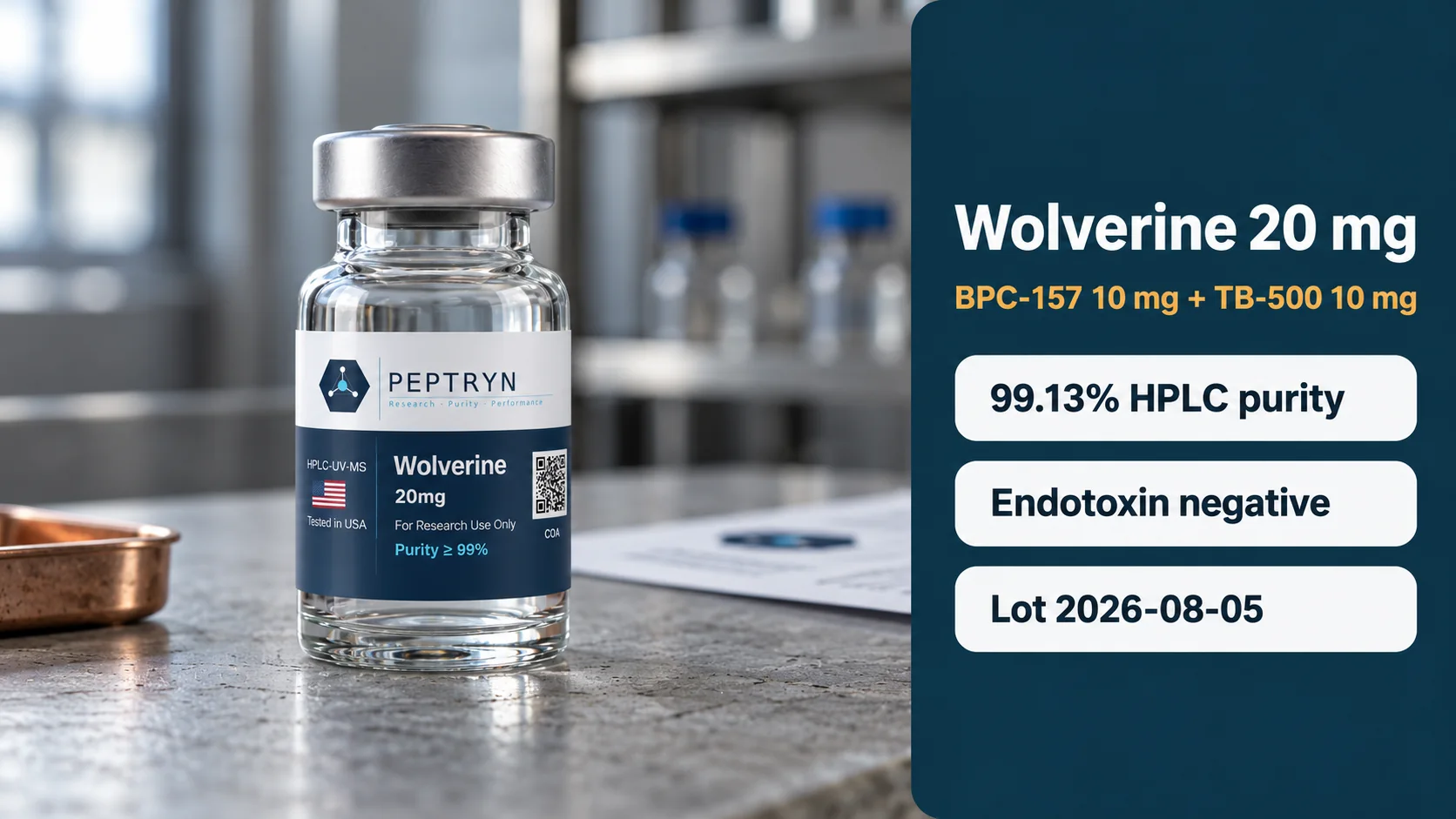
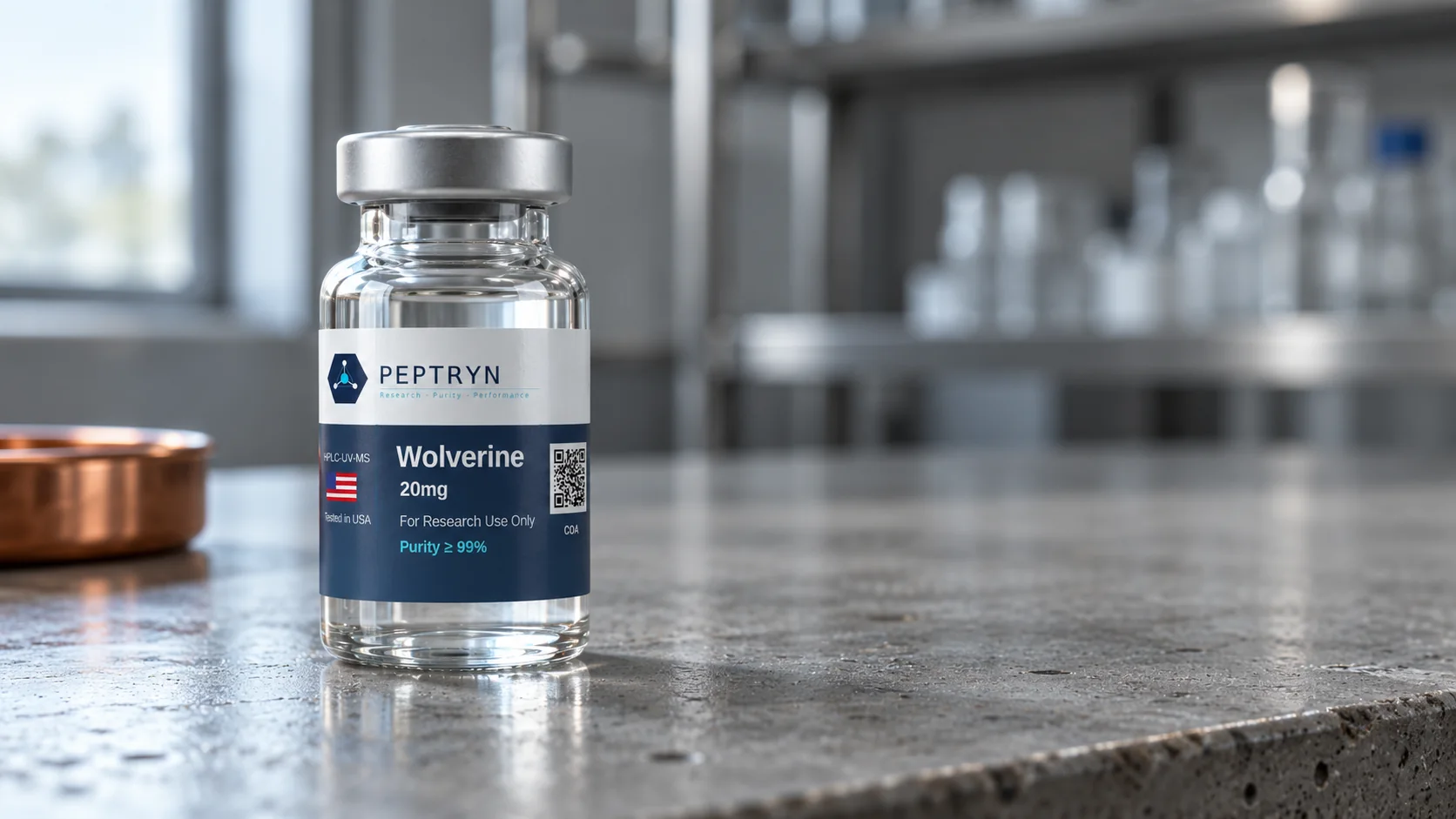
Quick answer: Peptryn sells its Wolverine blend as one 20 mg lyophilized research vial for $200.00, which is $10.00 per mg. It holds 10 mg of BPC-157 and 10 mg of TB-500. Lot 2026-08-05 reads 99.13% HPLC purity with a negative endotoxin result, tested by MZ Biolabs, and the certificate links to a report on the lab’s own site. “Wolverine” is a nickname with no standard formulation, so the same word on another listing can mean a different split or size. Peptryn sells it only for laboratory research, to buyers who are 21 or older.
This page covers the buying side: the price, what the certificate shows and leaves out, and the checks that matter for a two-compound vial. For the research on the two peptides, read our Wolverine peptide guide.
Key takeaways
- The 20 mg vial lists at $200.00 ($10.00 per mg). Quantity pricing takes 3%, 5% or 10% off. The same two peptides in separate 10 mg vials cost $169.98.
- Lot 2026-08-05 reads 99.13% purity and negative endotoxin. The purity and identity record sits on MZ Biolabs’ own site.
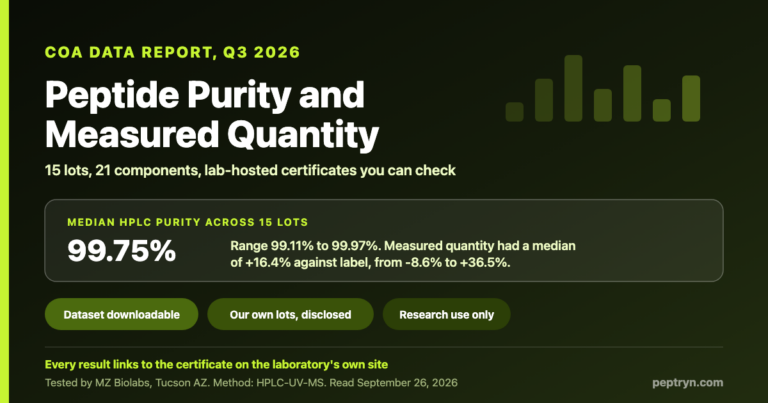
- In our September data report the lab measured 11.64 mg of BPC-157 and 13.56 mg of thymosin beta-4 against 10 mg labels (+16.4% and +35.6%). That is one lot from one lab.
- “10 mg plus 10 mg” splits the mass evenly, and the molecule counts follow a different ratio: about 3.5 BPC-157 molecules for every thymosin beta-4 molecule.
Last verified October 14, 2026. Prices and lot details are as listed on that date and change with each batch, so check the product page and certificate before you rely on a number. Sources are listed at the end. For laboratory and research use only. Nothing here is medical or legal advice.
What Peptryn’s Wolverine vial includes
| Item | Detail |
|---|---|
| Form and size | Lyophilized powder, 20 mg (BPC-157 10 mg plus TB-500 10 mg) |
| Listed price | $200.00 ($10.00 per mg) |
| Quantity pricing | 3% off at 3 to 4 units ($194.00 each), 5% off at 5 to 9 ($190.00), 10% off at 10 or more ($180.00) |
| Lot | 2026-08-05 |
| Lab analysis date | 2026-08-27 |
| HPLC purity | 99.13% (HPLC-UV-MS) |
| Endotoxin | Negative |
| Lab | MZ Biolabs, Tucson, Arizona |
| Components | BPC-157, 1,419.53 Da; TB-500 as full-length thymosin beta-4, 4,963.44 Da |
| Storage | -20 °C, protected from light and repeated freeze-thaw cycles |
| Shipping | From the USA with same-day dispatch, free on orders over $150 |
| Certificate | Wolverine 20 mg COA |
The product page lists the full specification. Peptryn does not give dosing or use guidance for the blend, because no dose has been established for either compound.
What “Wolverine” means on a label
The name has no fixed definition. Most listings mean BPC-157 plus TB-500, but the split and the vial size are the seller’s choice. One shop’s “Wolverine” bundle on the first results page pairs BPC-157 5 mg, TB-500 10 mg and ipamorelin 5 mg. Another sells the two peptides as a 10 mg vial of 5 mg each. Read the amounts, not the name.
BPC-157 is a synthetic 15-amino-acid peptide, a fragment of a protein found in human gastric juice. TB-500 is a name that covers two different molecules. Anti-doping literature uses it for a short acetylated fragment of thymosin beta-4, and some suppliers use it for the full 43-amino-acid protein. Peptryn’s listing is the full-length form. Our TB-500 guide explains the naming, and our BPC-157 guide covers the other half.
Equal mass does not mean equal molecule count. BPC-157 weighs about 1,420 Da and thymosin beta-4 about 4,963 Da. Ten milligrams of each is roughly 7.0 micromoles of BPC-157 and 2.0 micromoles of thymosin beta-4, a ratio near 3.5 to 1 by count. That is arithmetic on the label amounts, not a recommended ratio.
Wolverine, Glow and Klow80 on Peptryn
Peptryn lists three blends that share the same two peptides at the same labeled amounts.
| Wolverine | Glow | Klow80 | |
|---|---|---|---|
| Contents | BPC-157 10 mg, TB-500 10 mg | BPC-157 10 mg, TB-500 10 mg, GHK-Cu 50 mg | Glow’s three, plus KPV 10 mg |
| Vial size | 20 mg | 70 mg | 80 mg |
| Listed price | $200.00 | $150.00 | $160.00 |
| Lot | 2026-08-05 | 2026-07-07 | 2026-07-07 |
| HPLC purity | 99.13% | 99.81% | 99.74% |
Compare contents before you compare prices. The Glow product page and the Klow80 product page carry their own certificates, and our Klow buying page goes through that listing.
Wolverine price: what to compare
At the listed price, the 20 mg vial costs $10.00 per mg of labeled peptide. Price per mg compares two sellers only when the products match. Line up these before you compare:
- Size and split. Sellers list 10 mg and 20 mg vials, and some change the ratio or add a third compound. Peptryn lists 10 mg of each peptide in a 20 mg vial.
- Which TB-500 it is. The full protein and the short fragment are different molecules with different weights.
- Lot and lab. A price with no lot-matched report gives you a number and no verification.
- What the report covers. Purity, identity, endotoxin and quantity are separate results, and a blend needs them for each component.
Measured amounts change the arithmetic. The lab found 25.20 mg of peptide in this lot against 20 mg on the label, so $200.00 works out to $7.94 per measured mg. That is one lot from one lab, and a seller that publishes only label amounts gives you nothing to divide by.
Buying the two peptides separately is another route. Peptryn’s BPC-157 ($79.99) and TB-500 ($89.99) 10 mg vials cost $169.98 together, which is $30.02 less than the blend for the same labeled amounts. Two vials bring two certificates instead of one. Our BPC-157 and TB-500 buying page compares them in detail.
What the Wolverine certificate shows and leaves out
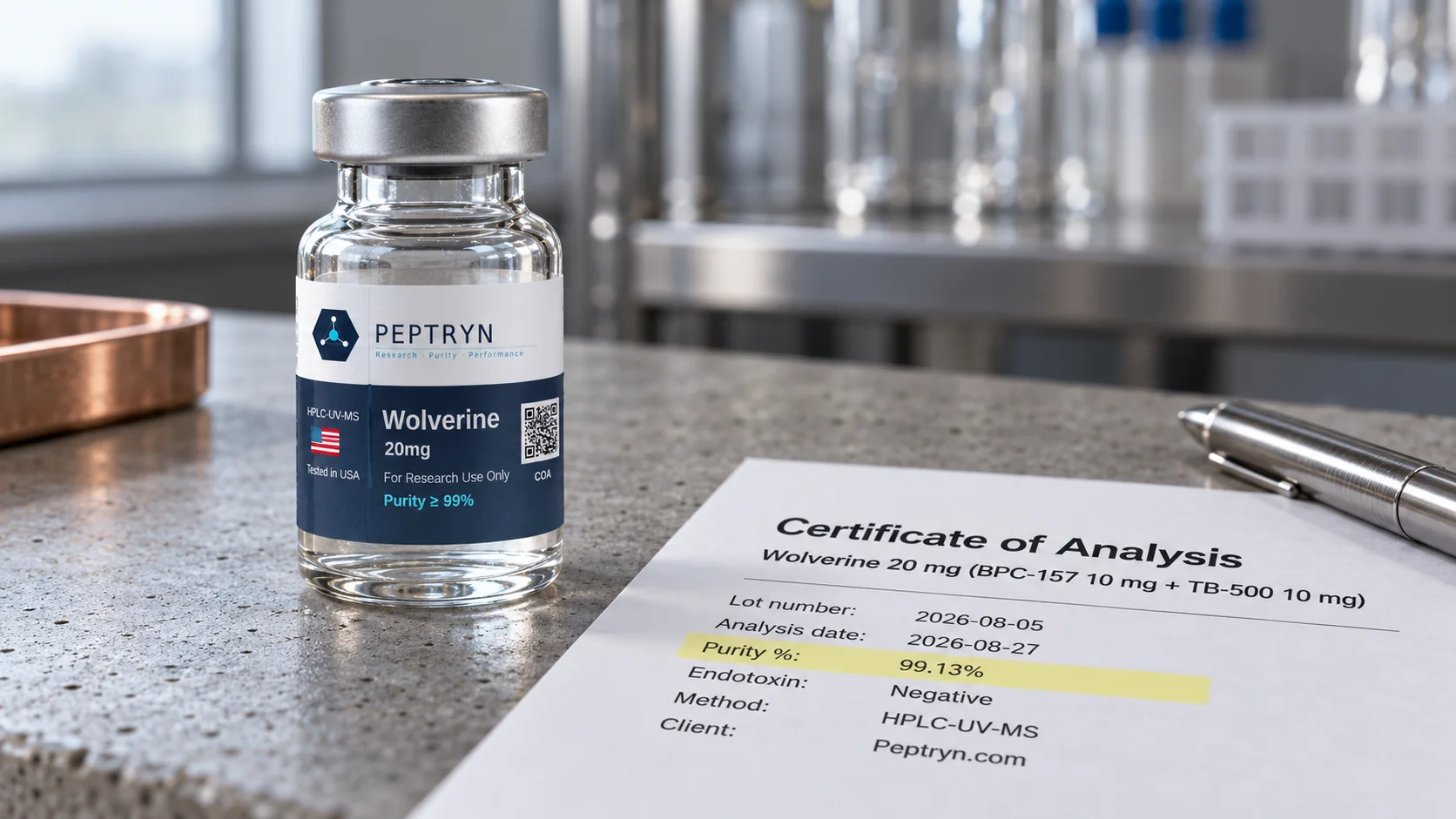
| Question | What the certificate shows |
|---|---|
| Method | HPLC-UV-MS |
| Purity | 99.13%, one figure for the whole vial |
| Endotoxin | Negative |
| Where the records sit | The purity and identity record is on MZ Biolabs’ own site and linked by a QR code on the certificate. The endotoxin report is a PDF shown on the certificate page |
| Quantity per peptide | The lab report prints a measured amount for each peptide (BPC-157 11.64 mg, thymosin beta-4 13.56 mg) |
A single purity figure for a two-compound vial tells you little about each compound. Our September 2026 data report read the lab’s report for this lot and listed the measured quantity of each component. BPC-157 measured 11.64 mg against a 10 mg label (+16.4%), and thymosin beta-4 measured 13.56 mg against 10 mg (+35.6%). That was the highest of the nine blend components in the report. By measured mass the vial was about 46% BPC-157 and 54% thymosin beta-4, not an even split.
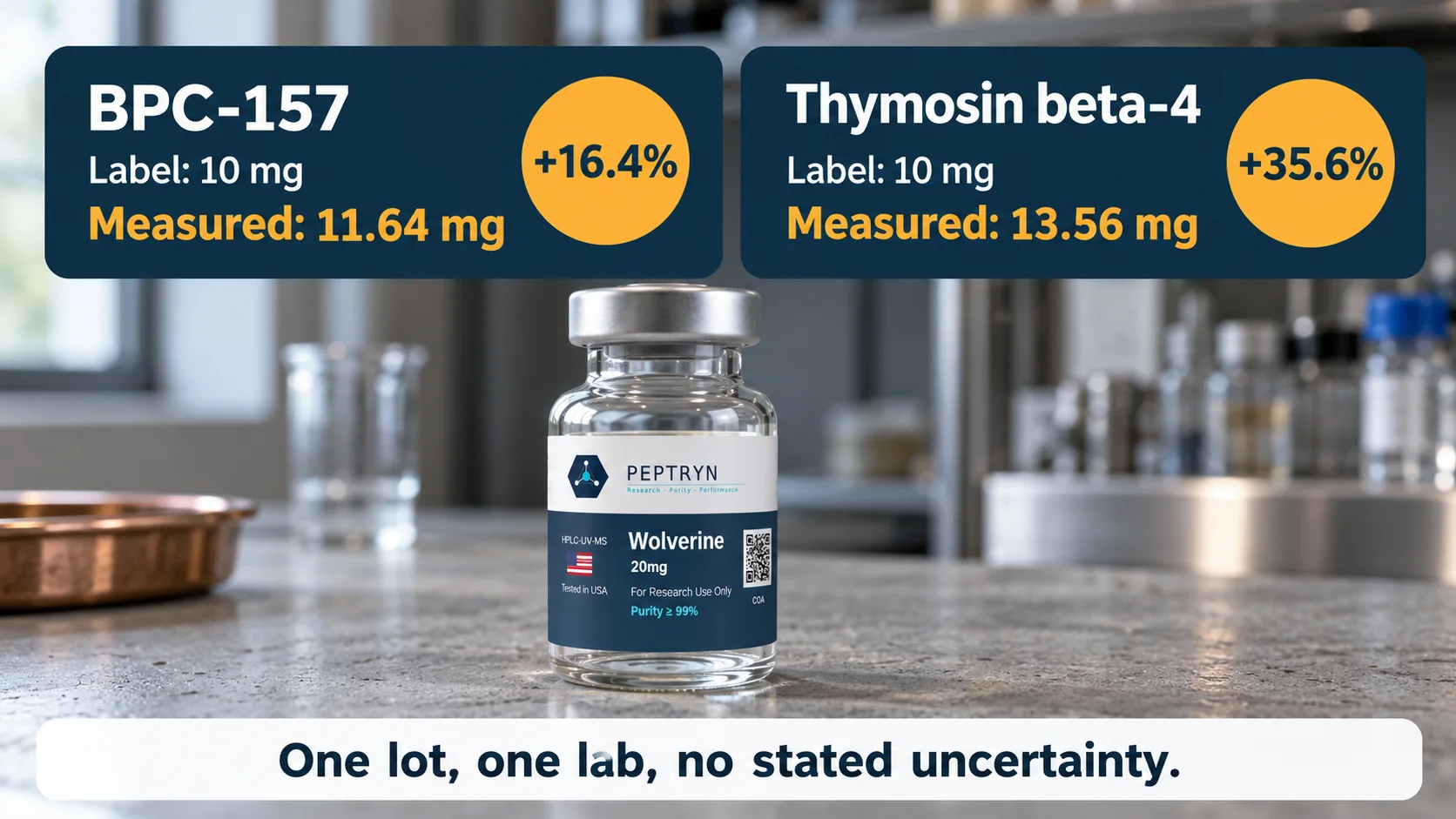
The results come from one lot, from one laboratory, without a stated assay uncertainty. The report lists open questions, including whether a quantity figure is net peptide content or the gross contents of the vial.
Six checks for any Wolverine vial
- Is the split stated? A label that says only “20 mg” does not tell you how much of each peptide is inside.
- Does the report cover each component? Look for identity and a measured amount for BPC-157 and for TB-500, not one figure for the vial.
- Which TB-500 is it? Full-length thymosin beta-4 shows a mass near 4,963 Da, and BPC-157 near 1,420 Da. A report that lists a mass far from both is describing something else.
- Does the lot match? Compare the lot on your vial with the lot on the report, and check that the analysis date fits the lot date.
- Is the report on the lab’s own site? A link or QR code to the lab’s record beats a PDF that lives only on the seller’s server. Our third-party tested peptides guide sorts these claims into five levels, and our certificate guide shows how to read each line.
- How does the seller describe use? A research listing promises no healing, recovery or performance results and gives no dosing schedule or cycle. The research on both compounds comes mainly from animals and cells, and none of it settles those claims. See are peptides legal? for background.
Why Wolverine search results look so mixed
On October 13, 2026, searches for “wolverine peptide for sale” and “where to buy wolverine stack peptides” returned research-peptide shops, clinics and med spas that offer the pair as a supervised program, editorial explainers, a video and an Amazon listing for a supplement sold under the same name. Listings differ in vial size, split and documentation, and prices run from under $60 for a small vial to several hundred dollars for a clinic program.
Those are different products with different rules. Peptryn’s listing is a laboratory research material. It is not a clinic program, a supplement or a drug, and Peptryn does not offer it for human use.
Common questions
Where can I buy Wolverine stack peptides for research?
Peptryn sells its Wolverine blend as a 20 mg lyophilized research vial on its Wolverine product page. It is sold only for laboratory research, to buyers who are 21 or older and who confirm qualified research use.
How much does the Wolverine peptide stack cost?
Peptryn lists the 20 mg vial at $200.00, which is $10.00 per mg. Quantity pricing takes 3% off at 3 to 4 units, 5% at 5 to 9 and 10% at 10 or more. Prices change, so check the product page.
What is in Peptryn’s Wolverine vial?
BPC-157 10 mg and TB-500 10 mg, freeze-dried together in one 20 mg vial. TB-500 here means full-length thymosin beta-4, not the short fragment that anti-doping literature also calls TB-500.
Is Peptryn’s Wolverine third-party tested?
Yes. Lot 2026-08-05 was tested by MZ Biolabs, which reports 99.13% HPLC purity and a negative endotoxin result. The purity and identity record is on the lab’s own site, and Peptryn is the client that ordered the test.
Should I buy the Wolverine blend or the two peptides separately?
The separate 10 mg vials cost $169.98 together, $30.02 less than the $200.00 blend, and come with two certificates. The blend is one vial and one certificate. The choice depends on your work, not on a recommended ratio.
What is the difference between Wolverine, Glow and Klow80?
All three hold BPC-157 10 mg and TB-500 10 mg. Glow adds GHK-Cu 50 mg for a 70 mg vial, and Klow80 adds GHK-Cu 50 mg and KPV 10 mg for an 80 mg vial.
Does the Wolverine certificate show how much of each peptide is in the vial?
Yes. The lab report on the certificate page prints a measured amount for each peptide. Our September data report recorded measured quantities of 11.64 mg of BPC-157 (+16.4%) and 13.56 mg of thymosin beta-4 (+35.6%) for this lot.
Is the Wolverine stack FDA approved?
No. Neither BPC-157 nor TB-500 is an approved drug. In July 2026 an FDA advisory committee voted 8 to 6 to recommend BPC-157, TB-500 and KPV for a compounding list. That vote is advice, not approval. Both are also on the World Anti-Doping Agency’s prohibited list.
Related: Wolverine peptide guide · BPC-157 and TB-500 buying page · BPC-157 guide · TB-500 guide · COA Library · Third-party tested peptides · Peptide COA data report · Best place to buy peptides online
Sources
All pages were read on October 11 to 14, 2026 unless noted.
- Peptryn. Wolverine product page; Wolverine 20 mg certificate; Glow product page; Klow80 product page; COA Library; Peptide COA data report, September 26, 2026.
- MZ Biolabs. Certificate report for lot 2026-08-05, linked from the Peptryn certificate above.
- PubChem. Pentadecapeptide BPC 157, CID 9941957; Thymosin beta-4, CID 45382195.
- U.S. Food and Drug Administration. July 23-24, 2026: Meeting of the Pharmacy Compounding Advisory Committee.
- Search results for “wolverine peptide for sale”, “where to buy wolverine stack peptides” and “wolverine peptide stack price”, Google US, October 13, 2026.
Editorial note: Peptryn sells the research peptides discussed on this site for laboratory use only. This guide is informational and is not medical advice. To report an error, use the contact page.
All products on peptryn.com are intended for laboratory research purposes only. They are not drugs, foods, dietary supplements or cosmetics, and they are not for human consumption, self-administration, or veterinary use. You must be 21 or older to buy. The information on this page has not been evaluated by the U.S. Food and Drug Administration and is not intended to diagnose, treat, cure, or prevent any disease.