TB-500 (Thymosin Beta-4): What the Research Shows and Where FDA Stands (2026)
Note: This guide is educational and is not medical advice. Peptryn supplies research-use-only peptides to laboratories, and nothing here suggests using research materials on yourself. Speak to a licensed clinician about any injury or medical decision.
The short answer
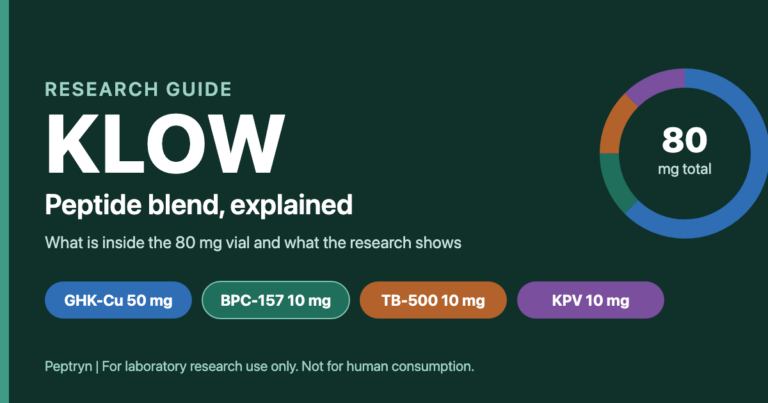
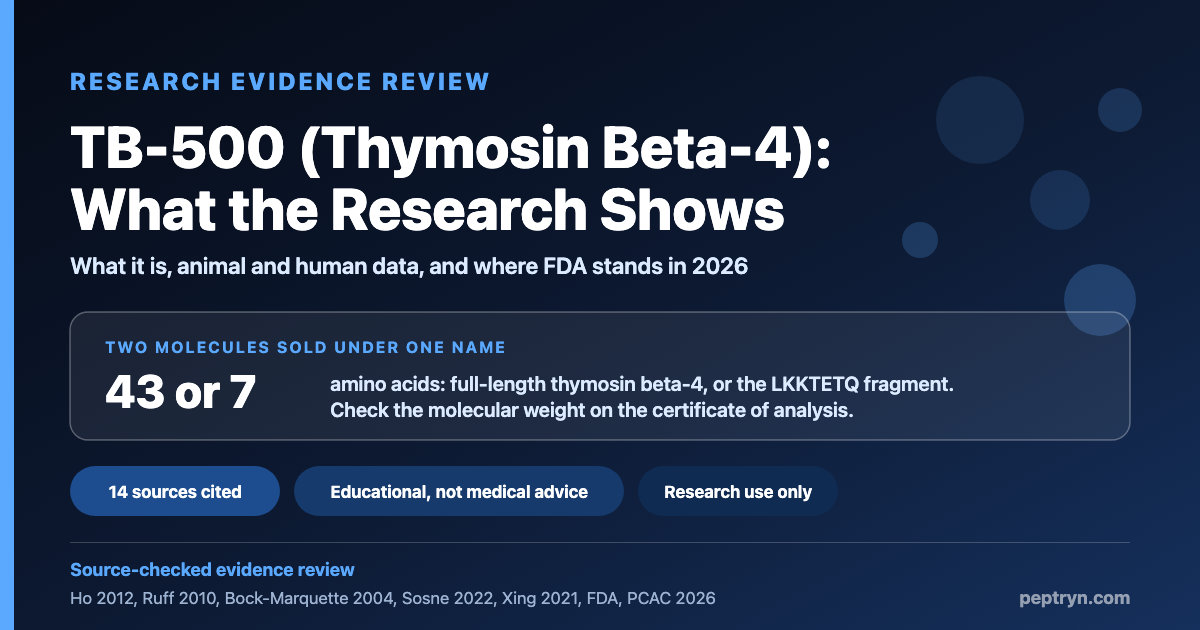
TB-500 is the trade name for a synthetic version of thymosin beta-4 (Tβ4), a peptide of 43 amino acids that cells make naturally. Suppliers use the name for two different things: in the veterinary and anti-doping literature it means a short fragment of seven amino acids, while some sellers, including Peptryn, use it for the full-length molecule. That difference matters because most of the research was done on full-length Tβ4.
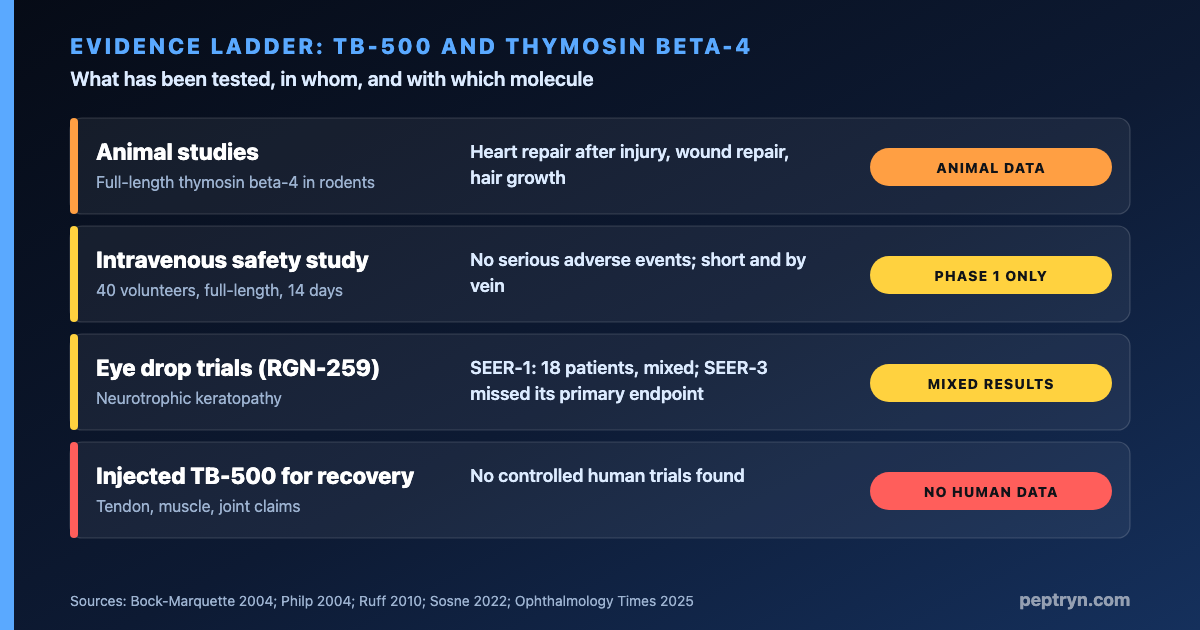
The research is real and uneven. Animal studies show Tβ4 promoting blood vessel growth, tissue repair and even hair follicle development in rodents. In people, full-length Tβ4 has been tested in a small intravenous safety study and in eye drop trials, with mixed results. We found no controlled human trial of injected TB-500 for tendon, muscle, joint or general recovery, which is what most online claims are about. FDA has not approved it, and the World Anti-Doping Agency prohibits it.
| Question | What is known | Evidence |
|---|---|---|
| What is it? | A synthetic form of thymosin beta-4, or of a 7-amino-acid fragment of it, depending on the seller | Chemistry and doping literature |
| Does it work in animals? | Rodent studies report improved cardiac function after heart injury, faster wound repair and hair growth | Animal studies |
| Is it safe in people? | Full-length Tβ4 given intravenously to 40 volunteers in one early study had no serious adverse events; nothing comparable for injected TB-500 was found | One phase 1 study |
| Does it work in people? | Eye drop trials of Tβ4 had mixed results; no controlled trials for injuries or recovery were found | Small human trials |
| Is it approved or allowed? | Not FDA-approved; prohibited in sport; regulatory status for compounding is unresolved in 2026 | FDA, WADA |
What TB-500 actually is
Thymosin beta-4 is a widely distributed peptide of 43 amino acids that binds actin, a protein that cells use to move and change shape. A 2021 review describes it as multifunctional, with roles in blood vessel growth, cell proliferation and inflammation.
The name TB-500 comes from a veterinary product. A 2012 anti-doping paper describes it as a veterinary preparation containing a synthetic version of the peptide LKKTETQ, amino acids 17 to 23 of Tβ4, with an added acetyl group on one end. That segment is the part of Tβ4 responsible for actin binding, cell migration and repair, according to the authors. They developed a test to catch its misuse in racehorses.
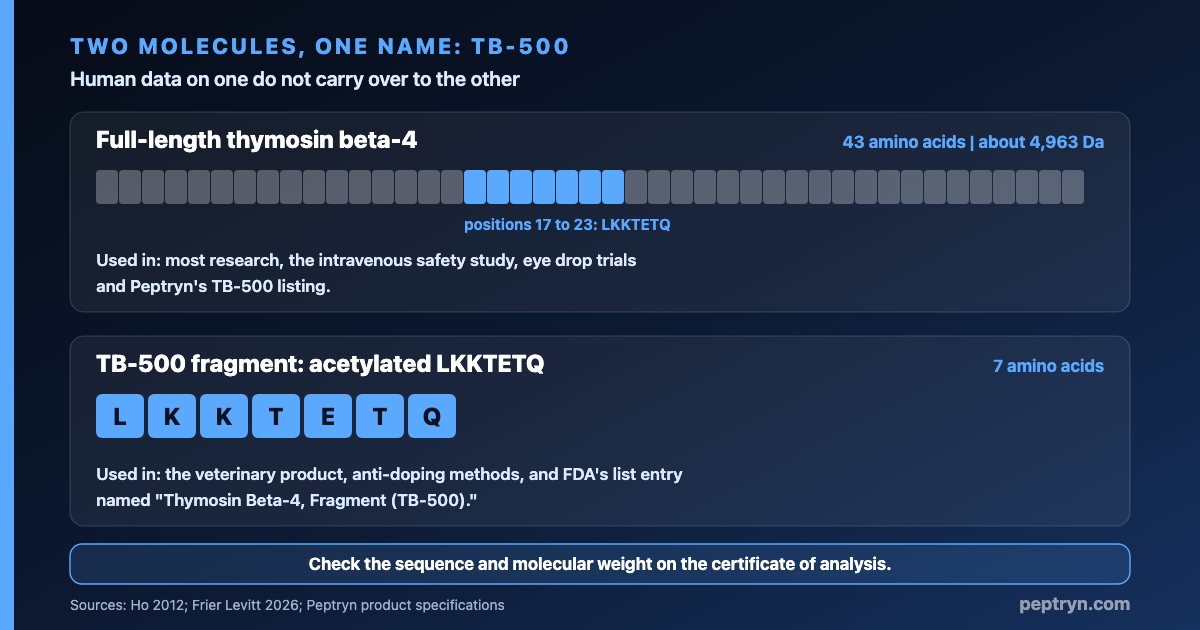
Today the name covers both. Search results describe TB-500 as the 43-amino-acid protein on some pages and as the short fragment on others, and FDA’s own compounding list names it “Thymosin Beta-4, Fragment (TB-500).” Peptryn’s TB-500 listing is the full-length thymosin beta-4 acetate, about 4,963 daltons, and we say so on the product page because the name is ambiguous. Whatever the seller, the molecular weight and sequence on the certificate of analysis tell you which molecule is in the vial, and human data on one do not carry over to the other.
What animal studies show
The best-known results use full-length Tβ4. A 2004 Nature paper found that Tβ4 promoted the migration and survival of heart muscle and blood vessel cells, and that after a coronary artery was tied off in mice, Tβ4 improved early cell survival and cardiac function. A second 2004 paper reported that Tβ4 promoted blood vessel growth and wound repair in normal and aged rodents and promoted hair growth in both. The same paper notes that new blood vessel growth matters in tumor growth as well as in repair, a reason for caution that comes up again below.
Results in mice and rats often fail to carry over to people. They show why researchers study Tβ4. They do not show what an injection does in a person.
What human studies show
Intravenous safety in volunteers
A 2010 phase 1 study gave synthetic Tβ4 intravenously to 40 volunteers without known illness across four dose groups, as a single dose and then daily for 14 days. Adverse events were infrequent and mild or moderate, and there were no dose-limiting toxicities or serious adverse events. The study was aimed at heart attack use, and the authors said further development for cardiac ischemia should be considered. This was full-length Tβ4, given by vein, in people without known illness for two weeks. It does not describe the fragment, injection under the skin or long-term use.
Eye drop trials
The most developed human program is RGN-259, an eye drop containing Tβ4, in neurotrophic keratopathy, a condition where the cornea does not repair itself. In the SEER-1 phase 3 trial, 18 people were randomized to the drops or placebo five times a day. At day 29, the primary endpoint, 60% of the eye drop group had complete repair of the corneal defect versus 12.5% on placebo, which did not reach statistical significance (p = 0.0656). At day 43, 50% versus 0% was significant (p = 0.0359). The authors acknowledged the small number of participants, and several worked for the developer. In June 2025, the developer announced that a larger European phase 3 trial, SEER-3, missed its primary endpoint, and attributed that to a stronger-than-expected placebo response. A US trial was ongoing at that point.
What is missing
A 2021 review lists the areas where Tβ4 has been studied in animals or trials: myocardial infarction and ischemia-reperfusion injury, dry eye, liver and kidney fibrosis, ulcerative colitis, colon cancer and skin trauma. Tendon, muscle and joint injuries, the main reason people buy TB-500, are not on that list. The same gap applies to BPC-157, which we cover in our BPC-157 guide and in the Wolverine stack guide.
Safety questions that remain
- No data on the fragment. The safety study used the full-length molecule, and the sources reviewed contain no human safety study of the TB-500 fragment.
- Angiogenesis and cancer. Because Tβ4 promotes blood vessel growth, and blood vessels feed tumors, researchers watch for effects on cancer. A 2003 study of 70 people with early-stage lung cancer found that higher Tβ4 expression in tumors was associated with metastasis and poorer survival. That is an association in tumor tissue and does not show that injecting Tβ4 causes cancer, and the question has not been answered for injected use.
- Product quality. Injectable research products are unregulated. Our guide to peptide safety covers contamination, endotoxin and immune reactions. In our own COA data report, the TB-500 lot read 99.84% purity but measured 12.8 mg against a 10 mg label, and the lab reports give no assay uncertainty.
FDA and anti-doping status
TB-500 is not an FDA-approved drug. In 2023, FDA placed a group of peptides in Category 2 of its compounding list because of concerns about immune reactions, impurities and limited human data. On April 15, 2026, FDA removed twelve peptides from Category 2, including TB-500, because the nominations for them had been withdrawn. FDA said the removal does not make them eligible for compounding. On July 23, 2026, the Pharmacy Compounding Advisory Committee voted 8 to 6, with one abstention, to recommend adding TB-500 to the bulk drug substances list. That vote is advice, and FDA still has to complete rulemaking, which a law firm following the process expects could run into 2027 or longer. The timeline is in are peptides safe? and the legal background in are peptides legal?
In sport, the World Anti-Doping Agency has listed thymosin beta-4 and its derivatives, with TB-500 as an example, as prohibited growth factors under S2 since the 2018 list, at all times.
TB-500 and BPC-157 compared
| Feature | TB-500 / thymosin beta-4 | BPC-157 |
|---|---|---|
| Size | 43 amino acids (full-length) or 7 (fragment) | 15 amino acids |
| Human trials | Phase 1 intravenous safety study (40 volunteers); eye drop trials | One intravenous pilot in two adults |
| Injury or recovery trials | None found | One clinical study among 36 in a 2025 review |
| Advisory committee vote, July 2026 | 8 to 6 in favor | 8 to 6 in favor |
| Anti-doping status | Prohibited (S2) | Prohibited (S0) |
Questions to ask about any TB-500 product
- Which molecule is it? Ask for the amino acid count, sequence and molecular weight.
- Does the certificate match the lot? Look for identity by mass spectrometry, purity, quantity and endotoxin from a lab you can verify.
- What does the label say about use? “For research use only” means the seller is not offering it for human use.
- What does the seller claim? Promises about tendons, muscle or recovery are not supported by controlled human trials.
- Which studies are being cited? Trials of eye drops or intravenous Tβ4 do not describe an injected fragment.
Frequently asked questions
What is TB-500?
TB-500 is a synthetic form of thymosin beta-4 or of a 7-amino-acid fragment of it, depending on the seller. Thymosin beta-4 is a 43-amino-acid peptide that cells make naturally.
Is TB-500 the same as thymosin beta-4?
Sometimes. Anti-doping literature uses TB-500 for the acetylated LKKTETQ fragment, while some suppliers use it for full-length Tβ4. Check the molecular weight and sequence on the certificate.
Does TB-500 help injuries recover?
Animal studies of thymosin beta-4 report faster tissue repair, but we found no controlled human trial of TB-500 for tendon, muscle or joint injuries.
Is TB-500 legal?
It is not an FDA-approved drug, so it cannot lawfully be marketed for human use, and its compounding status is unresolved in 2026. Our guide on legality covers what “research use only” does and does not mean.
Is TB-500 banned in sports?
Yes. WADA prohibits thymosin beta-4 and its derivatives, with TB-500 named as an example, at all times.
Is TB-500 safe?
Full-length thymosin beta-4 was well tolerated in a small intravenous study in volunteers without known illness. No comparable safety data were found for the TB-500 fragment or for injected use, so no safety claim can be made.
Related: BPC-157 · Wolverine peptide · Are peptides safe? · Are peptides legal? · Peptide COA data report · What is a COA? · KPV peptide
Sources
Ho EN, et al. Doping control analysis of TB-500, a synthetic version of an active region of thymosin beta-4, in equine urine and plasma by liquid chromatography-mass spectrometry. Journal of Chromatography A, 2012 (PMID 23084823). pubmed.ncbi.nlm.nih.gov
Xing Y, Ye Y, Zuo H, Li Y. Progress on the function and application of thymosin beta-4. Frontiers in Endocrinology, 2021 (PMID 34992578). pubmed.ncbi.nlm.nih.gov
Bock-Marquette I, et al. Thymosin beta-4 activates integrin-linked kinase and promotes cardiac cell migration, survival and cardiac repair. Nature, 2004 (PMID 15565145). pubmed.ncbi.nlm.nih.gov
Philp D, Goldstein AL, Kleinman HK. Thymosin beta-4 promotes angiogenesis, wound repair and hair follicle development. Mech Ageing Dev, 2004 (PMID 15037013). pubmed.ncbi.nlm.nih.gov
Ruff D, et al. A randomized, placebo-controlled study of single and multiple intravenous doses of thymosin beta-4 in volunteers. Annals of the New York Academy of Sciences, 2010 (PMID 20536472). pubmed.ncbi.nlm.nih.gov
Sosne G, et al. SEER-1: phase 3 trial of 0.1% RGN-259 (thymosin beta-4) ophthalmic solution in neurotrophic keratopathy. International Journal of Molecular Sciences, 2022 (PMID 36613994). pubmed.ncbi.nlm.nih.gov
Ophthalmology Times. HLB Therapeutics misses primary end point in phase 3 SEER-3 trial of RGN-259. June 2025. ophthalmologytimes.com
Ji P, et al. MALAT-1, a novel noncoding RNA, and thymosin beta-4 predict metastasis and survival in early-stage non-small cell lung cancer. Oncogene, 2003 (PMID 12970751). pubmed.ncbi.nlm.nih.gov
Vasireddi N, et al. Emerging use of BPC-157 in orthopaedic sports medicine: a systematic review. HSS Journal, 2025. doi.org/10.1177/15563316251355551
U.S. Anti-Doping Agency. 2018 Prohibited List: summary of major changes. usada.org
Frier Levitt. FDA peptide update 2026: removal from the “do not compound” list. frierlevitt.com
McDermott Will & Schulte. Bulk-list bound? PCAC backs majority of peptides in two-day public meeting. mcdermottlaw.com
U.S. Food and Drug Administration. Certain bulk drug substances for use in compounding that may present significant safety risks. fda.gov
Peptryn. Peptide COA data report: purity and quantity across 15 lab-hosted certificates, September 2026. peptryn.com
For laboratory research use only. Not for human or veterinary use, and not a drug, food, dietary supplement or cosmetic. You must be 21 or older to buy.