DSIP Peptide: What Research Reports, FDA Status and How to Read a Certificate (2026)
Research use only. This guide is education, not medical advice. DSIP is not approved by the FDA, and I could not confirm approval by any other regulator. Nothing here is a dosing recommendation, a use instruction, or a statement that DSIP does anything in a person. Study results describe what each paper’s authors reported.
Short answer: DSIP (delta sleep-inducing peptide, international nonproprietary name emideltide) is a nine-amino-acid peptide, Trp-Ala-Gly-Gly-Asp-Ala-Ser-Gly-Glu (WAGGDASGE), with the formula C35H48N10O15, a monoisotopic mass of 848.33 Da and CAS number 62568-57-4. Schoenenberger and Monnier isolated it from rabbit blood and reported it in 1977, and the name records the EEG changes they saw in rabbits. The human studies span 1981 to 2014 (nearly all before 1999), are small and mostly intravenous, and disagree with one another. DSIP is not an FDA-approved drug. FDA’s briefing document of May 11, 2026 recommended against adding it to the compounding bulks list, and the agency’s advisory committee voted against on July 24, 2026 (6 to 7, one abstention, per RAPS).
Key takeaways
- The name dates from a 1977 rabbit experiment. Whether DSIP exists as a natural sleep factor is unresolved, and a 2006 review said no gene, protein or receptor for it had been isolated.
- Published human sleep studies were small, with 1 to 18 people in the abstracts I read. The double-blind studies of Monti (1987) and Bes (1992) did not reach the same conclusions as the earlier positive reports, and ClinicalTrials.gov lists no DSIP study.
- FDA status on October 15, 2026: no approved product, a negative staff briefing (May 11, 2026) and a negative advisory vote (July 24, 2026). I found no final FDA decision.
- On any certificate, look for the expected [M+H]+ at m/z 849.34. A purity percentage does not tell you how much peptide a vial holds, which salt form it is, or its endotoxin level.
Last verified October 15, 2026. FDA pages and dockets change, so recheck the sources before you rely on a status statement. Sources are listed at the end. For laboratory and research use only. Nothing here is medical or legal advice.
Contents
- DSIP at a glance
- Where the name came from
- What published research reports
- Structure and expected mass values
- Regulatory status as of October 15, 2026
- What the studies did not show
- Reading a DSIP certificate
- Compounds confused with DSIP
- Common questions
DSIP at a glance
| Item | Detail |
|---|---|
| Name | Delta sleep-inducing peptide (DSIP). International nonproprietary name: emideltide |
| Sequence | Trp-Ala-Gly-Gly-Asp-Ala-Ser-Gly-Glu (WAGGDASGE), 9 residues, free N-terminus, free C-terminal acid, all L-amino acids |
| Formula | C35H48N10O15 |
| Mass | 848.33 Da monoisotopic. About 848.8 Da average (848.81 or 848.82 depending on the atomic-weight table) |
| CAS number | 62568-57-4 (PubChem also lists 69431-45-4; I could not confirm what it denotes) |
| Database IDs | PubChem CID 68816, UNII YN28Z5YZ73, ChEMBL CHEMBL2104403 |
| First reported | 1977, Schoenenberger and Monnier, PNAS (rabbits) |
| US approval | None. No Drugs@FDA record, and no ClinicalTrials.gov study |
Where the name came from
In 1977 Schoenenberger and Monnier reported a peptide isolated from rabbits that raised delta and spindle EEG activity after infusion into the brain ventricles of 58 rabbits including controls. Of nine synthetic peptides tested, only synthetic DSIP showed a significant, specific effect (PNAS 1977). A 1978 paper described its isolation from the dialysate of cerebral venous blood, reported a 35% mean rise in delta EEG over controls in 61 rabbits, and found only the alpha-aspartyl form highly active, in contrast to its beta-aspartyl isomer (Pflugers Archiv 1978).
The name records that finding. A 2006 review in the Journal of Neurochemistry (Kovalzon and Strekalova) said the link between DSIP and sleep was never further characterized, in part because the DSIP gene, protein and receptor were never isolated. In their own rabbit and rat work, certain artificial analogues promoted slow-wave sleep and DSIP itself did not.
What antibodies to DSIP detect is also unsettled. A 77-residue protein from pig brain that an anti-DSIP serum recognized has a sequence unrelated to DSIP (Sillard 1993). Its human homologue was cloned and is related to TSC-22 (Vogel 1996), and a 2009 review discusses the same “DSIP immunoreactor” as the glucocorticoid-induced leucine zipper protein (Gimble 2009).
What published research reports
A PubMed search on the DSIP terms returns about 460 records, but that count includes unrelated uses of the acronym, so it is not a study count. The records peak in the 1980s. The tables give study type, year and size, and leave out dose amounts and schedules on purpose.
Animal and in vitro work
| Year | Study | Design and size | What the authors reported |
|---|---|---|---|
| 1977 | Schoenenberger and Monnier, PNAS | Rabbits, double-blind, 58 animals including controls | More delta and spindle EEG activity; only DSIP, of nine synthetic peptides, did so significantly |
| 1980 | Tobler and Borbely | Rats, two routes | No significant rise in sleep or delta power; DSIP did not qualify as a specific sleep-promoting substance |
| 1983 | Ursin and Larsen | Rats | A 20% rise in slow-wave sleep over a sham baseline |
| 1984 to 1986 | Inoue; Obal (two papers) | Rats | No sleep increase from DSIP; two analogues raised sleep early in the night |
| 2021 | Tukhovskaya et al. | Rat stroke model; separate rat heart-attack pilot | A smaller infarct that did not reach significance; better motor recovery. In a heart-attack pilot, DSIP given during occlusion produced 100% mortality (one preliminary pilot, so do not generalize) |
Human studies, 1981 to 2014
| Year | Study | Design and size | What the authors reported |
|---|---|---|---|
| 1981 | Schneider-Helmert et al. | Double-blind crossover, 6 healthy volunteers, intravenous | Median total sleep time 59% above placebo within 130 minutes; no side effects observed |
| 1981 | Schneider-Helmert and Schoenenberger | 6 people with chronic insomnia, acute intravenous | Longer sleep and fewer interruptions, starting from the second hour; no daytime sedation reported |
| 1987 | Schneider-Helmert | 14 people with chronic insomnia; authors call it placebo-controlled | Better night sleep and daytime performance reported. FDA says there was no placebo arm, only an external control |
| 1987 | Monti et al. | Double-blind crossover against placebo, 6 people with severe chronic insomnia | Total sleep time and NREM time rose, but the authors reported no significant differences against baseline or placebo nights and judged the improvement of little clinical significance |
| 1992 | Bes et al. | Double-blind, matched pairs, 16 people with chronic insomnia | Some objective measures beat placebo, partly because the placebo group changed; authors judged short-term treatment unlikely to bring major benefit |
| 1983 to 1984 | Dick et al. | Open, uncontrolled, 67 enrolled (49 evaluable) and 107 inpatients in withdrawal | Authors reported improvement. FDA calls the design uncontrolled and unblinded and counts 3 serious reactions |
| 1998 | Backmund et al. | Open, 7 people in opioid detoxification | No abstract. Per FDA, 2 of 7 completed the schedule |
| 1989 to 1995 | Bjartell; Chiodera; Spath-Schwalbe; Giusti | Healthy volunteers, 5 to 11 per group | ACTH fell in two studies and was unchanged in a third; growth hormone and prolactin were unchanged in 8 women |
| 2009 | Pomfrett et al. | Randomized, saline-controlled, 24 women under propofol and isoflurane anesthesia | Higher heart rate and lower heart rate variability; in one DSIP group delta rhythm fell and the BIS index rose, which the authors called paradoxical and read as lighter anesthesia |
| 2014 | Kresiun and Godlevskii | A DSIP-based product (deltalicin), 45 people, no clear control for the treated subgroup | Faster recovery of an eye-test signal after photostress in treated retinopathy patients; a surrogate marker |
On October 15, 2026 I queried the ClinicalTrials.gov API for DSIP, delta sleep-inducing peptide, emideltide, Deltaran, deltalycin, deltalicin and the sequence. Every query returned zero studies, while a control query on eloralintide returned 18. FDA’s briefing counts 209 people given intravenous DSIP across the studies it found.
Levels measured in people
Studies of DSIP-like immunoreactivity measure what an antibody recognizes, which may not be the nine-residue peptide, and they disagree on whether levels follow sleep. Plasma levels in 12 people sampled over 24 hours were lower in REM and slow-wave sleep than awake (Friedman 1994), while cerebrospinal-fluid levels in 15 drug-free men with schizophrenia correlated with first-period delta sleep (van Kammen 1992).
Structure and expected mass values
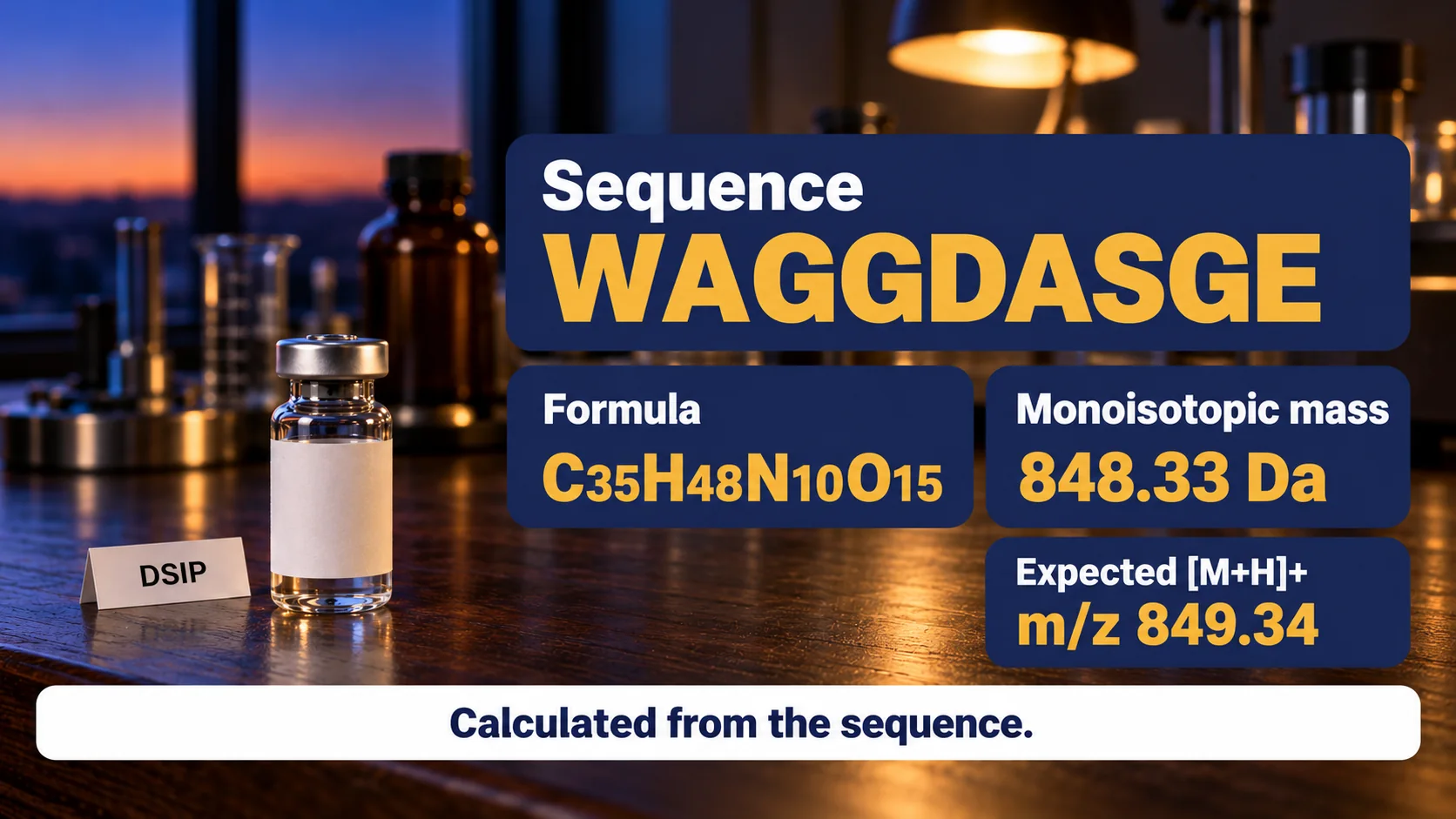
DSIP has one basic site (the N-terminal amine) and three acidic sites (aspartate, glutamate and the C-terminal acid). Its N-terminal residue is tryptophan, and it has no cysteine, methionine, lysine, arginine or histidine. I recomputed the masses from residue formulas with NIST monoisotopic masses and two common average-mass tables. The monoisotopic result, 848.33006 Da, matches PubChem’s 848.33006086. The average mass is 848.8136 or 848.8240 depending on the table, which accounts for the 848.81 and 848.82 figures in PubChem, ChEMBL and FDA’s briefing. The ion values below are calculated, and none is a measurement.
| Ion | Monoisotopic m/z | Average m/z |
|---|---|---|
| Neutral M | 848.3301 | 848.8136 |
| [M+H]+ | 849.3373 | 849.8216 |
| [M+2H]2+ | 425.1723 | 425.4148 |
Other monoisotopic reference ions: [M+Na]+ 871.3193, [M+K]+ 887.2932, [M+NH4]+ 866.3639, [M+H-H2O]+ 831.3268, [M-H]- 847.3228 and [M-2H]2- 423.1578. Charge states 3+ to 8+ can be calculated (283.7840 down to 107.0485), but a peptide with one basic site is unlikely to carry them, and in my reading a certificate should not offer them as identity evidence. Negative mode suits an acidic peptide like this one.
Regulatory status as of October 15, 2026
Approval
DSIP is not an approved drug in the United States. The openFDA Drugs@FDA data returns no record for emideltide. FDA’s briefing says it has no USP or NF monograph, is not a component of an approved drug and is not recognized in the European, Japanese or International pharmacopoeias. I could not verify any IND history or any approval in another country. ChEMBL’s “phase 2” annotation for the compound cites no trial and is a database field with no regulatory meaning.
Compounding list
FDA’s page on bulk drug substances that may present significant safety risks (content current as of April 22, 2026) places “Emideltide (DSIP)” in the table of substances nominated but withdrawn, which it describes as substances previously in category 2 whose nominations were withdrawn. It is absent from the current category 2 table. FDA’s text says compounded drugs containing it may pose a risk of immunogenicity and carry complexities in impurities and characterization. Lumalex notes that leaving category 2 did not authorize compounding, and Bass Berry notes that the committee’s votes do not authorize compounding either.
FDA briefing and advisory vote
FDA’s briefing document for the Pharmacy Compounding Advisory Committee, dated May 11, 2026, evaluated emideltide free base and emideltide acetate for the 503A bulks list after the nominators withdrew. It found both forms not well characterized, found no endotoxin testing in either nominator’s certificate, found insufficient evidence of effectiveness for insomnia, narcolepsy or opioid withdrawal, and proposed not adding either form. On July 24, 2026 the committee voted against recommending emideltide, 6 to 7 with one abstention (RAPS Regulatory Focus). I did not open FDA’s own vote record, so the tally rests on that report. The vote is advisory. Adding a substance to the list takes notice-and-comment rulemaking, and as of October 15, 2026 I found no proposed or final rule.
Other records
openFDA’s National Drug Code directory holds five bulk-ingredient listings for emideltide, none a finished drug and none with an application number. Such listings show neither approval nor quality. The 2026 WADA Prohibited List text names neither DSIP nor emideltide. Its class S0 covers substances with no current approval from any governmental regulatory health authority, and I found no WADA statement about DSIP. For the general legal picture, see are peptides legal?.
What the studies did not show
- FDA found no information on benefit with long-term use, and the registry holds no trial.
- FDA found no human study of subcutaneous administration, the route the nominators proposed.
- FDA found no repeat-dose, genotoxicity, reproductive or abuse-potential studies for emideltide, and one acute rat study.
- Results do not agree. Rat studies split, human insomnia studies split, and the ACTH studies split (Bjartell 1989 and Chiodera 1994 against Spath-Schwalbe 1995).
- The safety record is thin. FDA lists 3 serious reactions among 107 people in the 1984 withdrawal cohort and zero FAERS reports through March 3, 2024, and an absence of reports is not evidence of safety. FDA also could not exclude immunogenicity or aggregation, and said opioid-system involvement could carry addiction liability that no data address.
Reading a DSIP certificate
A single purity number answers only one question, so read a DSIP certificate line by line. Our guides to peptide purity, what a COA is and how to read a certificate of analysis cover the general method. The table covers what is specific to DSIP.
| Result | What it tells you | DSIP detail |
|---|---|---|
| Identity by mass | The molecule weighs what DSIP should | Expect [M+H]+ near 849.34 and a neutral mass near 848.33. FDA reported one nominator’s certificate listing a formula that matches no emideltide structure, so read the formula and sequence as well |
| HPLC purity | The share of UV peak area that belongs to the main peak | Usually read at 210 to 220 nm (Bachem). It misses water and counterions |
| Measured quantity | How much peptide the vial holds | Separate from purity. Net peptide content compares peptide with counterions and moisture (Bachem). One seller’s own test table shows 5.36 mg measured on a 5 mg label |
| Salt form | Free base, acetate or trifluoroacetate (TFA) | FDA treats free base and acetate as different bulk substances. Reverse-phase HPLC purification often leaves TFA (Cornish 1999) |
| Endotoxin | Bacterial endotoxin load | FDA calls it a critical quality attribute for injectable products and found none in the nominators’ certificates. Check the units and what they are per |
| Variants | Oxidation, truncation, isomers | Tryptophan oxidation adds 15.99 or 31.99 Da. Loss of the N-terminal Trp subtracts 186.08 Da, and the remaining 2 to 9 fragment appears at 663.26. Aspartate and isoaspartate share one mass, so only chromatography can separate them |
Two DSIP details explain why those variants matter. Cleavage of the N-terminal tryptophan is reported as the first step in its breakdown (Graf 1986), and FDA’s briefing says peptidases in blood break it down from the N-terminal end. That is a biological pathway and says nothing about vial stability. The indole ring of tryptophan is prone to oxidation (Simat and Steinhart 1998), and aspartate can isomerize through a succinimide intermediate (Geiger and Clarke 1987). If a document gives a different sequence, mass or formula from WAGGDASGE, C35H48N10O15 and 848.33 Da, treat it as describing a different product. For what a vial listing should show for each lot, see our DSIP buying checklist.
Compounds confused with DSIP
| Name | What it is | Source |
|---|---|---|
| Emideltide, DSIP acetate, free base, TFA salt | Names and forms of the same peptide. FDA calls emideltide a common name (it is not a USAN) and treats free base and acetate as different bulk substances | PubChem; FDA briefing |
| Phosphorylated DSIP (P-DSIP) | DSIP carrying a phosphate group. A 2018 rat study used it, not DSIP | Roy 2018 |
| KND peptide (WKGGNASGE) | Differs from DSIP at 2 of 9 positions; tested as an analogue in 2021 and proposed as a precursor fragment in 2011 | Tukhovskaya 2021; Mikhaleva 2011 |
| Deltaran | A product combining DSIP with glycine, used in a 2003 mouse study. FDA warns that glycine alone has reported antimutagenic and anti-tumor properties, so results cannot be read as a DSIP effect. I could not confirm its registration | Popovich 2003; FDA briefing |
| DSIP-immunoreactive protein | A longer protein that anti-DSIP antibodies recognize, unrelated in sequence | Sillard 1993; Vogel 1996 |
| Other research peptides | Separate sequences with separate literature, for example Pinealon and Selank | See each page |
For a wider view of the field, see what peptides are and our list of peptides.
Common questions
What is DSIP peptide?
DSIP stands for delta sleep-inducing peptide (international nonproprietary name emideltide), a nine-amino-acid peptide with the sequence WAGGDASGE. Schoenenberger and Monnier isolated it from rabbit blood and described it in 1977 after seeing delta-wave EEG changes in rabbits, which gave it its name. Whether people make it naturally is unresolved, and it is not an approved drug.
What are the sequence and molecular weight of DSIP?
The sequence is Trp-Ala-Gly-Gly-Asp-Ala-Ser-Gly-Glu (WAGGDASGE) and the formula is C35H48N10O15. The monoisotopic mass is 848.33 Da and the average mass is about 848.8 Da. The CAS number is 62568-57-4. In positive mode, the expected [M+H]+ ion sits at m/z 849.34, and the expected [M+2H]2+ ion at 425.17.
Is DSIP FDA approved?
No. Drugs@FDA holds no record for emideltide, and FDA’s May 11, 2026 briefing says it is not a component of an approved drug and has no USP or NF monograph. FDA also recommended against adding it to the compounding bulks list. As of October 15, 2026 I found no final FDA decision, and I could not confirm approval in any other country.
What did the FDA advisory committee decide about DSIP?
On July 24, 2026 the Pharmacy Compounding Advisory Committee voted against recommending emideltide for the compounding bulks list, 6 to 7 with one abstention, according to RAPS Regulatory Focus. The vote is advisory, FDA decides, and adding a substance to the list requires rulemaking. I found no FDA rule or final decision as of October 15, 2026.
What do published studies report about DSIP’s effects?
Published studies disagree, and Peptryn claims no effect. One 1983 rat study reported a 20% rise in slow-wave sleep, while four other rat papers found no sleep increase. Early small human studies reported improvement. The double-blind studies of Monti (1987, 6 people) and Bes (1992, 16 people) found no significant effect or weak effects. FDA judged the evidence insufficient for insomnia, narcolepsy or opioid withdrawal.
What side effects have published studies of DSIP reported?
Peptryn does not describe effects in people, so this answer lists what studies reported. A 1981 volunteer study of 6 people reported none. FDA counts 9 of 107 people in a 1984 withdrawal cohort with minor transient events (sweating, headache, nausea, vertigo) and 3 with serious ones, two of them hypotension. A 2009 anesthesia trial of 24 women recorded a higher heart rate. FDA found no repeat-dose toxicity studies.
Is DSIP naturally produced in the body?
That is unresolved. A 2006 review says the DSIP gene, protein and receptor were never isolated. An anti-DSIP serum recognized a larger protein (77 residues, from pig brain) whose sequence is unrelated to it, and a 2011 analysis proposed a histone demethylase fragment as a possible precursor. Antibody measurements in human blood and spinal fluid do not prove the nine-residue peptide is present.
What is the half-life of DSIP?
FDA’s briefing lists reported half-lives of about 2 to 3 minutes in rats and a monkey, 3 to 6 minutes in dogs and 5 to 10 minutes in human serum in vitro. Cleavage of the N-terminal tryptophan is reported as the first step in its breakdown (Graf 1986). These are animal and in vitro figures.
How is DSIP different from P-DSIP, Deltaran and the KND peptide?
P-DSIP carries a phosphate group, and a 2018 rat study used it in place of DSIP. Deltaran combines DSIP with glycine, which confounds results. The KND peptide (WKGGNASGE) differs from DSIP at 2 of 9 positions and was tested as an analogue in 2021. Each is a separate substance with its own literature.
How do I read a DSIP certificate of analysis?
Check the sequence and formula first, then the identity ion (expected [M+H]+ near 849.34), then purity, measured quantity, salt form and endotoxin as four separate results, and confirm that the lot on the vial matches the lot on the report. Our guide to reading a certificate explains each line.
Related: What are peptides? · Peptide purity · What is a COA? · How to read a certificate of analysis · List of peptides · Are peptides legal? · Pinealon explained · Selank
Sources
All pages were read on October 15, 2026. Masses and ion values were calculated by the author from the sequence.
- PubChem. Delta sleep-inducing peptide, CID 68816. ChEMBL. CHEMBL2104403.
- U.S. Food and Drug Administration. Emideltide-Related Bulk Drug Substances, briefing document, May 11, 2026. FDA. Bulk drug substances that may present significant safety risks, current as of April 22, 2026.
- Federal Register. Pharmacy Compounding Advisory Committee notice, April 16, 2026 (docket FDA-2025-N-6895).
- RAPS Regulatory Focus. FDA advisory committee backs two more peptides, rejects one. Bass Berry and Sims. Advisory committee recommends six peptides. Lumalex Law. The July 2026 PCAC peptide meeting.
- FDA. Drugs@FDA database, searched through the openFDA API (no match for emideltide; zolpidem used as a control). openFDA. NDC directory query. ClinicalTrials.gov. API query for emideltide.
- World Anti-Doping Agency. Prohibited List. Bachem. Quality control of amino acids and peptides.
- Origin and identity (PubMed): 265572, 568769, 16539679, 8375381, 8982256, 19849801, 21262293.
- Animal work (PubMed): 7405185, 6688864, 6593603, 3841214, 3754970, 34500605, 33918965, 12782416, 30107169.
- Human studies (PubMed): 6895513, 7028502, 3622582, 3583493, 1299794, 6328354, 6548969, 9617990, 2554357, 8475226, 7698722, 7777652, 19142086, 25739189, 8175965, 1475566.
- Chemistry (PubMed): 3777433, 10567002, 10554268, 3805008.
Editorial note: Peptryn sells research materials for laboratory use only. This guide is informational and is not medical advice. To report an error, use the contact page.
All products on peptryn.com are intended for laboratory research purposes only. They are not drugs, foods, dietary supplements or cosmetics, and they are not for human consumption, self-administration, or veterinary use. You must be 21 or older to buy. The information on this page has not been evaluated by the U.S. Food and Drug Administration and is not intended to diagnose, treat, cure, or prevent any disease.