Thymosin Alpha 1 (Ta1, Thymalfasin): Structure, FDA Status and What the Studies Reported (2026)
Research use only. This guide is education, not medical advice. FDA has approved no drug product containing thymosin alpha 1. Nothing here is a dosing recommendation, a protocol or an instruction for self-administration, and Peptryn gives none. Study results describe what each trial reported for its own participants and materials. They are not claims about any Peptryn product.
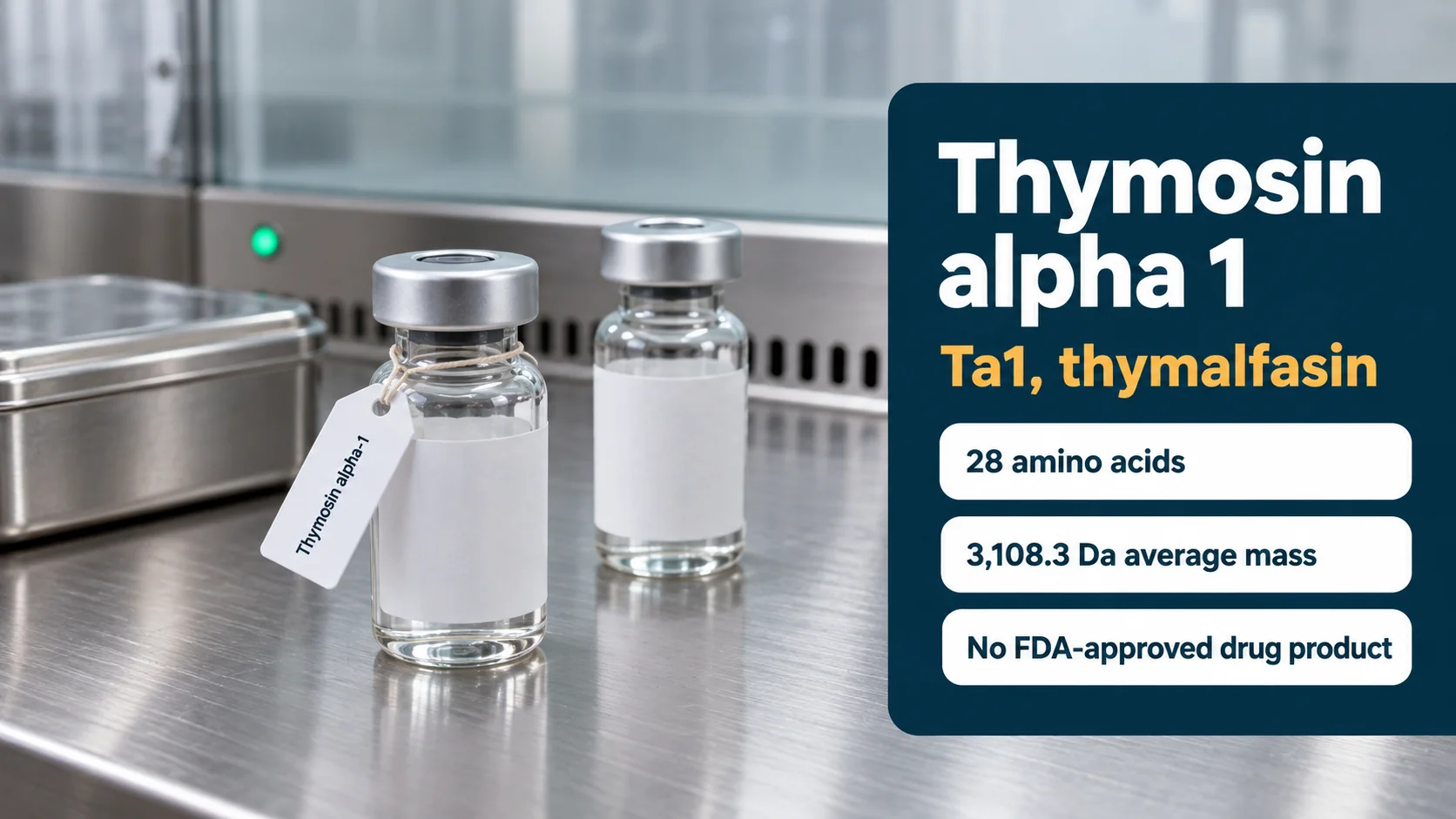
Short answer: Thymosin alpha 1 (Ta1, thymalfasin) is a 28-amino-acid peptide with an acetyl group on its first residue (formula C129H215N33O55, monoisotopic mass 3,106.5041 Da, average about 3,108.3 Da, CAS 62304-98-7). It was isolated from calf thymus in 1977. FDA says it has approved no drug product containing Ta1, although the peptide is sold as Zadaxin in other countries. Published trials are mixed: a 1,106-adult placebo-controlled sepsis trial (BMJ 2025) found no clear difference in 28-day mortality (23.4% vs 24.1%), and a 2026 Cochrane review of hepatitis B trials rates the certainty of evidence very low for most outcomes. Ta1 is a different molecule from thymosin beta-4 and TB-500.
Key takeaways
- Ta1 has 28 residues and a calculated monoisotopic mass of 3,106.5041 Da, which matches PubChem and FDA.
- Published “molecular weights” differ by about one dalton, so a certificate should say which mass it quotes.
- Thymosin beta-4 (43 residues, about 4,963 Da) is a different peptide, and TB-500 is a name used for it.
- FDA has approved no drug product containing Ta1. On December 4, 2024, its advisory committee voted 17 to 4 against adding Ta1 to the compounding bulks list.
- Of 622 PubMed records, 39 are randomized trials. The larger trials are mixed or negative.
Last verified October 15, 2026. Sources are listed at the end. For laboratory and research use only. Nothing here is medical or legal advice.
Contents
- Thymosin alpha 1 at a glance
- Where thymosin alpha 1 comes from
- Structure, mass and expected m/z
- Thymosin alpha 1 vs thymosin beta-4, TB-500 and similar names
- What the published research reports
- Regulatory status as of October 15, 2026
- What the studies did not show
- Quality and certificate reading for thymosin alpha 1
- Common questions
Thymosin alpha 1 at a glance
| Item | Value | Source |
|---|---|---|
| Names | Thymosin alpha 1 (Ta1). International nonproprietary name thymalfasin. Brand name Zadaxin (SciClone). PubChem CID 16130571 | FDA GSRS, PubChem |
| CAS number | 62304-98-7 | PubChem, GSRS, FDA |
| Sequence | Ac-SDAAVDTSSEITTKDLKEKKEVVEEAEN-OH (28 L-amino acids, N-acetylserine first, free C-terminal acid, no disulfide) | GSRS, Low and Goldstein 1979 |
| Formula | C129H215N33O55 | PubChem, FDA, our calculation |
| Monoisotopic mass | 3,106.5041 Da | Our calculation, PubChem |
| Average mass | About 3,108.3 Da | PubChem, FDA, our calculation |
| Parent protein | Prothymosin alpha (111 residues). Ta1 is residues 2 to 29 | UniProt P06454 |
| US approval | None for any drug product | FDA briefing, 2024 |
Where thymosin alpha 1 comes from
Goldstein and colleagues sequenced a 28-residue, heat-stable, highly acidic polypeptide from calf thymus in 1977 (PNAS), one of several peptides in a preparation called thymosin fraction 5. In 1979 Low and Goldstein reported an acetylserine at the front, an isoelectric point of 4.2 and a chemically made copy that matched the natural peptide in their bioassays. The made version, thymalfasin, has the same sequence.
Mammalian cells make the same 28 residues by cutting a larger protein. A 2003 study (Sarandeses, Journal of Biological Chemistry) showed that the enzyme legumain cleaves prothymosin alpha at Asn28-Gly29 to release Ta1, which is present in diverse mammalian tissues.
Structure, mass and expected m/z
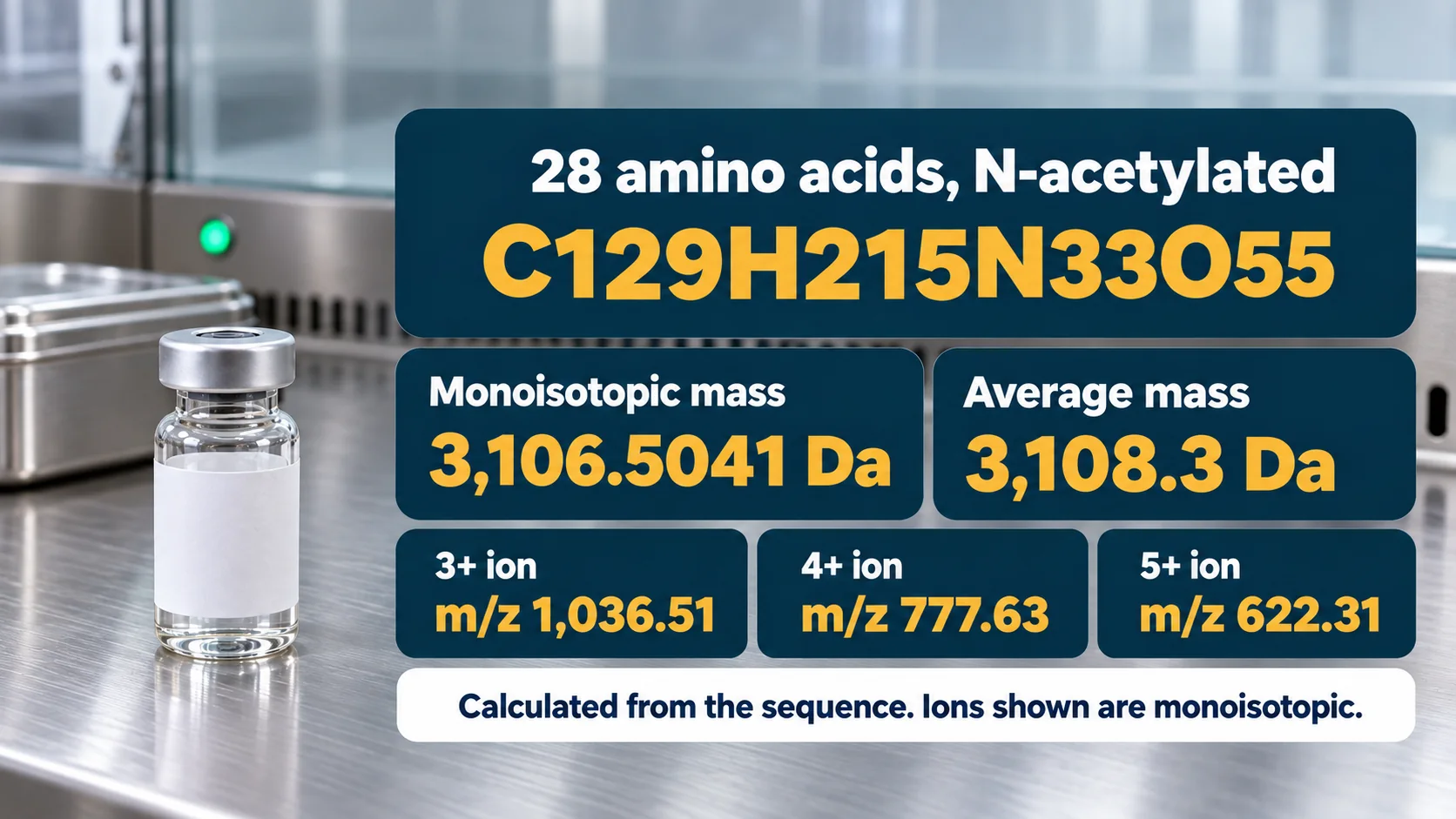
The sequence has nine acidic residues (six glutamic acid, three aspartic acid), four basic ones (all lysine) and no cysteine, methionine, tryptophan or proline. By our reading that means no disulfide bond and no methionine to oxidize.
| Quantity | Value | Check |
|---|---|---|
| Formula | C129H215N33O55 | Matches PubChem and FDA |
| Monoisotopic mass | 3,106.5041 Da | PubChem lists 3,106.5041 |
| Average mass | 3,108.28 to 3,108.32 Da, depending on the atomic weights used | PubChem and FDA list 3,108.3 |
| Without the acetyl group | 3,064.4936 Da monoisotopic | Calculated by us. The acetyl group adds 42.0106 Da |
Expected m/z values
Electrospray mass spectrometry shows a peptide as a series of charged ions. These are calculated [M+nH]n+ values, not measurements.
| Charge | Monoisotopic m/z | Average m/z | Tallest isotopic peak m/z |
|---|---|---|---|
| 2+ | 1,554.26 | 1,555.15 | 1,554.76 |
| 3+ | 1,036.51 | 1,037.10 | 1,036.84 |
| 4+ | 777.63 | 778.08 | 777.88 |
| 5+ | 622.31 | 622.66 | 622.51 |
| 6+ | 518.76 | 519.05 | 518.93 |
At this mass the tallest isotopic peak is M+1, not the monoisotopic peak. Relative to M+1 (100%), M+0 is 64.0% and M+2 is 84.8%. A report that compares an observed peak with the monoisotopic value has to say which peak it picked.
Why published masses disagree
- PubChem’s separate “ExactMass” field (3,107.5075) is the monoisotopic mass plus one carbon-13 (1.0034 Da).
- FDA’s GSRS record lists the formula C129H216N33O56. A neutral molecule with 33 nitrogens needs an odd number of hydrogens, so we treat that formula as a database error.
- A 2011 paper reports 3107.44 Da (recombinant) and 3107.42 Da (synthetic). Both sit within 0.1 Da of the [M+H]+ ion (3,107.51), and the abstract does not say which ion type it measured.
A mass match supports identity and does not prove the sequence, because an isomer has the same mass. Our guide to reading a certificate of analysis covers what else a report should show.
Thymosin alpha 1 vs thymosin beta-4, TB-500 and similar names
The name “thymosin” covers several unrelated peptides, and the first residues of Ta1 and thymosin beta-4 look alike.
| Feature | Thymosin alpha 1 | Thymosin beta-4 | TB-500 |
|---|---|---|---|
| Length | 28 residues, N-acetylated | 43 residues | FDA’s compounding page names it as a fragment (LKKTETQ) of thymosin beta-4. Peptryn’s own listing is the full-length acetate |
| Mass | 3,108.3 Da average | About 4,963 Da (C212H350N56O78S) | Depends on which molecule a seller means |
| Start of sequence | Ac-SDAAVDTSSEIT… | Ac-SDKPDMAEIEK… | Not applicable |
Our thymosin beta-4 and TB-500 guide covers the beta-4 side. Thymosin alpha 11 (35 residues) is a longer natural cleavage product of prothymosin alpha. Readers also search for thymalin next to Ta1. It is a different compound outside the research for this guide, so it is not compared here.
What the published research reports
PubMed holds 622 records with thymosin alpha 1 or thymalfasin in the title or abstract, including 39 randomized controlled trials and 12 systematic reviews or meta-analyses (October 15, 2026). This section states what each study did and reported. None of it says that any product works.
Cell and animal studies
- A 2006 study in human and mouse dendritic cells (Romani, Blood) found that Ta1 induced IDO expression in the mouse cells through TLR9 and type I interferon receptor signaling.
- FDA’s pharmacology summary says published rodent studies reported suppressed tumor growth, suppressed viral infections and decreased sepsis, at doses whose human equivalent is markedly higher than those in most clinical studies.
- A 2017 Nature Medicine paper (Romani) reported that Ta1 increased CFTR maturation in cystic fibrosis mice and in cells from people with the F508del mutation. It later received two corrections. Two laboratories in JCI Insight (2018) found no activity on mutant CFTR, and a 2019 Scientific Reports paper states that six laboratories in all failed to show correction.
Human trials
| Year and journal | Design and setting | Size | Reported result |
|---|---|---|---|
| 2025, BMJ (corrected May 30, 2025) | TESTS: phase 3, double-blind, placebo-controlled, sepsis, 22 centres in China | 1,106 randomized | 28-day mortality 127 of 542 (23.4%) with Ta1 vs 132 of 547 (24.1%) with placebo, hazard ratio 0.97 (95% CI 0.76 to 1.24). No secondary or safety outcome differed. The pre-specified age and diabetes subgroup analyses showed what the authors call a potential differential effect |
| 2013, Critical Care | ETASS: single-blind, 6 hospitals in China, severe sepsis | 361 | 28-day mortality 26.0% with Ta1 vs 35.0% (P=0.062 unstratified, log-rank P=0.049). Relative risk 0.74 (95% CI 0.54 to 1.02) |
| 2022, Intensive Care Medicine | Double-blind, placebo-controlled, predicted severe acute necrotising pancreatitis | 508 | Infected pancreatic necrosis 15.7% vs 18.1% (difference -2.4%, 95% CI -7.4 to 5.1; P=0.48). The authors say it did not reduce incidence |
| 2010, Journal of Clinical Oncology | Phase 2, five arms, metastatic melanoma with dacarbazine | 488 | Median overall survival 9.4 vs 6.6 months (HR 0.80; P=.08) |
| 2012, Journal of Viral Hepatitis | Double-blind, placebo-controlled, chronic hepatitis C not responding to earlier treatment | 552 | Sustained virologic response 12.7% vs 10.5% in the intention-to-treat population (P=0.407). Among those completing 48 weeks, 41.0% vs 26.3% (P=0.048) |
| 2018, Expert Opinion on Biological Therapy | Open-label, entecavir with or without Ta1, hepatitis B cirrhosis | 690 | After a median 38.2 months, decompensation, hepatocellular carcinoma or death were similar in both groups |
| 2024, Biotechnology and Genetic Engineering Reviews | Randomized, one hospital, colorectal cancer surgery plus chemotherapy | 400 | The authors report lower infection and complication rates and higher disease-free survival. Single center, with causal wording in the abstract |
ClinicalTrials.gov lists 65 studies that match Ta1, thymalfasin or Zadaxin (October 15, 2026): 24 completed, 17 unknown, 11 recruiting, 5 not yet recruiting and 8 in other states. The largest registered one, NCT05086614 (phase 3, colorectal cancer), plans 2,500 participants, but its record was last updated in October 2021.
Reviews and pooled analyses
- A 2026 Cochrane review of 10 randomized hepatitis B trials (1,349 participants) reports that Ta1 may reduce all-cause mortality (risk ratio 0.53, 95% CI 0.29 to 0.96; 3 studies) with very low certainty. The authors say they are not sure it changes these outcomes.
- A 2011 Cochrane review of thymic peptides for cancer (26 trials) found no significant pooled survival result for Ta1 (risk ratio 1.21, 95% CI 0.94 to 1.56).
- A 2025 meta-analysis of five pancreatitis trials (706 patients) reports fewer extrapancreatic infections (risk ratio 0.56, 95% CI 0.40 to 0.78) and no significant change in hospital stay.
- A 2024 meta-analysis of 39 COPD trials (3,329 patients) reports improvements in lung function, blood gases and hospital stay and asks for higher-quality trials. FDA’s reviewers found the studies lacked methods detail and clinical endpoints.
Safety as published
FDA’s review says that in most clinical studies Ta1 was not linked to significant adverse events, and that local irritation, redness and discomfort were the most common. Individual reports include liver-enzyme flares in a 2005 hepatitis B trial and one fatal immune hemolytic anemia among six stem cell transplant recipients. FDA raised concern about people who are deliberately immunosuppressed and about immunogenicity, which it described as a risk and not as measured data. For pharmacokinetics, FDA summarizes a healthy-volunteer study with a serum half-life of about 2 hours, and for rats it reports 1.9 to 3 minutes, citing papers we did not open.
Regulatory status as of October 15, 2026
| Question | Answer | Source |
|---|---|---|
| Approved by FDA? | No. FDA’s December 2024 briefing says the agency has approved no drug product containing Ta1. Our query of FDA’s drug database through openFDA returned no match for thymalfasin | FDA briefing |
| Approved elsewhere? | SciClone’s fiscal 2016 annual report says Zadaxin is approved in over 30 countries, primarily China. FDA says it could not verify all of them. EMA’s orphan record (last updated 2003) says thymalfasin is authorised in Italy | SEC filing, EMA |
| Orphan designations | Four, all to SciClone, none approved for the orphan use: hepatitis B (1991), DiGeorge anomaly (1998), hepatocellular carcinoma (2000), melanoma (2006) | FDA orphan database |
| IND or NDA history | Not confirmed. The sources we opened list designations, not filings | None |
| Compounding | FDA proposed that Ta1 free base and acetate not go on the 503A bulks list, and its advisory committee voted 4 yes and 17 no on each (December 4, 2024). FDA’s page lists Ta1 under “nominated but withdrawn”. 21 CFR 216.23 does not name it | FDA briefing, minutes, eCFR |
| Warning letters | Two 2020 letters went to sellers who offered Ta1 with COVID-19 claims: Paradigm RE LLC (December 7, 2020, joint with the FTC) and Center for Wellness and Integrative Medicine (June 30, 2020) | FDA letters |
FDA’s stated grounds were that Ta1 is not well characterized, that safety and immunogenicity information is insufficient, and that it found a lack of evidence of effectiveness for the 12 uses it reviewed. In 2026 FDA also sent warning letters to sellers of peptides labeled “research use only”, saying website content showed intended human use. None that we read names Ta1.
Pages that call Zadaxin FDA-approved, or cite “over 30 countries” as if that covered the US, mix two statuses, and no FDA page we opened confirms claims that Ta1 is back in Category 1. Read FDA’s page directly, and see are peptides legal? and are peptides safe? for the wider picture.
What the studies did not show
- Sepsis. TESTS found no clear mortality difference and ETASS was borderline. FDA’s reviewers concluded that most sepsis trials show changes in immune markers without meaningful clinical benefit.
- Pancreatitis. One trial of 508 found no reduction in infected pancreatic necrosis. The meta-analysis reports fewer extrapancreatic infections, a different outcome.
- Hepatitis B and C. The hepatitis C trial of 552 found no difference in its intention-to-treat population, and two hepatitis B trials found no advantage over the comparison regimen. FDA concluded the evidence was insufficient to determine effectiveness in either disease.
- Cystic fibrosis, melanoma and cancer. The 2017 cystic fibrosis result was not reproduced. The melanoma survival differences did not reach P<0.05, and the 2011 Cochrane pooled survival results were not significant.
- Evidence quality. FDA’s reviewers described the sepsis studies as small, mostly not double-blinded and all from China, and the COPD studies as small and short with little methods detail. Older hepatitis and melanoma trials compared Ta1 with regimens FDA called outdated, and some abstracts use causal wording the design cannot support.
Quality and certificate reading for thymosin alpha 1
Salt form and net peptide content. FDA treats Ta1 free base and Ta1 acetate as separate bulk substances. A 2025 study states that peptides made by solid-phase synthesis are obtained as trifluoroacetate (TFA) salts and that many studies report TFA affecting biological assays, so the authors stress quantifying the counter-ion. Net peptide content is the share of the powder that is peptide, and it differs from HPLC purity. Because the N-terminus is acetylated, by our reading only the four lysine side chains can hold an anion. If each peptide carried 1, 2, 3 or 4 acetic acid molecules, the peptide share before water would be 98.1%, 96.3%, 94.5% or 92.8%. That is arithmetic, not a statement about any lot.
Impurities and endotoxin. A 2022 study identified 23 related impurities above 0.1 mg per g in a pharmacopoeia standard of thymalfasin and applied its method to three commercial materials. The impurities included deamination products, succinimide, dimers and isomers, and more than half traced to the C-terminal asparagine, so a single main-peak percentage does not describe the material. FDA also noted missing endotoxin data as a gap, which a result with its method and unit addresses without making a safety claim.
Storage. FDA reported powder storage statements of below -18 degrees C desiccated for the free base and 2 to 8 degrees C sealed for the acetate. Our storage and handling page covers lyophilized peptides in general.
On the certificate. Look for the lot number, the lab’s name, a mass result that names the mass and ions, a purity method with its peak table, a measured quantity, the counter-ion and an endotoxin result. Our guides to what a COA is and peptide purity explain each. For what a 10 mg research listing should show, see thymosin alpha 1 listing and certificate checks.
Common questions
What is thymosin alpha 1?
Thymosin alpha 1 (Ta1, thymalfasin) is a 28-amino-acid peptide with an acetyl group on its first residue, formula C129H215N33O55 and an average mass of about 3,108.3 Da. It was first isolated from calf thymus in 1977 and is sold as Zadaxin in other countries. FDA has approved no drug product containing it.
What is thymosin alpha 1 used for?
In the US it has no approved use, because FDA has approved no drug product containing it. Abroad, SciClone sells it as Zadaxin. Published studies have tested it in sepsis, pancreatitis, hepatitis B and C, melanoma and other settings, with mixed or negative results in the larger trials.
Is thymosin alpha 1 FDA approved?
No. FDA’s December 2024 briefing states that the agency has approved no drug product containing Ta1, and a query of its drug database through openFDA on October 15, 2026 returned no match. Pages that call Zadaxin FDA-approved mix up approval abroad with US status.
Is thymosin alpha 1 the same as TB500?
No. Thymosin alpha 1 is a 28-residue peptide of about 3,108 Da derived from prothymosin alpha. Thymosin beta-4 has 43 residues and weighs about 4,963 Da, and TB-500 is a name used for it or for a fragment of it. They come from different genes (PTMA and TMSB4X).
What is the molecular weight of thymosin alpha 1?
The average molecular weight is about 3,108.3 Da and the monoisotopic mass is 3,106.5041 Da, both for the formula C129H215N33O55. We recomputed both from the sequence, and they match PubChem and FDA. A value near 3,107.5 can be the [M+H]+ ion, the tallest isotopic peak of the neutral molecule or PubChem’s separate ExactMass field.
Is thymosin alpha 1 safe?
Peptryn does not call any research material safe, and FDA has approved no product containing Ta1. FDA’s review says that in most clinical studies Ta1 was not linked to significant adverse events, with local irritation the most common, and it raised concerns about immunogenicity and use in immunosuppressed people.
What are the side effects of thymosin alpha 1?
FDA’s summary of clinical studies lists local irritation, redness and discomfort as the most common reports. Individual studies reported liver-enzyme flares in chronic hepatitis B and, in a six-patient transplant report, one fatal immune hemolytic anemia. A 1,106-adult randomized trial reported no safety difference between groups.
Does thymosin alpha 1 actually work?
The evidence is mixed. In a placebo-controlled trial of 1,106 adults with sepsis (BMJ 2025), 28-day mortality was 23.4% with Ta1 and 24.1% with placebo. A 2026 Cochrane review of hepatitis B trials rates the certainty of evidence very low for most outcomes. Some smaller or open-label studies report positive results.
Do you need a prescription for thymosin alpha 1?
FDA has approved no drug product containing Ta1, so no approved US product exists to prescribe. Some clinics advertise compounded Ta1, but FDA’s advisory committee voted 17 to 4 against adding it to the 503A compounding list in December 2024, and its current status is unsettled in public sources. Peptryn sells research materials only and is not a pharmacy.
What is the half-life of thymosin alpha 1?
FDA’s briefing summarizes a healthy-volunteer study that reported a serum half-life of about 2 hours, and a 2001 pharmacy review gives the same figure. For rats, FDA reports a half-life of 1.9 to 3 minutes. We did not open the papers FDA cited for either figure.
What is the difference between thymosin alpha 1, thymalfasin and Zadaxin?
Thymalfasin is the international nonproprietary name for thymosin alpha 1, and Ta1 is the usual abbreviation. Zadaxin is SciClone’s brand name for the chemically made peptide, which has the same sequence as the natural one. PubChem returns one record (CID 16130571) for all three names.
Related: Thymosin beta-4 and TB-500 · How to read a certificate of analysis · What are peptides? · List of peptides · Thymosin alpha 1 listing and certificate checks
Sources
All pages were opened on October 15, 2026. Masses and m/z values were calculated for this guide from the sequence.
- Identity. PubChem, thymalfasin CID 16130571; FDA GSRS record W0B22ISQ1C?view=full); UniProt P06454; PubChem thymosin beta-4 properties.
- Origin. Goldstein 1977, PubMed 265536; Low and Goldstein 1979, PubMed 762108; Sarandeses 2003, PubMed 12554742; Ren 2011, PubMed 21513520.
- Cell and animal studies. Romani 2006; Romani 2017; Tomati 2018; Armirotti 2019.
- Human trials. Wu 2025 (TESTS), corrected paper and BMJ correction of May 30, 2025; ETASS 2013; pancreatitis 2022; melanoma 2010; hepatitis C 2012; hepatitis B 2005; hepatitis B 2012; hepatitis B cirrhosis 2018; colorectal surgery 2024; transplant report 2010.
- Reviews. Cochrane 2026; Cochrane 2011; pancreatitis meta-analysis 2025; COPD meta-analysis 2024; pharmacy review 2001.
- Analytical background. Cheng 2022; Erckes 2025.
- FDA. Advisory committee briefing, December 4, 2024; final summary minutes; Certain bulk drug substances that may present significant safety risks (current as of April 22, 2026); 21 CFR 216.23.
- FDA orphan designations. Hepatitis B, DiGeorge anomaly, hepatocellular carcinoma, melanoma.
- FDA warning letters. Paradigm RE LLC, 2020; Center for Wellness and Integrative Medicine, 2020; Gram Peptides, 2026.
- Approvals abroad. EMA orphan register EU/3/02/110; SciClone annual report, fiscal 2016.
- Registry. NCT02867267 and NCT05086614; counts from the ClinicalTrials.gov API.
- Peptryn. Thymosin beta-4 and TB-500 guide. Search results and “People also ask” for thymosin alpha 1 queries, Google US, October 15, 2026.
Editorial note: Peptryn sells research materials for laboratory use only. This guide is informational and is not medical advice. To report an error, use the contact page.
All products on peptryn.com are intended for laboratory research purposes only. They are not drugs, foods, dietary supplements or cosmetics, and they are not for human consumption, self-administration, or veterinary use. You must be 21 or older to buy. The information on this page has not been evaluated by the U.S. Food and Drug Administration and is not intended to diagnose, treat, cure, or prevent any disease.