Eloralintide Dosage: What the Trials Tested and Why No Approved Dose Exists (2026)
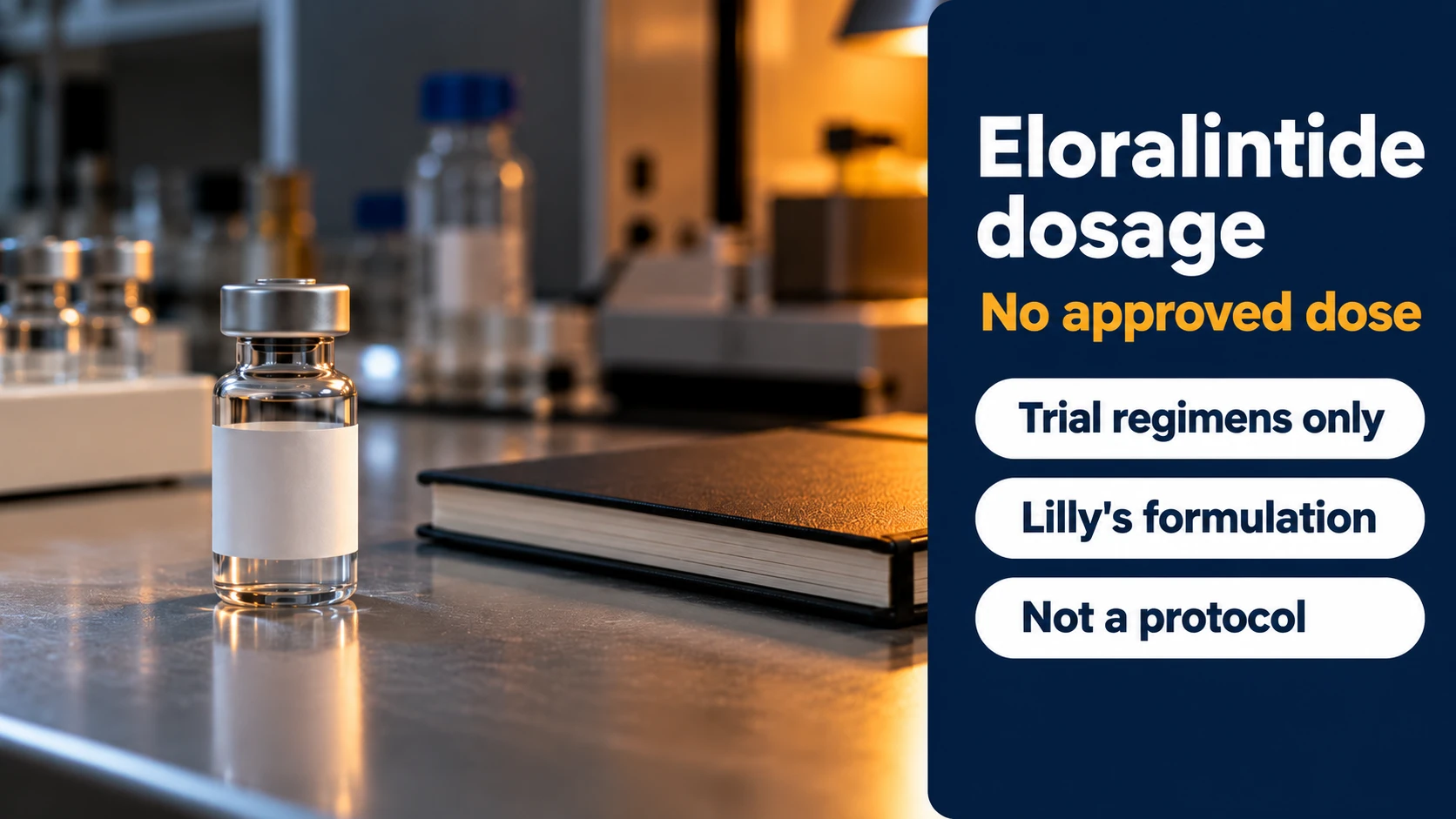
Research use only. This guide is education, not medical advice, and it is not a dosing guide. Eloralintide is an investigational drug with no approved dose, no label and no approved use. The regimens below are what Eli Lilly tested in clinical trials with Lilly’s own formulation under medical supervision. They are not a protocol, and Peptryn does not give dosing, preparation or administration instructions for any research material.
Short answer: There is no approved dosage for eloralintide, because no regulator has approved it. In clinical trials, Lilly gave once-weekly injections of its own formulation at fixed doses of 1 to 12 mg and at stepped-up regimens, and found that starting at a lower dose reduced nausea and fatigue. Phase 3 is testing four dose levels that Lilly has not published. A trial regimen cannot be carried over to a research vial from a website, because the amount, purity, identity and sterility of such a vial are not established.
Key takeaways
- No label, no approved dose, no maximum dose and no list of contraindications exist for eloralintide.
- Trials used once-weekly injections. Phase 2 tested 1, 3, 6 and 9 mg arms and two stepped regimens (6 to 9 mg and 3 to 9 mg) over 48 weeks.
- Side effects depended on the starting dose as much as the final dose: the arm that started at 3 mg and reached 9 mg had 25% nausea, while the 6 mg fixed arm had 64%.
- Four dose arms are being tested in phase 3 (ENLIGHTEN-1, -2 and -6). The doses are not public, and a label dose is unlikely before 2029.
- Our September 2026 data report found that the measured amount in research vials ran from 8.6% below to 36.5% above the label across 21 components, so a printed milligram figure does not equal what is in a vial.
- Dose questions for kidney or liver impairment, other drugs, older age and pregnancy are open. Lilly’s phase 1 studies in renal and hepatic impairment are still running.
Last verified October 15, 2026. Sources are listed at the end. For laboratory and research use only. Nothing here is medical or legal advice.
Contents
- What “dosage” means for a drug that is not approved
- What each study tested
- Four things the dose trials do and do not show
- Why a trial regimen does not transfer to a research vial
- What no one knows yet about eloralintide dosing
- Where an official dose will come from
- How to judge a dosing chart you find online
- If you want access to eloralintide
- Common questions
What “dosage” means for a drug that is not approved
A dosage is a labeled recommendation: an amount, a schedule and the conditions under which a regulator has judged it safe and effective. It comes from phase 3 trials and a review of the full data. Eloralintide has not reached that point. What exists is a set of trial regimens, which are experimental designs. Each tests a dose, a schedule and a way of stepping up to it, to find out what works and what is tolerated. A regimen that fits one trial’s design, supervision and formulation says nothing about whether it fits anything else.
Searches for “eloralintide dosage” have risen from zero in April 2026 to about 320 a month by September, and the pages that answer them online are mostly vendor charts. This page does what those pages do not: it reports what the trials tested, shows what is unknown and explains why the numbers do not travel.
What each study tested
| Study | Participants | Regimen tested | Length |
|---|---|---|---|
| Phase 1, single dose | 48 healthy adults | One dose of 0.04, 0.12, 0.4, 1.2, 4 or 12 mg, or placebo | One dose, with follow-up |
| Phase 1b, multiple dose | 100 adults with obesity or overweight | Weekly 1.2, 3, 6 or 12 mg, or placebo, without escalation | 12 weeks |
| Phase 2 | 263 adults without diabetes | Weekly 1, 3, 6 or 9 mg; stepped regimens of 6 to 9 mg and 3 to 9 mg; or placebo | 48 weeks |
| Phase 2b (EloraTZP) | 367 adults with type 2 diabetes | Weekly eloralintide 3, 6 or 9 mg alone or with tirzepatide, with stepwise escalation set by the protocol | 48 weeks |
| Phase 3 (ENLIGHTEN-1, -2, -6) | Thousands, planned | Four dose arms plus placebo; doses not published | Up to 2028 and beyond |
These are regimens tested in clinical trials. They are not guidance.
What the results looked like by regimen
| Phase 2 regimen | Participants | Mean weight change at 48 weeks (on treatment) | Nausea | Fatigue |
|---|---|---|---|---|
| Placebo | 53 | -0.4% | 14% | 12% |
| 1 mg weekly | 28 | -9% | 11% | 0% |
| 3 mg weekly | 24 | -12% | 13% | 13% |
| 6 mg weekly | 28 | -18% | 64% | 29% |
| 9 mg weekly | 54 | -20% | 33% | 43% |
| 6 to 9 mg stepped | 24 | -20% | 54% | 46% |
| 3 to 9 mg stepped | 52 | -16% | 25% | 21% |
More dose gave more weight change up to about 9 mg, and more nausea and fatigue as well. The trial reported that starting at 3 mg and stepping up reduced stomach symptoms and fatigue compared with starting at 6 or 9 mg.
Four things the dose trials do and do not show
- Dose-response exists. Weight change deepened from -9% to -20% across the fixed arms. That supports a dose range worth studying.
- Starting low helps tolerability. The stepped 3 to 9 mg arm had less nausea and fatigue than the 9 mg fixed arm at the same final dose.
- The best dose is not established. The 9 mg and 6 to 9 mg arms matched at -20%, while the 3 to 9 mg arm reached -16%, a result consistent with less time at the top dose. Phase 3 uses four dose levels to pick the labeled ones.
- Weekly is the only schedule tested. Despite a half-life of about 14 days, no trial has tested longer intervals.
Our structure and half-life guide explains why the half-life is long, and our side effects guide lists every adverse event figure by arm.
Why a trial regimen does not transfer to a research vial
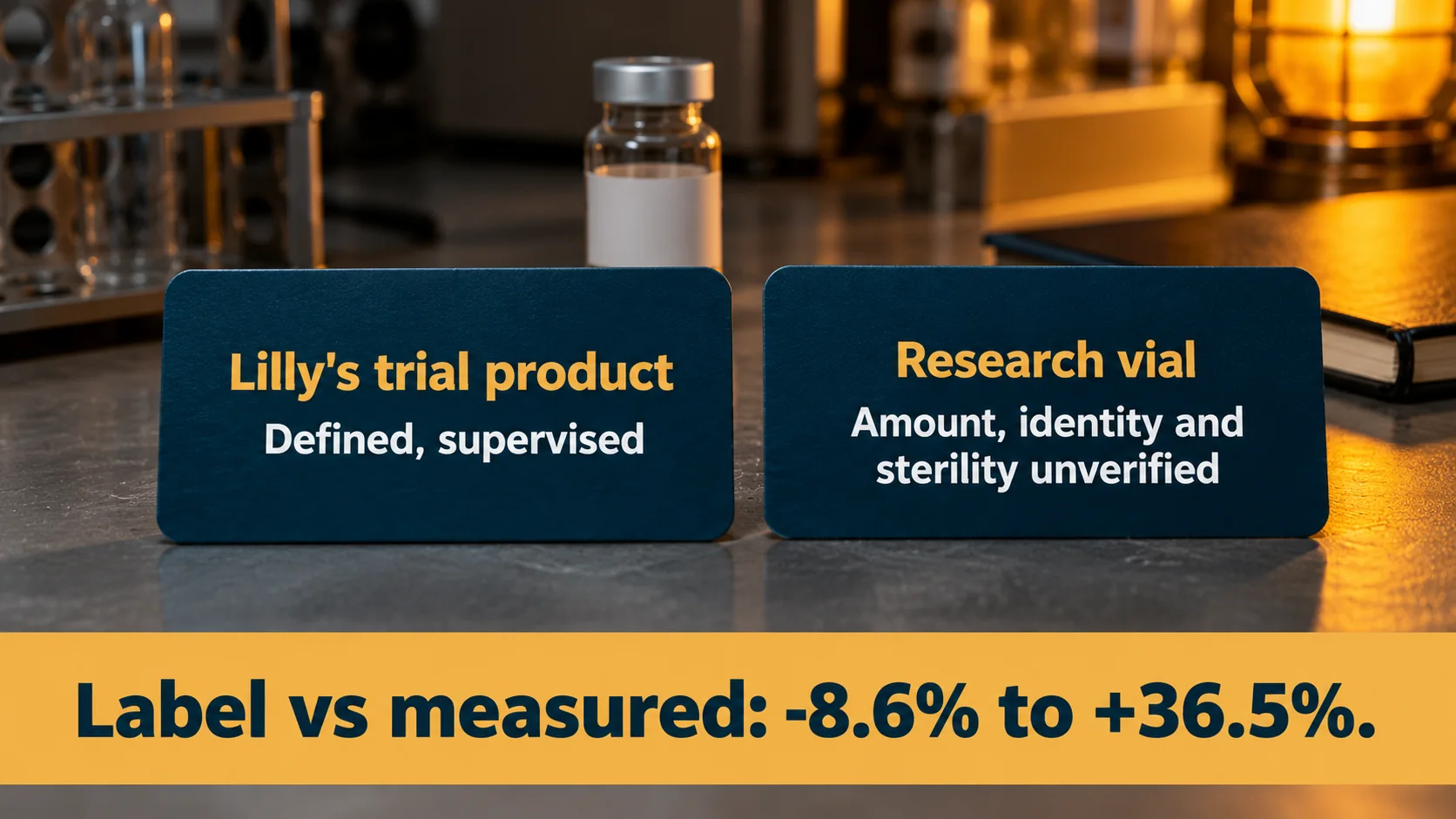
A “10 mg” regimen in a Lilly trial and a “10 mg” vial from a website share a number and little else.
| Factor | Lilly’s trial product | A research vial from a website |
|---|---|---|
| Source | Made and released under Lilly’s quality system | Made by an unknown third party |
| Identity | Defined and controlled | Unproven unless a lab verified it, and mass alone does not prove the structure |
| Amount | Defined by specification | Label amount only; measured quantity ranged from -8.6% to +36.5% of label in our data report |
| Purity | Specified, with impurity limits | A percentage from one method, which says nothing about quantity |
| Sterility and endotoxin | Required for an injectable | Research vials are not sterile products, and endotoxin is tested only if the seller does it |
| Supervision | Clinicians, laboratory monitoring, stopping rules | None |
| Formulation | Lilly’s liquid or powder formulation and device | A lyophilized powder with unknown excipient and salt content |
Two practical points follow. First, the same label number can hide a spread of roughly 40% in what is in the vial. Second, the trial’s safety record applies to Lilly’s product and to participants who were screened and monitored. It does not apply to an unknown product used by someone who was not.
What no one knows yet about eloralintide dosing
- A maintenance dose. Whether people stay on the top dose or step down after reaching their goal is a phase 3 question.
- Kidney and liver impairment. Lilly is running phase 1 studies in people with renal impairment (NCT07426380) and hepatic impairment (NCT07401862). Until they report, how the drug is cleared and whether doses need adjusting in those groups is unknown.
- Other drugs. Interaction data are limited. A phase 1 study in women with obesity or overweight (NCT07808060) started in September 2026.
- Age, body weight and sex. Phase 2 enrolled adults aged 18 to 75, 78% women, with an average weight of 109 kg. Whether dose should vary with weight is not reported.
- Missed or interrupted doses and stopping. No data describe what happens, and they would need a clinical setting to interpret.
- Pregnancy and breastfeeding. No data.
- Combination dosing. The EloraTZP trial used set combinations of two drugs, and Lilly plans a single co-formulation with a new escalation schedule.
Where an official dose will come from
The route is the normal one for a new drug:
- The ENLIGHTEN phase 3 studies compare four dose levels against placebo. Primary completion is estimated for January to June 2028.
- Lilly files an application with the dose or doses it proposes.
- The FDA reviews the data, typically over about 12 months, and sets the labeled dose range, the escalation schedule and the warnings.
- A label would exist no earlier than 2029 on public schedules. That date is an estimate and not a Lilly statement.
Our approval status guide has the timeline.
How to judge a dosing chart you find online
Dosing charts for eloralintide circulate on vendor and forum pages. They are not Lilly documents. Ask five questions of any of them:
- Who wrote it, and who profits? A seller’s chart is marketing for the seller.
- What is the source? If it cites the phase 2 arms, it is converting an experimental design into a recommendation.
- Does it use a different unit? Conversions to volumes or “units” mix a label amount with an unknown concentration, which compounds the uncertainty about what is in the vial.
- Does it tell you to combine, cycle or stack with other drugs? That has no trial support at all.
- Does it mention testing, monitoring or a clinician? A safe regimen depends on all three.
Peptryn does not publish dosing charts, preparation steps, volume conversions or injection instructions for any research material. That is a policy decision about laboratory-only sales, and it is why this page reports trial facts and stops there.
If you want access to eloralintide
Two lawful routes exist. The first is a clinical trial. You can search for eloralintide trials on ClinicalTrials.gov or on Lilly’s trial site. The second is an approved obesity or diabetes drug prescribed by a clinician, because several are available. A clinician can discuss which fits your situation, and nothing here is a substitute for that.
Common questions
What is the dosage of eloralintide?
There is none. Eloralintide is not approved, so there is no labeled dose. Lilly’s trials tested once-weekly regimens from 1 mg to 12 mg, and phase 3 is testing four dose levels that have not been published.
What dose of eloralintide was used in clinical trials?
Phase 2 tested weekly 1, 3, 6 and 9 mg arms and stepped regimens of 6 to 9 mg and 3 to 9 mg for 48 weeks. Phase 1b tested weekly 1.2, 3, 6 and 12 mg for 12 weeks, and the single-dose study tested 0.04 to 12 mg. These are trial designs, not recommendations.
How often is eloralintide given in trials?
Once a week, as a subcutaneous injection. No trial has tested a different schedule.
What is the starting dose of eloralintide?
No starting dose is approved. In phase 2, a stepped regimen that began at 3 mg caused less nausea and fatigue than regimens beginning at 6 or 9 mg, and the combination trial also used a stepwise escalation. Both are trial findings under medical supervision.
Is there a maximum dose of eloralintide?
None has been set. The highest weekly dose I found in a published trial is 12 mg (phase 1b), and the highest dose in phase 2 was 9 mg.
Can I use the phase 2 doses with a research vial?
No. Trial doses describe Lilly’s formulation in supervised participants. A research vial’s amount, purity and identity are unverified, and in our data report measured quantity differed from label by -8.6% to +36.5%. Peptryn does not advise on use.
Does the dose depend on body weight?
The trials report average body weight (109 kg in phase 2) but I found no analysis showing a weight-based dose. It is a phase 3 question.
How long should eloralintide be taken?
Unknown. The longest published treatment is 48 weeks, ENLIGHTEN-1 runs to 2030, and no data describe stopping or long-term maintenance.
Where can I find a legitimate eloralintide dosing schedule?
Only in Lilly’s trial protocols, to which participants have access, and later in an FDA label if the drug is approved. Any chart on a vendor site is not a clinical document.
Related: What is eloralintide? · Eloralintide side effects · Eloralintide approval status · Eloralintide clinical trials · Peptide COA data report · Are peptides legal? · All eloralintide guides
Sources
All pages read October 14 to 15, 2026.
- Billings LK, et al. Eloralintide phase 2. The Lancet 2025; DOI 10.1016/S0140-6736(25)02155-5; NCT06230523.
- Briere DA, et al. Eloralintide: from discovery to clinical proof of concept (single ascending dose). Molecular Metabolism 2025; PMC12640043.
- Bhattachar S, et al. Eloralintide phase 1 proof of concept (multiple ascending dose). Diabetes, Obesity and Metabolism 2026; PMC12992164.
- Eli Lilly. EloraTZP phase 2b release, September 30, 2026: PR Newswire.
- ClinicalTrials.gov: NCT07321886, NCT07282600, NCT07392190, NCT07426380, NCT07401862, NCT07808060, retrieved October 15, 2026.
- Peptryn. Peptide COA data report, Q3 2026, September 26, 2026 (measured quantity against label).
- Google Ads search volume via DataForSEO, US, September 2026.
Editorial note: Peptryn sells research materials for laboratory use only. This guide is informational and is not medical advice. To report an error, use the contact page.
All products on peptryn.com are intended for laboratory research purposes only. They are not drugs, foods, dietary supplements or cosmetics, and they are not for human consumption, self-administration, or veterinary use. You must be 21 or older to buy. The information on this page has not been evaluated by the U.S. Food and Drug Administration and is not intended to diagnose, treat, cure, or prevent any disease.