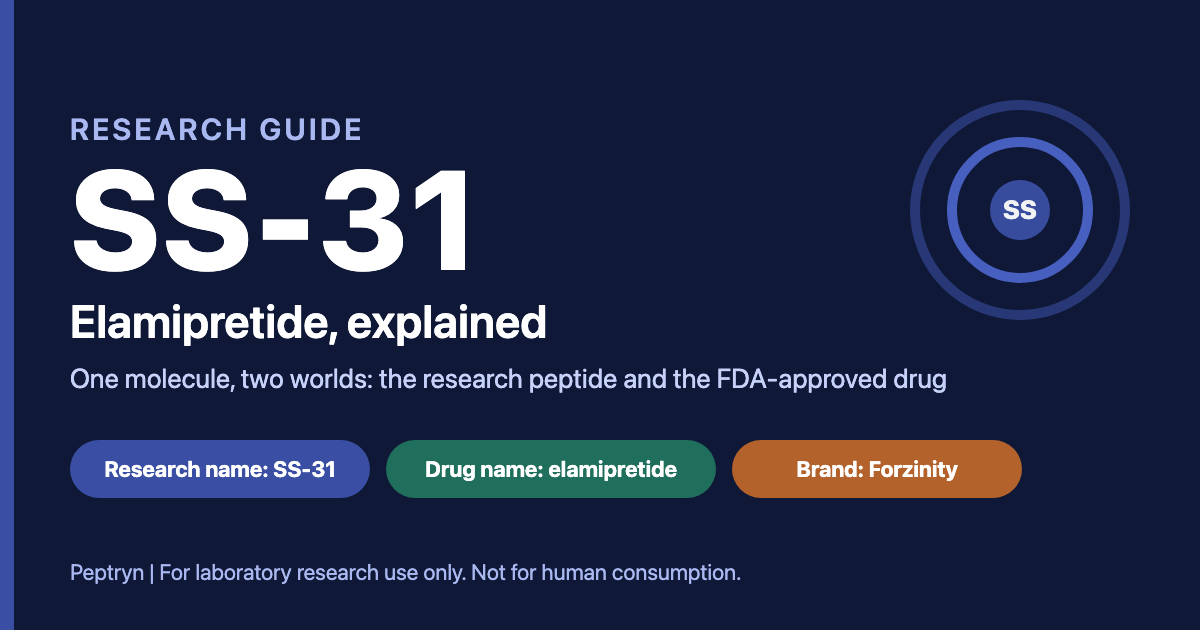
SS-31 Peptide (Elamipretide): The FDA Approval, What the Research Shows, and What It Means for Research Vials
Research use only. Peptides supplied by Peptryn are sold strictly for in vitro and preclinical laboratory research. They are not approved by the FDA for human or veterinary use, and nothing here is medical advice, a dosing recommendation, or an instruction for self-administration. This guide explains what SS-31 is, what happened when its drug form was tested and approved, and how researchers should evaluate a research-grade vial.
Quick answer: what is SS-31 peptide?
SS-31 peptide (also searched as SS 31 peptide) is the research name for elamipretide, a synthetic four-amino-acid peptide (D-Arg-Dmt-Lys-Phe-NH2, 639.8 g/mol) designed to concentrate in the inner membrane of mitochondria and bind a lipid called cardiolipin. It also appears in older literature as MTP-131 and Bendavia.
The part most pages miss: SS-31 is now an approved drug, for one rare disease. On September 19, 2025, the FDA granted accelerated approval to elamipretide HCl (Forzinity) to improve muscle strength in people with Barth syndrome who weigh at least 30 kg. That is the only approved use. Trials in primary mitochondrial myopathy and heart failure missed their primary endpoints, and there are no controlled human trials for aging, longevity or performance.
At a glance
| What it is | Synthetic tetrapeptide, D-Arg-Dmt-Lys-Phe-NH2; C32H49N9O5; 639.8 g/mol (free base) |
| Other names | Elamipretide, MTP-131, Bendavia; brand Forzinity (elamipretide HCl) |
| Proposed mechanism | Binds cardiolipin in the inner mitochondrial membrane; stabilizes cristae; supports respiratory complexes |
| Approved use | Barth syndrome, patients 30 kg or more (accelerated approval, Sept 2025) |
| Other human trials | Primary mitochondrial myopathy and heart failure: primary endpoints missed |
| Research vials | Not approved; laboratory research only |
| Peptryn SS-31 | 50 mg lyophilized vial, ≥99% by HPLC, batch COA, $149.99. Product page → |
Sourcing for research: SS-31 (elamipretide) · Batch COA library · Mitochondrial peptides
Table of contents
- SS-31, elamipretide and Forzinity: what is the difference?
- What SS-31 is
- How SS-31 is proposed to work
- The FDA approval, in plain English
- What the human trials show
- Approved drug vs research vial
- SS-31 vs MOTS-c, and the July 2026 FDA panel
- SS-31 peptide dosage: why a chart will not help you
- Handling a research vial
- How to evaluate an SS-31 vial before you buy
- FAQ
SS-31, elamipretide and Forzinity: what is the difference?
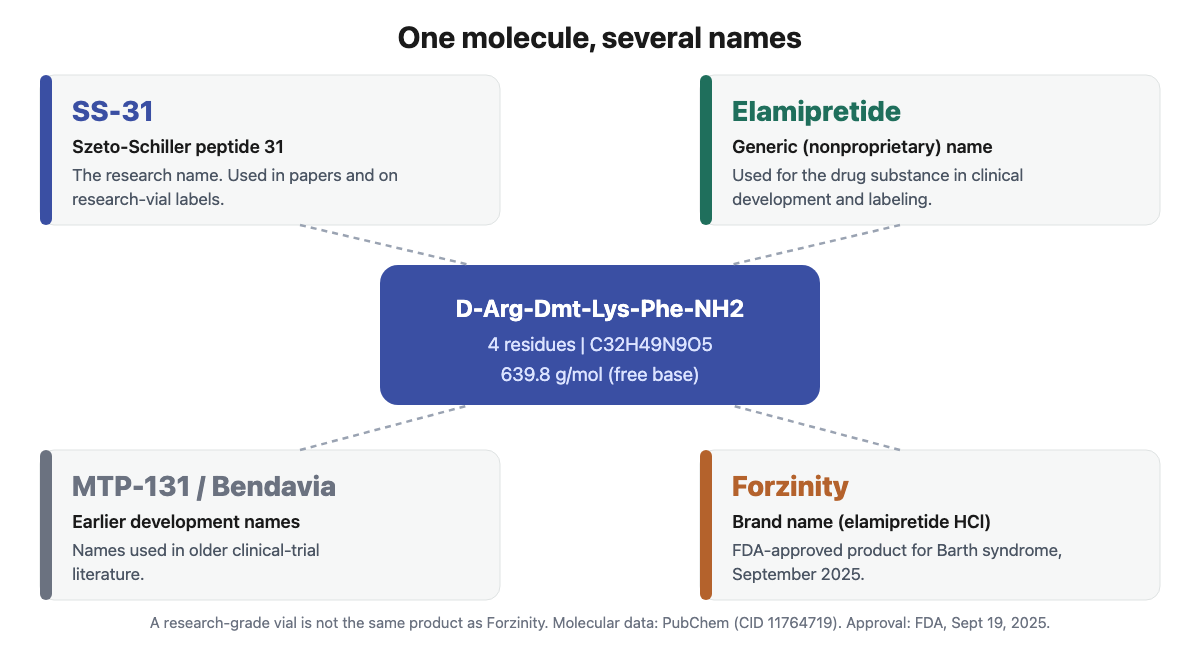
The confusion is understandable, because one molecule has several names:
- SS-31 is the research name. “SS” refers to the Szeto-Schiller family of aromatic-cationic peptides, and it is the name you see in papers and on research-vial labels.
- Elamipretide is the generic (nonproprietary) name used for the drug substance in clinical development.
- MTP-131 and Bendavia are earlier development names that appear in older trial literature.
- Forzinity is the brand name of the FDA-approved product, elamipretide HCl, made by Stealth BioTherapeutics.
It is one molecule, but the products are not the same. An FDA-approved drug and a research-grade vial differ in manufacturing oversight, labeling, intended use and evidence, and we cover exactly how below.
What SS-31 is
SS-31 is a short peptide of four residues: D-arginine, 2′,6′-dimethyltyrosine (Dmt), lysine and phenylalanine, with the C-terminus capped as a primary amide (D-Arg-Dmt-Lys-Phe-NH2). Two features stand out:
- Two positive charges (from D-Arg and Lys), which draw it toward negatively charged cardiolipin in the inner mitochondrial membrane.
- Non-natural residues (a D-amino acid and Dmt), which matter for identity testing, as we discuss in the buyer checklist.
The free-base peptide has the formula C32H49N9O5 and a molecular weight of 639.8 g/mol (PubChem). Salt forms weigh more; PubChem lists a hydrochloride form at about 749.2 g/mol. That is why a certificate of analysis should state the salt form, not just “SS-31.”
How SS-31 is proposed to work
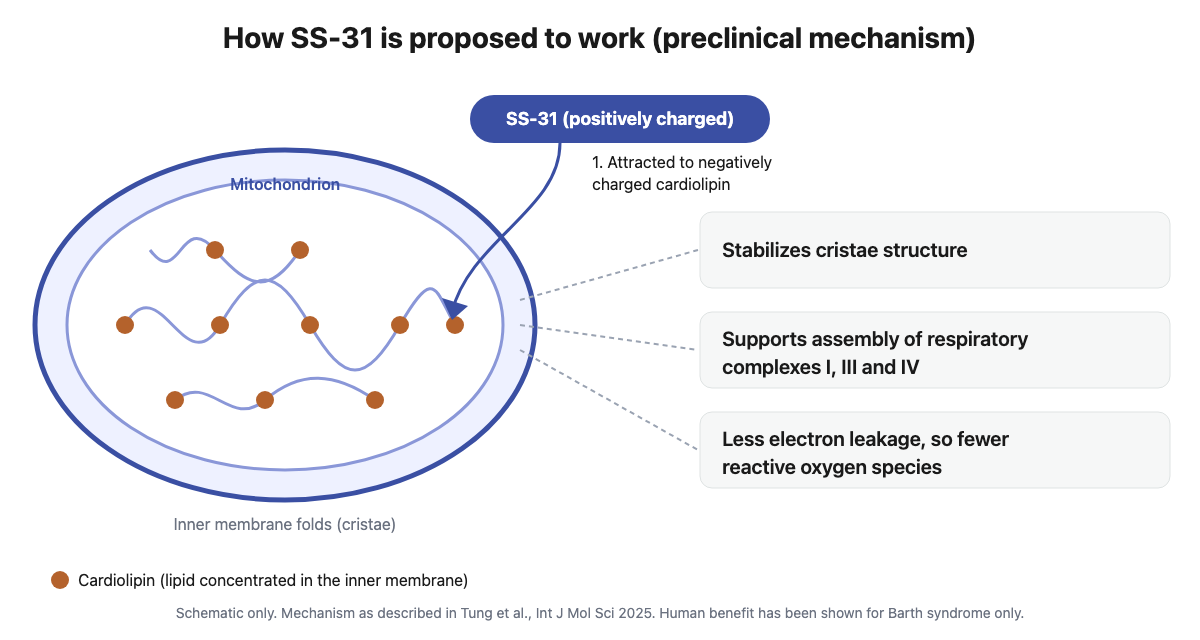
The proposed mechanism, as described in a 2025 review by Tung and colleagues, runs like this:
- Targeting. The positive charges attract SS-31 to cardiolipin, a negatively charged lipid concentrated in the inner mitochondrial membrane.
- Cristae stabilization. Binding is proposed to protect cardiolipin from oxidation and stabilize the folded membrane structures (cristae) where energy production happens.
- Respiratory support. The review describes enhanced assembly and stability of respiratory complexes I, III and IV.
- Less oxidative stress. More efficient electron transfer means less electron leakage, a major source of mitochondrial reactive oxygen species (Tung et al., 2025).
This is a mechanistic hypothesis built mostly on laboratory work. Whether it translates into a clinical benefit depends on the disease, and the trial record below shows it has translated in one condition so far.
The FDA approval, in plain English
- What was approved: Forzinity (elamipretide HCl), made by Stealth BioTherapeutics.
- When: September 19, 2025, under the FDA’s accelerated approval pathway.
- For whom: Barth syndrome, an ultra-rare X-linked genetic disorder affecting roughly 150 people in the United States, in patients weighing at least 30 kg (about 66 pounds), adults and children.
- On what evidence: improvement in knee-extensor muscle strength, an intermediate clinical endpoint, from the TAZPOWER trial (NCT03098797), which enrolled 12 patients with genetically confirmed Barth syndrome.
- The catch: accelerated approval means continued approval may depend on confirmatory trials verifying clinical benefit.
- Most common side effects reported: injection-site reactions.
(Stealth BioTherapeutics announcement.)
What the approval does not mean. It does not approve elamipretide for aging, longevity, fitness, “energy,” or any other condition. It does not evaluate research-grade material. And it is not evidence that SS-31 works for anything outside Barth syndrome.
What the human trials show
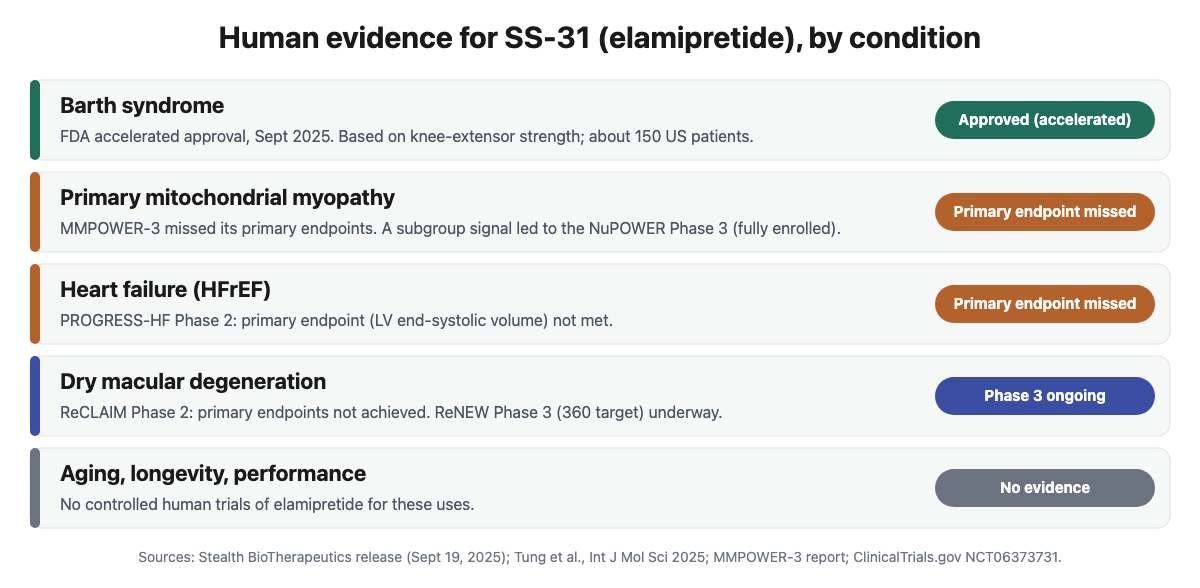
| Condition | Trial | Result |
|---|---|---|
| Barth syndrome | TAZPOWER | Basis for accelerated approval (knee-extensor strength) |
| Primary mitochondrial myopathy | MMPOWER-3 | Primary endpoints (6-minute walk test and a fatigue score) not met. A post hoc analysis found a signal in patients with nuclear DNA variants, which led to the NuPOWER Phase 3 trial, now fully enrolled |
| Heart failure with reduced ejection fraction | PROGRESS-HF (Phase 2) | Primary endpoint (LV end-systolic volume) not met |
| Dry age-related macular degeneration | ReCLAIM (Phase 2), ReNEW (Phase 3) | Phase 2 primary endpoints not achieved; a secondary signal on ellipsoid-zone degradation was reported. Phase 3 (target 360 patients) is underway |
| Aging, longevity, performance | None | No controlled human trials |
How to read this table. A drug program that produces one approval, several missed primary endpoints, and a few ongoing trials is normal in drug development, and that is the point: the honest picture is mixed, not miraculous. Sources: MMPOWER-3, NuPOWER enrollment, PROGRESS-HF, the Tung 2025 review, and ReNEW (NCT06373731).
Approved drug vs research vial
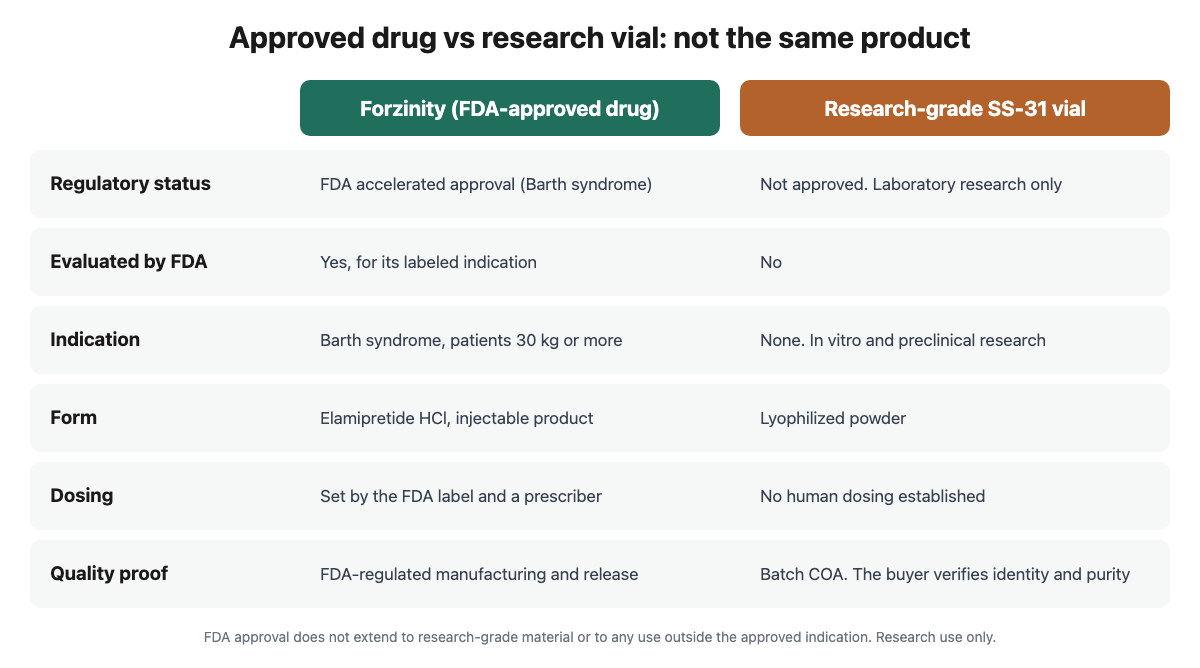
Because SS-31 now has an approved form, it is easy to blur the line between the drug and a research vial. Here it is plainly:
- Regulatory status. Forzinity has FDA approval for one indication. A research-grade vial has none and is sold for laboratory use only.
- FDA evaluation. The approved product’s manufacturing, labeling and evidence were reviewed for its indication. Research material was not.
- Dosing. The approved product’s dosing is set by its FDA label and a prescriber. No human dosing has been established for a research vial.
- Quality proof. For the drug, that is regulated manufacturing and release. For a research vial, it is a batch certificate of analysis, and the buyer has to check it.
An approval for Barth syndrome does not turn a research vial into a treatment, and it does not validate any use outside that indication.
SS-31 vs MOTS-c, and the July 2026 FDA panel
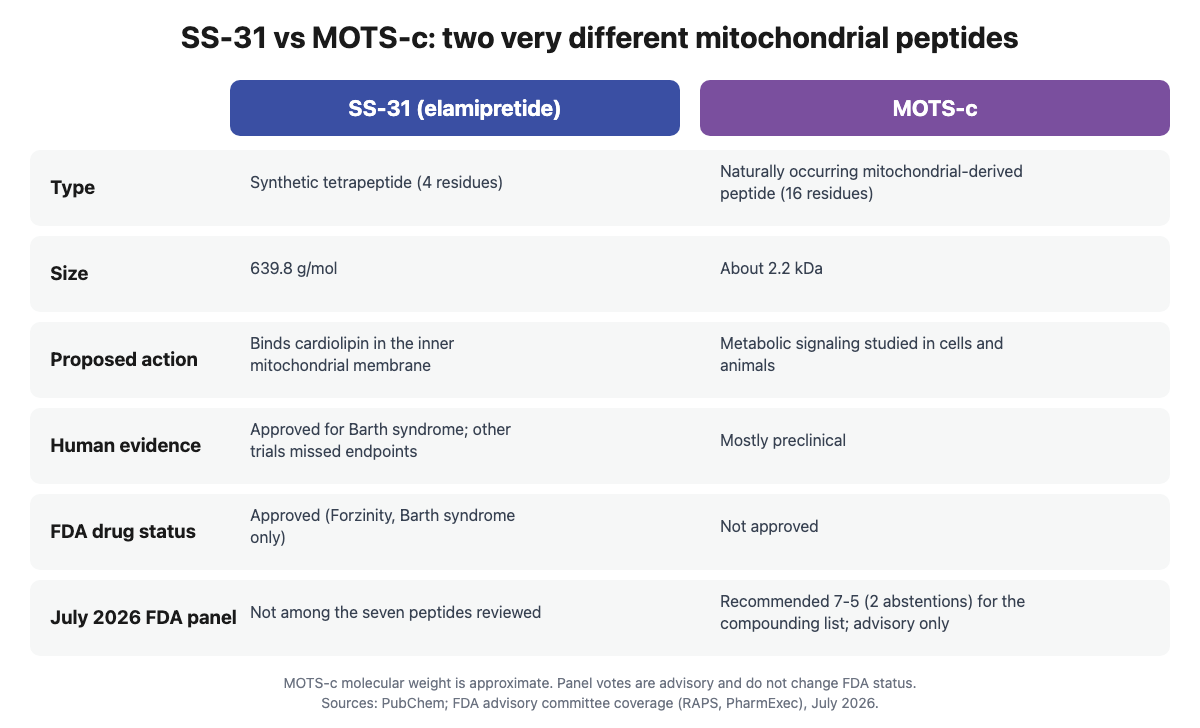
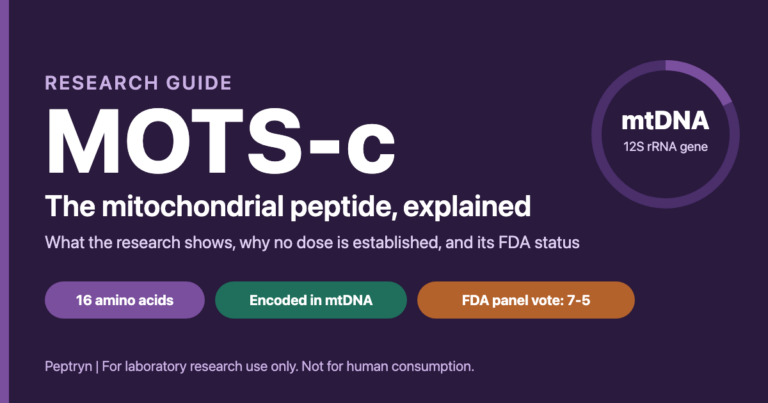
SS-31 and MOTS-c are often mentioned together because both relate to mitochondria, but they are unrelated molecules. SS-31 is a synthetic four-residue peptide that binds cardiolipin. MOTS-c is a naturally occurring 16-residue peptide encoded in mitochondrial DNA, studied mainly in cells and animals. If you are comparing the two for research, Peptryn lists both: SS-31 and MOTS-c, alongside NAD+ in its mitochondrial peptides category.
The July 2026 FDA panel. On July 23–24, 2026, the FDA’s Pharmacy Compounding Advisory Committee reviewed seven peptides, according to news coverage: BPC-157, KPV, TB-500, MOTS-c, emideltide, epitalon and semax. The panel voted 8-6 (one abstention) in favor of adding BPC-157, KPV and TB-500 to the compounding list, and 7-5 (two abstentions) for MOTS-c. SS-31 was not among them. These votes are advisory: the FDA is not bound by them, and any change would require formal rulemaking (FDA meeting page; PharmExec). They do not make any of those peptides approved drugs.
SS-31 peptide dosage: why a chart will not help you
“SS-31 peptide dosage,” “dose” and “dosing” each draw about 4,400 searches a month, so here is a direct answer: this guide does not give a dose, and a dosage chart from a vendor or forum is not a reliable substitute for one. Reasons:
- The approved drug’s dosing belongs to its label. For Forzinity, dosing is defined by the FDA label for Barth syndrome and applied by a prescriber. It does not transfer to research vials or to other uses.
- No human dosing exists for research vials. Nothing has been established for aging, performance or any condition outside Barth syndrome, and trials in other conditions missed their primary endpoints.
- Chart numbers come from somewhere. Usually that is animal studies, the approved product’s trials, or anecdote, all of which are the wrong basis for a decision about a vial of unknown formulation.
What researchers do need is concentration math, which depends only on mass and volume:
Concentration (mg/mL) = peptide mass (mg) ÷ diluent volume (mL)
For a 50 mg vial: adding 2 mL gives 25 mg/mL, 5 mL gives 10 mg/mL, and 10 mL gives 5 mg/mL (confirm your vial can hold the volume). This is laboratory arithmetic, not a dosing table.
Handling a research vial
Per the Peptryn product specification, store the lyophilized powder at −20 °C, protected from light and repeated freeze-thaw cycles. For sterile technique and the arithmetic, see the reconstitution basics guide, the peptide calculator, the storage and handling guide, and the bacteriostatic water guide. If your protocol uses bacteriostatic water, it is here: BAC Water 10 mL →
How to evaluate an SS-31 vial before you buy
SS-31 is a good example of why paperwork matters, because its structure includes a D-amino acid and a non-natural residue that HPLC purity alone cannot verify.
- Identity by mass spectrometry. The free-base peptide should show a mass near 639.8 Da. Purity alone does not tell you what the molecule is.
- Molecular weight and formula that match. For the free base, C32H49N9O5 and 639.8 g/mol. Some vendor pages in circulation list figures that cannot describe a four-residue peptide of this structure. Treat a mismatch as a red flag and ask for the mass-spec data.
- Salt form stated. Free base, acetate or hydrochloride forms differ in weight, so the COA should say which one you have and how peptide content was determined.
- Purity by HPLC. Look for ≥99% and a chromatogram that shows a single dominant peak.
- Endotoxin testing for any material handled in solution.
- A COA for your specific lot, from an independent lab, with a lot number and date.
- No medical claims. A seller promising energy, anti-aging or recovery results from a research chemical is signaling the wrong thing.
Not sure how to read the paperwork? Peptryn’s guide on how to read a certificate of analysis walks through each line. If a lot’s COA is not published yet, email support with your order number. Orders ship from the USA with same-day dispatch, and orders over $150 ship free.
Get SS-31 (elamipretide) 50 mg with a batch COA →
Frequently asked questions
What is SS-31 peptide?
SS-31 is the research name for elamipretide, a synthetic four-amino-acid peptide that targets the inner mitochondrial membrane and binds cardiolipin. It is also known as MTP-131 and Bendavia.
Is SS-31 the same as elamipretide?
They are the same molecule. SS-31 is the research name and elamipretide is the generic name. The FDA-approved product, Forzinity, is elamipretide HCl, a specific regulated drug product. A research vial is not the same product.
Is SS-31 FDA-approved?
Elamipretide HCl (Forzinity) received FDA accelerated approval on September 19, 2025 for Barth syndrome in patients weighing at least 30 kg. Research-grade SS-31 vials are not approved for any use.
What is SS-31 peptide used for?
The approved drug is used for Barth syndrome. In the laboratory, SS-31 is used to study mitochondrial function, oxidative stress and bioenergetics in cell and animal models. Uses such as anti-aging or performance are marketing claims without controlled human evidence.
What does SS-31 peptide do?
The proposed mechanism is that it binds cardiolipin, stabilizes mitochondrial cristae, supports respiratory complexes and reduces oxidative stress. What it does in patients depends on the condition. The clinical record shows benefit-related evidence for Barth syndrome and missed primary endpoints in other trials.
What are the SS-31 peptide benefits?
For Barth syndrome, the approved drug improved knee-extensor muscle strength, the endpoint supporting its accelerated approval. Beyond that, claimed benefits are hypotheses drawn from laboratory work, and controlled human trials in other conditions did not meet their primary endpoints.
What are the SS-31 peptide side effects?
For the approved drug, the most commonly reported side effects were injection-site reactions. For research vials, no safety profile has been established.
Does SS-31 work for anti-aging or longevity?
No controlled human trials support that use. The approved indication is Barth syndrome only.
What is the SS-31 peptide dosage?
There is no established dosage for research vials, and this guide does not provide one. The approved drug’s dosing is set by its FDA label and a prescriber.
SS-31 vs MOTS-c: what is the difference?
They are unrelated. SS-31 is a synthetic four-residue peptide that binds cardiolipin and has one FDA-approved use. MOTS-c is a naturally occurring 16-residue peptide encoded in mitochondrial DNA, studied mainly in cells and animals. See the comparison above.
SS-31 peptide Reddit: what do people say?
Forum posts are anecdotes. They cannot show that a product works or is safe, and they often come from sellers or people with something to sell. Batch certificates you can check yourself are more useful than any testimonial.
SS-31 peptide for sale: where can researchers buy it?
Peptryn supplies SS-31 (elamipretide) as a 50 mg lyophilized vial, ≥99% by HPLC, with a batch COA. View the product → Buyers must be 21 or older and confirm laboratory research use.
What is the SS-31 peptide price?
Peptryn lists the 50 mg SS-31 vial at $149.99, with volume discounts on eligible orders.
Final take
SS-31 is unusual among research peptides: the molecule has a real regulatory story. It is a drug approved for a single ultra-rare disease, with a mixed record elsewhere, and a laboratory tool with a plausible mechanism. Keep those two facts separate. For researchers, the practical questions are identity, purity and paperwork, not hype.
Browse research-grade SS-31, MOTS-c and NAD+ with batch COAs →
Related guides: Klow peptide guide · Wolverine peptide guide · How to reconstitute retatrutide · How to read a certificate of analysis · MOTS-c peptide guide · Glow peptide guide · Glutathione peptide guide · 5 Amino 1MQ guide · What is a COA? · Peptide purity · Peptide testing · Popular peptides
Editorial note: Peptryn sells the research peptides discussed in this guide for laboratory use only. This guide is informational and is not medical advice. Sources are listed below. To report an error, email [email protected].
Sources
- Tung C, et al. Elamipretide: A Review of Its Structure, Mechanism of Action, and Therapeutic Potential. Int J Mol Sci, 2025. pmc.ncbi.nlm.nih.gov
- Stealth BioTherapeutics. Announces FDA Accelerated Approval of FORZINITY (elamipretide HCl) (Sept 19, 2025). prnewswire.com
- PubChem. Elamipretide (CID 11764719). pubchem.ncbi.nlm.nih.gov
- Karaa A, et al. Efficacy and Safety of Elamipretide in Individuals With Primary Mitochondrial Myopathy: The MMPOWER-3 Randomized Clinical Trial. ncbi.nlm.nih.gov
- Stealth BioTherapeutics. Completes Target Enrollment in Global Phase 3 NuPOWER Trial. stealthbt.com
- Effects of Elamipretide on Left Ventricular Function in Patients With HFrEF: The PROGRESS-HF Phase 2 Trial. pubmed.ncbi.nlm.nih.gov
- ClinicalTrials.gov. ReNEW: Phase 3 study of elamipretide in dry AMD (NCT06373731). clinicaltrials.gov
- U.S. Food and Drug Administration. July 23-24, 2026: Meeting of the Pharmacy Compounding Advisory Committee. fda.gov
- Pharmaceutical Executive. FDA Panel Votes to Loosen Restrictions for Four Peptides. pharmexec.com
All products on peptryn.com are intended for laboratory research purposes only. Not for human consumption, self-administration, or veterinary use. The information on this page has not been evaluated by the U.S. Food and Drug Administration and is not intended to diagnose, treat, cure, or prevent any disease. Nothing here should be construed as medical advice.