Bacteriostatic Water for Peptides: What It Is, How Long It Lasts, and When Not to Use It
Research use only. Peptides supplied by Peptryn are sold strictly for in vitro and preclinical laboratory research. They are not approved by the FDA for human or veterinary use, and nothing here is medical advice or an instruction for self-administration. This guide covers the diluent used to reconstitute lyophilized research peptides in the laboratory.
Quick answer: what is bacteriostatic water?
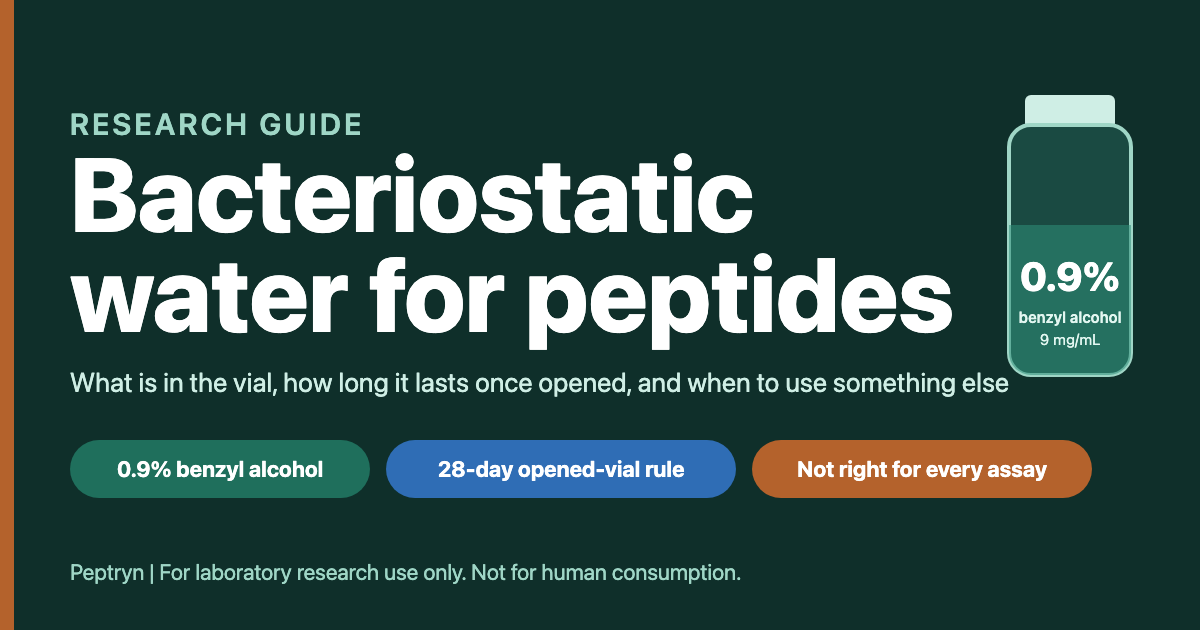
Bacteriostatic water (BAC water) is sterile water with 0.9% benzyl alcohol (9 mg/mL) added as a preservative. Bacteriostatic water for peptides is the standard multi-dose diluent labs use to reconstitute lyophilized peptides, because the preservative lets one vial of water be entered more than once.
Once opened, a multi-dose vial gets discarded within 28 days unless the manufacturer states another date, and it never outlasts its printed expiry. That 28 days belongs to the vial of water. It does not set the shelf life of a peptide dissolved in it. Bacteriostatic water is also a poor fit for some work, such as cell assays, because benzyl alcohol can damage cells.
At a glance
| What it is | Sterile, nonpyrogenic water for injection with 0.9% (9 mg/mL) benzyl alcohol |
| What the label says it is for | Diluting or dissolving drugs for injection |
| Storage | 20 to 25 °C on the USP labels we read. Peptryn’s listing: room temperature unopened, refrigerate after first use |
| After opening | Discard within 28 days unless the manufacturer states another date (CDC, USP 797) |
| Shelf life of the peptide solution | Set by the peptide, not by the water |
| Poor fit | Cell assays and other work where a preservative interferes |
| Peptryn BAC water | 10 mL multi-dose vial, 0.9% benzyl alcohol, $12.99. Product page |
Sourcing for research: BAC water 10 mL, peptide calculator, batch COA library
Table of contents
- What bacteriostatic water is
- Why labs use bacteriostatic water for reconstituting peptides
- How much bacteriostatic water to add
- Bacteriostatic water vs sterile water vs saline
- Does bacteriostatic water need to be refrigerated?
- How long is bacteriostatic water good for?
- When not to use bacteriostatic water
- Handling an opened vial
- Where to buy bacteriostatic water for peptides
- Frequently asked questions
- Final take
What bacteriostatic water is
Bacteriostatic water for injection, USP is sterile, nonpyrogenic water for injection with 0.9% (9 mg/mL) benzyl alcohol added as a bacteriostatic preservative. Some labels list 1.1% (11 mg/mL). The DailyMed labels we read describe it as indicated only for diluting or dissolving drugs for intravenous, intramuscular or subcutaneous injection.
“Bacteriostatic” means the preservative stops bacteria from multiplying in the vial. It does not sterilize a vial that is already contaminated, and it does not make careless handling safe.
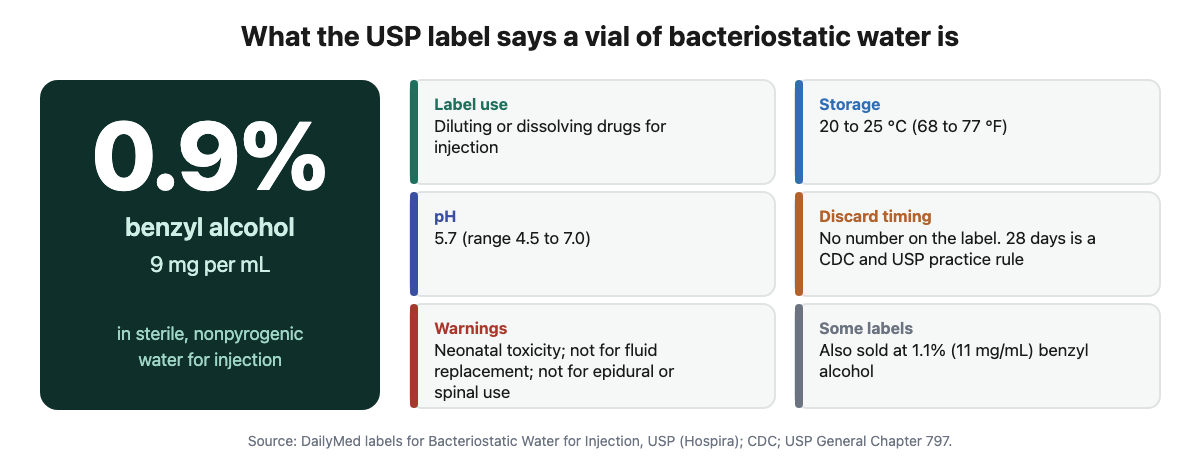
The label carries warnings. Benzyl alcohol has been associated with toxicity in neonates, so the product must not be used in that population. The label also says not to use it for fluid replacement or in epidural or spinal procedures. It lists storage at 20 to 25 °C and a pH of 5.7 (range 4.5 to 7.0).
The label gives no discard timeframe after first use. The 28-day figure comes from CDC guidance and USP General Chapter 797, covered below.
Why labs use bacteriostatic water for reconstituting peptides
Lyophilized peptides arrive as a dry powder and need a liquid before anyone can work with them. A multi-dose diluent lets a lab enter the same vial of water again when it reconstitutes several peptide vials from one bottle. Sterile water has no preservative, and sterile water vials are typically labeled single-dose, so a vial that has been entered carries more risk than a preserved one.
For the full reconstitution procedure, see our reconstitution basics guide. The retatrutide reconstitution guide works through BAC water charts for three vial sizes, and the Klow and Glow guides do the same for multi-peptide blends.
How much bacteriostatic water to add
The volume depends on the concentration your protocol calls for, and this guide does not pick one for you. The arithmetic takes one line:
Concentration (mg/mL) = peptide mass (mg) ÷ diluent volume (mL)
| Peptide in the vial | Add 1 mL | Add 2 mL | Add 5 mL |
|---|---|---|---|
| 5 mg | 5 mg/mL | 2.5 mg/mL | 1 mg/mL |
| 10 mg | 10 mg/mL | 5 mg/mL | 2 mg/mL |
| 20 mg | 20 mg/mL | 10 mg/mL | 4 mg/mL |
Laboratory arithmetic for concentration records, not a dosing table. Confirm the vial can hold the volume you add.
Less diluent gives a stronger solution and more gives a weaker one. The mass of peptide stays the same. A 10 mL vial of bacteriostatic water covers five reconstitutions at 2 mL each, or ten at 1 mL, and the 28-day rule decides whether you use all of it. The peptide calculator does this math for any vial.
Bacteriostatic water vs sterile water vs saline
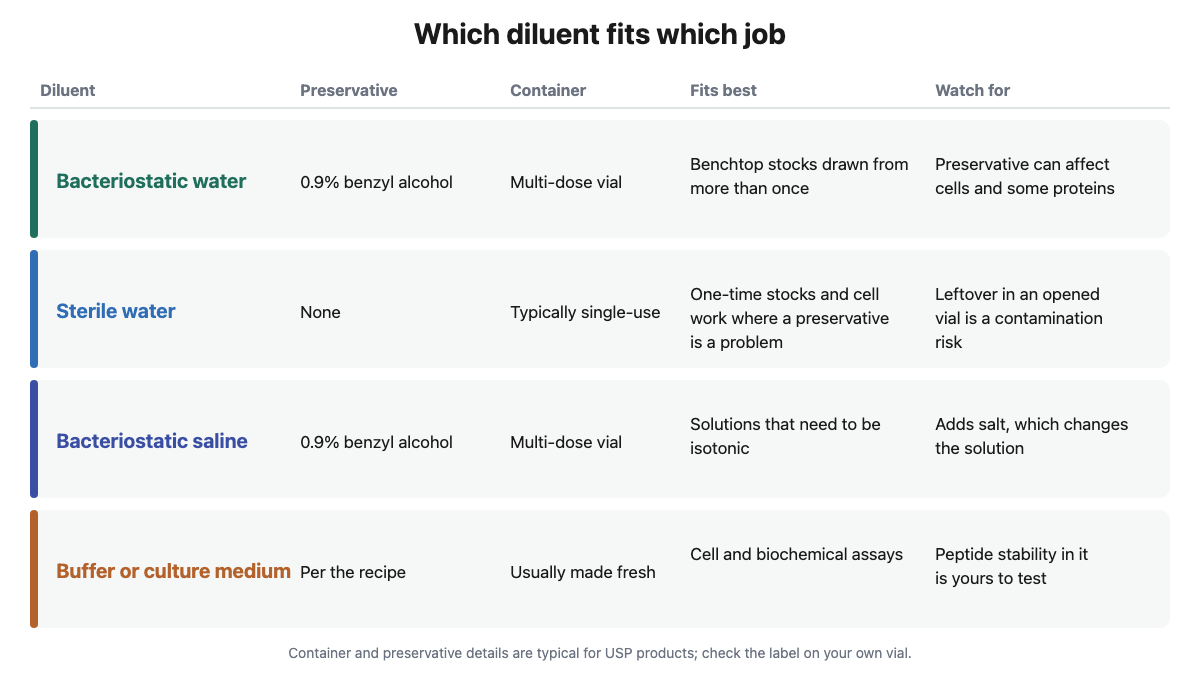
Bacteriostatic saline is 0.9% sodium chloride with benzyl alcohol added, so it is isotonic and preserved. Sterile water has neither the salt nor the preservative. Buffers and culture media depend on the recipe.
Labs do reconstitute peptides in sterile water. The trade is the missing preservative: use the vial once and discard the rest. Tap water and distilled water are not sterile and do not belong in this list.
Does bacteriostatic water need to be refrigerated?
Not according to the label. The USP labels we read say to store at 20 to 25 °C. Peptryn’s listing says room temperature before opening, then 2 to 8 °C after first use, with use inside 28 days, and says not to freeze it.
Refrigerating an opened vial of water does no harm, and many labs do it. It does not change the 28-day rule. What most protocols refrigerate is the reconstituted peptide solution, and the right temperature for that comes from the peptide’s own specification. Our storage and handling guide covers lyophilized and reconstituted material.
How long is bacteriostatic water good for?
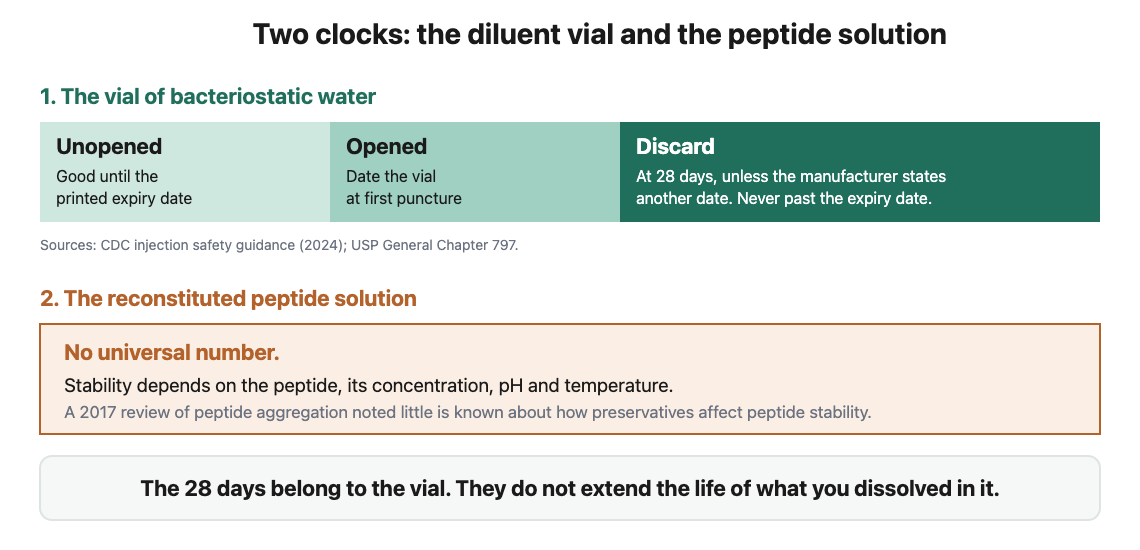
Two separate clocks run in a peptide lab, and they get confused.
The first clock belongs to the vial of water. Unopened, it is good until the expiry date printed on it. Once opened, the CDC says a multi-dose vial should be dated when first punctured and discarded within 28 days unless the manufacturer states another date, and that the beyond-use date should never exceed the manufacturer’s expiration date (CDC, 2024). USP General Chapter 797 sets the same 28 days for multiple-dose containers (USP).
The second clock belongs to the peptide solution, and neither CDC nor USP sets a number for it. Vendor pages and forums often attach “28 days” to reconstituted peptides. That figure comes from the diluent rule. How long a peptide lasts in solution depends on the peptide, its concentration, the pH, the temperature and the container.
The preservative does not vouch for the peptide. A 2017 review of peptide aggregation states that preservatives can sometimes cause protein aggregation, cites benzyl alcohol inducing aggregation of a recombinant interleukin-1 receptor, and concludes that little is known about how preservatives affect the physical stability of peptides (Zapadka et al., 2017). The preservative protects the vial from microbes and says nothing about the peptide.
If a peptide has published solution stability data, use it. If it has none, treat any storage time as something to test in your own assay, and record the date, lot and concentration.
When not to use bacteriostatic water
Cell assays are the clearest case. In a study of cultured human and rabbit retinal pigment epithelial cells, benzyl alcohol damage was dose and time dependent. At 9 mg/mL, the concentration in bacteriostatic water, it was toxic to the cells within 5 minutes. At 0.225 mg/mL it impaired human cell function after 2 hours, and at 0.0225 mg/mL it did not (Chang et al., 2008). A follow-up study found the cells died by both necrosis and apoptosis (Chang et al., 2011).
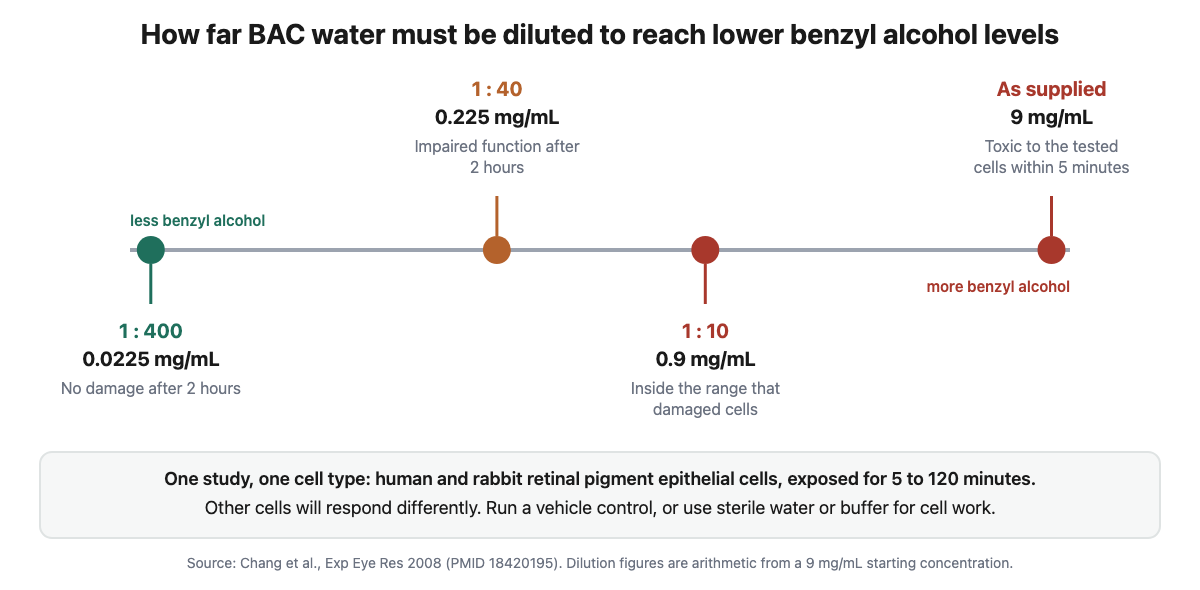
Those numbers come from one cell type in one study, and your cells will respond differently. The arithmetic still applies to any lab. A stock made in bacteriostatic water and diluted 1 to 100 into culture medium carries 0.09 mg/mL of benzyl alcohol, which is above the level that showed no damage in that study. Two options fit most protocols: make the stock in sterile water or buffer, or add a vehicle control matched for benzyl alcohol so you can see its effect separately from the peptide’s.
Two other situations call for a different diluent. Some peptides and proteins are sensitive to preservatives, as the aggregation review notes. And if your protocol names a diluent, follow the protocol.
Handling an opened vial
Standard aseptic practice applies to every entry:
- Wipe the stopper with alcohol before each entry and let it dry.
- Use a new sterile needle and syringe for each entry.
- Write the date on the vial at first puncture, as CDC advises.
- Discard at 28 days, or sooner if the liquid turns cloudy, discolored or shows particles.
Where to buy bacteriostatic water for peptides
Bacteriostatic water for injection carries an Rx only label in the US, as the DailyMed listings show. Pharmacies and retailers set their own rules on what they sell, and this guide cannot tell you what a particular store will hand over. Laboratory suppliers sell diluent for research use.
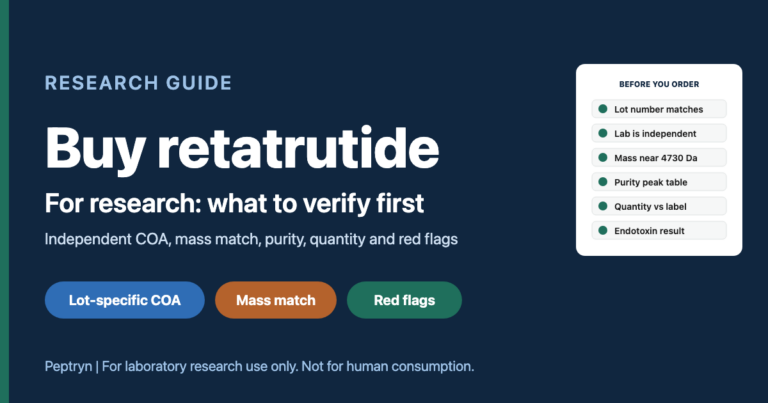
Before you buy from anyone, check five things:
- The benzyl alcohol concentration is printed on the label (0.9% is typical).
- The container is a multi-dose vial with a stopper, and the label says sterile.
- A lot number and an expiry date are printed on it.
- The seller states what testing was done and can produce a record.
- The volume matches how you work.
The last point saves money. A 30 mL vial supports fifteen 2 mL reconstitutions, but if your lab reconstitutes one peptide vial a week at 2 mL each, you use about 8 mL before the 28 days end and discard the rest. Ten milliliters matches a bench that reconstitutes a few vials in 28 days.
Peptryn’s BAC water is a 10 mL sterile multi-dose vial with a septum cap and 0.9% benzyl alcohol (9 mg/mL), listed at $12.99. The listing says to store it at room temperature before opening, refrigerate after first use and use within 28 days. It ships from the USA with same-day dispatch, and orders over $150 ship free. It is sold for laboratory research use only.
Add BAC water 10 mL to your order
Frequently asked questions
What is bacteriostatic water?
Sterile water with 0.9% benzyl alcohol added to stop bacteria from multiplying in an opened vial. Labs use it to reconstitute lyophilized peptides.
Is bacteriostatic water the same as sterile water?
No. Sterile water has no preservative and is typically labeled single-dose. Bacteriostatic water contains benzyl alcohol and comes in multi-dose vials.
Can you use sterile water to reconstitute peptides?
Yes, labs do. Use the vial once and discard the leftover, because sterile water has no preservative to protect an opened vial. Sterile water or buffer is also the better choice for cell assays.
How much bacteriostatic water do you add to peptides?
It depends on the concentration your protocol needs. Divide the peptide mass in milligrams by the diluent volume in milliliters to get mg/mL, or use the peptide calculator. This guide sets no concentration or dose.
How long is bacteriostatic water good for after opening?
Discard the vial within 28 days of first puncture unless the manufacturer states another date, and never keep it past the printed expiry. That rule covers the vial of water, not the peptide solution.
Does bacteriostatic water need to be refrigerated?
The USP labels we read say store at 20 to 25 °C. Peptryn’s listing recommends refrigerating after first use. Either way, the 28-day limit stays the same.
What is the difference between bacteriostatic water and saline?
Bacteriostatic saline is 0.9% sodium chloride with benzyl alcohol, so it is isotonic. Bacteriostatic water has the benzyl alcohol without the salt.
What are the side effects of bacteriostatic water?
The label warns that benzyl alcohol has been associated with toxicity in neonates, and it says not to use the product for fluid replacement or in epidural or spinal procedures. Peptryn’s BAC water is for laboratory research use only.
Can you buy bacteriostatic water over the counter?
The USP product carries an Rx only label in the US. Whether a given store sells it depends on that store’s rules. Laboratory suppliers, including Peptryn, sell it for research use.
Where can you buy bacteriostatic water for peptides?
Peptryn sells a 10 mL multi-dose vial for $12.99. View the product. Buyers must be 21 or older and confirm laboratory research use.
Can you drink bacteriostatic water?
No. The label describes it as a product for diluting or dissolving drugs for injection.
Can you use bacteriostatic water for cell culture?
It is usually a poor choice. Benzyl alcohol at 9 mg/mL was toxic to cultured cells within minutes in one study, and even diluted stocks can carry enough to matter. Use sterile water or buffer, or run a vehicle control.
Final take
For a bench that reconstitutes several peptides from one bottle over a few weeks, bacteriostatic water is the practical diluent. Date the vial when you first enter it, discard it at 28 days, and keep the peptide solution’s shelf life as a separate question that the peptide’s own data has to answer. For cell work, start from sterile water or buffer, or run a benzyl alcohol vehicle control. A 10 mL vial of Peptryn BAC water fits a bench that reconstitutes a few vials in 28 days, and the peptide calculator gives the volume for any vial.
Related guides: Reconstitution basics for laboratory peptides, Proper storage and handling of research peptides, How to read a certificate of analysis, How to reconstitute retatrutide, Peptide calculator, Are peptides legal?, What is a COA?, Peptide purity, Peptide testing
Editorial note: Peptryn sells the research peptides discussed in this guide for laboratory use only. This guide is informational and is not medical advice. Sources are listed below. To report an error, email [email protected].
Sources
- DailyMed. Bacteriostatic Water for Injection, USP (Hospira). dailymed.nlm.nih.gov and a second USP label, dailymed.nlm.nih.gov
- Centers for Disease Control and Prevention. Preventing Unsafe Injection Practices, March 26, 2024. cdc.gov
- United States Pharmacopeia. General Chapter 797, Pharmaceutical Compounding: Sterile Preparations. uspnf.com
- Zapadka KL, Becher FJ, Gomes dos Santos AL, Jackson SE. Factors affecting the physical stability (aggregation) of peptide therapeutics. Interface Focus, 2017. pmc.ncbi.nlm.nih.gov
- Chang YS, Wu CL, Tseng SH, Kuo PY, Tseng SY. In vitro benzyl alcohol cytotoxicity: implications for intravitreal use of triamcinolone acetonide. Exp Eye Res, 2008. pubmed.ncbi.nlm.nih.gov
- Chang YS, et al. Mechanisms underlying benzyl alcohol cytotoxicity (triamcinolone acetonide preservative) in human retinal pigment epithelial cells. Invest Ophthalmol Vis Sci, 2011. pubmed.ncbi.nlm.nih.gov
All products on peptryn.com are intended for laboratory research purposes only. Not for human consumption, self-administration, or veterinary use. The information on this page has not been evaluated by the U.S. Food and Drug Administration and is not intended to diagnose, treat, cure, or prevent any disease. Nothing here should be construed as medical advice.