Klow Peptide: What Is Inside the 80 mg Blend, What the Research Shows, and How to Evaluate It
Research use only. Peptides supplied by Peptryn are sold strictly for in vitro and preclinical laboratory research. They are not approved by the FDA for human or veterinary use, and nothing here is medical advice, a dosing recommendation, or an instruction for self-administration. This guide explains what the Klow peptide blend is, what published research does and does not show, and how researchers should evaluate a vial.
Quick answer: what is Klow peptide?
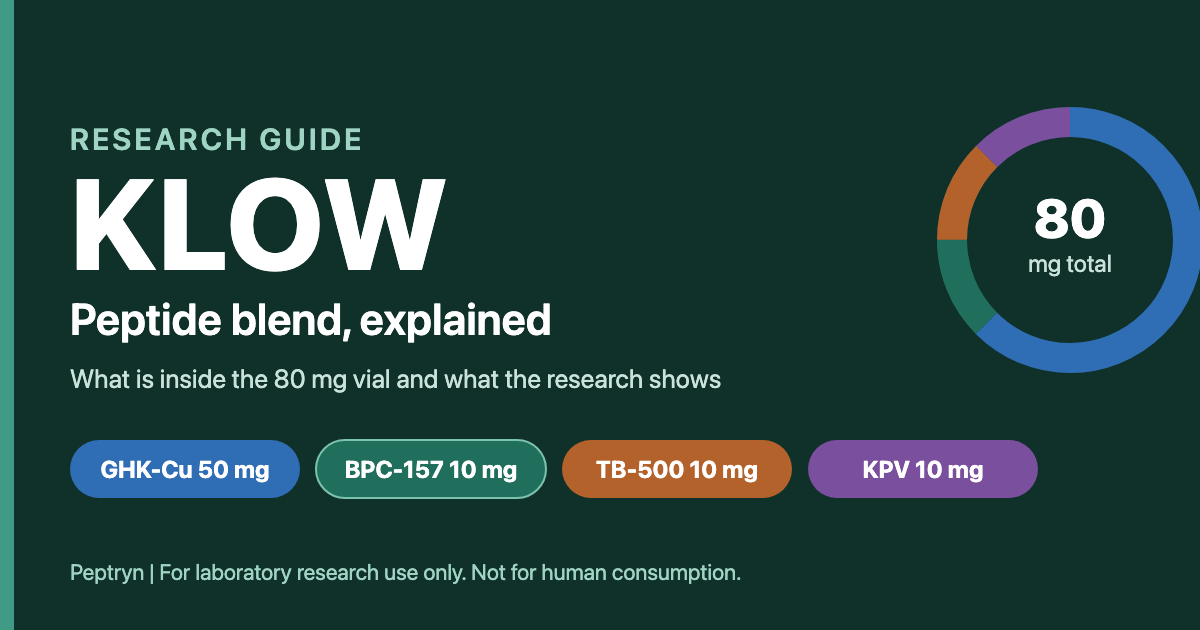
Klow peptide (often written Klow 80, Klow80, or the Klow blend peptide) is a four-peptide research blend of GHK-Cu, BPC-157, TB-500 and KPV. It is commonly described as the three-peptide “Glow” blend (GHK-Cu, BPC-157, TB-500) with KPV added. In the standard 80 mg vial the amounts are GHK-Cu 50 mg, BPC-157 10 mg, TB-500 10 mg and KPV 10 mg.
The evidence in one paragraph: each of the four peptides has been studied in cells or animals, and GHK-Cu also has small human trials of topical skin products. We found no published controlled human trial of injected BPC-157, the TB-500 fragment or KPV, and no study of all four together. Two randomized BPC-157 trials are registered without results, and full-length thymosin beta-4 has been tested in human trials as pharmaceutical products by other routes. None of the four is an FDA-approved drug. Claims about Klow “benefits” are hypotheses drawn from lab work, not established results.
At a glance
| What it is | A four-peptide blend: GHK-Cu, BPC-157, TB-500, KPV |
| Standard vial | 80 mg total (50 / 10 / 10 / 10 mg) |
| Relationship to Glow | Glow plus KPV (Glow is not defined the same way by every seller) |
| Best evidence | Cell and animal studies; small topical human trials for GHK-Cu; human trials of thymosin beta-4 pharmaceutical products; two BPC-157 trials registered without results |
| Approved drug? | No |
| Sport status | BPC-157 (WADA S0) and TB-500 (WADA S2 class) are prohibited |
| Peptryn’s Klow80 | Lyophilized, ≥99% per component by HPLC and mass spectrometry, batch COA, $160. Product page → |
Sourcing for research: Klow80 blend · Batch COA library · Lab results
Table of contents
- What Klow peptide is
- What is in the vial
- The four peptides
- Why four peptides?
- What the research shows
- Klow peptide benefits and “before and after” claims
- Klow vs Glow vs Wolverine vs single peptides
- Klow peptide dosage: why there is no established one
- Reconstitution and handling
- Regulatory and sport status
- Safety: what is known and unknown
- Klow peptide reviews and Reddit
- How to evaluate a Klow vial before you buy
- FAQ
What Klow peptide is
There is no single official definition of “Klow.” It is a market name, and the most common meaning is a fixed-ratio blend of four synthetic peptides. The name is generally explained as a variation on “Glow,” an earlier blend built around GHK-Cu, with KPV added to the mix. Because no standards body defines it, two vials sold as “Klow” can contain different peptides or different amounts.
Two facts about naming matter for anyone comparing products:
- Klow is usually GHK-Cu + BPC-157 + TB-500 + KPV. That matches the Peptryn listing and the explanations on most clinic and vendor pages that rank today.
- “Glow” is not defined the same way everywhere. Peptryn’s Glow is GHK-Cu, BPC-157 and TB-500 (70 mg). At least one guide in the search results defines “GLOW” as GHK-Cu with glutathione and ascorbic acid instead.
The practical takeaway: the name tells you very little. The certificate of analysis tells you what is actually in the vial.
What is in the Klow vial
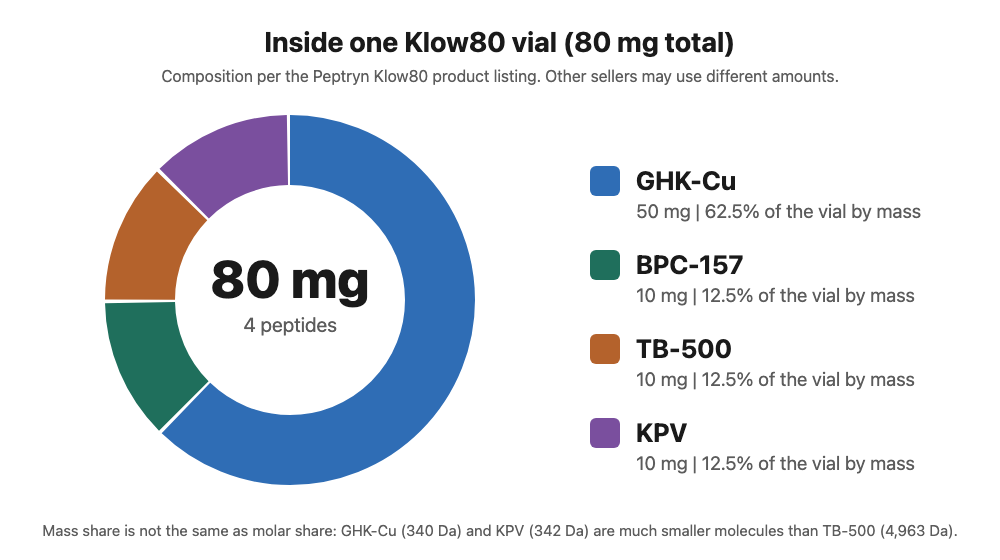
| Component | Amount per vial | Share of vial by mass | Approx. molecular weight |
|---|---|---|---|
| GHK-Cu (copper tripeptide) | 50 mg | 62.5% | 340.38 Da |
| BPC-157 | 10 mg | 12.5% | 1,419.53 Da |
| TB-500 (thymosin beta-4 form) | 10 mg | 12.5% | 4,963.44 Da (full-length) |
| KPV | 10 mg | 12.5% | 342.44 Da |
| Total | 80 mg | 100% |
Composition and molecular weights come from the Peptryn product listings. Two details are worth understanding:
- GHK-Cu is most of the vial by weight. It is a small molecule, though, so its share of the molecules is even larger than 62.5%. The fixed 5:1:1:1 mass ratio means you cannot vary one component without changing the others.
- The “80 mg” figure is total peptide, not an amount of any one compound. Someone reading “80 mg” and assuming 80 mg of active material is misreading the label.
The four peptides in Klow
GHK-Cu (copper tripeptide)
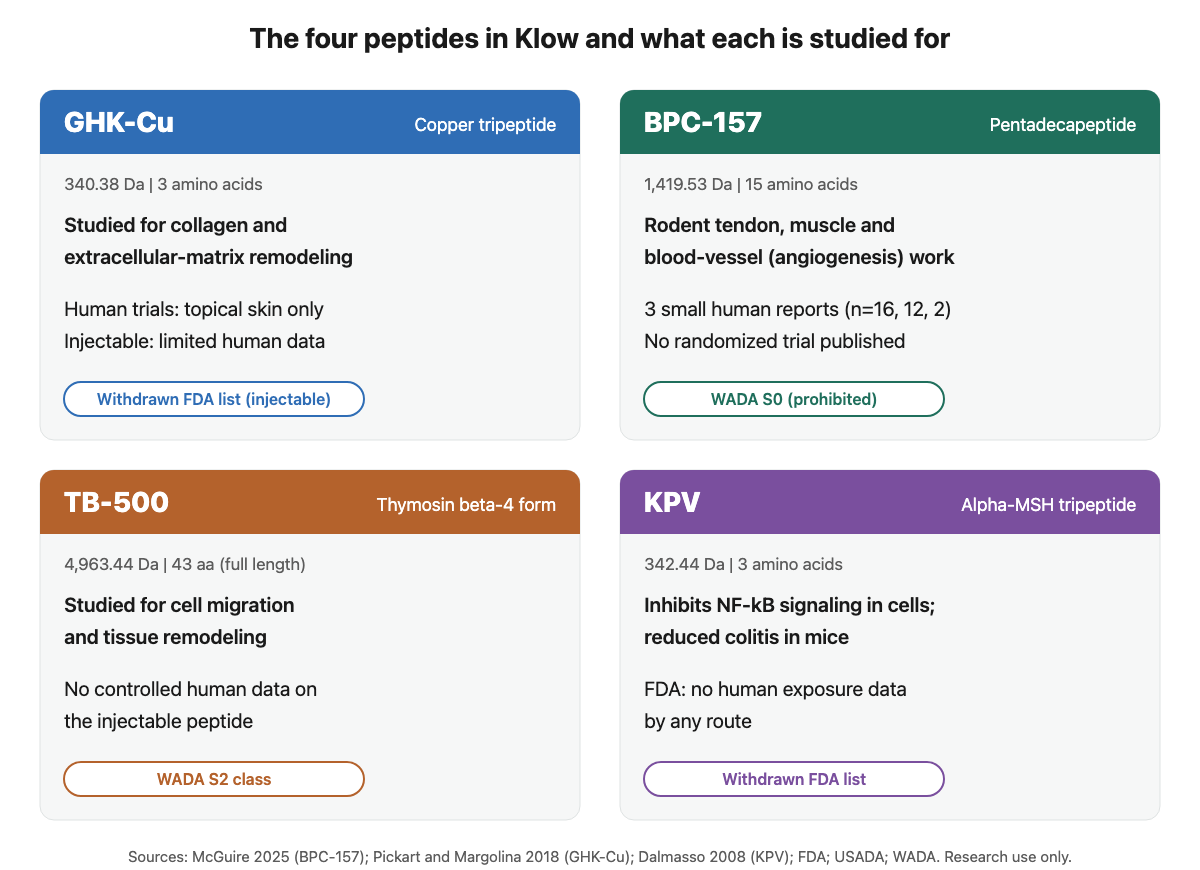
GHK-Cu is a naturally occurring three-amino-acid peptide (glycyl-L-histidyl-L-lysine) bound to copper. It appears in blood plasma and sits within the collagen chain, and it is released when tissue is broken down. A 2018 review by Pickart and Margolina reports plasma GHK falling from about 200 ng/mL at age 20 to about 80 ng/mL by age 60, and describes effects on collagen, elastin and glycosaminoglycan synthesis and on matrix-remodeling enzymes. Using gene-expression data, the same authors report that GHK is associated with changes in the expression of thousands of genes. That is a hypothesis-generating analysis, not proof of a clinical effect.
Human evidence is topical. The controlled human work the review describes involves creams and serums for skin: a 12-week facial cream study in 71 women reported greater skin density and fewer wrinkles, and an eye-cream study in 41 women reported better results than placebo. Those are small, skin-focused trials of topical products. They do not tell us anything about injected GHK-Cu, and NPR reported in September 2026 that the copper peptide trend has moved from creams to injections ahead of the science (NPR). The FDA lists injectable GHK-Cu among substances it has flagged for immunogenicity risk from aggregation and peptide-related impurities, noting limited human data.
BPC-157 (Body Protection Compound-157)
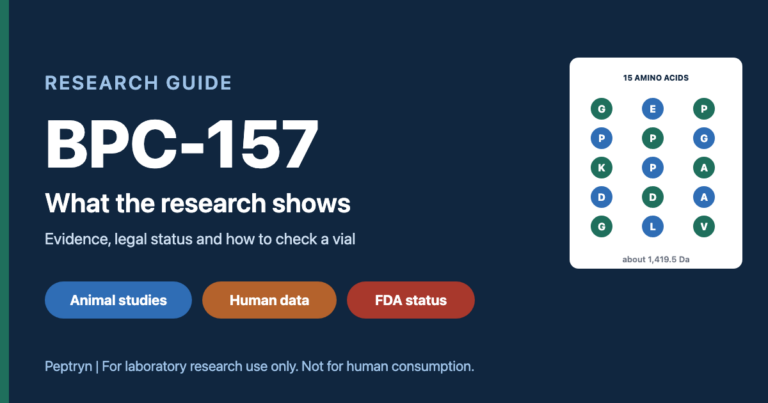
BPC-157 is a synthetic 15-amino-acid peptide (Gly-Glu-Pro-Pro-Pro-Gly-Lys-Pro-Ala-Asp-Asp-Ala-Gly-Leu-Val) described in the 1990s from a protein in human gastric juice. Rodent studies report faster tendon, ligament and muscle healing and effects on blood vessel growth through VEGFR2 and nitric oxide signaling. A 2025 narrative review counts only three published human reports (two randomized trials have since been registered, NCT07437547 in acute hamstring strain and NCT07803250 after rotator cuff repair, and neither has posted results): a retrospective review of 16 patients with knee pain, a 12-person pilot in interstitial cystitis, and a 2-person intravenous safety pilot. It found no randomized controlled trial, and concluded BPC-157 should be treated as investigational (McGuire et al., 2025). For more, see our Wolverine peptide guide, which covers BPC-157 and TB-500 in depth.
TB-500 (thymosin beta-4 form)
“TB-500” names two different molecules: the 7-amino-acid fragment Ac-LKKTETQ, and full-length thymosin beta-4 (43 amino acids, about 4,963 Da). The full-length protein has been tested in human trials as pharmaceutical products, including topical thymosin beta-4 for venous stasis ulcers (NCT00832091), RGN-259 eye drops for dry eye (NCT03937882) and intravenous recombinant thymosin beta-4 in healthy volunteers and after heart attack (NCT04555824, NCT05984134). We did not assess whether those trials succeeded, and none tested a research vial. Peptryn’s Glow listing identifies its TB-500 as thymosin beta-4 acetate, the full-length form, and the standalone TB-500 listing gives 4,963.44 Da. Confirm the form on the Klow COA. The FDA states it has identified no human exposure data for the fragment. The first registered human trial of the fragment that we found, a Phase 1/2 safety study in adults with stable cardiovascular disease (NCT07487363), began in February 2026, is recruiting, and lists primary completion for February 2027. It is not a tendon or muscle study (ClinicalTrials.gov).
KPV (Lys-Pro-Val)
KPV is the three-amino-acid tail of the hormone alpha-MSH. It is the addition that turns Glow into Klow. The core study is a 2008 Gastroenterology paper by Dalmasso and colleagues: nanomolar KPV inhibited NF-kappaB and MAP-kinase inflammatory signaling in human cell lines, worked through the PepT1 peptide transporter, and, given orally in drinking water, reduced the incidence of chemically induced colitis in two mouse models (PubMed). That is cell and mouse evidence. The FDA states it has identified no human exposure data for KPV by any route, and we found no published controlled human trial.
Why four peptides?
The reasoning behind the stack is that each component acts on a different part of tissue repair:
- GHK-Cu: extracellular matrix and collagen turnover
- BPC-157: blood vessel growth and fibroblast activity in animal injury models
- TB-500: cell migration and actin dynamics
- KPV: inflammatory signaling
The logic is intuitive: repair needs new matrix, blood supply, cell movement and controlled inflammation. But it is a hypothesis about combining compounds, and we found no published study that tests the four together, even in animals. Adding more components also adds more unknowns: more chances for interactions, impurities, and effects that cannot be attributed to any single peptide.
What the research shows
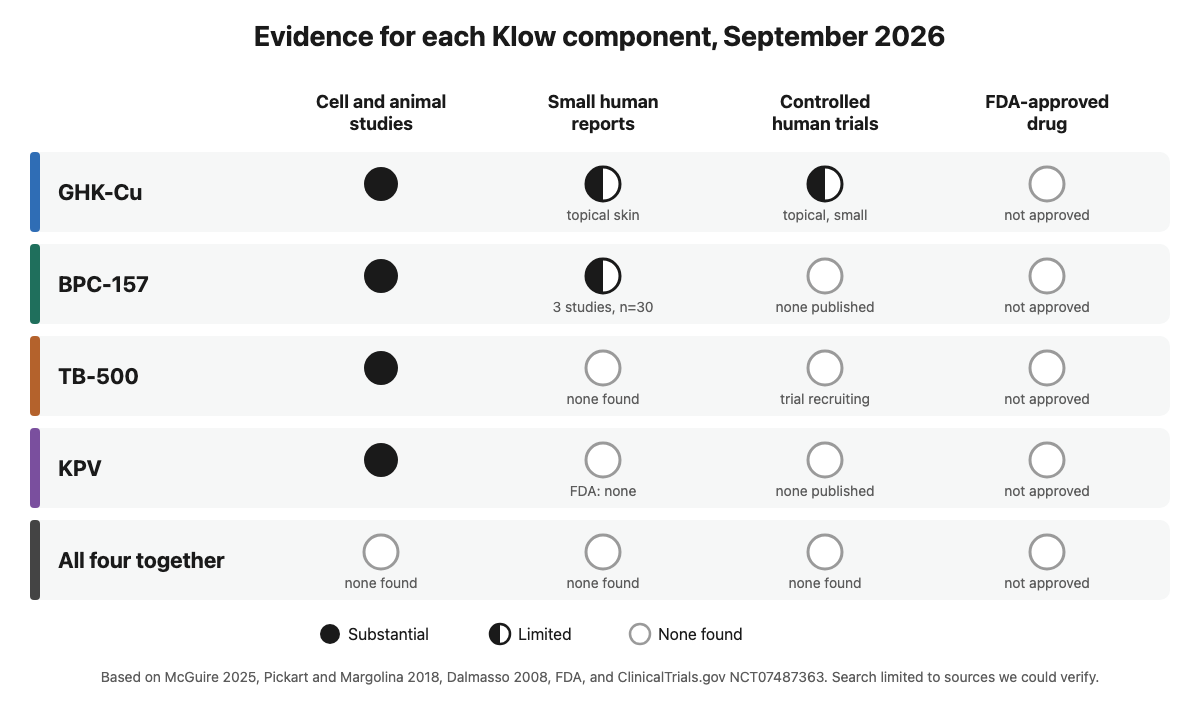
| Component | Cell and animal studies | Human evidence | Controlled human trials | FDA-approved drug |
|---|---|---|---|---|
| GHK-Cu | Yes (fibroblasts, animal wounds) | Topical skin products | Small topical trials | No |
| BPC-157 | Yes (rodent tendon, muscle, vessels) | 3 small reports (16, 12, 2 people) | None published | No |
| TB-500 | Yes | FDA: none identified for the fragment | Phase 1/2 safety trial recruiting | No |
| KPV | Yes (cell lines, mouse colitis) | FDA: none identified by any route | None published | No |
| All four together | None found | None found | None found | No |
This is the honest summary. Every component has laboratory support, GHK-Cu has controlled human data for topical skin use, full-length thymosin beta-4 has trials of pharmaceutical products by other routes, BPC-157 has two registered trials without results, and the combination has no direct evidence at all. Evidence status here reflects our review as of September 2026 and only the sources we could verify.
Klow peptide benefits and “before and after” claims
“Klow peptide benefits” is the most-searched question in this topic, and “before and after” is close behind. The benefits usually claimed online are faster recovery, better skin quality, less inflammation, and joint or tendon repair. Here is how to read them:
- They are extrapolations. Each claim traces to an animal or cell study of one component, or to a topical GHK-Cu trial. None were tested for this blend.
- “Before and after” posts are not evidence. Photos and stories lack controls, blinding, and objective measures. Lighting, angle, weight change, other products and ordinary healing all confound them. A person who feels better after starting something has not shown that the something caused it.
- What would count as evidence? A randomized, placebo-controlled trial with pre-specified outcomes and reported adverse events. None exists for Klow.
Klow vs Glow vs Wolverine vs single peptides
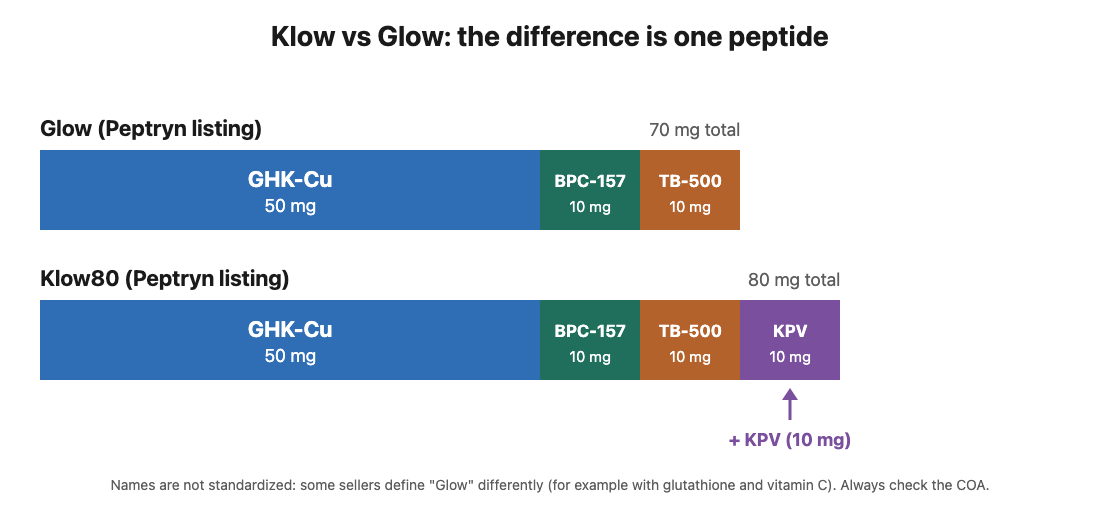
Researchers deciding between a blend and individual compounds should weigh the design of their study, not the name.
| Klow80 | Glow | Wolverine | Single peptides | |
|---|---|---|---|---|
| Contents | GHK-Cu 50, BPC-157 10, TB-500 10, KPV 10 mg | GHK-Cu 50, BPC-157 10, TB-500 10 mg | Typically BPC-157 + TB-500 (confirm on COA) | One compound per vial |
| Total | 80 mg | 70 mg | 10 or 20 mg | Varies |
| Price (Peptryn) | $160 | $150 | From $200 | GHK-Cu 100 mg $74.99; BPC-157 10 mg $79.99; TB-500 10 mg $89.99 |
| Compared with Glow | Adds KPV | n/a | Lacks GHK-Cu | n/a |
| Best for | Studying the four-peptide combination | Studying GHK-Cu with BPC-157 and TB-500 | Studying the two-peptide combination | Attributing an effect to one compound |
How to choose. If your protocol needs to attribute an effect to a single compound, use single-peptide vials, because a fixed-ratio blend cannot separate them. If it deliberately tests a combination in a set ratio, a blend reduces vial handling and the number of punctures. For the Wolverine side of the comparison, see our Wolverine peptide guide.
Klow80 → · Glow → · Wolverine → · GHK-Cu → · BPC-157 → · TB-500 → · KPV →
Klow peptide dosage: why there is no established one
“Klow peptide dosage” gets about 8,100 searches a month, with related “dosage chart,” “dose per day,” and “dosing” queries adding thousands more. The direct answer is that there is no evidence-based dose for Klow, and this guide does not give one.
Here is why any chart you find online should not be trusted as a dose:
- No human trial has tested the blend. Doses on charts are borrowed from animal work, vendor material, or anecdote.
- Each component lacks an established dose too. For BPC-157, USADA states it is unknown whether any dose is safe. The FDA states it has identified no human exposure data for the TB-500 fragment or for KPV.
- The ratio is fixed. Because GHK-Cu is 62.5% of the blend by mass, any amount of Klow delivers five times as much GHK-Cu as each other peptide. You cannot adjust one without the others.
- Concentration is not a dose. Concentration is a laboratory property of a solution. It says nothing about how much of anything is appropriate.
What lab users legitimately need is concentration math, which depends only on mass and volume:
Concentration (mg/mL) = peptide mass (mg) ÷ diluent volume (mL)
Reconstitution and handling of Klow in the lab
For an 80 mg vial, the concentration of the whole blend and of each component depends on how much diluent is added:
| Diluent added | Total blend | GHK-Cu | BPC-157 | TB-500 | KPV |
|---|---|---|---|---|---|
| 2 mL | 40 mg/mL | 25 mg/mL | 5 mg/mL | 5 mg/mL | 5 mg/mL |
| 3 mL | 26.7 mg/mL | 16.7 mg/mL | 3.3 mg/mL | 3.3 mg/mL | 3.3 mg/mL |
| 4 mL | 20 mg/mL | 12.5 mg/mL | 2.5 mg/mL | 2.5 mg/mL | 2.5 mg/mL |
This is arithmetic for laboratory concentration records, not a dosing table. Confirm the vial can hold the total volume you add.
Handling basics (per the Peptryn product specification and standard practice):
- Store the lyophilized powder at −20 °C, protected from light and repeated freeze-thaw cycles.
- Let the vial and diluent reach room temperature, disinfect the stoppers, and add bacteriostatic water slowly down the inner wall of the vial. Swirl gently, never shake.
- Refrigerate the reconstituted solution at 2–8 °C. Bacteriostatic water is usable for up to 28 days once opened, but there is no published stability data for a reconstituted four-peptide blend, so shorter is safer.
- GHK-Cu is a copper complex, and copper peptide solutions can carry a bluish tint. A clear solution with a slight tint is not necessarily a problem, but cloudiness, particles or strands are. If in doubt, discard it and contact support with your lot number.
For the full step-by-step process, see the reconstitution basics guide, the bacteriostatic water guide, the peptide calculator, and the storage and handling guide. Bacteriostatic water is available here: BAC Water 10 mL →
Regulatory and sport status
FDA. None of the four is an FDA-approved drug. On the FDA’s page listing bulk drug substances that may present significant safety risks for compounding, all four appear in the section for nominations that were later withdrawn, as of our September 2026 check. The FDA’s published concerns remain:
- GHK-Cu (injectable): possible immunogenicity from aggregation and peptide-related impurities; limited human data.
- KPV: no human exposure data identified by any route; the agency lacks information on whether it would cause harm.
- TB-500 fragment: possible immunogenicity; no human exposure data identified.
- BPC-157: possible immunogenicity and impurity concerns; no or limited safety information.
(FDA.) Regulatory pages change, so verify the current status before relying on it.
The July 2026 advisory panel. Three of the four components were among the peptides the FDA’s Pharmacy Compounding Advisory Committee reviewed on July 23, 2026: BPC-157 (nominated for ulcerative colitis), TB-500 (wound healing) and KPV (wound healing and inflammatory conditions). The panel voted 8-6, with one abstention, to recommend adding them to the list of substances pharmacies may compound. GHK-Cu was not among the peptides reported as reviewed. These votes are advisory: they do not make any component an approved drug, the FDA is not bound by them, and trade coverage reports a formal rulemaking process of roughly eight to twelve months would have to follow. FDA staff recommended against the nominations, citing safety and efficacy concerns (Pharmaceutical Executive; RAPS). A recommendation about pharmacy compounding of individual substances says nothing about a four-peptide research blend.
Sport. BPC-157 is prohibited at all times under the S0 (non-approved substances) category of the WADA Prohibited List, and USADA states that it is unknown whether any dose is safe (USADA). TB-500, a thymosin beta-4 derivative, is addressed under the S2 class of the WADA Prohibited List. Because Klow contains both, athletes subject to testing should treat it as prohibited.
Sale as research material. Peptryn supplies peptides for laboratory research only, to buyers who are 21 or older and who confirm qualified research use. It is not a compounding pharmacy and does not offer these products for human use.
Safety: what is known and unknown
Known. The topical GHK-Cu literature describes decades of cosmetic use without reported adverse effects, but that applies to skin products and not injections. The three BPC-157 human reports (30 people in total) reported no adverse events.
Theoretical. Reviewers of BPC-157 have raised the concern that a compound promoting blood vessel growth could, in principle, support unwanted vessel growth, and that heavy nitric oxide signaling could have downstream effects. These are proposed risks, not observed ones.
Unknown.
- Long-term safety of any component, alone or combined
- Any safe or effective dose in humans
- Interactions between the four peptides, and with other drugs
- Effects of the copper in GHK-Cu when combined with the others
Practical, present risk. The FDA points to aggregation and impurities as drivers of immune reactions. Product quality can matter as much as the molecule, which is why batch-level testing of each component is the most useful thing a researcher can verify.
Klow peptide reviews and Reddit: how to read anecdotes
Searches for “Klow peptide reviews” and “Klow peptide Reddit” show people looking for other users’ experiences. A few points on reading them:
- Anecdotes are not trials. They can generate questions but cannot show that a product works or is safe.
- Watch the incentives. Many “reviews” come from sellers, affiliates or clinics with something to sell.
- Product reviews are not efficacy evidence. A review of shipping speed or packaging says nothing about biological effect.
- Verify, then trust. A vendor’s own documents (lot-specific COAs) are more useful than any testimonial.
This guide contains no testimonials, because they would not be evidence. What you can check for yourself are batch certificates in the COA library.
How to evaluate a Klow vial before you buy
Because “Klow” is a name and not a standard, the paperwork is what separates a reliable vial from a mislabeled one. Use this checklist.
- A COA for your specific lot. It should show the lot number and date, not a generic sample.
- Identity for each of the four peptides by mass spectrometry. A blend needs four identities confirmed, not one.
- Purity and content per component. Look for ≥99% by HPLC for each peptide, and ask whether the mass of each is quantified. A single “blend purity” number can hide a wrong ratio.
- The TB-500 form. Ask whether it is the 7-amino-acid fragment or full-length thymosin beta-4.
- Endotoxin testing. Relevant for any material handled in solution.
- An independent lab. Peptryn’s batch testing is done by MZ Biolabs, with certificates published by lot.
- A clear statement of composition and amounts. You should know the milligrams of each peptide per vial.
- No medical claims from the seller. A supplier promising healing or results for a research chemical is signaling the wrong thing.
- Correct storage and shipping. Lyophilized powder should be stored cold and protected from light.
Not sure how to read the paperwork? Peptryn’s guide on how to read a certificate of analysis walks through each line. If a lot’s COA isn’t published yet, email support with your order number and they will send the current report on file.
Orders ship from the USA with same-day dispatch, and orders over $150 ship free.
Frequently asked questions
What is Klow peptide used for?
In the laboratory, Klow is used to study combined effects of GHK-Cu, BPC-157, TB-500 and KPV on tissue-repair, matrix and inflammatory pathways in cell and animal models. Online, it is marketed for recovery, skin and inflammation, but those uses have not been tested in controlled human trials.
What is in Klow peptide?
Klow80 contains GHK-Cu (50 mg), BPC-157 (10 mg), TB-500 (10 mg) and KPV (10 mg) in an 80 mg vial, per the Peptryn listing. Other sellers may differ.
What is the difference between Klow and Glow?
Klow is Glow plus KPV. Peptryn’s Glow is 70 mg (GHK-Cu 50 mg, BPC-157 10 mg, TB-500 10 mg), and Klow80 adds 10 mg of KPV for 80 mg. Some sellers define Glow differently, so check the COA.
Does Klow peptide work?
No controlled human trial has tested the blend, so there is no evidence that it does. Animal and cell studies of individual components report effects on tissue repair and inflammation, and topical GHK-Cu has small human skin trials.
What are the Klow peptide side effects?
No reliable side-effect profile exists for the blend. The FDA has raised concerns about immunogenicity and impurities for injectable versions of its components, and has identified no human exposure data for KPV or the TB-500 fragment.
How long should you stay on Klow peptide?
No one knows. There is no established duration, dose or schedule because no controlled human trial has tested it.
How much does Klow peptide cost per month?
The Klow peptide price at Peptryn is $160 per 80 mg vial, with volume discounts from three vials. Any “per month” figure depends on a usage protocol, and no human protocol has been established.
Is Klow peptide safe?
Safety has not been established. The available human data for the components is limited and mostly topical or very small, and the FDA has published safety concerns.
Is Klow peptide FDA-approved?
No. None of GHK-Cu, BPC-157, TB-500 or KPV is an approved drug for these uses. In July 2026 an FDA advisory panel voted 8-6 to recommend adding BPC-157, TB-500 and KPV to the pharmacy compounding list. That is an advisory recommendation about compounding, not an approval, and it does not apply to a four-peptide blend.
Is Klow peptide legal?
It is sold in the US as a research chemical for laboratory use. It is not approved for human use, and BPC-157 and TB-500 are banned in tested sports. If you have a legal question about your situation, consult an attorney.
Is there an oral Klow peptide?
Some sellers market capsules or sprays. We found no human data on oral Klow. The oral KPV evidence is limited to a mouse colitis model.
Klow peptide for sale: where can researchers buy it?
Peptryn supplies Klow80 in 80 mg vials with batch-specific certificates of analysis. View the product → Buyers must be 21 or older and confirm laboratory research use.
Where do you inject Klow peptide?
Peptryn’s products are not for human injection or self-administration, so this guide gives no injection instructions.
Final take
Klow is best understood as a marketing name for a hypothesis: that four peptides acting on matrix, blood supply, cell movement and inflammation might work better together. Each component has real laboratory support, GHK-Cu has controlled human data (topical, for skin) and thymosin beta-4 has trials of pharmaceutical products by other routes, and the combination has never been tested directly. For researchers, the useful questions are practical: is the identity of each peptide confirmed, is each one quantified, and is the paperwork for your lot?
Browse Klow80, Glow, Wolverine and single peptides with batch COAs →
Related guides: BPC-157 research guide · Wolverine peptide guide · How to read a certificate of analysis · Reconstitution basics for laboratory peptides · Proper storage and handling of research peptides · MOTS-c peptide guide · SS-31 peptide guide · Glow peptide guide · What is a COA? · Peptide purity · Peptide testing · Popular peptides
Editorial note: Peptryn sells the research peptides discussed in this guide for laboratory use only. This guide is informational and is not medical advice. Sources are listed below. To report an error, email [email protected].
Sources
- Pickart L, Margolina A. Regenerative and Protective Actions of the GHK-Cu Peptide in the Light of the New Gene Data. Int J Mol Sci, 2018. pmc.ncbi.nlm.nih.gov
- McGuire FP, et al. Regeneration or Risk? A Narrative Review of BPC-157 for Musculoskeletal Healing. Current Reviews in Musculoskeletal Medicine, 2025. pmc.ncbi.nlm.nih.gov
- Dalmasso G, et al. PepT1-mediated tripeptide KPV uptake reduces intestinal inflammation. Gastroenterology, 2008. pubmed.ncbi.nlm.nih.gov
- U.S. Food and Drug Administration. Certain Bulk Drug Substances for Use in Compounding that May Present Significant Safety Risks. fda.gov
- U.S. Anti-Doping Agency. BPC-157: Experimental Peptide Creates Risk for Athletes. usada.org
- World Anti-Doping Agency. Prohibited List. wada-ama.org
- ClinicalTrials.gov. Phase 1/2 study of TB-500 (thymosin beta 4 17-23 fragment) in adults with stable atherosclerotic cardiovascular disease (NCT07487363). clinicaltrials.gov
- NPR. The copper peptide trend has gone from creams to injections, ahead of the science (September 7, 2026). npr.org
- U.S. Food and Drug Administration. July 23-24, 2026: Meeting of the Pharmacy Compounding Advisory Committee. fda.gov
- Pharmaceutical Executive. FDA Panel Votes to Loosen Restrictions for Four Peptides. pharmexec.com
- Regulatory Affairs Professionals Society. FDA advisory committee backs two controversial peptides. raps.org
All products on peptryn.com are intended for laboratory research purposes only. Not for human consumption, self-administration, or veterinary use. The information on this page has not been evaluated by the U.S. Food and Drug Administration and is not intended to diagnose, treat, cure, or prevent any disease. Nothing here should be construed as medical advice.