KPV Peptide: What the Research Shows and Where FDA Stands (2026)
Note: This guide is educational and is not medical advice. Peptryn supplies research-use-only peptides to laboratories, and nothing here suggests using research materials on yourself. Speak to a licensed clinician about gut, skin or joint symptoms.
The short answer
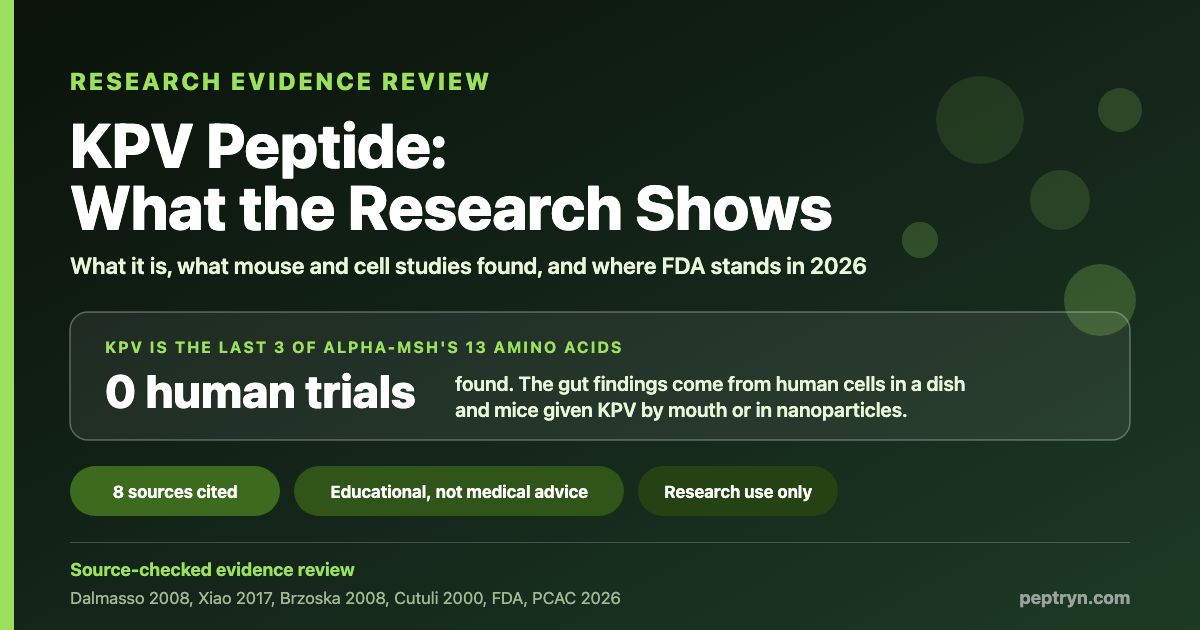
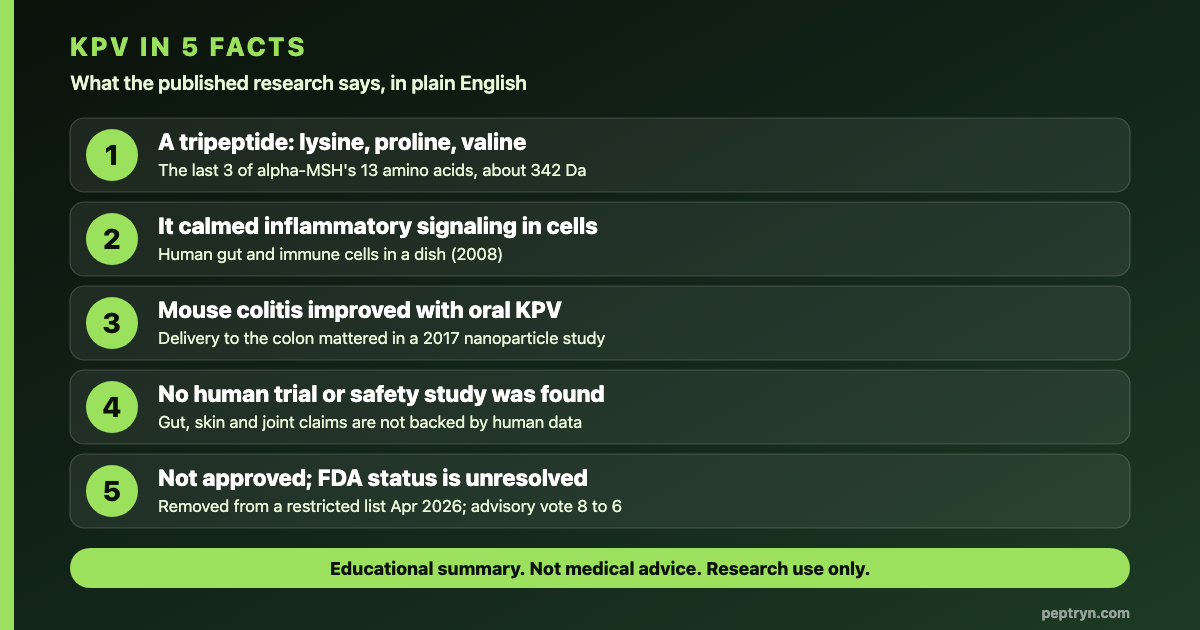
KPV is a tripeptide, three amino acids long (lysine, proline, valine). It matches the last three positions of alpha-melanocyte-stimulating hormone (alpha-MSH), a 13-amino-acid hormone the body makes. Laboratory and mouse studies report that KPV calms inflammatory signaling, mostly in the gut. We found no published human clinical trial of KPV, so what it does in people is unknown.
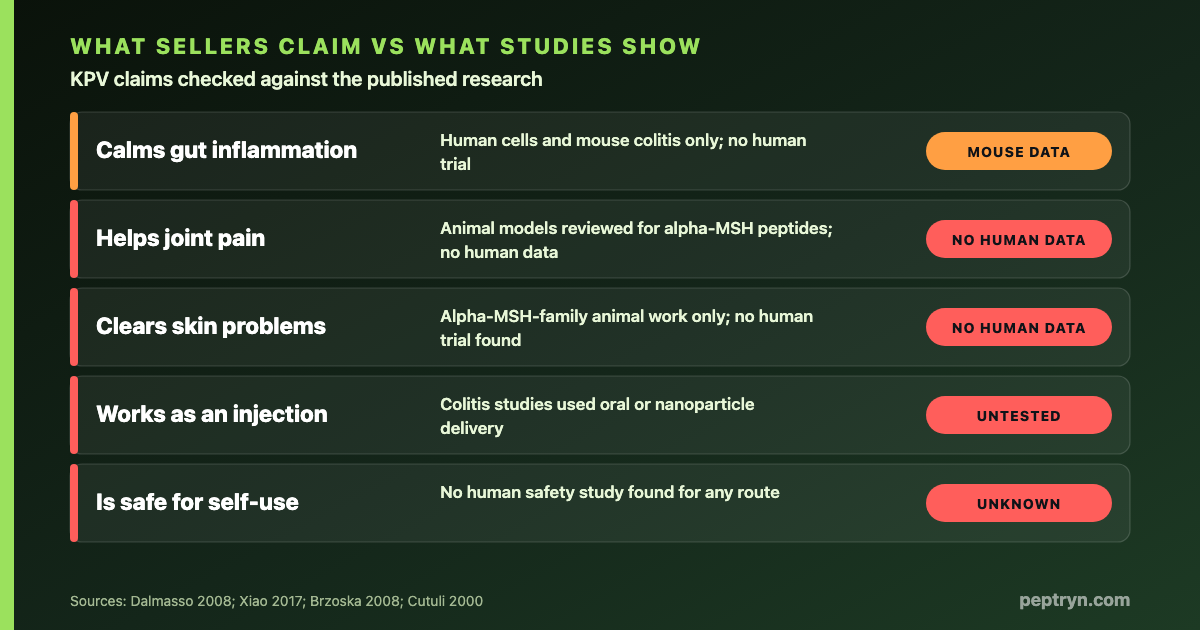
KPV is widely marketed for gut, skin and joint problems, often as an oral capsule, a cream or an injection. The research behind those claims is on cells and mice, and the mouse work involved oral delivery to the gut. It says little about an injection or a supplement. On regulation, KPV is not an approved drug. FDA removed it from a restricted compounding list in April 2026, and an advisory committee voted 8 to 6 in July to recommend it for a compounding list, which is advice and not approval.
| Question | What is known | Evidence |
|---|---|---|
| What is KPV? | Lys-Pro-Val, residues 11 to 13 of alpha-MSH, about 342 daltons | Chemistry |
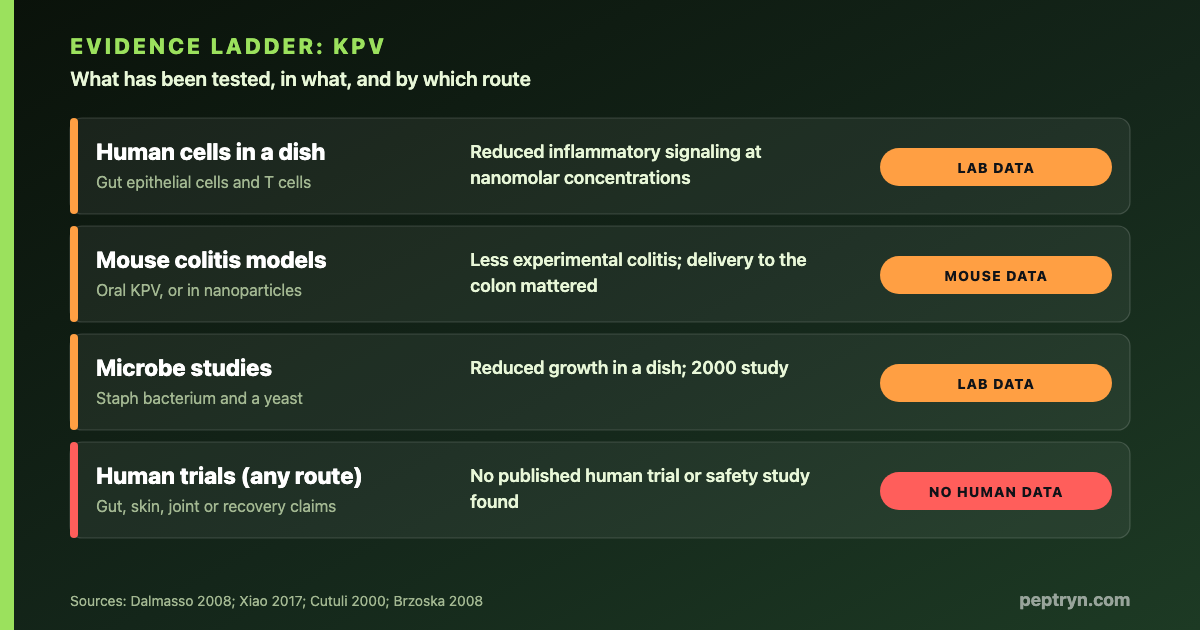
| Does it reduce inflammation? | In human gut and immune cells it reduced inflammatory signaling; in mice, oral KPV reduced experimental colitis | Cells and mice |
| Does it fight microbes? | It slowed growth of a staph bacterium and a yeast in a dish | Laboratory only |
| Does it work in people? | No published human trial found | None |
| Is it approved? | No; compounding status unresolved in 2026 | FDA |
What KPV is
Alpha-MSH is best known for its effect on skin pigment, but it also has anti-inflammatory effects. A 2008 review in Endocrine Reviews explains that the pigment effect limits its use as an anti-inflammatory, and that the C-terminal tripeptide, KPV, keeps the anti-inflammatory activity without the pigmentary action. That is the reason researchers became interested in it. The reviewers also note that a small, simple peptide should be cheap to manufacture.
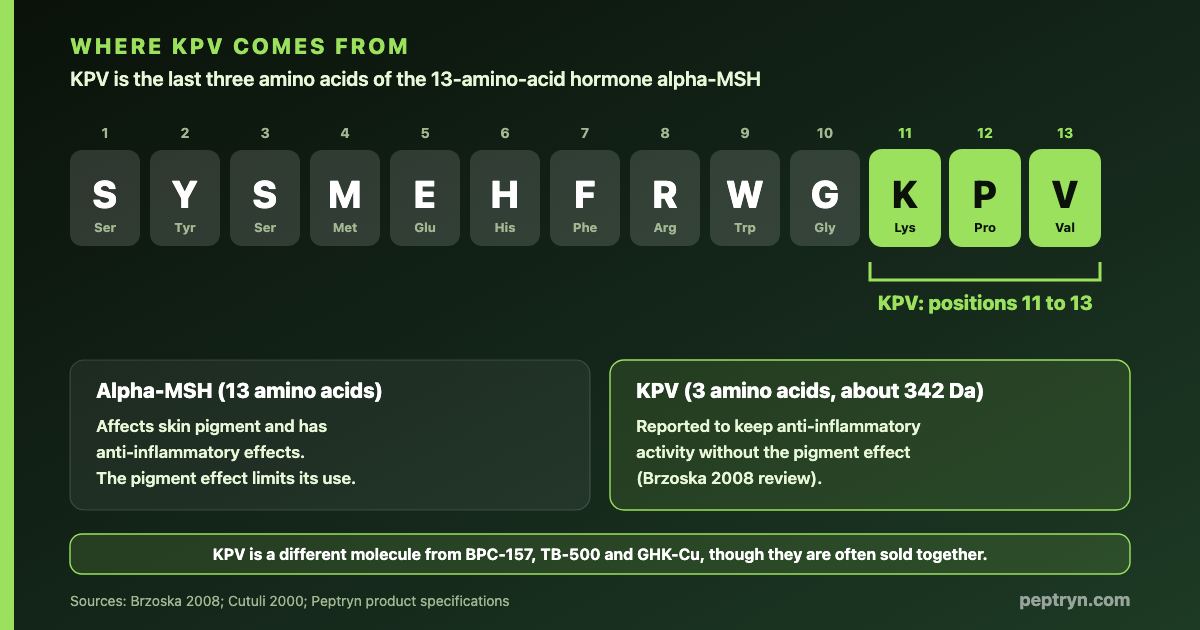
KPV is a fragment, and it is different from BPC-157, TB-500 and GHK-Cu even though online guides often group them. Our guides on BPC-157 and TB-500 cover those.
What the research shows
Human cells and mouse colitis
The most-cited study is a 2008 paper in Gastroenterology. It found that nanomolar concentrations of KPV blocked inflammatory signaling (NF-kappaB and MAP kinase pathways) and reduced the release of inflammatory proteins in human intestinal epithelial cells and human T cells. The authors showed KPV enters cells through PepT1, a transporter that is increased in the colon during inflammatory bowel disease. When KPV was added to the drinking water of mice, it reduced the incidence of two chemically induced forms of colitis. The authors concluded that KPV might be a new therapeutic agent for inflammatory bowel disease.
A 2017 study in Molecular Therapy loaded KPV into hyaluronic acid nanoparticles and found that, in a mouse model of ulcerative colitis, the particles delivered KPV to colon cells, helped mucosal repair and reduced inflammation. The hyaluronic acid version worked better than a comparison particle system without it, so how KPV is delivered mattered.
Antimicrobial findings
A 2000 study found that alpha-MSH and KPV reduced growth of Staphylococcus aureus and the yeast Candida albicans in a dish, and did not reduce the ability of human neutrophils to kill them. It is an early laboratory result and gives no guidance on any use in people.
What is missing
In our searches we found no published human trial of KPV for inflammatory bowel disease, skin conditions or joint pain, and no human safety study. Claims that KPV helps joint pain, skin or general recovery are not backed by controlled human data. A 2008 review lists animal models of skin, lung, joint, eye and gut inflammation for alpha-MSH and related peptides, and describes KPV as a candidate for future use in those areas. Candidate is a long way from established.
Oral, topical and injected KPV are different questions
The main colitis result used KPV taken by mouth in mice, which fits a peptide that is absorbed by a transporter in the gut lining. That says little about a capsule for people, because digestion, dose and formulation all change what reaches the colon. It says even less about injection. The nanoparticle study shows that delivery to the colon changed the result in mice. No study we found tested injected KPV in people. Our peptide safety guide covers what injecting an unregulated product adds in contamination and immune-reaction risk.
Where FDA stands in 2026
KPV is not an FDA-approved drug. In 2023 FDA placed a group of peptides in a restricted category of its compounding list because of concerns about immune reactions, impurities and limited human data. On April 15, 2026, FDA removed twelve peptides from that category, including KPV, because the nominations for them had been withdrawn, and said removal does not make them eligible for compounding. On July 23, 2026, the Pharmacy Compounding Advisory Committee voted 8 to 6, with one abstention, to recommend KPV for the bulk drug substances list, the same margin as BPC-157 and TB-500. FDA scientists raised concerns about insufficient safety, efficacy and characterization information. FDA still has to complete rulemaking, which a law firm following the process expects could run into 2027 or longer. See are peptides legal? for what “research use only” does and does not mean.
Safety questions
- No human data. We found no human safety study of KPV by any route.
- Mouse doses do not translate. The colitis studies used mice and gut-specific delivery, so they do not describe what happens in a person with a capsule or an injection.
- Melanocortin biology. Alpha-MSH acts on pigment and immune cells, and the 2008 review says KPV does not have the pigment effect. We found no study linking KPV to cancer or showing it is free of that risk, so it remains an open question.
- Product quality. Peptides sold online vary in purity, quantity and contamination. Our COA data report found that the KPV component of a blend read 11.73 mg against a 10 mg label, and Peptryn’s standalone KPV listing does not yet have a certificate in its library, which the product page says openly.
Questions to ask about any KPV product
- Is the sequence right? KPV is 342 daltons, and the certificate should show identity by mass spectrometry.
- Is there a lot-matched certificate? Look for purity, quantity and endotoxin from a lab you can verify.
- What form is being sold? Oral, topical and injectable products are different, and the research covers none of them in people.
- What is the label’s stated use? “For research use only” means the seller is not offering it for human use.
- Which studies does the seller cite? Mouse colitis work does not support claims about joints, skin or recovery.
Frequently asked questions
What is KPV peptide?
KPV is a tripeptide, lysine-proline-valine, that matches the last three amino acids of alpha-MSH. It has been studied in cells and mice for its anti-inflammatory activity.
What is KPV used for?
In research it is studied mainly for gut inflammation in cell and mouse models. It is not approved for any use, and no human trial supports the gut, skin or joint claims made for it online.
Is KPV the same as BPC-157?
No. BPC-157 is a 15-amino-acid peptide, and KPV is a three-amino-acid fragment of alpha-MSH. They are often sold together, but they are different molecules with different research.
Is KPV safe?
No human safety data were found, so no safety claim can be made.
Is KPV FDA approved?
No. FDA removed it from a restricted compounding list in April 2026, and an advisory committee recommended it for a compounding list in July, but neither step approves it.
Is KPV legal?
It is not an approved drug, so it cannot lawfully be marketed for human use, and its compounding status is unresolved in 2026.
Related: BPC-157 · TB-500 · Klow peptide · Wolverine peptide · Kisspeptin-10 · Are peptides safe? · Are peptides legal? · Pinealon
Sources
Dalmasso G, et al. PepT1-mediated tripeptide KPV uptake reduces intestinal inflammation. Gastroenterology, 2008 (PMID 18061177). pubmed.ncbi.nlm.nih.gov
Xiao B, et al. Orally targeted delivery of tripeptide KPV via hyaluronic acid-functionalized nanoparticles in a mouse model of ulcerative colitis. Molecular Therapy, 2017 (PMID 28143741). pubmed.ncbi.nlm.nih.gov
Brzoska T, Luger TA, Maaser C, Abels C, Boehm M. Alpha-melanocyte-stimulating hormone and related tripeptides: biochemistry, anti-inflammatory and protective effects, and future perspectives for immune-mediated inflammatory diseases. Endocrine Reviews, 2008 (PMID 18612139). pubmed.ncbi.nlm.nih.gov
Cutuli M, Cristiani S, Lipton JM, Catania A. Antimicrobial effects of alpha-MSH peptides. Journal of Leukocyte Biology, 2000 (PMID 10670585). pubmed.ncbi.nlm.nih.gov
Frier Levitt. FDA peptide update 2026: removal from the “do not compound” list. frierlevitt.com
McDermott Will & Schulte. Bulk-list bound? PCAC backs majority of peptides in two-day public meeting. mcdermottlaw.com
U.S. Food and Drug Administration. Certain bulk drug substances for use in compounding that may present significant safety risks. fda.gov
Peptryn. Peptide COA data report: purity and quantity across 15 lab-hosted certificates, September 2026. peptryn.com
For laboratory research use only. Not for human or veterinary use, and not a drug, food, dietary supplement or cosmetic. You must be 21 or older to buy.