Kisspeptin-10: What Human Studies Show and Where FDA Stands (2026)
Note: This guide is educational and is not medical advice. Peptryn supplies research-use-only peptides to laboratories, and nothing here suggests using research materials on yourself. Speak to a licensed clinician about testosterone, fertility or libido concerns.
The short answer
Kisspeptin is a peptide made in the brain that switches on the hormone chain controlling reproduction. It acts on GnRH neurons, which release the signal that tells the pituitary to make LH and FSH, which in turn drive testosterone in men and ovulation in women. Kisspeptin-10 is the 10-amino-acid fragment of the full peptide that keeps its activity.
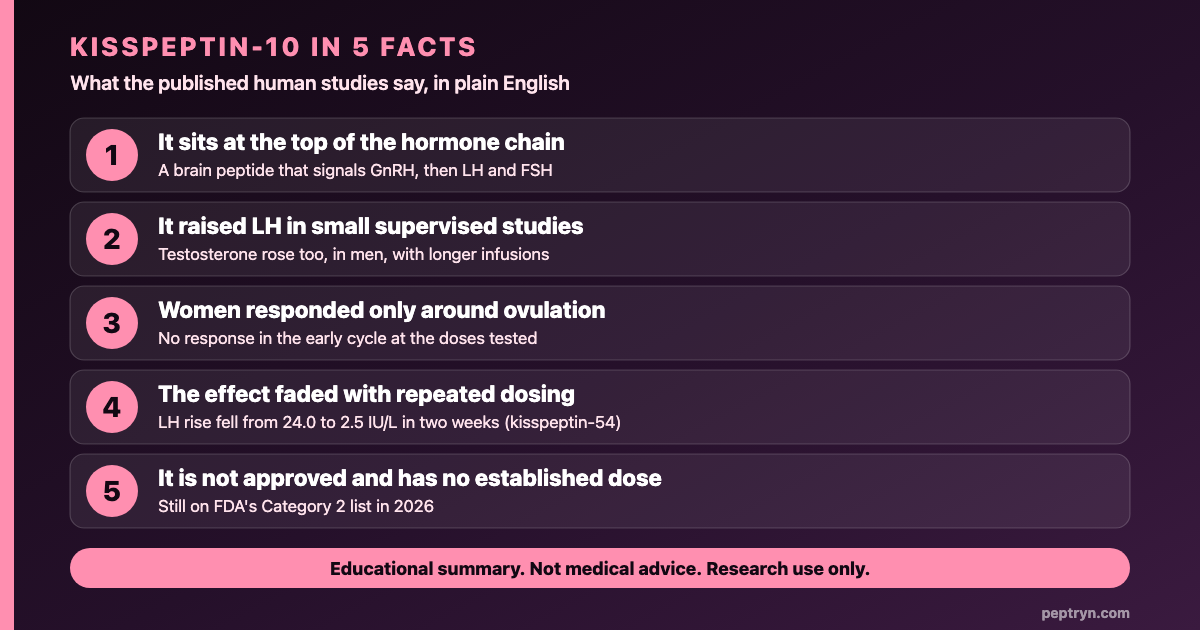
In short, tightly supervised human studies, kisspeptin-10 and its longer relative kisspeptin-54 raised LH, and in men testosterone. The size of the effect depends on sex and, in women, on the phase of the menstrual cycle. When kisspeptin-54 was given twice daily for two weeks to women, the response faded. We found no trial showing that kisspeptin-10 improves fertility, libido, muscle or mood. It is not an approved drug, and it is one of the peptides FDA still lists in its most restricted compounding category.
| Question | What is known | Evidence |
|---|---|---|
| What is it? | A 10-amino-acid fragment (about 1,302 daltons) of the KISS1 gene product | Chemistry |
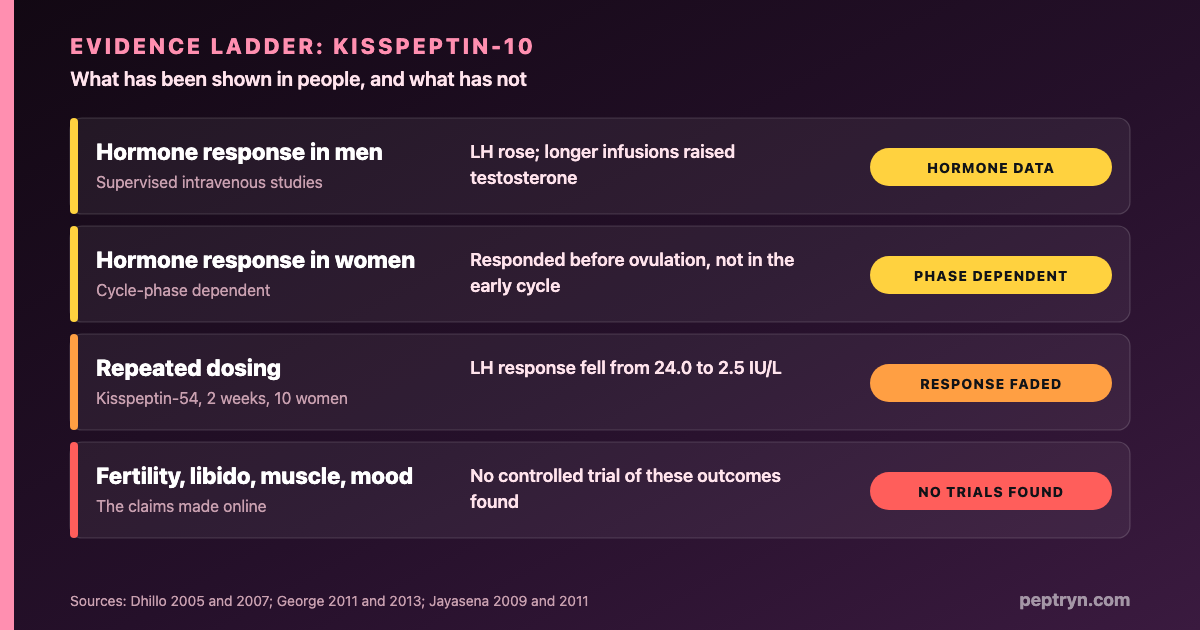
| Does it raise hormones in men? | Yes, in short intravenous studies: LH rose, and testosterone rose with longer infusions | Small human studies |
| Does it in women? | Only around ovulation; no response in the early cycle at the doses tested | Small human studies |
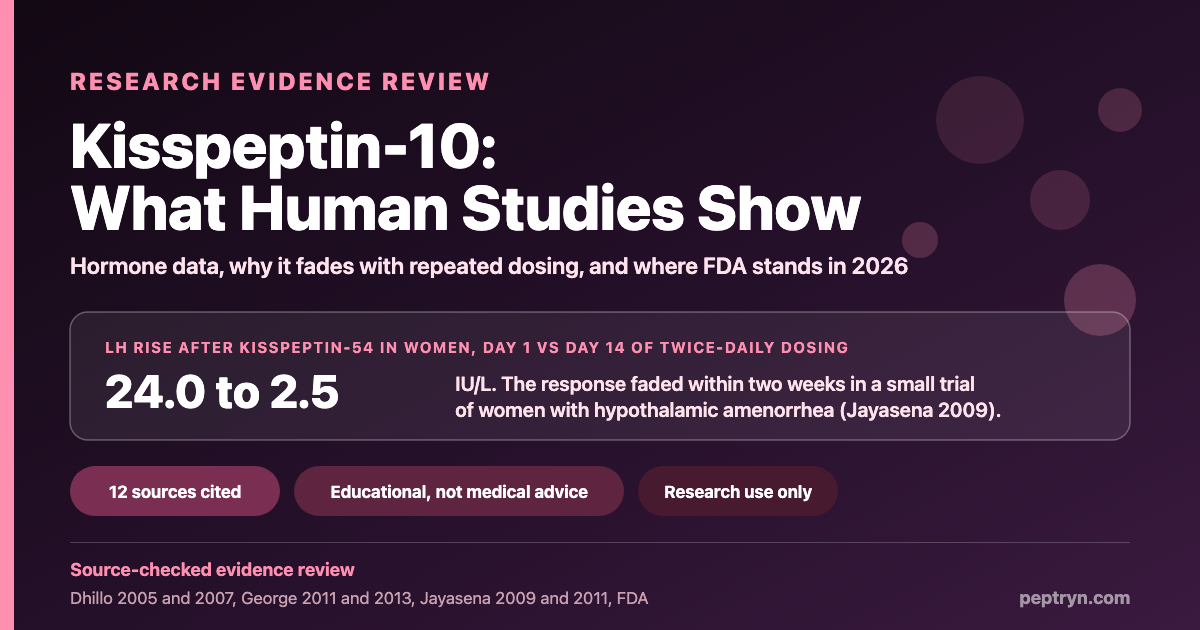
| Does the effect last? | With repeated dosing of kisspeptin-54 for two weeks, the response fell sharply | One small trial |
| Does it improve outcomes? | No trial of fertility, libido, muscle or mood outcomes found | None |
| Is it approved? | No; remains on FDA’s Category 2 list | FDA |
What kisspeptin is and why researchers care
Two 2003 studies showed how central it is. In people with mutations in GPR54, the gene for the protein that kisspeptin activates, puberty was absent or incomplete and the reproductive hormones stayed low, a condition called hypogonadotropic hypogonadism. A 2014 review by Skorupskaite, George and Anderson describes kisspeptin as a principal regulator of gonadotrophin secretion, critical for puberty, for sex-hormone feedback and for adult fertility, in both men and women. It acts upstream of GnRH, and when given to people in different forms, routes and doses, it robustly stimulates LH.
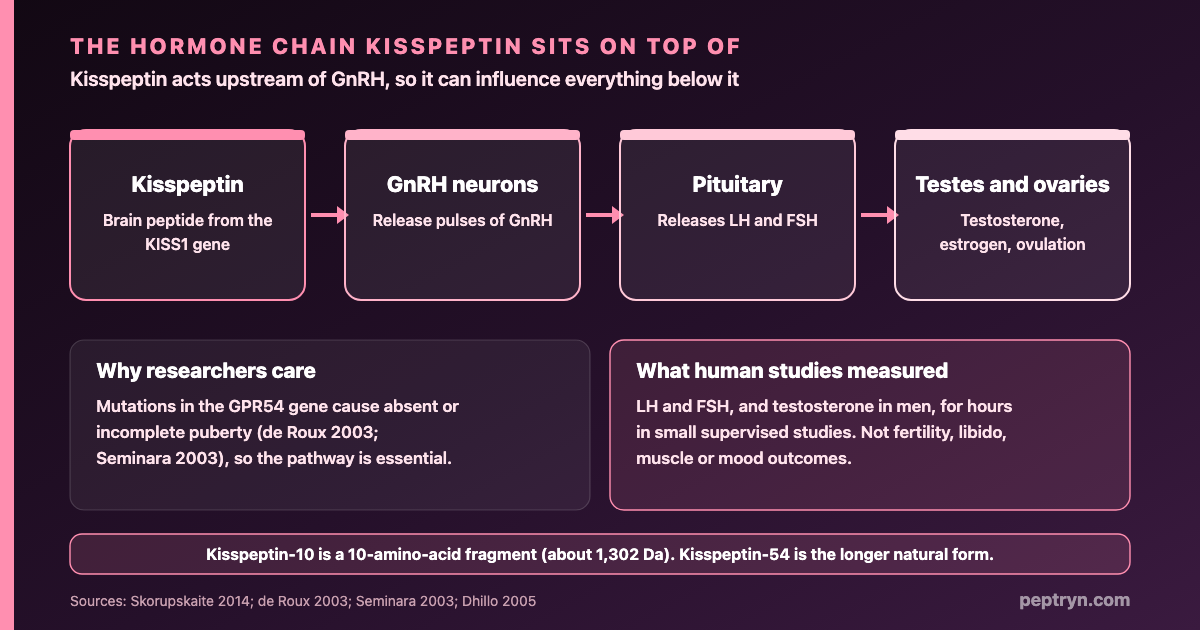
That is why kisspeptin attracts both researchers and marketers. Because it sits at the top of the chain, it could in principle adjust several hormones at once. Whether it can do so safely and usefully outside a laboratory is a separate question.
What human studies show
| Study | Who | Molecule and route | Finding |
|---|---|---|---|
| Dhillo 2005 | 6 men | Kisspeptin-54, 90-minute infusion | LH, FSH and testosterone rose versus saline (mean LH 10.8 vs 4.2 U/L) |
| George 2011 (Edinburgh) | Men without known illness | Kisspeptin-10, intravenous | Dose-dependent LH rise; infusion up to 22.5 hours raised testosterone, LH pulse frequency and pulse size |
| George 2013 | 5 men with type 2 diabetes and low testosterone | Kisspeptin-10, intravenous | Proof-of-concept: more LH pulses and higher testosterone |
| Dhillo 2007 | Women with regular cycles | Kisspeptin-54, under the skin | LH rose in all phases; largest before ovulation, smallest in the early cycle |
| Jayasena 2011 (Imperial) | 4 to 5 men and women per group | Kisspeptin-10, intravenous and subcutaneous | Men responded; women responded before ovulation but not in the early cycle, at the maximum doses tested |
| Jayasena 2009 | 10 women with hypothalamic amenorrhea (5 per group) | Kisspeptin-54, twice daily for 2 weeks | Strong LH rise on day 1 (24.0 IU/L), much smaller by day 14 (2.5 IU/L): desensitization |
Three cautions follow from the table. The studies were small, often five or fewer people per group. Most measured hormone levels for hours, not outcomes such as fertility or sexual function. And two different molecules are involved: kisspeptin-54 has 54 amino acids, kisspeptin-10 has 10, and results for one do not automatically apply to the other.
The 2011 Edinburgh paper concluded that kisspeptin analogues have therapeutic potential as regulators of LH and thus testosterone secretion. That is the researchers’ hypothesis, and it is not a demonstration of benefit. The 2013 proof-of-concept study in men with diabetes was five people.
What is not shown
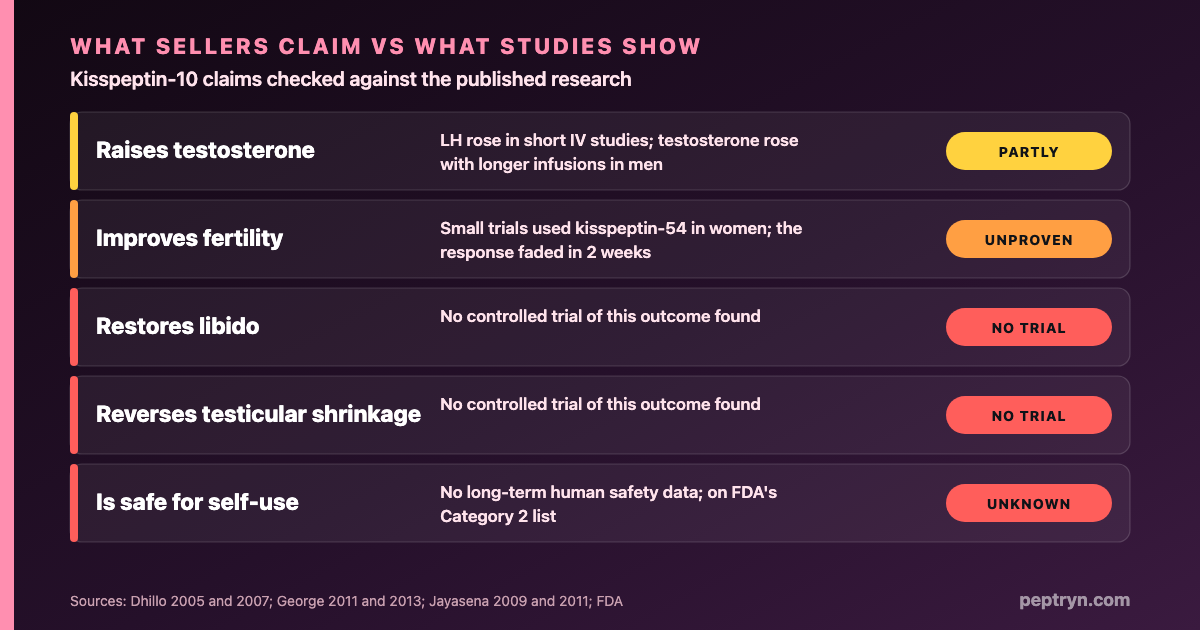
Online clinics and sellers describe kisspeptin as a way to raise testosterone, restore libido, reverse testicular shrinkage or improve fertility. In the sources reviewed for this guide, we found no controlled trial of kisspeptin-10 that measured those outcomes. A rise in LH in a supervised study is a hormone signal. It does not show a patient feels or functions better, and the two-week trial suggests the signal may fade when the peptide is given repeatedly.
Why there is no established dose
Dosing is one of the most common kisspeptin searches. There is no approved product and no dosing guidance from a regulator. The trials used different molecules, routes and amounts in supervised settings, mostly for hours, and they were designed to study hormone physiology. Any schedule you see online for self-use is a guess, so this guide does not list one.
Where FDA stands in 2026
Kisspeptin-10 is not an approved drug. FDA lists Kisspeptin-10 (503A) in Category 2 of its compounding list, the category for substances that may present significant safety risks, citing immune reactions, impurities and limited human data for peptides in general. That sets it apart from several peptides that get discussed alongside it. On April 15, 2026, FDA removed twelve peptides from Category 2 because their nominations were withdrawn, and kisspeptin-10 was not among them. It was also not one of the seven the Pharmacy Compounding Advisory Committee voted on in July 2026. Our guides on TB-500 and KPV cover those votes, and are peptides legal? explains what “research use only” does and does not mean.
Safety questions
- Hormone-axis effects. The 2005 authors described kisspeptin infusion as a way to manipulate the hypothalamic-pituitary-gonadal axis. Changing a hormone axis is a medical intervention and needs supervision.
- Desensitization. The response to repeated kisspeptin-54 dosing fell sharply in two weeks. Long-term effects on the axis are unknown.
- Who was studied. Participants were small groups in supervised research settings, and there are no long-term safety data for self-administered products.
- Product quality. Our guide to peptide safety covers contamination, endotoxin and immune reactions in unregulated injectables. Peptryn’s Kisspeptin-10 listing does not yet have a certificate in its COA library, and the product page says so, so ask any seller, including us, for a lot-matched report first.
Questions to ask about any kisspeptin product
- Which molecule is it? Kisspeptin-10 is about 1,302 daltons. Kisspeptin-54 is much larger. The certificate should show identity by mass spectrometry.
- Is there a lot-matched certificate? Look for purity, quantity and endotoxin from a lab you can verify. Our COA guide explains each test.
- What does the label say about use? “For research use only” means the seller is not offering it for human use.
- What is being claimed? Testosterone, fertility or libido claims go beyond the published studies.
- Which studies are cited? Short intravenous hormone studies in a few people do not describe daily self-injection.
Frequently asked questions
What is kisspeptin?
Kisspeptin is a brain peptide, made from the KISS1 gene, that triggers GnRH release and so controls LH, FSH and the sex hormones.
Is kisspeptin-10 the same as kisspeptin-54?
No. Kisspeptin-54 is the longer natural form and kisspeptin-10 is the 10-amino-acid fragment that keeps its activity. Both raised LH in human studies, but results for one do not carry over to the other.
Does kisspeptin-10 raise testosterone?
In short, supervised studies in men, kisspeptin-10 raised LH, and longer infusions raised testosterone. No trial shows a lasting increase or a benefit from using it.
Does kisspeptin help fertility?
Researchers are interested in it for reproductive disorders, and small studies in women with hypothalamic amenorrhea used kisspeptin-54. We found no trial showing that kisspeptin-10 improves fertility, and the response faded with repeated dosing.
Is kisspeptin FDA approved?
No. FDA lists kisspeptin-10 in Category 2 of its compounding list.
What is the kisspeptin dosage?
There is no established or approved dose. Trial doses were set by researchers for hormone studies and are not guidance for self-use.
Related: Best peptides for men · Best peptides for women · KPV · TB-500 · Are peptides safe? · Are peptides legal? · Pinealon
Sources
de Roux N, et al. Hypogonadotropic hypogonadism from loss of function of the KiSS1-derived peptide’s GPR54 signaling. Proceedings of the National Academy of Sciences, 2003 (PMID 12944565). pubmed.ncbi.nlm.nih.gov
Seminara SB, et al. The GPR54 gene as a regulator of puberty. New England Journal of Medicine, 2003 (PMID 14573733). pubmed.ncbi.nlm.nih.gov
Skorupskaite K, George JT, Anderson RA. The kisspeptin-GnRH pathway in human reproduction and disease. Human Reproduction Update, 2014 (PMID 24615662). pubmed.ncbi.nlm.nih.gov
Dhillo WS, et al. Kisspeptin-54 stimulates the hypothalamic-pituitary gonadal axis in human males. Journal of Clinical Endocrinology and Metabolism, 2005 (PMID 16174713). pubmed.ncbi.nlm.nih.gov
George JT, et al. Kisspeptin-10 is a potent stimulator of LH and increases pulse frequency in men. Journal of Clinical Endocrinology and Metabolism, 2011 (PMID 21632807). pubmed.ncbi.nlm.nih.gov
George JT, et al. Kisspeptin-10 stimulates serum testosterone and LH secretion in men with type 2 diabetes and mild biochemical hypogonadism. Clinical Endocrinology, 2013 (PMID 23153270). pubmed.ncbi.nlm.nih.gov
Dhillo WS, et al. Kisspeptin-54 stimulates gonadotropin release most potently during the preovulatory phase of the menstrual cycle in women. Journal of Clinical Endocrinology and Metabolism, 2007 (PMID 17635940). pubmed.ncbi.nlm.nih.gov
Jayasena CN, et al. The effects of kisspeptin-10 on reproductive hormone release show sexual dimorphism in humans. Journal of Clinical Endocrinology and Metabolism, 2011 (PMID 21976724). pubmed.ncbi.nlm.nih.gov
Jayasena CN, et al. Subcutaneous injection of kisspeptin-54 acutely stimulates gonadotropin secretion in women with hypothalamic amenorrhea, but chronic administration causes tachyphylaxis. Journal of Clinical Endocrinology and Metabolism, 2009 (PMID 19820030). pubmed.ncbi.nlm.nih.gov
U.S. Food and Drug Administration. Certain bulk drug substances for use in compounding that may present significant safety risks (Category 2). fda.gov
Frier Levitt. FDA peptide update 2026: removal from the “do not compound” list. frierlevitt.com
McDermott Will & Schulte. Bulk-list bound? PCAC backs majority of peptides in two-day public meeting. mcdermottlaw.com
For laboratory research use only. Not for human or veterinary use, and not a drug, food, dietary supplement or cosmetic. You must be 21 or older to buy.