Peptides for Hair Growth: What the Evidence Shows (2026)
Note: This guide is educational and is not medical advice. Peptryn supplies research-use-only peptides to laboratories, and nothing here suggests using research materials on yourself. Hair loss has many causes, so speak to a dermatologist before starting anything.
The short answer
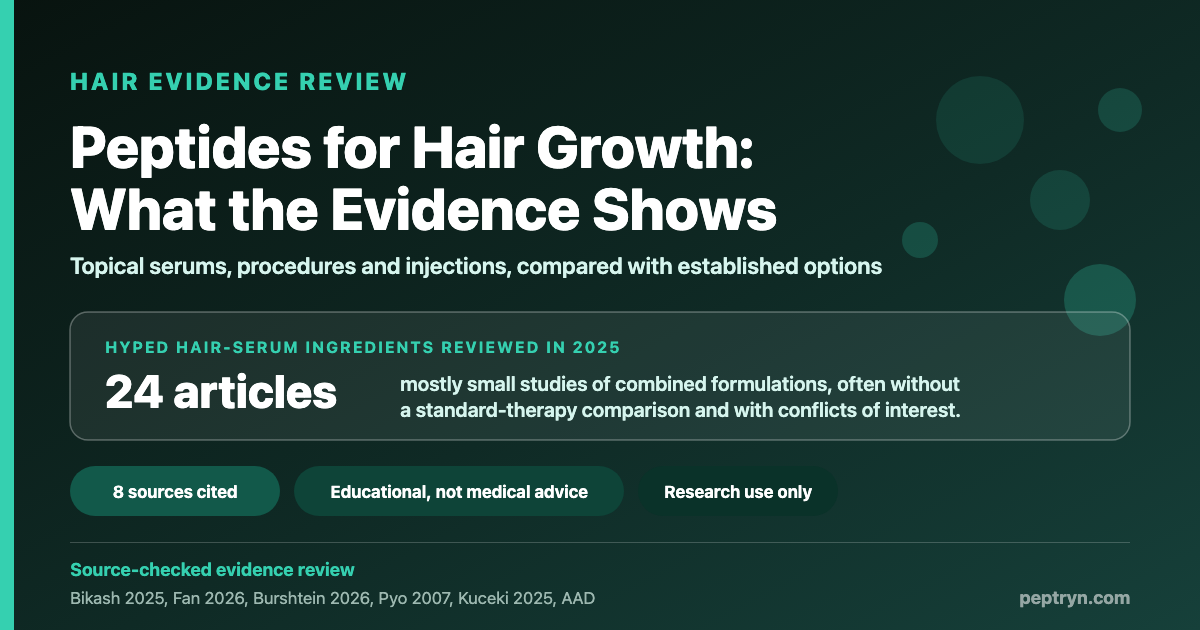
Peptides for hair growth is a label that covers three quite different things: topical serums that list peptide ingredients, in-clinic procedures that push a mix of ingredients into the scalp, and injectable research peptides sold online. The evidence for each is thin, and it gets thinner as you move down that list. A 2025 review of the most hyped topical hair-growth ingredients found that the studies were mostly small, tested combined formulations, often did not compare against standard therapy and often carried conflicts of interest. For injected peptides, we found no published human hair studies at all.
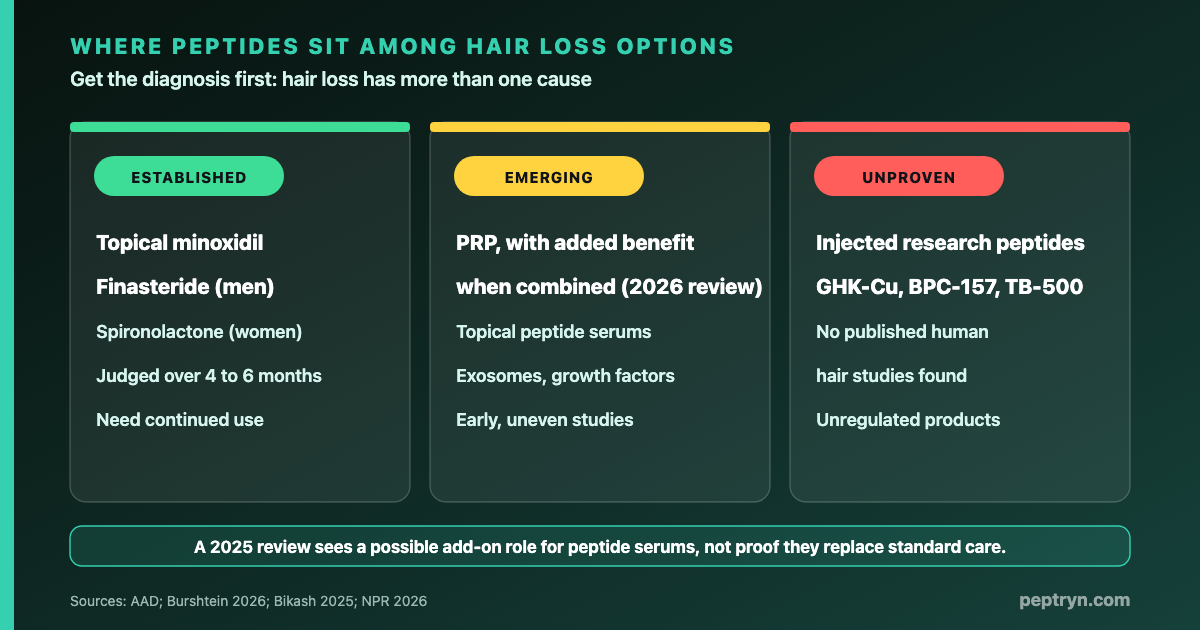
The options with established evidence are older and less fashionable: minoxidil, finasteride for men, and spironolactone for some women, chosen after a dermatologist confirms the cause of the hair loss.
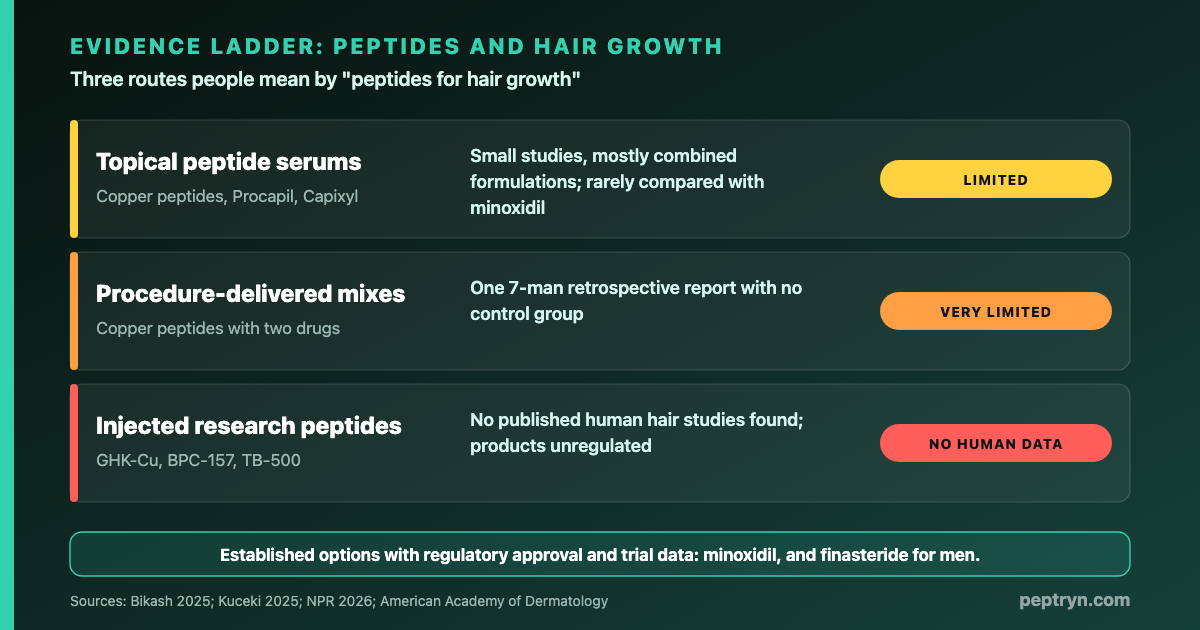
| Route | What the studies look like | Evidence | Main gap |
|---|---|---|---|
| Topical peptide serums | Small randomized or cohort studies, mostly of combined formulations | Limited | Rarely compared with minoxidil or finasteride; conflicts of interest |
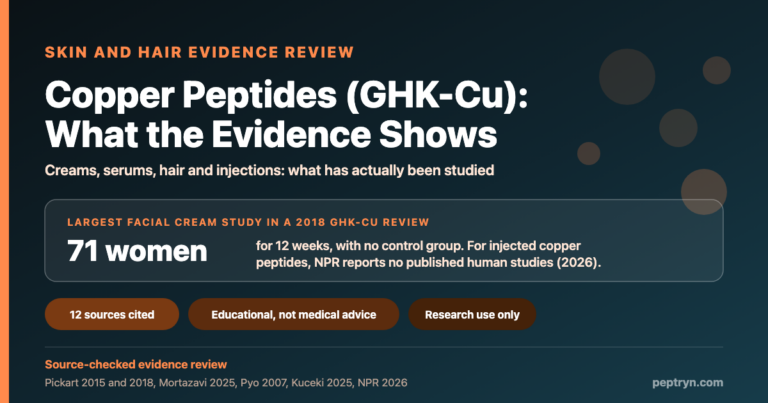
| Procedure-delivered mixes | A 7-man retrospective report of copper peptides given with two drugs by tattoo machine | Very limited | No control group; the peptide’s effect cannot be isolated |
| Injected research peptides | No published human hair studies found | None | Safety and benefit unknown; products are unregulated |
First, what kind of hair loss is it?
Androgenetic alopecia, or pattern hair loss, is the most common form of non-scarring hair loss. It involves progressive shrinking of hair follicles (miniaturization), a shorter growth phase and more hairs in the resting phase. Other causes include hormonal imbalances, autoimmune disorders, infections and psychological stress, according to a 2026 review. Each has a different outlook, so a product tested on one type may do nothing for another. That is one reason dermatologists stress getting the right diagnosis early.
Why peptides are proposed for hair
Short peptides act as signals in the body, and researchers have asked whether some can nudge the cells that drive follicle growth. The best-known laboratory result is a 2007 study of AHK-Cu, a copper peptide, which lengthened human hair follicles kept in culture and increased the growth of dermal papilla cells, the cells that direct follicle growth. A 2026 review of short peptides for hair loss calls the approach promising and says formulations and nanosystems can address peptides’ delivery limits. A result in a dish, though, does not show that a serum on the scalp does the same. Our guide to copper peptides covers this evidence in detail.
What studies of peptide hair serums look like
A 2025 review in the International Journal of Trichology looked at the most hyped active ingredients in hair-growth serums, oils and shampoos, including Redensyl, Procapil, Capixyl, Baicapil and AnaGain. It reviewed 24 articles and technical files. The ingredients had mostly been studied as combined formulations, in randomized trials or prospective cohorts, with promising results. The reviewer also listed the weaknesses: limited sample sizes, no comparison with standard therapies, uneven groups, undisclosed alopecia type and conflicts of interest. The review sees a possible role for these topicals as an add-on, or for people who cannot tolerate standard therapies.
A 2023 randomized trial shows how hard these studies are to read. It enrolled 54 men with androgenetic alopecia and compared two combination regimens, one using topical Procapil and the other using Redensyl, saw palmetto and biotin, each together with platelet-rich plasma (PRP). Because both groups received PRP and neither received a plain vehicle, the trial can say which regimen scored better on hair photography, and it cannot say what the peptide serum did on its own.
Injectable peptides for hair
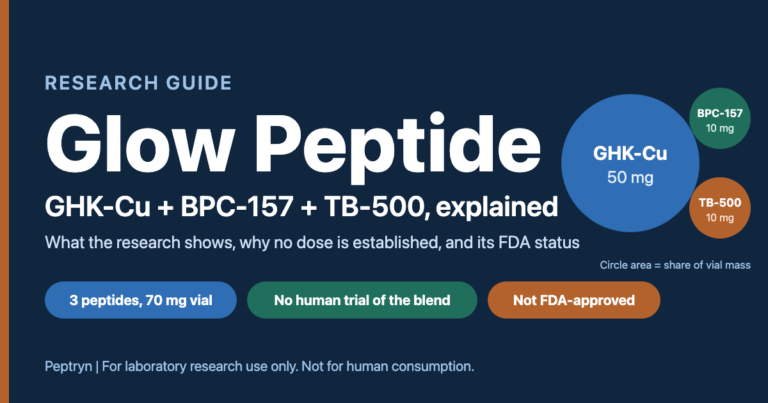
The most searched injectable is GHK-Cu, with BPC-157 and TB-500 also discussed in forums. NPR reported in September 2026 that no published human studies show that injecting copper peptides is safe or effective, and it described reports of raised liver enzymes, elevated copper levels, injection site irritation and infections after people injected products bought online. It is unclear whether the peptide or contaminants caused those problems. In the sources reviewed for this guide, we found no human hair studies for BPC-157 or TB-500, and forum threads are not evidence. See are peptides safe? for the wider safety picture. Laboratory-grade peptides sold for research are not hair products and have not been evaluated for use in people.
What established options look like
The American Academy of Dermatology describes minoxidil (topical, and sometimes oral), finasteride (oral, mainly for men) and spironolactone (oral, for women) as medical options for androgenetic alopecia, plus non-medical ones such as scalp micropigmentation and hair fibers. Topical minoxidil is the option FDA has approved for hair loss in both men and women. One dermatologist quoted by the AAD typically has patients use topical minoxidil for four to six months to judge whether it works, and all of these options need continued use to maintain results. A 2026 review calls minoxidil and finasteride the traditional therapies, notes that their efficacy varies and that they need long-term adherence, and describes PRP as one of the most studied regenerative options, with evidence of added benefit when combined with traditional therapies.
Questions to ask about any peptide hair product
- Which peptide is it, and at what strength? “Peptide complex” on a label does not say.
- Was it tested by itself? Combination studies cannot show what one ingredient does.
- Which type of hair loss did the study include? Results may not carry over to your type.
- Was it compared with minoxidil or a plain vehicle? Without a comparison, improvement could come from anything else in the routine.
- Who paid for the study? Conflicts of interest are common in this field, according to the 2025 review.
- Is it being sold for injection? No human data support that, and unregulated vials add contamination risk.
Frequently asked questions
Do peptides help hair growth?
Some topical peptide ingredients show promising early results, mostly in small studies of combined formulations. No peptide has been shown to match established options such as minoxidil in a controlled comparison in the sources we reviewed.
What is the best peptide for hair growth?
The evidence does not allow a ranking. Copper peptides (GHK-Cu and AHK-Cu) have the most laboratory work, and other ingredients such as Procapil and Capixyl have small studies, but no head-to-head trial compares them.
Are peptide hair serums safe?
The 2025 review describes these topicals as having a less significant side effect profile than standard therapies. We did not find a systematic safety review of them, so ask a dermatologist if you have a scalp condition.
Can peptide injections regrow hair?
No published human studies show that they can, and injected research peptides carry real safety concerns that are covered above.
Are peptides better than minoxidil?
There is no controlled trial showing that in the sources reviewed. Minoxidil has the stronger evidence and regulatory approval for hair loss.
Related: Copper peptides (GHK-Cu) · Are peptides safe? · What are peptides? · List of peptides and what they do · Are peptides legal?
Sources
Bikash C. Topical alternatives for hair loss: beyond the conventional. International Journal of Trichology, 2025 (PMID 40654553). pubmed.ncbi.nlm.nih.gov
Fan C, et al. Overview of short peptides for hair loss. Biomedicines, 2026 (PMID 42072405). pubmed.ncbi.nlm.nih.gov
Burshtein J, Burshtein A, Schlesinger T. Emerging pharmacotherapies and regenerative solutions for promoting hair growth for androgenetic alopecia. Frontiers in Pharmacology, 2026 (PMID 41919230). pubmed.ncbi.nlm.nih.gov
Pyo HK, et al. The effect of tripeptide-copper complex on human hair growth in vitro. Archives of Pharmacal Research, 2007 (PMID 17703734). pubmed.ncbi.nlm.nih.gov
Kuceki G, et al. Enhanced hair regrowth with five monthly sessions of minoxidil-dutasteride-copper peptides tattooing for androgenetic alopecia. JAAD International, 2025 (PMID 40225275). pmc.ncbi.nlm.nih.gov
Tr P, et al. Randomized comparison of topical Procapil with PRP versus Redensyl, saw palmetto and biotin with PRP in androgenetic alopecia, 2023 (PMID 37292551). pubmed.ncbi.nlm.nih.gov
American Academy of Dermatology. Options for genetic hair loss (androgenetic alopecia), with Dr. Paradi Mirmirani. aad.org
Stone W. The copper peptide trend has gone from creams to injections, ahead of the science. NPR, September 7, 2026. npr.org
For laboratory research use only. Not for human or veterinary use, and not a drug, food, dietary supplement or cosmetic. You must be 21 or older to buy.