What Are Peptides? A Plain-English Guide (2026)
Note: This guide is educational and is not medical advice. Peptryn supplies research-use-only peptides to laboratories, and nothing here suggests using research materials on yourself. Speak to a licensed clinician about any medical decision.
The short answer
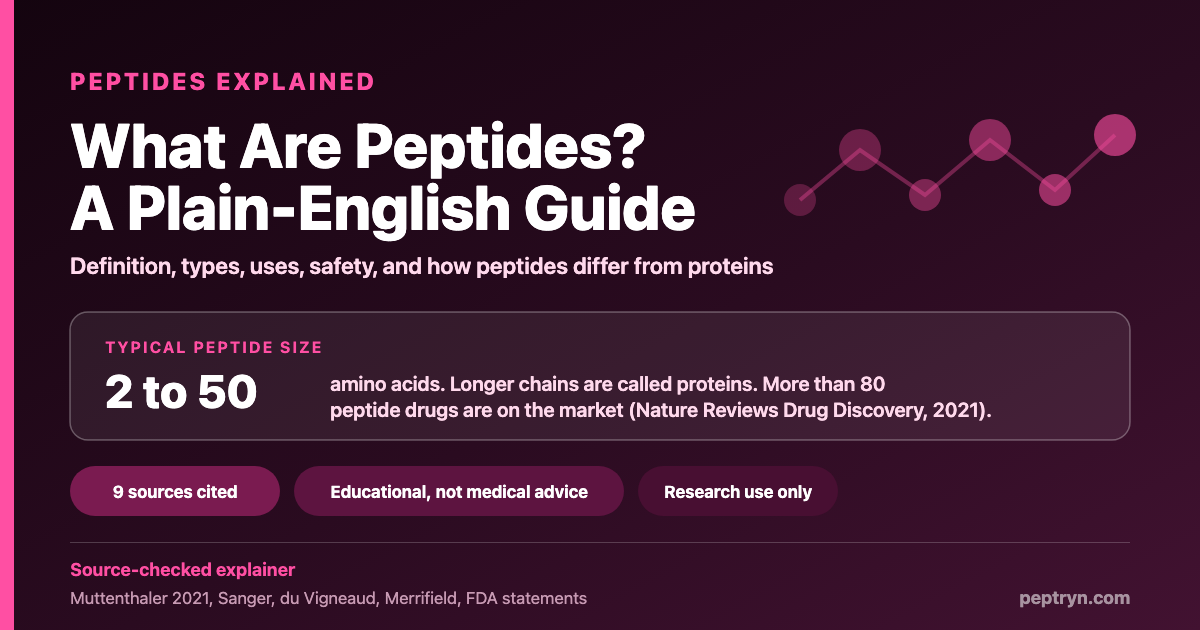
A peptide is a short chain of amino acids joined by peptide bonds. By common convention, a chain of about 2 to 50 amino acids is a peptide, and a longer chain is a protein. Peptides occur naturally in the body, where hormones such as insulin and oxytocin are peptides. They are also found in food, used as medicines (a 2021 review counted more than 80 peptide drugs on the market and about twice as many in clinical development), added to skincare products, and made in laboratories for research. The word covers very different things, from a three-amino-acid antioxidant to an approved diabetes drug, so what a peptide can do and how safe it is depend entirely on which peptide you mean.
What are peptides made of?
Peptides are built from amino acids, the same 20 standard building blocks that make up proteins. Each amino acid has an amino group at one end and a carboxyl group at the other. When the carboxyl group of one amino acid reacts with the amino group of the next, the two join with a peptide bond and release a molecule of water. Repeat that process and you get a chain. The order of amino acids is the peptide’s sequence, and the sequence determines its shape and what it does.
Chains have a direction. One end is the N-terminus and the other is the C-terminus. Cells build proteins from the N-terminus to the C-terminus, while chemists making peptides in a laboratory usually build in the opposite direction. Read more in peptide synthesis explained.
Peptides vs proteins
| Feature | Peptides | Proteins |
|---|---|---|
| Size | About 2 to 50 amino acids | Usually more than 50, often hundreds |
| Shape | Often flexible or simple | Usually fold into stable three-dimensional structures |
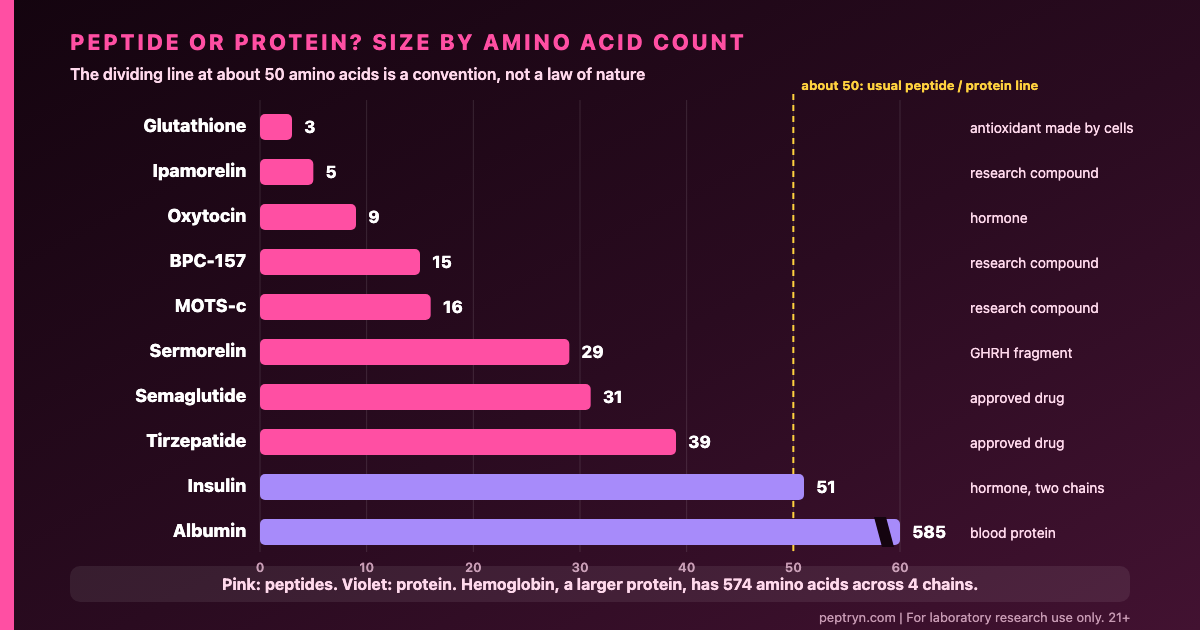
| Examples | Glutathione (3), oxytocin (9), semaglutide (31) | Albumin (585), hemoglobin (574 across 4 chains) |
| How they are made | Cells, or chemical or biological manufacturing | Cells, or biological manufacturing |
| Digestion | Broken down by digestive enzymes if swallowed | Also broken down into amino acids and small peptides |
The 50-amino-acid line is a convention and not a law of nature. Insulin has 51 amino acids in two linked chains and is still called a peptide hormone. For a closer look at the difference, see our list of peptides and what they do.
Types of peptides
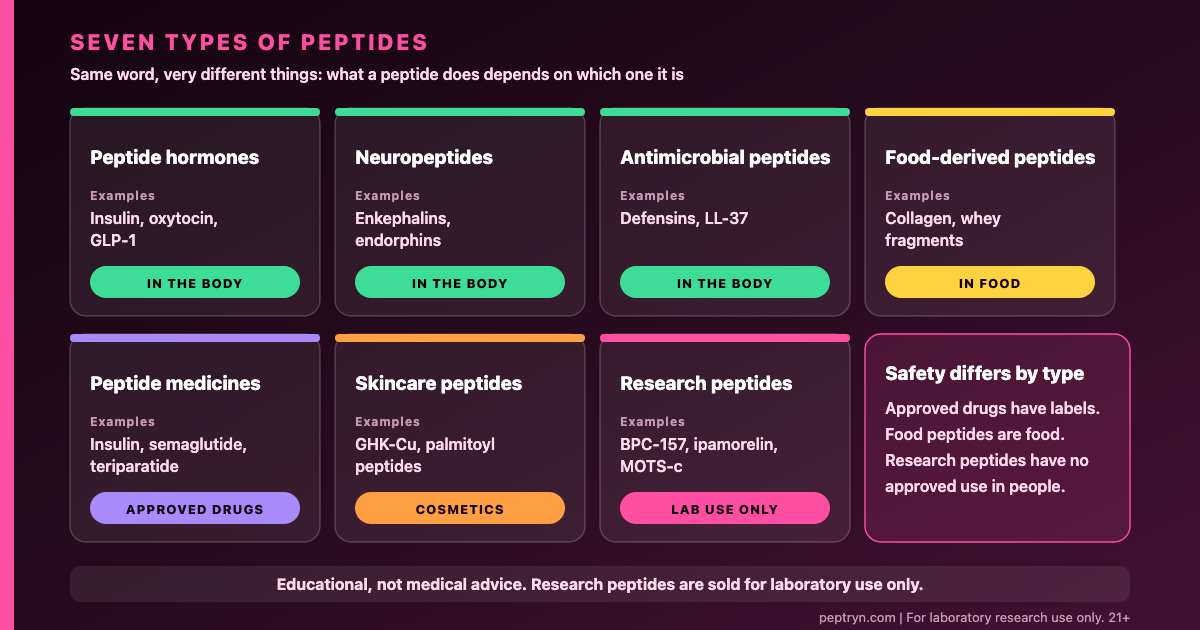
| Type | What it is | Examples |
|---|---|---|
| Peptide hormones | Messengers made in the body that regulate other tissues | Insulin, oxytocin, GLP-1 |
| Neuropeptides | Short peptides used by nerve cells to signal | Enkephalins, endorphins |
| Antimicrobial peptides | Part of the body’s defenses against microbes | Defensins, LL-37 |
| Food-derived peptides | Fragments released when dietary protein is digested or processed | Collagen peptides, whey peptides |
| Peptide medicines | Approved drugs based on peptides | Insulin, semaglutide, tirzepatide, teriparatide |
| Skincare peptides | Ingredients in creams and serums | Copper tripeptide GHK-Cu, palmitoyl peptides |
| Research peptides | Compounds made for laboratory use and not approved for human use | BPC-157, ipamorelin, MOTS-c |
Peptides you may have heard of
| Peptide | Length | What it is | Status |
|---|---|---|---|
| Insulin | 51 amino acids | Hormone that lowers blood glucose | Approved medicine (recombinant human insulin first approved in 1982) |
| Oxytocin | 9 amino acids | Hormone involved in birth and nursing | Also an approved medicine in hospital obstetric care |
| Glutathione | 3 amino acids | Antioxidant made by cells | Sold as a dietary supplement and as a research material |
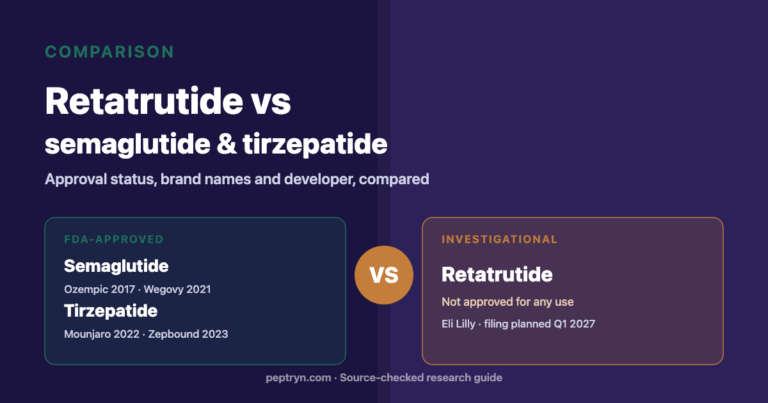
| Semaglutide | 31 amino acids | GLP-1-based drug | Approved medicine (Ozempic, Wegovy) |
| Tirzepatide | 39 amino acids | GIP and GLP-1-based drug | Approved medicine (Mounjaro, Zepbound) |
| Teriparatide | 34 amino acids | Fragment of parathyroid hormone | Approved medicine for osteoporosis |
| BPC-157 | 15 amino acids | Research compound studied mostly in animals | Not approved for human use |
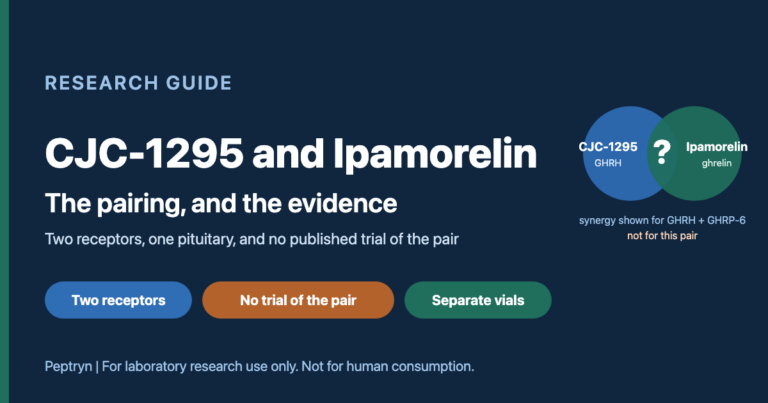
| Ipamorelin | 5 amino acids | Growth hormone secretagogue used in research | Not approved for human use |
| MOTS-c | 16 amino acids | Peptide encoded in mitochondrial DNA, studied in the laboratory | Not approved for human use |
| Collagen peptides | Mixture of fragments | Digested collagen protein | Dietary supplement |
Read our guides to BPC-157, MOTS-c and the most popular peptides for evidence on individual compounds.
What do peptides do?
Many natural peptides act as messengers. They travel through the blood or between nearby cells and fit into matching docking sites on cell surfaces, which tells the cell to change what it is doing. Insulin, for example, signals cells to take up glucose, and oxytocin is released in the brain and in the body during birth and nursing. Others help defend against microbes, and others serve as fragments or building blocks. What a given peptide does is set by its sequence, where it is made and where it can reach.
What are peptides used for?
- Medicine. Since insulin, more than 80 peptide drugs have reached the market for conditions including diabetes, cancer, osteoporosis, multiple sclerosis, HIV infection and chronic pain, according to a 2021 review in Nature Reviews Drug Discovery. GLP-1-based drugs such as semaglutide and tirzepatide are the best-known recent examples. See peptides for weight loss: what the evidence shows.
- Food and nutrition. Dietary protein is broken into peptides during digestion, and some food products contain added peptides, such as collagen peptides.
- Skincare. Cosmetic products list peptides as ingredients. Evidence varies widely by ingredient, so look for controlled studies published in peer-reviewed journals.
- Research. Laboratories use peptides as tools to study cells and to develop new drugs. Suppliers sell these materials for laboratory research only.
How peptides became medicines
Peptide science has a long history. Frederick Sanger worked out the amino acid sequence of insulin in the early 1950s and received the 1958 Nobel Prize in Chemistry for it. In 1953 Vincent du Vigneaud made oxytocin, the first peptide hormone to be synthesized, and won the 1955 Nobel Prize in Chemistry. Bruce Merrifield’s solid-phase method, published in 1963, made building peptides in a laboratory much faster and won the 1984 Nobel Prize in Chemistry.
How to judge claims about peptides
Because “peptide” covers so much ground, claims about peptides vary from well supported to invented. Four questions sort most of them out.
- Which peptide is it? Evidence for one compound says nothing about another.
- In whom was it studied? Results in cells or animals do not carry over to people automatically.
- Was there a control group? A randomized, placebo-controlled trial is stronger than a case report, a forum post or a testimonial.
- Who is making the claim? Look for a disclosed connection, such as a seller or affiliate, and for sources you can open and read.
Are peptides steroids?
No. Peptides are chains of amino acids. Steroids are a different class of molecule, built on a four-ring structure derived from cholesterol. The two are sometimes mentioned together because both can influence hormones, and because some peptides are prohibited in competitive sport. Athletes who are subject to anti-doping rules should check the current WADA prohibited list before using any peptide.
Are peptides safe?
There is no single answer, because “peptide” describes thousands of different compounds.
- Approved peptide drugs have FDA-reviewed labels that list known risks, such as the boxed warning about thyroid C-cell tumors seen in rodents on the labels of Wegovy and Zepbound, and common digestive side effects.
- Dietary peptides are part of ordinary food, and supplements are regulated differently from drugs.
- Research peptides are not approved for human use, have no label and have no established dose. The FDA has reported adverse events linked to compounded and unapproved GLP-1 products and has warned about dosing errors, contamination and counterfeit products.
Peptides side effects therefore depend on the compound, the dose, the route and the quality of the product. Anyone considering a peptide for a medical reason should discuss it with a licensed clinician.
What are peptide injections?
People searching for peptide injections usually mean one of two things. The first is approved injectable medicines, such as insulin and GLP-1-based drugs, which are prescribed and dispensed by licensed pharmacies. The second is research peptides sold as lyophilized powder for laboratory use. Peptides are commonly injected because digestive enzymes break down most of them if swallowed. Oral peptide medicines exist but need special formulation, such as the Wegovy pill approved by the FDA in December 2025. Research materials are not approved for human use, and our guide to whether peptides are legal explains the regulatory background.
What are research peptides?
Research peptides are compounds made for laboratory work, such as studies on cells or in animals. They are sold with a “for research use only” label, which means they are not approved for people to take. The important quality questions are whether the vial contains what the label says and how pure it is. A certificate of analysis answers those questions, and independent testing of each lot is the standard to look for. Our guides to what a COA is, peptide purity and peptide testing cover how to read the results, and our COA data report shows real lab certificates.
Keep learning
Browse our evidence-based guides to individual peptides, or look at the lot-level lab results behind our research materials. Research use only. You must be 21 or older.
Common questions
What are peptides?
Peptides are short chains of amino acids linked by peptide bonds, usually 2 to about 50 amino acids long. Hormones such as insulin and oxytocin are peptides.
What is a peptide?
A peptide is a molecule made of two or more amino acids joined in a specific order. Longer chains are called proteins.
What do peptides do?
It depends on the peptide. Many act as messengers that signal cells, some defend against microbes, and others are fragments from digested food or building blocks made by cells.
What are peptides used for?
Peptides are used as medicines, in food products, in skincare formulas and as research tools in laboratories. More than 80 peptide drugs have reached the market.
What are peptides made of?
Amino acids joined by peptide bonds. The order of the amino acids is the peptide’s sequence.
What is the difference between peptides and proteins?
Size is the usual dividing line: peptides are about 2 to 50 amino acids, and proteins are longer. Proteins usually fold into stable three-dimensional shapes.
What are peptide bonds?
A peptide bond is the chemical link between the carboxyl group of one amino acid and the amino group of the next, formed with the loss of a molecule of water.
Are peptides steroids?
No. Peptides are amino acid chains, and steroids are ring-shaped molecules derived from cholesterol.
Are peptides safe?
It depends on the compound and its source. Approved peptide drugs have labels with known risks, while research-use-only peptides are not approved for human use and have no established dose.
What are peptides side effects?
They depend on the specific peptide. For example, approved GLP-1-based drugs commonly cause digestive effects such as nausea and diarrhea, and their labels carry additional warnings.
What are peptide injections?
They are either approved injectable medicines prescribed by clinicians or research peptides sold for laboratory use. Peptides are usually injected because digestion breaks down most of them.
What are peptides in skincare?
Skincare peptides are short amino acid chains used as ingredients in creams and serums. Evidence differs by ingredient, and they are not the same as injectable peptides.
How do peptides work?
Many peptides send signals: they fit into matching docking sites on cell surfaces and change what the cell does. What a peptide does depends on its sequence and where it reaches.
What are research peptides?
Compounds made for laboratory research. They are sold for research use only, are not approved for human use, and should come with a lot-matched certificate of analysis.
What are bioactive peptides?
Bioactive peptides are peptide fragments, often released from food proteins during digestion or processing, that scientists study for effects on the body.
Related: List of peptides and what they do · Peptide synthesis explained · Popular peptides · Peptides for weight loss: what the evidence shows · Are peptides legal? · What is a COA? · Are peptides safe? · Copper peptides (GHK-Cu) · Peptides for hair growth · Peptides for skin · TB-500 (thymosin beta-4)
Sources
Muttenthaler M, King GF, Adams DJ, Alewood PF. Trends in peptide drug discovery. Nature Reviews Drug Discovery, 2021 (PMID 33536635). nature.com
The Nobel Prize in Chemistry 1958 (Frederick Sanger, structure of insulin). NobelPrize.org
The Nobel Prize in Chemistry 1955 (Vincent du Vigneaud, synthesis of a polypeptide hormone). NobelPrize.org
The Nobel Prize in Chemistry 1984 (R. Bruce Merrifield, solid-phase synthesis). NobelPrize.org
Merrifield RB. Solid phase peptide synthesis. I. The synthesis of a tetrapeptide. Journal of the American Chemical Society, 1963;85(14):2149-2154. doi.org/10.1021/ja00897a025
Stawikowski M, Fields GB. Introduction to peptide synthesis. Current Protocols in Protein Science (PMC3564544). pmc.ncbi.nlm.nih.gov
U.S. Food and Drug Administration. FDA’s concerns with unapproved GLP-1 drugs used for weight loss. fda.gov
U.S. Food and Drug Administration. Wegovy prescribing information (boxed warning). accessdata.fda.gov
Novo Nordisk. Wegovy pill FDA approval, December 22, 2025. novonordisk.com
For laboratory research use only. Not for human or veterinary use, and not a drug, food, dietary supplement or cosmetic. You must be 21 or older to buy.