MOTS-c Peptide: What It Is, What the Research Shows, and Why No Dose Is Established
Research use only. Peptides supplied by Peptryn are sold strictly for in vitro and preclinical laboratory research. They are not approved by the FDA for human or veterinary use, and nothing here is medical advice, a dosing recommendation, or an instruction for self-administration. This guide explains what MOTS-c is, what research supports and does not support, and how researchers should evaluate a vial.
Quick answer: what is MOTS-c?
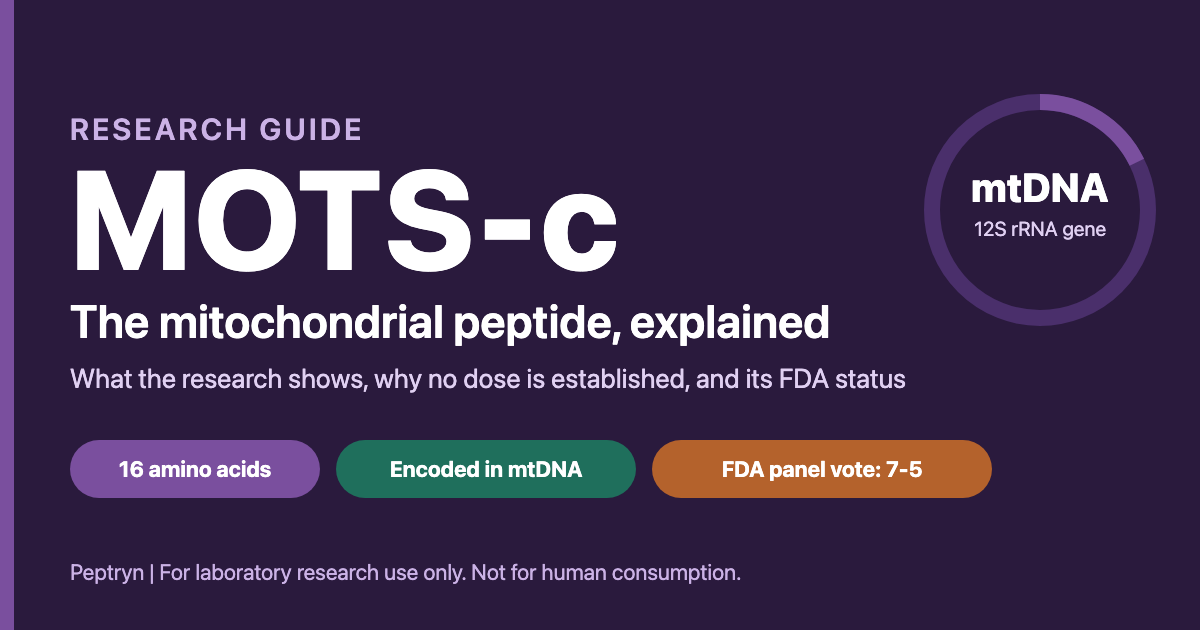
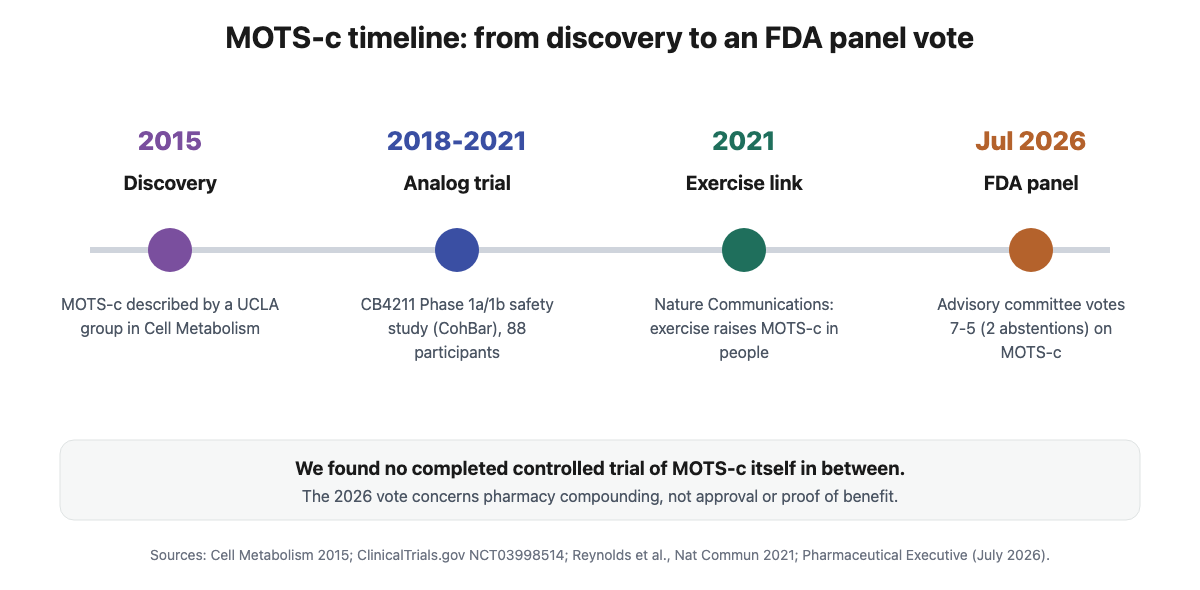
MOTS-c (mitochondrial open reading frame of the 12S rRNA type-c) is a 16-amino-acid peptide encoded inside mitochondrial DNA, first described by a UCLA group in 2015. In cells and mice it has been linked to metabolism, insulin sensitivity and exercise capacity through AMPK signaling. In people, its levels rise with exercise and fall with age.
What is missing matters as much as what is there. We found no completed controlled human trial of MOTS-c itself. It is not an approved drug, no dose has been established, and the World Anti-Doping Agency’s list prohibits it. In July 2026 an FDA advisory panel voted 7-5 (two abstentions) to recommend adding it to the pharmacy compounding list. That vote is advisory and is not an approval.
At a glance
| What it is | 16-residue peptide, MRWQEMGYIFYPRKLR; C101H152N28O22S2; 2,174.6 g/mol |
| Origin | Encoded in the mitochondrial 12S rRNA gene (MT-RNR1); described in 2015 |
| Proposed mechanism | AMPK activation and nuclear signaling under stress (no receptor identified) |
| Best evidence | Cell and mouse studies; human observational data (exercise, aging) |
| Controlled human trials | None completed for MOTS-c itself; one Phase 1 study of an analog |
| FDA status | Not approved. July 2026 advisory vote: 7-5, two abstentions (compounding list, advisory only) |
| Sport status | Prohibited (WADA metabolic modulators, AMPK activators) |
| Peptryn MOTS-c | 40 mg lyophilized vial, ≥99% by HPLC and mass spectrometry, batch COA, $140. Product page → |
Sourcing for research: MOTS-c 40 mg · Batch COA library · Mitochondrial peptides
Table of contents
- What MOTS-c is
- How MOTS-c is proposed to work
- What the research shows
- MOTS-c benefits, weight loss and “before and after” claims
- MOTS-c dosage: why there is no established dose
- MOTS-c side effects and safety
- The July 2026 FDA panel and sport status
- MOTS-c vs SS-31
- Handling a research vial
- How to evaluate a MOTS-c vial before you buy
- FAQ
What MOTS-c is
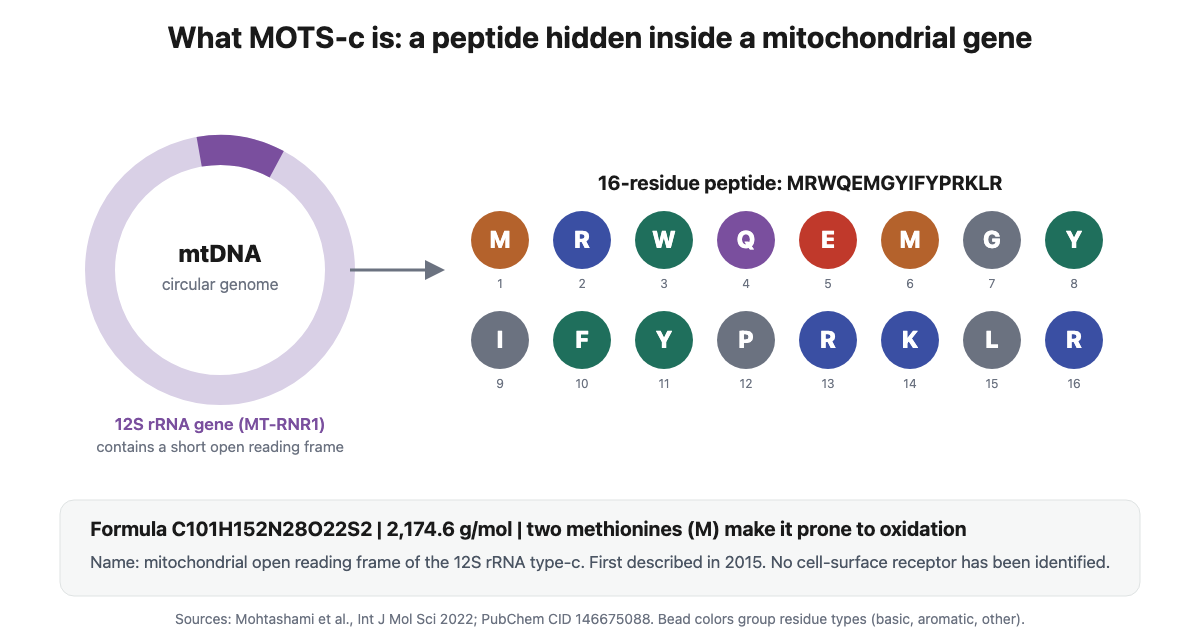
Most peptides in your body are encoded by genes in the cell nucleus. MOTS-c is one of a small class called mitochondrial-derived peptides, encoded by a short open reading frame inside the mitochondrion’s own DNA, within the 12S rRNA gene (MT-RNR1). Its 16 residues are MRWQEMGYIFYPRKLR, and 11 of them are conserved across 14 mammalian species (Mohtashami et al., 2022).
Key identity facts, because they matter when you evaluate a vial:
- Formula and weight: C101H152N28O22S2 and 2,174.6 g/mol (PubChem).
- Two methionines (positions 1 and 6). Methionine can oxidize, which adds 16 Da per residue, so oxidation is a real quality concern for this peptide.
- No identified receptor. The 2022 review states that no cellular receptor has been described for MOTS-c, which limits how well its mechanism is understood.
How MOTS-c is proposed to work
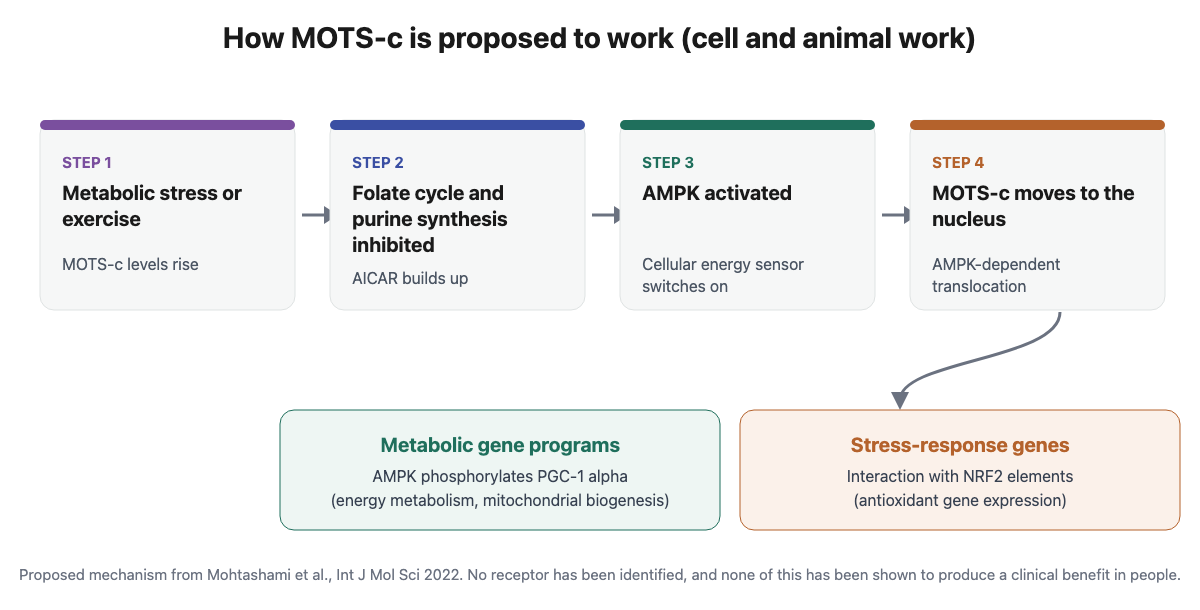
The mechanism described in the literature is built mainly on cell and animal work:
- Trigger. Metabolic stress or exercise raises MOTS-c.
- Folate cycle. MOTS-c is proposed to inhibit the folate cycle and de novo purine synthesis, causing AICAR to accumulate.
- AMPK. AICAR activates AMPK, the cell’s energy sensor.
- Nucleus. Under stress, MOTS-c moves to the nucleus in an AMPK-dependent way, where AMPK phosphorylates PGC-1 alpha and MOTS-c is proposed to interact with NRF2 stress-response elements, influencing metabolic and antioxidant genes (Mohtashami et al., 2022).
This is a working hypothesis, not a demonstrated route to a clinical benefit. Notably, AMPK activation is also why MOTS-c is treated as a performance substance by anti-doping agencies.
What the research shows
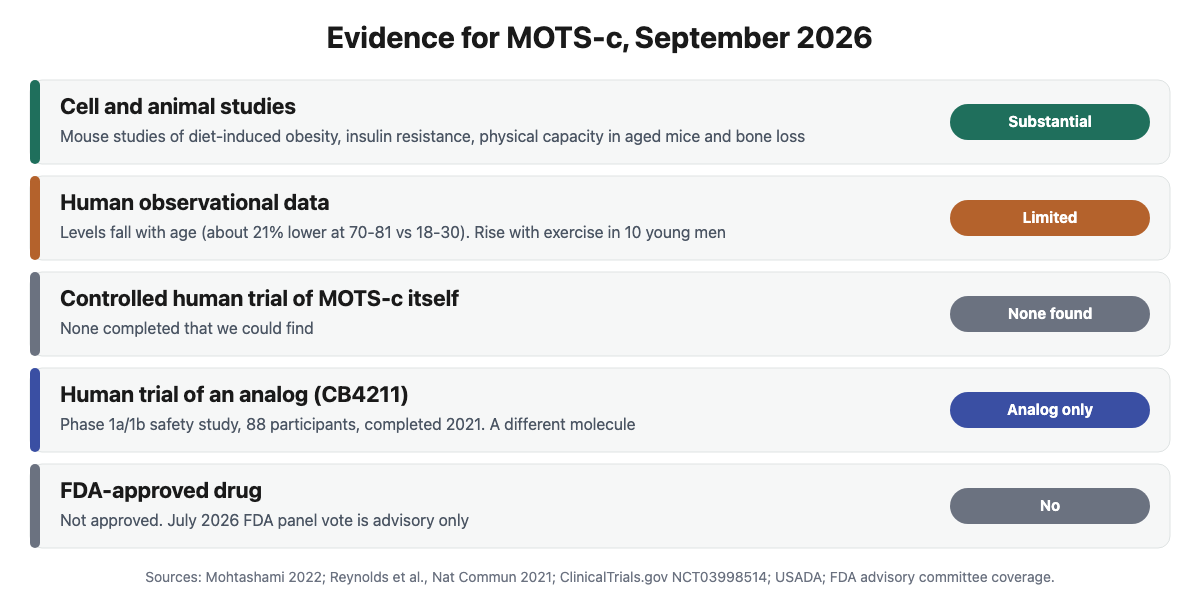
Cell and animal studies (substantial). Reviews describe mouse experiments in which MOTS-c reduced the metabolic effects of a high-fat diet, improved physical performance across age groups, and reduced bone loss after ovariectomy (Mohtashami et al., 2022). In a 2021 Nature Communications study, older mice treated with MOTS-c ran about twice as long as untreated controls, and late-life treatment showed only a trend toward longer median (6.4%) and maximum (7.0%) lifespan, which the authors describe as preliminary (Reynolds et al., 2021).
Human observational data (limited).
- Exercise: in the same 2021 paper, ten sedentary young men cycled, and skeletal-muscle MOTS-c rose about 12-fold, while circulating MOTS-c rose 1.5 to 1.6-fold and returned to baseline after rest.
- Age: the 2022 review reports MOTS-c levels about 21% lower in 70 to 81-year-olds than in 18 to 30-year-olds.
- Genetics: an Asian-specific variant (m.1382A>C, a K14Q change) was linked to type 2 diabetes susceptibility in men, though later larger cohorts contradicted that association.
Observational data can show that MOTS-c responds to exercise and aging. It cannot show that giving MOTS-c produces a benefit.
Human trials (none for MOTS-c itself). We found no completed controlled trial of MOTS-c. The closest is CB4211, an analog developed by CohBar and tested in a Phase 1a/1b study in healthy non-obese people and people with fatty liver disease (88 participants, completed April 2021, NCT03998514). It was a safety study of a different molecule, and published summaries describe injection-site reactions as common. It does not establish a dose or effect for MOTS-c. USADA likewise states that there are no completed human clinical trials of MOTS-c (USADA).
MOTS-c benefits, weight loss and “before and after” claims
“What are the benefits of taking MOTS-c peptide?” is the first question people ask. The benefits usually claimed online are fat loss, better insulin sensitivity, endurance and longevity. Here is how to read them:
- They are extrapolations from mice. Each claim traces to an animal experiment or to the observation that MOTS-c rises with exercise. None were shown in a controlled human trial of MOTS-c.
- “Does MOTS-c get rid of belly fat?” There is no human evidence that it does. The mouse work concerns diet-induced obesity in mice, which is not the same question. Note also that the compounding-list nomination for MOTS-c named obesity and osteoporosis as the proposed uses, and a nomination is a request, not evidence.
- “Before and after” posts are not evidence. MOTS-c “before and after” is a heavily searched phrase, but photos and stories lack controls, blinding and objective measures. Diet, training, weight change, lighting and other products all confound them.
- What would count as evidence? A randomized, placebo-controlled trial of MOTS-c with pre-specified outcomes and reported adverse events. None has been completed.
MOTS-c dosage: why there is no established dose
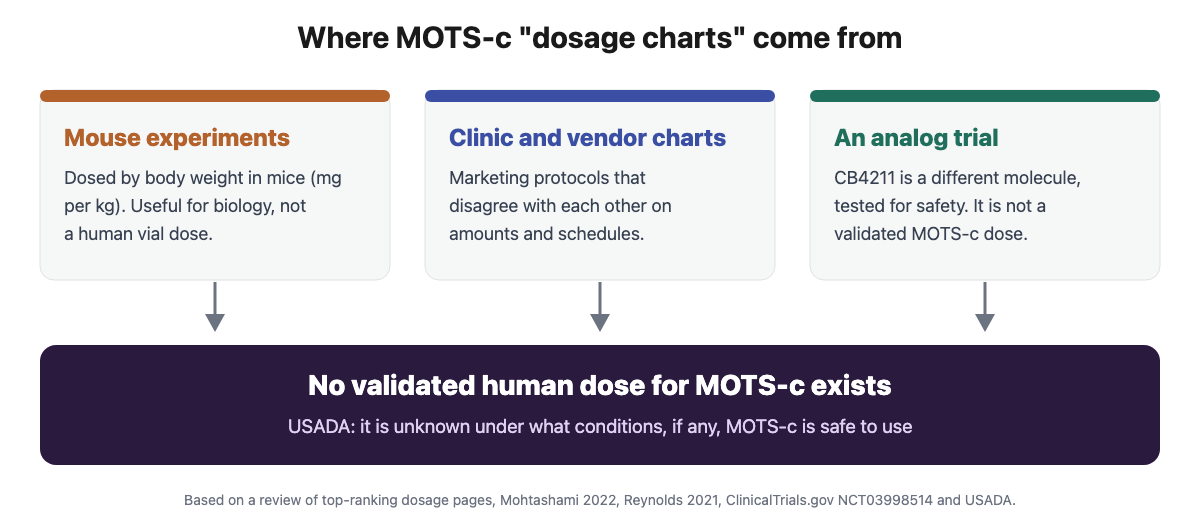
Searches for MOTS-c dosage, MOTS-c dose, MOTS-c dosing and MOTS-c dosage charts add up to tens of thousands a month, and the pages that rank are mostly clinic and vendor “dosage chart” pages. We compared several of the top-ranking ones. They disagree with each other on amounts and schedules, from daily use to intervals of several days, and none of them can point to a controlled human dose-finding study, because none exists.
That is why this guide does not give a dose, schedule, MOTS-c protocol or cycle length. The reasons:
- Mouse doses are per kilogram of body weight. They are useful for biology and are not a human vial dose.
- No controlled human dose-finding exists for MOTS-c. The only controlled human work is for an analog, which is a different molecule.
- Safety is unknown. USADA states that it is unknown under what conditions, if any, it is safe to use MOTS-c.
- Charts are marketing artifacts. A chart’s confident numbers reflect a seller’s protocol, not evidence.
What a laboratory researcher does need is concentration math, which depends only on mass and volume:
Concentration (mg/mL) = peptide mass (mg) ÷ diluent volume (mL)
| Diluent added to a 40 mg vial | Concentration |
|---|---|
| 2 mL | 20 mg/mL |
| 4 mL | 10 mg/mL |
| 8 mL | 5 mg/mL |
This is laboratory arithmetic for concentration records, not a dosing table. Confirm the vial can hold the volume you add.
MOTS-c side effects and safety
What is known. USADA lists reported adverse effects including elevated heart rate, palpitations, injection-site irritation, insomnia, immune reactions and fever, and says long-term safety data are unavailable. For the CB4211 analog, injection-site reactions were reported as common in short-term testing.
What is unknown.
- Long-term safety of MOTS-c in any form
- Any safe or effective dose in humans
- Interactions with other drugs or peptides
- Effects on people with metabolic, cardiac or other conditions
A practical risk. A peptide with two methionines is prone to oxidation, and impurities and aggregation can drive immune reactions in injected products. Quality documentation matters as much as the molecule.
The July 2026 FDA panel and sport status
FDA panel. On July 23, 2026, the FDA’s Pharmacy Compounding Advisory Committee voted 7-5, with two abstentions, to recommend adding MOTS-c to the list of substances pharmacies may compound. It was nominated for obesity and osteoporosis. The same meeting voted 8-6 on BPC-157, KPV and TB-500, which are covered in our Wolverine peptide guide and Klow peptide guide. Points to keep straight:
- These votes are advisory. The FDA is not bound by them, and trade coverage reports a formal rulemaking of roughly eight to twelve months would have to follow before pharmacies could compound these peptides.
- They do not make MOTS-c an approved drug.
- FDA staff had raised safety and efficacy concerns, and USADA quotes the briefing document as highlighting “the lack of clinical data to indicate efficacy or safety.”
(Pharmaceutical Executive; FDA meeting page.) Regulatory proposals change, so verify the current status before relying on it.
Sport. USADA states that MOTS-c is prohibited under the metabolic modulators category of the WADA Prohibited List, as an AMPK activator. Athletes subject to testing should treat it as off-limits (USADA).
Sale as research material. Peptryn supplies MOTS-c for laboratory research only, to buyers who are 21 or older and who confirm qualified research use. It is not a compounding pharmacy and does not offer these products for human use.
MOTS-c vs SS-31
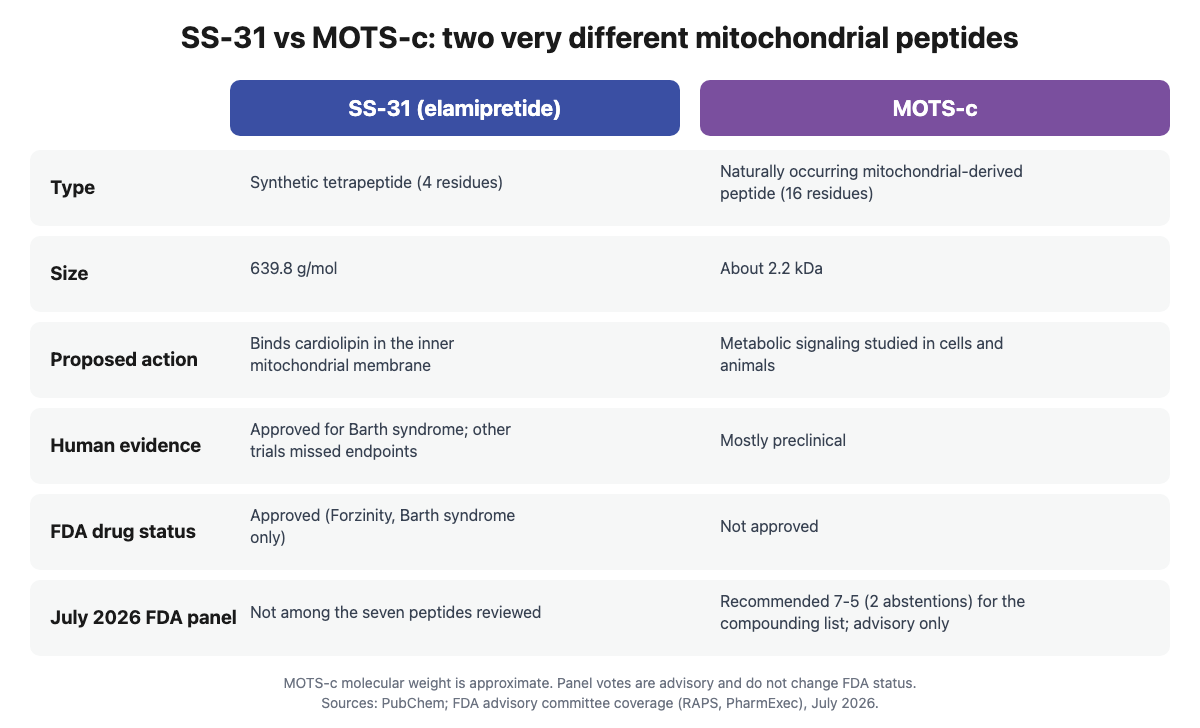
Both are described as “mitochondrial peptides,” but they are unrelated. MOTS-c is a naturally occurring 16-residue peptide encoded in mitochondrial DNA and studied mainly for metabolic signaling. SS-31 (elamipretide) is a synthetic four-residue peptide that binds cardiolipin, and it is the one with an FDA-approved form, for a single rare disease. The full story is in our SS-31 guide. Peptryn lists SS-31 and NAD+ alongside MOTS-c in its mitochondrial peptides category.
Handling a research vial
Per the Peptryn product specification, store the lyophilized powder at −20 °C, protected from light and repeated freeze-thaw cycles. Because of the two methionines, minimizing air exposure and prolonged storage in solution is sensible practice. For sterile technique and the arithmetic, see the reconstitution basics guide, the peptide calculator, the storage and handling guide, and the bacteriostatic water guide. Bacteriostatic water: BAC Water 10 mL →
How to evaluate a MOTS-c vial before you buy
- Identity by mass spectrometry. The average mass should be about 2,174.6 Da. Purity alone does not tell you what the molecule is.
- A formula and sequence that match. C101H152N28O22S2 for MRWQEMGYIFYPRKLR. A listing whose formula contains no sulfur cannot describe a peptide with two methionines, so treat a mismatch as a red flag.
- Oxidation assessed. Ask whether the mass-spec data checked for +16 Da and +32 Da species (oxidized methionine).
- Purity by HPLC, with a chromatogram showing a single dominant peak, and peptide content stated.
- Endotoxin testing for any material handled in solution.
- A COA for your specific lot, from an independent lab, with a lot number and date.
- No medical claims. A seller promising fat loss, longevity or performance from a research chemical is signaling the wrong thing.
Peptryn’s MOTS-c listing states ≥99% purity by HPLC and mass spectrometry with a batch certificate. Not sure how to read the paperwork? Our guide on how to read a certificate of analysis walks through each line. If a lot’s COA is not published yet, email support with your order number. Orders ship from the USA with same-day dispatch, and orders over $150 ship free.
Get MOTS-c 40 mg with a batch COA →
Frequently asked questions
What is MOTS-c?
MOTS-c is a 16-amino-acid peptide encoded in mitochondrial DNA (the 12S rRNA gene), first described in 2015. It has been studied for effects on metabolism and exercise capacity in cells and animals.
What does MOTS-c do?
In cell and animal studies it is proposed to activate AMPK, influence metabolic and antioxidant gene programs, and improve metabolic and physical measures in mice. What it does in people has not been established by controlled trials.
What are the benefits of taking MOTS-c peptide?
Claimed benefits include fat loss, insulin sensitivity, endurance and longevity, but they come from mouse work and from the observation that MOTS-c rises with exercise. No completed controlled human trial of MOTS-c supports them.
Does MOTS-c get rid of belly fat?
No human evidence shows that it does. Mouse studies of diet-induced obesity do not answer that question for people.
What are the MOTS-c side effects?
No established side-effect profile exists. USADA lists reported effects including elevated heart rate, palpitations, injection-site irritation, insomnia, immune reactions and fever. For an analog tested in Phase 1, injection-site reactions were common.
What is the MOTS-c dosage?
There is no established dosage, and this guide does not provide one. Dosage charts online come from mouse experiments, seller protocols or an analog trial, and they disagree with each other.
How long can I take MOTS-c?
No one knows. There is no established duration, dose or schedule because no controlled human trial of MOTS-c has been completed.
Is MOTS-c FDA-approved?
No. In July 2026 an FDA advisory panel voted 7-5 (two abstentions) to recommend adding it to the pharmacy compounding list. That is an advisory recommendation about compounding, not an approval.
Is MOTS-c banned in sport?
Yes. USADA says it is prohibited under the WADA metabolic modulators category as an AMPK activator.
What are the MOTS-c before and after results?
There are no controlled results. “Before and after” posts are anecdotes and cannot show that MOTS-c caused any change.
MOTS-c Reddit: what do people say?
Forum posts are anecdotes and often come from sellers or people with something to sell. Batch certificates you can check yourself are more useful than any testimonial.
What is the difference between MOTS-c and SS-31?
They are unrelated. MOTS-c is a natural mitochondrial-derived peptide studied for metabolic signaling. SS-31 is a synthetic peptide that binds cardiolipin and has one FDA-approved form. See the comparison above.
MOTS-c peptide for sale: where can researchers buy it?
Peptryn supplies MOTS-c as a 40 mg lyophilized vial, ≥99% by HPLC and mass spectrometry, with a batch COA, at $140. View the product → Buyers must be 21 or older and confirm laboratory research use.
Final take
MOTS-c is a genuinely interesting molecule: a peptide encoded in mitochondrial DNA that rises with exercise and falls with age. That is a reason for research, not a reason to assume it works as a treatment. The mouse data are real, the human data are observational, no controlled trial of MOTS-c itself has been completed, and the popular dosage charts have no evidence base. For researchers, the useful questions are identity, oxidation and paperwork.
Browse research-grade MOTS-c, SS-31 and NAD+ with batch COAs →
Related guides: SS-31 (elamipretide) guide · Wolverine peptide guide · Klow peptide guide · How to read a certificate of analysis · Glow peptide guide · Glutathione peptide guide · 5 Amino 1MQ guide · What is a COA? · Peptide purity · Peptide testing · Popular peptides
Editorial note: Peptryn sells the research peptides discussed in this guide for laboratory use only. This guide is informational and is not medical advice. Sources are listed below. To report an error, email [email protected].
Sources
- Mohtashami Z, et al. MOTS-c, the Most Recent Mitochondrial Derived Peptide in Human Aging and Age-Related Diseases. Int J Mol Sci, 2022. pmc.ncbi.nlm.nih.gov
- Reynolds JC, et al. MOTS-c is an exercise-induced mitochondrial-encoded regulator of age-dependent physical decline and muscle homeostasis. Nat Commun, 2021. pmc.ncbi.nlm.nih.gov
- PubChem. MOTS-c (CID 146675088). pubchem.ncbi.nlm.nih.gov
- ClinicalTrials.gov. A Phase 1a/1b Study of Safety, Tolerability, and Pharmacokinetics of CB4211 (NCT03998514; sponsor CohBar). clinicaltrials.gov
- U.S. Anti-Doping Agency. What is the MOTS-c peptide? usada.org
- Pharmaceutical Executive. FDA Panel Votes to Loosen Restrictions for Four Peptides. pharmexec.com
- U.S. Food and Drug Administration. July 23-24, 2026: Meeting of the Pharmacy Compounding Advisory Committee. fda.gov
All products on peptryn.com are intended for laboratory research purposes only. Not for human consumption, self-administration, or veterinary use. The information on this page has not been evaluated by the U.S. Food and Drug Administration and is not intended to diagnose, treat, cure, or prevent any disease. Nothing here should be construed as medical advice.