5 Amino 1MQ: A Small Molecule, Not a Peptide, and What the Research Shows
Research use only. Products supplied by Peptryn are sold strictly for in vitro and preclinical laboratory research. They are not approved by the FDA for human or veterinary use, and nothing here is medical advice, a dosing recommendation, or an instruction for self-administration. This guide explains what 5 amino 1MQ is, what published research does and does not show, and how researchers should evaluate a vial.
Quick answer: what is 5 Amino 1MQ?
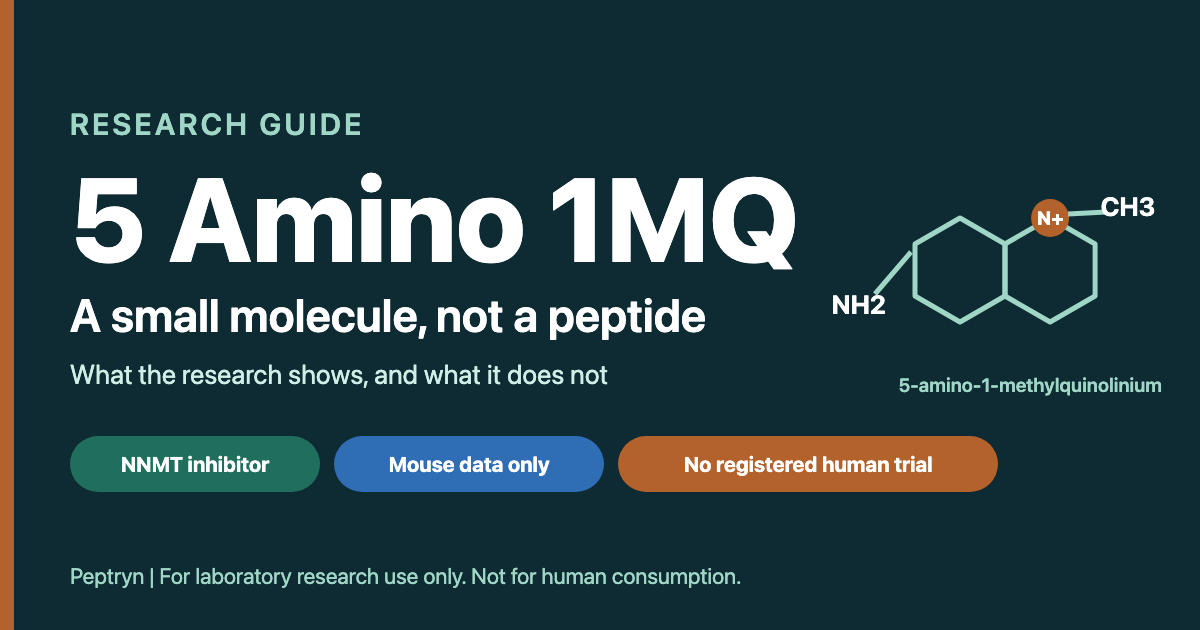
5 Amino 1MQ (5-amino-1-methylquinolinium) is a small-molecule inhibitor of an enzyme called nicotinamide N-methyltransferase, or NNMT. It is often sold beside research peptides, but it is not a peptide.
The evidence comes from cell assays and mouse studies. In one 11-day study, obese mice treated with it had less white fat tissue and lower cholesterol than controls. We found no registered human trial, no published human safety or absorption study, and no FDA approval. Claims about 5 amino 1MQ benefits in people are hypotheses drawn from animal work.
At a glance
| What it is | A quinolinium small molecule that inhibits the NNMT enzyme |
| Chemical class | Small molecule. Not a peptide |
| Mass | 159.21 Da for the ion (C10H11N2+). 286.11 Da for the iodide salt (PubChem) |
| Best evidence | Cell assays and mouse studies (obesity, aged muscle) |
| Human trials | None registered in ClinicalTrials.gov as of September 2026 |
| Approved drug? | No |
| Peptryn’s 5 Amino 1MQ | 10 mg, batch COA (HPLC-UV-MS purity 99.86%, endotoxin negative), $64.99. Product page |
Sourcing for research: 5 Amino 1MQ 10 mg, 5 Amino 1MQ COA, batch COA library
Table of contents
- Is 5 Amino 1MQ a peptide?
- What NNMT does, and why anyone inhibits it
- What the research shows
- Claims that go beyond the papers
- 5 Amino 1MQ benefits and “before and after” claims
- 5 Amino 1MQ dosage: why there is no established one
- Oral capsules or injection?
- 5 Amino 1MQ side effects and safety
- Regulatory status
- 5 Amino 1MQ reviews and Reddit: how to read anecdotes
- How to check a 5 Amino 1MQ vial before you buy
- Frequently asked questions
- Final take
Is 5 Amino 1MQ a peptide?
No. A peptide is a chain of amino acids. 5 Amino 1MQ is a small quinoline-based molecule with a methyl group on the ring nitrogen and an amino group on the ring. PubChem lists the ion as C10H11N2+ with a mass of 159.21 Da, smaller than the three-amino-acid peptides GHK (340.38 Da) and KPV (342.44 Da) that Peptryn lists.
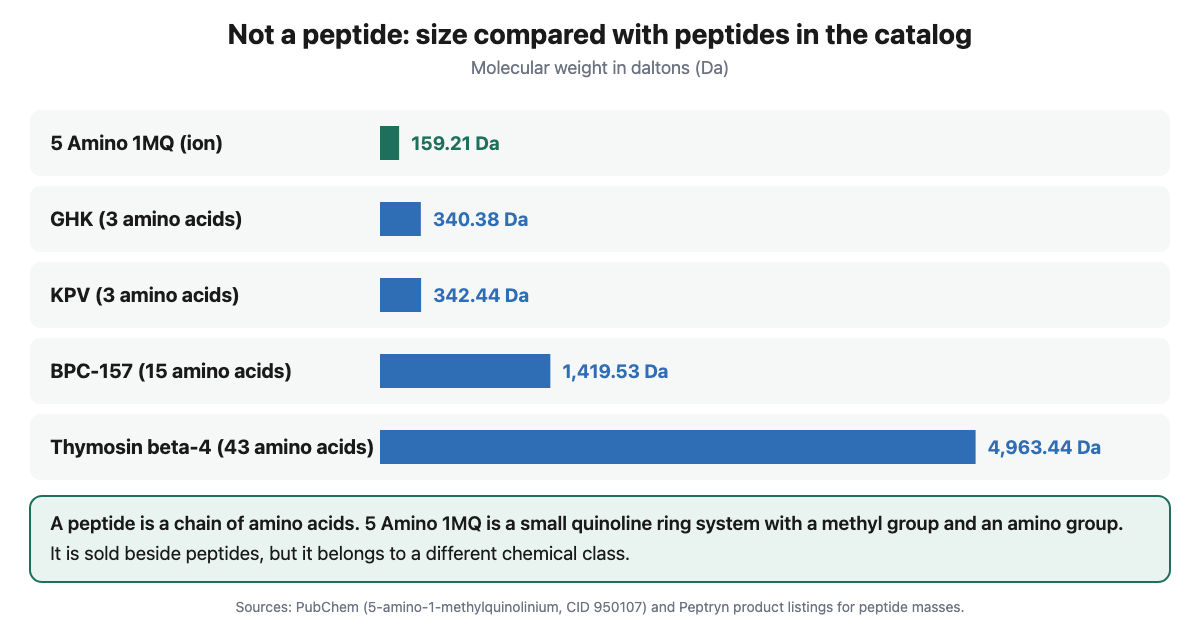
Searches for “5 amino 1MQ peptide” run about 4,400 a month, and the confusion has a source. Vendors, clinics and Peptryn’s own catalog group it with peptides, and the Peptryn listing itself calls it a small molecule powder. The distinction matters for handling. Peptide reconstitution advice assumes a lyophilized peptide that dissolves in water, and a small molecule can behave differently. Peptryn’s listing gives the solubility as DMSO or ethanol and not water. Solubility depends on the salt form, so use the data sheet for your lot.
What NNMT does, and why anyone inhibits it
NNMT is an enzyme that transfers a methyl group from S-adenosylmethionine (SAM) onto nicotinamide, a form of vitamin B3. The products are 1-methylnicotinamide and S-adenosylhomocysteine.
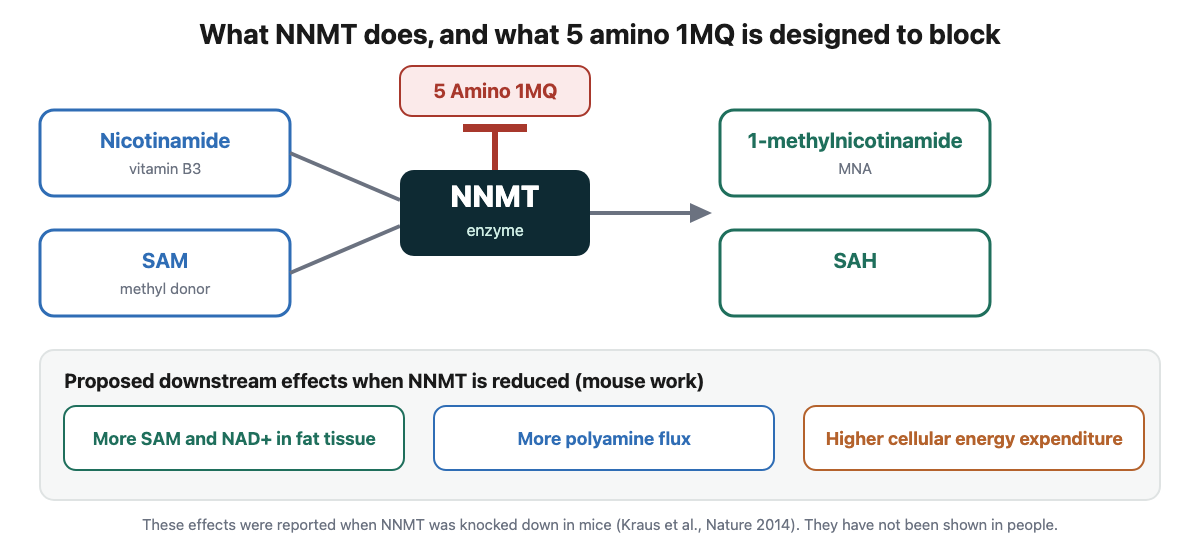
The interest in blocking it started with obesity research. A 2014 Nature paper found that NNMT expression was higher in white fat and liver of obese and diabetic mice. When the researchers knocked NNMT down in those tissues, mice were protected against diet-induced obesity, which the authors attribute to higher cellular energy expenditure. NNMT inhibition raised SAM and NAD+ levels in fat tissue and increased polyamine flux (Kraus et al., 2014).
Human data are associations. A 2015 Diabetologia study found NNMT expression about twofold higher in the fat tissue of people with type 2 diabetes than in controls, and plasma 1-methylnicotinamide tracked with that expression (Kannt et al., 2015). A higher level of an enzyme in a disease shows a link. It does not show that blocking the enzyme in a person would help.
What the research shows
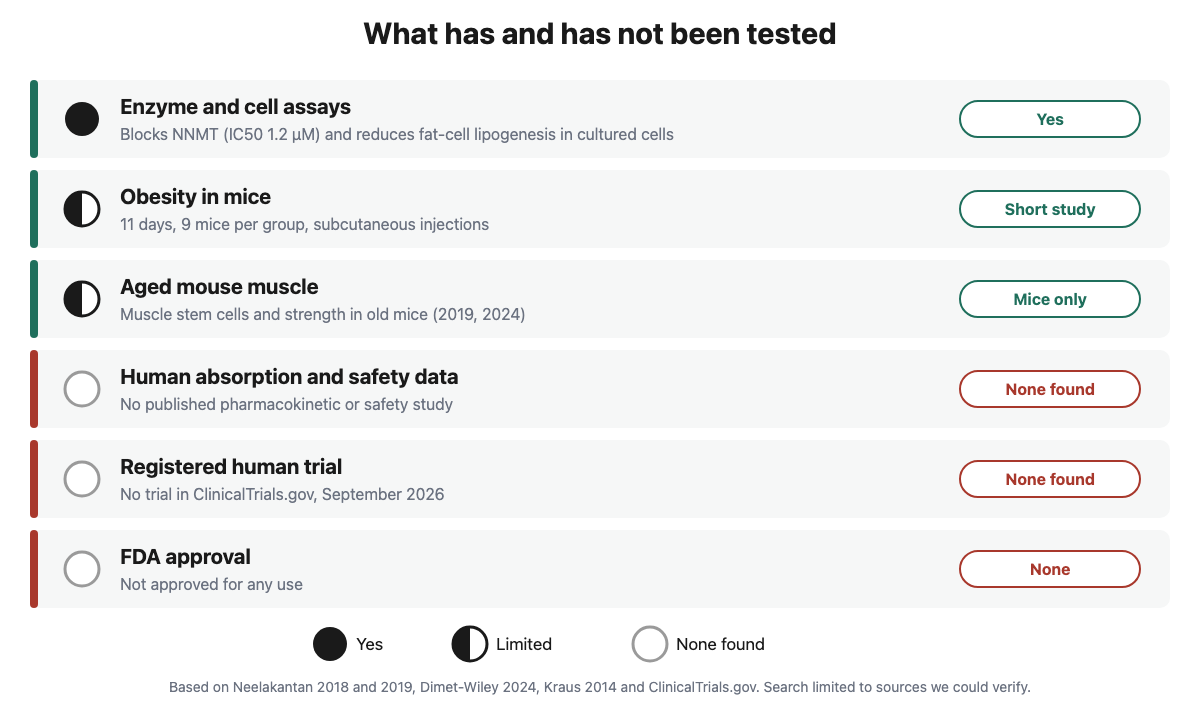
| Level of evidence | What exists |
|---|---|
| Enzyme and cell assays | Yes. Blocks NNMT and reduces lipid formation in cultured fat cells |
| Mouse studies | Yes. A short obesity study and two aged-muscle studies |
| Human absorption and safety | None found |
| Registered human trial | None found |
| FDA-approved drug | No |
The 2018 obesity study
The main paper is a 2018 Biochemical Pharmacology study from groups at the University of Texas Medical Branch and collaborators (Neelakantan et al., 2018).
In cultured cells, 5 amino 1MQ inhibited NNMT with an IC50 of 1.2 µM. In fat-cell precursors, concentrations of 30 and 60 µM reduced lipid formation by 50% and 70%. A 10 µM concentration did not affect cell viability, and toxicity appeared only at 100 to 600 µM.
The mouse experiment used diet-induced obese mice, 16 weeks on a high-fat diet and then 11 days of treatment, with 9 mice per group and subcutaneous injections.
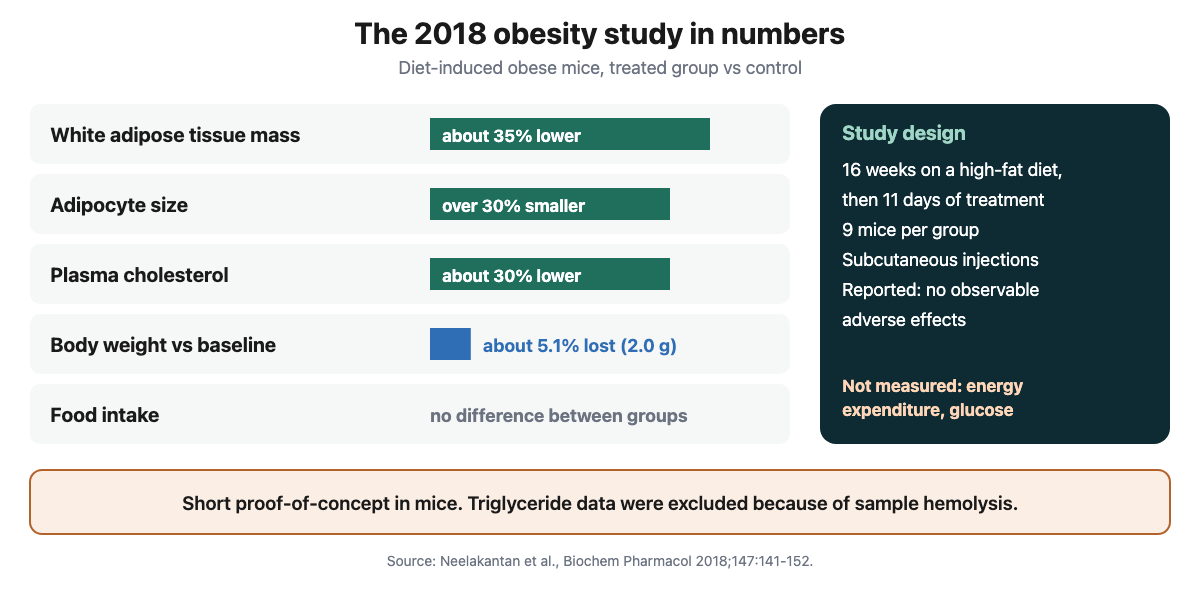
Treated mice lost about 2.0 g, roughly 5.1% of baseline body weight. White adipose tissue mass was about 35% lower, adipocytes were over 30% smaller, and plasma cholesterol was about 30% lower. Food intake did not differ between groups, and the authors reported no observable adverse effects.
The authors describe it as a short proof-of-concept study. They excluded triglyceride data because of sample hemolysis, and they reported no glucose measurements and no direct measurement of energy expenditure.
Other NNMT inhibitor studies
Other groups have tested NNMT inhibition with different compounds, and the results add context without proving anything about 5 amino 1MQ in people.
- A different inhibitor, JBSNF-000088, reduced body weight and improved insulin sensitivity and glucose tolerance in obese mice. Those effects were absent in mice lacking NNMT, which supports the enzyme as the target (Kannt et al., 2018).
- A 2019 study from the Texas group reported that an NNMT inhibitor activated muscle stem cells and improved regeneration in 24-month-old mice after injury (Neelakantan et al., 2019).
- A 2024 Scientific Reports study gave 5-amino-1-methylquinolinium, alone or with exercise, to 22-month-old female mice for eight weeks. It reported higher grip strength in treated sedentary mice than in controls, and the authors conclude that NNMT inhibitors may help age-related muscle loss (Dimet-Wiley et al., 2024). The affiliations include a company, Ridgeline Therapeutics, so check the paper’s competing-interests statement. The authors also list male mice, other species and longer treatment as future work.
What has not been done in people
ClinicalTrials.gov returned no registered study of 5 amino 1MQ in September 2026, and we found no published human pharmacokinetic, safety or dose-finding study. Everything above is animal or cell work.
Claims that go beyond the papers
Some pages say 5 amino 1MQ raises resting energy expenditure by up to 20%. We could not find that figure in the 5 amino 1MQ papers we read. The 2018 study measured body weight, fat tissue and cholesterol, and it reported no energy expenditure measurement. The energy expenditure finding belongs to the 2014 knockdown work, where NNMT was knocked down in mouse tissues and no small-molecule compound was given.
That gap between a knockdown experiment and a drug is common. A knockdown lowers an enzyme in chosen tissues. A compound reaches many tissues at once, with its own absorption and off-target effects.
5 Amino 1MQ benefits and “before and after” claims
“5 Amino 1MQ benefits” gets about 2,400 searches a month, and “before and after” about 1,600. The benefits usually claimed are fat loss, preserved muscle, more energy and slower aging. Here is how to read them.
- Each claim traces to a mouse or cell study. None of the claims has a human trial behind it.
- Weight loss in an 11-day mouse study is not weight loss in a person. The 2018 mice lost about 5% of baseline weight under laboratory conditions.
- “Before and after” photos have no controls, no blinding and no objective measures. Diet, training, lighting and other products confound them.
- A randomized, placebo-controlled human trial with pre-specified outcomes and reported adverse events would count as evidence. None exists.
5 Amino 1MQ dosage: why there is no established one
“5 Amino 1MQ dosage” gets about 4,400 searches a month, with “protocol” and “50mg” queries adding more. This guide does not give a dose, because none has been established.
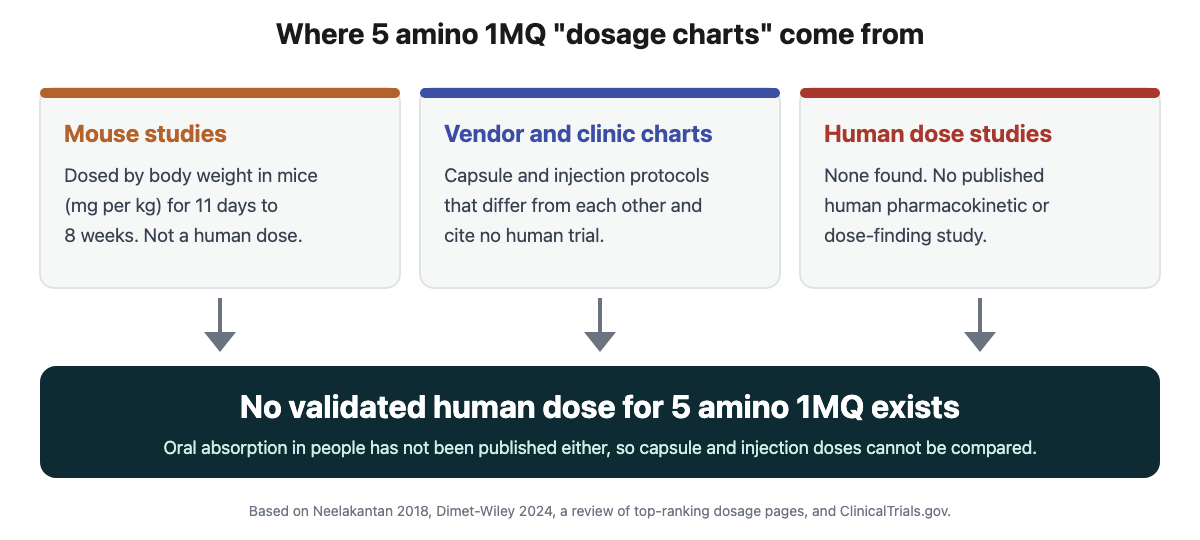
- The published doses come from mice. They are given in milligrams per kilogram of body weight, for 11 days in the obesity study and up to eight weeks in the aged-muscle work.
- No published human study gives a dose, an absorption profile or a safety margin.
- Vendor and clinic charts disagree with each other and cite no human trial.
- A concentration is a property of a solution, and it says nothing about how much of a compound is appropriate.
Researchers who prepare solutions need only the arithmetic:
Concentration (mg/mL) = compound mass (mg) ÷ solvent volume (mL)
Oral capsules or injection?
Vendors sell 5 amino 1MQ as oral capsules and as vials, and searches for both run into the hundreds a month. The 2018 mouse study used subcutaneous injections. The same paper reports high passive and active transport across cell membranes in a Caco-2 assay, which suggests the molecule crosses membranes well in a dish. That is a cell-culture result. Nobody has published how much of an oral capsule reaches the bloodstream in people, so the two forms cannot be compared.
The same gap answers the reconstitution question. The term comes from peptide work. Whether and how a 5 amino 1MQ powder dissolves depends on its salt form and the supplier’s data.
5 Amino 1MQ side effects and safety
No reliable side-effect profile exists. In the 2018 study the authors reported no observable adverse effects over 11 days in mice. That says little about people or about longer use.
Three points shape the unknowns:
- NNMT handles nicotinamide, a form of vitamin B3, and moves methyl groups in cells, so blocking it changes normal metabolism as well as the target pathway. The long-term effects are unstudied.
- Pages that list side effects such as raised heart rate or appetite changes describe anecdotes. We found no controlled human data behind them.
- Product quality is a risk in its own right. Identity, purity and salt form vary between suppliers, and only a lot-specific report shows what is in the vial.
Regulatory status
5 Amino 1MQ is not an FDA-approved drug for any use, and we found no registered human trial of it. It is sold for laboratory research. Peptryn supplies it for laboratory research use only, to buyers who are 21 or older and who confirm research use. Peptryn is not a compounding pharmacy.
5 Amino 1MQ reviews and Reddit: how to read anecdotes
Searches for “5 amino 1MQ reviews” and “5 amino 1MQ Reddit” show people looking for other users’ experiences. Anecdotes can raise questions, but they cannot show that a compound works or is safe. Many reviews come from sellers, affiliates or clinics with something to sell, and a review of shipping speed says nothing about biological effect. This guide has no testimonials because they would not be evidence. A batch certificate, such as the 5 Amino 1MQ COA, is a document you can check.
How to check a 5 Amino 1MQ vial before you buy
Because 5 amino 1MQ is sold as different salts by different suppliers, the paperwork carries most of the weight.
- Ask which form it is. PubChem lists the ion as C10H11N2+ (159.21 Da) and the iodide salt as C10H11IN2 (286.11 Da). Mass spectrometry usually detects the cation, while the label mass of a salt is higher.
- Check that the listed formula, mass and CAS number agree with each other. PubChem gives 685079-15-6 for the ion and 42464-96-0 for the iodide salt. A CAS number that resolves to a different compound is a red flag.
- Look for a certificate for your specific lot with the lot number and date. The Peptryn COA shows batch 2026-08-05, method HPLC-UV-MS, purity 99.86% and negative endotoxin, tested by MZ Biolabs. Its mass spectrometry section confirms the ion (159.10 Da measured against 159.09 expected) and does not name a counter-ion, so ask the seller which salt you are getting.
- Confirm identity by mass spectrometry, and treat HPLC purity as a separate result.
- Ask for solubility and storage data for your form. Peptryn’s listing gives storage at -20 °C, protected from moisture and light.
- Distrust any seller that makes medical claims about a research chemical.
For help reading a certificate, see the guide on how to read a certificate of analysis. Storage advice is in the storage and handling guide. If a lot’s COA is not published, email support with your order number.
Get 5 Amino 1MQ with a batch COA
Frequently asked questions
What is 5 Amino 1MQ?
A small-molecule inhibitor of the NNMT enzyme, chemically 5-amino-1-methylquinolinium. It has been studied in cells and mice, mainly in obesity and aged muscle research.
Is 5 Amino 1MQ a peptide?
No. It is a small molecule of 159.21 Da as the ion. Peptides are chains of amino acids. It is often listed with peptides, which causes the confusion.
What does 5 Amino 1MQ do?
In mouse studies it lowered white fat tissue, adipocyte size and cholesterol in obese mice, and in aged mice it was linked with better muscle stem cell activity and strength. In people, no one has shown that it does anything.
Does 5 Amino 1MQ work?
No human trial has tested it, so there is no evidence that it does in people. The animal results are real but come from short studies.
What are the 5 Amino 1MQ side effects?
No reliable profile exists. The 2018 authors reported no observable adverse effects in mice over 11 days. Human side effects have not been studied.
Is 5 Amino 1MQ safe?
Safety in people has not been established. No published human safety study exists, and long-term effects of blocking NNMT are unknown.
What is the 5 Amino 1MQ dosage?
None has been established. The doses in the literature are mouse doses in milligrams per kilogram, and no human dose study exists. This guide gives no dose.
Is 5 Amino 1MQ FDA approved?
No. It is not approved for any use, and we found no registered human trial.
How long does 5 Amino 1MQ take to work?
No one knows for people. The 2018 mouse study measured effects after 11 days of treatment, and that timeline does not transfer to humans.
Does 5 Amino 1MQ raise NAD+?
In mouse work where NNMT was knocked down, NAD+ and SAM rose in fat tissue (Kraus et al., 2014). We found no human measurement, so the effect in people is unknown.
Can you reconstitute 5 Amino 1MQ like a peptide?
The word comes from peptide work. Whether a 5 amino 1MQ powder dissolves in a given solvent depends on its form and the supplier’s data. Peptryn’s listing gives DMSO or ethanol and not water, so use the data sheet for your lot.
Are 5 Amino 1MQ capsules or injections better?
No human data compare them. The mouse study used subcutaneous injection, and no one has published oral absorption in people.
Where can researchers buy 5 Amino 1MQ?
Peptryn supplies 5 Amino 1MQ in 10 mg vials with a batch certificate of analysis. View the product. Buyers must be 21 or older and confirm laboratory research use.
Final take
5 Amino 1MQ is best understood as a research tool for studying the NNMT enzyme. Its supporting evidence is one 11-day obesity study in mice, two aged-muscle studies in mice and a set of cell assays, and its central mechanism comes from a genetic knockdown experiment. No human has been studied in a registered trial. For a researcher, the useful facts are practical: it is a small molecule and not a peptide, its mass depends on the salt form, and a lot-specific certificate with the right formula and CAS number is the proof to ask for.
Related guides: MOTS-c guide · How to read a certificate of analysis · Proper storage and handling of research peptides · Are peptides legal? · What is a COA? · Peptide purity · Peptide testing · Popular peptides
Editorial note: Peptryn sells the research peptides discussed in this guide for laboratory use only. This guide is informational and is not medical advice. Sources are listed below. To report an error, email [email protected].
Sources
- Neelakantan H, Vance V, Wetzel MD, Wang HL, McHardy SF, Finnerty CC, Hommel JD, Watowich SJ. Selective and membrane-permeable small molecule inhibitors of nicotinamide N-methyltransferase reverse high fat diet-induced obesity in mice. Biochem Pharmacol, 2018;147:141-152. pmc.ncbi.nlm.nih.gov
- Kraus D, Yang Q, Kong D, et al. Nicotinamide N-methyltransferase knockdown protects against diet-induced obesity. Nature, 2014. pmc.ncbi.nlm.nih.gov
- Kannt A, Pfenninger A, Teichert L, et al. Association of nicotinamide-N-methyltransferase mRNA expression in human adipose tissue and the plasma concentration of its product, 1-methylnicotinamide, with insulin resistance. Diabetologia, 2015. pmc.ncbi.nlm.nih.gov
- Kannt A, Rajagopal S, Kadnur SV, et al. A small molecule inhibitor of Nicotinamide N-methyltransferase for the treatment of metabolic disorders. Sci Rep, 2018. pmc.ncbi.nlm.nih.gov
- Neelakantan H, Brightwell CR, Graber TG, et al. Small molecule nicotinamide N-methyltransferase inhibitor activates senescent muscle stem cells and improves regenerative capacity of aged skeletal muscle. Biochem Pharmacol, 2019. pmc.ncbi.nlm.nih.gov
- Dimet-Wiley AL, Latham CM, Brightwell CR, et al. Nicotinamide N-methyltransferase inhibition mimics and boosts exercise-mediated improvements in muscle function in aged mice. Sci Rep, 2024. pmc.ncbi.nlm.nih.gov
- PubChem, National Library of Medicine: 5-amino-1-methylquinolinium (CID 950107) and the iodide salt (CID 66522933)
- ClinicalTrials.gov, searched September 2026 for 5 amino 1MQ and NNMT inhibitors. clinicaltrials.gov
All products on peptryn.com are intended for laboratory research purposes only. Not for human consumption, self-administration, or veterinary use. The information on this page has not been evaluated by the U.S. Food and Drug Administration and is not intended to diagnose, treat, cure, or prevent any disease. Nothing here should be construed as medical advice.