Proper Storage and Handling of Research Peptides
Proper Storage and Handling of Research Peptides
Peptides are more fragile than most small-molecule reagents. Heat, light, moisture, and repeated freeze-thaw cycles can all degrade a sample well before its labeled purity would suggest. A few consistent habits go a long way toward preserving sample integrity.
Lyophilized (freeze-dried) vials
Unopened, lyophilized peptide vials are generally the most stable form and should be stored in a freezer, ideally at -20°C or colder, away from light. Many peptides remain stable for extended periods in this state when kept sealed and protected from moisture. Avoid storing vials in a frost-free freezer’s door compartment, where temperature fluctuates more with each opening.
After reconstitution
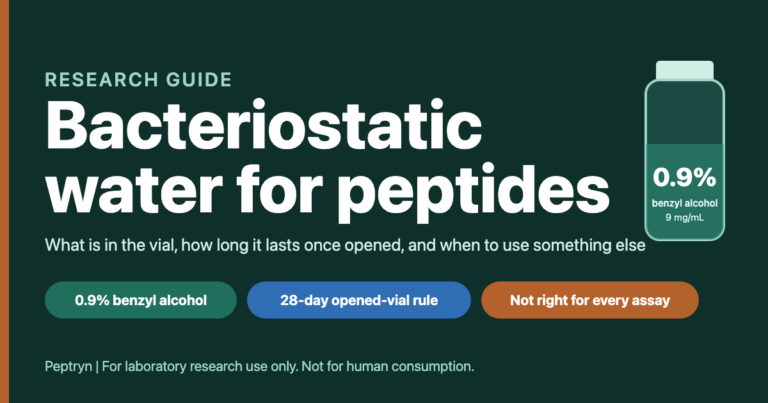
Once a peptide is reconstituted in solution, it becomes significantly more sensitive to degradation. Reconstituted solutions should be stored refrigerated at 2-8°C and used within the timeframe appropriate for that specific compound, which varies. Avoid leaving reconstituted vials at room temperature longer than necessary for the immediate research step.
Minimize freeze-thaw cycles
Repeatedly freezing and thawing a reconstituted sample can cause aggregation and loss of activity. Where possible, aliquot a reconstituted stock into smaller single-use volumes at the time of reconstitution rather than repeatedly freezing and thawing the same vial.
Light and moisture
Many peptides are light-sensitive. Store vials in their original packaging or amber containers, and keep desiccant in long-term storage containers to limit moisture exposure, which can accelerate hydrolysis.
Documentation
Log the date a vial was reconstituted, the diluent used, and the storage conditions. This record matters for interpreting results later and for identifying whether an unexpected experimental result might be attributable to sample degradation rather than the variable under study.
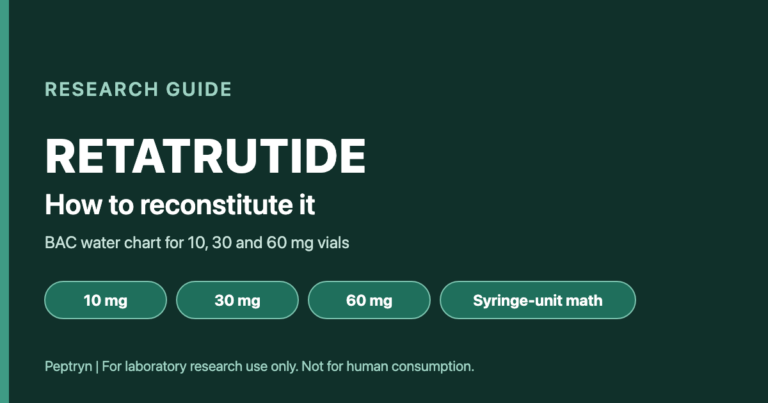
These principles apply differently to each compound. For example, our MOTS-c guide explains why a peptide with two methionines is prone to oxidation, and our retatrutide reconstitution guide applies them to a specific vial.
Peptryn products are intended strictly for laboratory research use and are not for human or veterinary consumption.
For a peptide where oxidation makes storage matter, see how storage and the batch COA are covered in our glutathione peptide guide.