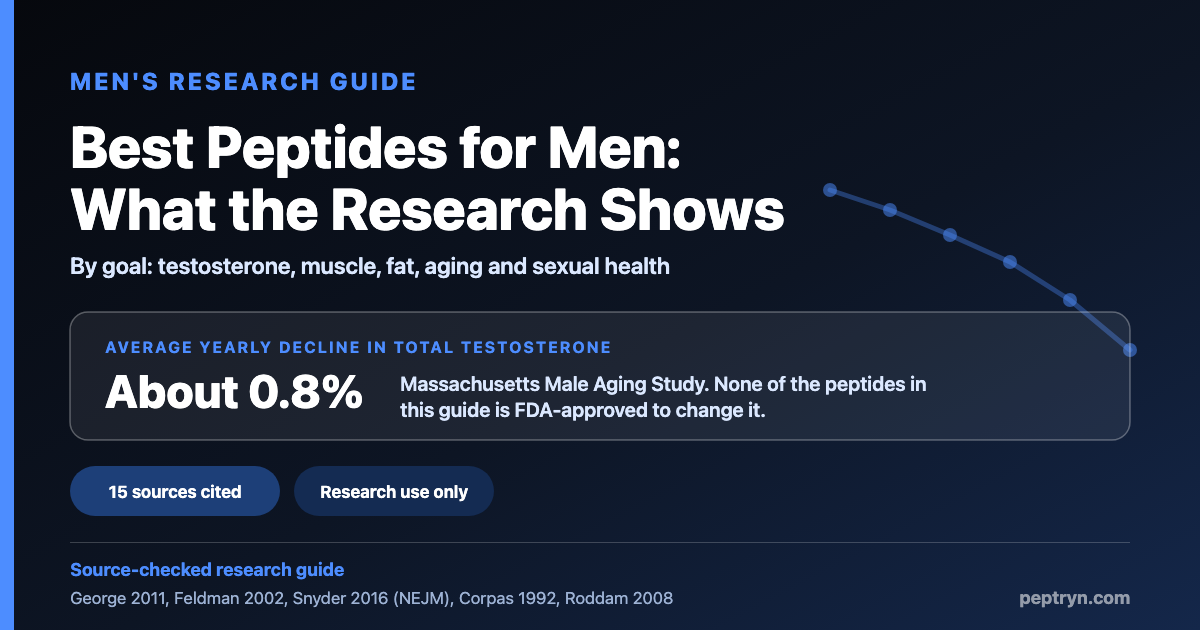
Best Peptides for Men: What the Research Shows by Goal
The short answer
There is no single best peptide for men, because the answer depends on the goal, and for most goals the honest answer is that the human evidence is thin or absent. The compounds men most often search for are growth-hormone-axis peptides (sermorelin, CJC-1295, ipamorelin, tesamorelin), tissue-repair peptides (BPC-157, TB-500), kisspeptin-10 for testosterone-related research, and PT-141 for sexual function. Only a few have controlled human data, and none is FDA-approved to raise testosterone, build muscle or reverse aging in men. Tesamorelin is approved for excess abdominal fat in HIV-associated lipodystrophy, and bremelanotide (PT-141) is approved for premenopausal women. This guide sorts the peptides men ask about by goal and by strength of evidence, flags the men-specific safety questions, and explains how to vet a research-peptide supplier if you are sourcing materials for laboratory work.
Best peptides for men by goal: evidence at a glance
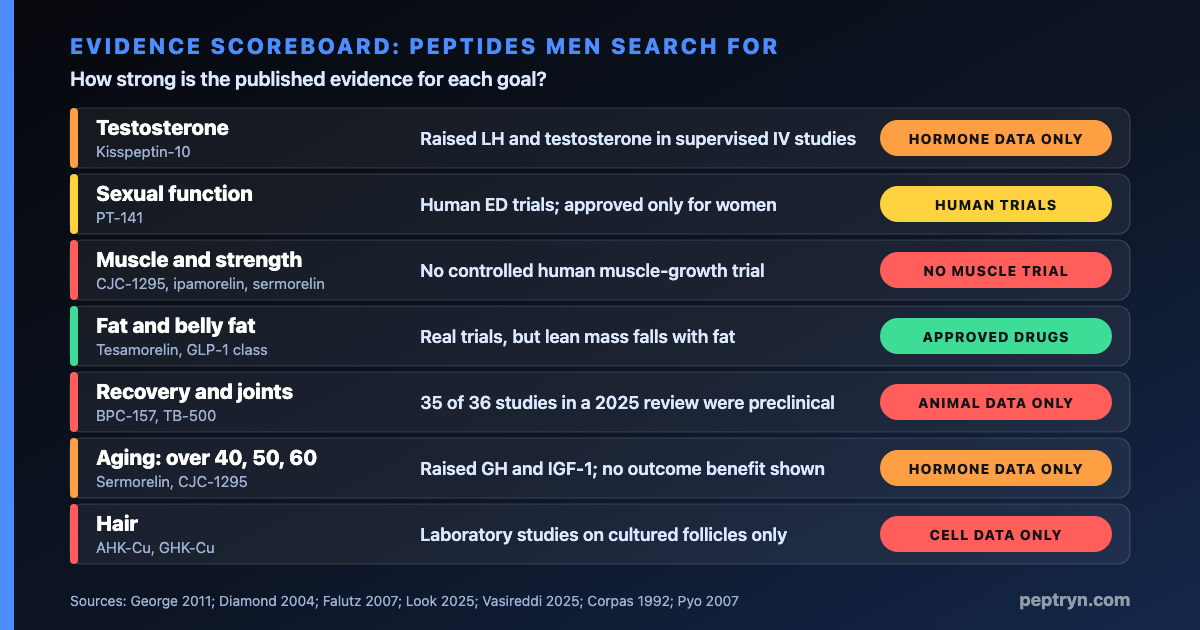
Searches for the best peptides for men and peptides for men cluster around six goals. This table shows what the published research says for each, and whether Peptryn carries the compound as a laboratory research material.
| Goal | Compounds discussed | What the evidence shows | At Peptryn |
|---|---|---|---|
| Testosterone | Kisspeptin-10 | Supervised IV studies raised LH and testosterone for hours. No symptom outcomes | Kisspeptin-10 |
| Sexual function | PT-141 | Human erectile dysfunction trials, but approved only for women | Not sold |
| Muscle | CJC-1295, ipamorelin, sermorelin | Hormone levels or animal data. No human muscle-growth trial | All three |
| Fat and belly fat | Tesamorelin, GLP-1 class | Real trial data, approved drugs. Lean mass falls with fat | Tesamorelin |
| Recovery and joints | BPC-157, TB-500 | Animal studies. 1 clinical study in a 2025 review | Both |
| Aging (over 40, 50, 60) | Sermorelin, CJC-1295 | Raised GH and IGF-1 in older men. No proof of better outcomes | Both |
Peptides vs HGH vs testosterone vs SARMs: what is the difference?
Much of the confusion in this topic comes from four different kinds of compound being discussed as if they were one. They differ in what they are and in how they act.
| Compound type | What it is | Example |
|---|---|---|
| Research peptides | Short chains of amino acids, often signaling molecules that prompt the body to release or respond to a hormone | Sermorelin, CJC-1295, ipamorelin, kisspeptin-10 |
| Human growth hormone (HGH) | A full-length protein hormone of 191 amino acids, given directly, not stimulated | Recombinant somatropin |
| Testosterone | A steroid hormone, not a peptide, given directly; approved for confirmed low testosterone | Testosterone gel, injection |
| SARMs | Small synthetic molecules, not peptides, none FDA-approved | Ostarine, ligandrol |
Growth-hormone-axis peptides are designed to raise the body’s own growth hormone, not to supply it, which is why they are not the same as HGH and why their results in trials are measured in hormone levels first. None of the peptides in this guide is testosterone or acts as a substitute for it.
Best peptides for testosterone
Best peptides for testosterone and peptides for men testosterone are among the most-searched phrases in this topic, and they start from a misunderstanding worth clearing up. Most peptides marketed to men do not act on testosterone directly. Growth-hormone-axis peptides raise growth hormone and IGF-1, which is a different hormonal system.
The one peptide with real human data on testosterone is kisspeptin-10, and the details matter. In a University of Edinburgh-led study (George et al., Journal of Clinical Endocrinology and Metabolism, 2011; PMID 21632807), healthy men received intravenous kisspeptin-10. Boluses raised LH quickly and in proportion to dose, and a 22.5-hour continuous infusion raised mean LH from 5.4 to 20.8 IU/L and serum testosterone from 16.6 to 24.0 nmol/L, with more frequent LH pulses. That is a real result, and it is also narrow: it was intravenous, supervised in a research unit, lasted hours, and measured hormone levels, not symptoms, muscle, mood or libido. It says nothing about self-administration or long-term use, and the longer kisspeptin-54 peptide is a different molecule.
The context for “low testosterone” also matters. Total testosterone declines by roughly 0.8 to 1 percent per year in middle-aged and older men (Feldman et al., Massachusetts Male Aging Study, Journal of Clinical Endocrinology and Metabolism, 2002), and symptoms such as low energy and low libido overlap with sleep apnea, depression, obesity and medication effects. Even testosterone itself has modest, specific benefits. In the Testosterone Trials (Snyder et al., New England Journal of Medicine, 2016; 790 men aged 65 and older with low testosterone, one year of testosterone gel), sexual activity, desire and erectile function improved, mood improved slightly, and vitality and the primary walking-distance measure did not improve significantly, with similar rates of cardiovascular and prostate events in both groups. If a proven hormone replacement produces results that specific, a research peptide that transiently raises LH in a clinic is a long way from an established option.
One of the best-supported findings for men is not about peptides at all. A meta-analysis of 24 studies (Corona et al., European Journal of Endocrinology, 2013) found that losing weight raised total testosterone in men with obesity, by about 2.9 nmol/L with a low-calorie diet and about 8.7 nmol/L with bariatric surgery, with larger gains in men who lost more weight. For men whose testosterone is low because of excess body fat, that is the most direct lever the evidence supports. See our guide to the best peptides for muscle growth and fat loss for how the fat-loss peptide drugs compare.
Best peptides for men over 40, 50 and 60
Searches for the best peptides for men over 40, best peptides for men over 50 and best peptides for older men reflect one idea: that age-related decline can be reversed by restoring hormone signals. The research supports one part of this and not the rest.
Growth hormone secretion falls with age, and the compounds discussed for older men mostly target that. Searches for the best HGH peptides for men usually mean this group of growth-hormone-releasing peptides, which are not growth hormone itself. In a 1992 study (Corpas et al., Journal of Clinical Endocrinology and Metabolism; PMID 1379256), 10 men averaging 68 years received a growth hormone-releasing hormone fragment, GHRH(1-29), the same 29-amino-acid sequence as sermorelin, for two weeks compared with 9 young men. At the higher dose it reversed the age-related drop in growth hormone and IGF-1 in the older men. The authors suggested that longer treatment might improve body composition, and that remained a suggestion: the study measured hormone levels, not muscle, strength, fat or wellbeing. CJC-1295 is a longer-acting analogue of the same hormone, and its main human study (Teichman et al., 2006; PMID 16352683) also measured growth hormone and IGF-1 rather than body composition.
What raising growth hormone does in older adults is documented, and it is mixed. A 2007 systematic review of growth hormone in healthy older adults (Liu et al., Annals of Internal Medicine; 31 articles, 220 people receiving growth hormone) found lean mass up about 2.1 kg and fat mass down about 2.1 kg, with more side effects including fluid retention, joint pain, carpal tunnel syndrome and insulin resistance. The men-specific caution comes next.
Men-specific safety questions
Three safety topics come up for men in particular, and a good answer names them plainly.
- IGF-1 and prostate cancer risk. Growth-hormone-axis peptides raise IGF-1. In a pooled analysis of 12 prospective studies (Roddam et al., Annals of Internal Medicine, 2008; about 3,700 men with prostate cancer and 5,200 controls), men in the highest quintile of circulating IGF-1 had higher odds of prostate cancer than men in the lowest (odds ratio 1.38). That is an observational association, not proof that raising IGF-1 with a peptide causes cancer, but it is a reason the question deserves a clinician’s attention, especially for men over 50.
- Fertility. Compounds that alter the testosterone axis can affect sperm production, and we found no fertility-safety data for the research peptides discussed here in the sources cited.
- Blood pressure. Melanocortin-pathway compounds such as PT-141 raise blood pressure and cause nausea in trials, which is why cardiovascular history matters.
Beyond these, the general gaps apply: a 2025 systematic review found no clinical safety data for BPC-157, and many of these compounds are prohibited in tested sport by the World Anti-Doping Agency.
Peptides for men’s sexual health
PT-141 (bremelanotide) is the compound behind most searches in this area. In a double-blind, placebo-controlled study in healthy men and men with mild-to-moderate erectile dysfunction (Diamond et al., International Journal of Impotence Research, 2004; PMID 14963471), an intranasal form produced a statistically significant erectile response compared with placebo. Its FDA approval, however, is Vyleesi (2019) for hypoactive sexual desire disorder in premenopausal women, not for men, and blood pressure and nausea effects are part of its safety profile. Peptryn does not sell PT-141. The compound tied to male hormone research that Peptryn does carry is kisspeptin-10, described above, for laboratory use only.
Peptides for muscle and recovery in men
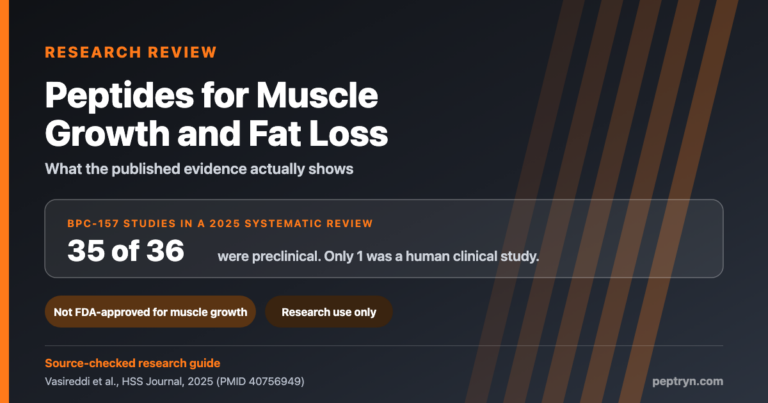
Men searching for muscle-building peptides are usually pointed to CJC-1295, ipamorelin, sermorelin, BPC-157 and TB-500. The evidence summary is short: hormone-level data for the first group, animal data for the second, and no controlled human trial showing muscle or strength gains in healthy men. A 2008 systematic review of growth hormone and athletic performance (Liu et al.; PMID 18347346) found that lean mass rose but strength may not, and that exercise capacity may worsen. Our companion guide to peptides for muscle growth covers each compound’s evidence in detail, and the 2025 BPC-157 review (Vasireddi et al.; PMID 40756949) found 35 preclinical studies and 1 clinical study among the 36 it included.
Peptides for fat loss and belly fat in men
For men, the peptide-drug evidence on fat is the strongest in this whole topic, and it comes with a lean-mass caveat. Tesamorelin reduced visceral fat by 15.2% in a 26-week randomized trial in adults with HIV-associated lipodystrophy (Falutz et al., New England Journal of Medicine, 2007; PMID 18057338), and it is approved only for that population. Tirzepatide’s SURMOUNT-1 body-composition substudy found about a quarter of weight lost was lean mass (Look et al., 2025; PMID 39996356). The full numbers are in our fat loss and muscle guide, and Peptryn carries tesamorelin and tirzepatide as laboratory research materials.
Best peptides for hair, sleep and energy in men
Searches for the best hair peptides for men, and for sleep and energy support, attract a lot of confident claims and very little evidence. The published work on AHK-Cu and hair, for example, is a 2007 laboratory study using cultured human hair follicles and dermal papilla cells (Pyo et al.; PMID 17703734), not a human trial. For sleep and energy, no controlled human trial of the research peptides discussed here has tested those outcomes. These are open questions, not established uses.
What has the best evidence for men
The interventions with the strongest evidence for men’s testosterone, body composition and function are not peptides. Losing weight raises testosterone in men with obesity, as the meta-analysis above shows. Resistance training builds muscle, and in a meta-analysis of 49 trials (Morton et al., British Journal of Sports Medicine, 2018; PMID 28698222), protein supplementation added about 0.30 kg of fat-free mass and 2.49 kg of strength on top of training. Sleep apnea, depression and some medications are common contributors to the same symptoms peptides are marketed for. A licensed physician can test morning total testosterone and check for them, which is the step that decides whether a hormone question is relevant at all.
How to choose a research-peptide supplier
If you are sourcing peptides for laboratory research, the compound matters less than whether you can verify what is in the vial. Five checks separate a supplier worth using from one that is not:
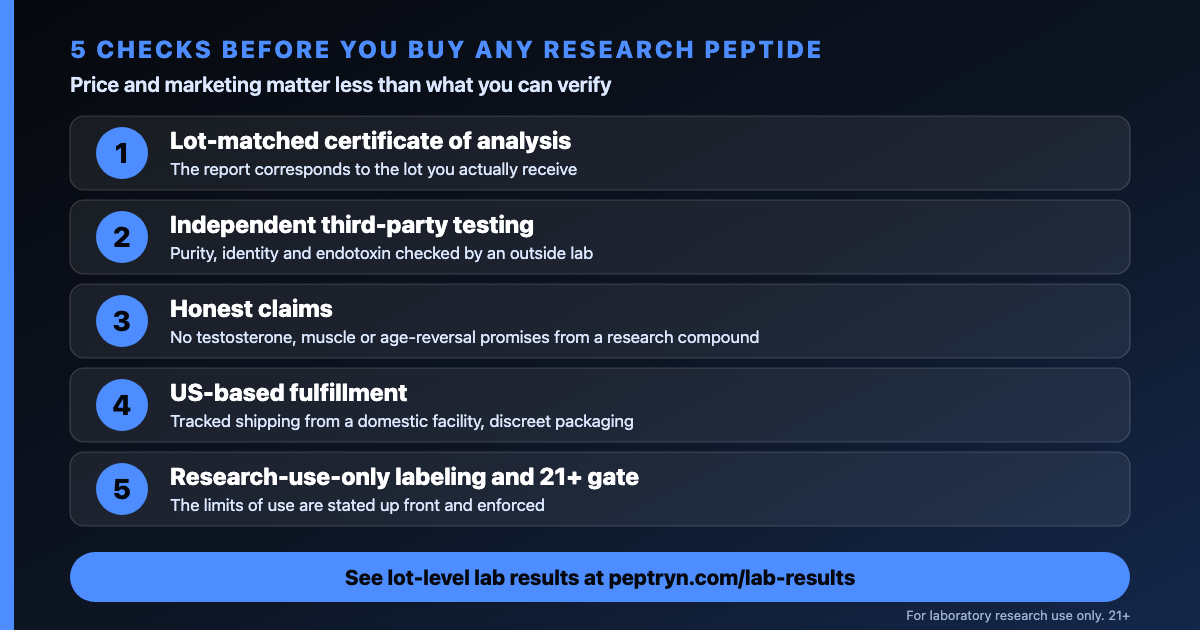
- A lot-matched certificate of analysis. The report should correspond to the lot you receive (see what is a COA).
- Independent testing. Purity, identity and endotoxin testing by an outside lab (see peptide purity).
- Honest claims. A supplier promising testosterone, muscle or age-reversal results from a research compound is asserting something the science does not support.
- US-based fulfillment. Tracked shipping from a domestic facility and discreet packaging.
- Clear research-use-only labeling and an age gate. Legitimate suppliers state the limits of use and require buyers to be 21 or older. See our peptide legality guide.
Peptryn was built around those checks: independent third-party testing of every batch, Certificates of Analysis published by lot in the COA Library, and US-based fulfillment. Read more on our about page.
Sourcing research peptides for laboratory work?
Check the lot-level certificates of analysis first, then browse the compounds below. Orders over $150 ship free, with same-day dispatch from the USA. Research use only. You must be 21 or older.
Research materials commonly studied in male-physiology research
These are the compounds from this guide that Peptryn carries as laboratory research materials. Each is sold for in-vitro research only, and nothing here is a claim that it produces any result in people.
Kisspeptin-10
Studied in supervised human research on LH and testosterone release.
CJC-1295 (no DAC)
Growth-hormone-releasing hormone analogue studied for GH signaling.
Tesamorelin
GHRH analogue that is the active compound in the approved drug Egrifta.
Why there is no established dose, timing or schedule
Many searches in this topic ask how to take peptides or what the best dose is for men. No controlled human trial has established a dose, timing, route or schedule of sermorelin, CJC-1295 (no DAC), ipamorelin, BPC-157, TB-500 or kisspeptin-10 for any of the goals in this guide. The doses in the studies cited above were supervised research protocols, often intravenous, and they do not transfer to self-administration. Any chart in circulation is extrapolated from animal work, vendor material or anecdote. For that reason this guide does not give doses, timing, routes or schedules.
Common questions
What are the best peptides for men?
The research does not support a single best peptide. The most-studied compounds are sermorelin, CJC-1295, ipamorelin and tesamorelin for the growth hormone axis, BPC-157 and TB-500 for tissue repair in animals, and kisspeptin-10 for testosterone-related research. None is FDA-approved to raise testosterone, build muscle or reverse aging in men.
What are the best peptides for testosterone?
Kisspeptin-10 is the only peptide here with human data on testosterone: in a 2011 study of healthy men, a 22.5-hour intravenous infusion raised LH and testosterone. It was a supervised, short-term study measuring hormone levels, not symptoms, and it does not establish a self-use option.
What are the best peptides for men over 40?
Sermorelin and CJC-1295 are discussed most, because growth hormone secretion falls with age. A 1992 study showed a GHRH fragment restored growth hormone and IGF-1 levels in older men, but no trial showed better strength, body composition or wellbeing as a result.
What are the best peptides for men over 50?
The same compounds are discussed, and the same evidence gap applies. For men over 50, the IGF-1 and prostate cancer association from a pooled analysis of 12 studies is a reason to involve a physician before considering any growth-hormone-axis compound.
What are the best peptides for men over 60?
No peptide has been shown to improve strength, body composition or wellbeing in men over 60 in a controlled trial. The 1992 study of men averaging 68 years showed restored growth hormone and IGF-1 levels only, and prostate health is an added consideration at this age.
What are the best peptides for young men?
The age-related growth hormone and testosterone decline discussed above does not apply to most young men, and no research in the sources cited here supports peptide use in them. Persistent low energy or low libido at a young age is a reason to see a physician, not to self-source a research compound.
What are the best peptides to take for men?
No peptide has been shown to be the best to take for men. The research supports comparing goals and evidence, as in the table above, and it does not support a ranking or a dose.
Do peptides increase testosterone?
Most do not act on testosterone directly. Growth-hormone-axis peptides raise growth hormone and IGF-1, not testosterone. Kisspeptin-10 raised testosterone briefly in a supervised infusion study. Losing weight raised testosterone in men with obesity in a meta-analysis of 24 studies.
Are there peptides for men’s sexual health?
PT-141 was tested in men with erectile dysfunction and produced a significant response in a 2004 trial, but its FDA approval is for premenopausal women, and it raises blood pressure. Peptryn does not sell it.
What are the best peptides for men to take for muscle growth?
No peptide is approved for muscle growth, and none has human muscle-growth data in healthy adults. See our peptides for muscle growth guide.
What are the best fat loss peptides for men?
The strongest evidence is for approved drugs, such as tesamorelin for visceral fat in HIV lipodystrophy and the GLP-1 class for obesity, and those trials also show lean mass falling. See the fat loss and muscle guide.
Are the best collagen peptides for men the same as these peptides?
No. Collagen peptides are oral dietary protein products. They are unrelated to the injectable research compounds in this guide, and the best evidence on protein supplements is a modest 0.30 kg gain in fat-free mass alongside resistance training.
Are “best peptides for men Reddit” threads reliable?
Forum posts are anecdotes: no placebo group, unverified products and self-reported results. They are useful for finding questions, not for answering them.
Are peptides safe for men?
Long-term human safety has not been established for the research peptides discussed. Men-specific concerns include the IGF-1 and prostate cancer association, unknown fertility effects, and blood pressure effects of melanocortin-pathway compounds.
Where can men buy research peptides, and what should they check?
Research-use-only suppliers sell lyophilized materials to laboratories for in-vitro research, not for human use. Check for a lot-matched certificate of analysis, independent testing, honest claims, US-based fulfillment and an age gate. See how Peptryn’s COA Library works.
Related: Peptides for muscle growth · Best peptides for muscle growth and fat loss · List of peptides and what they do · What is a COA? · Peptides for women · Peptides for weight loss: what the evidence shows
Sources
George JT, et al. Kisspeptin-10 is a potent stimulator of LH and increases pulse frequency in men. Journal of Clinical Endocrinology and Metabolism, 2011 (PMID 21632807). pubmed.ncbi.nlm.nih.gov
Feldman HA, et al. Age trends in the level of serum testosterone and other hormones in middle-aged men: longitudinal results from the Massachusetts Male Aging Study. Journal of Clinical Endocrinology and Metabolism, 2002;87(2):589. academic.oup.com
Snyder PJ, et al. Effects of testosterone treatment in older men. New England Journal of Medicine, 2016. nejm.org
Corona G, et al. Systematic review and meta-analysis of body-weight reduction and testosterone in men with obesity. European Journal of Endocrinology, 2013;168(6):829-843. academic.oup.com
Corpas E, et al. Growth hormone-releasing hormone-(1-29) twice daily reverses the decreased growth hormone and insulin-like growth factor-I levels in old men. Journal of Clinical Endocrinology and Metabolism, 1992;75(2):530. academic.oup.com
Teichman SL, et al. Prolonged stimulation of growth hormone and IGF-I secretion by CJC-1295. Journal of Clinical Endocrinology and Metabolism, 2006 (PMID 16352683). pubmed.ncbi.nlm.nih.gov
Liu H, et al. Systematic review: the safety and efficacy of growth hormone in the healthy elderly. Annals of Internal Medicine, 2007;146(2):104-115. doi.org/10.7326/0003-4819-146-2-200701160-00005
Liu H, et al. Systematic review: the effects of growth hormone on athletic performance. Annals of Internal Medicine, 2008 (PMID 18347346). pubmed.ncbi.nlm.nih.gov
Roddam AW, et al. Insulin-like growth factors, their binding proteins, and prostate cancer risk: analysis of individual patient data from 12 prospective studies. Annals of Internal Medicine, 2008;149(7):461-471. doi.org/10.7326/0003-4819-149-7-200810070-00006
Diamond LE, et al. Double-blind, placebo-controlled evaluation of intranasal PT-141 in healthy males and patients with mild-to-moderate erectile dysfunction. International Journal of Impotence Research, 2004 (PMID 14963471). pubmed.ncbi.nlm.nih.gov
Falutz J, et al. Metabolic effects of a growth hormone-releasing factor in patients with HIV. New England Journal of Medicine, 2007 (PMID 18057338). nejm.org
Look M, et al. Body composition changes during weight reduction with tirzepatide in the SURMOUNT-1 study. Diabetes, Obesity and Metabolism, 2025 (PMID 39996356). pubmed.ncbi.nlm.nih.gov
Vasireddi N, et al. Emerging use of BPC-157 in orthopaedic sports medicine: a systematic review. HSS Journal, 2025 (PMID 40756949). pubmed.ncbi.nlm.nih.gov
Pyo HK, et al. The effect of tripeptide-copper complex on human hair growth in vitro. Archives of Pharmacal Research, 2007 (PMID 17703734). pubmed.ncbi.nlm.nih.gov
Morton RW, et al. A systematic review, meta-analysis and meta-regression of the effect of protein supplementation on resistance training-induced gains in muscle mass and strength in healthy adults. British Journal of Sports Medicine, 2018 (PMID 28698222). pubmed.ncbi.nlm.nih.gov
For laboratory research use only. Not for human or veterinary use, and not a drug, food, dietary supplement or cosmetic. You must be 21 or older to buy.