Glutathione Peptide: What It Is, What Supplement and Injection Research Shows, and How Labs Use It
Research use only. Peptides supplied by Peptryn are sold strictly for in vitro and preclinical laboratory research. They are not approved by the FDA for human or veterinary use, and nothing here is medical advice, a dosing recommendation, or an instruction for self-administration. This guide summarizes published research on glutathione and shows how to read a certificate of analysis. Peptryn’s glutathione is a laboratory reagent, not a dietary supplement.
Quick answer: what is glutathione peptide?
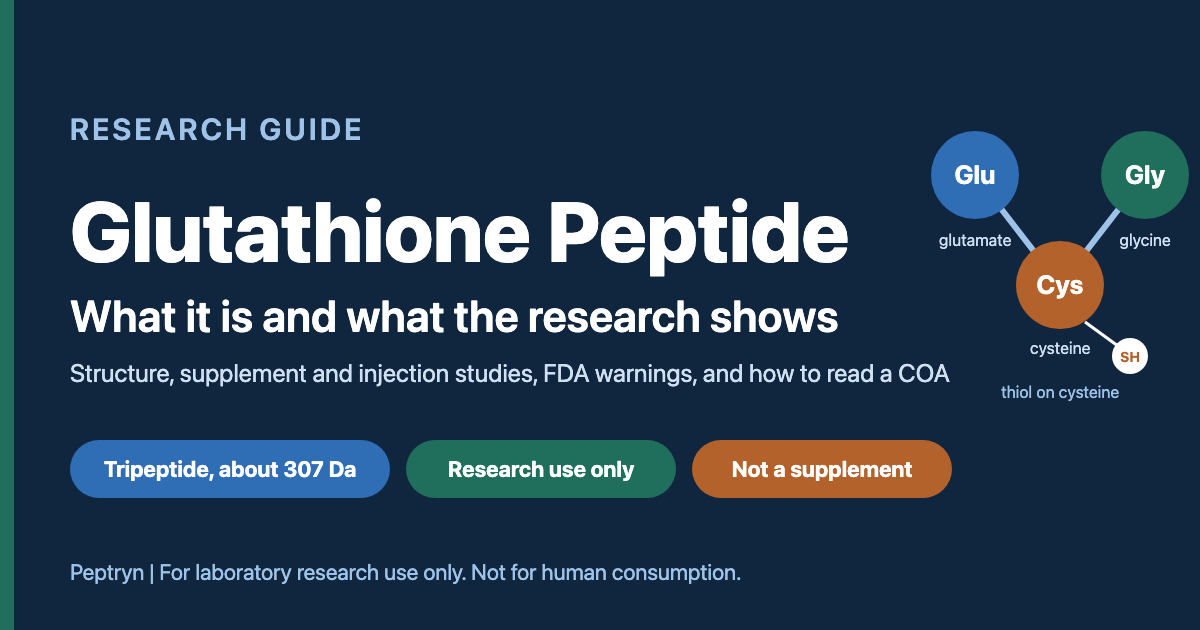
Glutathione is a tripeptide: three amino acids (glutamate, cysteine and glycine) joined into one small molecule with a molecular weight of about 307 Da. Cells make it themselves, and it is the most abundant non-protein thiol in mammalian tissue. “Glutathione peptide” usually means the purified compound, abbreviated GSH in its reduced form and GSSG in its oxidized, disulfide-linked form.
Search results for this term center on two questions: does swallowing glutathione work, and is injecting it safe. The published record answers both, with caveats.
A 1992 study of 7 healthy volunteers found no significant rise in plasma glutathione after a single large oral amount. Later trials of daily use reported higher glutathione levels in blood. None measured a health outcome.
For injections, the evidence is thin and the warnings are specific. The Philippine FDA said in 2019 that no published trials had evaluated injectable glutathione for skin lightening, and FDA reported adverse events in seven patients after a compounded injectable made from dietary-grade powder.
At a glance
| Item | Detail |
|---|---|
| Full name | γ-L-glutamyl-L-cysteinylglycine |
| Forms | GSH (reduced, one molecule) and GSSG (oxidized, two molecules joined by a disulfide bond) |
| Molecular formula and weight | GSH: C10H17N3O6S, 307.32 Da. GSSG: C20H32N6O12S2, about 612.6 Da |
| CAS number | 70-18-8 (GSH) |
| How cells make it | Two enzymes in the cytosol, glutamate cysteine ligase (rate-limiting) and glutathione synthetase |
| Peptryn listing | Lyophilized powder, 1500 mg vial, store at -20°C, protect from light, moisture and oxygen |
| Status | Laboratory research use only. Not a dietary supplement. Not for human use |
Table of contents
- What glutathione is
- How cells make and recycle glutathione
- Why swallowed or injected glutathione is hard to interpret
- Glutathione supplement research: what the trials measured
- Glutathione injections: what regulators and reviews say
- How researchers work with glutathione
- Reading a glutathione COA: Peptryn’s lot as an example
- Frequently asked questions
- Final take
What glutathione is
Glutathione is built from glutamate, cysteine and glycine, in that order. One detail sets it apart from the peptides inside proteins: the glutamate is attached through its side-chain carboxyl group (the gamma position) instead of the usual backbone carboxyl. PubChem’s systematic name for the molecule, 2-amino-5-[[…]amino]-5-oxopentanoic acid, shows this. That is why chemists write it γ-glutamylcysteinylglycine.
The reactive part is the sulfur on cysteine, a thiol (-SH). Two glutathione molecules can give up electrons and join through their sulfurs to form GSSG. Glutathione reductase, using NADPH, converts GSSG back to GSH. A 2009 review by Forman and colleagues describes glutathione’s roles as removing oxidants by reduction, removing electrophiles by conjugation, and maintaining redox balance in the cell.
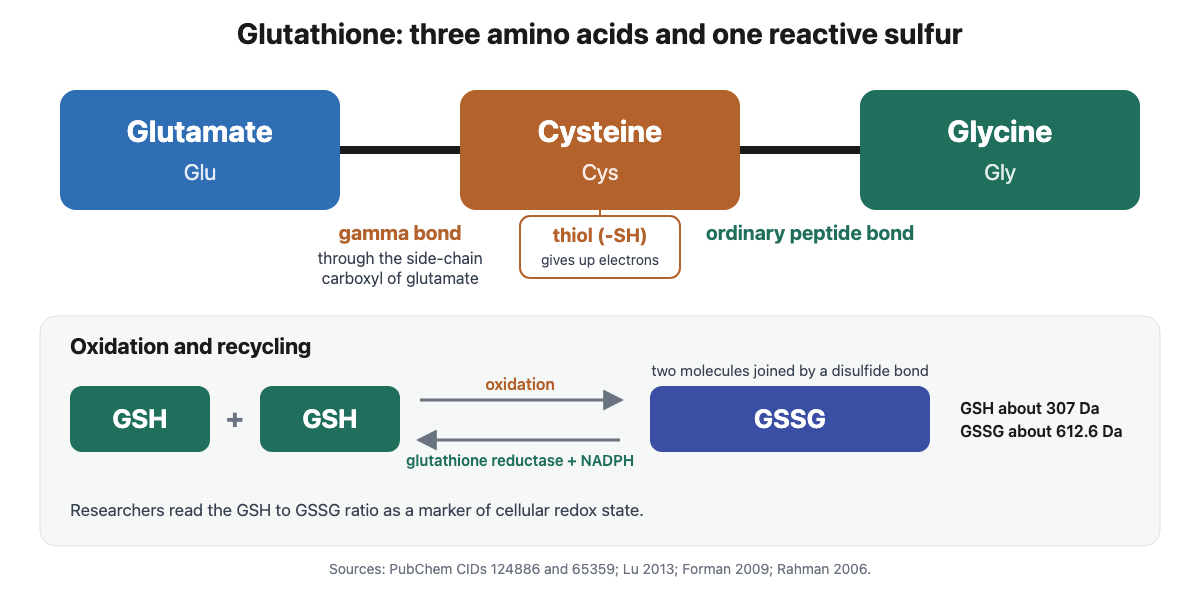
Because the ratio of GSH to GSSG shifts when cells face oxidative stress, researchers use it as a readout of redox state, and they use glutathione itself as a lever in oxidative stress experiments.
How cells make and recycle glutathione
Lu’s 2013 review lays out the pathway. Synthesis happens in the cytosol in two steps. Glutamate cysteine ligase (GCL), made of a catalytic subunit (GCLC) and a modifier subunit (GCLM), joins glutamate to cysteine. Glutathione synthetase then adds glycine. Two things limit the output: how much cysteine is available and how active GCL is. Transcription factors including Nrf2, AP-1 and NF-κB control the genes for these enzymes.
The review also notes rising evidence that disrupted glutathione synthesis contributes to diabetes, lung and liver fibrosis, alcoholic liver disease, cholestatic liver injury, endotoxemia and drug-resistant tumor cells.
The cysteine limit matters for the supplement debate. Cells build glutathione from precursors, so one line of research looks at cysteine sources such as N-acetylcysteine (NAC) instead of glutathione itself. The 2015 crossover study discussed below compared NAC directly with oral and sublingual glutathione.
Why swallowed or injected glutathione is hard to interpret
Two older papers explain the difficulty.
Witschi and colleagues (1992) gave glutathione by mouth to 7 healthy volunteers and tracked plasma glutathione, cysteine and glutamate for 270 minutes. None rose significantly. The authors attributed this to breakdown by γ-glutamyltransferase in the intestine and liver, and concluded that systemic availability of oral glutathione in people was negligible after a single large dose.
Wellner and colleagues (1984) found a related problem at the cell level. Glutathione was not effectively transported into human lymphoid cells or skin fibroblasts, including cells from patients with genetic glutathione deficiencies. The monoethyl ester of glutathione, in which the glycine carboxyl is esterified, was taken up readily, hydrolyzed inside the cell, and raised cellular glutathione, often above normal levels. That is a 1984 result in specific cell types, so it does not settle every culture system, but it is the reason researchers choose the form of glutathione deliberately when they want to raise intracellular levels.
Together they show glutathione being broken down before it reaches the blood and being poorly taken up by cells in the form it is sold.
Glutathione supplement research: what the trials measured
Later trials looked at repeated use instead of one dose. They are small, they measure glutathione concentrations and not health outcomes, and they tested specific products, so they support only narrow statements.
| Study | Design | Form tested | What was measured | Reported result | Main limit |
|---|---|---|---|---|---|
| Witschi 1992 | 7 healthy volunteers, single oral load | Oral glutathione | Plasma GSH, cysteine, glutamate for 270 min | No significant increase | Single dose, very small |
| Richie 2015 | 54 non-smoking adults, randomized, double-blind, placebo-controlled, 6 months | Oral glutathione at two levels | GSH in blood, erythrocytes, plasma, lymphocytes, cheek cells | Blood GSH higher at 1, 3 and 6 months. At 6 months in the high group, about 30 to 35% higher in erythrocytes, plasma and lymphocytes and 260% higher in cheek cells | Surrogate marker, healthy adults |
| Schmitt 2015 | 20 volunteers with metabolic syndrome, randomized 3-week crossover | NAC, oral glutathione and a new sublingual form | Plasma GSH, GSH to GSSG ratio, oxidative markers | Sublingual form raised GSH more than oral glutathione or NAC, per the authors | Very small, tested a new product |
| Sinha 2018 | 12 healthy adults, 1-month pilot | Liposomal glutathione at two levels | GSH in whole blood, erythrocytes, plasma, PBMCs | Peaks after 2 weeks: about 40% (whole blood), 25% (erythrocytes), 28% (plasma), 100% (PBMCs) | Preliminary by the authors’ own description |
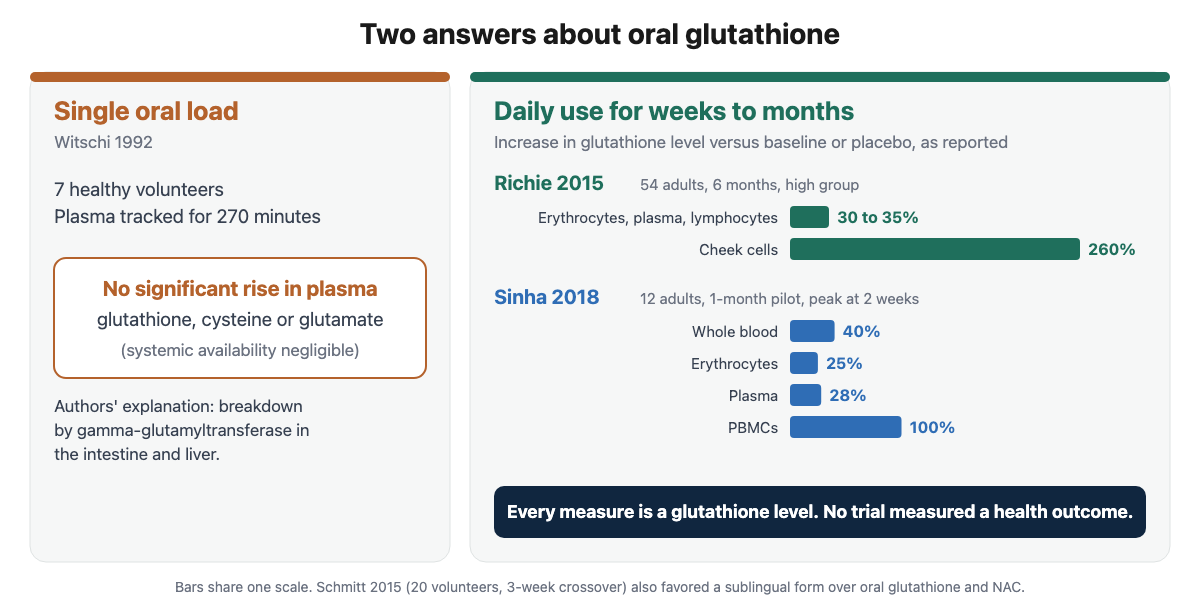
The designs differ: one measured plasma for hours after a single load, the others measured several compartments over weeks to months. The studies do not establish why the results differ, and none tested whether higher blood glutathione changes anything a person would notice or a clinician would treat.
Is there a best glutathione supplement?
No trial ranks the products on the market against each other, so the research cannot name one. What the trials do allow is a comparison of how well a claim is supported. When you read a supplement page, four questions sort most of them.
- Did a published study test that form (plain oral, liposomal, sublingual, or a precursor like NAC), or a different one?
- Did it measure glutathione in blood, or an outcome such as skin, fatigue or lab values?
- How many people, for how long, and was there a placebo group?
- Who paid for it? The funding statement is in the paper.
Peptryn does not sell a glutathione supplement. Its glutathione is a reagent for laboratory work, so nothing on this page is a product comparison.
Glutathione and skin lightening
A large share of searches pair glutathione with skin whitening, so the evidence deserves a direct answer. Weschawalit and colleagues (2017) ran a 12-week randomized, placebo-controlled trial of oral reduced and oxidized glutathione in healthy women. Melanin index tended to be lower than placebo, and there were no serious adverse effects. A 2019 systematic review by Dilokthornsakul and colleagues found four eligible clinical studies (three placebo-controlled trials and one single-arm trial) using oral or topical glutathione. It called the evidence for skin lightening still inconclusive because of study quality and inconsistent findings, with a possible brightening trend in sun-exposed skin. Sonthalia and colleagues (2018) reached a similar view and were harsher on the injected route, which they said rested on a single study with a dubious design and flawed analysis.
Glutathione injections: what regulators and reviews say
Injected glutathione has approved uses in some countries. Sonthalia and colleagues note that parenteral glutathione is approved only for severe liver disorders and for preventing chemotherapy-associated neurotoxicity, and the Philippine FDA lists it as an adjunct in cisplatin chemotherapy. The searches that drive most of the volume are about something else: skin lightening, “wellness” clinics and telehealth.
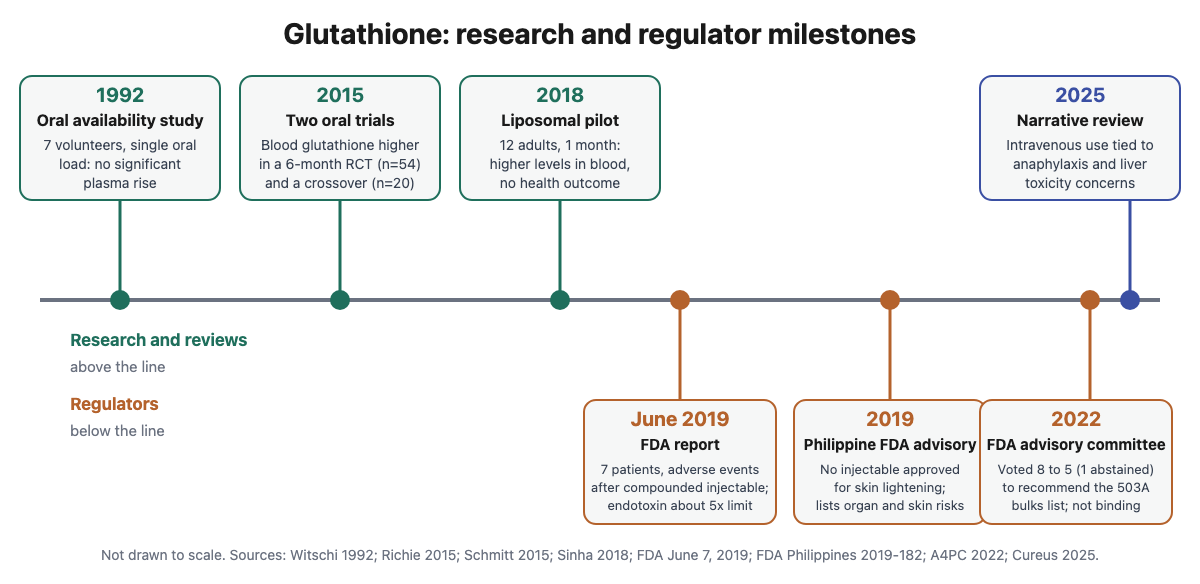
In June 2019, FDA reported that seven patients had adverse events (nausea, vomiting, lightheadedness, chills, body aches and sneezing) after an injectable drug compounded from L-glutathione powder. One patient developed low blood pressure and breathing difficulty and was hospitalized. FDA said the dietary-grade powder contained bacterial endotoxin at about five times the appropriate limit, and warned that ingredients not intended for sterile injectables can carry impurities and contaminants. A second patient, injected in October 2018, was hospitalized with a suspected bloodstream infection.
The Philippine FDA’s Advisory 2019-182 says no published clinical trials had evaluated injectable glutathione for skin lightening, that there were no published dosing guidelines, and that the agency had approved no injectable for skin lightening. It lists toxic effects on the liver, kidneys and nervous system, the possibility of Stevens-Johnson syndrome, and infection risk when a non-medical practitioner gives it or it is given in a non-sterile setting.
A 2025 narrative review in Cureus looked at oral, topical and intravenous glutathione for skin lightening. Oral use reduced melanin to a variable degree with limited side effects. The authors linked intravenous use to serious safety concerns such as anaphylaxis and hepatotoxicity, noted the absence of standardized dosing, and called for large, rigorous trials.
On compounding, FDA staff recommended against adding glutathione to the 503A bulk drug substances list, and in 2022 the Pharmacy Compounding Advisory Committee voted 8 to 5, with one abstention, to recommend adding it. The vote does not bind FDA. Check FDA’s current bulk drug substances pages for where glutathione stands today.
Research-grade material is not manufactured for human injection, and a COA for a research lot does not change that. Anyone considering glutathione for a health or cosmetic reason should talk to a licensed clinician. For how these questions fit into US law, see our guide on whether peptides are legal.
How researchers work with glutathione
Oxidation
The thiol that makes glutathione useful also makes it easy to oxidize to GSSG. Peptryn’s listing says to store the powder at -20°C, protect it from light, moisture and oxygen, and handle it under inert conditions where possible. A COA reflects the lot on the day it was tested, not the vial after months of opening and closing.
Measurement
The standard plate-reader method uses DTNB, which reacts with GSH to give a yellow product read at 412 nm. Glutathione reductase and NADPH recycle GSSG back to GSH, so the assay reports total glutathione. Rahman and colleagues published the protocol in 2006. Measuring GSSG on its own requires blocking free GSH first, and Griffith’s 1980 method did this with 2-vinylpyridine.
Cell delivery
Given the Wellner result above, culture experiments that need higher intracellular glutathione often use an ester or a precursor rather than adding plain glutathione to the medium, and the choice should be stated in the methods.
Form and molar math
Molecular weight 307.32 Da applies to free glutathione. A salt weighs more per mole. If you prepare molar solutions, you need to know which form the vial contains.
Reading a glutathione COA: Peptryn’s lot as an example
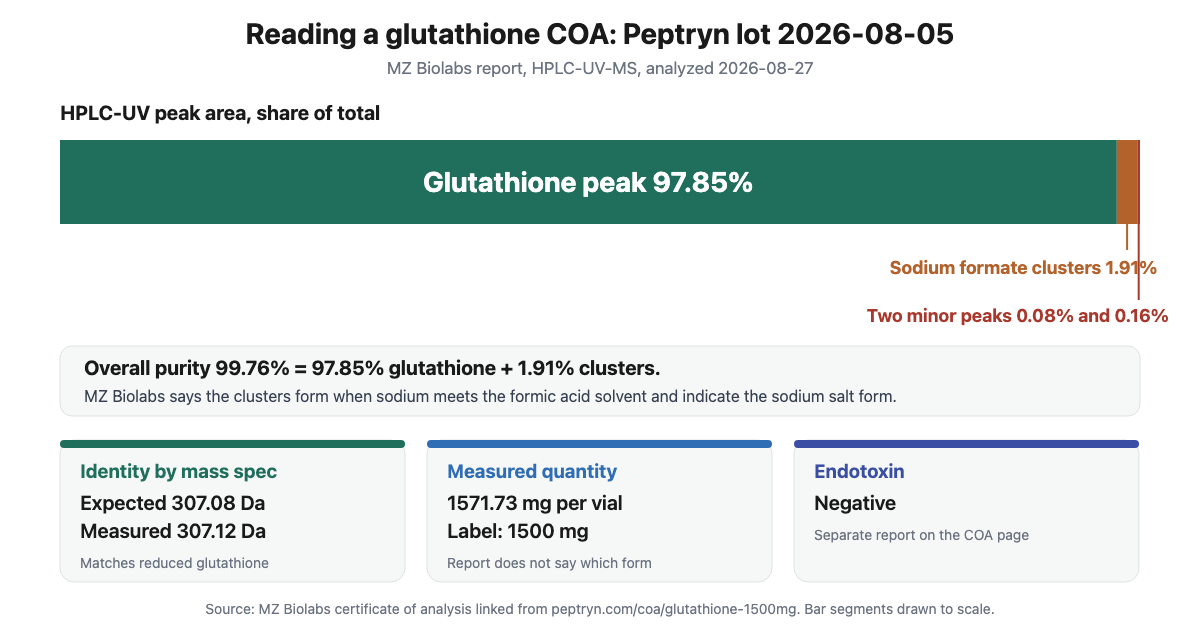
Peptryn publishes a glutathione COA page that links to the MZ Biolabs report (lot 2026-08-05, analyzed 2026-08-27, method HPLC-UV-MS). It shows how purity and salt form appear on a real report.
| COA field | What the report shows | How to read it |
|---|---|---|
| Identity by mass spec | Expected monoisotopic mass 307.08 Da, measured 307.12 Da | Matches glutathione (GSH). GSSG would appear near 612 Da |
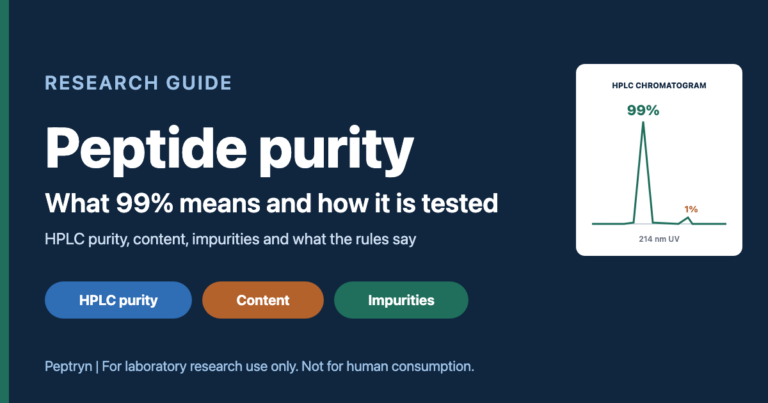
| Overall purity | 99.76% | Equals the glutathione peak plus the clusters (97.85 + 1.91) |
| Glutathione peak alone | 97.85% of area | The figure for the compound itself |
| Sodium formate clusters | 1.91% of area | MZ Biolabs says these form when sodium in the sample meets formic acid in the HPLC solvent and indicate the sodium salt form |
| Other peaks | 0.08% and 0.16% | Unidentified minor components |
| Measured quantity | 1571.73 mg per vial (label 1500 mg) | The report does not say whether this is free glutathione or the salt |
| Endotoxin | Negative | Separate report linked from the COA page |
Two lessons follow. First, “purity” depends on what the lab counts as the product, so read the peak table and not only the headline number. Second, a salt form changes the molecular weight you should use for molar calculations, and the COA is where that shows up. If a listing gives one molecular weight and the COA implies a salt, ask the supplier which basis the vial quantity uses. More on reading these documents is in our guide to how to read a certificate of analysis.
Frequently asked questions
Is glutathione a peptide?
Yes. It is a tripeptide of glutamate, cysteine and glycine, with the glutamate linked through its gamma carboxyl group.
What is glutathione peptide used for in research?
Redox biology. Researchers study its depletion and restoration in cell and animal models, use the GSH to GSSG ratio as a marker of oxidative stress, and examine its role in detoxifying electrophiles, as Forman and colleagues describe.
Does oral glutathione raise glutathione levels?
A single large oral amount did not raise plasma levels in 7 volunteers in 1992. Trials of daily use over weeks to months reported higher levels in blood in small groups. No trial reviewed here measured a health outcome.
What is the best glutathione supplement?
The research does not rank products. The trials tested specific forms, and none compared brands. See the four questions above for judging a claim. Peptryn sells no supplement.
Are glutathione injections safe?
Regulators and reviewers raise specific concerns: contamination of compounded product, anaphylaxis, liver toxicity and infection risk. This summarizes the sources and is not medical advice. Talk to a licensed clinician.
Are glutathione injections approved for skin lightening?
The Philippine FDA says it has approved no injectable for skin lightening, and the sources reviewed for this guide show no regulator approving one for that purpose.
What is the difference between glutathione and NAC?
Glutathione is the finished tripeptide. NAC supplies cysteine, one of the limiting precursors cells use to make it. The 2015 crossover study in 20 volunteers with metabolic syndrome compared both with an oral and a sublingual glutathione form, and its authors favored the sublingual form. It was a small study of a new product.
Final take
Glutathione is a well-characterized tripeptide central to redox biology. The human supplement data are small trials that measured blood levels, the injection record is mostly regulator warnings and one 2019 FDA report of adverse events, and the skin-lightening evidence was rated inconclusive in a 2019 systematic review. For a laboratory, the useful details are which form is in the vial, how much of the main peak the COA reports, and how the powder is stored. On Peptryn’s lot 2026-08-05 the glutathione peak is 97.85% of area, MZ Biolabs reports a sodium salt form, and the measured quantity is 1571.73 mg per 1500 mg vial.
See glutathione with its batch COA · Browse antioxidant research peptides
Related guides: SS-31 peptide guide · MOTS-c peptide guide · How to read a certificate of analysis · Are peptides legal? · What is a COA? · Peptide purity · Peptide testing · Popular peptides
Editorial note: Peptryn sells the research peptides discussed in this guide for laboratory use only. This guide is informational and is not medical advice. Sources are listed below. To report an error, email [email protected].
Sources
- Lu SC. Glutathione synthesis. Biochim Biophys Acta, 2013. pmc.ncbi.nlm.nih.gov
- Forman HJ, Zhang H, Rinna A. Glutathione: overview of its protective roles, measurement, and biosynthesis. Mol Aspects Med, 2009. pmc.ncbi.nlm.nih.gov
- Witschi A, Reddy S, Stofer B, Lauterburg BH. The systemic availability of oral glutathione. Eur J Clin Pharmacol, 1992. pubmed.ncbi.nlm.nih.gov
- Wellner VP, Anderson ME, Puri RN, Jensen GL, Meister A. Radioprotection by glutathione ester: transport of glutathione ester into human lymphoid cells and fibroblasts. Proc Natl Acad Sci USA, 1984. pmc.ncbi.nlm.nih.gov
- Richie JP, Nichenametla S, Neidig W, Calcagnotto A, Haley JS, et al. Randomized controlled trial of oral glutathione supplementation on body stores of glutathione. Eur J Nutr, 2015. pubmed.ncbi.nlm.nih.gov
- Schmitt B, Vicenzi M, Garrel C, Denis FM. Effects of N-acetylcysteine, oral glutathione (GSH) and a novel sublingual form of GSH on oxidative stress markers: a comparative crossover study. Redox Biol, 2015. pmc.ncbi.nlm.nih.gov
- Sinha R, Sinha I, Calcagnotto A, et al. Oral supplementation with liposomal glutathione elevates body stores of glutathione and markers of immune function. Eur J Clin Nutr, 2018. pmc.ncbi.nlm.nih.gov
- Weschawalit S, Thongthip S, Phutrakool P, Asawanonda P. Glutathione and its antiaging and antimelanogenic effects. Clin Cosmet Investig Dermatol, 2017. pmc.ncbi.nlm.nih.gov
- Dilokthornsakul W, Dhippayom T, Dilokthornsakul P. The clinical effect of glutathione on skin color and other related skin conditions: a systematic review. J Cosmet Dermatol, 2019. pubmed.ncbi.nlm.nih.gov
- Sonthalia S, Jha AK, Lallas A, Jain G, Jakhar D. Glutathione for skin lightening: a regnant myth or evidence-based verity? Dermatol Pract Concept, 2018. pmc.ncbi.nlm.nih.gov
- Alzahrani TF, et al. Exploring the safety and efficacy of glutathione supplementation for skin lightening: a narrative review. Cureus, 2025. pmc.ncbi.nlm.nih.gov
- Rahman I, Kode A, Biswas SK. Assay for quantitative determination of glutathione and glutathione disulfide levels using enzymatic recycling method. Nat Protoc, 2006. pubmed.ncbi.nlm.nih.gov
- Griffith OW. Determination of glutathione and glutathione disulfide using glutathione reductase and 2-vinylpyridine. Anal Biochem, 1980. pubmed.ncbi.nlm.nih.gov
- U.S. Food and Drug Administration. FDA highlights concerns with using the dietary ingredient glutathione to compound sterile injectables, June 7, 2019. fda.gov
- Food and Drug Administration Philippines. FDA Advisory No. 2019-182: Unsafe use of glutathione as skin lightening agent. fda.gov.ph
- Alliance for Pharmacy Compounding. PCAC recommends glutathione for bulks list, 2022. a4pc.org
- PubChem, National Library of Medicine: glutathione (CID 124886) and glutathione disulfide (CID 65359).
- MZ Biolabs certificate of analysis, glutathione 1500 mg, lot 2026-08-05, analyzed 2026-08-27, via peptryn.com/coa/glutathione-1500mg.
All products on peptryn.com are intended for laboratory research purposes only. Not for human consumption, self-administration, or veterinary use. The information on this page has not been evaluated by the U.S. Food and Drug Administration and is not intended to diagnose, treat, cure, or prevent any disease.