Peptide purity: what 99% means and how it is tested
Research use only. Peptides supplied by Peptryn are sold strictly for in vitro and preclinical laboratory research. They are not approved by the FDA for human or veterinary use, and nothing here is medical advice. This guide explains how to read an analytical result. It does not tell anyone how to use a peptide.
Quick answer: what is peptide purity?
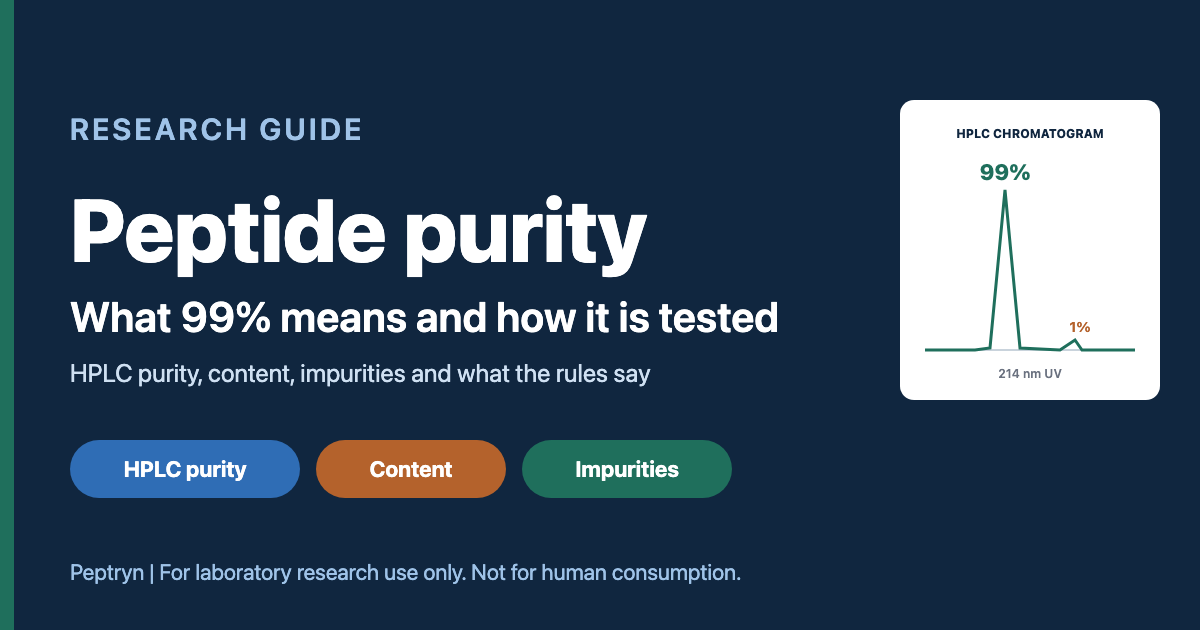
Peptide purity is the share of a sample’s detected signal that belongs to the target peptide, as measured by high performance liquid chromatography (HPLC). A result of 99% means that 99% of the peptide-related peak area on the chromatogram is the target peptide and about 1% is something else.
The statement is narrower than it sounds. It does not say how much of the powder is peptide, because water and salts do not show up in the measurement. It does not say the peptide is the right molecule, because that takes mass spectrometry. It does not say what the remaining 1% is.
The table separates the four numbers that are often blurred together.
| Measurement | Question it answers | Usual method | Where it appears on a COA |
|---|---|---|---|
| HPLC purity | What share of the peptide-related signal is the target | Reversed-phase HPLC with UV detection | Purity, with a peak table |
| Identity | Is the main peak the right molecule | Mass spectrometry | Expected and measured mass |
| Peptide content | What share of the powder’s weight is peptide | Amino acid analysis, nitrogen analysis or qNMR | Assay or content, when reported |
| Quantity per vial | How many milligrams of peptide the vial holds | HPLC-UV quantification | Measured quantity |
- How peptide purity is measured
- Purity is not content
- What is in the remaining 1%
- Purity grades and what they are used for
- What the rules say about peptide impurity limits
- What published quality studies show
- Purity on a Peptryn COA
- How to read a “99% purity” claim
- Frequently asked questions
- Final take
How peptide purity is measured
A peptide purity test is an HPLC run. HPLC separates the components of a dissolved sample as they pass through a column. In reversed-phase HPLC, which is the standard for peptides, trifluoroacetic acid is commonly used as a solvent, which is why many purified peptides end up as TFA salts. A UV detector records each component as it leaves the column, usually at about 214 nm, where the peptide bond absorbs, according to LifeTein’s technical page. The instrument draws peaks, and purity is the area of the target peak divided by the total area of the peptide-related peaks.
The number is relative. It compares peaks with each other and says nothing about absolute amounts.
It depends on the method. A different column or gradient can separate two components that another method reports as one peak. The European Medicines Agency’s peptide guideline says that when co-eluting impurities appear as one peak, the 1.0% qualification threshold applies to that peak unless justified, and that one method may not separate every peptide-related impurity, so additional independent methods may be needed.
Anything that does not absorb at the detection wavelength is invisible. LifeTein states that water, residual salts and counterions such as trifluoroacetate are not represented in the HPLC purity percentage. The MZ Biolabs reports we have read carry a similar note: injectable peptides may contain salts and sugars that are not normally detected by UV and that the lab does not count as impurities.
And a purity figure is only meaningful next to identity. A sample can be 99% one compound and be the wrong one. Mass spectrometry, which the same reports run alongside HPLC, reports the mass of the main component. Our guide to what a COA is shows where each line sits on a report.
Purity is not content
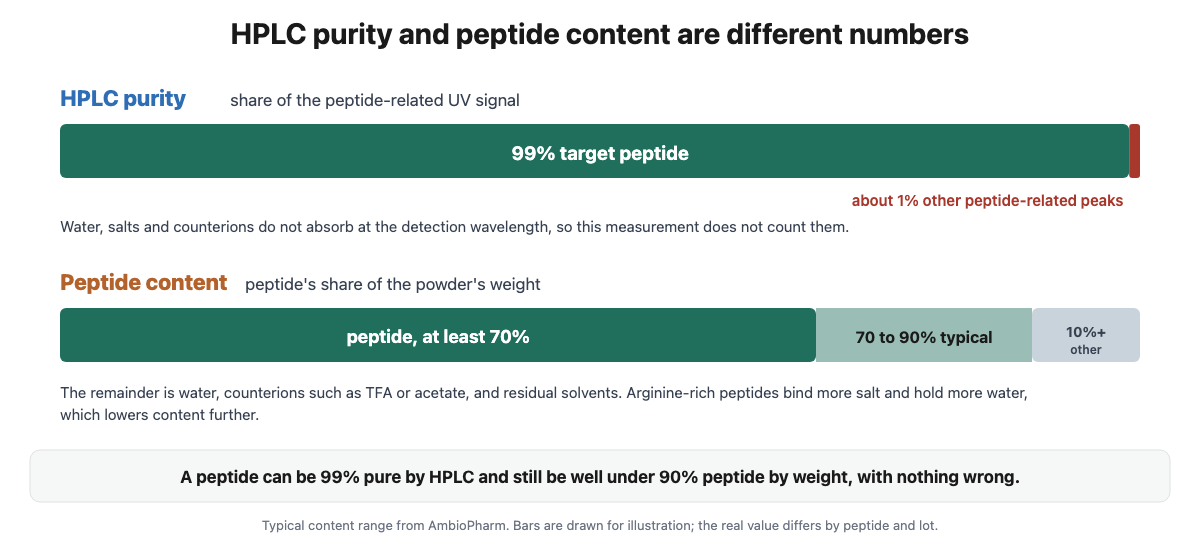
A vial of lyophilized peptide holds the peptide plus water and counterions, and sometimes residual solvents. Peptide content is the peptide’s share of that mass. AmbioPharm, a peptide manufacturer, states that typical peptide content is between 70% and 90%, and that arginine-rich sequences bind more salt and are more hygroscopic, which lowers content further.
So a peptide can be 99% pure by HPLC and still be well under 90% peptide by weight, with nothing wrong. The two numbers answer different questions. Confusing them is the source of most disputes about label claims.
Published data show how far apart they can drift in uncontrolled products. In a 2026 paper in Drug and Alcohol Review, Piatkowski and colleagues sent three products sold as retatrutide and labelled 10 mg to an accredited laboratory. All three contained a molecule whose measured mass closely matched retatrutide’s expected 4730.477 Da. The measured content was 5.13 mg (51.3% of the label), 16.5 mg (165%) and 19.0 mg (190%). The authors did not assess sterility or endotoxin, and three samples is a small study, but it shows that the right molecule at the wrong amount is possible. The paper is open access.
The measured quantity line on a COA is where content shows up. Our guide to reading a certificate of analysis covers how to compare that line with the label.
What is in the remaining 1%
Peptides made by solid-phase synthesis pick up a predictable set of impurities. A 2014 review in the Journal of Pharmaceutical and Biomedical Analysis by D’Hondt and colleagues sorts them into two groups.
The first group comes from the synthesis itself. It includes deleted or inserted amino acids, racemization that produces diastereomeric impurities, adducts from incompletely removed protecting groups, oxidized side chains, and dimers or oligomers. Trifluoroacetate counterions left over from synthesis and purification may also be present.
The second group comes from degradation. The review names beta-elimination, diketopiperazine formation, pyroglutamate formation and succinimide formation. The same impurity types can be found in finished peptide drugs.
Non-peptide impurities sit outside the HPLC peak table entirely. The EMA guideline lists process reagents, by-products, residual solvents and elemental impurities.
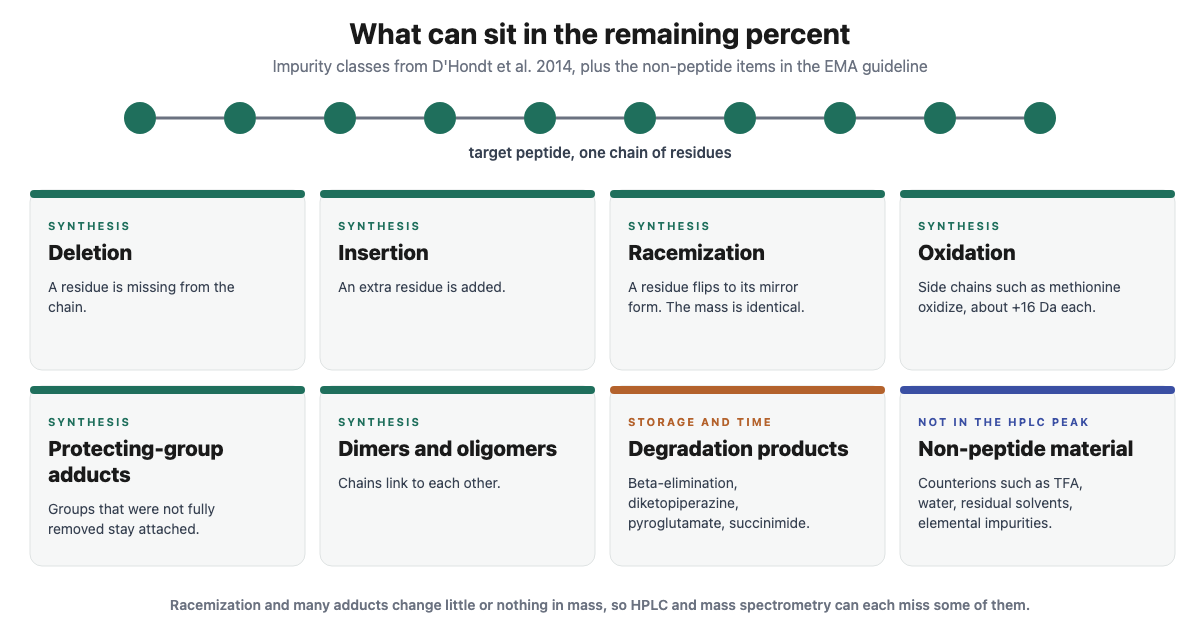
The review notes that these impurities can influence early functional studies and possibly lead to erroneous conclusions, which is a reason to look at the peak table and not only the headline.
Why the counterion matters
Peptides purified by reversed-phase HPLC are often supplied as trifluoroacetate (TFA) salts. In a 1999 study in the American Journal of Physiology, Cornish and colleagues found that TFA at 10 to 100 nanomolar (10 to the minus 8 to 10 to the minus 7 molar) reduced cell numbers in fetal rat osteoblast cultures. When they compared TFA and hydrochloride salts of amylin, amylin fragment 1 to 8 and calcitonin, cell proliferation was consistently lower with the TFA salts, which risked missing a proliferative effect or wrongly reporting an antiproliferative one. They concluded that the effect was likely relevant to purified peptides above 1 nanomolar in any cell or tissue type.
The point for a purity figure is that a 99% HPLC result is silent on which counterion the peptide carries.
Purity grades and what they are used for
There is no universal ladder of peptide grades. Suppliers publish their own. GenScript’s guidance, for example, lists these tiers.
| Grade | Purity | Uses named by GenScript |
|---|---|---|
| Crude | Not specified | Non-sensitive screening, mutation screening, sequence optimization |
| Immuno grade | Above 75% | ELISA, peptide arrays, antigens for polyclonal antibodies |
| Biochemistry grade | Above 85% | In vitro bioassays, epitope mapping, phosphorylation studies, semi-quantitative enzyme-substrate work |
| High purity grade | Above 95% | Quantitative receptor-ligand and inhibition studies, NMR |
| Industrial grade | Above 98% | Crystallography, GMP peptides, clinical trials, structure-activity work |
Treat this as one manufacturer’s guidance and not as a standard. It does show the logic: the more quantitative the experiment, the higher the purity a lab typically asks for. It also shows that “99% purity” is above every tier listed, which is why the number alone stops being informative and the other lines start to matter.
What the rules say about peptide impurity limits
Two documents come up when people ask what purity a peptide should have. Neither applies to research peptides.
ICH Q3A(R2), the guideline that sets impurity thresholds for chemically synthesized drug substances, excludes peptides from its scope, and the EMA guideline repeats that point. The Q3A scope text lists biological and biotechnological products, peptides, oligonucleotides, radiopharmaceuticals, fermentation products, herbal products and crude products of animal or plant origin as not covered. Any impurity threshold quoted online for peptides that traces back to Q3A is borrowed from a guideline that says it does not apply.
The European Medicines Agency filled part of that gap with its Guideline on the Development and Manufacture of Synthetic Peptides. The Committee for Medicinal Products for Human Use adopted it on 1 December 2025, and it came into effect on 1 June 2026. Its scope is synthetic peptides used in a medicinal product, and it notes that synthetic peptides are fully or partially excluded from ICH Q3A/B, Q6A/B and M7. It ties peptide impurity control to the European Pharmacopoeia general monograph on substances for pharmaceutical use, under which peptide-related impurities are reported above 0.1%, identified above 0.5% and qualified above 1.0%.
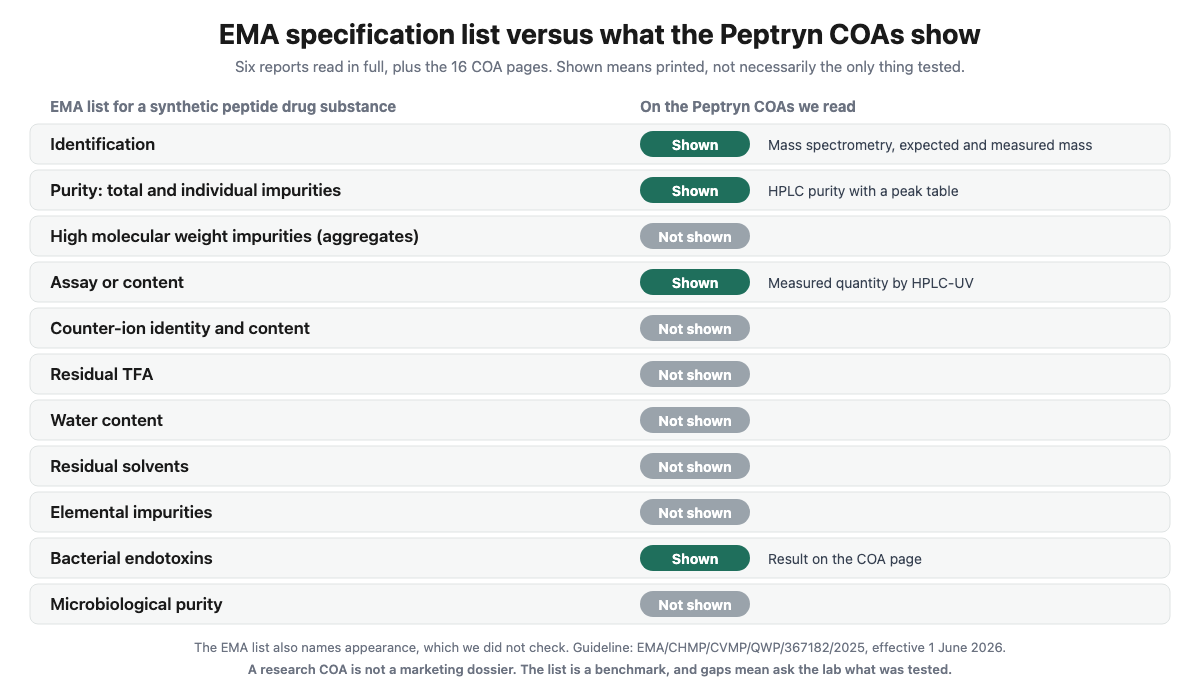
Its specification list for a synthetic peptide active substance is the useful part. It is described as non-exhaustive and includes:
- appearance and identification
- purity, meaning total impurities and individual impurities
- high molecular weight impurities such as aggregates
- assay or content, by LC, amino acid analysis, nitrogen analysis or qNMR
- counter-ion identity and content, and residual TFA
- water content
- residual solvents
- elemental impurities
- bacterial endotoxins
- microbiological purity
The guideline also says LC assay limits are expressed on the counter-ion-free, anhydrous basis. In other words, the regulator asks for the exact conversions that a headline purity number leaves out.
A research-use peptide is not a drug substance, and a research COA is not a marketing dossier. The list is a benchmark, and the graphic below compares it with what a research COA usually prints. For the Peptryn reports we read in full, the lines shown are identity, purity with a peak table and a measured quantity, and the COA pages show an endotoxin result. We did not see counter-ion content, water, residual solvents, elemental impurities or microbiological purity printed on them. If the lab tested those and did not print them, that is a question for the lab.
What published quality studies show
Three sources describe what a purity or content claim is worth when nobody checks it.
A 2026 preprint by Mendias and Awan analyzed 6,441 samples of 14 gray market research peptides from a public independent testing dataset. Depending on the quality model, 41.6% to 71.1% of samples failed basic quality criteria, and measurable endotoxin was present in 15%. It is a preprint and has not been peer reviewed.
A 2024 analysis in the Journal of Medical Internet Research tested three vials of semaglutide bought from illegal online pharmacies. Content exceeded the labelled amount by 28.56% to 38.69%, endotoxin was detected in all samples, and the paper reports a measured “purity” of 7.7% to 14.37% against the 99% claimed on the labels. The same abstract says no peptide-like impurities were identified. Those two results cannot both describe HPLC area percent, so the study is also a reminder to check how any purity number was defined.
The retatrutide study above found the expected molecule in all three samples and content from 51.3% to 190% of the label.
None of these describes Peptryn’s lots, and sample sizes range from three vials to thousands of samples. They show what unverified claims can hide.
Purity on a Peptryn COA
The COA library lists 16 lots. As printed on the pages on September 20, 2026, HPLC purity runs from 99.11% to 99.97%. The lot-level pages carry the lot number, the method (HPLC-UV-MS) and the purity, and 15 of the 16 also list an endotoxin result. The full reports sit on MZ Biolabs’ own site.
Two examples show why the peak table beats the headline.
The tesamorelin lot (2026-08-05) reports two peaks: the main peak at 99.97% of area and one minor peak at 0.03%.
The glutathione lot (2026-08-05) reports the glutathione peak at 97.85% of area, and a second peak at 1.91% labeled sodium formate clusters, which MZ Biolabs explains form when sodium in the sample meets formic acid in the solvent and indicate the sodium salt form. The report’s overall purity, 99.76%, counts both. Both numbers are correct. They answer different questions, and only the peak table shows which one a page quoted.
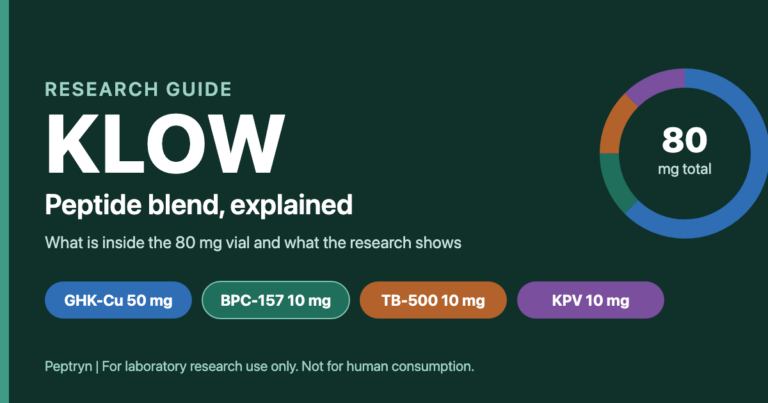
For the blends, check the report to see whether the purity figure covers each component or the blend as a whole.
You can open a lot’s page and match its lot number to the report on the lab’s site. The retatrutide, MOTS-c and SS-31 pages sit alongside the retatrutide, MOTS-c and SS-31 product pages.
How to read a “99% purity” claim
Seven questions cover most claims about high purity peptides.
- Which method produced it, and at what wavelength? HPLC with UV detection near 214 nm is the usual answer.
- Which peak is the number? Find the peak table and see whether the headline counts one peak or several.
- Is identity confirmed by mass spectrometry, with expected and measured mass shown?
- Is content reported, and what does the label mean: free peptide, salt or gross powder?
- Which counterion does the peptide carry, and is water content given?
- Which lot and which lab? A number that cannot be tied to a lot has not shown you a result.
- Is endotoxin reported separately? A negative endotoxin result is not a sterility result.
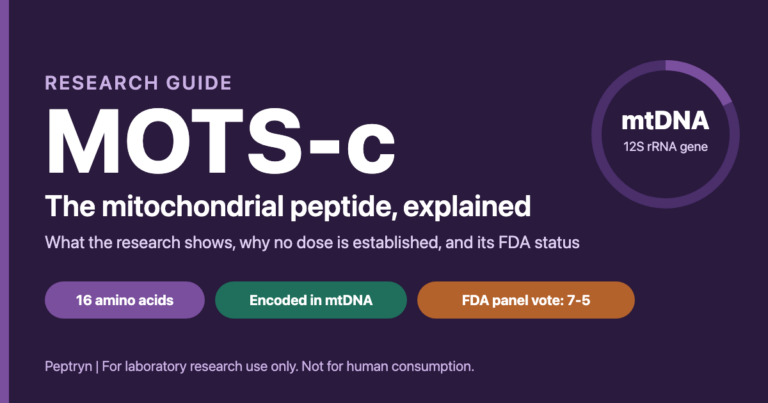
The peptide’s own chemistry can add a step. MOTS-c has two methionines, and oxidation adds about 16 Da per residue, so a mass spectrum showing a peak that far above the main mass is worth asking about. Our MOTS-c guide covers the peptide in detail.
Can you test peptide purity at home?
HPLC purity needs a chromatography system, so it is a laboratory measurement. We did not evaluate consumer test kits and make no claim about them. Our peptide testing guide covers what independent labs test. Independent labs quote prices by sample and method, and we did not verify a public price, so we do not print one.
Does purity change with storage?
A COA describes the lot on the date it was tested. The degradation routes in the D’Hondt review, and oxidation of susceptible residues, mean purity at the time of use can differ from purity at the time of the report. Our post on storage and handling of research peptides covers the basics.
Frequently asked questions
What does 99% purity mean for a peptide?
It means 99% of the peptide-related peak area on an HPLC chromatogram belongs to the target peptide. It does not mean the powder is 99% peptide by weight, and it does not confirm identity.
What is the difference between peptide purity and peptide content?
Purity compares the target peptide with other peptide-related molecules. Content is the peptide’s share of the powder’s weight, with the rest being water, counterions and residual solvents. AmbioPharm states typical content is 70% to 90%.
Is 95% purity good enough?
It depends on the experiment. GenScript’s guidance lists above 95% for quantitative receptor-ligand and inhibition studies and above 75% or 85% for less sensitive work. That is one supplier’s advice and not a standard. Ask what the remaining percent is made of.
Does higher purity always mean a better peptide?
No. Two peptides at 99% can differ in content, counterion and water. Purity is one line among several.
What causes peptide impurities?
Mostly the synthesis and later degradation. Deletion and insertion sequences, racemization, protecting-group adducts, oxidation and dimers come from synthesis. Pyroglutamate, succinimide and diketopiperazine formation are degradation routes, per D’Hondt and colleagues.
Why does the TFA counterion matter?
Cornish and colleagues showed that TFA salts of peptides lowered cell proliferation in osteoblast cultures compared with hydrochloride salts, which can distort the result of a cell experiment. A purity number does not tell you which counterion is present.
Is a 99% pure research peptide the same as pharmaceutical grade?
No. A drug substance in the EU must meet a specification of about twelve items, including counterion, water, residual solvents and elemental impurities, plus impurity thresholds of 0.1%, 0.5% and 1.0%. A research COA usually reports fewer lines.
How do I know a purity result is real?
Match the lot number to your vial, open the report on the lab’s own website and confirm the two agree, and read the peak table. Our longer certificate of analysis guide has a ten-step checklist.
Final take
Peptide purity is a relative measure of the peptide-related signal on one chromatogram. It matters most alongside identity, content and the lot it describes. Ask for the peak table, the mass match and the content line before the headline number.
To look at the paperwork for a specific lot, open the Peptryn COA library. For the legal picture around research peptides, read are peptides legal?.
Editorial note: Peptryn sells the research peptides discussed in this guide for laboratory use only. This guide is informational and is not medical advice. Sources are listed below. To report an error, email [email protected].
Sources
- European Medicines Agency. Guideline on the Development and Manufacture of Synthetic Peptides, EMA/CHMP/CVMP/QWP/367182/2025. Adopted by CHMP 1 December 2025, effective 1 June 2026. ema.europa.eu
- ICH. Q3A(R2) Impurities in New Drug Substances, scope section. database.ich.org
- D’Hondt M, Bracke N, Taevernier L, et al. Related impurities in peptide medicines. J Pharm Biomed Anal, 2014. pubmed.ncbi.nlm.nih.gov
- Cornish J, Callon KE, Lin CQ, et al. Trifluoroacetate, a contaminant in purified proteins, inhibits proliferation of osteoblasts and chondrocytes. Am J Physiol, 1999. pubmed.ncbi.nlm.nih.gov
- Piatkowski T, Craven A, Cornell S, Ferris J. Composition and labelling accuracy of products sold as retatrutide in Australia. Drug Alcohol Rev, 2026. doi.org
- Mendias CL, Awan TM. Evaluation of research grade peptides marketed directly to consumers reveals extensive variability in purity and measured abundance. Preprints.org, 2026 (not peer reviewed). doi.org
- Ashraf AR, Mackey TK, Vida RG, et al. Multifactor quality and safety analysis of semaglutide products sold by online sellers without a prescription. J Med Internet Res, 2024. pmc.ncbi.nlm.nih.gov
- GenScript. Recommended peptide purity guidelines. genscript.com
- AmbioPharm. What is peptide content? ambiopharm.com
- LifeTein. What is peptide purity? lifetein.com
- Peptryn COA library, certificate pages for the 16 listed lots, read September 20, 2026, with reports hosted by MZ Biolabs. peptryn.com/coa
All products on peptryn.com are intended for laboratory research purposes only. Not for human consumption, self-administration, or veterinary use. The information on this page has not been evaluated by the U.S. Food and Drug Administration and is not intended to diagnose, treat, cure, or prevent any disease.