Are Peptides Legal? What US Law Says, What “Research Use Only” Means, and What the FDA Did in 2026
Want more research guides like this from Peptryn in your Google results?
Add Peptryn as a Preferred SourceInformation only, not legal advice. This guide summarizes US federal law and FDA positions as of September 2026. It does not cover state law, other countries, or any person’s situation. Peptryn sells peptides for laboratory research use only. For questions about your circumstances, consult an attorney.
Quick answer: are peptides legal?
It depends on the peptide and on what someone does with it.
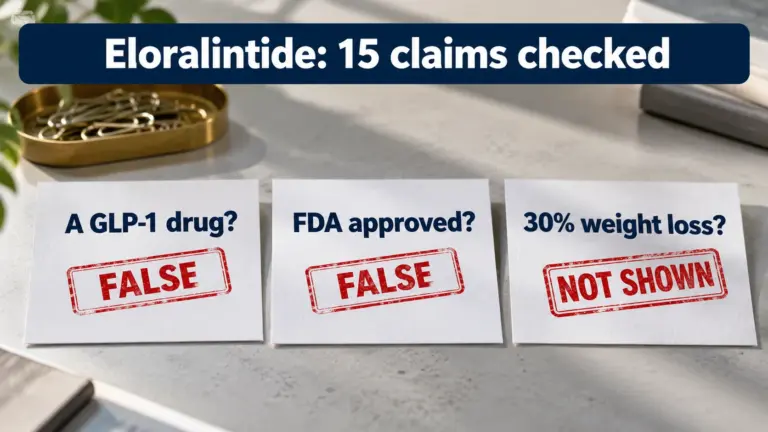
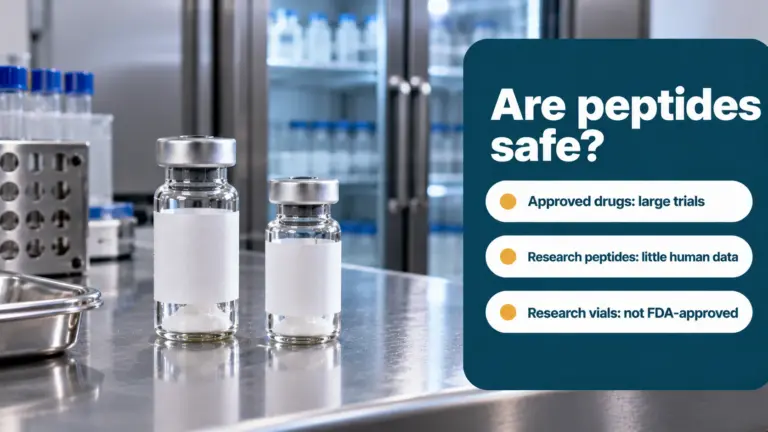
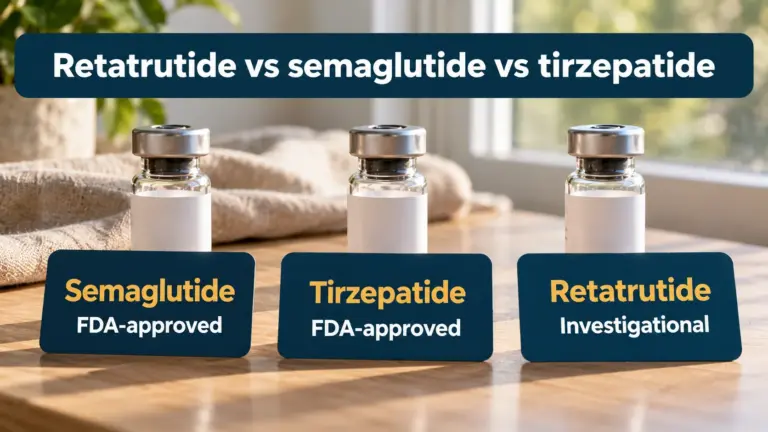
Some peptides are FDA-approved prescription drugs, including insulin, semaglutide and tirzepatide. Many others, such as BPC-157, TB-500 and retatrutide, are not approved for any use. Federal law bars selling an unapproved drug across state lines, and the FDA decides whether a product is a drug by looking at what it is intended for. A “research use only” label does not settle that question. On August 24, 2026, the FDA sent warning letters to online peptide sellers on exactly this basis.
Pharmacies cannot yet compound most of these peptides either. In July 2026 an FDA advisory panel voted to recommend several of them for the compounding list, but those votes are advice, and the FDA has not adopted them.
At a glance
| Question | Short answer |
|---|---|
| Is an approved peptide drug legal? | Yes, with a prescription, for its approved use |
| Is it legal to sell an unapproved peptide as a drug for people? | No. Federal law bars marketing unapproved new drugs |
| Does “research use only” fix that? | No. The FDA looks at intended use, which claims and circumstances show |
| Can pharmacies compound BPC-157 or TB-500? | Not yet. The July 2026 panel votes were advisory |
| Are peptides controlled substances? | As far as we found, none of the peptides in this guide is on the DEA schedules |
| Are peptides steroids? | No. They are different chemistry, and both can be banned in sport |
Sourcing for research: batch COA library · lab results
Table of contents
- What counts as a peptide, and why the answer changes
- The federal law in plain English
- What “research use only” means legally
- What the FDA cited in the 2026 warning letters
- The 2026 FDA peptides timeline
- Compounded peptides
- Legal status of common peptides, September 2026
- Are peptides steroids?
- Are peptides controlled substances?
- Who this affects
- Where Peptryn stands
- Frequently asked questions
- Final take
What counts as a peptide, and why the answer changes
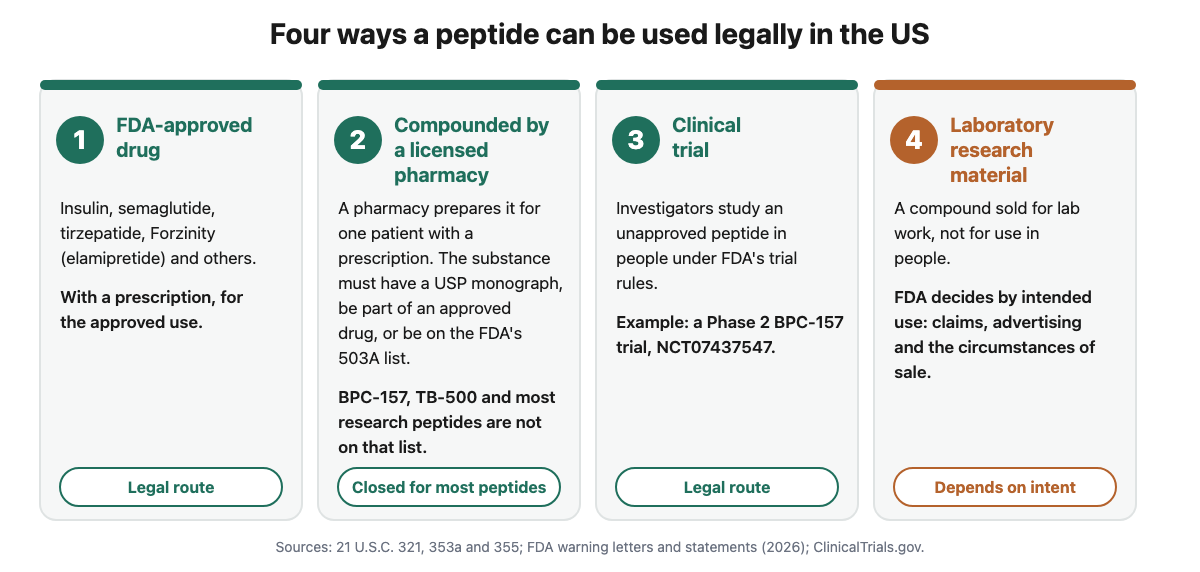
A peptide is a short chain of amino acids. That single word covers products with very different legal standing:
- Approved drugs. Insulin, semaglutide and tirzepatide are FDA-approved prescription drugs. So is elamipretide, sold as Forzinity, approved in September 2025 for Barth syndrome only. Our SS-31 guide explains how the approved drug differs from a research vial.
- Unapproved compounds. BPC-157, TB-500, MOTS-c and retatrutide have no FDA approval for any use as of September 2026.
- Compounded preparations. A pharmacy makes these for an individual patient under a prescription, under separate rules covered below.
Peptides in cosmetic skincare products fall under different rules and are outside this guide.
The federal law in plain English
Three provisions do most of the work.
Definition of a drug. The Federal Food, Drug, and Cosmetic Act defines a drug to include articles intended for use in the diagnosis, cure, mitigation, treatment, or prevention of disease, and articles (other than food) intended to affect the structure or any function of the body (21 U.S.C. 321).
Approval before sale. No person may introduce or deliver for introduction into interstate commerce any new drug unless an approval is effective for it (21 U.S.C. 355(a)). An unapproved new drug sold across state lines violates this rule, and the FDA’s 2026 letters cite it together with section 301(d) of the Act.
Intended use. The FDA regulation on intended use says the test is the objective intent of the people responsible for labeling the article. It says intent may be shown by labeling claims, advertising, and oral or written statements, and by the circumstances of distribution, including knowing that the article is offered or used for a purpose it is not labeled for (21 CFR 201.128).
Together these mean a peptide becomes a drug because of what it is intended for, and an unapproved drug cannot be sold across state lines.
What “research use only” means legally
A research use only label does not decide what a product is. In the August 2026 letters we read, the FDA wrote that despite labeling the products “research use only” and “not for human consumption,” the evidence establishes that they are intended to be drugs for human use. The FDA’s GLP-1 page, dated September 1, 2026, says the agency has warned companies that sold semaglutide, tirzepatide, retatrutide, survodutide or mazdutide falsely labeled for research purposes or not for human consumption (FDA).
That does not make every research chemical a drug. Intent decides, and a compound sold for laboratory work is a different case from the ones in the letters when nothing about the sale points to human use. Where the line falls for a particular seller is a question for a lawyer, and this guide does not draw it.
What the FDA cited in the 2026 warning letters
We read four FDA warning letters: Gram Peptides (March 31, 2026) and Peak Performance Peptides, Royal Peptides and Peptide Partners (all August 24, 2026). Each alleges that the seller distributed unapproved new drugs in interstate commerce, and the letters we checked cite sections 301(d) and 505(a) of the Act. The August letters gave each company 15 business days to respond. The Peak Performance letter warns that failure to correct the violations may lead to seizure and injunction.
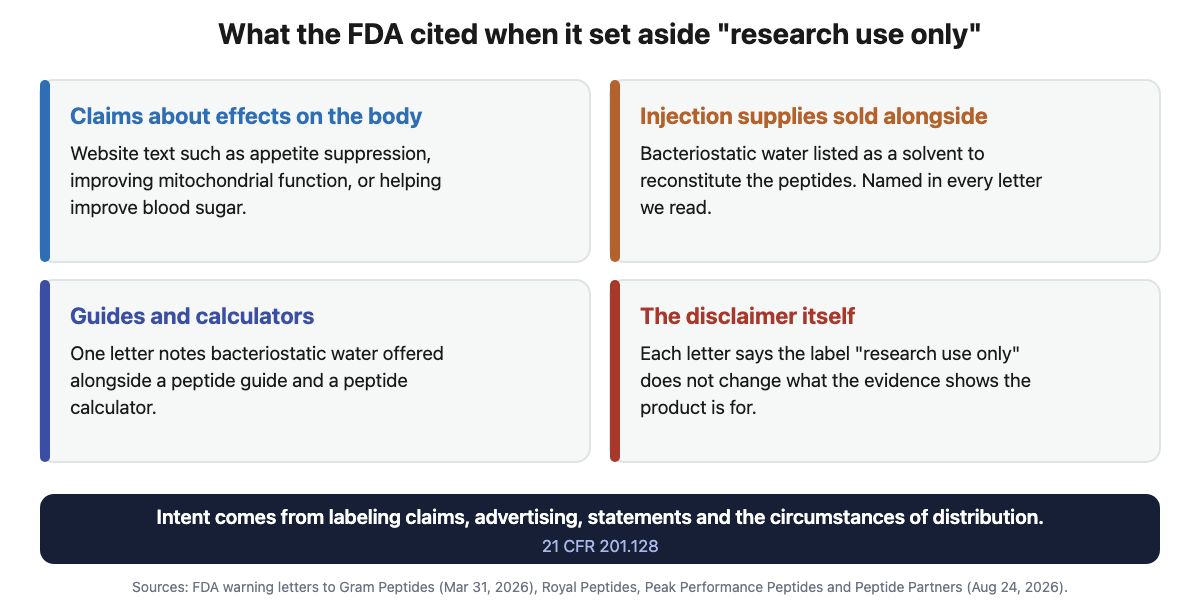
The letters name semaglutide, tirzepatide, retatrutide, SS-31, PT-141, tesamorelin and bacteriostatic water among the products. The FDA cited four kinds of evidence:
- Website claims about effects on the body, such as appetite suppression, improving mitochondrial function, and helping improve blood sugar.
- Bacteriostatic water offered as the solvent to reconstitute the peptides, which the FDA treated as a sign the products were meant for injection. Every letter we read mentions it.
- A peptide guide and a peptide calculator, which the Royal Peptides letter notes alongside its bacteriostatic water.
- The disclaimer itself, which each letter treats as outweighed by the rest of the evidence.
The letters are addressed to sellers, and they treat the whole marketing picture as the evidence. Read the letters yourself: Gram Peptides, Peak Performance Peptides, Royal Peptides, Peptide Partners.
The 2026 FDA peptides timeline
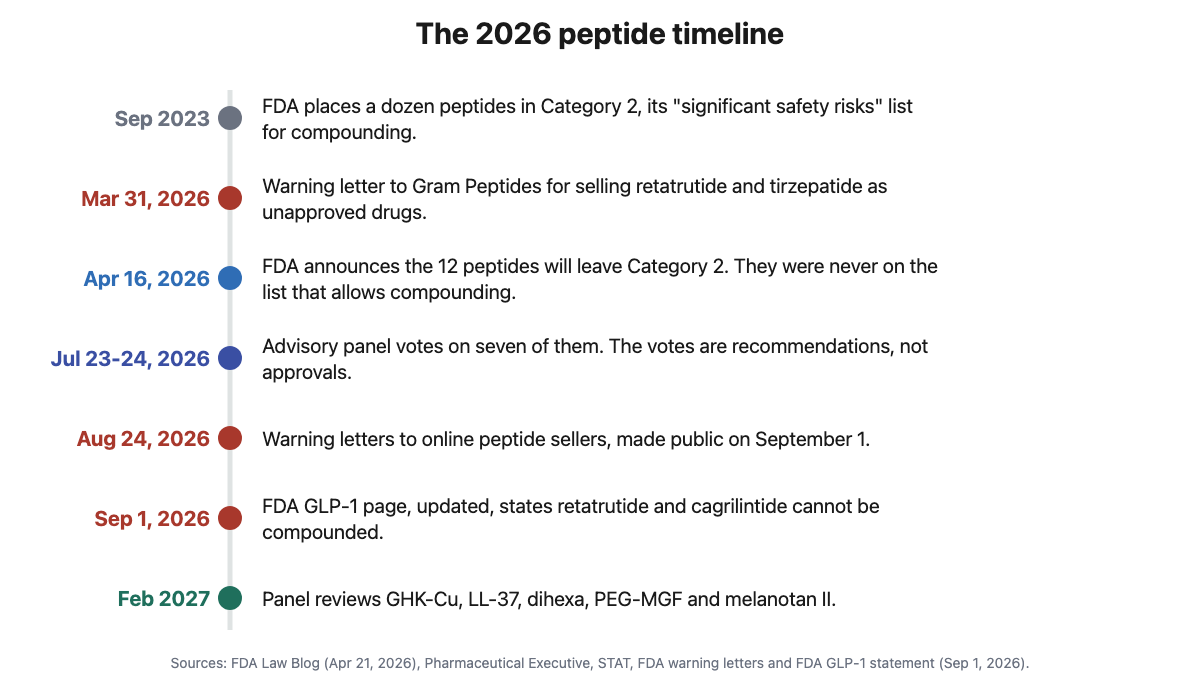
In September 2023 the FDA moved a dozen peptides to Category 2, its list of substances that raise significant safety concerns for compounding. On April 16, 2026 the FDA announced it would remove them from that category within seven calendar days (FDA Law Blog).
The removal did not make them legal to compound. The same analysis points out that these peptides were never on Category 1, the list that allows compounding, so leaving Category 2 restored nothing. It opened the way for the FDA to consider them, which is what the July panel did.
Compounded peptides
Compounding is the legal route by which a pharmacy prepares a drug for an individual patient. Under section 503A, the pharmacy needs a valid prescription for an identified patient, and each bulk substance it uses must meet a USP or National Formulary monograph, be a component of an FDA-approved drug, or appear on a list the FDA develops by regulation (21 U.S.C. 353a).
Most research peptides meet none of the three conditions today. On July 23 and 24, 2026, the FDA’s Pharmacy Compounding Advisory Committee voted on seven of the twelve peptides.
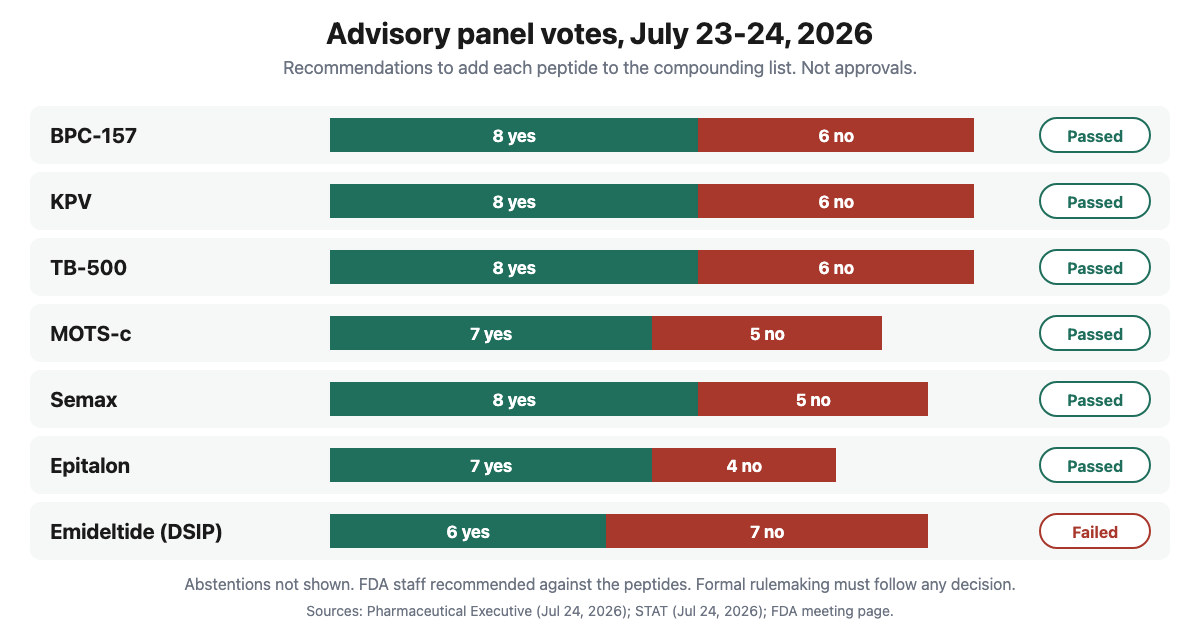
The panel voted 8 to 6, with one abstention, for BPC-157, KPV and TB-500, and 7 to 5, with two abstentions, for MOTS-c (Pharmaceutical Executive). On July 24 it voted 8 to 5 for semax and 7 to 4 for epitalon, and 6 to 7 against emideltide (STAT).
Those votes are recommendations. STAT reports that FDA staff recommended against all of the peptides for lack of safety and efficacy data, and that the FDA does not have to follow the panel. A formal rulemaking has to come next. Trade coverage estimates eight to twelve months, and the FDA Law Blog notes that standard timelines can run more than a year. GHK-Cu (injectable), LL-37, dihexa, PEG-MGF and melanotan II are due for review at a separate panel by February 2027.
Two peptides have a firmer answer. The FDA’s GLP-1 page, updated September 1, 2026, states that retatrutide and cagrilintide cannot be used in compounding under federal law, and that neither is a component of an FDA-approved drug.
Legal status of common peptides, September 2026
| Peptide | Status |
|---|---|
| Semaglutide, tirzepatide | FDA-approved prescription drugs. The FDA warns about unapproved versions sold as research products |
| Retatrutide | Not approved. The FDA says it cannot be used in compounding |
| Cagrilintide | Not approved. The FDA says it cannot be used in compounding |
| Elamipretide (SS-31) | Approved as Forzinity for Barth syndrome only. Research vials are not the approved drug |
| BPC-157 | Not approved. Left Category 2 in April 2026. Panel voted 8-6 on July 23, advisory only. Prohibited in sport (WADA S0) |
| TB-500 | Not approved. Panel voted 8-6, advisory only. Addressed under WADA class S2 |
| KPV | Not approved. Panel voted 8-6, advisory only |
| MOTS-c | Not approved. Panel voted 7-5, advisory only. Prohibited in sport |
| Semax, epitalon | Not approved. Panel votes of 8-5 and 7-4 on July 24, advisory only |
| Emideltide (DSIP) | Not approved. Panel vote failed 6-7 |
| GHK-Cu (injectable) | Not approved. The FDA lists safety concerns for injectable use. Panel review due by February 2027 |
For the evidence behind several of these, see our guides to BPC-157 and TB-500 (Wolverine), MOTS-c, Klow and Glow. For the full list, including compounds not in this table, see our list of research peptides.
Are peptides steroids?
No. A peptide is a chain of amino acids. Anabolic steroids are synthetic variations of the hormone testosterone, according to the National Institute on Drug Abuse (NIDA). Anabolic steroids are controlled substances under the Controlled Substances Act (21 U.S.C. 812).
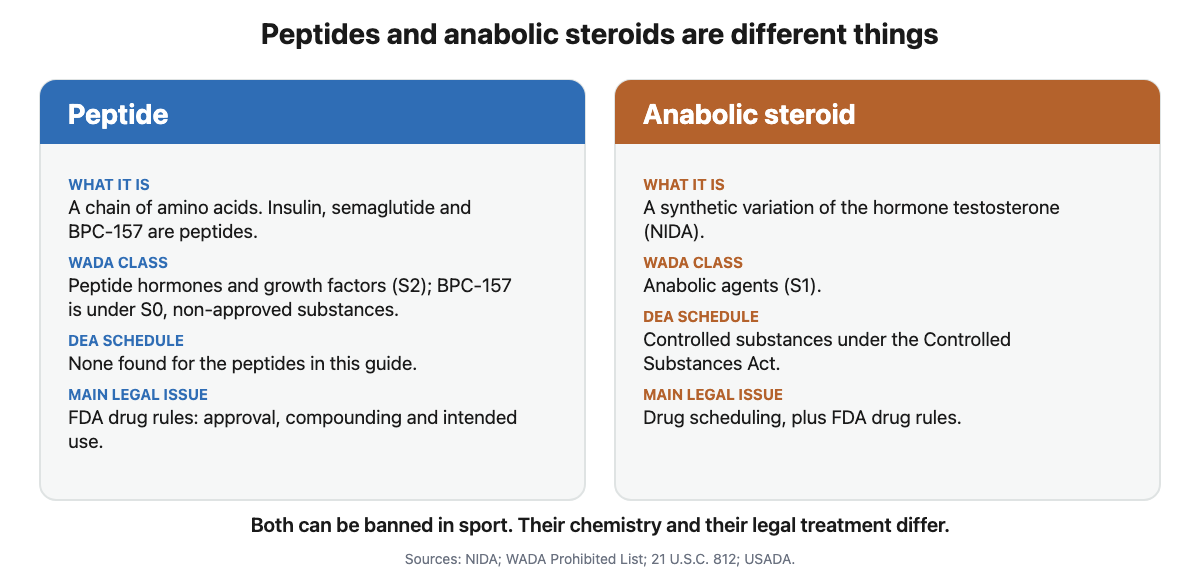
The overlap is in sport. The World Anti-Doping Agency prohibits anabolic agents and also prohibits many peptide hormones and growth factors, and BPC-157 falls under its category for non-approved substances (USADA; WADA).
Are peptides controlled substances?
As far as we could tell, none of the peptides in this guide is on the DEA schedules, and the FDA actions described above rest on drug-approval law, not on scheduling. We could not check every compound against the full current schedules, so confirm before relying on this. Even an unscheduled substance is not legal for human use when it is an unapproved drug, because the FDA rules above apply whether or not a substance is scheduled.
Human growth hormone is a separate case. Federal law makes it a crime to knowingly distribute, or possess with intent to distribute, human growth hormone for any use in humans other than a medical use authorized under the approval process and ordered by a physician, with penalties of up to five years in prison (21 U.S.C. 333(e)). The statute defines human growth hormone as somatrem, somatropin, or an analogue of either.
Who this affects
Sellers face the enforcement described above: warning letters, and if the FDA’s concerns are not corrected, possible seizure and injunction.
Buyers appear in the FDA’s warnings as a safety issue. The agency tells consumers to buy only from state-licensed pharmacies and says products sold online may contain the wrong, excessive, insufficient or no active ingredient and may be counterfeit. The letters we read are addressed to sellers, and we did not find FDA action against individual buyers in these sources. Possession, state law and personal circumstances are outside this guide, and an attorney is the right person to ask.
Researchers can continue laboratory work. Studying an unapproved peptide in people goes through clinical trials, such as the registered BPC-157 hamstring trial (NCT07437547).
Athletes face the WADA rules regardless of FDA status.
Where Peptryn stands
Peptryn sells peptides for laboratory research use only, to buyers who are 21 or older and who confirm research use. It is not a compounding pharmacy or an outsourcing facility, and it does not give dosing or medical advice. Because the FDA’s position is that a label does not decide a product’s status, read this paragraph as a description of Peptryn’s policy and not as a legal conclusion.
Frequently asked questions
Are peptides legal in the US?
Approved peptide drugs are legal with a prescription for their approved use. Unapproved peptides cannot lawfully be sold as drugs for human use, and the FDA does not accept a research label as a way around that when the evidence shows human use is intended.
Are peptides illegal?
We found no federal law that bans peptides as a class. The legal problems come from selling unapproved drugs, compounding rules and, for a few substances, sport regulations. Which rule applies depends on the peptide and on how it is marketed and used.
Are research peptides legal to buy?
The FDA’s actions so far target sellers. Its position is that a research label does not decide a product’s status when the product is intended for human use. Whether buying or possessing a particular product is lawful depends on the facts and on state law, so ask an attorney.
Is it legal to buy peptides online?
The FDA warns that peptides sold online may contain the wrong amount of active ingredient or none, and may be counterfeit, and tells consumers to use state-licensed pharmacies. It has issued warning letters to online sellers. This guide does not give an opinion on individual purchases.
Are peptides FDA approved?
Some are, including insulin, semaglutide, tirzepatide and elamipretide (Forzinity, for Barth syndrome). Others, including BPC-157, TB-500, MOTS-c and retatrutide, are not approved for any use.
What is the FDA doing about peptides?
In 2026 it removed twelve peptides from its Category 2 list, held an advisory panel on seven of them in July, sent warning letters to online sellers in August, and states on its GLP-1 page that retatrutide and cagrilintide cannot be compounded. A panel review of five more peptides is due by February 2027.
Are compounded peptides legal?
Compounding is lawful only under the conditions of section 503A (pharmacies) or 503B (outsourcing facilities). For peptides without a USP monograph that are not part of an approved drug, the substance has to appear on the FDA’s list, and most research peptides are not on it. The July 2026 panel votes were advisory.
Is BPC-157 legal?
BPC-157 has no FDA approval and is not on a compounding list. It left Category 2 in April 2026, and the panel voted 8 to 6 in July to recommend it for the list, which does not change its status until the FDA acts. WADA prohibits it in sport.
Is retatrutide legal?
Retatrutide is not FDA-approved. The FDA states it cannot be used in compounding and has warned companies that sold it labeled for research.
Are peptides steroids?
No. Peptides are chains of amino acids. Anabolic steroids are synthetic variations of testosterone and are controlled substances.
Are peptides legal in sports?
Many are prohibited. BPC-157 falls under WADA’s non-approved substances category, and MOTS-c and TB-500 are also addressed by the prohibited list. Athletes subject to testing should check the current list.
Final take
As of September 2026, no unapproved research peptide has a lawful route to human use through a pharmacy, the FDA has told sellers in writing that a research label does not change what a product is, and the next scheduled checkpoint is the February 2027 panel meeting. Before relying on anything in this guide, check the FDA pages linked below for changes.
Related guides: Wolverine peptide guide · MOTS-c guide · SS-31 guide · How to read a certificate of analysis · Glutathione peptide guide · 5 Amino 1MQ guide · CJC-1295 peptide guide · Ipamorelin peptide guide · CJC-1295 and ipamorelin · Sermorelin peptide guide · Tesamorelin peptide guide · What is a COA? · Peptide purity · Peptide testing · Popular peptides · Best place to buy peptides online · Peptides for weight loss: what the evidence shows · What are peptides? · Are peptides safe? · TB-500 (thymosin beta-4) · KPV peptide · Kisspeptin-10 · Pinealon
Editorial note: Peptryn sells the research peptides discussed in this guide for laboratory use only. This guide is informational and is not medical advice. Sources are listed below. To report an error, email [email protected].
Sources
- FDA warning letters: Gram Peptides, March 31, 2026; Peak Performance Peptides, August 24, 2026; Royal Peptides LLC, August 24, 2026; Peptide Partners LLC, August 24, 2026
- U.S. Food and Drug Administration. FDA’s Concerns with Unapproved GLP-1 Drugs Used for Weight Loss, September 1, 2026. fda.gov
- Snow CD, Palmer KL. FDA’s Pep(tide) Rally! What Compounders and Industry Need to Know, FDA Law Blog, April 21, 2026. thefdalawblog.com
- Pharmaceutical Executive. FDA Panel Votes to Loosen Restrictions for Four Peptides, July 24, 2026. pharmexec.com
- STAT. FDA advisory panel narrowly rejects compounding of one peptide, backs two others, July 24, 2026. statnews.com
- FDA. July 23-24, 2026: Meeting of the Pharmacy Compounding Advisory Committee. fda.gov
- Federal Food, Drug, and Cosmetic Act as codified: 21 U.S.C. 321, 21 U.S.C. 353a, 21 U.S.C. 355, 21 U.S.C. 333; 21 CFR 201.128
- Controlled Substances Act, 21 U.S.C. 812; National Institute on Drug Abuse, Anabolic Steroids
- USADA, BPC-157 peptide: prohibited; WADA Prohibited List
- ClinicalTrials.gov, NCT07437547
All products on peptryn.com are intended for laboratory research purposes only. Not for human consumption, self-administration, or veterinary use. The information on this page has not been evaluated by the U.S. Food and Drug Administration and is not intended to diagnose, treat, cure, or prevent any disease. Nothing here should be construed as medical advice or legal advice.