Tesamorelin Peptide: FDA-Approved Egrifta, What the Trials Showed, and How It Compares With Sermorelin, Ipamorelin and CJC-1295
Research use only. Peptides supplied by Peptryn are sold strictly for in vitro and preclinical laboratory research. They are not approved by the FDA for human or veterinary use, and nothing here is medical advice, a dosing recommendation, or an instruction for self-administration. This guide summarizes published trials and FDA labeling on tesamorelin and explains how to read a certificate of analysis. A research vial is not Egrifta.
Quick answer: what is tesamorelin?
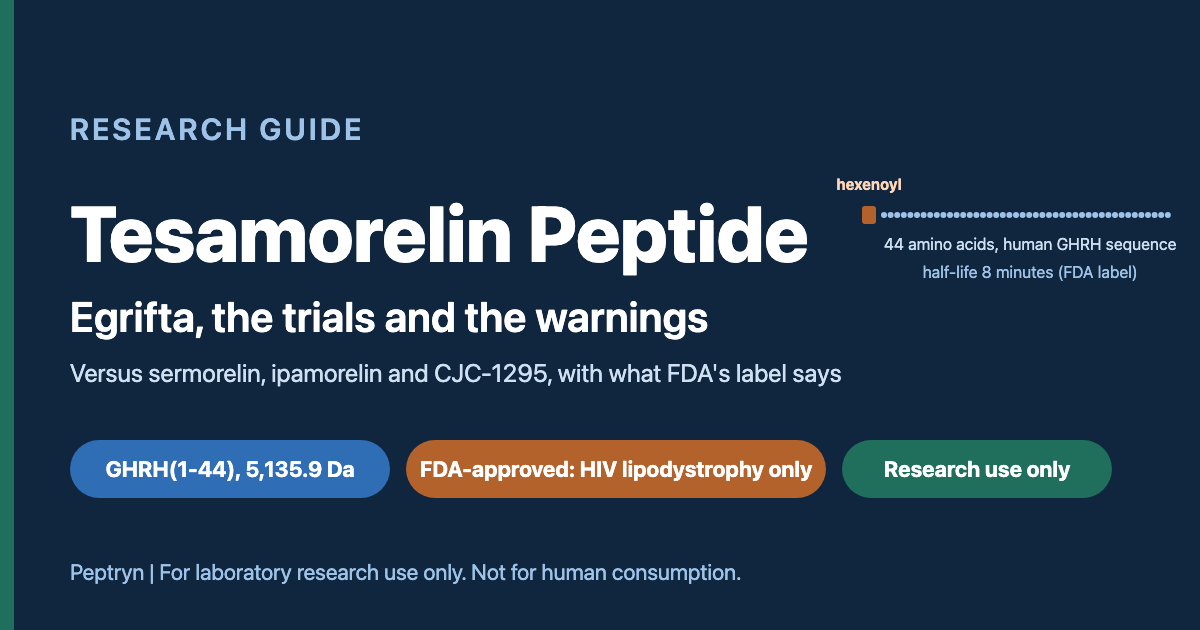
Tesamorelin is a synthetic analog of growth hormone-releasing hormone (GHRH). It has the full 44-amino-acid sequence of human GHRH plus a hexenoyl group attached to the N-terminal tyrosine. It acts on the GHRH receptor to stimulate the pituitary to release growth hormone (GH), which raises IGF-1.
Among the GH-axis peptides covered in these guides, it is the only one that is a currently labeled FDA-approved drug. Egrifta was approved on November 10, 2010, and FDA’s label for both current versions (Egrifta SV and Egrifta WR) states one indication: reduction of excess abdominal fat in HIV-infected adult patients with lipodystrophy. The label also says it is not indicated for weight loss management. In two phase 3 trials, visceral fat fell 15.2% versus a 5.0% rise on placebo in one and 10.9% versus 0.6% in the other. Its elimination half-life is 8 minutes.
Outside that indication the human evidence is thinner. Trials in older adults with and without mild cognitive impairment gave mixed results, and we found no tesamorelin approval or trial for weight loss in healthy people. Peptryn sells tesamorelin for laboratory research only.
Tesamorelin at a glance
| Item | Detail |
|---|---|
| Structure | GHRH(1-44) with a trans-3-hexenoyl group on the N-terminal tyrosine, as the acetate salt |
| Molecular weight | 5,135.9 Da as free base (FDA label) |
| Target | GHRH receptor on pituitary somatotrophs |
| Human half-life | 8 minutes after a single subcutaneous dose (healthy subjects, FDA label) |
| Approved product | Egrifta, November 10, 2010; now Egrifta SV and Egrifta WR |
| Approved use | Excess abdominal fat in HIV-infected adults with lipodystrophy |
| Peptryn listing | Lyophilized powder, 10 mg and 20 mg sizes, store at -20°C, research use only |
Table of contents
- What tesamorelin is
- Is tesamorelin FDA approved?
- What the trials showed
- Tesamorelin beyond HIV: cognition and other trials
- Does tesamorelin work for weight loss or belly fat?
- Does tesamorelin cause cancer?
- Tesamorelin side effects and safety
- Tesamorelin half-life and pharmacology
- Tesamorelin vs sermorelin vs ipamorelin vs CJC-1295
- Tesamorelin dosage: why there is no established one for a research vial
- Regulatory and sport status
- How to evaluate a tesamorelin vial
- Frequently asked questions
- Final take
What tesamorelin is
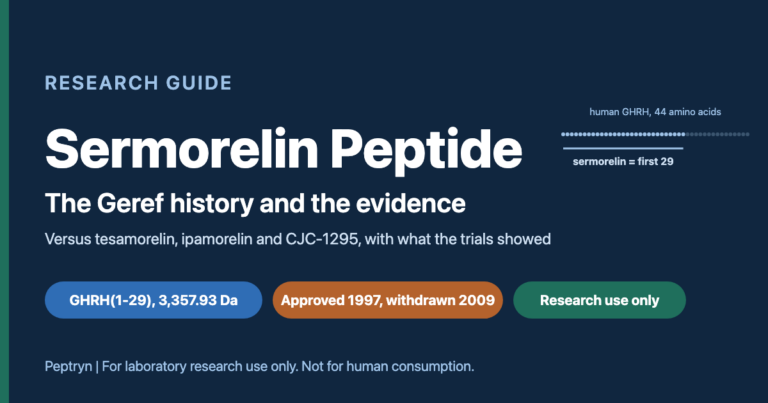
Sermorelin is the first 29 amino acids of human GHRH. Tesamorelin keeps the whole 44-amino-acid sequence and adds a hexenoyl group to the N-terminus, a change that protects it from breakdown. The 2012 cognition trial described it as a stabilized, degradation-protected analog of human GHRH. FDA’s label describes the drug as a synthetic GRF analog prepared as an acetate salt, with a molecular weight of 5,135.9 Da as free base.
That makes it a different molecule from CJC-1295, which is a modified version of the shorter 1-29 fragment. See our sermorelin guide and CJC-1295 guide for those.
Is tesamorelin FDA approved?
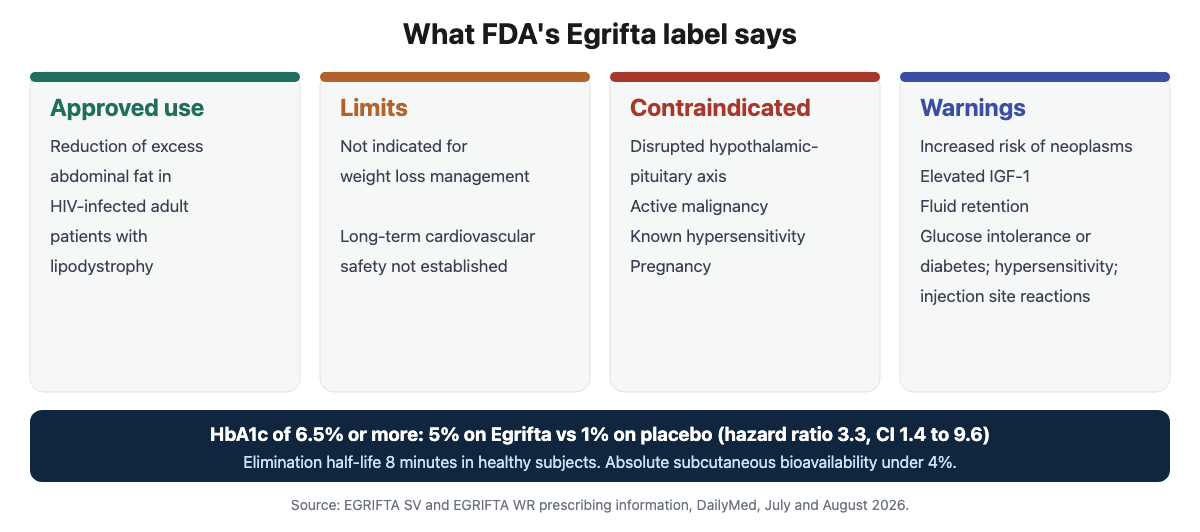
Yes, for one use. FDA’s records list Egrifta’s original approval on November 10, 2010, as a new molecular entity, from Theratechnologies. The current labels for Egrifta SV and Egrifta WR (DailyMed, July and August 2026) state the same indication: reduction of excess abdominal fat in HIV-infected adult patients with lipodystrophy. Both labels add limitations:
- Long-term cardiovascular safety has not been established.
- Continuation should be reconsidered in patients who have not had a reduction in visceral adipose tissue.
- It is not indicated for weight loss management, because it has a weight-neutral effect.
The SV and WR versions were approved on the basis of the studies done with the original formulation, plus data showing comparable bioavailability at different labeled amounts. A different formulation can change exposure, which is one reason a product’s labeled amount cannot be applied to another product.
What the trials showed
The FDA approval rests on two randomized, double-blind, placebo-controlled trials in HIV-infected patients with lipodystrophy and excess abdominal fat, each with a 26-week main phase and a 26-week extension. Entry criteria required a waist circumference of at least 95 cm (37.4 inches) and a waist-to-hip ratio of at least 0.94 in men or 0.88 in women, and excluded diabetes and hypopituitarism.
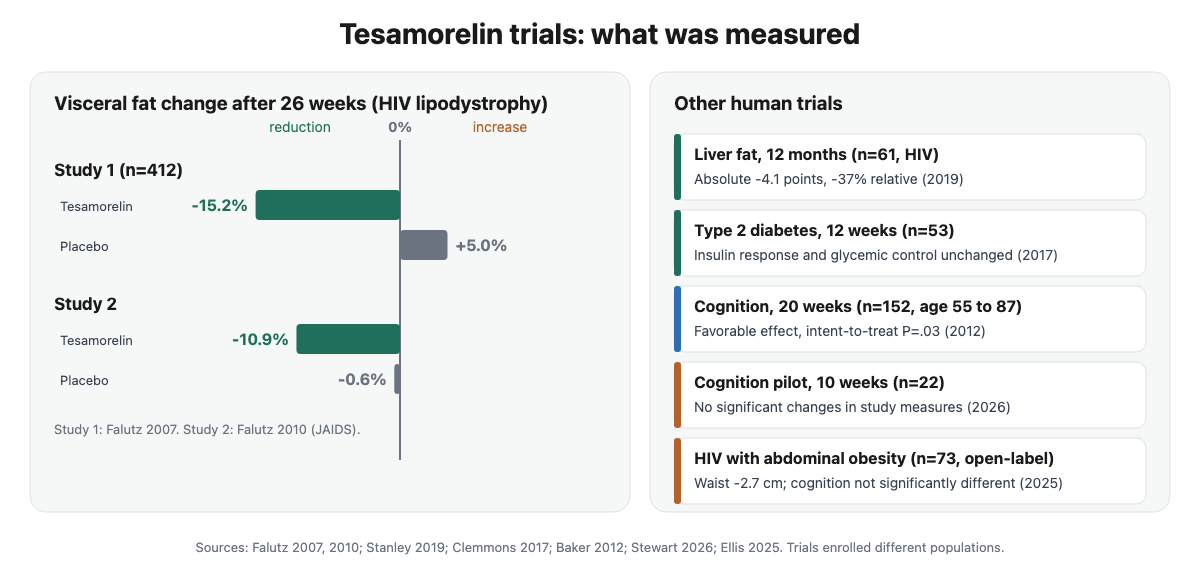
Study 1 (Falutz 2007). The trial randomized 412 patients: 273 to tesamorelin and 137 to placebo. Visceral fat fell 15.2% on tesamorelin and rose 5.0% on placebo. Triglycerides and the total-to-HDL cholesterol ratio also improved.
Study 2 (Falutz 2010). Visceral fat fell 10.9% on tesamorelin versus 0.6% on placebo in the 6-month phase.
Pooled analysis (Falutz 2010, JCEM). The visceral fat treatment effect was 15.4%, with no significant change in abdominal subcutaneous fat. Triglycerides fell by a treatment effect of 12.3% and the cholesterol ratio by 7.2%. IGF-I rose by a mean of 108 ng/ml on tesamorelin against a 7 ng/ml fall on placebo. At 52 weeks the visceral fat reduction was maintained in patients who stayed on treatment, and there were no clinically meaningful differences in glucose parameters between groups.
Liver fat (Stanley 2019, Lancet HIV). In 61 people with HIV and fatty liver disease, 12 months of tesamorelin cut liver fat fraction by an absolute 4.1 percentage points relative to placebo, a 37% relative reduction from baseline.
Type 2 diabetes (Clemmons 2017). In 53 patients with type 2 diabetes treated for 12 weeks, tesamorelin did not change insulin response or glycemic control.
Tesamorelin beyond HIV: cognition and other trials
Outside the approved indication, the main human trials looked at cognition.
Baker and colleagues (2012) randomized 152 adults aged 55 to 87, 66 of them with mild cognitive impairment, to 20 weeks of tesamorelin or placebo. In the intent-to-treat analysis GHRH had a favorable effect on cognition (P = .03), similar in healthy older adults and those with mild impairment. IGF-1 rose 117% within the physiological range, percent body fat fell 7.4%, and fasting insulin rose 35% in the impaired group. Adverse events were mild and reported by 68% of treated adults and 36% of those on placebo.
Later studies were less clear. A 2026 pilot randomized 22 people to 10 weeks of low-dose tesamorelin or placebo and found no significant changes in its study measures. A 2025 phase 2 trial in 73 virally suppressed people with HIV and abdominal obesity found a larger waist circumference reduction with tesamorelin than standard care (median difference 2.7 cm) but no significant difference in neurocognitive performance between groups. It was open-label and lacked a placebo arm.
Does tesamorelin work for weight loss or belly fat?
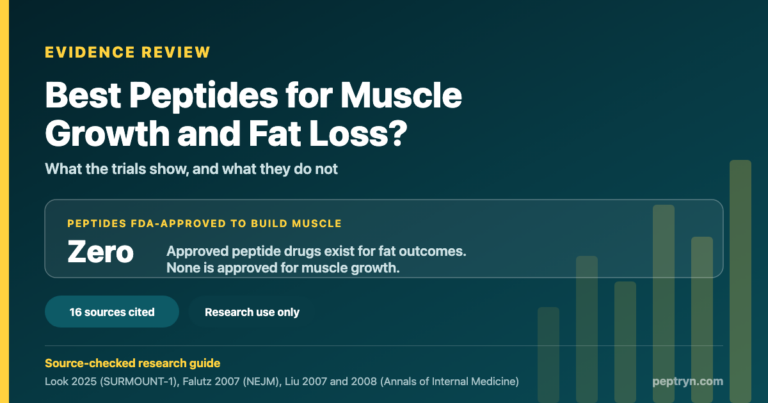
The trials that show a visceral fat effect enrolled HIV-infected adults with lipodystrophy and large waists, and the label calls the effect weight neutral and rules out weight loss management. We found no phase 3 trial of tesamorelin for fat loss in healthy adults. The 2012 trial reported a 7.4% fall in percent body fat in older adults, as a secondary finding in a cognition study.
“Before and after” posts (880 searches a month for the plain phrase, 590 each for men and women) describe results in unregulated products and unverified users. Study 1 was 86% male. No trial reported a sex-specific result in the sources we read. Photos cannot separate the peptide from diet, training or the placebo effect.
Does tesamorelin cause cancer?
The label treats it as a precaution based on how the drug works. Tesamorelin induces the release of endogenous GH, which the label calls a known growth factor. It contraindicates the drug in active malignancy and says any preexisting malignancy should be inactive and its treatment complete before starting. It advises weighing the higher background cancer risk in HIV-positive patients, and says to discontinue if there is evidence of recurrent malignancy. On IGF-1, the label states that the effects of prolonged elevation are unknown and advises monitoring. That is the label’s language. We found no trial that measured cancer as an outcome.
Tesamorelin side effects and safety
The label lists as important adverse reactions increased risk of neoplasms, elevated IGF-1, fluid retention, glucose intolerance or diabetes, hypersensitivity reactions and injection site reactions. Among 740 HIV-infected patients treated in trials, the most common reactions were arthralgia, injection site erythema and pruritus, pain in extremity, peripheral edema and myalgia. In the combined 26-week phase (543 on tesamorelin, 263 on placebo), injection site reactions occurred in 17% versus 6%, peripheral edema in 6% versus 2%, and myalgia in 6% versus 2%.
On glucose, the label reports HbA1c of 6.5% or more in 5% of tesamorelin patients versus 1% on placebo, an intent-to-treat hazard ratio for developing diabetes of 3.3 (CI 1.4 to 9.6), and says to evaluate glucose status before starting and monitor periodically. The pooled trial analysis reported no clinically meaningful glucose differences. Both are on record, and the label’s wording is the safety language that applies to the approved drug.
Contraindications are disruption of the hypothalamic-pituitary axis (hypophysectomy, hypopituitarism, pituitary tumor or surgery, head irradiation or head trauma), active malignancy, known hypersensitivity, and pregnancy. This summarizes FDA labeling for an approved drug and is not medical advice. A research vial is not that drug.
Tesamorelin half-life and pharmacology
The label reports that after a single subcutaneous dose in healthy subjects the peak concentration came at about 0.15 hours and the mean elimination half-life was 8 minutes. Absolute bioavailability after subcutaneous injection was under 4%, and exposure (AUC) was 34% higher in HIV-infected patients than in healthy subjects. The half-life is short, yet the visceral fat effect appeared over weeks of daily treatment, so a short plasma half-life does not rule out effects that last longer.
Tesamorelin vs sermorelin vs ipamorelin vs CJC-1295
| Tesamorelin | Sermorelin | Ipamorelin | CJC-1295 | |
|---|---|---|---|---|
| Class | GHRH analog (1-44, hexenoyl) | GHRH analog (1-29) | Ghrelin receptor agonist | GHRH analog (modified 1-29) |
| Human half-life | 8 minutes | Not covered in the sources we read | About 2 hours | 5.8 to 8.1 days (DAC form) |
| Approval | Egrifta, Nov 10, 2010 | Geref, withdrawn 2009 | None | None |
| Strongest human evidence | Two phase 3 trials, 412 patients in one | Pediatric GH deficiency, small adult study | Human PK study, phase 2 ileus trial | Two trials in healthy adults (DAC form) |
| FDA compounding page | Not on the Category 2 page | Not on the Category 2 page | Category 2 | Category 2 |
Tesamorelin has the clearest clinical record of the four and the narrowest approved use. Against sermorelin (5,400 searches a month), the difference is length, stability and evidence: see the sermorelin guide. Against ipamorelin (2,400), the difference is the receptor: tesamorelin acts on the GHRH receptor and ipamorelin on the ghrelin receptor, covered in the ipamorelin guide.
Tesamorelin and ipamorelin together
Tesamorelin with ipamorelin is a large search (4,400 a month, 3,600 for “blend”), and we found no published or registered trial of the pair in Europe PMC or ClinicalTrials.gov. The reasoning is the same as for CJC-1295 with ipamorelin: two receptors, one pituitary. The one human study of a GHRH plus a GHRP-family peptide together used GHRP-6, not ipamorelin, and is described in our CJC-1295 and ipamorelin guide. The combination is an inference.
Tesamorelin dosage: why there is no established one for a research vial
The FDA labels specify doses, but for approved products with defined formulations, for a specific population, under clinician monitoring. The label bridges the newer formulations to the original by showing comparable bioavailability at different labeled amounts, which shows that the amount depends on the formulation. A research vial is not one of those products. Online tesamorelin dosing charts (the dose, per-day, chart and calculator searches total tens of thousands a month) copy label numbers, trial numbers and clinic marketing, and apply them to unregulated vials. Peptryn does not publish a dose for any product, and this guide does not either.
Regulatory and sport status
Tesamorelin is FDA-approved as Egrifta for the single indication above. Tesamorelin does not appear on FDA’s Category 2 page for bulk drug substances that may present significant safety risks (content current as of 04/22/2026), unlike CJC-1295 and ipamorelin. We did not confirm its compounding status from FDA’s own pages. The World Anti-Doping Agency prohibits GHRH analogues, and its list names tesamorelin as an example. A past or present approval for one indication does not make a research vial suitable for human use. See our legal guide.
How to evaluate a tesamorelin vial
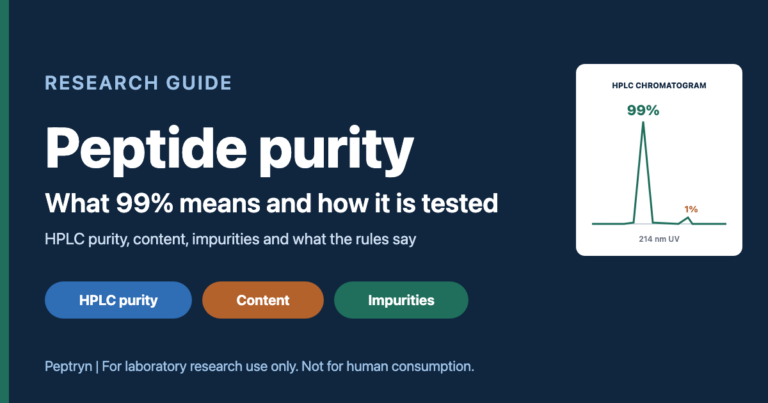
A 2026 preprint by Mendias and Awan analyzed 6,441 samples of 14 gray market research peptides, including tesamorelin, ipamorelin, CJC-1295 and sermorelin, from a public independent testing dataset. Depending on the quality model, 41.6% to 71.1% of samples failed basic quality criteria, and measurable endotoxin was present in 15%. It is a preprint and has not been peer reviewed, but it explains why a lot-specific COA matters.
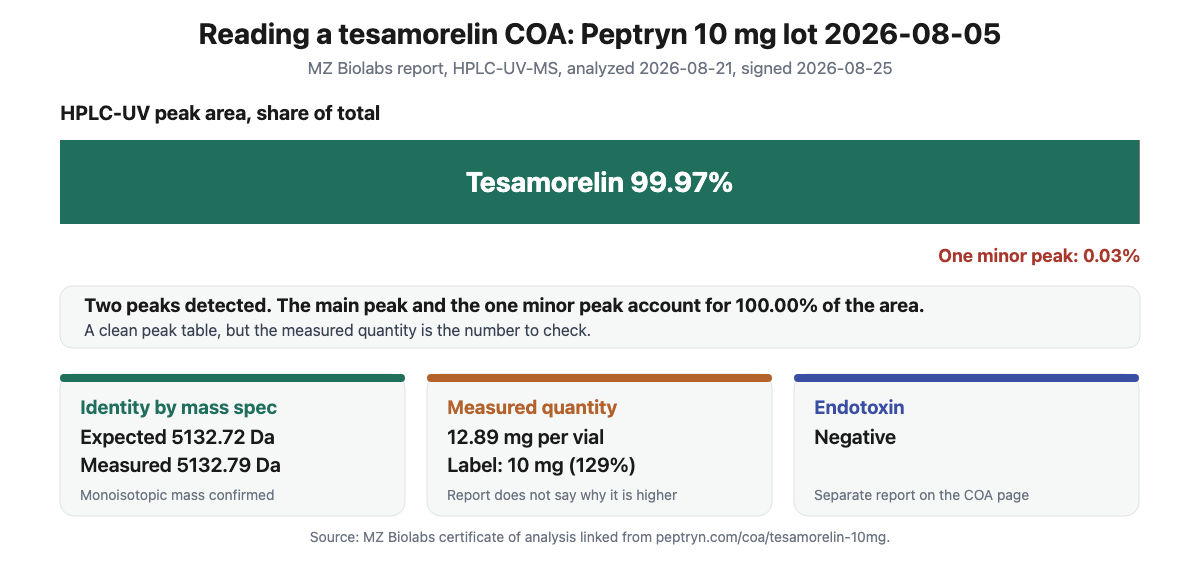
Peptryn’s tesamorelin COA page links to the MZ Biolabs report for the 10 mg lot 2026-08-05.
| COA field | What the report shows |
|---|---|
| Lot and method | 2026-08-05, HPLC-UV-MS, analyzed 2026-08-21, report signed 2026-08-25 |
| Main peak | 99.97% of peak area, with one minor peak at 0.03% |
| Identity by mass spec | Expected monoisotopic mass 5132.72 Da, measured 5132.79 Da |
| Measured quantity | 12.89 mg per vial (label: 10 mg) |
| Endotoxin | Negative, per the separate report on the COA page |
The peak table is clean and the mass matches. The measured quantity is 29% above the label, and the report does not say why, so ask the supplier before you calculate concentrations from the label amount. The listing’s 5,135.88 Da is an average mass, while the COA reports monoisotopic mass. See our guide to how to read a certificate of analysis.
Frequently asked questions
What is tesamorelin peptide?
A synthetic GHRH analog with the full 44-amino-acid sequence and an N-terminal hexenoyl group. It stimulates the pituitary to release GH and is the active ingredient in the FDA-approved drug Egrifta.
Is tesamorelin FDA-approved?
Yes, as Egrifta (approved November 10, 2010; now Egrifta SV and Egrifta WR) for excess abdominal fat in HIV-infected adults with lipodystrophy. It is not indicated for weight loss management. A research vial is not an approved drug.
What does tesamorelin do?
It raises GH and IGF-1 through the GHRH receptor. In two phase 3 trials in HIV lipodystrophy, visceral fat fell 15.2% and 10.9% on tesamorelin against changes of +5.0% and -0.6% on placebo, and triglycerides improved.
Does tesamorelin cause cancer?
The label warns of an increased risk of neoplasms because tesamorelin induces release of GH, a growth factor, and contraindicates it in active malignancy. We found no trial that measured cancer as an outcome.
What is the half-life of tesamorelin?
8 minutes after a single subcutaneous dose in healthy subjects, according to the FDA label.
Is tesamorelin better than sermorelin?
Both are GHRH analogs. Tesamorelin has an approved indication and two phase 3 trials. Sermorelin’s approval was withdrawn in 2009 and its evidence is older and smaller. No head-to-head trial was found.
Does tesamorelin work for weight loss?
The label says it is not indicated for weight loss management, and we found no trial of it for fat loss in healthy adults.
Can tesamorelin be combined with ipamorelin?
Online pages describe it, but we found no published or registered trial of the pair.
Final take
Tesamorelin is the best-documented peptide in this family and also the most tightly bounded: FDA-approved for excess abdominal fat in HIV-infected adults with lipodystrophy, not for weight loss, with warnings on neoplasms, IGF-1, fluid retention and glucose. Outside that indication the trials are small or mixed. For a laboratory, the useful details are the confirmed mass, the peak table and the measured quantity. On Peptryn’s 10 mg lot 2026-08-05 the main peak is 99.97%, the mass matches, and the measured quantity is 12.89 mg per 10 mg vial.
See tesamorelin with its batch COA · Browse GH secretagogue research peptides
Related guides: Sermorelin peptide guide · Ipamorelin peptide guide · CJC-1295 peptide guide · CJC-1295 and ipamorelin · How to read a certificate of analysis · Are peptides legal? · What is a COA? · Peptide purity · Peptide testing · Popular peptides
Editorial note: Peptryn sells the research peptides discussed in this guide for laboratory use only. This guide is informational and is not medical advice. Sources are listed below. To report an error, email [email protected].
Sources
- EGRIFTA SV (tesamorelin) prescribing information, Theratechnologies, DailyMed, published July 31, 2026. dailymed.nlm.nih.gov
- EGRIFTA WR (tesamorelin) prescribing information, Theratechnologies, DailyMed, published August 3, 2026. dailymed.nlm.nih.gov
- U.S. FDA, Drugs@FDA: Egrifta (tesamorelin acetate), application 022505, original approval November 10, 2010. accessdata.fda.gov
- Falutz J, Allas S, Blot K, et al. Metabolic effects of a growth hormone-releasing factor in patients with HIV. N Engl J Med, 2007. pubmed.ncbi.nlm.nih.gov
- Falutz J, Potvin D, Mamputu JC, et al. Effects of tesamorelin, a growth hormone-releasing factor, in HIV-infected patients with abdominal fat accumulation: a randomized placebo-controlled trial with a safety extension. J Acquir Immune Defic Syndr, 2010. pubmed.ncbi.nlm.nih.gov
- Falutz J, Mamputu JC, Potvin D, et al. Effects of tesamorelin (TH9507), a growth hormone-releasing factor analog, in human immunodeficiency virus-infected patients with excess abdominal fat: a pooled analysis of two multicenter, double-blind placebo-controlled phase 3 trials with safety extension data. J Clin Endocrinol Metab, 2010. pubmed.ncbi.nlm.nih.gov
- Stanley TL, Fourman LT, Feldpausch MN, et al. Effects of tesamorelin on non-alcoholic fatty liver disease in HIV: a randomised, double-blind, multicentre trial. Lancet HIV, 2019. pmc.ncbi.nlm.nih.gov
- Clemmons DR, Miller S, Mamputu JC. Safety and metabolic effects of tesamorelin, a growth hormone-releasing factor analogue, in patients with type 2 diabetes: a randomized, placebo-controlled trial. PLoS One, 2017. pmc.ncbi.nlm.nih.gov
- Baker LD, Barsness SM, Borson S, et al. Effects of growth hormone-releasing hormone on cognitive function in adults with mild cognitive impairment and healthy older adults. Arch Neurol, 2012. pmc.ncbi.nlm.nih.gov
- Stewart CE, French KP, Wright TJ, et al. The effect of growth hormone-releasing hormone on cognition and brain connectivity in adults with cognition ranging from normal to mild cognitive impairment. eNeurologicalSci, 2026. pmc.ncbi.nlm.nih.gov
- Ellis RJ, Vaida F, Hu K, et al. Effects of tesamorelin on neurocognitive impairment in persons with HIV and abdominal obesity. J Infect Dis, 2025. pubmed.ncbi.nlm.nih.gov
- Mendias CL, Awan TM. Evaluation of research grade peptides marketed directly to consumers reveals extensive variability in purity and measured abundance. Preprints.org, 2026 (not peer reviewed). doi.org
- U.S. Food and Drug Administration. Certain Bulk Drug Substances for Use in Compounding that May Present Significant Safety Risks (content current as of 04/22/2026). fda.gov
- World Anti-Doping Agency. The Prohibited List, section S2. wada-ama.org
- MZ Biolabs certificate of analysis, tesamorelin 10 mg, lot 2026-08-05, via peptryn.com/coa/tesamorelin-10mg.
Related: Peptides for fat loss and muscle growth: the research · Best peptides for belly fat and visceral fat
All products on peptryn.com are intended for laboratory research purposes only. Not for human consumption, self-administration, or veterinary use. The information on this page has not been evaluated by the U.S. Food and Drug Administration and is not intended to diagnose, treat, cure, or prevent any disease.