Peptides for Muscle Growth and Fat Loss: What the Research Shows
The short answer
No peptide is approved by the FDA for muscle growth, and no peptide has been shown in a published human trial to build muscle or strength in healthy adults. The compounds most often searched under “peptides for muscle growth” fall into three groups: growth-hormone-axis peptides such as CJC-1295, ipamorelin, sermorelin and tesamorelin; tissue-repair peptides such as BPC-157 and TB-500; and fat-metabolism compounds such as AOD-9604. Each group has real research behind it, but that research measures hormone levels, animal injury models or visceral fat in a specific approved population, not muscle size or strength in healthy people. This guide walks through what each group’s published evidence actually shows, what marketing claims go beyond it, and how to read a supplier when you are researching these compounds.
What “peptides for bodybuilding” searches actually mean
Searches for muscle building peptides return three very different product categories under one name, and mixing them up is the most common source of confusion.
- Collagen and “growth peptide” supplements. Oral powders and capsules sold at supplement retailers. These are food-category products, mostly short protein fragments, and they have no relationship to the injectable research peptides discussed below.
- Prescription and compounded peptides. Compounds prescribed by a licensed provider and dispensed by a pharmacy, such as tesamorelin (Egrifta) for its approved indication. These operate under medical and pharmacy law.
- Research-use-only peptides. Lyophilized compounds sold to laboratories for in-vitro research. Peptryn operates in this category only, and RUO products are never sold for human consumption or as a way to build muscle.
The rest of this guide is about the second and third categories, and about what the science says regardless of who sells them.
Peptides for muscle growth: evidence at a glance
| Compound | What it is studied for | Strongest evidence | Muscle data in humans? | FDA status |
|---|---|---|---|---|
| CJC-1295 | Raising growth hormone and IGF-1 levels | 2006 human trial of the DAC version measuring hormone levels | No | Not approved |
| Ipamorelin | Growth hormone release | 1998 study in rat cells, rats and pigs | No | Not approved |
| Sermorelin | Growth hormone release | Former diagnostic and pediatric use as Geref | No | Discontinued 2008 |
| Tesamorelin | Visceral fat in HIV-associated lipodystrophy | 26-week randomized trial, NEJM 2007 | No, fat outcomes only | Approved as Egrifta for that use only |
| BPC-157 | Tendon, muscle and gut injury models | 35 preclinical studies in a 2025 systematic review | Nearly none | Not approved |
| TB-500 | Tissue repair and cell migration in animals | Animal studies of thymosin beta-4 | No | Not approved |
| AOD-9604 | Fat metabolism | Mouse data, then a human obesity trial that missed its main goal | No | Not approved |
For identity details and FDA status on every compound in this table and more than 25 others, see our full list of peptides and what they do.
Muscle building peptides: the growth hormone axis
Most muscle-related peptide marketing rests on one idea: raise the body’s own growth hormone and muscle follows. To test that idea, it helps to look at what growth hormone itself has been shown to do, because the secretagogue peptides are meant to produce a similar hormonal effect.
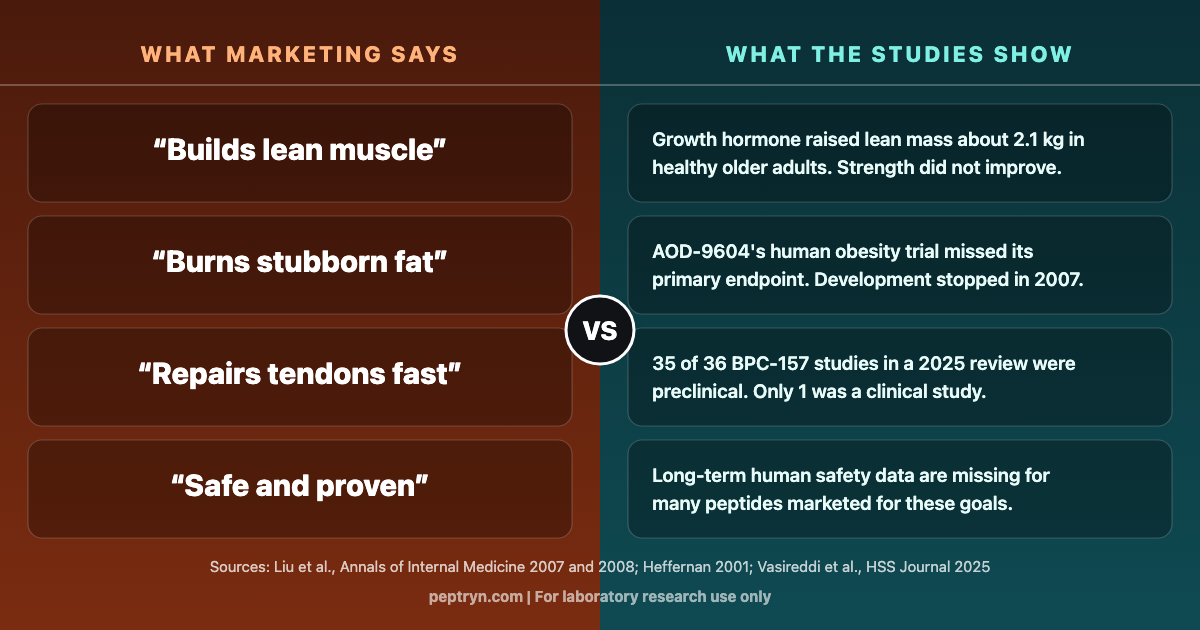
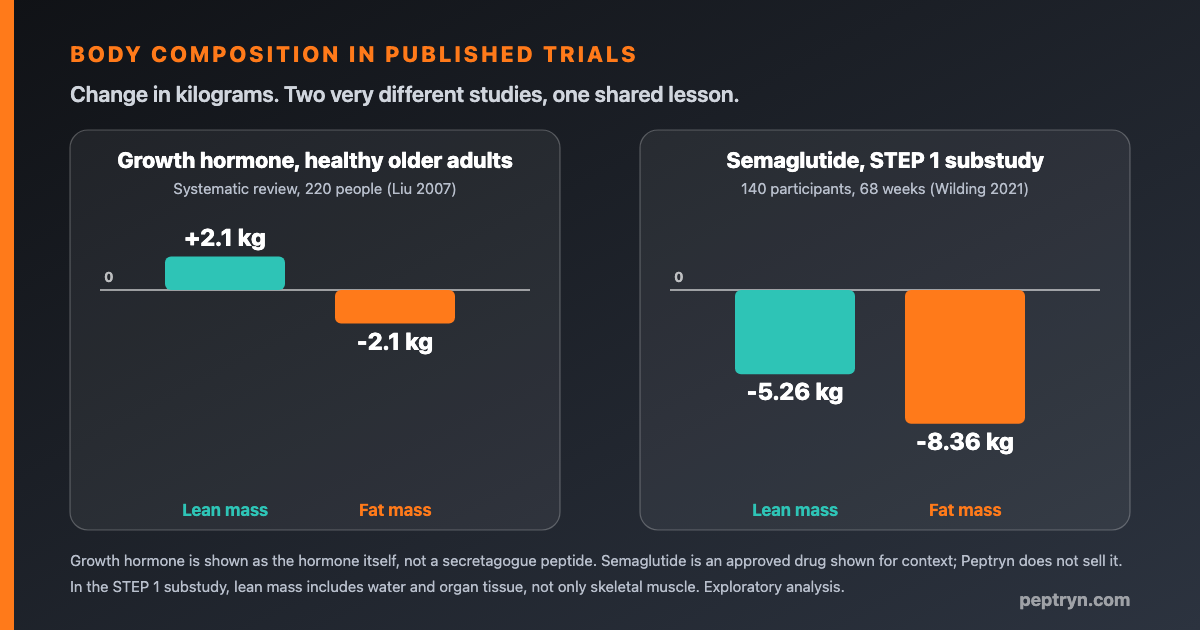
Two systematic reviews in the Annals of Internal Medicine are the clearest sources. A 2007 review of growth hormone in healthy older adults (Liu et al., 31 articles, 18 study groups, 220 people receiving growth hormone) found that lean body mass rose by about 2.1 kg and fat mass fell by about 2.1 kg, with no meaningful change in body weight, and reported more side effects in the treated groups, including joint pain, fluid retention, carpal tunnel syndrome and insulin resistance. A 2008 review of growth hormone and athletic performance (Liu et al., 27 study samples, 303 people receiving growth hormone; PMID 18347346) concluded that claims of enhanced physical performance were not supported: lean body mass appeared to increase, but strength may not improve, exercise capacity may worsen, and adverse events increased.
That is the ceiling of the evidence for the hormone itself. For the peptides meant to raise it, the picture is thinner:
- CJC-1295 is a synthetic analogue of growth hormone-releasing hormone. The main human study (Teichman et al., 2006, Journal of Clinical Endocrinology and Metabolism, PMID 16352683) tested the long-acting DAC version and measured growth hormone and IGF-1 levels, which stayed elevated for days. It did not measure muscle size or strength, and it did not test the shorter “no DAC” version that most suppliers sell.
- Ipamorelin was introduced in a 1998 study (Raun et al., European Journal of Endocrinology, PMID 9849822) in rat pituitary cells, rats and pigs. It released growth hormone without a large rise in cortisol in those animals, a selectivity the authors highlighted, but that is animal data and says nothing directly about muscle in people. Many suppliers and clinics discuss it alongside CJC-1295; see our CJC-1295 and ipamorelin guide.
- Sermorelin was marketed as Geref for evaluating pituitary growth hormone secretion and for pediatric growth hormone deficiency until its manufacturer discontinued it in 2008 for commercial reasons, according to a 2013 Federal Register determination. It was never approved for building muscle.
- Tesamorelin is the one compound here with strong human trial data, and it is instructive. In a 26-week randomized, placebo-controlled trial (Falutz et al., New England Journal of Medicine, 2007, PMID 18057338), it selectively reduced visceral abdominal fat in adults with HIV-associated lipodystrophy, which led to FDA approval as Egrifta in 2010 for that specific population. The outcome was fat, not muscle, and the approval does not extend to healthy adults.
Peptides for fat loss: what the trials show
“Peptides for fat loss” now draws more searches than almost any other peptide phrase, and the honest answer is that the compounds with the strongest fat-related evidence are approved prescription drugs, not the research peptides sold online under muscle-and-fat marketing.
AOD-9604 is the cautionary example. It is a fragment of human growth hormone (residues 176-191) that reduced weight gain in obese mice (Heffernan et al., Endocrinology, 2001, PMID 11713213). A Phase IIb human trial of several hundred obese adults, disclosed by its developer in February 2007, did not beat placebo on its primary endpoint, and development for that use stopped that year. It has never been approved for any human indication.
GLP-1 pathway peptides such as semaglutide and tirzepatide do have large trial results, and they also expose a problem with the “muscle and fat loss” idea. In the STEP 1 body-composition substudy (Wilding et al., Journal of the Endocrine Society, 2021; 140 participants), the semaglutide group lost about 8.4 kg of fat mass and also about 5.3 kg of lean mass over 68 weeks, meaning roughly two-fifths of the total loss was lean tissue. This was an exploratory analysis, and lean mass here includes water and organ tissue, not just skeletal muscle, but it shows that the most effective fat-reducing drugs do not automatically preserve muscle. See our guides to retatrutide and how it compares with semaglutide and tirzepatide for the approval picture. For the full body-composition data on semaglutide, tirzepatide and retatrutide, see our guide to the best peptides for muscle growth and fat loss.
Recovery peptides: BPC-157 and TB-500
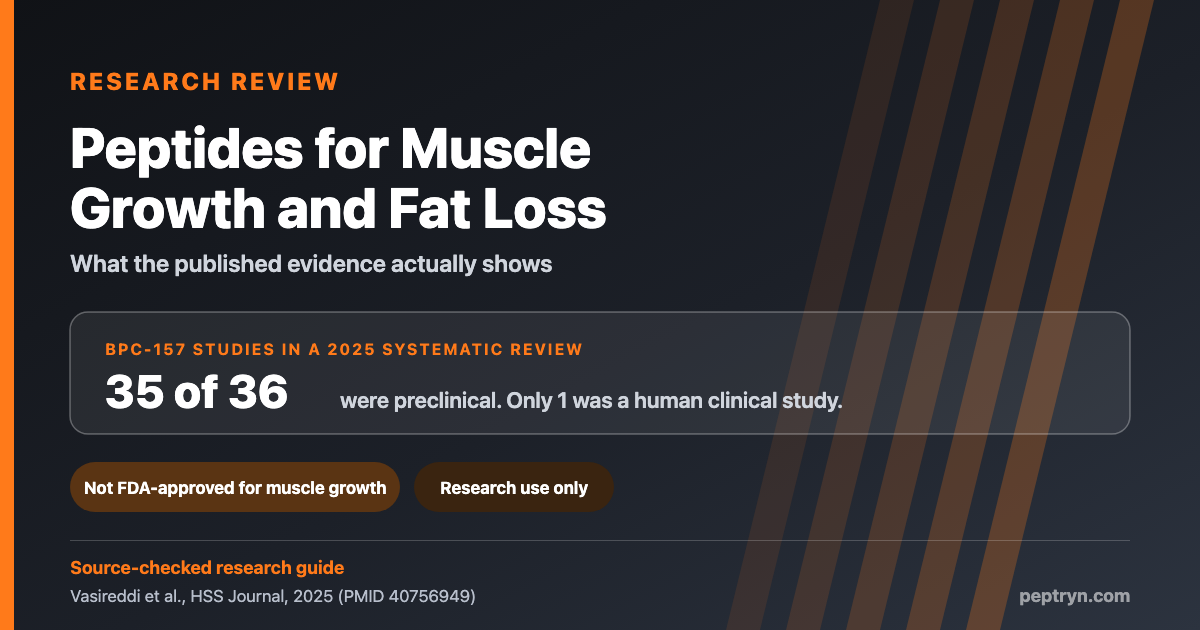
These two are usually marketed for tendon and muscle recovery, which is why they appear in “peptides for bodybuilding” content. BPC-157 is a 15-amino-acid peptide derived from a protein in human gastric juice. A 2025 systematic review of its use in orthopaedic sports medicine (Vasireddi et al., HSS Journal; PMID 40756949) screened 544 articles from 1993 to 2024 and included 36: 35 were preclinical and only 1 was a clinical study, a retrospective report on knee pain. The authors concluded that BPC-157 shows promise in animal models but that the lack of clinical outcome and safety data prevents evidence-based use guidelines. The FDA placed BPC-157 in its Category 2 list of bulk drug substances in 2023, and an FDA advisory committee later voted 8-6 in July 2026 to recommend considering it for a compounding list, which is not an approval.
TB-500 refers to thymosin beta-4 acetate, studied in animals for tissue repair and cell migration, and its name is also used for a shorter fragment by some suppliers, so the certificate of analysis matters. Both compounds are prohibited by the World Anti-Doping Agency, and growth-hormone-releasing peptides are generally prohibited in tested sport as well.
Best peptides for muscle growth: why there is no honest ranking
Any list that names the “best peptides for muscle growth” is ranking compounds by something the research has not measured. The evidence is not strong enough to rank them by effect on muscle, and the ordering used in most listicles reflects popularity and marketing, not outcomes. A more accurate way to sort the field is by strength of evidence:
- Human trial data for a specific outcome: tesamorelin (visceral fat, HIV lipodystrophy) and the approved GLP-1 pathway drugs. None of these is a muscle-growth result.
- Human hormone data only: CJC-1295 (DAC form), which raised growth hormone and IGF-1 in a 2006 trial.
- Animal data only: ipamorelin, BPC-157, TB-500 and AOD-9604’s early work.
Whether any of these can build muscle in a healthy person is an open question, not a settled one.
Why there is no established dose
Searches for peptide dosing charts are common in this topic, and it deserves a direct answer. No controlled human trial has established a dose, route or schedule of CJC-1295 (no DAC), ipamorelin, BPC-157, TB-500 or AOD-9604 for muscle growth or fat loss, so any chart in circulation is extrapolated from animal work, vendor material or anecdote. The doses used in the tesamorelin and hormone trials above were supervised research or approved-drug protocols, not something that transfers to self-administration. For that reason this guide does not give doses, routes or schedules.
Where to buy peptides for muscle growth: what the options actually are
People asking where to buy peptides for muscle growth are usually choosing between the three categories described above, and the legal basis is different for each.
- Supplement retailers sell oral collagen and protein-fragment products. These are not the injectable compounds in this guide.
- Licensed providers and compounding pharmacies can prescribe and dispense certain compounds under medical law. Availability depends on FDA status, which for most compounds in this guide is not approved.
- Research-use-only suppliers sell lyophilized materials to qualified laboratory researchers. Peptryn is in this category: our products are sold strictly for in-vitro research, never for human or veterinary use, and we make no claim that any product builds muscle or reduces fat. You must be 21 or older to order. See our guide to peptide legality.
If you are evaluating any research-peptide supplier, three checks matter more than price or marketing. First, whether a certificate of analysis is published and matched to the specific lot (see what is a COA). Second, whether the testing is done by an independent outside lab, and what it covers (see peptide purity). Third, whether the supplier is honest about what a compound has and has not been shown to do, since a page that promises muscle growth from a research peptide is making a claim the science does not support. Peptryn’s published reports are in the COA Library; if a report for a lot you are considering is not published, email [email protected] before ordering.
Common questions
Do peptides build muscle?
No peptide has been shown in a published human trial to build muscle or strength in healthy adults, and none is FDA-approved for that purpose. Growth hormone itself raised lean mass by about 2.1 kg in a 2007 systematic review of healthy older adults without improving strength, and the peptides meant to raise it have even less direct evidence.
What are the best peptides for muscle growth?
The research does not support a ranking. The compounds most often discussed are CJC-1295, ipamorelin, sermorelin, tesamorelin, BPC-157 and TB-500, and their evidence is limited to hormone levels, animal studies or fat outcomes in a specific approved population, not muscle growth in healthy people.
What are the best peptides for muscle growth and fat loss?
No peptide has been shown to do both. Tesamorelin reduced visceral fat in a specific approved population, AOD-9604 failed its human obesity trial, and the GLP-1 pathway drugs reduced fat while also reducing lean mass in the STEP 1 substudy.
Are muscle building peptides legal?
Most compounds discussed here are not FDA-approved drugs. Research-use-only suppliers may sell them for laboratory research, but not for human use, and many are prohibited in tested sport by the World Anti-Doping Agency. See our peptide legality guide.
Are collagen peptides the same as CJC-1295 or ipamorelin?
No. Collagen peptides are oral dietary protein fragments. CJC-1295 and ipamorelin are synthetic research compounds designed to act on the growth hormone axis, and they are entirely different products.
Where can I buy peptides for muscle growth?
Supplement retailers sell oral collagen products, licensed providers can prescribe certain compounds under medical law, and research-use-only suppliers sell lyophilized materials for laboratory research. Peptryn is a research-use-only supplier and does not sell any product for muscle growth or human use.
Is there a standard dose for muscle building peptides?
No. No controlled human trial has established a dose, route or schedule for any of these compounds for muscle growth, so this guide does not provide one.
Related: List of peptides and what they do · CJC-1295 and ipamorelin · What is a COA? · Popular peptides · Best peptides for muscle growth and fat loss
Sources
Liu H, et al. Systematic review: the safety and efficacy of growth hormone in the healthy elderly. Annals of Internal Medicine, 2007;146(2):104-115. doi.org/10.7326/0003-4819-146-2-200701160-00005
Liu H, et al. Systematic review: the effects of growth hormone on athletic performance. Annals of Internal Medicine, 2008 (PMID 18347346). pubmed.ncbi.nlm.nih.gov
Teichman SL, et al. Prolonged stimulation of growth hormone and IGF-I secretion by CJC-1295. Journal of Clinical Endocrinology and Metabolism, 2006 (PMID 16352683). pubmed.ncbi.nlm.nih.gov
Raun K, et al. Ipamorelin, the first selective growth hormone secretagogue. European Journal of Endocrinology, 1998 (PMID 9849822). pubmed.ncbi.nlm.nih.gov
Falutz J, et al. Metabolic effects of a growth hormone-releasing factor in patients with HIV. New England Journal of Medicine, 2007 (PMID 18057338). nejm.org
Heffernan M, et al. The effects of human GH and its lipolytic fragment (AOD9604) on lipid metabolism. Endocrinology, 2001 (PMID 11713213). pubmed.ncbi.nlm.nih.gov
Wilding J, et al. Impact of semaglutide on body composition in adults with overweight or obesity: exploratory analysis of the STEP 1 study. Journal of the Endocrine Society, 2021. academic.oup.com
Vasireddi N, et al. Emerging use of BPC-157 in orthopaedic sports medicine: a systematic review. HSS Journal, 2025 (PMID 40756949). pubmed.ncbi.nlm.nih.gov
Federal Register. Determination that Geref (sermorelin acetate) was not withdrawn for reasons of safety or effectiveness, March 4, 2013. federalregister.gov
U.S. Food and Drug Administration. July 23-24, 2026: Meeting of the Pharmacy Compounding Advisory Committee. fda.gov
For laboratory research use only. Not for human or veterinary use, and not a drug, food, dietary supplement or cosmetic. You must be 21 or older to buy.