Sermorelin Peptide: The Geref History, What the Human Trials Showed, and How It Compares With Tesamorelin, Ipamorelin and CJC-1295
Research use only. Peptides supplied by Peptryn are sold strictly for in vitro and preclinical laboratory research. They are not approved by the FDA for human or veterinary use, and nothing here is medical advice, a dosing recommendation, or an instruction for self-administration. This guide summarizes published research and regulatory records on sermorelin and explains how to read a certificate of analysis. A research vial is not Geref.
Quick answer: what is sermorelin?
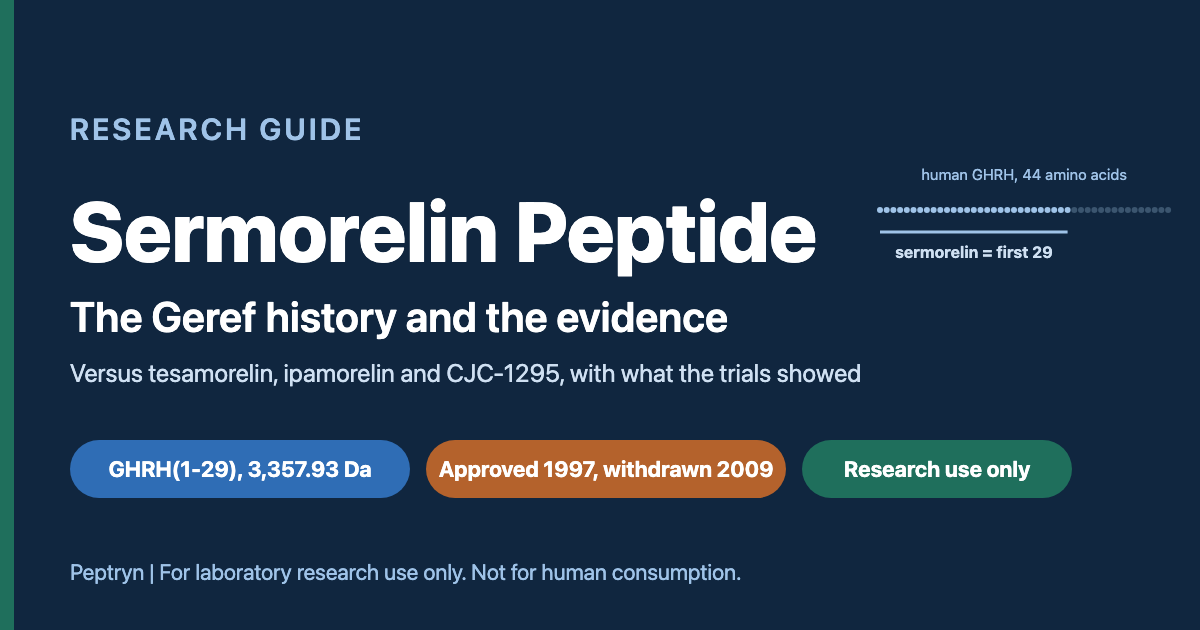
Sermorelin is a synthetic peptide made of the first 29 amino acids of human growth hormone-releasing hormone (GHRH). A 1999 review describes it as the shortest synthetic peptide with the full biological activity of GHRH. It acts on the GHRH receptor on pituitary cells to stimulate growth hormone (GH) release.
Of CJC-1295, ipamorelin and sermorelin, only sermorelin has an FDA approval history. Geref (sermorelin acetate) was approved in 1990 as a diagnostic for GH secretion and in 1997 for children with idiopathic GH deficiency and growth failure. Its maker discontinued it in 2008, and FDA later determined it had not been withdrawn for reasons of safety or effectiveness. Since then the published human evidence has stayed thin: trials in children, and a small adult study in older men where GH rose but IGF-I and body composition did not change.
Peptryn sells sermorelin for laboratory research only.
Sermorelin at a glance
| Item | Detail |
|---|---|
| Structure | GHRH(1-29), 29 amino acids, C-terminal amide |
| Formula and weight | C149H246N44O42S, 3,357.93 Da |
| CAS number | 86168-78-7 |
| Target | GHRH receptor on pituitary somatotrophs |
| Approved product | Geref, discontinued 2008, approval withdrawn 2009 |
| Peptryn listing | 10 mg vial, lyophilized, store at -20°C, research use only |
Table of contents
- What sermorelin is
- Sermorelin and the FDA: what “approved” means here
- What the human studies show
- Sermorelin benefits and before-and-after claims
- Sermorelin dosage: why there is no established one
- Sermorelin side effects
- Sermorelin vs tesamorelin vs ipamorelin vs CJC-1295
- How to evaluate a sermorelin vial
- Frequently asked questions
- Final take
What sermorelin is
Human GHRH has 44 amino acids, and the first 29 carry its full activity. Sermorelin is that 29-amino-acid fragment. CJC-1295 is built on it: Jetté and colleagues (2005) describe CJC-1295 as a tetrasubstituted form of hGRF(1-29), which is sermorelin’s sequence with four amino acid substitutions, plus an albumin-binding linker in the DAC version. Sermorelin acetate is the salt form used in the approved product. Our CJC-1295 guide covers the modified version.
Sermorelin and the FDA: what “approved” means here
Clinics often say sermorelin is FDA-approved. The Federal Register record explains why that statement needs a date.
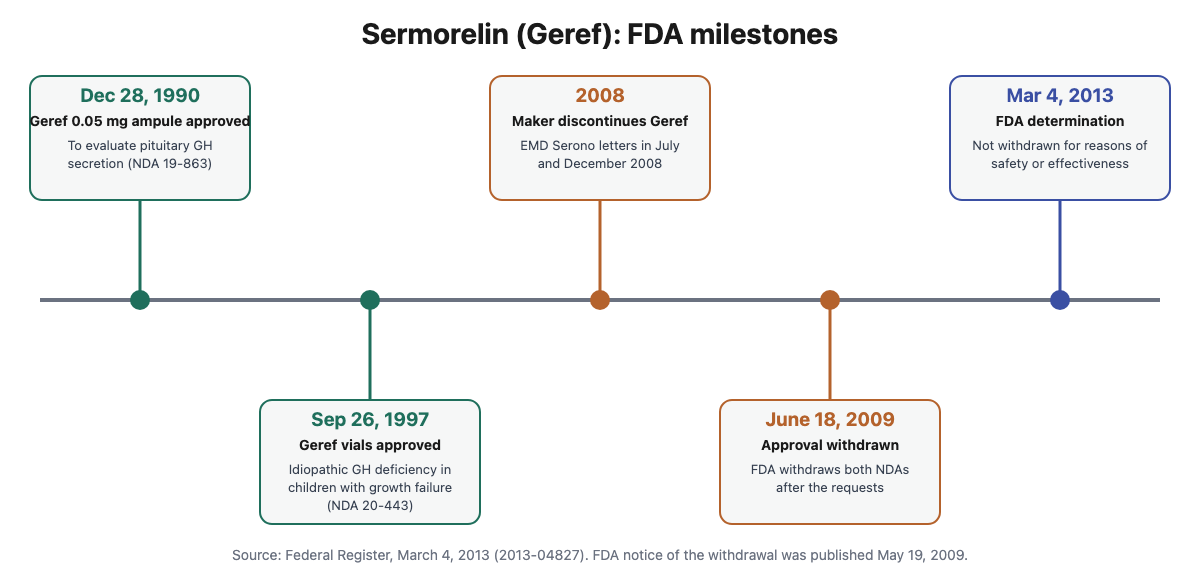
GEREF (sermorelin acetate) injection in the 0.05 mg ampule, indicated for evaluating the ability of the pituitary somatotroph to secrete GH, was initially approved on December 28, 1990 (NDA 19-863). GEREF in the 0.5 mg and 1.0 mg vials, indicated for treating idiopathic GH deficiency in children with growth failure, was initially approved on September 26, 1997 (NDA 20-443). Both were held by EMD Serono. The company notified FDA of the discontinuations in July and December 2008 and requested withdrawal of the applications, and FDA withdrew approval of both effective June 18, 2009.
In 2012 a citizen petition asked FDA to determine whether Geref had been withdrawn for safety or efficacy reasons. On March 4, 2013, FDA published its determination that the products were not withdrawn from sale for reasons of safety or effectiveness, and noted that the petitioner had identified no data suggesting otherwise. That finding lets FDA approve generic versions if all other requirements are met. We found no currently marketed FDA-approved sermorelin product, and readers should confirm that against Drugs@FDA.
Two things follow. A past approval for a specific pediatric use does not approve a research vial for anyone, and it does not approve any other use. And sermorelin’s status differs from CJC-1295 and ipamorelin, which FDA lists in Category 2 for compounding. Sermorelin does not appear on that Category 2 page (content current as of 04/22/2026). See our legal guide for how research-use-only sales are treated.
What the human studies show
Children
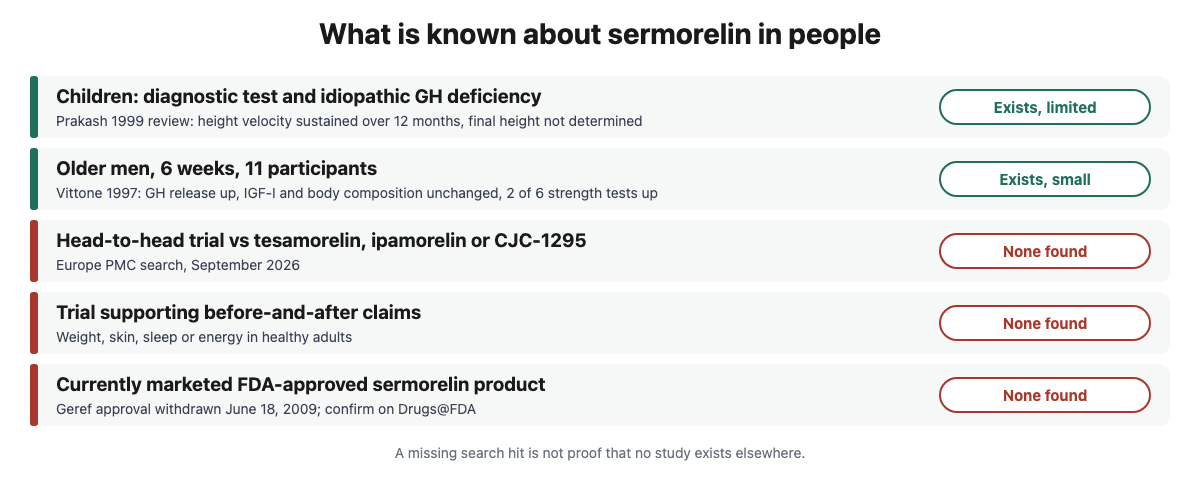
Prakash and Goa (1999) reviewed the pediatric record. A single intravenous dose works as a provocative test for GH deficiency, and the review notes fewer false positives in children without the deficiency than with some other tests. Limited data showed that daily subcutaneous sermorelin sustained increases in height velocity over 12 months of treatment, with catch-up growth in most treated GH-deficient children, and suggested the effect held in a few children for 36 months. The effect on final adult height was not yet determined. The review says sermorelin had not been compared directly with somatropin, though its height velocity gains were smaller than those reported for children on once-daily somatropin. It calls sermorelin well tolerated, with transient facial flushing and injection-site pain the most common adverse events.
Older adults
Vittone and colleagues (1997) treated 11 healthy men aged 64 to 76 with low IGF-I using nightly subcutaneous GHRH(1-29) for 6 weeks. Nocturnal GH release rose, with a larger GH peak and no change in pulse frequency. IGF-I, IGF binding protein-3, weight, body mass index, DEXA measures of muscle and fat, glucose, insulin and lipids did not change. Two of six strength measures and one endurance test improved. No significant adverse effects were observed. The authors concluded that single nightly doses were less effective than multiple daily doses at producing GH and IGF-I effects, and they suggested that an optimized regimen might help with age-related muscle decline. It is an 11-person study without a control group described in the abstract, and it is now nearly thirty years old.
Sermorelin benefits and before-and-after claims
Sermorelin has 12,100 monthly searches for “before and after”, and no trial we found supports the images and stories behind them. The pediatric data measure height velocity in children with a diagnosed deficiency. The adult data measure GH release, with small strength changes and no change in body composition. Neither describes weight loss, sleep, skin, energy or “anti-aging” in healthy adults. Before-and-after posts come from unregulated products and unverified users, so they cannot separate the peptide from diet, training or the placebo effect.
Sermorelin dosage: why there is no established one
Sermorelin’s approved pediatric use was weight-based and clinician-directed, and the adult trial used a different regimen for a different question. Neither describes a research vial. Online charts mix pediatric label doses, adult trial doses and clinic marketing, and they conflict. Peptryn does not publish a dose for any product, and this guide does not either.
Sermorelin side effects
In the pediatric review, transient facial flushing and injection-site pain were the most commonly reported adverse events, and the drug was well tolerated. In the adult study, no significant adverse effects were observed over 6 weeks in 11 men. These are trial-level findings in small groups, not a safety profile for any research product. Research vials lack the manufacturing controls of a drug product, and a certificate of analysis does not change that. This section summarizes sources and is not medical advice.
Sermorelin vs tesamorelin vs ipamorelin vs CJC-1295
| Sermorelin | Tesamorelin | Ipamorelin | CJC-1295 | |
|---|---|---|---|---|
| Class | GHRH analog (1-29) | GHRH analog, longer | Ghrelin receptor agonist | GHRH analog (tetrasubstituted 1-29) |
| Approval history | Geref approved 1990 and 1997, withdrawn 2009 | Egrifta approved Nov 10, 2010 | None | None |
| Human evidence | Pediatric GH deficiency, 6-week study in older men | 412 HIV patients, 26 weeks: visceral fat -15.2% vs +5.0% on placebo | PK study, phase 2 ileus trial (no significant difference) | Two randomized trials in healthy adults (DAC form) |
| FDA compounding page | Not on the Category 2 page | Not covered here | Category 2 | Category 2 |
The sermorelin versus tesamorelin comparison is the biggest of these searches (5,400 a month). Both act on the GHRH receptor. Tesamorelin has the stronger clinical record and is a regulated drug (Falutz 2007). Sermorelin has the older, smaller one. No head-to-head trial of the two was found. See the ipamorelin guide for how a ghrelin receptor agonist differs, and the CJC-1295 and ipamorelin guide for the pairing.
Against growth hormone itself, Prakash and Goa found sermorelin’s height velocity gains in children were smaller than those from once-daily somatropin, though the two had not been compared directly in a trial.
How to evaluate a sermorelin vial
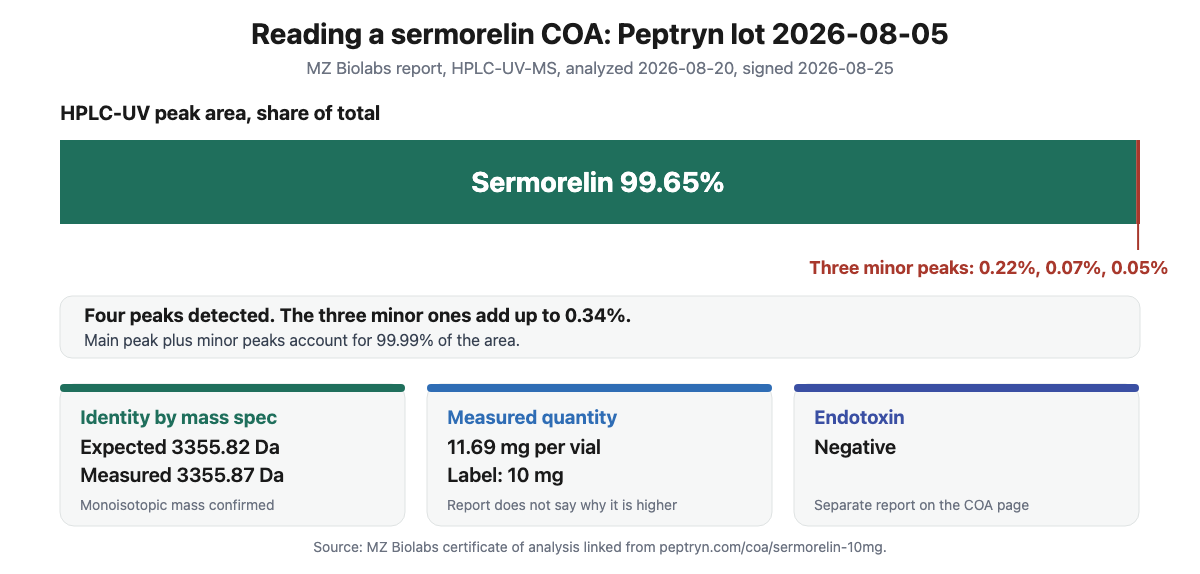
Peptryn’s sermorelin COA page links to the MZ Biolabs report for lot 2026-08-05.
| COA field | What the report shows |
|---|---|
| Lot and method | 2026-08-05, HPLC-UV-MS, analyzed 2026-08-20, report signed 2026-08-25 |
| Main peak | 99.65% of peak area, with three minor peaks at 0.22%, 0.07% and 0.05% |
| Identity by mass spec | Expected monoisotopic mass 3355.82 Da, measured 3355.87 Da |
| Measured quantity | 11.69 mg per vial (label: 10 mg) |
| Endotoxin | Negative, per the separate report on the COA page |
The mass matches sermorelin, and the peak table is clean. The measured quantity is 17% above the label, and the report does not say why, so ask the supplier before calculating concentrations from the label amount. The listing’s molecular weight, 3,357.93 Da, is the average mass, while the COA reports monoisotopic mass, which is why the two numbers differ. See our guide to how to read a certificate of analysis.
Frequently asked questions
What is sermorelin?
A synthetic peptide of the first 29 amino acids of GHRH that stimulates GH release from the pituitary through the GHRH receptor.
Is sermorelin FDA-approved?
Geref (sermorelin acetate) was approved in 1990 and 1997 and discontinued in 2008, with approval withdrawn effective June 18, 2009. FDA found in 2013 it was not withdrawn for safety or effectiveness reasons. We found no currently marketed FDA-approved sermorelin product. A research vial is not an approved drug.
Is sermorelin legal?
It does not appear on FDA’s Category 2 page, unlike CJC-1295 and ipamorelin, but that does not make a research vial suitable for human use. See our legal guide.
Does sermorelin work?
In children with idiopathic GH deficiency, limited data showed sustained increases in height velocity. In a 6-week study of 11 older men, GH rose but IGF-I and body composition did not change.
What are the side effects of sermorelin?
Transient facial flushing and injection-site pain were the most common in the pediatric review. This summarizes sources and is not medical advice. Talk to a licensed clinician.
Sermorelin or tesamorelin?
Both are GHRH analogs. Tesamorelin has an FDA-approved indication and a 412-patient trial. Sermorelin has an older, smaller record. No head-to-head trial was found.
Does sermorelin have before-and-after results?
No trial we found supports before-and-after claims for sermorelin.
Final take
Sermorelin has a longer regulatory history than CJC-1295 or ipamorelin and an older, smaller evidence base than tesamorelin. It was approved for a pediatric diagnostic use and for childhood GH deficiency, discontinued, and found by FDA not to have been withdrawn for safety or effectiveness. The adult data are one 6-week study of 11 older men. For a laboratory, the useful details are the confirmed mass and the measured quantity. On Peptryn’s lot 2026-08-05 the main peak is 99.65%, the mass matches, and the measured quantity is 11.69 mg per 10 mg vial.
See sermorelin with its batch COA · Browse GH secretagogue research peptides
Related guides: CJC-1295 peptide guide · Ipamorelin peptide guide · CJC-1295 and ipamorelin · How to read a certificate of analysis · Are peptides legal? · Tesamorelin peptide guide · What is a COA? · Peptide purity · Peptide testing · Popular peptides
Editorial note: Peptryn sells the research peptides discussed in this guide for laboratory use only. This guide is informational and is not medical advice. Sources are listed below. To report an error, email [email protected].
Sources
- U.S. Food and Drug Administration. Determination That GEREF (Sermorelin Acetate) Injection, 0.5 Milligrams Base/Vial and 1.0 Milligrams Base/Vial, and GEREF (Sermorelin Acetate) Injection, 0.05 Milligrams Base/Amp, Were Not Withdrawn From Sale for Reasons of Safety or Effectiveness. Federal Register, March 4, 2013. federalregister.gov
- Prakash A, Goa KL. Sermorelin: a review of its use in the diagnosis and treatment of children with idiopathic growth hormone deficiency. BioDrugs, 1999. pubmed.ncbi.nlm.nih.gov
- Vittone J, Blackman MR, Busby-Whitehead J, et al. Effects of single nightly injections of growth hormone-releasing hormone (GHRH 1-29) in healthy elderly men. Metabolism, 1997. pubmed.ncbi.nlm.nih.gov
- Jetté L, Léger R, Thibaudeau K, et al. Human growth hormone-releasing factor (hGRF)1-29-albumin bioconjugates activate the GRF receptor on the anterior pituitary in rats: identification of CJC-1295 as a long-lasting GRF analog. Endocrinology, 2005. pubmed.ncbi.nlm.nih.gov
- Falutz J, Allas S, Blot K, et al. Metabolic effects of a growth hormone-releasing factor in patients with HIV. N Engl J Med, 2007. pubmed.ncbi.nlm.nih.gov
- U.S. FDA, Drugs@FDA: Egrifta (tesamorelin acetate), application 022505, original approval November 10, 2010. accessdata.fda.gov
- U.S. Food and Drug Administration. Certain Bulk Drug Substances for Use in Compounding that May Present Significant Safety Risks (content current as of 04/22/2026). fda.gov
- PubChem, National Library of Medicine: CID 16132413, as cited on the MZ Biolabs report.
- MZ Biolabs certificate of analysis, sermorelin 10 mg, lot 2026-08-05, via peptryn.com/coa/sermorelin-10mg.
All products on peptryn.com are intended for laboratory research purposes only. Not for human consumption, self-administration, or veterinary use. The information on this page has not been evaluated by the U.S. Food and Drug Administration and is not intended to diagnose, treat, cure, or prevent any disease.