CJC-1295 and Ipamorelin: What the Pairing Is, What the Evidence Shows, and What It Does Not
Research use only. Peptides supplied by Peptryn are sold strictly for in vitro and preclinical laboratory research. They are not approved by the FDA for human or veterinary use, and nothing here is medical advice, a dosing recommendation, or an instruction for self-administration. This guide summarizes published research on CJC-1295 and ipamorelin and explains how to read a certificate of analysis.
Quick answer: what is CJC-1295 and ipamorelin?
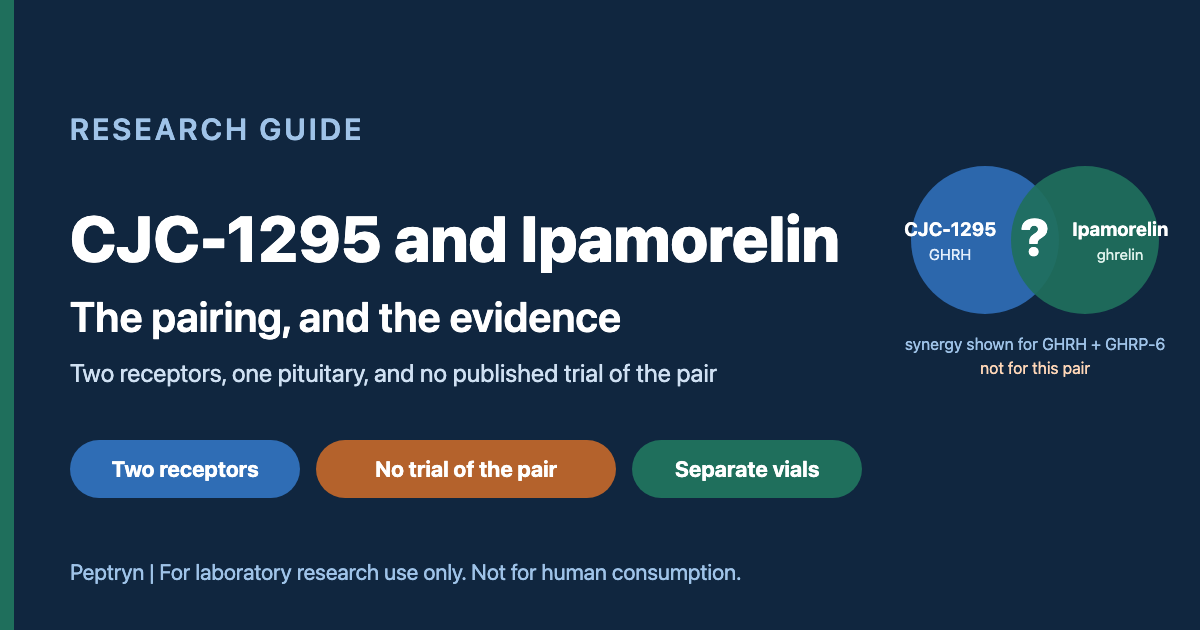
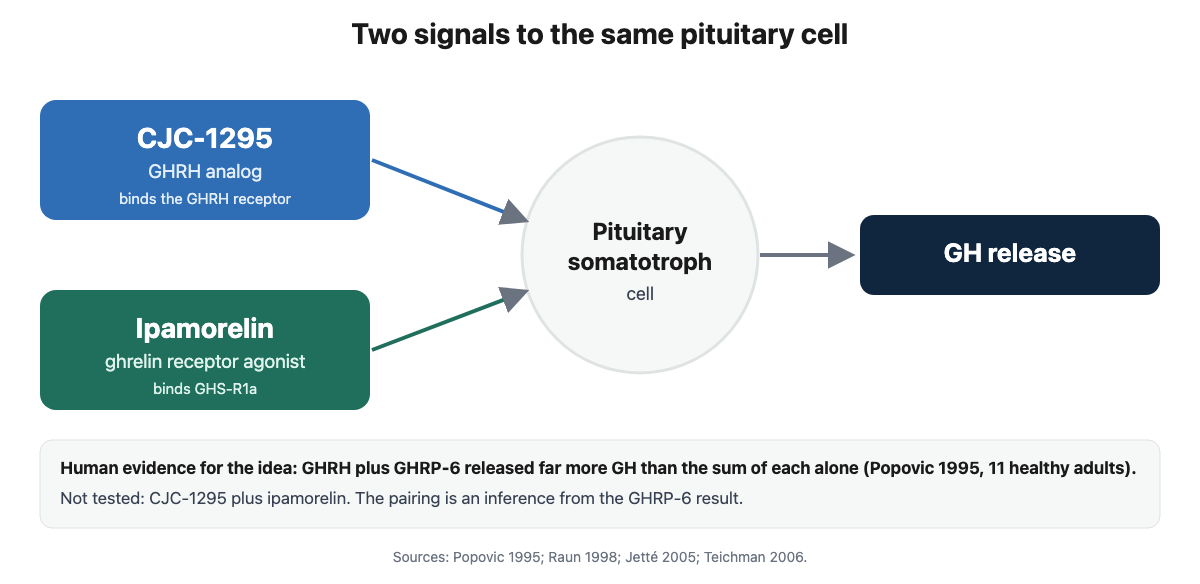
CJC-1295 and ipamorelin are two different peptides that both raise growth hormone (GH), and online pages describe them as a “stack” or a blend. CJC-1295 is a growth hormone-releasing hormone (GHRH) analog that acts on the GHRH receptor. Ipamorelin is a ghrelin receptor agonist that acts on the GH secretagogue receptor. The idea behind pairing them is that two separate signals to the pituitary should release more GH than either one alone.
That idea has real support, but not for this pair. In 1995, Popovic and colleagues gave healthy adults GHRH, the older peptide GHRP-6, or both together, and GH release after both was significantly greater than the sum of the two alone. We searched Europe PMC and ClinicalTrials.gov and found no published or registered trial of CJC-1295 combined with ipamorelin. The synergy claim for this specific pair is an inference from GHRP-6 work.
Peptryn lists CJC-1295 without DAC and ipamorelin as separate research vials, each with its own COA. It does not list a blend.
At a glance
| CJC-1295 | Ipamorelin | |
|---|---|---|
| Receptor | GHRH receptor | Ghrelin receptor (GHS-R1a) |
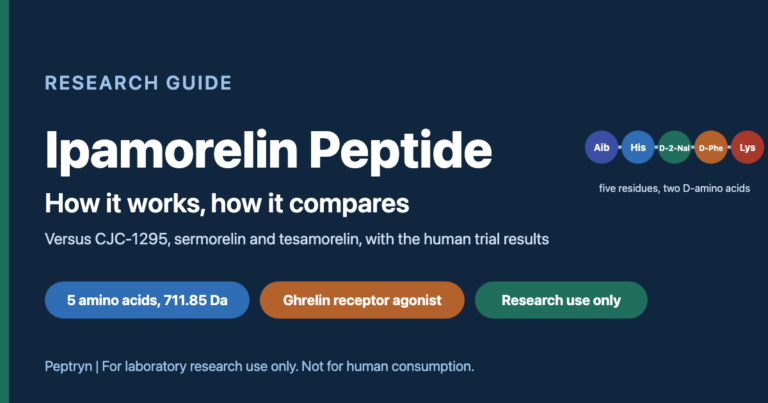
| Size | 29 amino acids (about 3,368 Da without DAC) | 5 amino acids (711.85 Da) |
| Human half-life | 5.8 to 8.1 days (DAC form only, no published figure for no DAC) | About 2 hours |
| Published human trials | Two randomized trials in healthy adults (DAC form), one terminated phase 2 | PK study in healthy men, two phase 2 ileus trials |
| Trial of the pair | None found | None found |
| FDA | Category 2 for compounding | Category 2 for compounding |
| WADA | Prohibited (S2) | Prohibited (S2) |
Table of contents
- Why the two are paired: two receptors, one pituitary
- Which CJC-1295 is in the pair
- What the evidence covers and what it lacks
- What is in a CJC-1295 and ipamorelin blend vial
- CJC-1295 and ipamorelin dosage: why there is no established one
- Benefits, results and before-and-after claims
- Safety, FDA status and sport
- How to evaluate a CJC-1295 and ipamorelin product
- Frequently asked questions
- Final take
Why the two are paired: two receptors, one pituitary
GHRH and ghrelin-receptor agonists reach GH release by different routes. Popovic’s 1995 paper puts it in one sentence: GHRP-6 releases GH through mechanisms different from those of GHRH, is more efficacious than GHRH in people, and shows a striking synergistic action when the two are given together. In the 11 healthy adults, GH exposure (area under the curve) was 483.7 after GHRH, 1,434.8 after GHRP-6 and 3,771.5 after both, above the arithmetic sum of 1,918.5. The same study tested 12 patients with hypothalamopituitary disconnection, whose pituitary is cut off from the hypothalamus, and found GHRP-6-induced GH release was blocked and the synergy absent. The authors read that as evidence that GHRP-6 acts mainly at the hypothalamic level.
That single-dose, intravenous, hospital-setting study is the experimental backbone of the whole “stack” idea. Ipamorelin belongs to the same receptor family as GHRP-6 and behaves similarly in animals (see our ipamorelin guide), and CJC-1295 is a GHRH analog (see the CJC-1295 guide). It is reasonable to expect a similar interaction. Expecting it is different from having shown it.
Which CJC-1295 is in the pair
This is the detail most pages skip. Every published human CJC-1295 trial tested the DAC version, which binds albumin and has a half-life of days. Vendor pages for “CJC-1295 and ipamorelin” blends commonly specify the without-DAC form (one top-ranking listing is titled “CJC-1295 (NO DAC) + IPAMORELIN”), which has no published human trial under that name. So a blend page that cites CJC-1295 human data may be citing a different product than the one in the vial. The DAC question changes the whole pharmacology of the pairing, because a days-long GHRH signal and a two-hour ghrelin-receptor signal are not the same interaction as two short signals.
What the evidence covers and what it lacks
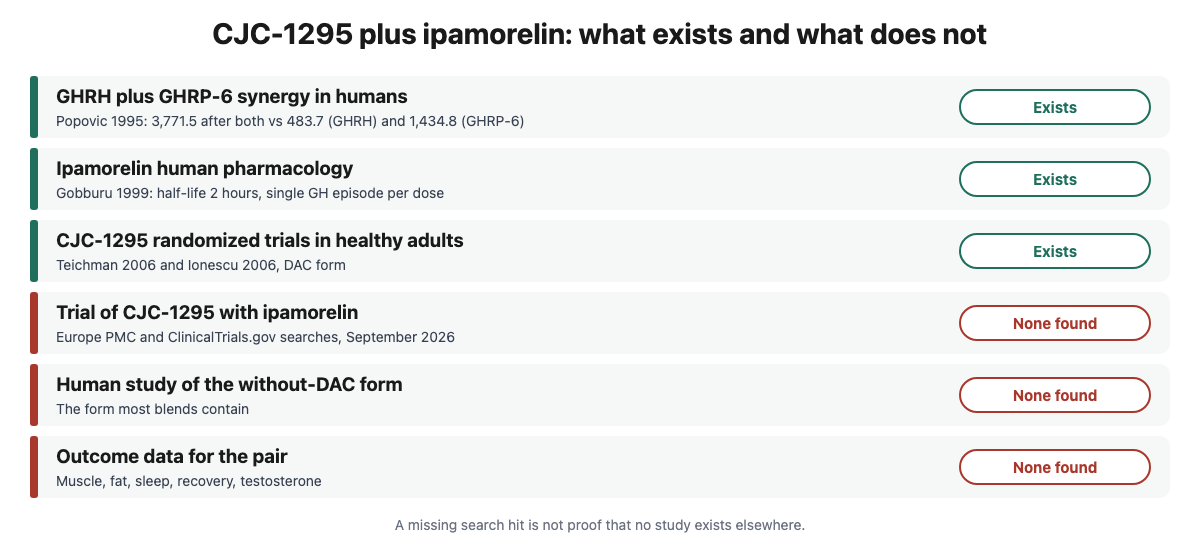
What exists: GHRH plus GHRP-6 synergy in healthy adults (Popovic 1995). A pharmacokinetic study of ipamorelin in eight men per dose level, with a 2-hour half-life (Gobburu 1999). Two randomized trials of CJC-1295 with DAC in healthy adults, reporting higher GH and IGF-I and no serious adverse reactions (Teichman 2006). Overnight GH sampling after DAC showing preserved pulsatility (Ionescu 2006).
What does not: a published or registered trial of CJC-1295 with ipamorelin. Any human study of the without-DAC form. Any outcome data for the pair, such as body composition, sleep, recovery or testosterone. The 2026 review in Frontiers in Endocrinology sorts these peptides into evidence tiers and contrasts the peer-reviewed data with the online self-administration protocols, and it lists the two peptides, and the DAC and no-DAC forms of CJC-1295, as separate items.
What is in a CJC-1295 and ipamorelin blend vial
Vendor pages describe blend vials as the two peptides freeze-dried together, commonly at equal masses. For illustration, take a vial with 5 mg of CJC-1295 without DAC and 5 mg of ipamorelin. The mass is split evenly, but the molecule count is not. CJC-1295 without DAC weighs about 3,368 Da and ipamorelin 711.85 Da, so 5 mg of each is roughly 1.5 micromoles of CJC-1295 and 7.0 micromoles of ipamorelin. Ipamorelin is about 83% of the molecules and CJC-1295 about 17%.
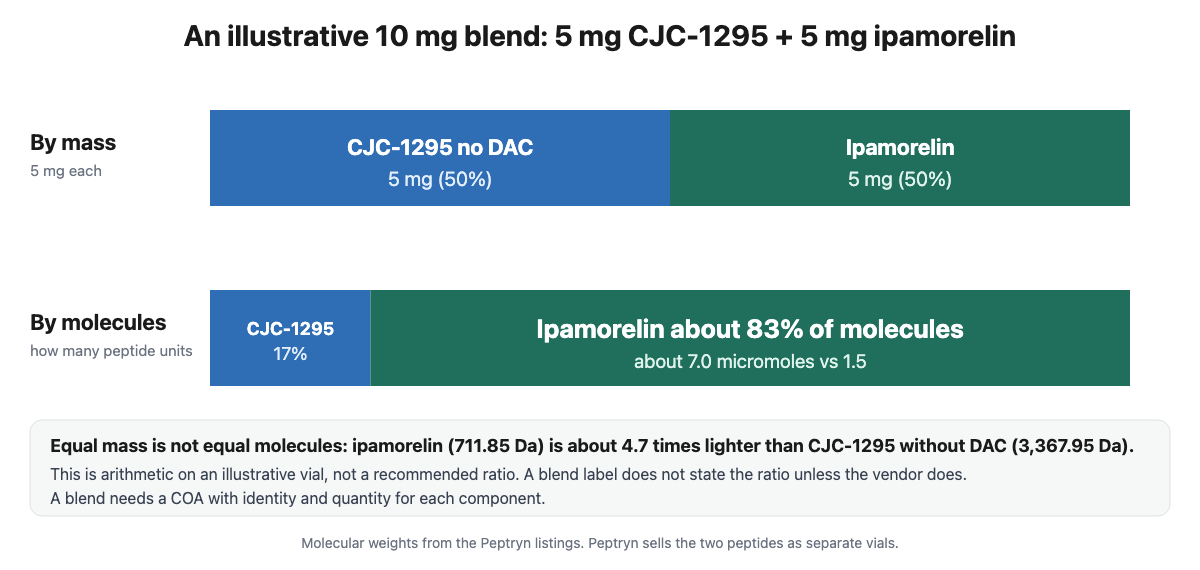
This is arithmetic on an illustrative vial, not a recommended ratio. Real blends vary, and the label does not tell you the ratio unless the vendor states it. It also shows why a blend needs a COA that reports identity and quantity for each component. Peptryn’s separate vials come with their own reports: the CJC-1295 without DAC lot 2026-08-05 has a 99.11% main peak, matching mass and 11.54 mg measured against a 10 mg label, and the ipamorelin lot 2026-08-05 has a 99.34% main peak, matching mass and 9.93 mg measured against 10 mg. Details are on the CJC-1295 COA page and the ipamorelin COA page.
CJC-1295 and ipamorelin dosage: why there is no established one
The dosage cluster around this pair (8,100 searches a month for the main phrase, plus per-day, calculator and chart variants) has no evidence-based answer. The published human doses come from single-agent studies: weight-based DAC dosing in healthy adults, and intravenous ipamorelin in a pharmacology study and in surgical patients. No trial has dosed the pair. Online charts combine numbers from those trials, from GHRP-6 work, from animal studies and from clinic marketing, and they disagree. Peptryn does not publish a dose, ratio or schedule for any product, and this guide does not either.
Benefits, results and before-and-after claims
The trials measured hormone levels. CJC-1295 with DAC raised GH and IGF-I in healthy adults. Ipamorelin released GH in healthy men. Neither program reported the outcomes the online pages promise, such as muscle gain, fat loss, better sleep or faster recovery, for this pair or for either peptide alone in healthy people. Ipamorelin’s one clinical-outcome program, postoperative ileus, showed no significant difference from placebo on its main endpoint in the published trial, and CJC-1295’s one clinical-outcome trial, in HIV visceral fat, was terminated. Before-and-after posts and forum reports are anecdotes on unverified products, so they cannot separate the peptide from the product, the diet or the placebo effect.
Safety, FDA status and sport
FDA lists both CJC-1295 and ipamorelin acetate in Category 2 of the bulk substances nominated for compounding, the group it says may present significant safety risks (page content current as of 04/22/2026). For CJC-1295 FDA cites possible immunogenicity, impurity and characterization complexities, and says it has identified serious adverse events including increased heart rate and a systemic vasodilatory reaction. For ipamorelin it cites possible immunogenicity from aggregation or impurities, the complexity of its unnatural amino acids, and a published study with serious adverse events including death after intravenous use for gastric motility. We found no safety study of the pair.
The World Anti-Doping Agency prohibits both peptides at all times: CJC-1295 as a GHRH analogue and ipamorelin as a growth hormone secretagogue, both under S2. For the legal picture of research-use-only sales, see our legal guide. This guide does not describe how anyone would inject either peptide, and Peptryn does not supply that information.
How to evaluate a CJC-1295 and ipamorelin product
Four checks matter more than the marketing.
- Which CJC-1295 is it: DAC or without DAC? The COA name and the confirmed mass should say.
- Does the COA cover each peptide separately, with identity by mass spectrometry, a peak table and measured quantity?
- Is the ratio stated, and does the measured quantity match it? A label that shows only a total mass does not tell you how much of each peptide is present.
- Is the lot number on the COA the one on your vial, and does the report live on the lab’s own site?
Buying the peptides as separate vials, each with its own report, answers the second and third checks directly. Our guide to how to read a certificate of analysis covers the rest.
Frequently asked questions
What is CJC-1295 with ipamorelin?
Two separate peptides, a GHRH analog and a ghrelin receptor agonist, that online pages describe as a stack or blend for raising GH. No published trial tests them together.
Are CJC-1295 and ipamorelin synergistic?
GHRH plus GHRP-6 was strongly synergistic for GH release in a 1995 human study. We found no study showing it for CJC-1295 plus ipamorelin, so the claim is an inference.
What is the difference between CJC-1295 and ipamorelin?
CJC-1295 is a GHRH analog on the GHRH receptor. Ipamorelin is a ghrelin receptor agonist. The DAC form of CJC-1295 has a half-life of days and ipamorelin about 2 hours.
Should the CJC-1295 in the pair have DAC?
The published human CJC-1295 data are for the DAC form, and blends are commonly sold with the no-DAC form. Blend pages that cite CJC-1295 trials may therefore be describing a different product.
Does CJC-1295 with ipamorelin work?
The pair has no published outcome trial. Each peptide raised GH in healthy volunteers, and neither has shown a benefit on the outcomes marketing pages cite.
Does CJC-1295 with ipamorelin affect testosterone?
We found no trial of the pair that measured it. This is not medical advice, and anyone with a health question should talk to a licensed clinician.
Is CJC-1295 with ipamorelin legal?
FDA lists both in Category 2 for compounding and WADA prohibits both in sport. See our legal guide.
Final take
The pairing rests on a real 1995 finding that GHRH and a GHRP-family peptide together release far more GH than the sum of either alone. That finding was in GHRP-6, in a single intravenous test. For CJC-1295 with ipamorelin there is no trial, the human CJC-1295 data belong to the DAC form that blends rarely contain, and both peptides sit in FDA’s Category 2. For a laboratory, the useful details are the form, the ratio, the per-component mass and the measured quantity, which is why Peptryn lists each peptide with its own COA.
See CJC-1295 without DAC · See ipamorelin · Browse GH secretagogue research peptides
Related guides: Sermorelin peptide guide · CJC-1295 peptide guide · Ipamorelin peptide guide · How to read a certificate of analysis · Are peptides legal? · Tesamorelin peptide guide · What is a COA? · Peptide purity · Peptide testing · Popular peptides
Editorial note: Peptryn sells the research peptides discussed in this guide for laboratory use only. This guide is informational and is not medical advice. Sources are listed below. To report an error, email [email protected].
Sources
- Popovic V, Damjanovic S, Micic D, et al. Blocked growth hormone-releasing peptide (GHRP-6)-induced GH secretion and absence of the synergic action of GHRP-6 plus GH-releasing hormone in patients with hypothalamopituitary disconnection. J Clin Endocrinol Metab, 1995. pubmed.ncbi.nlm.nih.gov
- Gobburu JV, Agersø H, Jusko WJ, Ynddal L. Pharmacokinetic-pharmacodynamic modeling of ipamorelin, a growth hormone releasing peptide, in human volunteers. Pharm Res, 1999. pubmed.ncbi.nlm.nih.gov
- Raun K, Hansen BS, Johansen NL, et al. Ipamorelin, the first selective growth hormone secretagogue. Eur J Endocrinol, 1998. pubmed.ncbi.nlm.nih.gov
- Teichman SL, Neale A, Lawrence B, et al. Prolonged stimulation of growth hormone and insulin-like growth factor I secretion by CJC-1295, a long-acting analog of GH-releasing hormone, in healthy adults. J Clin Endocrinol Metab, 2006. pubmed.ncbi.nlm.nih.gov
- Ionescu M, Frohman LA. Pulsatile secretion of growth hormone persists during continuous stimulation by CJC-1295, a long-acting GH-releasing hormone analog. J Clin Endocrinol Metab, 2006. pubmed.ncbi.nlm.nih.gov
- Beck DE, Sweeney WB, McCarter MD; Ipamorelin 201 Study Group. Prospective, randomized, controlled, proof-of-concept study of the ghrelin mimetic ipamorelin for the management of postoperative ileus in bowel resection patients. Int J Colorectal Dis, 2014. pubmed.ncbi.nlm.nih.gov
- Dominikowski A, Rękoś Z, Olejarz M, et al. The emerging landscape of performance-enhancing peptides modulating GH-IGF1 axis: bridging the gap between clinical evidence and patient self-administration. Front Endocrinol, 2026. pmc.ncbi.nlm.nih.gov
- U.S. Food and Drug Administration. Certain Bulk Drug Substances for Use in Compounding that May Present Significant Safety Risks (content current as of 04/22/2026). fda.gov
- World Anti-Doping Agency. The Prohibited List, section S2. wada-ama.org
- ClinicalTrials.gov: NCT00267527 (CJC 1295, HIV visceral obesity, terminated), NCT00672074 and NCT01280344 (ipamorelin, postoperative ileus). A search for CJC-1295 together with ipamorelin returned no studies.
- MZ Biolabs certificates of analysis, lot 2026-08-05: CJC-1295 without DAC and ipamorelin.
All products on peptryn.com are intended for laboratory research purposes only. Not for human consumption, self-administration, or veterinary use. The information on this page has not been evaluated by the U.S. Food and Drug Administration and is not intended to diagnose, treat, cure, or prevent any disease.