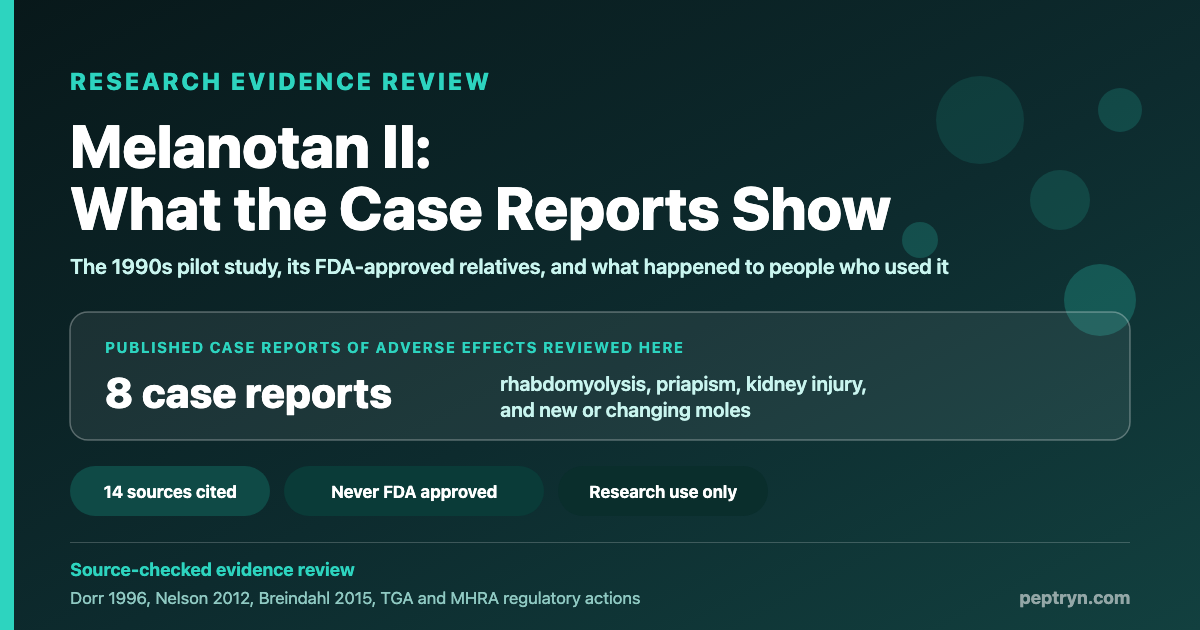
Melanotan II (MT-2): What the Case Reports and Regulators Show (2026)
Note: This guide is educational and is not medical advice. Peptryn does not sell Melanotan II, Melanotan I or any related compound; nothing here is instructions for using research material on yourself. If you have questions about a mole, a skin reaction, or anything you have already taken, speak to a licensed clinician.
The short answer
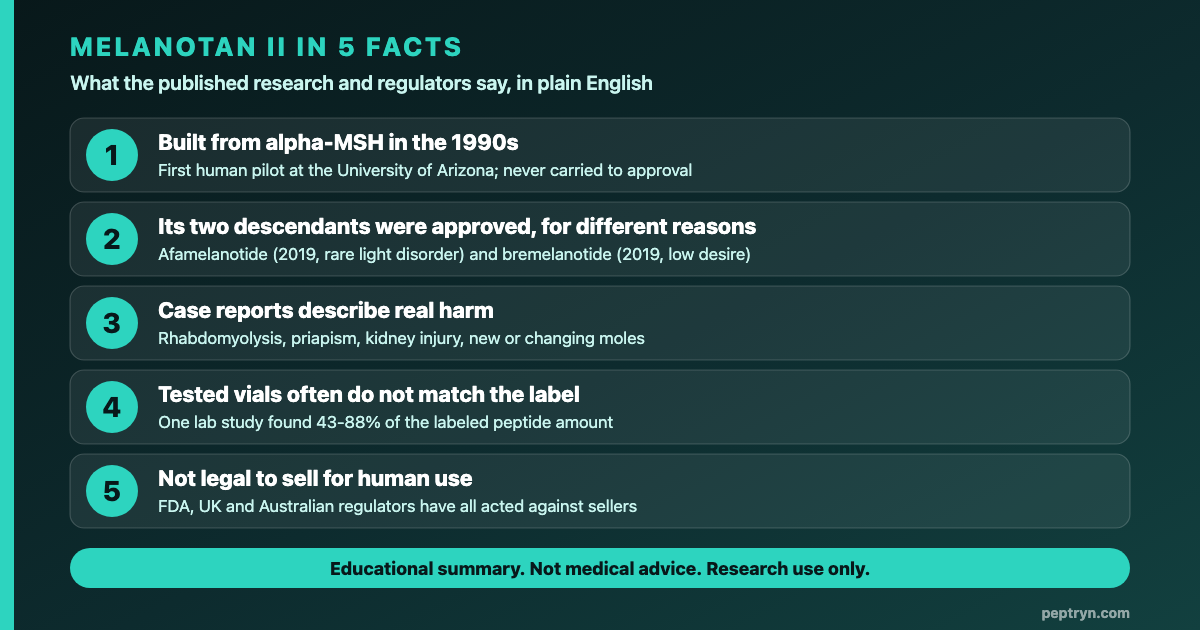
Melanotan II (MT-2) is a synthetic peptide built from natural alpha-MSH, first tested in people at the University of Arizona in the 1990s as an unusually stable way to darken skin pigment without sun exposure. It never became an approved medicine. What did get approved, more than two decades later and for an entirely different reason, is a related but chemically distinct compound called afamelanotide (brand name Scenesse), sometimes loosely referred to as Melanotan I. The two get conflated constantly online, and the confusion matters: afamelanotide’s approval covers a rare light-sensitivity disorder, administered as a clinician-placed implant, not tanning.
MT-2 itself is sold today as an unregulated research chemical, usually by injection, marketed for tanning and sometimes for libido. The published case-report literature on people who have actually used it includes rhabdomyolysis, priapism, kidney injury and new or changing moles, alongside laboratory findings that vials sold online often contain a different amount of peptide than the label states. None of that proves every user is harmed. It does mean the safety and quality picture is thin, self-reported, and worth reading in full before taking any seller’s claims at face value.
| Question | What is known | Evidence |
|---|---|---|
| What is it? | A synthetic cyclic peptide built from alpha-MSH, seven amino acids long | Chemistry |
| Was it ever approved? | No. Small pilot studies in the 1990s were not followed by approval | Regulatory history |
| What is the related approved compound? | Afamelanotide (Scenesse), a different molecule, FDA approved in 2019 for a rare light-sensitivity disorder, not for tanning | FDA record |
| What do case reports describe? | Rhabdomyolysis, priapism, renal infarction, new or changing moles, one report of five melanomas in situ | Published case reports |
| Is quality consistent? | A peer-reviewed lab analysis found vials with 43-88% of the labeled amount, plus impurities in some samples | Independent lab testing |
| Is it legal to sell for human use? | Not in the US, UK or Australia; regulators in all three have taken action against sellers | Regulatory |
What Melanotan II actually is
Melanotan II is a cyclic seven-amino-acid peptide, chemically Ac-Nle4-Asp5-His6-D-Phe7-Arg8-Trp9-Lys10-NH2, built as a more stable version of the body’s own alpha-melanocyte-stimulating hormone. It was designed and first tested at the University of Arizona, with the earliest published human data appearing in a 1996 pilot study by Dorr, Hruby, Hadley and colleagues.
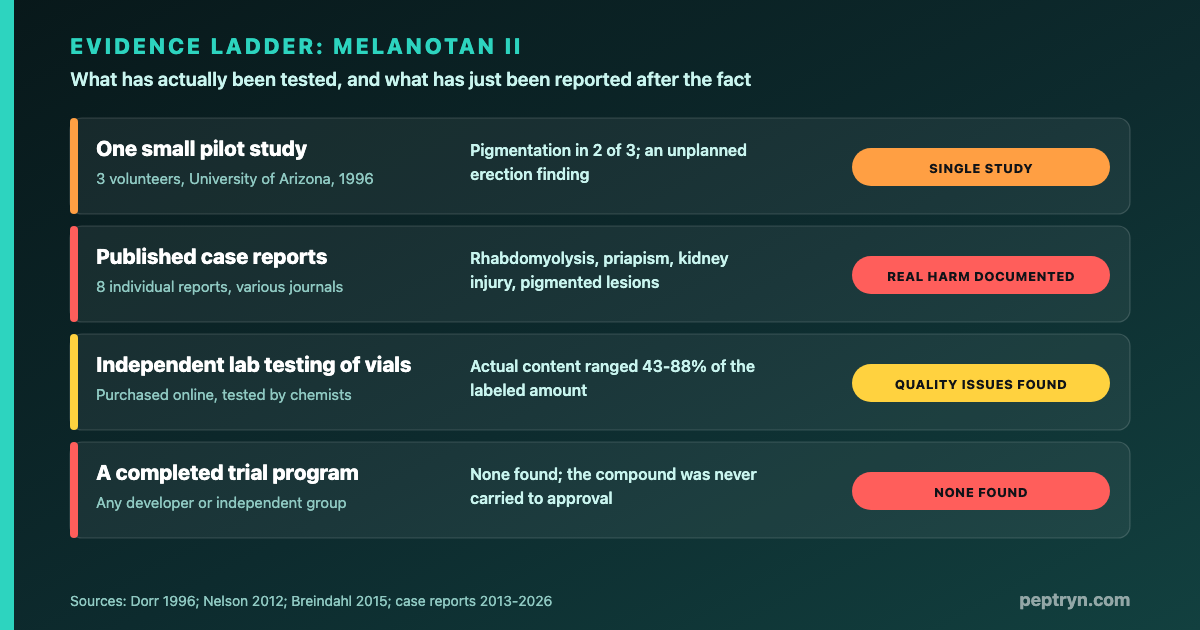
In that small pilot, three volunteers with no diagnosed condition received escalating subcutaneous doses over two weeks. Two of the three showed visibly darker pigmentation. A separate, unplanned finding drew as much attention as the pigmentation result: several volunteers had spontaneous, unrequested erections lasting one to five hours. That side observation is what redirected research interest toward sexual function rather than tanning, and it is the reason two very different compounds eventually branched off this one starting point.
Three compounds, three different paths
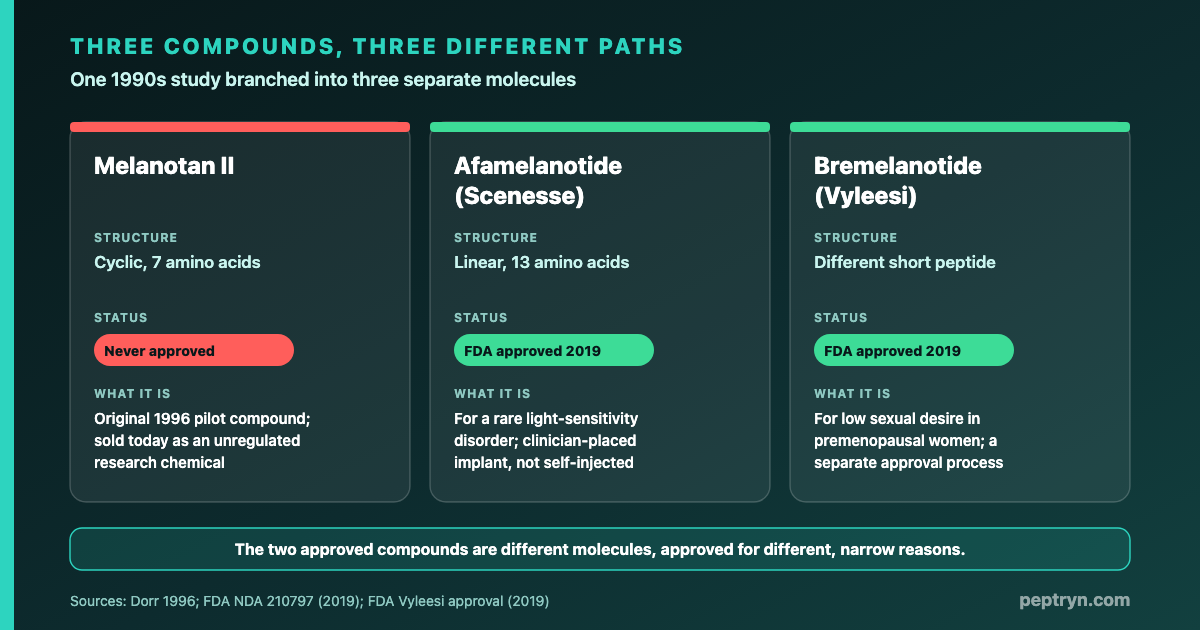
The pigmentation and sexual-function signals from that first study eventually split into three separate compounds, and keeping them apart matters for anyone reading claims online.
- Melanotan II is the original 1996 molecule. It activates a broad set of melanocortin binding sites, described in the original pilot work as MC1R, MC3R, MC4R and MC5R together, rather than one specific target. It was never carried through to approval for any use.
- Afamelanotide, sold as Scenesse, is a longer, linear 13-amino-acid molecule, not simply a renamed Melanotan II. It went through a full development and review process and was approved by FDA in October 2019, specifically to extend pain-free light exposure in adults with erythropoietic protoporphyria, a rare inherited disorder that makes ordinary daylight painful. It is given as a single implant, placed by a trained clinician above the hip, roughly every two months, not self-injected and not marketed for tanning.
- Bremelanotide, sold as Vyleesi, is a different, shorter molecule descended from the same early sexual-function observations. FDA approved it separately in 2019 for low sexual desire in premenopausal women. It is also not the same compound as Melanotan II, despite sharing a research ancestor.
Online sellers routinely blur these three into one story, implying that because “a melanotan compound” is FDA approved, Melanotan II itself carries some version of that approval. It does not. Only the two purpose-built descendants went through review, for narrow, specific indications, under clinician administration.
What the case-report literature shows
Melanotan II is not the subject of a large modern clinical trial program. What exists instead is a body of individual case reports, published in toxicology, dermatology, urology and emergency-medicine journals, describing what happened to specific people after using it. Reading several of these together gives a more honest picture than any single case.
- Rhabdomyolysis and kidney strain. A 2012 case describes a man admitted to an emergency department with muscle breakdown and kidney dysfunction after injecting roughly six times a typical starting dose.
- Priapism. Two separate case reports, one in 2013 and one in 2019, describe prolonged, unwanted erections following Melanotan II injection, in one case linked directly to a larger-than-intended dose.
- Renal infarction. A 2020 case report describes a portion of a kidney losing blood supply shortly after Melanotan II use, with the authors reviewing prior literature for a possible link.
- New or changing moles, and one melanoma report. Multiple case reports describe new or changing pigmented lesions appearing within days to weeks of starting Melanotan II, and a 2014 case report describes a melanoma diagnosed in a person with a history of use. A 2026 case report describes five separate in-situ melanomas in one patient who also used a tanning bed and unregulated testosterone, and the authors are explicit that they cannot separate the peptide’s contribution from the other exposures.
- Reversible mouth pigmentation. A 2026 case report describes brown pigmentation appearing on the gums and inside the cheeks after roughly two months of self-injection, which faded over one to three months after stopping.
A pattern worth stating clearly: the mole and melanoma reports show association and a plausible biological pathway, since alpha-MSH-related compounds are known to darken existing pigment cells. They do not, on their own, prove that Melanotan II causes new melanoma, and the 2026 case report specifically flags that concurrent UV exposure clouds the picture. What they do establish is that unsupervised self-injection of a compound that visibly changes moles removes the normal safety net of a clinician tracking those changes over time.
What has been found in tested vials
Beyond what happens to people, there is direct laboratory data on what is actually in the products being sold. A peer-reviewed 2015 analysis tested Melanotan II vials bought from three separate online sellers, each labeled as containing 10mg. Measured content ranged from about 4.3mg to 8.8mg, meaning every tested vial contained less peptide than the label claimed, and vials from two of the three sellers also contained measurable unidentified impurities.
A separate finding reported by the Australian Therapeutic Goods Administration tested five bottles of a nasal-spray product from a single product line, all labeled with the same strength. Measured content across the five bottles varied roughly two and a half fold. Read together, these are two independent findings that point the same direction: labeled amount and actual amount are not reliably the same thing in this unregulated market, which matters for anyone trying to reason about dose from a label alone.
Regulatory status
Melanotan II has not been reviewed or approved by FDA for any use, in the United States or anywhere else. In 2007, FDA sent a warning letter to a US seller over marketing claims made for it, and unapproved peptide imports of this kind fall under FDA’s general Import Alert framework for unapproved new drugs.
In the UK, the medicines regulator (MHRA) issued a public advisory against unlicensed Melanotan injections and nasal sprays after receiving reports of adverse reactions including stomach, heart, blood and eye problems, and worked to close dozens of websites supplying it to UK buyers. Cancer Research UK separately warns that injectable Melanotan products have not been checked for safety, quality or effectiveness, and draws a clear line between that and ordinary topical fake tan, which carries no such warning.
In Australia, Melanotan II is prescription-only and has no approved products on the national therapeutic goods register, making unlicensed supply and advertising illegal. The Therapeutic Goods Administration issued dozens of infringement notices to one seller in 2026 and separately requested removal of thousands of unapproved-peptide advertisements from online and social platforms, after dermatologists reported a rise in abnormal mole cases among younger users.
What sellers claim versus what is shown
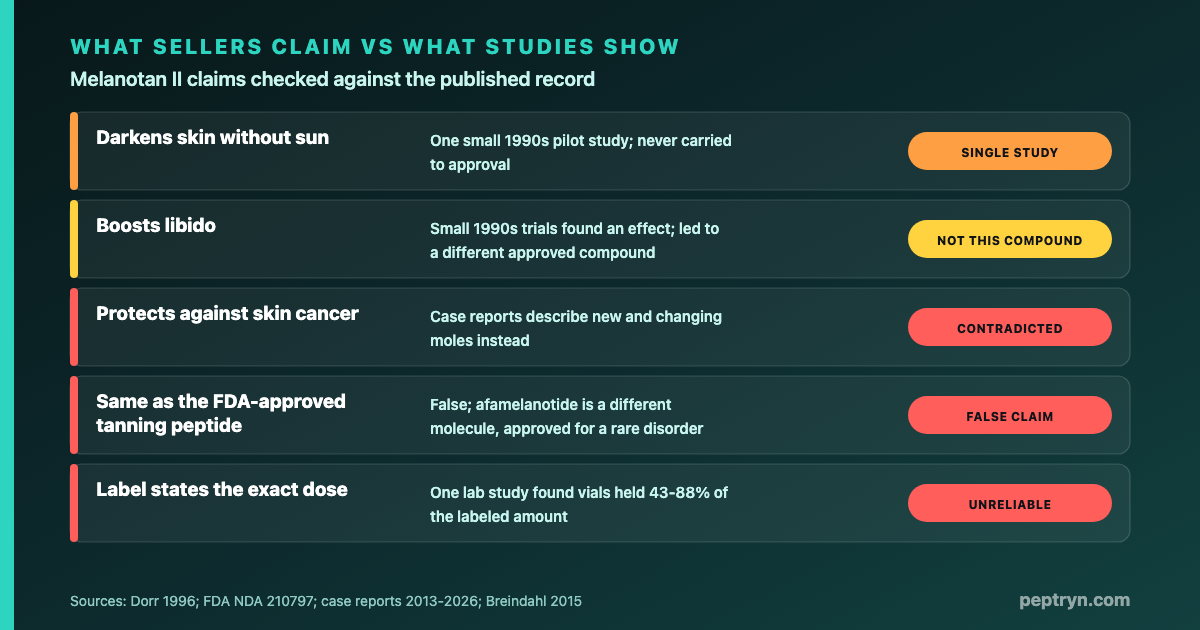
- “Darkens skin without sun exposure.” This is the one claim with direct human data behind it, from the original 1990s pilot work. The same studies that showed pigmentation also reported the unplanned erection finding and were never carried forward through a modern controlled trial.
- “Boosts libido.” Small, controlled studies in the late 1990s did find an effect on erections in men, which is exactly what led to the development of the two compounds that were eventually approved. Melanotan II itself was not carried through that process, and no controlled trial supports a libido claim for the compound as currently sold.
- “Protects against skin cancer” or “reduces UV damage.” The published case-report literature runs the other way: new and changing pigmented lesions, including melanoma reports, are exactly what has been documented in people using it, not a protective effect.
- “Same as the FDA-approved tanning peptide.” False as stated. The FDA-approved compound, afamelanotide, is a different molecule, approved for a rare light-sensitivity disorder, administered by a clinician, not sold for tanning.
- Purity and dosing claims on the label. The one published laboratory analysis of purchased vials found actual content well below the labeled amount in every sample tested, so a label number by itself is not reliable evidence of what is in the vial.
Where this leaves a buyer
Peptryn does not carry Melanotan II, Melanotan I or afamelanotide, so there is no product-specific certificate of analysis to point to here. What the record above supports is narrower than a lot of marketing implies: a single unreplicated pilot study from the 1990s showed pigmentation and an unplanned erection effect; the two compounds that were actually developed further and approved are different molecules, approved for different, specific reasons, under clinician administration; and the published case-report and lab-testing literature on Melanotan II as currently sold describes real, documented harms alongside inconsistent product quality. If you are researching this peptide, our COA guide and peptide safety guide cover what a lot-matched certificate should show and why that matters for any unregulated research material, not just this one.
Frequently asked questions
Is Melanotan II FDA approved?
No. It has not been reviewed or approved by FDA for any use.
Is Melanotan II the same as the approved tanning implant?
No. The FDA-approved compound is afamelanotide (Scenesse), a different molecule approved in 2019 for a rare light-sensitivity disorder, administered as a clinician-placed implant, not sold for tanning.
What is Melanotan I?
“Melanotan I” is often used loosely to mean afamelanotide, the linear compound that became Scenesse. It is chemically distinct from Melanotan II.
What do the safety case reports describe?
Published reports describe rhabdomyolysis, priapism, renal infarction, new or changing pigmented lesions, and reversible mouth pigmentation in people who used Melanotan II. The lesion reports show association with a plausible pathway, not proven causation of new melanoma.
Is Melanotan II legal to buy?
Regulators in the US, UK and Australia have all taken action against sellers marketing it for human use. Its legal status for research or laboratory use varies and does not extend to using it on a person.
Does Peptryn sell Melanotan II?
No. This guide is informational; it does not carry a Peptryn product.
Related: Are peptides safe? · Are peptides legal? · What is a COA? · What are peptides? · List of peptides · Popular peptides
Sources
Dorr RT, Lines R, Levine N, et al. Evaluation of melanotan-II, a superpotent cyclic melanotropic peptide in a pilot phase-I clinical study. Life Sciences, 1996 (PMID 8637402). pubmed.ncbi.nlm.nih.gov
Nelson ME, Bryant SM, Aks SE. Melanotan II injection resulting in systemic toxicity and rhabdomyolysis. Clinical Toxicology, 2012 (PMID 23121206). pubmed.ncbi.nlm.nih.gov
Devlin J, Pomerleau A, Foote J. Melanotan II overdose associated with priapism. Clinical Toxicology, 2013 (PMID 23537392). pubmed.ncbi.nlm.nih.gov
Dreyer BA, Amer T, Fraser M. Melanotan-induced priapism: a hard-earned tan. BMJ Case Reports, 2019 (PMID 30796078). pubmed.ncbi.nlm.nih.gov
Peters B, Hadimeri H, Wahlberg R, Afghahi H. Melanotan II: a possible cause of renal infarction. CEN Case Reports, 2020 (PMID 31953620). pubmed.ncbi.nlm.nih.gov
Hjuler KF, Lorentzen HF. Melanoma associated with the use of melanotan-II. Dermatology, 2014 (PMID 24355990). pubmed.ncbi.nlm.nih.gov
Reid C, Fitzgerald T, Fabre A, Kirby B. Atypical melanocytic naevi following melanotan injection. Irish Medical Journal, 2013 (PMID 23914578). pubmed.ncbi.nlm.nih.gov
Vadner DJ, Smith S. Five primary melanomas in situ in a patient with recent tanning bed use, melanotan exposure, and anabolic hormone use. JAAD Case Reports, 2026 (PMC13279914). pmc.ncbi.nlm.nih.gov
Bonchev A. Changes in oral mucosa associated with Melanotan II injections: a case report. Life, 2026 (PMC12942211). pmc.ncbi.nlm.nih.gov
Breindahl T, Evans-Brown M, Hindersson P, et al. Identification and characterization by LC-UV-MS/MS of melanotan II skin-tanning products sold illegally on the Internet. Drug Testing and Analysis, 2015 (PMID 24771717). pubmed.ncbi.nlm.nih.gov
U.S. Food and Drug Administration. Scenesse (afamelanotide) approval, NDA 210797, 2019. accessdata.fda.gov
Therapeutic Goods Administration (Australia). Melanotan II tanning peptide products found to be inconsistently dosed. tga.gov.au
Therapeutic Goods Administration (Australia). Individual issued infringement notices for alleged unlawful supply of Melanotan II. tga.gov.au
Cancer Research UK. Fake tan and melanotan injections. cancerresearchuk.org
For laboratory research use only. Not for human or veterinary use, and not a drug, food, dietary supplement or cosmetic. You must be 21 or older to buy.