Are Peptides Safe? What the Evidence Says (2026)
Note: This guide is educational and is not medical advice. Peptryn supplies research-use-only peptides to laboratories, and nothing here suggests using research materials on yourself. Speak to a licensed clinician about any medical decision.
The short answer
Whether a peptide is safe depends on four things: which peptide it is, where the product came from, how it is taken, and who is taking it. Peptides that are FDA-approved medicines, such as insulin, semaglutide and tirzepatide, have large trials behind them and labels that list their risks. Most peptides sold for recovery, longevity or performance have little or no human safety data, and the vials they come in are not made or checked to drug standards. “Peptide” describes a chemical structure and not a safety category, as our guide on what peptides are explains.
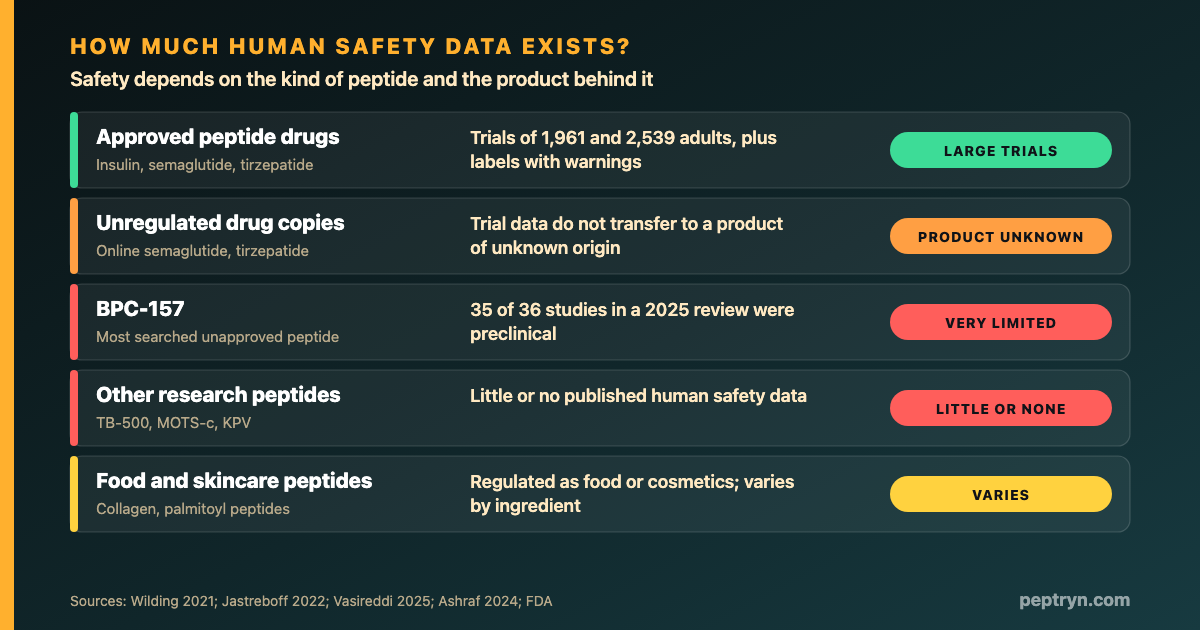
| Kind of peptide | Examples | Human safety data | Main concerns |
|---|---|---|---|
| Approved drugs | Insulin, semaglutide, tirzepatide | Large randomized trials, labels, FDA monitoring after approval | Known side effects, mostly digestive, plus label warnings |
| Unregulated copies of approved drugs | Semaglutide or tirzepatide from online sellers | The approved drug’s data do not transfer to a different product | Wrong amount, low purity, contamination, FDA warnings |
| Unapproved peptides | BPC-157, TB-500, MOTS-c | Little or none | Unknown effects, immune reactions, product quality |
| Food and skincare peptides | Collagen peptides, palmitoyl peptides | Varies by ingredient | Regulated as food or cosmetics, so the risks differ from injectables |
What trials of approved peptide drugs show
The best safety data for any peptide come from approved drugs, so they set the baseline. In STEP 1, a 68-week trial of 1,961 adults with obesity, nausea and diarrhea were the most common adverse events with semaglutide. They were typically transient and mild to moderate. More people on semaglutide than on placebo stopped taking it because of digestive problems (59 people, 4.5%, against 5 people, 0.8%).
A pooled analysis of the STEP 1 to 3 trials counted the digestive events in more detail.
| Event (STEP 1 to 3 pooled) | Semaglutide | Placebo |
|---|---|---|
| Nausea | 43.9% | 16.1% |
| Diarrhea | 29.7% | 15.9% |
| Vomiting | 24.5% | 6.3% |
| Constipation | 24.2% | 11.1% |
In the same analysis, 99.5% of these events were non-serious and 98.1% were mild to moderate, and they were most frequent during and shortly after dose escalation. In SURMOUNT-1, a 72-week trial of 2,539 adults, the most common adverse events with tirzepatide were also digestive. Adverse events caused 4.3% to 7.1% of participants to stop across the three tirzepatide groups, against 2.6% on placebo.
The label goes further than the trial headlines. Wegovy carries a boxed warning: semaglutide caused thyroid C-cell tumors in rodents, and the relevance to humans has not been determined. It is contraindicated in people with a personal or family history of medullary thyroid carcinoma, and its warnings include pancreatitis and gallbladder disease.
These figures describe screened trial participants, with clinical follow-up and pharmaceutical-grade product. They cannot be carried over to a vial of unknown origin. For the efficacy side of these trials, see peptides for weight loss: what the evidence shows.
What is known about peptides that are not approved
BPC-157 is the most searched example. A 2025 systematic review of BPC-157 in orthopaedic sports medicine found 544 articles and included 36 studies. Thirty-five were preclinical and one was clinical. A separate 2025 pilot study infused BPC-157 intravenously into two adult volunteers and reported no adverse effects and no changes in heart, liver, kidney or thyroid blood markers. That result is worth knowing, and it is also two people followed for a short time. It cannot show that a compound is safe for the wider public or for repeated use.
The US Anti-Doping Agency states that because BPC-157 has not been extensively studied in humans, it is unknown whether any safe dose exists. The World Anti-Doping Agency lists it as prohibited at all times under S0, the category for non-approved substances.
FDA’s stated worries about this group of peptides are specific. They include immune reactions (immunogenicity) linked to aggregation and peptide-related impurities, the difficulty of characterizing complex peptides, and too little information to know whether a substance causes harm when given to people. No reported harm in a handful of people is a different thing from demonstrated safety, and for most research peptides that gap is the whole story.
Where US regulation stands in 2026
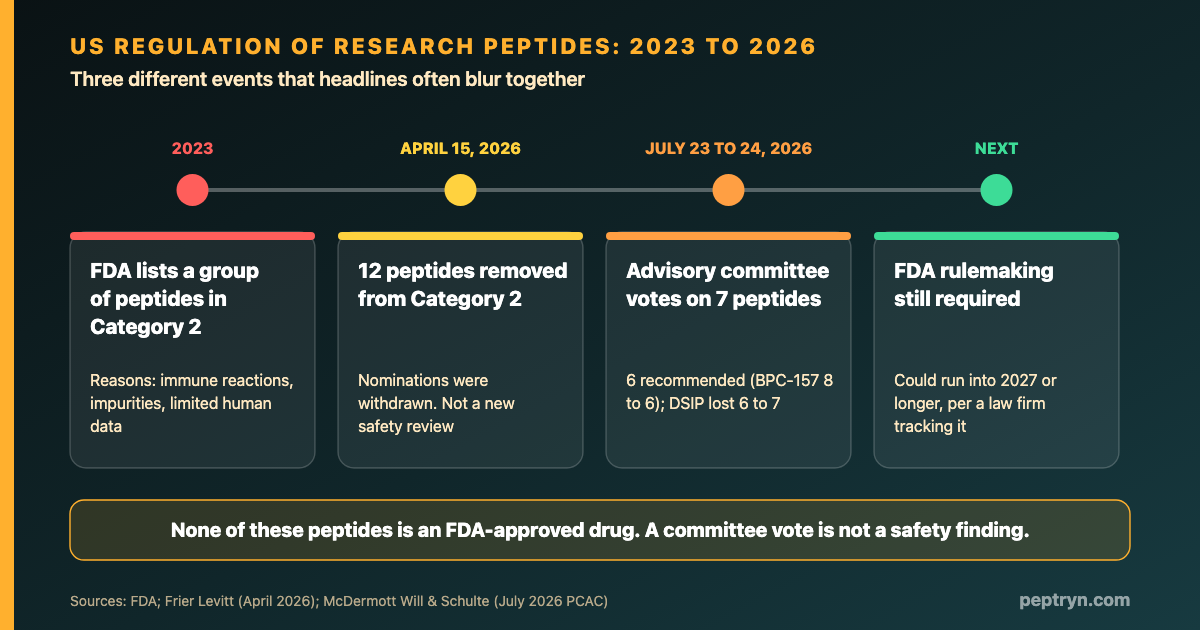
News about peptides and FDA changed quickly this year, and headlines blurred three different events.
- April 15, 2026: FDA republished its interim list for pharmacy compounding and removed twelve peptides from Category 2, among them BPC-157, TB-500, MOTS-c, epitalon, semax, KPV and injectable GHK-Cu. The stated reason was that the nominations for them had been withdrawn. It was not a new safety review, and FDA said removal does not make these substances eligible for compounding.
- July 23 and 24, 2026: FDA’s Pharmacy Compounding Advisory Committee voted on seven peptides. It recommended six for inclusion on the bulk drug substances list, with votes such as 8 to 6 for BPC-157 and 7 to 4 for epitalon, and did not recommend emideltide (DSIP), which lost 6 to 7. FDA scientists raised concerns about insufficient safety, efficacy and characterization information.
- What comes next: A committee recommendation is advice. FDA still has to complete notice-and-comment rulemaking, which a law firm tracking the process expects could run into 2027 or longer.
None of these peptides is an FDA-approved drug. A committee vote about compounding is neither a safety finding nor a safety warning. It also does not change the rules on research-use-only labeling, covered in are peptides legal?
The product problem: what is actually in the vial
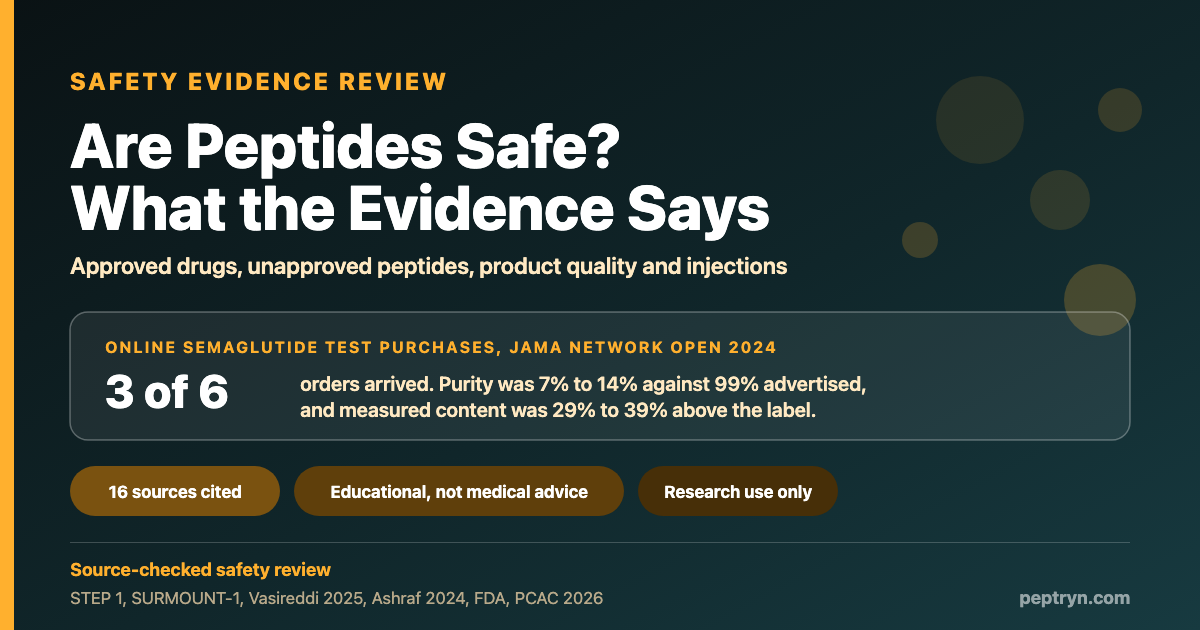
Even a well-studied peptide is only as safe as the product in your hand. The most cited test of that comes from a 2024 study in JAMA Network Open. Researchers found 1,080 links in search results for semaglutide, 317 of them online pharmacies, and 134 of those belonged to illegal operations. They bought from six sellers. Only three orders arrived; the other three were non-delivery scams asking for $650 to $1,200 more. In the three products that did arrive, purity was 7% to 14% against 99% advertised, the measured semaglutide content exceeded the label by 29% to 39%, and one sample had elevated endotoxin (8.95 EU/mg), although no viable microorganisms were detected. The sample was small, and the products were semaglutide from illegal online pharmacies, not peptides from laboratory suppliers. It still shows how far an advertised claim can sit from a lab result.
FDA has also reported adverse events tied to unapproved and compounded GLP-1 products: about 990 reports for compounded semaglutide and more than 730 for compounded tirzepatide as of May 31, 2026, and it has warned sellers of research-labeled versions.
We found the same gap in our own data. Peptryn is a supplier, and we audited the 15 laboratory certificates linked from our own product pages. Purity ranged from 99.11% to 99.97% (median 99.75%), yet measured quantity differed from the label by a median of +16.4% across 21 components, ranging from -8.6% to +36.5%. The reports do not state the uncertainty of the quantity assay, so we read the figures cautiously. The full method is in the peptide COA data report.
A certificate helps only if you know what it covers. Purity by HPLC and identity by mass spectrometry are separate tests from endotoxin and sterility, and a report that omits the last two says nothing about them. Our guides on how to read a COA and peptide testing go through each test.
Why injection changes the risk
Swallowed products meet stomach acid and the gut lining first. Injected products go straight into tissue or the bloodstream and skip those barriers, which is why injectable medicines are made under sterility and endotoxin limits. Contamination, unknown impurities and immune reactions therefore matter more with an injected product than with a capsule or a cream. Local infection and allergic reactions are the risks a clinician would name first.
One documented example: in July 2025, two women were hospitalized after receiving peptide injections at a wellness conference in Las Vegas, and at least one was intubated. Nevada regulators later fined the people involved for practicing and wholesaling drugs without licenses, but they could not determine what caused the reactions because they were unable to obtain or test the products, according to ProPublica. One event is not a rate, but it shows what an unverified product plus an unlicensed setting can look like.
This guide does not cover how to inject any product. For unapproved peptides there is no clinical guidance on sites, volumes or schedules, so any such instructions online are guesses.
Are peptides steroids?
No. Peptide hormones are built from amino acids, while steroid hormones are made from cholesterol. Peptide hormones also work differently: they act from outside the cell, whereas steroid hormones cross the cell membrane and act inside it. “Not a steroid” does not mean “no hormonal effect,” though. In a 1992 study of older men, a fragment of growth hormone releasing hormone raised growth hormone and IGF-1 levels. Changing hormone levels is a safety question in its own right, which is why these compounds are studied under supervision.
Who needs extra caution
- Anyone pregnant or planning a pregnancy. The Wegovy label advises stopping semaglutide at least two months before a planned pregnancy, and most research peptides have no pregnancy data at all.
- People taking other medicines. The tirzepatide label calls for a backup contraceptive method after starting and after each dose increase, an example of how a peptide drug can interact with other medicines.
- People with a personal or family history of medullary thyroid cancer or MEN 2. This is a contraindication for semaglutide on the Wegovy label.
- Competitive athletes. BPC-157 and other non-approved substances are prohibited under WADA rule S0.
- Anyone under 21. Research peptides are sold to adults for laboratory use, and there are no safety data for them in young people.
Five questions to ask before trusting any peptide product
- Is it FDA-approved, and for what? Approval is the only route to a label that lists tested risks.
- Who is supervising its use? Prescription drugs come with a prescriber, a pharmacy and a way to report problems.
- What does the lot-matched certificate cover? Look for identity, purity, quantity and endotoxin, from a lab you can verify.
- What is the label’s stated use? “For research use only” means the seller is not offering it for human use.
- What is the seller claiming? Promises about muscle, recovery or aging from a research compound are a warning sign.
Frequently asked questions
Are peptide injections safe?
Approved peptide injections, prescribed and supervised, come with a documented risk profile. For unapproved peptides there is not enough human data to call them safe, and injecting an unverified product adds contamination and immune-reaction risks on top.
Are peptides safe long term?
Multi-year human data exist for approved drugs. For unapproved peptides, the sources reviewed for this guide found no long-term human safety studies.
Do peptides have side effects?
Yes. For approved drugs the common ones are digestive: nausea, diarrhea, vomiting and constipation. For unapproved peptides the side effects have not been characterized in people, which is a different situation from having none.
Are research peptides safe?
Research peptides are sold for laboratory use, and the “research use only” label means they have not been evaluated or approved for people. No safety claim can be made for human use.
Are peptides bad for you?
Peptides are a broad class, and the body makes many of them. Insulin is a peptide, and so are the hormones that regulate appetite. Risk depends on the specific peptide, the product and the person, not on the word “peptide.”
Related: What are peptides? · Are peptides legal? · Peptide COA data report · What is a COA? · Peptide testing · Peptides for weight loss · Copper peptides (GHK-Cu) · Peptides for hair growth · Peptides for skin · TB-500 (thymosin beta-4) · KPV peptide · Kisspeptin-10 · Pinealon
Sources
Wilding JPH, et al. Once-Weekly Semaglutide in Adults with Overweight or Obesity (STEP 1). New England Journal of Medicine, 2021 (PMID 33567185). nejm.org
Wharton S, et al. Gastrointestinal tolerability of once-weekly semaglutide 2.4 mg in adults with overweight or obesity. Diabetes, Obesity and Metabolism, 2022. doi.org/10.1111/dom.14551
Jastreboff AM, et al. SURMOUNT-1: once-weekly tirzepatide in adults with obesity. New England Journal of Medicine, 2022 (PMID 35658024). nejm.org
U.S. Food and Drug Administration. Wegovy prescribing information (boxed warning, contraindications, warnings, pregnancy). Zepbound prescribing information (oral contraceptives). accessdata.fda.gov
Vasireddi N, et al. Emerging Use of BPC-157 in Orthopaedic Sports Medicine: A Systematic Review. HSS Journal, 2025. doi.org/10.1177/15563316251355551
Lee E, Burgess K. Safety of intravenous infusion of BPC157 in humans: a pilot study. 2025 (PMID 40131143). pubmed.ncbi.nlm.nih.gov
U.S. Anti-Doping Agency. BPC-157: Experimental Peptide Creates Risk for Athletes. usada.org
World Anti-Doping Agency. Prohibited List 2026, S0 Non-Approved Substances. wada-ama.org
U.S. Food and Drug Administration. Certain bulk drug substances for use in compounding that may present significant safety risks. fda.gov
Frier Levitt. FDA Peptide Update 2026: removal from the “do not compound” list. frierlevitt.com
McDermott Will & Schulte. Bulk-list bound? PCAC backs majority of peptides in two-day public meeting. mcdermottlaw.com
Ashraf AR, et al. Safety and Risk Assessment of No-Prescription Online Semaglutide Purchases. JAMA Network Open, 2024. doi.org/10.1001/jamanetworkopen.2024.28280
U.S. Food and Drug Administration. FDA’s concerns with unapproved GLP-1 drugs used for weight loss (adverse event reports as of May 31, 2026). fda.gov
ProPublica. Nevada issues fines for peptide injections at RAADFest, where two women fell ill. propublica.org
Corpas E, et al. Growth hormone (GH)-releasing hormone-(1-29) twice daily reverses the decreased GH and insulin-like growth factor-I levels in old men. Journal of Clinical Endocrinology and Metabolism, 1992 (PMID 1379256). doi.org/10.1210/jcem.75.2.1379256
Peptryn. Peptide COA data report: purity and quantity across 15 lab-hosted certificates, September 2026. peptryn.com
For laboratory research use only. Not for human or veterinary use, and not a drug, food, dietary supplement or cosmetic. You must be 21 or older to buy.