
Retatrutide Reconstitution Protocol: Peptryn’s Official Step-by-Step Guide
Research use only. Retatrutide is not approved by the FDA for human use and is sold strictly for in vitro and laboratory research.
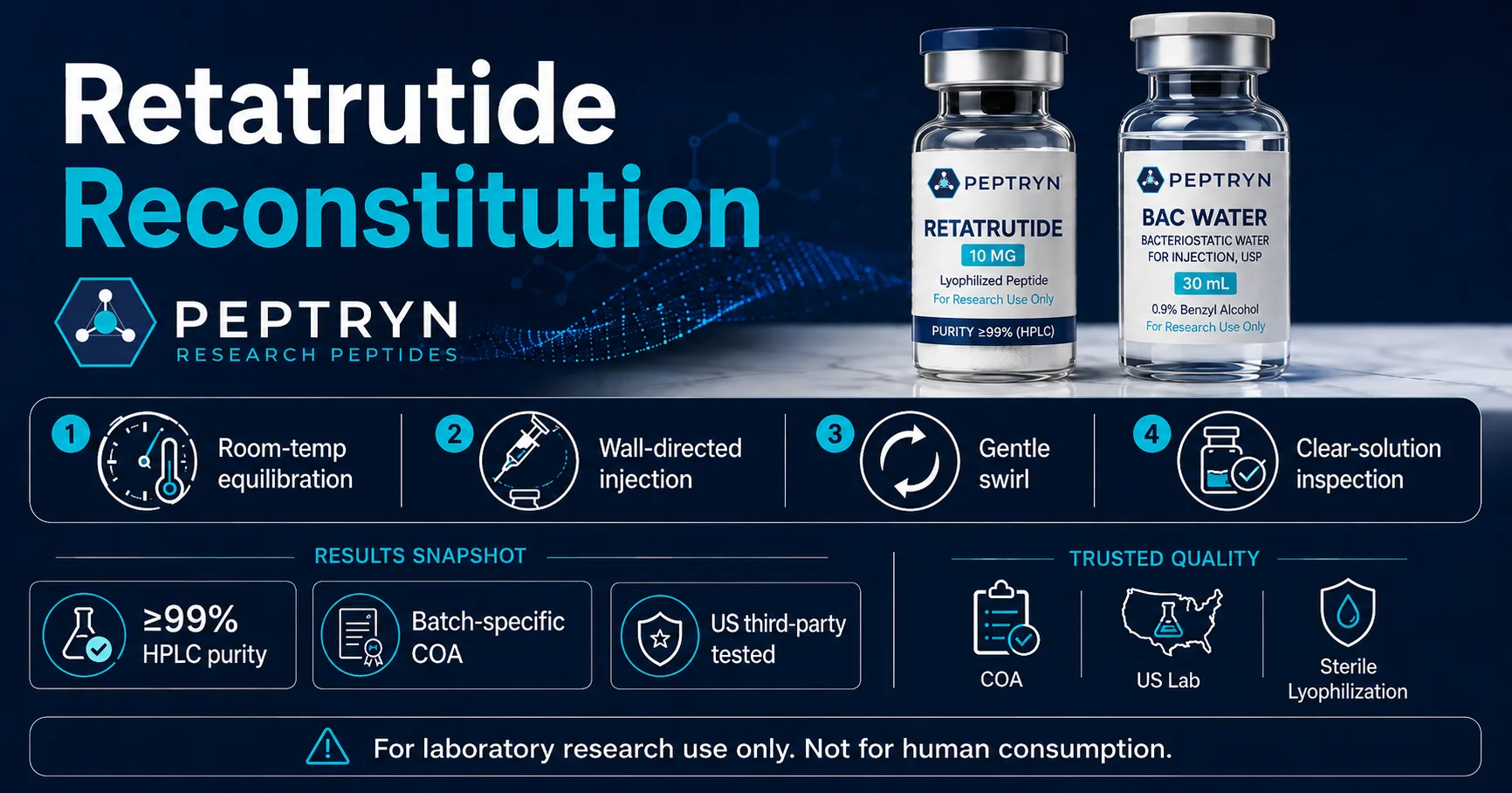
Table of Contents
- What Reconstitution Means and Why It Matters
- Materials Needed
- Step-by-Step Reconstitution Protocol
- Concentration Math for Research Records
- Common Mistakes to Avoid
- Signs a Sample May Have Degraded
- What the Research Community Reports
- Why Lot-Specific COAs Matter
- Frequently Asked Questions
- Final Take
What Reconstitution Means and Why It Matters
Retatrutide ships as a sterile, lyophilized (freeze-dried) powder — the most stable form for shipping and long-term storage. Before it can be used in any in vitro research application, it has to be dissolved into solution at a defined concentration. That process is reconstitution.
Getting it right matters for two reasons. First, rough handling, the wrong solvent, or thermal stress during preparation can damage the peptide before it ever reaches an experiment, meaning the material in use no longer reflects its catalogued purity. Second, an inaccurate concentration throws off downstream volume calculations, which affects reproducibility of any research protocol built around it.
This guide walks through the process end to end, the concentration math involved, and what real discussion in the research-peptide community says about where reconstitution commonly goes wrong.
Materials Needed
| Item | Purpose |
|---|---|
| Retatrutide vial (lyophilized) | The peptide to be reconstituted |
| Bacteriostatic water (BAC water) | Preferred solvent for vials accessed more than once |
| Sterile syringes | Accurate volume measurement |
| Sterile needles | Clean fluid transfer |
| Alcohol swabs | Sterilizing vial tops and workspace |
| Sterile gloves | Contamination prevention |
| Permanent marker and labels | Recording concentration and date |
| Sharps disposal container | Safe needle disposal |
On solvent choice: bacteriostatic water is preferred over plain sterile water for any vial that will be accessed more than once. The 0.9% benzyl alcohol it contains acts as a preservative, inhibiting bacterial growth from repeated septum punctures. Plain sterile water has no such preservative and is appropriate only for single-use preparations.
Step-by-Step Reconstitution Protocol
1. Bring both vials to room temperature. Remove the lyophilized peptide and the bacteriostatic water from cold storage and allow roughly 15–30 minutes to reach 20–25°C before proceeding. Cold solutions can interfere with complete dissolution.
2. Prepare a clean workspace. Disinfect the work surface, put on sterile gloves, and have alcohol swabs, syringes, and needles within reach.
3. Clean both vial tops. Wipe the rubber septum of each vial with a fresh alcohol swab and let it air-dry for 10–15 seconds. Avoid touching the cleaned surface afterward.
4. Determine your target concentration (see the math section below) before adding any liquid.
5. Draw the bacteriostatic water. Use a sterile syringe to draw the calculated volume, checking for air bubbles that would throw off the measurement.
6. Inject along the vial wall, slowly. Angle the needle so the tip touches the inner glass wall and let the water run down the side rather than striking the powder directly. Forceful, direct injection generates foam and mechanical stress that can reduce potency.
7. Swirl gently until dissolved — never shake. Rotate the vial in a slow circular motion. If the powder hasn’t fully dissolved after 2–3 minutes, let it rest briefly and swirl again. A properly reconstituted solution should be clear within 5–10 minutes.
8. Inspect the solution. It should be clear, colorless to very slightly off-white, and free of visible particles. Cloudiness or aggregates indicate a problem — see the degradation section below.
9. Label and store immediately. Record the peptide name, lot number, concentration, and reconstitution date on the vial, then refrigerate at 2–8°C, protected from light. Never freeze a reconstituted solution.
Concentration Math for Research Records
The underlying formula:
Concentration (mg/mL) = Peptide mass (mg) ÷ Volume of diluent (mL)
Reference table for common vial sizes:
| Vial Size | BAC Water Added | Resulting Concentration |
|---|---|---|
| 10mg | 1 mL | 10 mg/mL |
| 10mg | 2 mL | 5 mg/mL |
| 10mg | 3 mL | 3.33 mg/mL |
| 60mg | 3 mL | 20 mg/mL |
| 60mg | 6 mL | 10 mg/mL |
The volume of diluent chosen should match what a given research protocol calls for — a higher concentration means smaller working volumes; a lower concentration allows finer volume resolution. These figures are provided as mathematical reference only. For a quick automated version of this math, Peptryn’s Peptide Reconstitution & Dosage Calculator converts vial size, added water, and target amount into a single readout.
Common Mistakes to Avoid
- Shaking the vial — the most common error. Agitation foams the solution and can denature the peptide’s structure. Always swirl.
- Injecting solvent too fast or directly onto the powder — creates foam and mechanical stress. Slow, wall-directed injection avoids both.
- Using cold solvent — can cause incomplete dissolution or precipitation. Let everything equilibrate to room temperature first.
- Skipping the label — a labeled vial with a reconstitution date is the only way to track a solution’s stability window accurately.
- Using plain sterile water on a multi-access vial — no preservative means rising contamination risk with each puncture.
- Refreezing a reconstituted solution — freeze-thaw cycling causes ice-crystal formation that damages peptide structure.
Signs a Sample May Have Degraded
Cloudiness, visible particulates, or a gel-like texture in a solution that was previously clear are signs the sample should not be trusted for research use. Peptide degradation doesn’t always announce itself with a dramatic visual change — potency can decline before appearance shifts noticeably. When in doubt, treat the sample as compromised rather than assume it’s still viable.
What the Research Community Reports
A significant share of retatrutide search traffic includes terms like “reddit” — researchers and buyers looking for candid discussion rather than another vendor’s marketing copy. Rather than manufacture that discussion, here’s what’s actually being discussed in open research-peptide communities, read directly rather than summarized secondhand:
- Cloudiness after reconstitution is a recurring, genuine concern. A thread in r/PeptidePathways describes a solution that turned cloudy and developed a slimy layer within a day of mixing — exactly the kind of visible quality issue covered in the degradation section above. A related discussion traced the same problem across three separate vials back to the bacteriostatic water itself, not the peptide, after ruling out temperature and injection-speed variables one at a time.
- Unlabeled or bulk-repackaged product is a flagged red flag in the community. A widely-discussed thread in r/Retatrutide describes a supplier switching from individually labeled mg vials to unlabeled 1g bulk powder in plastic bottles — a change the original poster and commenters treated as a serious sourcing and sterility concern, not a minor inconvenience.
- Community-run vendor vetting lists exist precisely because COA quality varies this much. A long-running community guide maintains its own supplier-vetting notes and opens with an explicit scammer warning — evidence that buyers in this space actively look for, and value, verifiable batch documentation rather than taking purity claims at face value.
None of this is dosing or usage guidance — it’s what the research-buyer community says about product quality, handling, and sourcing verification, which is exactly the layer Peptryn’s batch-specific COAs are built to address.
Why Lot-Specific COAs Matter
A verified-pure batch that’s mishandled in storage can produce just as unreliable a result as an unverified batch to begin with — which is why purity documentation and correct handling both matter, not one or the other. Every Peptryn retatrutide batch ships with an independent, US-lab-issued Certificate of Analysis confirming identity and purity by HPLC and mass spectrometry, viewable in the COA library before you order — not a generic purity graphic, but a batch-specific document tied to the vial you’re actually receiving.
Frequently Asked Questions
What solvent should be used to reconstitute retatrutide?
Bacteriostatic water is standard for vials that will be accessed more than once, due to its preservative content.
How is the concentration of a reconstituted solution calculated?
Divide the peptide mass in mg by the volume of diluent in mL. Example: 10mg with 2mL of BAC water yields 5 mg/mL.
Can reconstituted retatrutide be frozen?
No. Freezing a reconstituted solution can cause ice-crystal formation that damages the peptide. The lyophilized (unreconstituted) powder can be frozen; the reconstituted solution should stay refrigerated at 2–8°C only.
How long does a reconstituted solution remain viable?
Up to 28 days refrigerated under proper conditions is the conservative guideline Peptryn provides. Discard immediately if the solution becomes cloudy or shows particulates.
What if the powder doesn’t fully dissolve?
Let it rest for a minute or two, then swirl again gently. If cloudiness persists past 10 minutes of careful swirling, don’t use the solution — contact Peptryn to report the batch.
Final Take
Reconstituting retatrutide correctly comes down to a short list of technique points — room-temperature materials, wall-directed injection, gentle swirling, and immediate labeling and refrigeration — but getting those details right is what keeps a batch’s documented purity meaningful once it’s in solution. Real community discussion consistently comes back to the same two failure points: solvent or handling issues causing visible degradation, and unverifiable sourcing undermining trust in the product itself. Peptryn’s batch-specific COAs are built to close that second gap.
Browse Retatrutide or check a specific batch in the COA library.
This article is for laboratory and research informational purposes only. Retatrutide is not approved by the FDA for human use and is sold strictly for in vitro and laboratory research. It is not intended for human consumption, self-administration, or veterinary use. Nothing in this article constitutes medical advice or usage instructions.