Peptides for Skin: What the Evidence Shows (2026)
Note: This guide is educational and is not medical advice. Peptryn supplies research-use-only peptides to laboratories, and nothing here suggests using research materials on yourself. Speak to a dermatologist about any skin concern.
The short answer
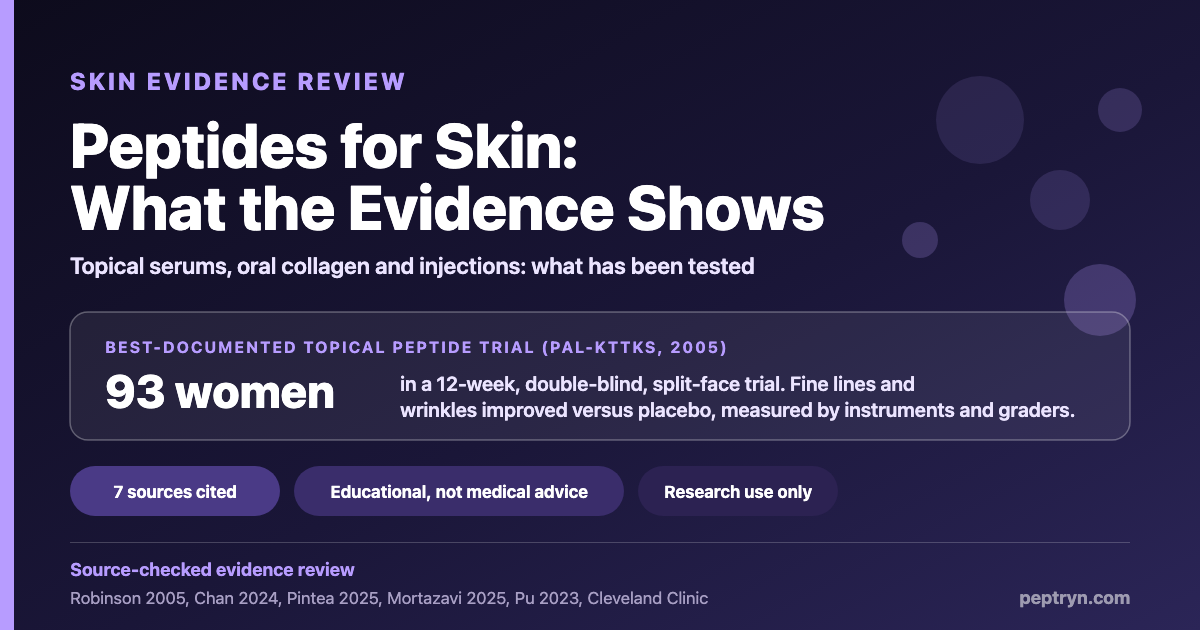
Peptides in skincare have better evidence than most trending skin ingredients, and less than the marketing implies. A 2024 systematic review of cosmeceuticals for sun-damaged skin found the evidence base for peptides to be the strongest of the groups it compared, with most studies reaching Level 1b, meaning individual randomized trials. A 12-week trial in 93 women found that a cream with a palmitoyl pentapeptide improved fine lines and wrinkles compared with placebo. The catch is what these trials measure: the look of fine lines, usually over about three months, for specific peptides in specific formulas.
Three limits are worth knowing. Getting a peptide through the skin’s outer layer is a known weak point. Individual peptides vary a lot, and the data on some, such as copper peptides, are thinner than their fame. And a Cleveland Clinic dermatologist points out that hyaluronic acid and retinoids are very effective and tend to cost less. Injected peptides sold for research are a separate matter and have no human skin studies.
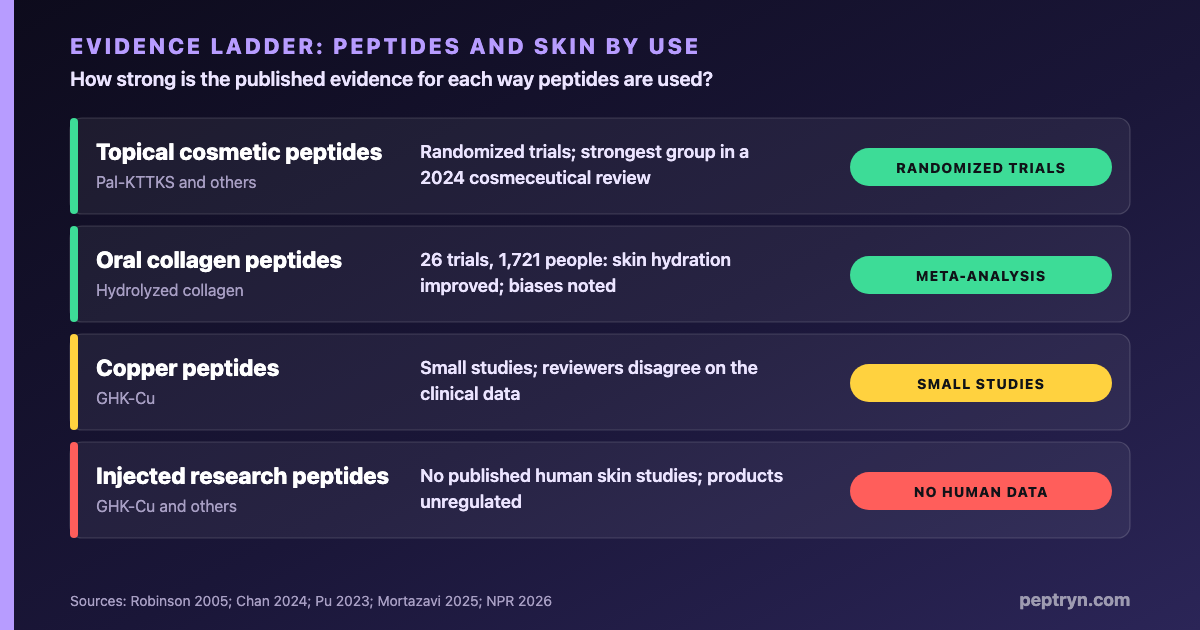
| Use | What has been shown | Evidence | Main gap |
|---|---|---|---|
| Topical cosmetic peptides | A 93-woman randomized split-face trial of pal-KTTKS improved lines and wrinkles versus placebo in 12 weeks | Randomized trials | Results are specific to each peptide and formula; skin penetration is limited |
| Oral collagen peptides | A meta-analysis of 26 randomized trials (1,721 people) found improved skin hydration | Meta-analysis | The authors found several biases and asked for larger trials |
| Copper peptides (GHK-Cu) | Small studies report better skin density and fewer fine lines | Small studies | Reviewers disagree on how strong the clinical data are |
| Injected research peptides | No published human skin studies | None | Safety and benefit unknown; products are unregulated |
What skincare peptides are
A peptide is a short chain of amino acids. In cosmetics, peptides are used as ingredients that are meant to send signals to skin cells or to support skin structure. A 2025 review groups them into four types by how they are proposed to work.
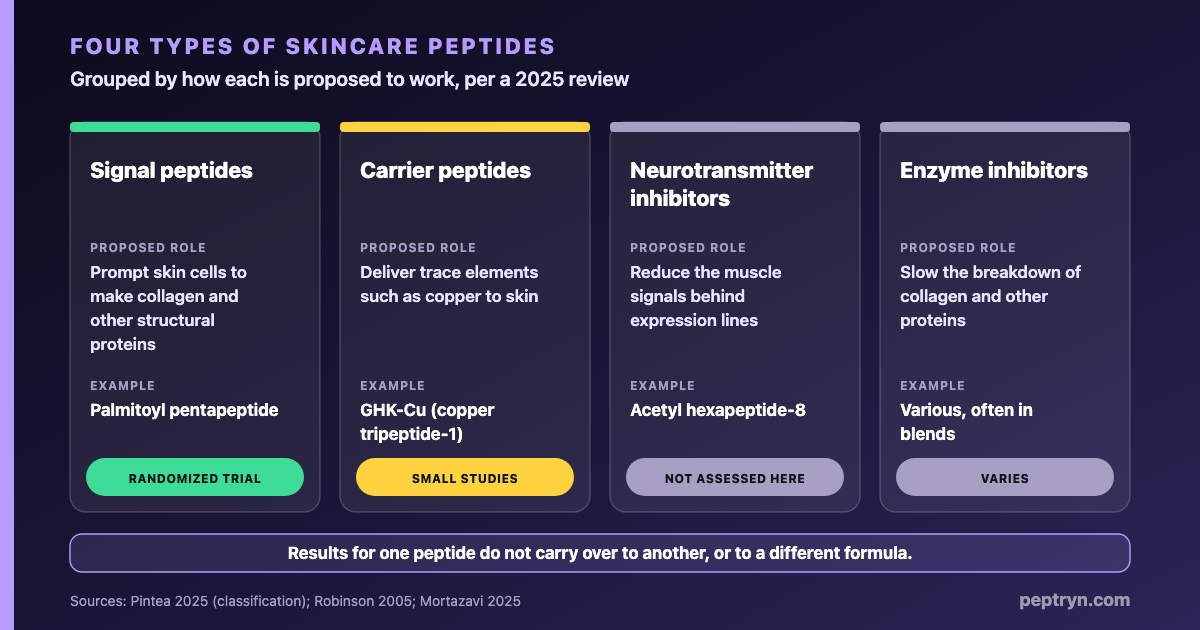
| Type | Proposed role | Example |
|---|---|---|
| Signal peptides | Prompt skin cells to make collagen and other structural proteins | Palmitoyl pentapeptide (pal-KTTKS) |
| Carrier peptides | Deliver trace elements such as copper to skin | GHK-Cu (copper tripeptide-1) |
| Neurotransmitter-inhibitor peptides | Reduce the muscle signals behind expression lines | Acetyl hexapeptide-8, often sold as “Argireline” |
| Enzyme-inhibitor peptides | Slow the breakdown of collagen and other proteins | Various, often in blends |
For a broader introduction to how peptides differ from proteins, see what are peptides?
What the trials show
The clearest single trial is a 2005 study of pal-KTTKS. It enrolled 93 women aged 35 to 55 in a 12-week, double-blind, placebo-controlled, split-face design: one side of the face received a moisturizer alone and the other the same moisturizer with 3 parts per million of the peptide. The peptide side improved more for wrinkles and fine lines by both instrument-based measurement and expert grading, and the peptide was well tolerated. Participants also reported improvement in their own assessments.
Zooming out, the 2024 systematic review in Skin Research and Technology compared botanicals, peptides and hydroquinone for photoaging. It graded the peptide evidence as the strongest, with most studies at Level 1b. That is encouraging, and it comes with limits: the grade describes study design and not how large the benefit is, and the peptides in the review are not interchangeable. A 2025 review of topical GHK-Cu and a related peptide, for instance, found the published information on their skin permeability and effectiveness insufficient, and noted “a surprising absence of clinical studies” using them. Our guide to copper peptides goes through that evidence.
Why delivery is the weak point
Skin is built to keep things out. A 2025 review of peptides for skin aging names poor permeability through membranes as one of the most significant drawbacks of cosmetic peptides, and describes efforts to improve it, including microneedles, ultrasound, liposomes and other nano-carriers. That helps explain why two products listing the same peptide can perform differently, and why the peptide’s presence on a label says little about what reaches the target layer.
What a dermatologist says
Dr. Wilma Bergfeld of the Cleveland Clinic says peptides can be anti-inflammatory and that some studies suggest they may help counteract aging effects. She also says hyaluronic acid and retinoids are very effective and tend to be less expensive, that some cheaper or newer brands can lack cosmetic chemistry quality, and that the basis of skin care is to cleanse, moisturize and reduce sun exposure, with the rest optional. That advice fits the trial evidence: the studies above support a modest, product-specific improvement in fine lines, not a replacement for sun protection.
Oral collagen peptides
Collagen peptides taken by mouth are a different product. A 2023 systematic review and meta-analysis pooled 26 randomized trials with 1,721 people and found that hydrolyzed collagen improved skin hydration. The authors also identified several biases in the included trials and said larger randomized trials are needed to confirm the findings.
Peptide injections for skin
Some people search for injectable peptides for skin, mostly around copper peptides. NPR reported in September 2026 that no published human studies show injecting copper peptides is safe or effective, and it described reports of raised liver enzymes, elevated copper levels, irritation and infections after people injected products bought online. It is unclear whether the peptide or contaminants were responsible. Laboratory-grade peptides sold for research are not skincare and have not been evaluated for use in people. The broader picture, including product-quality testing, is in are peptides safe?
Questions to ask before buying a peptide skincare product
- Which peptide is in it? Look for the specific ingredient name, such as palmitoyl pentapeptide-4 or copper tripeptide-1, and not just “peptide complex.”
- Is there a published test of that peptide? Results for one peptide do not carry over to another.
- Was it tested against a placebo? Improvement can also come from the moisturizer base and from sun protection habits.
- How long were the studies? The trials above ran 12 weeks, so expect a slow, modest change and not overnight results.
- Are the basics covered? Cleansing, moisturizer and sun protection come first, per the dermatologist above.
- Is it being sold for injection? Skincare products are not designed for that, and there are no human data.
Frequently asked questions
Do peptides work for skin?
Some topical peptides improved the look of fine lines and wrinkles in randomized trials, most clearly pal-KTTKS in a 12-week study of 93 women. Results depend on the specific peptide and formula.
Which peptides are best for wrinkles?
The best-documented example in the sources we reviewed is palmitoyl pentapeptide (pal-KTTKS), which has a randomized, placebo-controlled trial. No head-to-head trial ranks the popular peptides against each other.
Are peptides better than retinol?
The sources reviewed contain no head-to-head comparison. A Cleveland Clinic dermatologist describes retinoids and hyaluronic acid as very effective and often less expensive.
Are peptides safe for skin?
In the 93-woman trial the peptide was well tolerated. We did not find a systematic safety review of cosmetic peptides, so anyone with sensitive skin or a skin condition should ask a dermatologist.
Are peptide serums the same as peptide injections?
No. Serums are cosmetics applied to the skin surface. Injections deliver a product under the skin, and for research peptides there are no published human studies of safety or benefit.
Related: Copper peptides (GHK-Cu) · Peptides for hair growth · Are peptides safe? · What are peptides? · List of peptides and what they do
Sources
Robinson LR, et al. Topical palmitoyl pentapeptide provides improvement in photoaged human facial skin. International Journal of Cosmetic Science, 2005 (PMID 18492182). pubmed.ncbi.nlm.nih.gov
Chan LKW, et al. Cosmeceuticals in photoaging: a review. Skin Research and Technology, 2024 (PMID 39233460). pubmed.ncbi.nlm.nih.gov
Pintea A, et al. Review of cosmetic peptides for skin senescence and their delivery limits. Biomolecules, 2025 (PMID 39858482). pubmed.ncbi.nlm.nih.gov
Mortazavi SM, Mohammadi Vadoud SA, Moghimi HR. Topically applied GHK as an anti-wrinkle peptide: advantages, problems and prospective. BioImpacts, 2025 (PMID 39963574). pubmed.ncbi.nlm.nih.gov
Pu SY, et al. Systematic review and meta-analysis of oral collagen supplementation and skin hydration and elasticity. Nutrients, 2023 (PMID 37432180). pubmed.ncbi.nlm.nih.gov
Cleveland Clinic. Peptides for skin care: are they worth it? (Dr. Wilma Bergfeld). clevelandclinic.org
Stone W. The copper peptide trend has gone from creams to injections, ahead of the science. NPR, September 7, 2026. npr.org
For laboratory research use only. Not for human or veterinary use, and not a drug, food, dietary supplement or cosmetic. You must be 21 or older to buy.