Eloralintide vs Tirzepatide (Mounjaro, Zepbound) and Semaglutide (Ozempic, Wegovy): How They Compare (2026)
Research use only. This comparison is education, not medical advice. Tirzepatide and semaglutide are prescription drugs that should be used only under a clinician’s care, and nothing here is a reason to start, stop or change a prescribed medicine. Eloralintide is investigational and not approved anywhere. Peptryn gives no dosing or administration guidance.
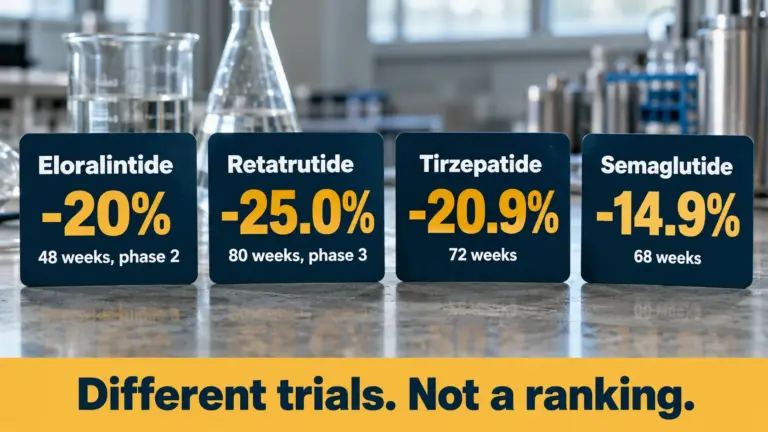
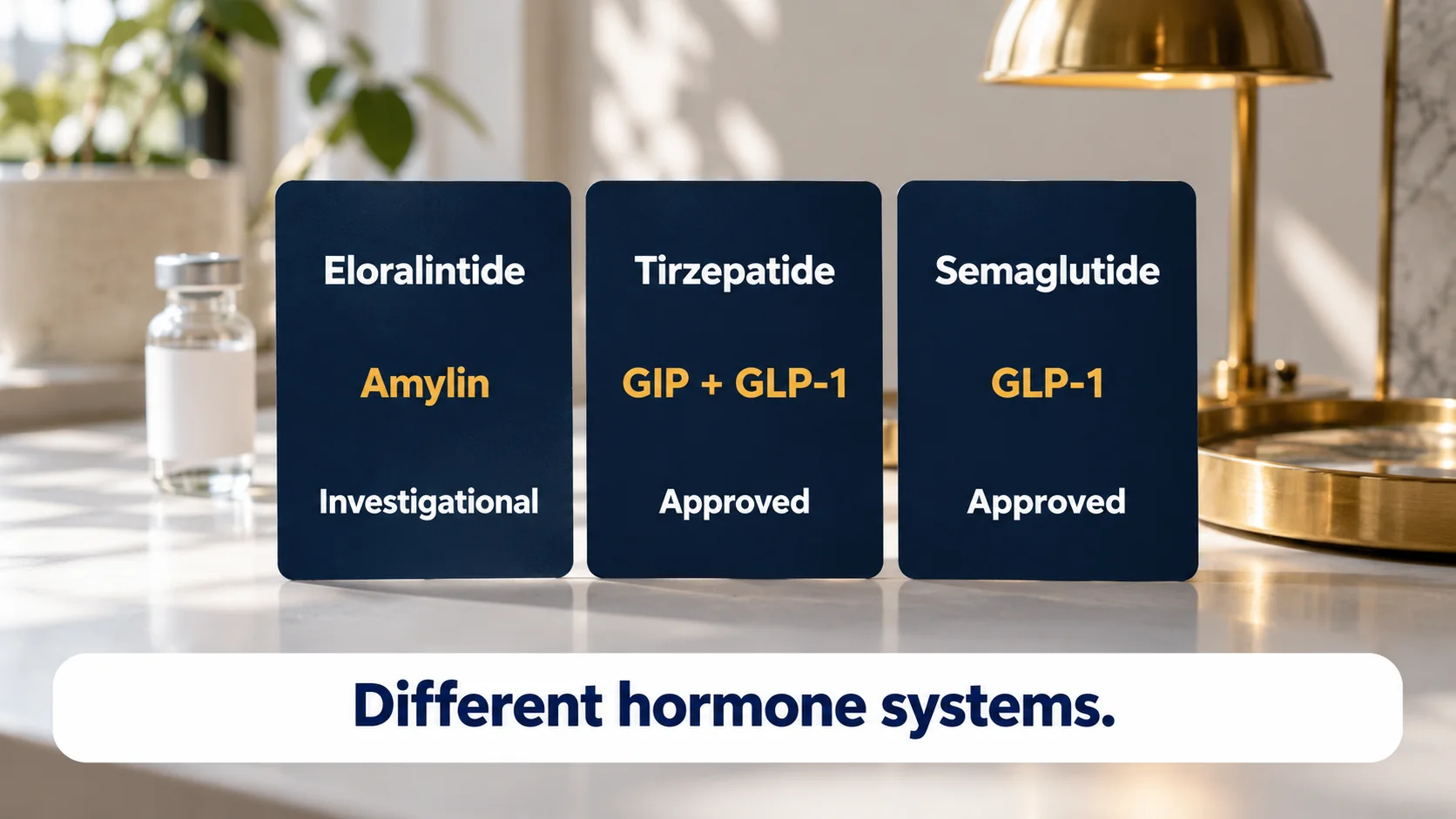
Short answer: Tirzepatide (sold as Mounjaro and Zepbound) and semaglutide (Ozempic and Wegovy) are approved drugs that work through gut hormones. Eloralintide is an investigational drug that works through amylin, a different hormone, and has not been approved. Tirzepatide reached -20.9% weight change at 72 weeks and semaglutide -14.9% at 68 weeks in their main trials, counting everyone randomized. Eloralintide reached about -20% at 48 weeks in phase 2 on treatment, and in a type 2 diabetes trial adding it to tirzepatide produced -23.3% against -14.8% for tirzepatide alone. Lilly’s trials position eloralintide as a possible add-on to these drugs and not a replacement.
Key takeaways
- Mechanism: semaglutide acts on GLP-1; tirzepatide acts on GIP and GLP-1; eloralintide acts on amylin receptors.
- Approval: Ozempic (December 2017), Wegovy (June 2021), Mounjaro (May 2022) and Zepbound (November 2023) are approved. Eloralintide is in phase 3 with no filing announced.
- The only direct comparison between two of these drugs is SURMOUNT-5 (tirzepatide -20.2% vs semaglutide -13.7% at 72 weeks, 751 adults). Eloralintide has no head-to-head trial.
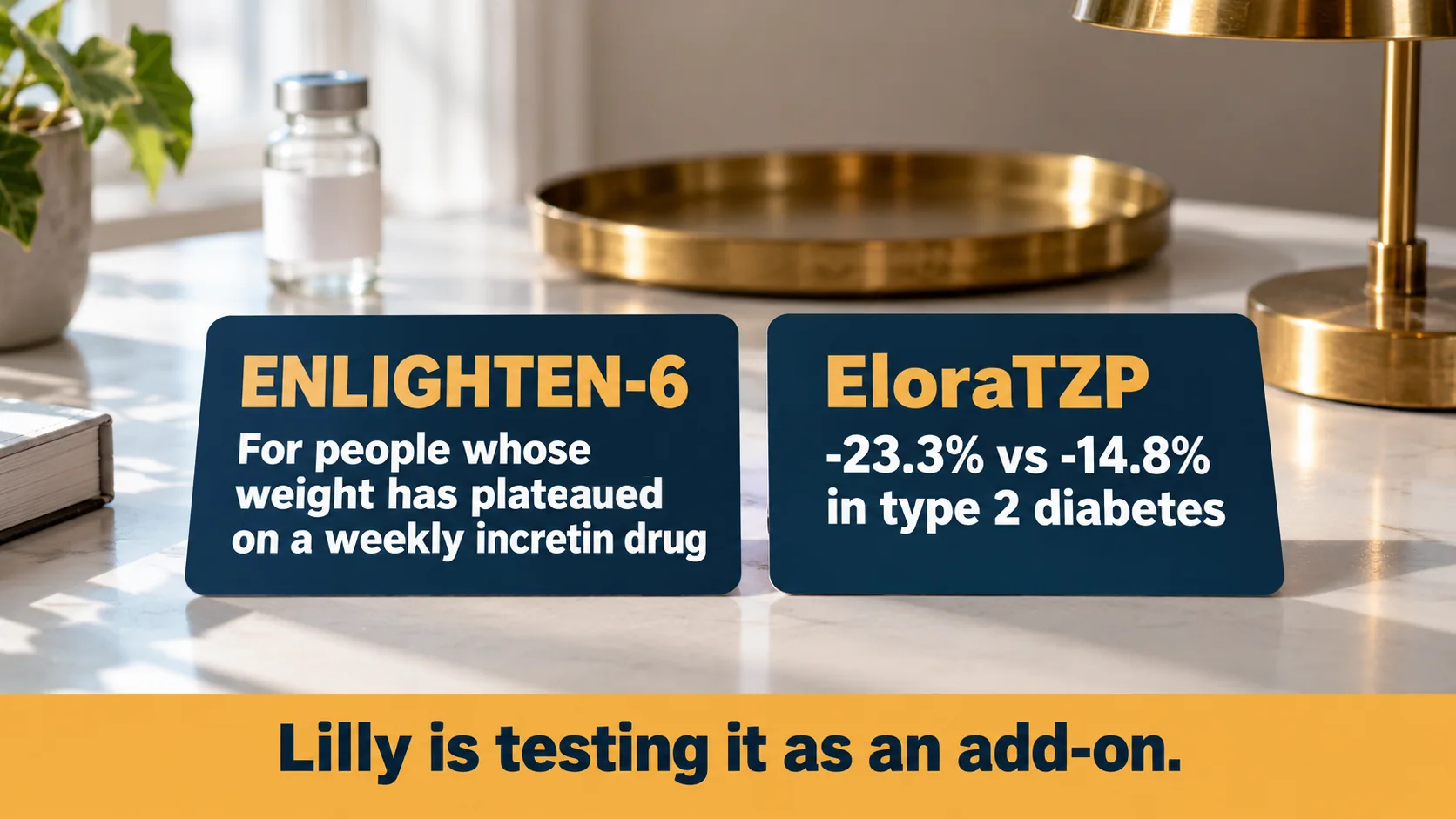
- Lilly is testing eloralintide with tirzepatide (EloraTZP) and in people whose weight has plateaued on a weekly incretin drug (ENLIGHTEN-6).
- No data exist on switching from tirzepatide or semaglutide to eloralintide, and eloralintide cannot be obtained outside a clinical trial.
Last verified October 15, 2026. Sources are listed at the end. For laboratory and research use only. Nothing here is medical or legal advice.
Contents
- The drugs and their brand names
- A different kind of drug
- Weight change in the main trials
- How many people reached each weight-loss mark
- The one head-to-head that exists
- Safety and tolerability, side by side
- Replacement or add-on? What Lilly is testing
- What no data exist for
- Availability and cost
- Common questions
The drugs and their brand names
| Drug | Brand names | Company | How it works | Approval |
|---|---|---|---|---|
| Semaglutide | Ozempic, Wegovy | Novo Nordisk | GLP-1 receptor agonist | Ozempic December 2017; Wegovy June 2021 |
| Tirzepatide | Mounjaro, Zepbound | Eli Lilly | GIP and GLP-1 receptor agonist | Mounjaro May 2022; Zepbound November 2023 |
| Eloralintide | None | Eli Lilly | Selective amylin receptor agonist | Not approved. Phase 3 |
Ozempic and Mounjaro carry diabetes labels, and Wegovy and Zepbound carry weight-management labels. Indications and warnings for each are on its prescribing information, and a clinician can explain which applies. This page compares the molecules and what the trials tested, not what to take.
A different kind of drug
Semaglutide and tirzepatide copy gut hormones released after eating. GLP-1 raises insulin release when glucose is high, slows the stomach and signals fullness. GIP, the second hormone in tirzepatide, adds effects on insulin and appetite. Eloralintide copies amylin, a pancreatic hormone released with insulin, which reviews describe as slowing stomach emptying, lowering post-meal glucagon and promoting fullness through the brain. Our mechanism guide has the detail.
Because amylin is a separate pathway, eloralintide is not a GLP-1 drug, and the side effects overlap in kind (nausea and vomiting appear with both) without being identical. Eloralintide’s phase 1b study measured a fall in pulse rate, while GLP-1 drugs are associated with a rise.
Weight change in the main trials
| Drug | Trial | Participants | Length | Mean change | Placebo | Counting |
|---|---|---|---|---|---|---|
| Semaglutide 2.4 mg | STEP 1 | 1,961 | 68 weeks | -14.9% | -2.4% | Everyone randomized |
| Tirzepatide 5, 10, 15 mg | SURMOUNT-1 | 2,539 | 72 weeks | -15.0%, -19.5%, -20.9% | -3.1% | Everyone randomized |
| Eloralintide 1 to 9 mg | Phase 2 | 263 | 48 weeks | -9% to -20% | -0.4% | On treatment |
These are regimens tested in clinical trials. They are not guidance.
In SURMOUNT-1, 57% of participants on the 15 mg dose lost 20% or more of body weight, against 3% on placebo. In STEP 1, 50.5% lost 15% or more on semaglutide, against 4.9% on placebo. Eloralintide’s phase 2 reports show more participants than placebo reaching the 5%, 10%, 15% and 20% marks, with exact percentages not in the sources I could read.
The “counting” column is the one to watch. A trial that counts everyone randomized gives a lower number than one that counts weight change on treatment. Eloralintide’s phase 3 will report both, and the all-randomized number will be lower than -20%.
How many people reached each weight-loss mark
Averages hide how many people reach a given milestone. The approved drugs’ pivotal trials report it.
| Mark reached | Semaglutide 2.4 mg (STEP 1) | Tirzepatide 5, 10, 15 mg (SURMOUNT-1) | Placebo | Eloralintide (phase 2) |
|---|---|---|---|---|
| 5% or more | 86.4% | 85%, 89%, 91% | 31.5% (STEP 1); 35% (SURMOUNT-1) | More than placebo; exact figures not in the sources I could read |
| 10% or more | 69.1% | Not in the abstract | 12.0% (STEP 1) | Same |
| 15% or more | 50.5% | Not in the abstract | 4.9% (STEP 1) | Same |
| 20% or more | Not in the abstract | 50% (10 mg), 57% (15 mg) | 3% (SURMOUNT-1) | Same |
The eloralintide column is empty for a reason: the Lancet abstract and the coverage I could read say that more participants than placebo reached the 5%, 10%, 15% and 20% marks and that the 9 mg groups were most likely to reach 25% or 30%, but give no percentages. Until they are published, any claim about “how many people lose 20% on eloralintide” is a guess. These threshold figures are the most useful numbers for comparing eloralintide with the approved drugs once they appear, and they will be reported for the phase 3 studies.
The one head-to-head that exists
SURMOUNT-5, published in the New England Journal of Medicine in 2025, randomized 751 adults to tirzepatide or semaglutide for 72 weeks. Mean weight change was -20.2% with tirzepatide and -13.7% with semaglutide (P<0.001), and waist circumference fell 18.4 cm against 13.0 cm. Gastrointestinal events were the most common adverse events in both groups, mostly mild to moderate and during dose escalation. It is the strongest piece of comparative evidence in this field, and nothing like it exists for eloralintide.
Safety and tolerability, side by side
| Drug | Most common adverse events | Stopped treatment because of an adverse event |
|---|---|---|
| Semaglutide 2.4 mg (STEP 1) | Nausea and diarrhoea, transient, mild to moderate | Gastrointestinal discontinuation 4.5% vs 0.8% on placebo |
| Tirzepatide (SURMOUNT-1) | Gastrointestinal, mostly during escalation | 4.3% (5 mg), 7.1% (10 mg), 6.2% (15 mg) vs 2.6% on placebo |
| Eloralintide (phase 2) | Nausea (11% to 64% by arm), fatigue (0% to 46%) | About 10% overall |
| Eloralintide with tirzepatide (phase 2b) | Gastrointestinal, mostly during escalation | 10.8% to 27.0% in combination arms vs 2.9% on tirzepatide alone |
The approved drugs have large, long trials and years of real-world use behind their safety profiles. Eloralintide’s record covers up to 48 weeks in a few hundred people. Its tolerability depended heavily on how fast the dose rose, and its discontinuation rate in phase 2 sat above the approved drugs’ pivotal-trial rates, though phase 2 arms are small and the comparison is rough. See the eloralintide side effects guide.
Replacement or add-on? What Lilly is testing
Lilly’s trial designs show how it thinks the drugs fit together.
- EloraTZP. In a 48-week trial of 367 adults with type 2 diabetes, the highest eloralintide plus tirzepatide combination averaged -23.3% against -14.8% on tirzepatide 15 mg alone. Between 10.8% and 27.0% of combination participants stopped treatment for adverse events, and Lilly plans a phase 3 co-formulation by the end of 2026. See our EloraTZP guide.
- ENLIGHTEN-6. A 900-person phase 3 study of eloralintide in people with persistent obesity despite a weekly incretin drug, with or without type 2 diabetes. It is the first direct test of an add-on strategy for people whose weight has plateaued.
- ENLIGHTEN-1 and -2. Single-agent phase 3 studies in people with and without type 2 diabetes. If they succeed, eloralintide could also be a stand-alone option.
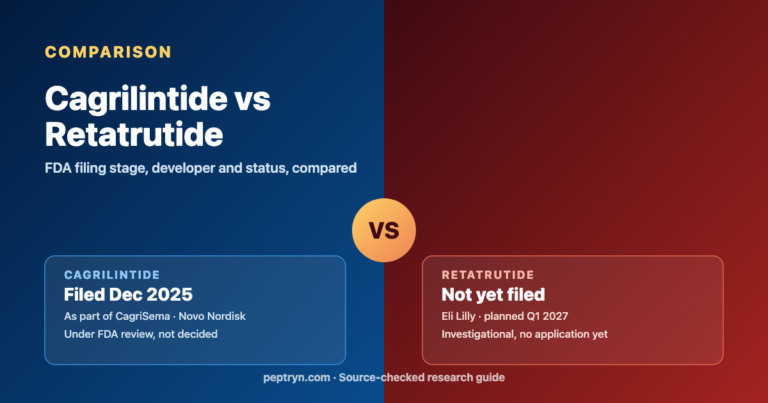
Novo Nordisk is following a parallel path with cagrilintide plus semaglutide (CagriSema), which is under FDA review. In February 2026 its trial against tirzepatide 15 mg (REDEFINE 4) did not meet non-inferiority: -20.2% vs -23.6% at 84 weeks for everyone randomized. See eloralintide vs cagrilintide.
What no data exist for
- Switching. No trial has switched people from semaglutide or tirzepatide to eloralintide, or the reverse, outside the ENLIGHTEN-6 add-on design.
- Eloralintide on top of semaglutide. Lilly’s combination data are with tirzepatide, and ENLIGHTEN-6 covers “a weekly incretin” without naming which.
- Real-world use. Approved drugs have extensive registry and post-marketing data. Eloralintide has none.
- Long-term outcomes. Semaglutide and tirzepatide have trial data on cardiovascular and other outcomes in specific groups. No amylin agonist has been tested in a cardiovascular outcomes trial.
- Cost and coverage. Eloralintide has no price, and its insurance status would be decided only after approval.
Availability and cost
Semaglutide and tirzepatide are available by prescription, with prices that vary by product, dose, insurer and cash-pay program. We do not quote a price because the figures change and depend on how a patient buys them. Our retatrutide vs tirzepatide guide sets out the figures we verified for that comparison.
Eloralintide has no approved price and no lawful retail source. Websites list it as a research chemical at widely varying prices (see eloralintide price), but a research label does not show what is in a vial or make a product lawful for human use. Lilly sued six sellers of unapproved retatrutide in August 2026, and the FDA sent warning letters to research-use-only vendors.
Common questions
Is eloralintide better than tirzepatide?
Not shown. Tirzepatide is approved and reached -20.9% at 72 weeks (15 mg) counting everyone randomized. Eloralintide’s best phase 2 arms reached about -20% at 48 weeks on treatment. No head-to-head trial exists. In type 2 diabetes, adding eloralintide to tirzepatide 15 mg produced -23.3% against -14.8% for tirzepatide alone.
Is eloralintide better than semaglutide?
No head-to-head trial exists. Semaglutide 2.4 mg averaged -14.9% at 68 weeks in STEP 1 and eloralintide’s phase 2 arms averaged -9% to -20% at 48 weeks on treatment. A 2026 network meta-analysis put high-dose eloralintide about 6.6 points ahead of semaglutide against placebo and called the result preliminary.
Is eloralintide the same as Mounjaro or Zepbound?
No. Mounjaro and Zepbound contain tirzepatide, which acts on GIP and GLP-1 receptors. Eloralintide acts on amylin receptors and is investigational.
Is eloralintide the same as Ozempic or Wegovy?
No. Ozempic and Wegovy contain semaglutide, a GLP-1 receptor agonist. Eloralintide is an amylin analogue.
Can you take eloralintide with tirzepatide?
Only in Lilly’s clinical trials, such as the EloraTZP phase 2b study, which gave the two drugs as separate injections under supervision. Peptryn cannot advise on combining them.
Will eloralintide replace Zepbound?
Nothing suggests so. Lilly’s program tests eloralintide as a stand-alone drug, as a partner for tirzepatide and as an add-on for people who plateau on an incretin drug.
Does eloralintide cause fewer side effects than Ozempic?
The data cannot say. Eloralintide’s phase 2 reported nausea in 11% to 64% of participants by arm, and about 10% stopped treatment. The approved drugs report nausea and diarrhoea as most common, with discontinuation of about 4% to 7% in their pivotal trials. Dose escalation speed changes every figure.
Can I switch from semaglutide or tirzepatide to eloralintide?
There are no switching data and no lawful way to obtain eloralintide outside a trial. A prescriber is the right person for any question about changing a medicine.
How do eloralintide and Ozempic differ in mechanism?
Ozempic’s semaglutide activates the GLP-1 receptor. Eloralintide activates amylin receptors. Both can slow stomach emptying and both can cause nausea.
When will eloralintide be approved?
Phase 3 studies have estimated primary completion dates in 2028, so a decision is unlikely before 2029. See the approval status guide.
Related: What is eloralintide? · Eloralintide vs retatrutide · EloraTZP · Eloralintide approval status · Retatrutide vs semaglutide vs tirzepatide · Peptides for metabolic research · All eloralintide guides
Sources
All pages read October 14 to 15, 2026.
- Wilding JPH, et al. Once-weekly semaglutide in adults with overweight or obesity (STEP 1). New England Journal of Medicine 2021; PubMed 33567185.
- Jastreboff AM, et al. Tirzepatide once weekly for the treatment of obesity (SURMOUNT-1). New England Journal of Medicine 2022; PubMed 35658024.
- Aronne LJ, et al. Tirzepatide as compared with semaglutide for the treatment of obesity (SURMOUNT-5). New England Journal of Medicine 2025; PubMed 40353578.
- Billings LK, et al. Eloralintide phase 2. The Lancet 2025; DOI 10.1016/S0140-6736(25)02155-5.
- Bhattachar S, et al. Eloralintide phase 1 proof of concept. Diabetes, Obesity and Metabolism 2026; PMC12992164.
- Eli Lilly. EloraTZP phase 2b release, September 30, 2026: PR Newswire.
- ClinicalTrials.gov: NCT07392190 (ENLIGHTEN-6), NCT07321886, NCT07282600, retrieved October 15, 2026.
- Novel amylin-based therapies for weight management: a network meta-analysis. Endocrinology, Diabetes and Metabolism 2026; PMC13240113.
- REDEFINE 4: Drug Topics, February 24, 2026.
- Peptryn. Is retatrutide FDA approved? (approval dates of Ozempic, Wegovy, Mounjaro and Zepbound).
- NPR. Eli Lilly files six lawsuits against sellers of unapproved retatrutide, August 13, 2026: npr.org.
Editorial note: Peptryn sells research materials for laboratory use only. This guide is informational and is not medical advice. To report an error, use the contact page.
All products on peptryn.com are intended for laboratory research purposes only. They are not drugs, foods, dietary supplements or cosmetics, and they are not for human consumption, self-administration, or veterinary use. You must be 21 or older to buy. The information on this page has not been evaluated by the U.S. Food and Drug Administration and is not intended to diagnose, treat, cure, or prevent any disease.