What Is Eloralintide? Lilly’s Once-Weekly Amylin Drug, Trial Results and Status (2026)
Research use only. This guide is education, not medical advice. Eloralintide is an investigational drug that no regulator has approved for any use. Nothing here is a dosing recommendation or an instruction for self-administration, and Peptryn gives none. Trial figures describe what Eli Lilly’s studies reported for Lilly’s own formulation under medical supervision.
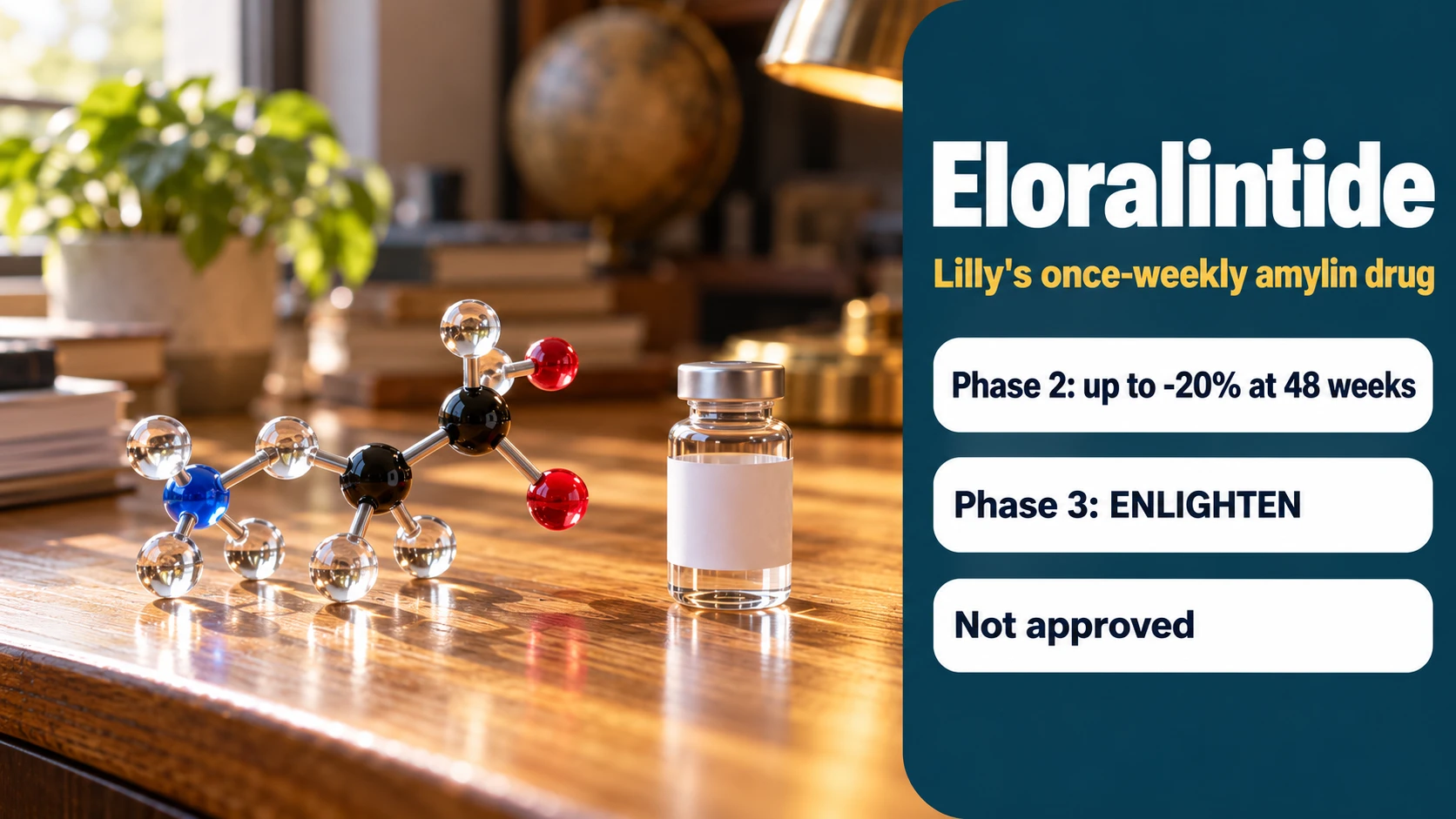
Short answer: Eloralintide (code LY3841136) is an experimental, once-weekly amylin receptor agonist developed by Eli Lilly for obesity. It is a lipidated 37-amino-acid peptide, about 4,526 Da, designed to act on the amylin pathway and not on GLP-1. In a 48-week phase 2 trial of 263 adults without diabetes, average weight change reached -20% on the highest-dose arms against -0.4% on placebo. Phase 3 (the ENLIGHTEN program) is enrolling, and no regulator has approved eloralintide.
Key takeaways
- Eloralintide is an amylin analogue. It is not a GLP-1 drug, not a GIP drug and not a glucagon drug.
- Phase 2 (Lancet, November 2025): -9% to -20% mean weight change at 48 weeks across dose arms, versus -0.4% on placebo. The two highest fixed-dose arms and the 6-9 mg escalation arm each averaged -20%.
- Nausea and fatigue were the most common adverse events, and both rose with dose and with a faster start. Slower escalation reduced them.
- Five phase 3 ENLIGHTEN studies are registered, with estimated primary completion between January and June 2028. I found no announced regulatory filing as of October 15, 2026.
- On September 30, 2026, Lilly reported that eloralintide plus tirzepatide (EloraTZP) reached -23.3% at 48 weeks in adults with obesity and type 2 diabetes, against -14.8% for tirzepatide 15 mg alone.
- Every efficacy number so far comes from phase 2 or earlier. They are early results, and cross-trial comparisons with approved drugs are unreliable.
Last verified October 15, 2026. Trial registries and company news change often. Sources are listed at the end, and the methods note below explains how we checked them. For laboratory and research use only. Nothing here is medical or legal advice.
Contents
- Eloralintide at a glance
- Where eloralintide came from: a timeline
- What amylin is and what an amylin agonist does
- How eloralintide is built
- Is eloralintide a GLP-1 drug?
- Phase 1 results
- Phase 2 results in The Lancet
- Safety and tolerability in one section
- Eloralintide plus tirzepatide: EloraTZP
- The phase 3 ENLIGHTEN program
- What eloralintide has not shown
- Is eloralintide approved, and who can get it?
- Eloralintide in the research-peptide market
- Glossary
- All eloralintide guides
- Common questions
Eloralintide at a glance
| Item | Detail |
|---|---|
| Name | Eloralintide (USAN). Lilly code LY3841136 |
| Developer | Eli Lilly and Company |
| Class | Selective, long-acting amylin receptor agonist |
| Route and schedule in trials | Once-weekly subcutaneous injection |
| Structure | Synthetic 37-amino-acid analogue of human amylin with a C20 fatty diacid on lysine 26 |
| Formula and mass | C201H319N49O65S2, about 4,526 Da |
| CAS number | 2883634-40-8 |
| Half-life in humans | About 13 to 15 days (310 to 366 hours after a single dose) |
| Largest trial reported | Phase 2, 263 adults, 48 weeks (The Lancet, 2025) |
| Best phase 2 result | -20% mean weight change at 48 weeks (efficacy estimand) against -0.4% on placebo |
| Late-stage status | Phase 3 ENLIGHTEN program recruiting since December 2025 |
| Approval | None. No marketing authorization anywhere |
Where eloralintide came from: a timeline
| Date | Event |
|---|---|
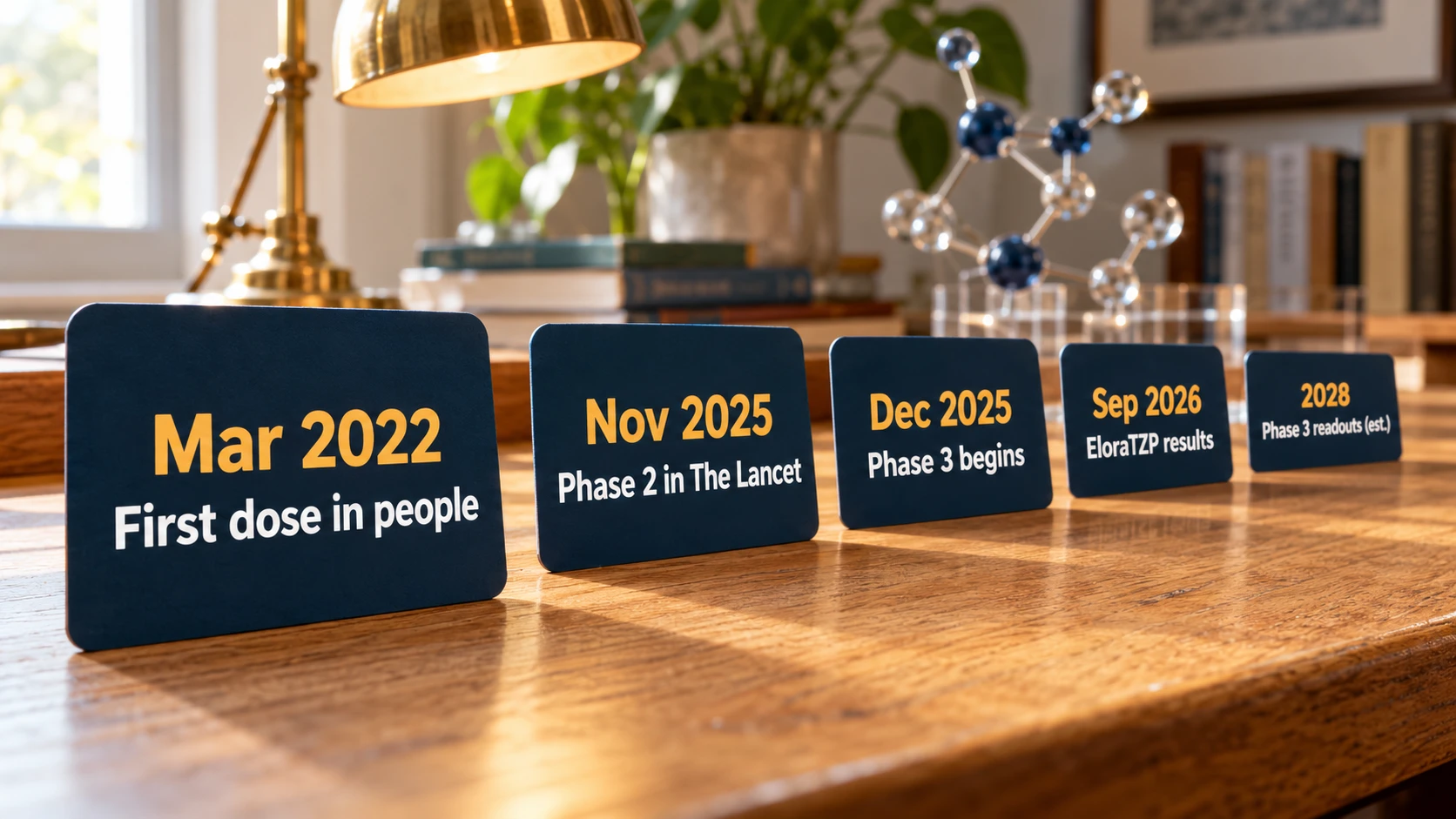
| March 2022 | First-in-human study starts (NCT05295940, 148 participants): a single-ascending-dose part in healthy adults and a multiple-ascending-dose part in adults with obesity or overweight |
| January 2024 | Phase 1 enrollment ends. Phase 1 data are later published in Molecular Metabolism (2025) and Diabetes, Obesity and Metabolism (2026) |
| February 2024 | Phase 2 starts (NCT06230523): 263 adults, 46 US sites |
| June 2025 | Phase 1b data shown as a poster at the American Diabetes Association Scientific Sessions |
| August 14, 2025 | Phase 2 trial completes |
| November 6, 2025 | Lilly announces phase 2 results, and The Lancet publishes them |
| December 15, 2025 | First phase 3 study (ENLIGHTEN-2, in type 2 diabetes) starts |
| February 2026 | Four more phase 3 studies start: ENLIGHTEN-1, -3, -4 and -6 |
| September 30, 2026 | Lilly presents EloraTZP phase 2b results at EASD in Milan and says it plans phase 3 of a co-formulation |
| 2028 | Estimated primary completion of the phase 3 studies (January to June) |
The program moved from first-in-human dosing to five phase 3 studies in under four years. That is quick, and it reflects how much money the obesity field is putting behind next-generation drugs. It also means most of the safety record is short.
What amylin is and what an amylin agonist does
Amylin is a hormone made by the beta cells of the pancreas and released together with insulin after a meal. Reviews of the physiology describe three main effects: it slows gastric emptying, it suppresses the release of glucagon after eating, and it promotes satiation through the brain (Pharmacological Research, 2026). The brain effect is the reason amylin became a weight-management target.
Human amylin is a poor drug. It clumps into fibrils (it is the main component of the amyloid deposits found in the pancreas in type 2 diabetes) and it does not last long in the blood. Pramlintide, a modified rat-sequence version that does not clump, was approved in 2005 for people with diabetes who use mealtime insulin. Its short action meant it was given around meals. Newer analogues try to keep the effect and fix both problems: they resist aggregation and last for days.
An amylin receptor is a pairing of the calcitonin receptor (CTR) with one of three helper proteins called RAMPs. The combinations are named AMY1R, AMY2R and AMY3R. Calcitonin itself acts on CTR alone, so a drug that hits the CTR without a RAMP can produce calcitonin-type effects. Drug designers talk about “selective” amylin agonists for that reason: they try to favour the AMY receptors and avoid plain CTR activity.
Two classes of long-acting amylin drug are now in development:
- Dual amylin and calcitonin receptor agonists (DACRAs) such as cagrilintide and petrelintide, which activate several AMY receptors and the CTR.
- Selective amylin receptor agonists (SARAs) such as eloralintide, which are built to favour AMY1R and to be weaker at the CTR.
Whether the selectivity matters in people is still an open question. The animal data suggest it might affect tolerability. The human data are too early to settle it. Our cagrilintide guide covers the other class, and the eloralintide vs cagrilintide comparison sets them side by side.
How eloralintide is built
The structure comes from the discovery paper by Briere and colleagues in Molecular Metabolism (2025). Eloralintide is a synthetic 37-amino-acid peptide based on amylin. Four design choices stand out:
- Three non-coded amino acids at positions 11, 15 and 22, which are not among the 20 standard amino acids. Reviews classify eloralintide as a non-clumping amylin analogue, unlike natural amylin.
- A methylene thioacetal bridge replaces the native disulfide bond. The authors say this improves chemical stability.
- A C20 fatty diacid attached through a linker to the lysine at position 26. It binds albumin in the blood, which acts as a depot and stretches the half-life to about two weeks. Semaglutide and cagrilintide use the same general strategy with different lipid chains.
- An amidated C-terminus and L-amino acids only, which is standard for peptide drugs.
In cell assays the human AMY1R responded to eloralintide at 23.9 picomolar, against 291.0 picomolar for the CTR (about 12 times weaker) and 253.8 for AMY3R (about 11 times weaker). The authors describe it as AMY1R-selective in human assays. In rat assays both AMY1R and AMY3R responded strongly.
Two animal findings are worth knowing, because they explain why the molecule was advanced:
- In a taste-avoidance test in lean rats, which is a common way to estimate nausea-like effects, eloralintide caused less avoidance than cagrilintide at matched doses (ED50 8.9 versus 4.2 nmol/kg).
- In obese rats, the reduction in body weight came mostly from fat (86% to 91% of the lost mass at the low and middle doses, against 63% for cagrilintide at its test dose), and lean mass loss was lower than with cagrilintide.
Rat data do not carry over to people automatically. Both findings are reasons for hope and not results.
Half-life. After a single dose in healthy adults, the terminal half-life averaged 310 to 366 hours (12.9 to 15.3 days). In the 12-week study it was about 14 days. For comparison, cagrilintide’s reported half-life is 159 to 195 hours, or about 6.6 to 8.1 days. A longer half-life supports once-weekly dosing and may allow wider spacing, but no trial has tested a monthly schedule.
Is eloralintide a GLP-1 drug?
No. Eloralintide does not activate the GLP-1 receptor. It acts on the amylin pathway, which is a separate hormone system from the incretin hormones (GLP-1 and GIP) used by semaglutide, tirzepatide and retatrutide. Google’s own “People also ask” box shows this question under searches for the drug.
The difference matters for two reasons. First, the side-effect profile of an amylin drug overlaps with GLP-1 drugs (nausea and vomiting are common to both) but is not identical. Second, the two classes can be combined. Lilly is testing eloralintide with tirzepatide, and Novo Nordisk is testing cagrilintide with semaglutide (CagriSema). The reason to combine is that two different appetite pathways might add up.
Phase 1 results
Two phase 1 programs have been published.
Single ascending dose (healthy adults, NCT05295940). Forty-eight people received one dose between 0.04 and 12 mg or placebo. Most adverse events were mild, there were no serious events, and two people had four gastrointestinal events between them, including one moderate vomiting episode at 12 mg. Four weeks after a single dose, body weight was 2.5% lower than placebo at 4 mg and 4.4% lower at 12 mg.
Multiple ascending dose (adults with obesity, Bhattachar and colleagues, 2026). One hundred participants received weekly doses for 12 weeks without escalation. At week 12 the average weight change was -2.6% at the lowest dose, -8.9% at 3 mg, -8.5% at 6 mg and -11.3% at 12 mg, against +0.2% on placebo. The most common adverse events were decreased appetite (19.2%), headache (12.3%), fatigue (11.0%), diarrhoea (9.6%), injection site reactions (9.6%) and nausea (8.2%). Vomiting affected 4.1%. Four participants had mood-related events (three depressed mood, one persistent depressive disorder), all at 6 mg or 12 mg, and the three at 12 mg stopped treatment. Those events resolved within two to four days. The numbers are small, but they are part of the record and our side effects guide covers them.
Phase 2 results in The Lancet
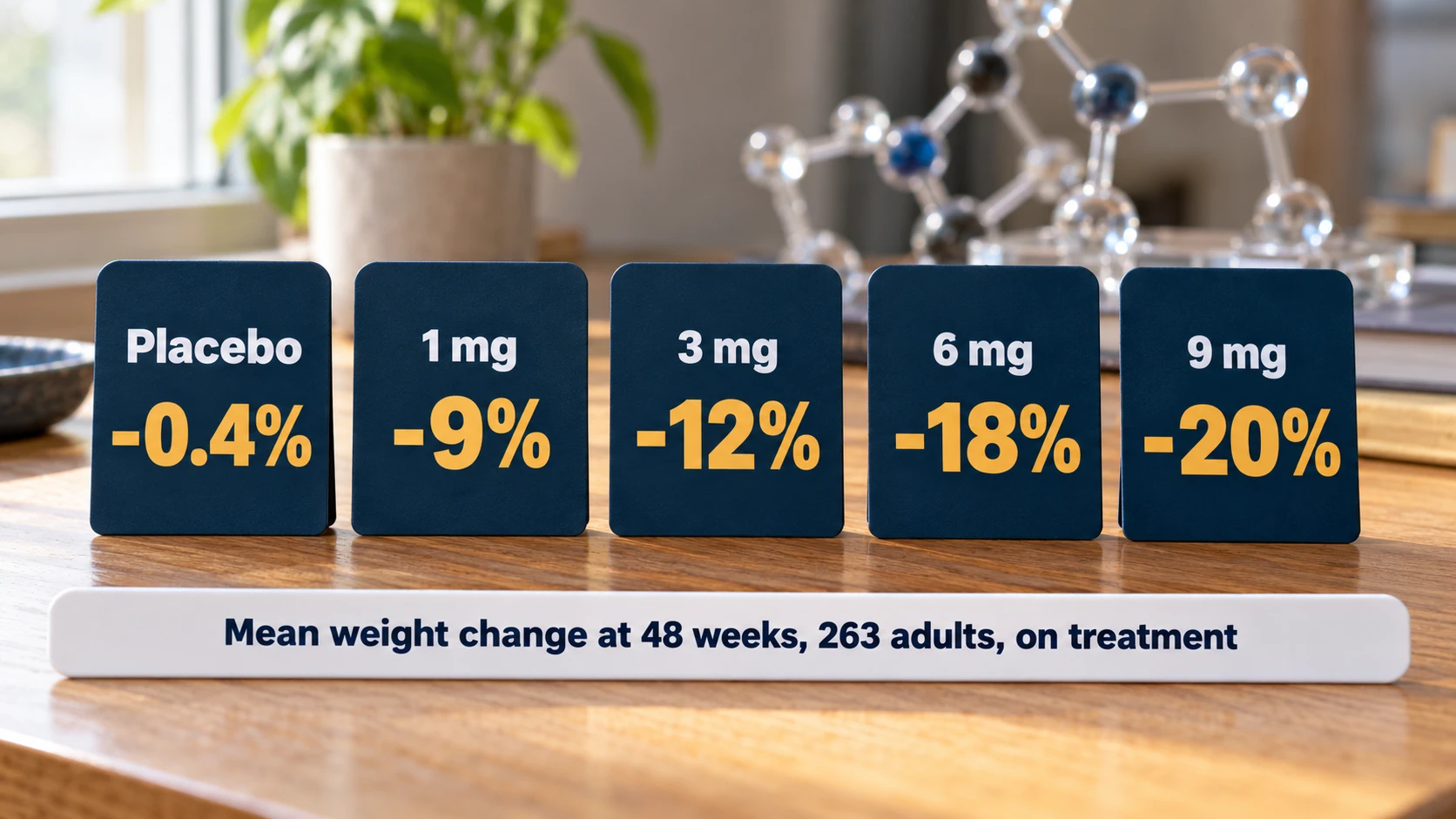
The main evidence for eloralintide is a single trial. Billings and colleagues published it in The Lancet on November 6, 2025 (NCT06230523). It enrolled 263 adults at 46 US sites. They were 18 to 75 years old, with a BMI of 30 or more, or 27 or more with a weight-related condition, and none had type 2 diabetes. The average participant was 49 years old, weighed 109.1 kg, had a BMI of 39.1, and 78% were women. Participants received once-weekly injections of placebo or eloralintide for 48 weeks.
| Arm | Participants | Mean weight change at 48 weeks (efficacy estimand) | 95% CI |
|---|---|---|---|
| Placebo | 53 | -0.4% | -2.2 to 1.4 |
| 1 mg weekly | 28 | -9% | -12.6 to -6.3 |
| 3 mg weekly | 24 | -12% | -14.9 to -9.8 |
| 6 mg weekly | 28 | -18% | -20.7 to -14.5 |
| 9 mg weekly | 54 | -20% | -22.7 to -17.5 |
| Escalation 6 to 9 mg | 24 | -20% | -22.7 to -17.0 |
| Escalation 3 to 9 mg | 52 | -16% | -18.6 to -14.1 |
These are the regimens Lilly tested in a clinical trial. They are not guidance, and no dose has been established for any use.
Lilly’s release gave the range as 9.5% to 20.1% on eloralintide against 0.4% on placebo. Secondary reports add that the best arms lost up to 21.3 kg, with waist circumference down by up to 17.1 cm.
Three things shape how to read this table.
- The estimand. The “efficacy estimand” counts weight change while people were still taking the drug. The primary results of the big approved-drug trials (STEP 1, SURMOUNT-1) use the “treatment-regimen” estimand, which counts everyone who was randomized, including people who stopped. The two give different numbers for the same trial, with the treatment-regimen number lower. Eloralintide’s headline figures are on-treatment numbers, so putting them next to a treatment-regimen number overstates the gap.
- The arm sizes. The fixed-dose arms with 24 to 28 people have wide confidence intervals. The 9 mg arm (54 people) and the 3 to 9 mg escalation arm (52) are the most precise.
- The shape of the curve. Weight change rose from 9% to 20% as the weekly dose rose from 1 mg to 9 mg, but the 6 to 9 mg escalation arm matched the 9 mg arm, and the arm that started low (3 to 9 mg) lost less (16%). That is consistent with less time at the top dose, although the trial was not designed to prove it.
Lilly’s Kenneth Custer described the potential for strong efficacy with improved tolerability, and lead author Liana Billings of Endeavor Health said the data suggest a promising tolerability profile without a cost to efficacy. Both are fair readings of an early trial, and both depend on what phase 3 shows. A Medscape report on the trial quoted a commentator who called the discontinuation rate in the higher-dose arms higher than usual for studies of this type.
Safety and tolerability in one section
The most common adverse events in phase 2 were nausea and fatigue.
| Arm | Nausea | Fatigue |
|---|---|---|
| 1 mg | 11% | 0% |
| 3 mg | 13% | 13% |
| 6 mg | 64% | 29% |
| 9 mg | 33% | 43% |
| Escalation 6 to 9 mg | 54% | 46% |
| Escalation 3 to 9 mg | 25% | 21% |
| Placebo | 14% | 12% |
Two patterns stand out. First, the rates did not rise in a straight line with dose: the 6 mg arm had the highest nausea (64%), more than the 9 mg arm (33%). That is a small-arm effect plus the effect of starting speed, and the trial authors found that starting at 3 mg and escalating reduced stomach symptoms and fatigue compared with starting at 6 or 9 mg. Second, the low doses (1 mg and 3 mg) looked like placebo for nausea.
Secondary reports of the Lancet paper list any adverse event in 81% on eloralintide versus 71% on placebo, 14 serious events overall with none judged treatment-related by investigators and sponsor, and no pancreatitis, gallbladder inflammation or deaths. About 10% of participants stopped treatment because of an adverse event overall, and one report puts the 6 mg arm at 21% against 8% on placebo. Because I could not read the full paper, exact per-arm tables are not reproduced here. Our eloralintide side effects page lists every figure with its source.
Eloralintide plus tirzepatide: EloraTZP
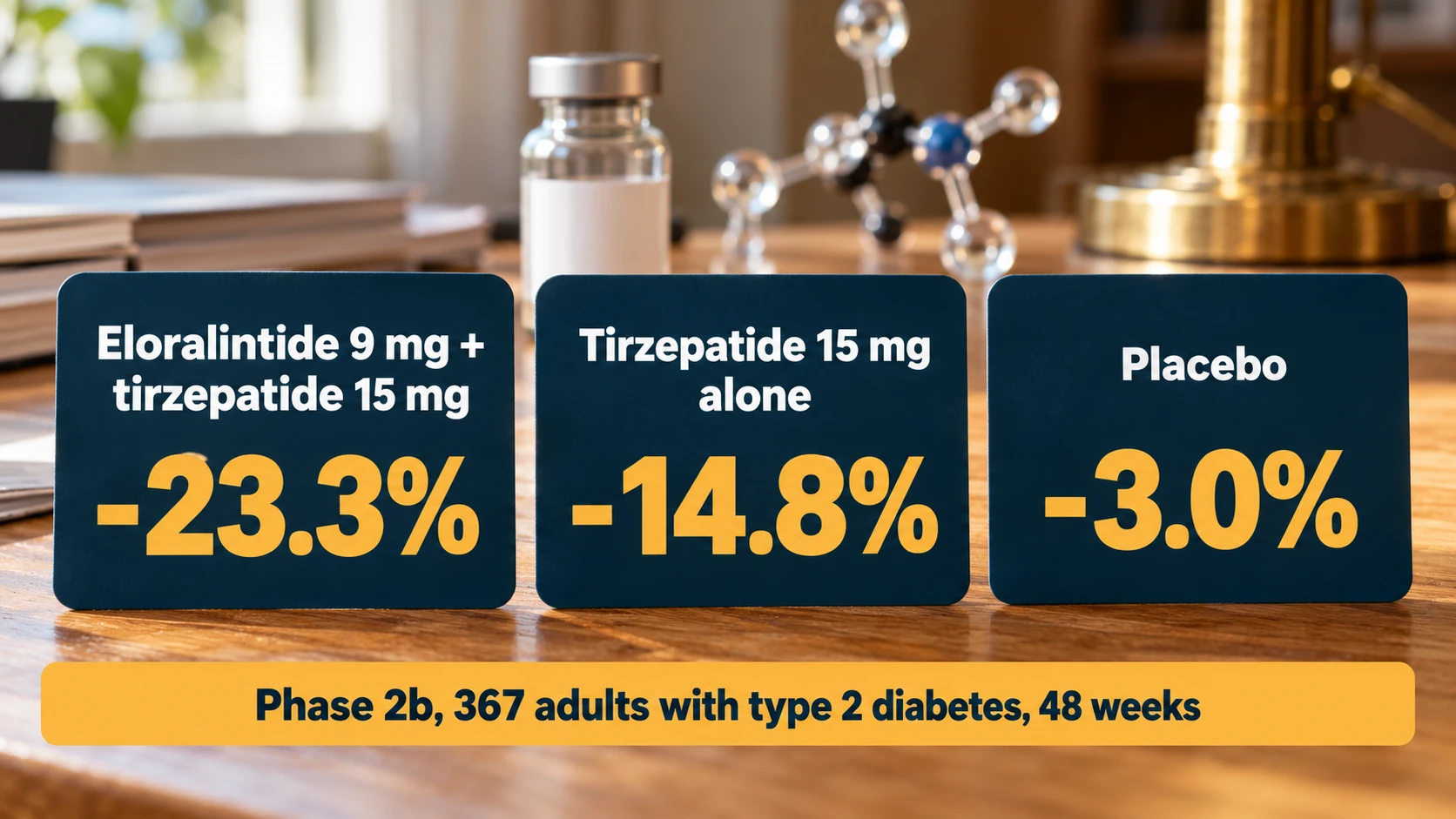
On September 30, 2026, Lilly presented phase 2b results of eloralintide combined with tirzepatide, which it calls EloraTZP, at the European Association for the Study of Diabetes meeting in Milan. The trial (NCT06603571) enrolled 367 adults with obesity or overweight and type 2 diabetes in the US and Argentina, with a baseline weight of 105.4 kg and HbA1c of 8.1%. Participants got the two drugs as separate injections for 48 weeks.
| Arm | Weight change | HbA1c change |
|---|---|---|
| Eloralintide 3 mg + tirzepatide 5 mg | -13.2% | -2.2 points |
| Eloralintide 6 mg + tirzepatide 5 mg | -19.4% | -2.7 points |
| Eloralintide 6 mg + tirzepatide 10 mg | -19.9% | -2.6 points |
| Eloralintide 9 mg + tirzepatide 15 mg | -23.3% | -2.9 points |
| Tirzepatide 15 mg alone | -14.8% | -2.4 points |
| Eloralintide 9 mg alone | -11.1% | -1.3 points |
| Placebo | -3.0% | -0.3 points |
The highest combination beat tirzepatide alone by 8.5 percentage points on average. In this trial, eloralintide alone (-8.2% to -12.3% across its three dose arms) did less than it did in the non-diabetes phase 2 trial, which is common: weight change is usually smaller in people with type 2 diabetes.
The cost showed up in tolerability. Treatment stopped because of adverse events in 10.8% to 27.0% of participants in the combination arms, against 0% to 10.8% on eloralintide alone, 2.9% on tirzepatide and 16.7% on placebo. Lilly said the stomach side effects were mostly mild or moderate and clustered during dose escalation. Coverage of the presentation quotes the lead author cautioning that the combination arms had fewer than 100 people each. Our approval status page covers what Lilly says comes next.
The phase 3 ENLIGHTEN program
Five phase 3 studies are registered on ClinicalTrials.gov. All are randomized, double-blind and placebo-controlled, with once-weekly dosing, and all take percent change in body weight as the primary outcome.
| Study | Population | Planned size | Started | Estimated primary completion |
|---|---|---|---|---|
| ENLIGHTEN-1 (NCT07321886) | Obesity or overweight, no type 2 diabetes | 1,980 | February 2026 | March 2028 |
| ENLIGHTEN-2 (NCT07282600) | Obesity or overweight with type 2 diabetes | 1,035 | December 2025 | January 2028 |
| ENLIGHTEN-3 (NCT07369011) | Obesity with moderate to severe obstructive sleep apnea | 800 | February 2026 | March 2028 |
| ENLIGHTEN-4 (NCT07353931) | Obesity with knee osteoarthritis pain | 900 | February 2026 | March 2028 |
| ENLIGHTEN-6 (NCT07392190) | Persistent obesity despite a weekly incretin drug | 900 | February 2026 | June 2028 |
ENLIGHTEN-3 adds the apnea-hypopnea index as an endpoint, and ENLIGHTEN-4 adds the WOMAC knee pain score. ENLIGHTEN-6 tests eloralintide as an add-on in people whose weight has plateaued on a drug such as semaglutide or tirzepatide. That is where an amylin drug might fit most easily in practice. The long-term study (ENLIGHTEN-1) runs to a study completion date of July 2030. I found no ENLIGHTEN-5 record.
What eloralintide has not shown
An honest summary of the evidence has a long list of gaps:
- No phase 3 data. Everything above is phase 2 or earlier. Drugs routinely look worse in larger, longer trials.
- No outcomes data. No trial has tested whether eloralintide changes heart attacks, strokes, kidney disease or survival. Weight is a surrogate.
- No head-to-head trials. There is no trial of eloralintide against cagrilintide, semaglutide, tirzepatide or retatrutide. Every comparison online is a cross-trial comparison.
- A narrow phase 2 population. The 263 participants were all treated in the US, and 78% were women and 78% were White.
- Body composition. Rat data suggest most of the loss is fat. I found no published human data on lean mass.
- Long-term safety. The longest exposure published is 48 weeks. Rare events, bone and mood effects, immune responses to the drug and effects of stopping are all unknown.
- Weight regain. No eloralintide data show what happens after stopping.
- Manufacturing and quality. A lipidated peptide is harder to make consistently than a small molecule, and filing for approval requires that evidence too.
Is eloralintide approved, and who can get it?
Eloralintide is not approved by the FDA, the European Medicines Agency or any other regulator. I found no announced regulatory submission as of October 15, 2026. The only legal route to the drug is enrollment in one of Lilly’s clinical trials, which are listed on ClinicalTrials.gov and on Lilly’s trial site.
The phase 3 studies have primary completion dates between January and June 2028. After that, Lilly would need to analyze the data, file an application and wait for a review that the FDA aims to finish within about 10 to 12 months for a new molecular entity. That puts the earliest realistic approval date after 2028, and likely in 2029. That date is an inference from public schedules and not a company statement. The approval status guide works through the timeline.
Eloralintide in the research-peptide market
Unapproved peptides from Lilly’s pipeline show up in the research-chemical market soon after their trial data appear, and eloralintide has followed that pattern: search results in October 2026 include vendor listings for a “10 mg” eloralintide vial. A research label does not make a vial legal for human use, and it does not prove what is in the vial.
Regulators have started to push back on the closest parallel. In August 2026 Lilly sued six US sellers over unapproved retatrutide and told authorities about more than 200 others, and the FDA sent warning letters to vendors selling retatrutide labeled “research use only.” I found no lawsuit or warning letter that names eloralintide as of October 15. The pattern is still worth knowing. Our guide on how to evaluate an eloralintide research listing and its certificate sets out what a lab would have to show before a vial could be treated as a verified research material, and our third-party tested peptides guide explains what each testing claim does and does not prove.
Glossary
| Term | Meaning |
|---|---|
| Amylin | A pancreatic hormone released with insulin that slows gastric emptying, reduces glucagon and promotes satiety |
| AMY1R, AMY2R, AMY3R | Amylin receptors, each a calcitonin receptor paired with a helper protein (RAMP1, 2 or 3) |
| CTR | Calcitonin receptor. Calcitonin acts here alone |
| DACRA | Dual amylin and calcitonin receptor agonist (cagrilintide, petrelintide) |
| SARA | Selective amylin receptor agonist (eloralintide) |
| Efficacy estimand | Results while participants were on treatment |
| Treatment-regimen estimand | Results for everyone randomized, whether or not they stayed on treatment |
| Lipidation | Attaching a fatty acid to a peptide so it binds albumin and lasts longer |
| ENLIGHTEN | The name of Lilly’s eloralintide phase 3 program |
| EloraTZP | Lilly’s name for eloralintide combined with tirzepatide |
All eloralintide guides
This page is the overview. Each guide below goes deeper on one question, and every number in them is sourced.
| If you want to know | Read |
|---|---|
| How it works in the body | How does eloralintide work? |
| Its structure, formula, molecular weight and half-life | Eloralintide structure and half-life |
| Every weight and blood-sugar result | Eloralintide trial results |
| Its side effects | Eloralintide side effects |
| What the trials tested for dose, and why there is no approved dose | Eloralintide dosage |
| How it compares with cagrilintide and the amylin class | Eloralintide vs cagrilintide and Amylin analogs |
| How it compares with retatrutide, tirzepatide and semaglutide | Eloralintide vs retatrutide and Eloralintide vs tirzepatide and semaglutide |
| The combination with tirzepatide | EloraTZP |
| Type 2 diabetes, sleep apnea and knee pain studies | Eloralintide for type 2 diabetes, sleep apnea and knee pain |
| Every registered study | Eloralintide clinical trials |
| When it could be approved | Eloralintide FDA approval status |
| What changed recently | Eloralintide news |
| Claims that are false or unproven | Eloralintide myths and facts |
| What research listings cost | Eloralintide price |
| What a research listing and certificate should show | Eloralintide research peptide guide |
Common questions
What is eloralintide?
Eloralintide (LY3841136) is an investigational once-weekly amylin receptor agonist from Eli Lilly, developed for obesity. It is a synthetic 37-amino-acid peptide with a fatty diacid chain that lets it bind albumin and last about two weeks in the body. It is not approved anywhere.
Is eloralintide a GLP-1?
No. Eloralintide acts on amylin receptors, not on the GLP-1 receptor. Semaglutide, tirzepatide and retatrutide are incretin-based drugs, which is a different class. Lilly is studying eloralintide alongside tirzepatide, which is a GLP-1 and GIP drug.
How much weight did people lose on eloralintide in trials?
In the 48-week phase 2 trial in adults without diabetes, average weight change was between -9% (lowest dose) and -20% (highest doses) on treatment, against -0.4% on placebo. In adults with type 2 diabetes, eloralintide alone averaged -8.2% to -12.3% at 48 weeks in a separate phase 2b trial. These are early results from small arms.
When will eloralintide be available?
Not before the phase 3 ENLIGHTEN studies finish, which are estimated for January to June 2028, and the FDA completes a review. I found no announced filing as of October 15, 2026. Public schedules point to 2029 at the earliest for approval, and that is an estimate and not a company statement.
What are the common side effects of eloralintide?
In phase 2, the most common were nausea (11% to 64% by arm) and fatigue (0% to 46%). Phase 1b also reported decreased appetite, headache, diarrhoea, injection site reactions and, in a few participants, depressed mood. Slower dose escalation reduced stomach symptoms and fatigue. See the side effects guide for the full table.
What are the benefits of eloralintide?
No benefit has been established, because eloralintide is not approved for any use. In trials it was studied for weight reduction, and phase 3 will also measure sleep apnea severity and knee osteoarthritis pain. Peptryn makes no claim that any research material has a health benefit.
How is eloralintide different from cagrilintide?
Both are long-acting amylin analogues with a fatty-acid chain. Eloralintide is designed to be selective for the AMY1 receptor and has a longer half-life (about 13 to 15 days versus about 7 days). Cagrilintide, from Novo Nordisk, is a dual amylin and calcitonin receptor agonist. No trial compares them directly. See eloralintide vs cagrilintide.
How does eloralintide compare with retatrutide and tirzepatide?
They work through different hormone systems and were tested for different lengths of time, so the numbers are not directly comparable. See eloralintide vs retatrutide for a side-by-side with the estimand differences explained.
What is EloraTZP?
EloraTZP is Lilly’s name for eloralintide combined with tirzepatide. In a 48-week phase 2b trial in adults with obesity and type 2 diabetes, the highest-dose combination averaged -23.3% against -14.8% for tirzepatide 15 mg alone. Lilly plans phase 3 of a co-formulation by the end of 2026.
What does the ENLIGHTEN program test?
Five phase 3 studies test once-weekly eloralintide against placebo in adults with obesity or overweight with or without type 2 diabetes, in people with obstructive sleep apnea, in people with knee osteoarthritis pain, and in people whose weight has plateaued on a weekly incretin drug.
Can I buy eloralintide?
Eloralintide is an unapproved investigational drug, and the only lawful source for human use is a clinical trial. Some vendors list it as a research chemical. A research label does not show what a vial contains. Our buyer’s guide explains what a certificate of analysis would need to show.
What is the structure and molecular weight of eloralintide?
Eloralintide has a 37-amino-acid backbone with three non-coded residues, a methylene thioacetal bridge in place of a disulfide, and a C20 fatty diacid on lysine 26. Its formula is C201H319N49O65S2, the molecular weight is about 4,526 Da, and its CAS number is 2883634-40-8.
Related: What is cagrilintide? · Retatrutide vs tirzepatide · Popular peptides · Peptides for metabolic research · Third-party tested peptides
Sources
All pages read October 14 to 15, 2026. Figures marked “secondary” come from news or review coverage and are labeled as such in the text.
- Billings LK, et al. Eloralintide, a selective amylin receptor agonist for the treatment of obesity: a 48-week phase 2, multicentre, double-blind, randomised, placebo-controlled trial. The Lancet 2025; DOI 10.1016/S0140-6736(25)02155-5; PubMed 41207310. ClinicalTrials.gov NCT06230523.
- Briere DA, et al. Eloralintide (LY3841136), a novel amylin receptor agonist for the treatment of obesity: from discovery to clinical proof of concept. Molecular Metabolism 2025; PMC12640043.
- Bhattachar S, et al. Eloralintide, a selective, long-acting amylin receptor agonist for treatment of obesity: Phase 1 proof of concept. Diabetes, Obesity and Metabolism 2026; PMC12992164.
- Eli Lilly and Company. EloraTZP phase 2b results (EASD 2026), September 30, 2026: PR Newswire. Phase 2 announcement, November 6, 2025: Lilly news release.
- ClinicalTrials.gov records for the ENLIGHTEN program: NCT07321886, NCT07282600, NCT07369011, NCT07353931, NCT07392190, and EloraTZP NCT06603571, retrieved October 15, 2026.
- PubChem. Eloralintide, compound CID 175663130.
- Review articles: Amylin analogs: the next major class of weight loss therapy, Diabetes, Obesity and Metabolism 2026 (PMC13588232); Beyond GLP-1: amylin-based pharmacotherapy, Pharmacological Research 2026 (PubMed 42586227); Novel amylin-based therapies network meta-analysis, Endocrinology, Diabetes and Metabolism 2026 (PMC13240113).
- Secondary coverage of the phase 2 trial: HCPLive, Medical Xpress, Drug Topics.
- Eli Lilly retatrutide enforcement: NPR, August 13, 2026.
- Search results and “People also ask” for “eloralintide”, Google US, October 14, 2026.
How we checked this. Trial numbers were read from the Lancet abstract, the two phase 1 papers and Lilly’s EloraTZP release, and registry dates were pulled from the ClinicalTrials.gov API on October 15, 2026. Where a figure comes only from news coverage, the text says so. The full Lancet article was not accessible to us, so per-arm adverse event tables beyond the abstract are not reproduced.
Editorial note: Peptryn sells research materials for laboratory use only. This guide is informational and is not medical advice. To report an error, use the contact page.
All products on peptryn.com are intended for laboratory research purposes only. They are not drugs, foods, dietary supplements or cosmetics, and they are not for human consumption, self-administration, or veterinary use. You must be 21 or older to buy. The information on this page has not been evaluated by the U.S. Food and Drug Administration and is not intended to diagnose, treat, cure, or prevent any disease.