Eloralintide FDA Approval Status: ENLIGHTEN Phase 3, EloraTZP and Timeline (2026)
Research use only. This guide is education, not medical advice. Eloralintide is an investigational drug that no regulator has approved for any use, and its only lawful route to people is a clinical trial. Peptryn does not sell it for human use and gives no dosing or administration guidance.
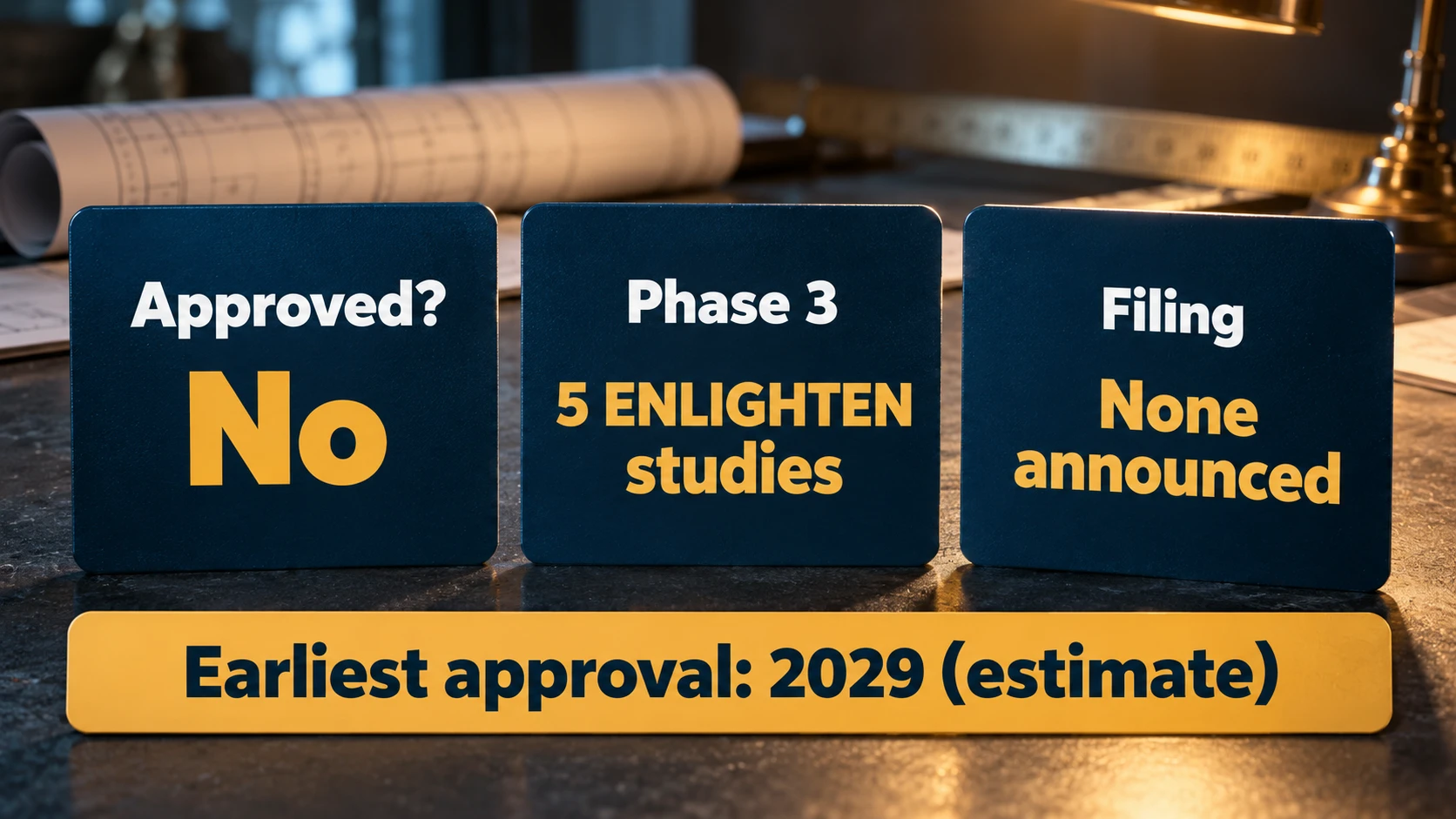
Short answer: Eloralintide is not approved by the FDA or any other regulator. Eli Lilly is running five phase 3 ENLIGHTEN studies that began between December 2025 and February 2026, with estimated primary completion between January and June 2028. I found no announced regulatory submission as of October 15, 2026. Lilly also plans phase 3 of an eloralintide and tirzepatide co-formulation (EloraTZP) by the end of 2026. On public schedules, approval is unlikely before 2029, and that date is an estimate and not a Lilly statement.
Key takeaways
- Status: investigational, phase 3. No new drug application announced.
- Five ENLIGHTEN studies: obesity without diabetes (1,980 planned), with type 2 diabetes (1,035), sleep apnea (800), knee osteoarthritis pain (900) and persistent obesity on a weekly incretin drug (900).
- The earliest estimated primary completion is January 2028 (ENLIGHTEN-2). The long-term study (ENLIGHTEN-1) runs to a study completion date of July 2030.
- A standard FDA review of a new molecular entity takes about 12 months from submission. Filing after the 2028 readouts puts a decision in 2029 on a normal schedule.
- EloraTZP phase 2b (September 30, 2026): -23.3% at 48 weeks versus -14.8% for tirzepatide 15 mg alone in adults with obesity and type 2 diabetes.
- The only lawful way to receive eloralintide today is by enrolling in a trial. Vendors who sell it as a research chemical are not a route to a medicine.
Last verified October 15, 2026. Registry data were pulled from the ClinicalTrials.gov API on that date. Sources are listed at the end. For laboratory and research use only. Nothing here is medical or legal advice.
Contents
- Eloralintide status at a glance
- The full timeline, from first dose to today
- The ENLIGHTEN phase 3 program
- EloraTZP: the combination program
- How an FDA approval works for a drug like this
- What could move the date
- Who can get eloralintide today
- The benchmarks eloralintide’s phase 3 has to meet
- What to watch between now and 2029
- Where the other drugs in its class stand
- Common questions
Eloralintide status at a glance
| Question | Answer as of October 15, 2026 |
|---|---|
| Approved by the FDA? | No |
| Approved by any regulator? | No approval found |
| Submitted to the FDA? | No announcement found |
| Development stage | Phase 3 (five ENLIGHTEN studies recruiting) |
| Sponsor | Eli Lilly and Company |
| Earliest estimated primary completion | January 2028 (ENLIGHTEN-2) |
| Latest estimated study completion | July 2030 (ENLIGHTEN-1) |
| Combination program | EloraTZP (with tirzepatide): phase 2b done, phase 3 planned by end of 2026 |
| Lawful access today | Clinical trials only |
| Price | None. No approved product exists |
The full timeline, from first dose to today
| Date | Milestone | Source |
|---|---|---|
| March 2022 | First-in-human studies begin (single and multiple ascending dose) | Trial papers |
| January 2024 | Phase 1 enrollment ends | Trial papers |
| February 5, 2024 | Phase 2 starts (NCT06230523) | ClinicalTrials.gov |
| September 20, 2024 | EloraTZP phase 2b starts (NCT06603571) | ClinicalTrials.gov |
| April 2025 | Studies in Chinese participants and of eloralintide with and without tirzepatide begin | ClinicalTrials.gov |
| August 14, 2025 | Phase 2 completes | ClinicalTrials.gov |
| October 16, 2025 | Macupatide plus eloralintide phase 2 starts (NCT07215559) | ClinicalTrials.gov |
| November 6, 2025 | Phase 2 results announced; The Lancet publishes them | Lilly; The Lancet |
| December 15, 2025 | First phase 3 study (ENLIGHTEN-2) starts | ClinicalTrials.gov |
| February 2026 | ENLIGHTEN-1, -3, -4 and -6 start | ClinicalTrials.gov |
| May 2026 | Second macupatide plus eloralintide phase 2 starts (NCT07589608) | ClinicalTrials.gov |
| July 1, 2026 | EloraTZP phase 2b primary completion | ClinicalTrials.gov |
| September 30, 2026 | EloraTZP results presented at EASD; Lilly plans a phase 3 co-formulation study | Lilly release |
| By end of 2026 | Planned start of EloraTZP phase 3 | Lilly release |
| January to June 2028 | Estimated primary completion of ENLIGHTEN studies | ClinicalTrials.gov |
| July 2030 | Estimated completion of the long-term ENLIGHTEN-1 study | ClinicalTrials.gov |
The ENLIGHTEN phase 3 program
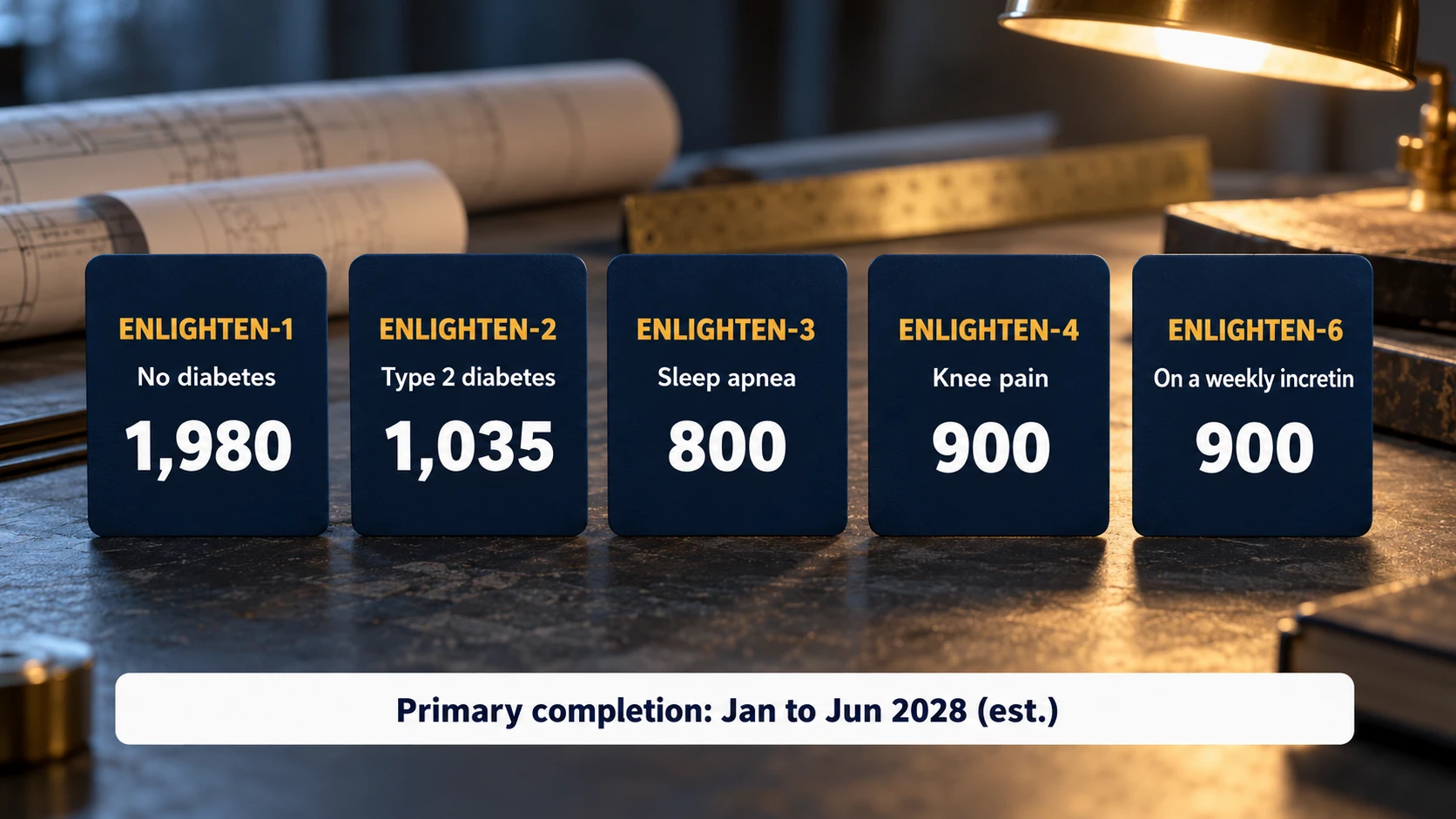
Lilly’s registry entries describe five placebo-controlled studies. All are randomized and double-blind, give eloralintide once weekly, and use the percent change in body weight as the primary outcome.
| Study | NCT number | Population | Planned size | Started | Primary completion (est.) | Extra primary outcome |
|---|---|---|---|---|---|---|
| ENLIGHTEN-1 | NCT07321886 | Obesity or overweight, no type 2 diabetes | 1,980 | February 6, 2026 | March 2028 | None |
| ENLIGHTEN-2 | NCT07282600 | Obesity or overweight with type 2 diabetes | 1,035 | December 15, 2025 | January 2028 | None |
| ENLIGHTEN-3 | NCT07369011 | Moderate to severe obstructive sleep apnea with obesity or overweight | 800 | February 10, 2026 | March 2028 | Apnea-hypopnea index |
| ENLIGHTEN-4 | NCT07353931 | Knee osteoarthritis pain with obesity or overweight | 900 | February 9, 2026 | March 2028 | WOMAC pain score |
| ENLIGHTEN-6 | NCT07392190 | Persistent obesity or overweight on a weekly incretin drug, with or without type 2 diabetes | 900 | February 10, 2026 | June 2028 | None |
Four design details are worth knowing.
- Dose arms. ENLIGHTEN-1, -2 and -6 each have four eloralintide dose arms and a placebo arm. Lilly has not published the doses. ENLIGHTEN-3 and -4 are master protocols with two sub-studies each.
- Who qualifies. ENLIGHTEN-2, -3 and -4 list a BMI of 27 kg/m² or higher. Participants are adults aged 18 and over.
- Names. I found five ENLIGHTEN records (1, 2, 3, 4 and 6) and no ENLIGHTEN-5. A fifth study may be registered under a different name or may not yet be public.
- Add-on question. ENLIGHTEN-6 tests eloralintide in people who still have obesity on a weekly incretin drug, which is the practical question for the many people who plateau on semaglutide or tirzepatide.
Together, these studies would give Lilly obesity data with and without diabetes, plus two disease-specific claims (sleep apnea and knee osteoarthritis pain) that retatrutide’s TRIUMPH-1 program also pursued.
Primary completion versus study completion
Registry dates are estimates and they change. “Primary completion” is the date the last participant gives data for the primary outcome. “Study completion” is the end of all follow-up. For ENLIGHTEN-1 the registry lists primary completion in March 2028 and study completion in July 2030, which means the long-term safety follow-up runs more than two years past the date of the main weight result. A drug company can file after primary completion and does not need to wait for the last follow-up visit.
EloraTZP: the combination program
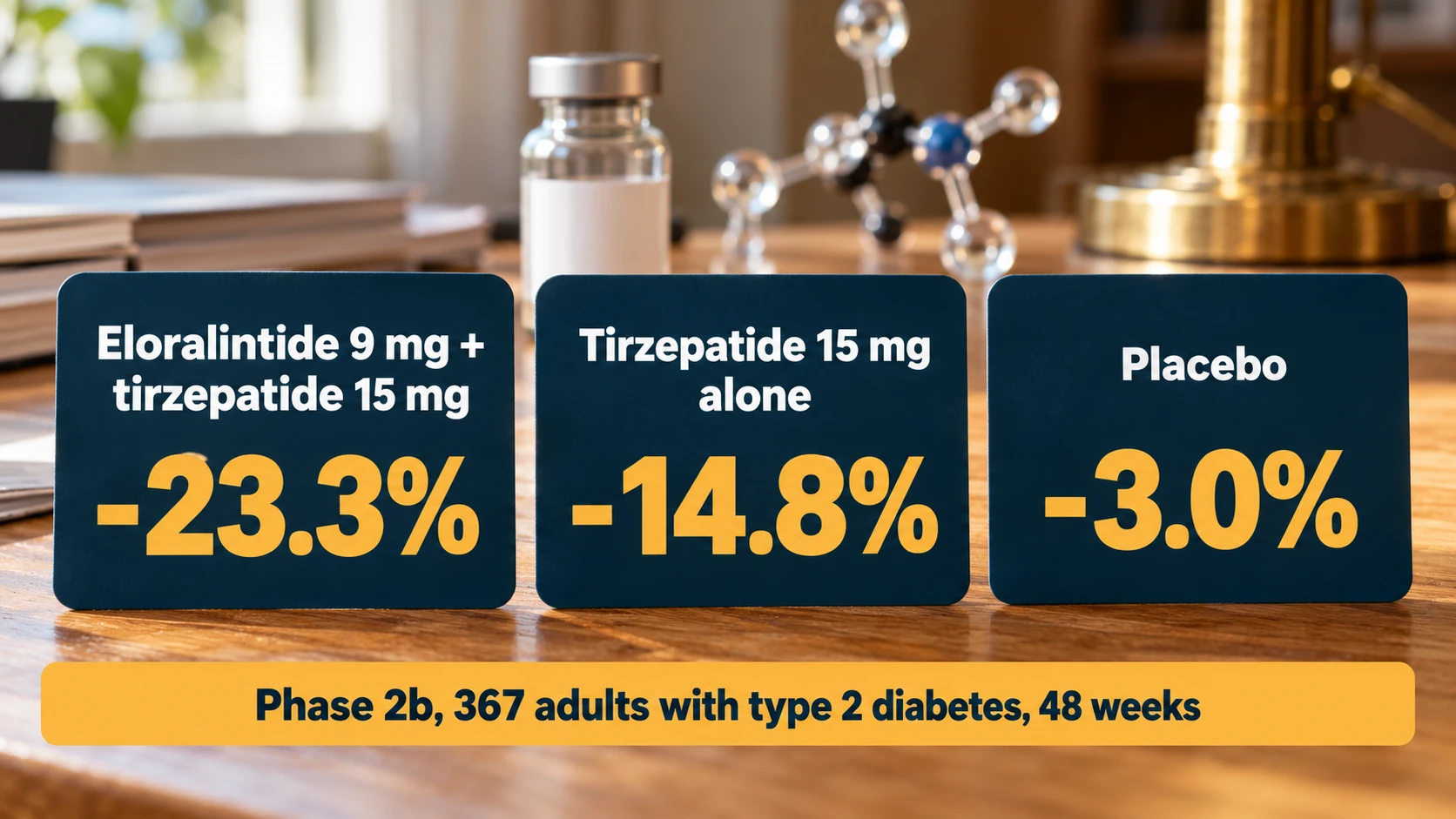
EloraTZP is Lilly’s name for eloralintide combined with tirzepatide. The 48-week phase 2b trial (NCT06603571) finished in 2026: primary completion on July 1 and study completion on September 14. It enrolled 367 adults with obesity or overweight and type 2 diabetes in the US and Argentina.
| Arm | Weight change | HbA1c change |
|---|---|---|
| Eloralintide 9 mg + tirzepatide 15 mg | -23.3% | -2.9 points |
| Eloralintide 6 mg + tirzepatide 10 mg | -19.9% | -2.6 points |
| Eloralintide 6 mg + tirzepatide 5 mg | -19.4% | -2.7 points |
| Eloralintide 3 mg + tirzepatide 5 mg | -13.2% | -2.2 points |
| Tirzepatide 15 mg alone | -14.8% | -2.4 points |
| Eloralintide 3, 6 or 9 mg alone | -8.2%, -12.3%, -11.1% | -1.1, -1.4, -1.3 points |
| Placebo | -3.0% | -0.3 points |
Lilly said all four combination arms met the primary and secondary endpoints. The primary endpoint compared EloraTZP with placebo, so the comparison with tirzepatide alone is secondary. Treatment stopped for adverse events in 10.8% to 27.0% of combination participants.
Lilly’s plan is to start phase 3 of a single co-formulation (one injection with both drugs) by the end of 2026, with an optimized escalation schedule. The phase 2b trial gave the two drugs as separate injections. A co-formulation is a different product with its own manufacturing and stability requirements, which makes it a separate regulatory filing from eloralintide alone.
Lilly is also testing eloralintide with macupatide (LY3532226) in two phase 2 studies (NCT07215559 in type 2 diabetes and NCT07589608 in people without diabetes). Public sources do not describe macupatide’s mechanism, and I do not speculate.
How an FDA approval works for a drug like this
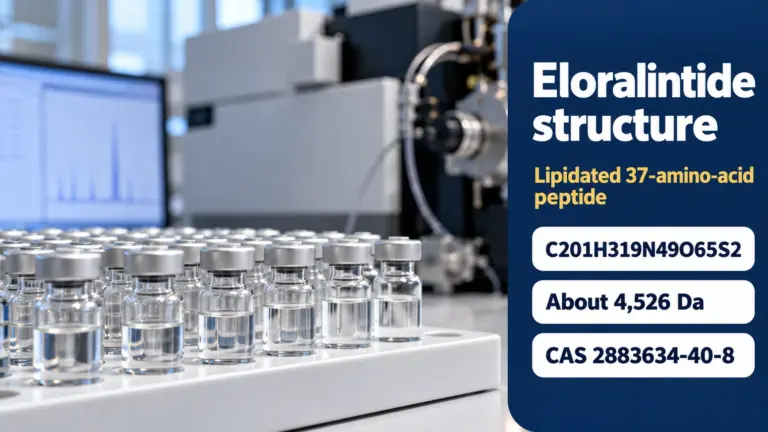
Eloralintide has a 37-amino-acid backbone. The FDA treats synthetic peptides of 40 or fewer amino acids as drugs approved under a New Drug Application (NDA), not as biologics, so an NDA is the expected route. The steps from here are:
- Finish phase 3. Lilly collects the efficacy and safety data from the ENLIGHTEN studies. Primary completion dates run from January to June 2028.
- Assemble the application. The NDA includes clinical, nonclinical and manufacturing sections. For a lipidated peptide the manufacturing section is substantial. When Lilly moved retatrutide’s planned filing from 2026 to the first quarter of 2027, it said the delay was about manufacturing and quality-control documentation and not about trial results (see our retatrutide approval status page).
- Submit. The FDA has 60 days to decide whether the application is complete enough to review.
- Review. The FDA’s standard goal for a new molecular entity is about 10 months after that 60-day filing period, or about 12 months from submission. A priority review is shorter but is reserved for drugs that offer a significant improvement over existing therapy, which would be hard to argue for obesity while approved drugs exist. That is my reading, not an FDA position.
- Decision. Approval, or a complete response letter asking for more data. Advisory committee meetings are optional.
On those steps and the 2028 completion dates, the earliest plausible approval is in 2029. If the FDA asks for more data or if a safety signal appears, it would be later. If Lilly files on the first readouts in early 2028, the decision could come a few months earlier, but an obesity filing would need the non-diabetes study (ENLIGHTEN-1, primary completion March 2028). This is an inference from public schedules, and Lilly has not given a date.
What could move the date
- Safety. The phase 1b mood-related events and the higher discontinuation rate at some phase 2 doses will draw attention. Phase 3 will show whether they matter.
- Dose and escalation choice. The phase 2 arms with the strongest weight change also had the most nausea and fatigue. Phase 3 uses four dose arms, and the final dose label depends on the balance.
- Manufacturing. Lilly’s own retatrutide delay shows that process data can set the filing date.
- Combination strategy. If Lilly prioritizes EloraTZP, a co-formulation filing could follow or lead the single-agent filing.
- Regulatory climate. The FDA and Lilly have been acting against unapproved obesity peptides sold online. That does not change the review, but it shapes how the market for the molecule develops.
Who can get eloralintide today
Only trial participants. You can search the registry at ClinicalTrials.gov or Lilly’s trial listing for sites near you. Each study sets its own criteria (for example, a BMI of 27 or higher and a stated condition), and enrollment is by randomization, so a participant may get placebo.
I found no expanded-access (compassionate use) program for eloralintide. Compounding rules generally bar pharmacies from making a drug from a bulk substance that is not a component of an approved drug, so compounded eloralintide is not a lawful route. The FDA has said the same of retatrutide. A product sold on a website as a “research chemical” is not a medicine, and the label does not show what is in the vial. Our guide on evaluating an eloralintide research listing explains what a certificate would need to show.
The benchmarks eloralintide’s phase 3 has to meet
Phase 3 results for eloralintide will be read against what the approved and near-approved drugs achieved in comparable trials. All figures below count everyone randomized (treatment-regimen or treatment-policy).
| Drug | Trial | Length | Mean weight change |
|---|---|---|---|
| Semaglutide 2.4 mg | STEP 1 | 68 weeks | -14.9% |
| Tirzepatide 15 mg | SURMOUNT-1 | 72 weeks | -20.9% |
| Tirzepatide 15 mg | SURMOUNT-5 | 72 weeks | -20.2% (semaglutide -13.7%) |
| CagriSema | REDEFINE 1 | 68 weeks | -20.4% |
| Retatrutide 12 mg | TRIUMPH-1 | 80 weeks | -25.0% |
| Eloralintide | Phase 2 (on treatment only) | 48 weeks | -20% at best |
Eloralintide has no all-randomized number yet. A phase 3 trial that reports one will probably be lower than -20%, and the field’s top results sit around -20% to -25%. Nobody outside Lilly can say where eloralintide will land, and a figure near the tirzepatide benchmark could support its use alone or as an add-on, while a figure well below it could push the case toward combinations like EloraTZP.
What to watch between now and 2029
| When | What | Why it matters |
|---|---|---|
| Around end of 2026 | FDA decision on CagriSema | Sets the first amylin-containing obesity drug on the market |
| By end of 2026 | Start of EloraTZP phase 3 | Shows whether Lilly commits to a co-formulation |
| First quarter of 2027 | Lilly’s planned retatrutide filing | Sets the pace for Lilly’s obesity portfolio |
| 2027 | Macupatide plus eloralintide phase 2 readouts (primary completion March and September 2027) | Tests a second combination partner |
| January 2028 | ENLIGHTEN-2 primary completion (type 2 diabetes) | First phase 3 weight result |
| March 2028 | ENLIGHTEN-1, -3 and -4 primary completion | Main obesity result, sleep apnea and knee pain results |
| June 2028 | ENLIGHTEN-6 primary completion | The add-on result |
| 2028 | Possible first filing | Starts a review of about 12 months |
| 2029 | Earliest likely FDA decision | Estimate only |
Registry dates are estimates and move. Check ClinicalTrials.gov before relying on any of them.
Where the other drugs in its class stand
| Drug | Status as of October 15, 2026 |
|---|---|
| Pramlintide | Approved for diabetes (older, short-acting amylin analogue) |
| CagriSema (cagrilintide plus semaglutide) | NDA filed December 2025; decision expected around the end of 2026 |
| Cagrilintide alone | Phase 3 (RENEW program); not filed |
| Retatrutide | Phase 3 data published; Lilly plans to file in the first quarter of 2027 |
| Eloralintide | Phase 3 enrolling; no filing announced |
| Petrelintide, amycretin and others | Phase 1 and 2 |
If CagriSema is approved around the end of 2026, it would be the first widely available amylin-containing obesity drug, which would shape how doctors and payers see eloralintide. Our cagrilintide guide and retatrutide vs tirzepatide guide cover those two.
Common questions
Is eloralintide FDA approved?
No. Eloralintide (LY3841136) is investigational. Lilly is running five phase 3 ENLIGHTEN studies, and I found no announced submission to the FDA or any other regulator as of October 15, 2026.
When will eloralintide be available?
Not before the phase 3 studies finish (estimated January to June 2028) and the FDA completes a review of about 12 months. On public schedules that puts an approval in 2029 at the earliest. That is an estimate, and Lilly has not announced a date.
Is eloralintide in phase 3?
Yes. Five phase 3 studies are registered on ClinicalTrials.gov: ENLIGHTEN-1, -2, -3, -4 and -6. ENLIGHTEN-2 began on December 15, 2025, and the others began in February 2026.
What is the ENLIGHTEN trial?
ENLIGHTEN is Lilly’s phase 3 program for eloralintide. It includes studies in obesity without diabetes, obesity with type 2 diabetes, obstructive sleep apnea, knee osteoarthritis pain and persistent obesity despite a weekly incretin drug. The primary outcome is percent change in body weight.
What is EloraTZP and when will it launch?
EloraTZP is eloralintide combined with tirzepatide. Phase 2b results on September 30, 2026 showed up to -23.3% at 48 weeks in adults with obesity and type 2 diabetes, against -14.8% for tirzepatide 15 mg alone. Lilly plans to start phase 3 of a co-formulation by the end of 2026, so a launch is several years away.
How much will eloralintide cost?
No price exists, because no product is approved. Lilly has not announced one, and any figure you read online is speculation or a research-chemical listing.
Can I get eloralintide now?
Only by enrolling in a clinical trial. A trial may give you placebo. Some websites sell vials labeled as research chemicals, but a research label does not show what is in a vial and does not make a product lawful for human use.
Is there an eloralintide pill?
All the registered studies I read give eloralintide as a once-weekly injection, and I found no oral program. Lilly’s other obesity pill programs are separate drugs.
Will eloralintide be approved?
Nobody can say. Phase 2 showed substantial weight reduction with manageable side effects in most arms, but phase 3 results, safety follow-up and the regulatory review are still ahead.
Has anyone been sued or warned for selling eloralintide?
I found no lawsuit or warning letter that names eloralintide as of October 15, 2026. In August 2026 Lilly sued six sellers of unapproved retatrutide, and the FDA sent warning letters to vendors selling retatrutide labeled “research use only.”
Related: What is eloralintide? · Eloralintide clinical trials · EloraTZP · Eloralintide news · Eloralintide price · Eloralintide vs cagrilintide · Eloralintide vs retatrutide · Eloralintide side effects · Is retatrutide FDA approved? · Are peptides legal?
Sources
All pages read October 14 to 15, 2026. Registry data were retrieved from the ClinicalTrials.gov API on October 15, 2026.
- ClinicalTrials.gov records: NCT07321886 (ENLIGHTEN-1), NCT07282600 (ENLIGHTEN-2), NCT07369011 (ENLIGHTEN-3), NCT07353931 (ENLIGHTEN-4), NCT07392190 (ENLIGHTEN-6), NCT06603571 (EloraTZP phase 2b), NCT06230523 (phase 2), NCT07215559 and NCT07589608 (macupatide plus eloralintide).
- Eli Lilly. EloraTZP phase 2b results and phase 3 plans, September 30, 2026: PR Newswire.
- Billings LK, et al. Eloralintide phase 2. The Lancet 2025; DOI 10.1016/S0140-6736(25)02155-5.
- Benchmark trials: STEP 1 (PubMed 33567185), SURMOUNT-1 (PubMed 35658024), SURMOUNT-5 (PubMed 40353578), REDEFINE 1 (PubMed 40544433), TRIUMPH-1 (PubMed 42814954).
- Peptryn. Is retatrutide FDA approved? The 2027 timeline explained and What is cagrilintide?.
- Novo Nordisk CagriSema filing and decision timing: Drug Topics, February 24, 2026.
- NPR. Eli Lilly files six lawsuits against sellers of unapproved retatrutide, August 13, 2026: npr.org.
- Searches for “eloralintide FDA approval”, “eloralintide phase 3” and regulatory submission news, October 14 to 15, 2026.
Editorial note: Peptryn sells research materials for laboratory use only. This guide is informational and is not medical advice. To report an error, use the contact page.
All products on peptryn.com are intended for laboratory research purposes only. They are not drugs, foods, dietary supplements or cosmetics, and they are not for human consumption, self-administration, or veterinary use. You must be 21 or older to buy. The information on this page has not been evaluated by the U.S. Food and Drug Administration and is not intended to diagnose, treat, cure, or prevent any disease.