EloraTZP: Lilly’s Eloralintide Plus Tirzepatide Combination, Phase 2b Results and Phase 3 Plans (2026)
Research use only. This guide is education, not medical advice. EloraTZP is an investigational combination that no regulator has approved. Eloralintide is also unapproved, and tirzepatide is a prescription drug that should be used only under a clinician’s care. Nothing here is a dosing recommendation or an instruction for self-administration, and Peptryn gives none.
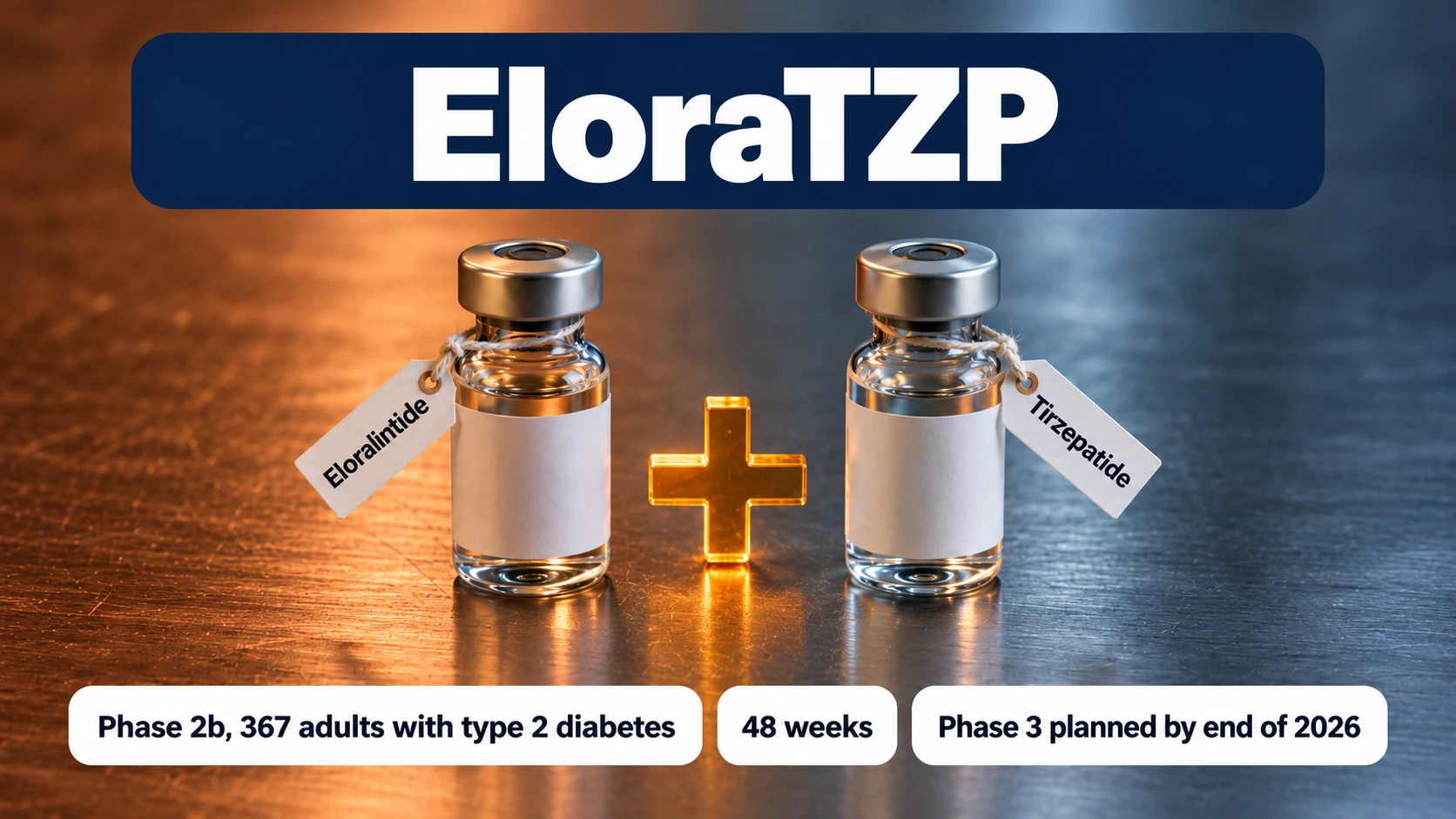
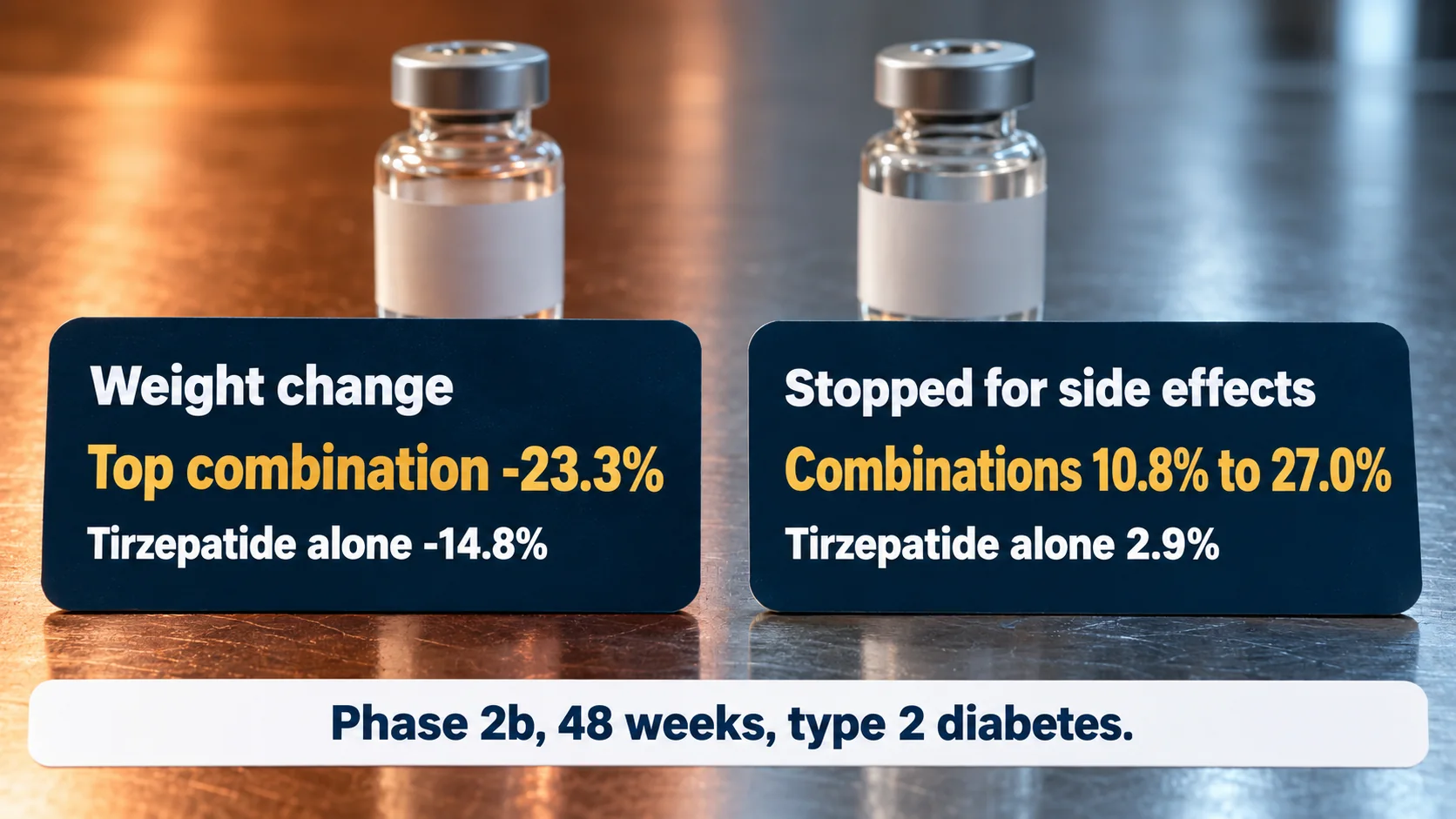
Short answer: EloraTZP is Eli Lilly’s investigational combination of eloralintide (an amylin receptor agonist) and tirzepatide (a GIP and GLP-1 receptor agonist). In a 48-week phase 2b trial of 367 adults with obesity or overweight and type 2 diabetes, the highest combination averaged -23.3% weight change against -14.8% for tirzepatide 15 mg alone and -3.0% for placebo, with HbA1c falling by up to 2.9 points. Between 10.8% and 27.0% of combination participants stopped treatment because of adverse events. Lilly plans to start phase 3 of a single co-formulation by the end of 2026.
Key takeaways
- The name: “Elora” for eloralintide and “TZP” for tirzepatide. Lilly presented the data at EASD 2026 in Milan on September 30, 2026.
- Four combinations were tested. Weight change ran from -13.2% to -23.3%, and HbA1c from -2.2 to -2.9 points, against -14.8% and -2.4 points for tirzepatide 15 mg alone.
- Placebo-adjusted, the top combination (-20.3 points) roughly equals the sum of the two drugs alone (-8.1 for eloralintide 9 mg and -11.8 for tirzepatide 15 mg). That arithmetic is mine, not Lilly’s, and phase 2 arms are small.
- The price of the extra effect was tolerability: adverse-event discontinuation was 10.8% to 27.0% in combination arms, 2.9% on tirzepatide and 16.7% on placebo. The two drugs were given as separate injections.
- Next step: a phase 3 of a co-formulation (one product containing both drugs) with an optimized escalation schedule, planned to start by the end of 2026.
- EloraTZP is not approved and is available only in clinical trials.
Last verified October 15, 2026. Sources are listed at the end. For laboratory and research use only. Nothing here is medical or legal advice.
Contents
- EloraTZP at a glance
- Why combine an amylin drug with tirzepatide?
- How the trial was designed
- The results
- Tolerability: the cost of the extra effect
- What phase 3 will test
- What this trial cannot tell us
- Seven questions phase 3 has to answer
- EloraTZP and CagriSema side by side
- Can anyone get EloraTZP?
- Common questions
EloraTZP at a glance
| Item | Detail |
|---|---|
| What it is | Eloralintide plus tirzepatide, tested together |
| Sponsor | Eli Lilly and Company |
| Eloralintide | Investigational once-weekly selective amylin receptor agonist (LY3841136) |
| Tirzepatide | Approved GIP and GLP-1 receptor agonist (Mounjaro, Zepbound) |
| Trial | Phase 2b, NCT06603571 (study dates September 2024 to September 2026) |
| Participants | 367 adults with obesity or overweight and type 2 diabetes, US and Argentina |
| Duration | 48 weeks |
| Baseline | Average weight 105.4 kg (232.4 lb); average HbA1c 8.1% |
| How it was given | Two separate pen injections |
| Presented | EASD 2026, Milan, September 30, 2026 (lead author Liana K. Billings, Endeavor Health) |
| Next | Phase 3 of a co-formulation, planned to start by the end of 2026 |
| Status | Investigational. No filing announced |
Why combine an amylin drug with tirzepatide?
The idea rests on two hormone systems that control appetite differently. Tirzepatide mimics the gut hormones GIP and GLP-1. Eloralintide mimics amylin, a hormone released from the pancreas with insulin. Reviews of amylin biology describe it as slowing stomach emptying, lowering the post-meal glucagon surge and promoting fullness through the brain, and describe the amylin route as distinct from the incretin route. Lilly’s release describes eloralintide as having the potential to reduce calorie intake, likely through satiety, and describes EloraTZP as activating GIP, GLP-1 and amylin pathways with minimal activity at the calcitonin receptor.
Two prior facts made the pairing attractive:
- Plateaus. Many people stop losing weight on an incretin drug well short of what the trials’ best responders achieved. A second pathway might push past that plateau.
- Precedent. Novo Nordisk’s CagriSema (cagrilintide plus semaglutide) showed in phase 3 that adding an amylin analogue to an incretin drug increased weight change. Our eloralintide vs cagrilintide guide compares the two strategies.
Lilly’s executive vice president Kenneth Custer called EloraTZP the company’s “next frontier,” pairing a selective amylin receptor agonist with tirzepatide.
How the trial was designed
The phase 2b registry entry (NCT06603571) lists ten arms: three eloralintide-alone arms, a tirzepatide-alone arm, five combination arms and placebo. Participants started at a set dose and escalated in steps to the target dose. In one combination arm, eloralintide was added on top of tirzepatide partway through the study, and Lilly’s release does not report that arm’s result. The primary endpoint was the percent change in body weight for EloraTZP versus placebo. All other comparisons, including the comparison with tirzepatide alone, were secondary.
The population matters. All participants had type 2 diabetes, so the results do not tell us how the combination performs in people without diabetes. People with type 2 diabetes usually lose less weight on the same drug than people without it.
The results
| Arm | Weight change | HbA1c change |
|---|---|---|
| Eloralintide 9 mg + tirzepatide 15 mg | -23.3% | -2.9 points |
| Eloralintide 6 mg + tirzepatide 10 mg | -19.9% | -2.6 points |
| Eloralintide 6 mg + tirzepatide 5 mg | -19.4% | -2.7 points |
| Eloralintide 3 mg + tirzepatide 5 mg | -13.2% | -2.2 points |
| Tirzepatide 15 mg alone | -14.8% | -2.4 points |
| Eloralintide 6 mg alone | -12.3% | -1.4 points |
| Eloralintide 9 mg alone | -11.1% | -1.3 points |
| Eloralintide 3 mg alone | -8.2% | -1.1 points |
| Placebo | -3.0% | -0.3 points |
These are regimens tested in a clinical trial. They are not guidance. Figures use the efficacy estimand (on treatment), as reported in Lilly’s release.
Lilly said all four combinations met the primary and secondary endpoints. Three observations follow from the table.
- A dose-response in the combination. Weight change deepened from -13.2% to -23.3% as both doses rose.
- The best arm beat tirzepatide alone by 8.5 points. That is -23.3% against -14.8%. The comparison is secondary, and the combination arms held fewer than 100 people each, according to coverage of the presentation.
- A small HbA1c edge. The top combination lowered HbA1c by 2.9 points against 2.4 for tirzepatide alone, a 0.5-point difference. Against a baseline of 8.1%, tirzepatide alone already moved most participants a long way, so there was likely less room to improve.
Is the combination more than the sum of its parts?
Subtract the placebo change from each arm to see the effect attributable to each drug.
| Arm | Reported | Placebo-adjusted |
|---|---|---|
| Eloralintide 9 mg alone | -11.1% | -8.1 points |
| Tirzepatide 15 mg alone | -14.8% | -11.8 points |
| Sum of the two | -19.9 points | |
| Eloralintide 9 mg + tirzepatide 15 mg | -23.3% | -20.3 points |
On this arithmetic the combination did about what you would expect from adding the two drugs’ placebo-adjusted effects. It did not show a synergy beyond that. This is my calculation from the release’s figures, in a phase 2 trial with small arms and different dose escalation across groups, so treat it as a rough check and not a result.
Tolerability: the cost of the extra effect
| Group | Stopped treatment because of an adverse event |
|---|---|
| Eloralintide plus tirzepatide | 10.8% to 27.0% |
| Eloralintide alone | 0% to 10.8% |
| Tirzepatide alone | 2.9% |
| Placebo | 16.7% |
Lilly said the most common adverse events were gastrointestinal, generally mild or moderate, mostly during dose escalation, and more frequent in the combination arms than with either drug alone. The release gives no per-arm nausea or vomiting rates and no serious-event figures.
Two points deserve attention. First, the upper end of the combination range (27.0%) is high for a drug aimed at long-term use. Second, the 16.7% on placebo is unexplained in the release and is higher than tirzepatide alone (2.9%), which suggests that discontinuation in these arms reflects more than drug effects or that the arms were small enough for chance to dominate. A fuller account is needed from the full publication.
Lilly’s phase 3 plan answers this problem directly: a co-formulation with “an optimized escalation schedule.” The phase 2b trial used separate injections and a fixed escalation, and the schedule is the main lever for reducing stomach side effects, as eloralintide’s own phase 2 showed (see our side effects guide).
What phase 3 will test
Lilly’s release says it plans to start phase 3 studies of an EloraTZP co-formulation by the end of 2026 (Q4 2026), and does not specify the populations. Some things are predictable:
- A co-formulation is a new product. One injection with both drugs needs its own stability, manufacturing and device work. That is a separate regulatory filing from eloralintide alone and from tirzepatide alone.
- People without diabetes will matter. The weight-management label depends on trials in people with obesity without diabetes, where eloralintide alone has only phase 2 data so far (ENLIGHTEN-1 is running).
- The comparator will probably be tirzepatide. The phase 2b result is the case for it.
- Timing. Phase 3 starting at the end of 2026 puts primary completion years away. Our approval status guide lays out the schedule for eloralintide alone, which is a year or more ahead of any co-formulation.
Lilly is separately studying eloralintide with a second partner, macupatide (LY3532226), in two phase 2 studies (NCT07215559 and NCT07589608) and as an add-on for people who plateau on a weekly incretin drug (ENLIGHTEN-6).
What this trial cannot tell us
A phase 2b trial is built to pick doses and show a signal. It is not built to settle a drug’s value. Six limits apply here.
- Small groups. With 367 participants across ten arms, each arm averaged about 37 people, and coverage of the presentation quotes the lead author saying the combination arms held fewer than 100 each. Percentages move a lot on small groups, and the discontinuation figures swing the most.
- One population. Everyone had type 2 diabetes. Results in people without diabetes, who usually lose more weight and have different stomach tolerance, are not available.
- On-treatment numbers. The headline figures use the efficacy estimand, which counts weight change while participants stayed on treatment. The all-randomized result, which is what a phase 3 label would quote, will be lower, especially where 27% stopped.
- A secondary comparison. The primary comparison was EloraTZP against placebo, which is an easy bar. The comparison with tirzepatide alone was secondary and not powered as a primary test.
- Separate injections. Participants received two separate pen injections. A single co-formulation may behave differently in stability, tolerability and convenience.
- No safety detail. The release does not give nausea, vomiting or serious adverse event rates by arm, so the safety picture rests on discontinuation percentages. A peer-reviewed paper would add those.
Seven questions phase 3 has to answer
| Question | Why it matters |
|---|---|
| Does the combination beat tirzepatide alone in people without diabetes? | Most weight-management patients do not have diabetes, and this is where the market is |
| What is the all-randomized weight change at the dose Lilly picks? | It sets the number that goes on a label and in comparisons with retatrutide and CagriSema |
| Does a slower escalation cut discontinuation below 10%? | The phase 2b discontinuation rate of up to 27% would limit real-world use |
| Is the co-formulation as effective as two separate pens? | The product Lilly would sell is a single injection |
| What happens to lean mass and bone? | A larger weight change raises the stakes on body composition, and no eloralintide human data on it are public |
| Do mood and heart rate signals from phase 1b hold up? | A small mood signal and a falling pulse appeared at higher eloralintide doses |
| How durable is the effect after 48 weeks? | The longest eloralintide exposure published is 48 weeks, and ENLIGHTEN-1 runs to 2030 |
Each of these can be checked against the registry entries as results are posted. We will update this page when Lilly starts phase 3 or publishes the full phase 2b paper.
EloraTZP and CagriSema side by side
| EloraTZP | CagriSema | |
|---|---|---|
| Company | Eli Lilly | Novo Nordisk |
| Amylin component | Eloralintide, selective amylin agonist | Cagrilintide, dual amylin and calcitonin agonist |
| Incretin component | Tirzepatide (GIP and GLP-1) | Semaglutide (GLP-1) |
| Stage | Phase 2b done; phase 3 co-formulation planned | Phase 3 done; NDA filed December 2025 |
| Type 2 diabetes result | -23.3% at 48 weeks (top arm, on treatment) | -13.7% at 68 weeks (REDEFINE 2, all randomized) |
| Without diabetes | Not yet reported | -20.4% at 68 weeks (REDEFINE 1, all randomized) |
| Against tirzepatide | -23.3% vs -14.8% in type 2 diabetes | Missed non-inferiority at 84 weeks (REDEFINE 4) |
| Stopped for adverse events | 10.8% to 27.0% | 6% (REDEFINE 1) |
The two programs are not comparable yet: the populations, analysis methods, durations and phases differ. The fact that CagriSema’s phase 3 comparison with tirzepatide fell short makes EloraTZP’s phase 2b edge over tirzepatide interesting, and also makes the phase 3 comparison higher-stakes.
Can anyone get EloraTZP?
Only in clinical trials. Eloralintide is not approved, so its combination with tirzepatide is not a lawful prescription or compounding option. Some websites list eloralintide as a research chemical, and some forums discuss using it with tirzepatide. A research label does not show what is in a vial, no dose has been established outside Lilly’s trials, and no safety record exists for the combination beyond 48 weeks in a small phase 2b trial. Peptryn does not sell eloralintide, gives no dosing guidance, and sells research materials only for laboratory use. See what a research listing would have to show.
Common questions
What is EloraTZP?
EloraTZP is Eli Lilly’s name for the combination of eloralintide, a once-weekly amylin receptor agonist, and tirzepatide, a GIP and GLP-1 receptor agonist. It is investigational and is being studied for obesity and type 2 diabetes.
What does TZP stand for?
TZP is the abbreviation for tirzepatide. “Elora” refers to eloralintide.
How much weight did people lose on EloraTZP?
In the 48-week phase 2b trial in adults with type 2 diabetes, the highest combination averaged -23.3% (on treatment), against -14.8% on tirzepatide 15 mg alone and -3.0% on placebo. Lower combinations averaged -13.2% to -19.9%.
Is EloraTZP better than tirzepatide alone?
In this trial, the top combination lost 8.5 points more than tirzepatide 15 mg alone, and more people stopped treatment because of adverse events. The comparison was secondary, in a small phase 2b trial, in people with type 2 diabetes. Phase 3 will test it properly.
Is EloraTZP FDA approved?
No. Lilly plans to begin phase 3 studies of a co-formulation by the end of 2026. No filing has been announced.
When will EloraTZP be available?
Not before phase 3 finishes and the FDA completes a review, which means several years. Eloralintide alone has estimated primary completion dates in 2028, and the co-formulation program starts later.
Does EloraTZP lower blood sugar?
Yes, in the trial. HbA1c fell by 2.2 to 2.9 points across the combination arms, against 2.4 points for tirzepatide alone and 0.3 for placebo, from a baseline of 8.1%.
Why did more people stop treatment on EloraTZP?
Lilly said adverse events were mostly gastrointestinal, mostly mild or moderate, clustered during dose escalation, and more frequent in the combination arms. Discontinuation for adverse events ran 10.8% to 27.0% in those arms. The phase 3 co-formulation is meant to use a better escalation schedule.
Can I combine eloralintide and tirzepatide myself?
Peptryn cannot advise on that and does not sell eloralintide. Only Lilly’s trials have studied the combination, under medical supervision, and the trial regimens do not transfer to anything bought elsewhere.
What is the difference between EloraTZP and CagriSema?
CagriSema pairs cagrilintide with semaglutide and has finished phase 3 with an FDA filing in December 2025. EloraTZP pairs eloralintide with tirzepatide and has finished phase 2b. See the comparison table above.
Related: What is eloralintide? · Eloralintide approval status · Eloralintide vs tirzepatide and semaglutide · Eloralintide vs cagrilintide · Eloralintide side effects · Eloralintide clinical trials · All eloralintide guides
Sources
All pages read October 14 to 15, 2026.
- Eli Lilly. EloraTZP phase 2b results, EASD 2026, September 30, 2026: PR Newswire.
- ClinicalTrials.gov. NCT06603571 (EloraTZP phase 2b), NCT07215559, NCT07589608 and NCT07392190, retrieved October 15, 2026.
- Coverage of the EASD presentation: Medscape and Pharmacy Times (secondary).
- Garvey WT, et al. Coadministered cagrilintide and semaglutide (REDEFINE 1). New England Journal of Medicine 2025; PubMed 40544433. REDEFINE 2: PubMed 40544432. REDEFINE 4: Drug Topics, February 24, 2026.
- Beyond GLP-1: amylin-based pharmacotherapy. Pharmacological Research 2026; PubMed 42586227.
- Billings LK, et al. Eloralintide phase 2. The Lancet 2025; DOI 10.1016/S0140-6736(25)02155-5.
Editorial note: Peptryn sells research materials for laboratory use only. This guide is informational and is not medical advice. To report an error, use the contact page.
All products on peptryn.com are intended for laboratory research purposes only. They are not drugs, foods, dietary supplements or cosmetics, and they are not for human consumption, self-administration, or veterinary use. You must be 21 or older to buy. The information on this page has not been evaluated by the U.S. Food and Drug Administration and is not intended to diagnose, treat, cure, or prevent any disease.