Eloralintide for Type 2 Diabetes, Sleep Apnea and Knee Pain: What the Trials Are Testing (2026)
Research use only. This guide is education, not medical advice. Eloralintide is an investigational drug that is not approved for type 2 diabetes, sleep apnea, knee osteoarthritis or any other use. Nothing here suggests it treats any condition, and Peptryn gives no dosing or administration guidance. A clinician is the right person for any question about a medical condition.
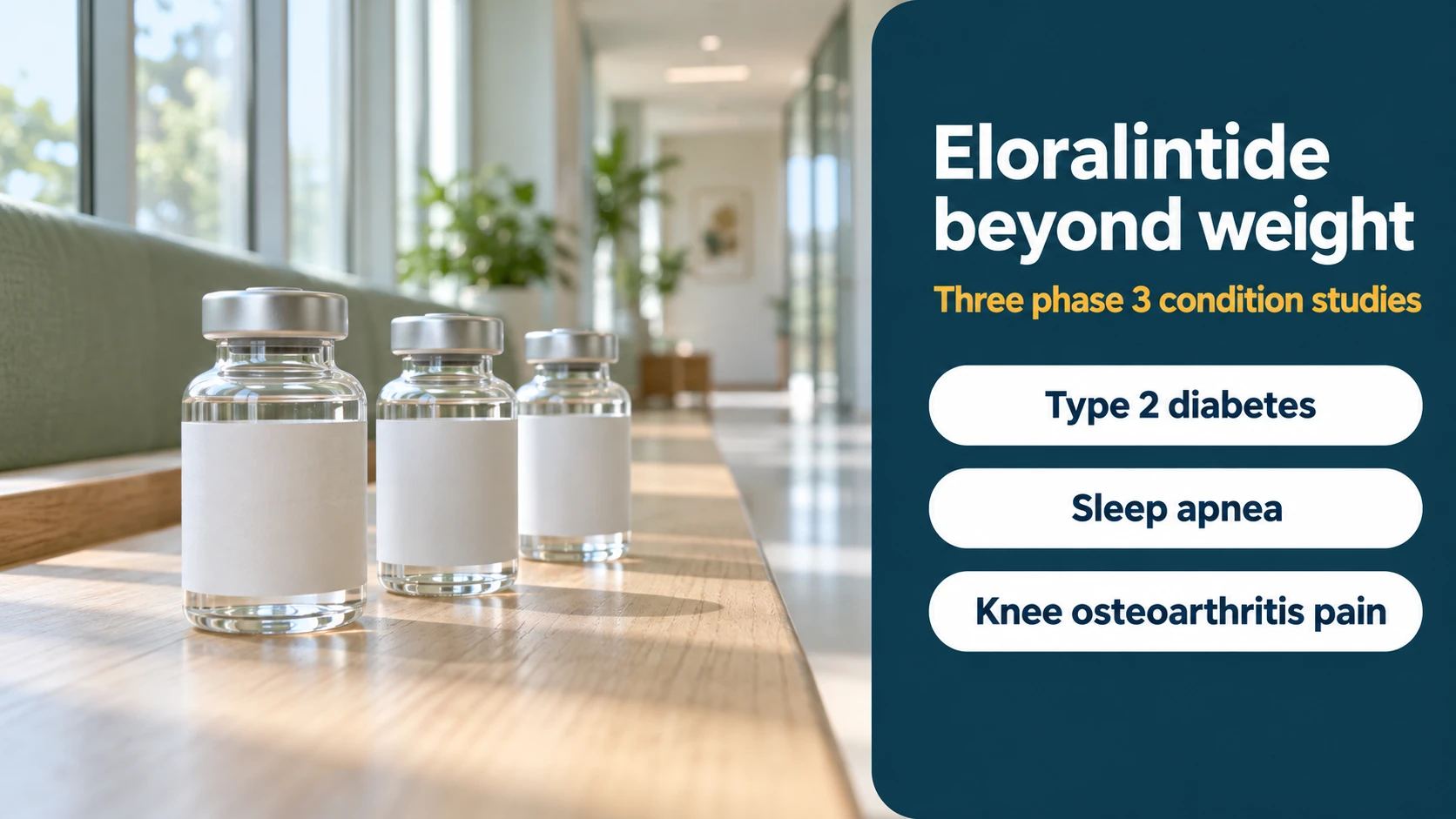
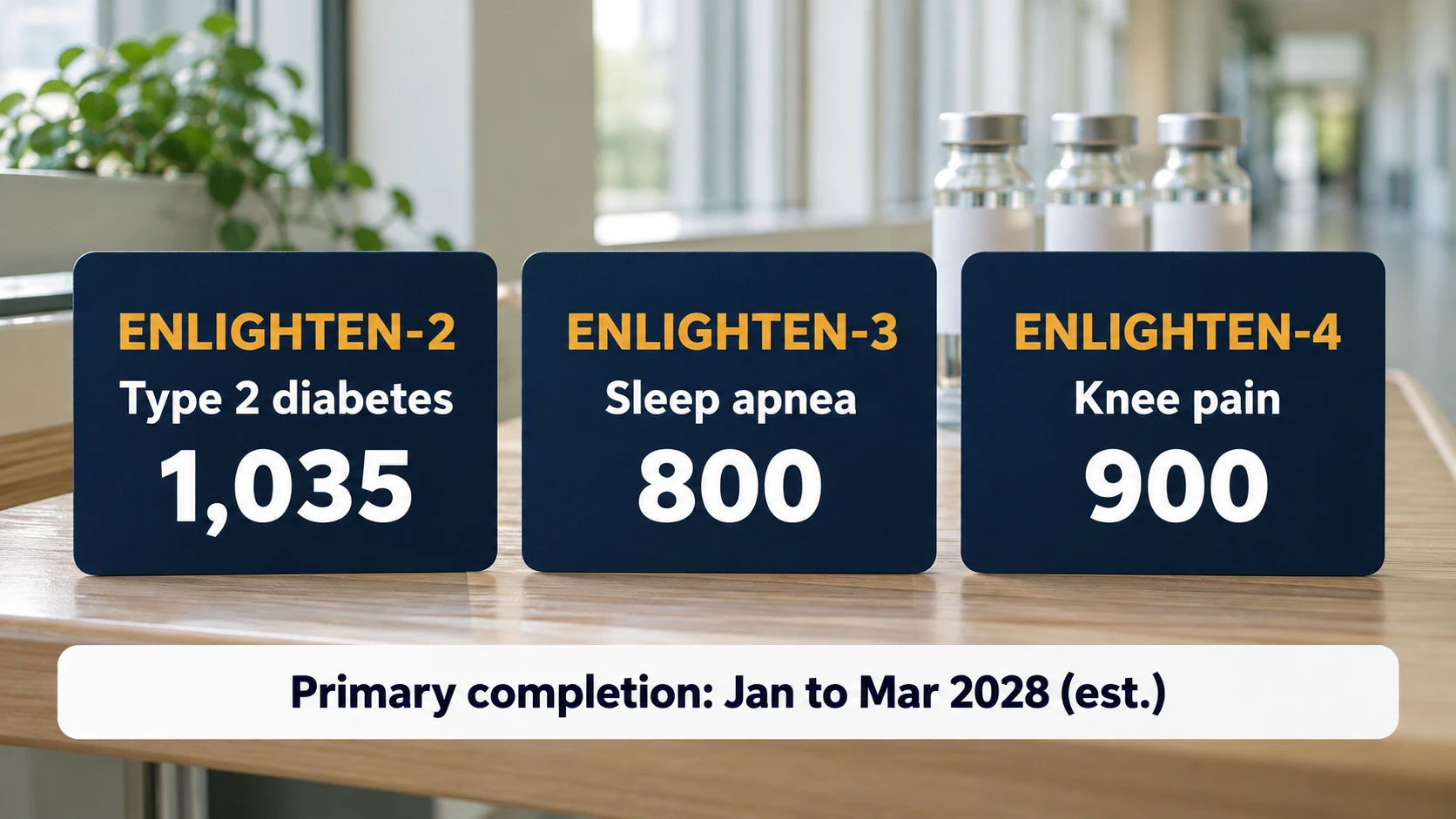
Short answer: Eloralintide is not approved for any condition. Eli Lilly is testing it in three condition-specific phase 3 settings alongside weight management: type 2 diabetes (ENLIGHTEN-2, 1,035 planned participants), moderate to severe obstructive sleep apnea (ENLIGHTEN-3, 800) and knee osteoarthritis pain (ENLIGHTEN-4, 900). So far, eloralintide has produced HbA1c reductions of 1.1 to 1.4 points on its own and up to 2.9 points with tirzepatide in a 48-week phase 2b trial in type 2 diabetes. No results on sleep apnea or knee pain have been reported. Primary completion for all three is estimated for January to March 2028.
Key takeaways
- Type 2 diabetes: phase 2b gave HbA1c changes of -1.1 to -1.4 points (eloralintide alone) and -2.2 to -2.9 points (with tirzepatide), from a baseline of 8.1%. ENLIGHTEN-2 is the phase 3 test.
- Sleep apnea: ENLIGHTEN-3 adds the apnea-hypopnea index (AHI) as a primary outcome. Participants need an AHI of 15 or more. No eloralintide results yet.
- Knee osteoarthritis pain: ENLIGHTEN-4 adds the WOMAC pain score as a primary outcome. No eloralintide results yet.
- Retatrutide’s phase 3 reported results on the same two conditions, which sets the benchmark: pain scores fell 1.6 to 1.8 points more than placebo, and breathing events fell by 22 to 24 per hour more than placebo.
- Weight is the first primary outcome in all three studies. A condition-specific benefit would be an additional finding and not a given.
Last verified October 15, 2026. Sources are listed at the end. For laboratory and research use only. Nothing here is medical or legal advice.
Contents
- The three condition studies at a glance
- Type 2 diabetes
- Obstructive sleep apnea
- Knee osteoarthritis pain
- What these studies can and cannot show
- Common questions
The three condition studies at a glance
| ENLIGHTEN-2 | ENLIGHTEN-3 | ENLIGHTEN-4 | |
|---|---|---|---|
| Condition | Type 2 diabetes with obesity or overweight | Moderate to severe obstructive sleep apnea with obesity or overweight | Knee osteoarthritis with obesity or overweight |
| Registry number | NCT07282600 | NCT07369011 | NCT07353931 |
| Planned participants | 1,035 | 800 | 900 |
| Started | December 15, 2025 | February 10, 2026 | February 9, 2026 |
| Estimated primary completion | January 2028 | March 2028 | March 2028 |
| Primary outcomes | Percent change in body weight | Percent change in body weight; change in apnea-hypopnea index | Percent change in body weight; change in WOMAC pain score |
| Design | Randomized, double-blind, placebo-controlled, four eloralintide dose arms | Master protocol with two sub-studies | Master protocol with two sub-studies |
| Sites listed | 143 | 115 | 153 |
Type 2 diabetes
What the studies enroll
ENLIGHTEN-2 enrolls adults with type 2 diabetes who have been on stable treatment for at least 90 days, have a BMI of 27 or more and have a stable body weight. People who took certain other diabetes and weight drugs recently, including amylin analogs, are excluded. The primary outcome is percent change in body weight, with four eloralintide dose arms against placebo.
What has been reported
The only results in type 2 diabetes come from the 48-week EloraTZP phase 2b trial (NCT06603571; 367 adults, average HbA1c 8.1%, average weight 105.4 kg).
| Arm | Weight change | HbA1c change |
|---|---|---|
| Eloralintide 3 mg alone | -8.2% | -1.1 points |
| Eloralintide 6 mg alone | -12.3% | -1.4 points |
| Eloralintide 9 mg alone | -11.1% | -1.3 points |
| Tirzepatide 15 mg alone | -14.8% | -2.4 points |
| Eloralintide 9 mg + tirzepatide 15 mg | -23.3% | -2.9 points |
| Placebo | -3.0% | -0.3 points |
These are regimens tested in a clinical trial. They are not guidance.
Eloralintide on its own lowered HbA1c by 1.1 to 1.4 points, and the combination lowered it further. Two cautions apply. HbA1c reductions in a trial that starts at 8.1% leave less room than one starting higher, and the weight change, not the glucose result, was the primary endpoint. Our EloraTZP guide covers the full trial.
Why amylin is relevant to glucose
Amylin is released from the pancreas with insulin, and reviews describe it as lowering the post-meal glucagon surge and slowing stomach emptying, both of which blunt blood sugar spikes. Pramlintide, the first amylin analogue, is approved for people with diabetes who use mealtime insulin. In the 12-week study in adults without diabetes, eloralintide did not change fasting glucose and showed no treatment-related change in a glucose tolerance test, as expected in people with normal glucose control.
Context from the other amylin combination
Novo Nordisk’s CagriSema is the best-studied amylin-containing drug in type 2 diabetes. In REDEFINE 2 (1,206 adults, 68 weeks), weight fell 13.7% against 3.4% on placebo, and 73.5% of the CagriSema group reached an HbA1c of 6.5% or less against 15.9% on placebo. A 2026 review adds that CagriSema reduced HbA1c by up to 2.0% on the trial-product estimand and cites a 40-week phase 3a study in which about one in two people with previously untreated type 2 diabetes reached remission, and another in which people on basal insulin needed about 20 units less than controls. Those are CagriSema results, not eloralintide’s, and they set the standard that ENLIGHTEN-2 and EloraTZP’s phase 3 will be read against.
Obstructive sleep apnea
What ENLIGHTEN-3 tests
ENLIGHTEN-3 is a master protocol with two sub-studies in adults with moderate to severe obstructive sleep apnea and a BMI of 27 or more. Participants need an apnea-hypopnea index (AHI) of at least 15 on a sleep study. One sub-study enrolls people who cannot or will not use airway pressure therapy, and the other enrolls people who have used it for at least three consecutive months and plan to continue. Each has two primary outcomes: percent change in body weight and change in AHI.
The AHI is the number of breathing pauses (apneas) and shallow breaths (hypopneas) per hour of sleep. An AHI of 15 or more is moderate or worse. A fall in AHI is the measure regulators use for sleep apnea drugs.
The benchmark
In December 2024, the FDA approved tirzepatide (Zepbound) for moderate to severe obstructive sleep apnea in adults with obesity. The approval rested on two placebo-controlled studies in 469 adults, one in people using airway pressure therapy and one in people unable or unwilling to use it. Retatrutide’s phase 3 TRIUMPH-1 trial (NEJM 2026) included 243 participants with sleep apnea, where AHI fell by 24.4 events per hour (9 mg) and 21.9 events per hour (12 mg) more than placebo on the hybrid estimand.
For eloralintide, no sleep apnea data have been reported. ENLIGHTEN-3 will be the first, with primary completion estimated for March 2028.
Knee osteoarthritis pain
What ENLIGHTEN-4 tests
ENLIGHTEN-4 is a master protocol with two sub-studies in adults with knee osteoarthritis, a BMI of 27 or more and a stable weight, who have tried and failed to lose weight by diet. People with any type of diabetes are excluded. The primary outcomes are percent change in body weight and change in the WOMAC pain subscale (a questionnaire scored from 1 to 10 in the retatrutide trial, where higher means worse pain).
The benchmark
In TRIUMPH-1, 574 participants with knee osteoarthritis had pain scores that fell 1.6 points (9 mg) and 1.8 points (12 mg) more than placebo on the hybrid estimand (1.4 and 1.6 points on the intention-to-treat estimand). Whether eloralintide matches that is unknown, and the eloralintide-specific data will arrive after March 2028.
What these studies can and cannot show
- They can show whether eloralintide improves sleep apnea severity and knee pain beyond placebo, and whether the effect is larger than weight change alone would predict.
- They cannot show that eloralintide is approved or appropriate for any individual with these conditions.
- Weight remains the lead outcome. If eloralintide helps these conditions, much of the effect may come through weight change, and the trials are not designed to separate the two.
- Each has placebo arms. Participants in the trials may not receive eloralintide.
- Results are years away. Primary completion is 2028, and a label for any of these uses would follow a regulatory review.
Common questions
Is eloralintide being tested for type 2 diabetes?
Yes. ENLIGHTEN-2 (NCT07282600) is a phase 3 study of once-weekly eloralintide in adults with obesity or overweight and type 2 diabetes, with 1,035 planned participants. A 48-week phase 2b trial has already reported HbA1c reductions.
Does eloralintide lower HbA1c?
In the phase 2b trial in type 2 diabetes, eloralintide alone lowered HbA1c by 1.1 to 1.4 points and eloralintide with tirzepatide by 2.2 to 2.9 points, against 2.4 for tirzepatide alone and 0.3 for placebo, from a baseline of 8.1%.
Is eloralintide being tested for sleep apnea?
Yes. ENLIGHTEN-3 (NCT07369011) tests it in adults with moderate to severe obstructive sleep apnea and obesity or overweight, with the apnea-hypopnea index as an extra primary outcome. No results have been reported.
Does eloralintide help knee osteoarthritis?
Not shown. ENLIGHTEN-4 (NCT07353931) is testing it, with the WOMAC pain score as an extra primary outcome. No results have been reported, and primary completion is estimated for March 2028.
Is eloralintide approved for diabetes?
No. It is not approved for any use. Pramlintide, an older amylin analogue, is approved for people with diabetes who use mealtime insulin.
Is there an FDA-approved drug for obstructive sleep apnea?
Yes. The FDA approved tirzepatide (Zepbound) in December 2024 for moderate to severe obstructive sleep apnea in adults with obesity. Eloralintide is not approved.
Will eloralintide treat sleep apnea or knee pain?
Nobody can say. Phase 3 will measure sleep apnea severity and knee pain, and the answer comes after 2028. Peptryn makes no claim that any research material treats a condition.
Can people with these conditions join the trials?
Possibly, if they meet each study’s criteria and a site is nearby. See eloralintide clinical trials for the registry records, and talk to a clinician first.
Related: What is eloralintide? · EloraTZP · Eloralintide clinical trials · Eloralintide trial results · Eloralintide vs retatrutide · Eloralintide approval status · All eloralintide guides
Sources
All pages read October 14 to 15, 2026.
- ClinicalTrials.gov: NCT07282600 (ENLIGHTEN-2), NCT07369011 (ENLIGHTEN-3), NCT07353931 (ENLIGHTEN-4), NCT06603571 (EloraTZP phase 2b), retrieved October 15, 2026.
- Eli Lilly. EloraTZP phase 2b release, September 30, 2026: PR Newswire.
- Retatrutide, a triple hormone receptor agonist, for treatment of obesity (TRIUMPH-1). New England Journal of Medicine 2026; PubMed 42814954.
- U.S. Food and Drug Administration. FDA approves first medication for obstructive sleep apnea, December 2024.
- Cagrilintide-semaglutide in adults with overweight or obesity and type 2 diabetes (REDEFINE 2). New England Journal of Medicine 2025; PubMed 40544432.
- New amylin-based agonists for obesity and type 2 diabetes mellitus. Diabetes Therapy 2026; PubMed 42803913.
- Bhattachar S, et al. Eloralintide phase 1 proof of concept. Diabetes, Obesity and Metabolism 2026; PMC12992164.
- Beyond GLP-1: amylin-based pharmacotherapy. Pharmacological Research 2026; PubMed 42586227.
Editorial note: Peptryn sells research materials for laboratory use only. This guide is informational and is not medical advice. To report an error, use the contact page.
All products on peptryn.com are intended for laboratory research purposes only. They are not drugs, foods, dietary supplements or cosmetics, and they are not for human consumption, self-administration, or veterinary use. You must be 21 or older to buy. The information on this page has not been evaluated by the U.S. Food and Drug Administration and is not intended to diagnose, treat, cure, or prevent any disease.