Janoshik Peptide Testing: How to Verify a Report and What “Third-Party Tested” Proves
Research use only. Peptides supplied by Peptryn are sold strictly for in vitro and preclinical laboratory research. They are not approved by the FDA for human or veterinary use, and nothing here is medical advice, a dosing recommendation, or an instruction for self-administration. This guide explains how to read and check a laboratory document. It does not tell anyone how to use a peptide.
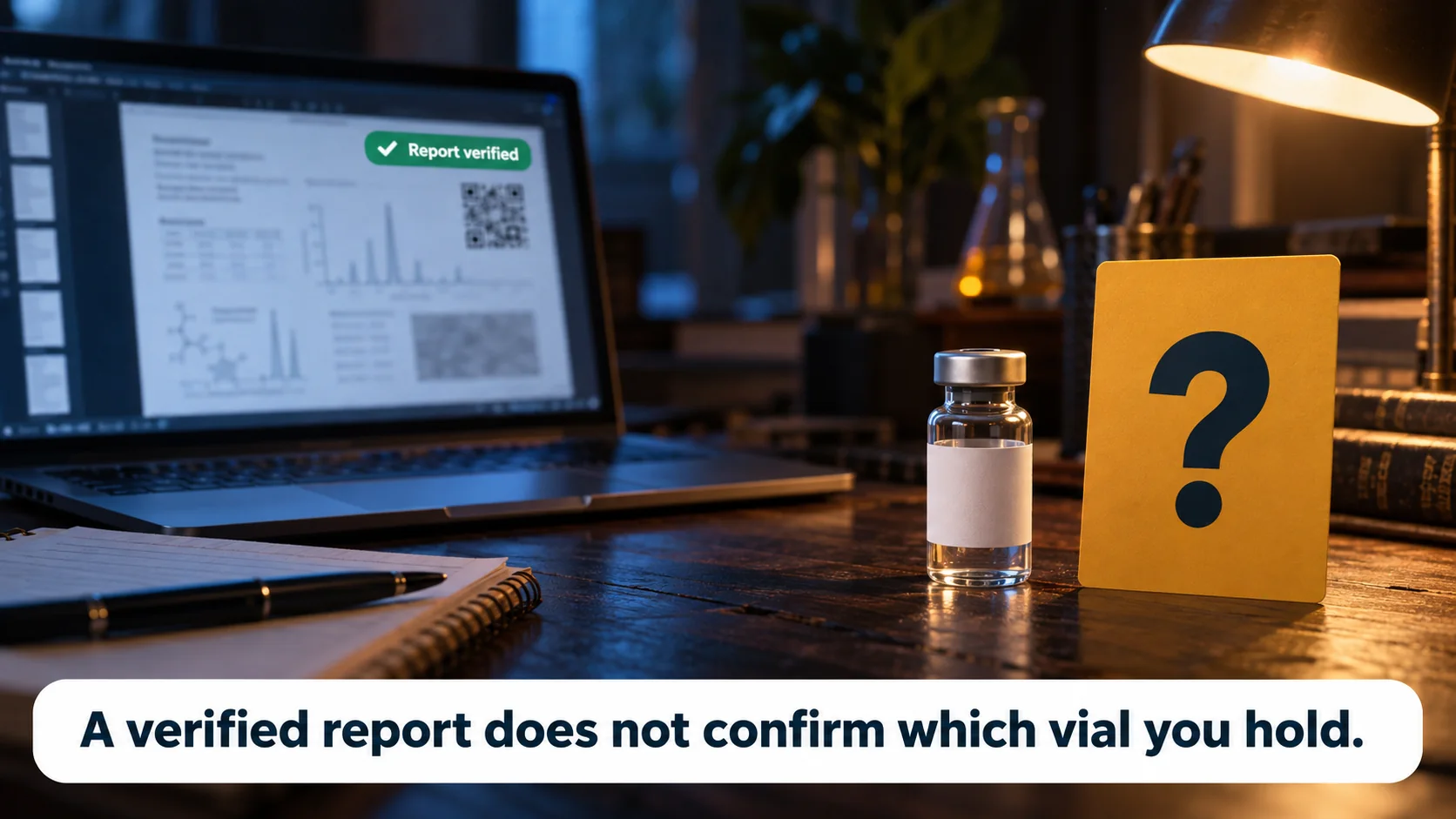
Quick answer: Janoshik peptide testing is done by Janoshik s.r.o., a commercial laboratory in the Czech Republic that tests samples customers mail to it. A Janoshik report shows what the lab measured in the one sample it received, on the dates printed, for the tests the customer bought. To verify a report, enter its task number and 12-character unique key at janoshik.com/verification, or scan the QR code printed on the report. A match confirms that Janoshik issued the report and that your copy is unaltered. It does not confirm that the vial in your hand is the one that was tested. The client, manufacturer and batch fields are typed by whoever ordered the test. We found no US statute, FDA rule or FTC document that defines “third-party tested” for research peptides, so judge the report itself.
Peptryn sells research peptides, so we have an interest in this topic. Our lab reports come from MZ Biolabs in Tucson, Arizona, not from Janoshik. Peptryn is not affiliated with Janoshik, and Janoshik says it does not endorse or recommend any seller.
Key takeaways
- A verified Janoshik report proves the lab issued it. It does not prove who made the product or that the vial you hold is the tested one. Customers type the client, sample, manufacturer and batch fields, and Janoshik sells extra copies of one result under different header details.
- The base test reports the amount per vial and the peptide purity by HPLC. Endotoxin, sterility, TFA, net peptide content, heavy metals and LC-MS screening are paid add-ons with their own reports, so a base report without those lines has not shown any of them.
- On October 10, 2026 we found no Janoshik listing in the Czech Accreditation Institute, A2LA or ANAB databases, and its pages make no accreditation claim.
- Janoshik’s public report list holds reports that clients paid to publish. Absence from the list tells you nothing, and a listing is not an endorsement.
- “Third-party tested” runs from a bare sentence to an independent purchase test, and each of five levels supports different claims. Peptryn’s reports come from MZ Biolabs, and we place them on the same ladder.
Last verified October 11, 2026. Prices, counts and directory searches are as of October 10, 2026, and Janoshik’s pages change, so check its site before you rely on a number. Sources are listed at the end. For laboratory and research use only. Nothing here is medical or legal advice.
What Janoshik is, and what it is not
Janoshik is a mail-in analytical laboratory. In the Czech business register it appears as Janoshik s.r.o., a limited liability company with its seat in Prague 1, created on October 25, 2022, with testing, measurement and analysis among its registered activities. Its website calls it an “independent testing laboratory” for anabolic compounds, peptides, SARMs and other substances. The About page says “Over 10 years of experience”. The register shows the company only from 2022. The lab may have operated earlier under another entity, and we did not research that.
Janoshik says it does not sell products and does not recommend suppliers. Its own pages address consumers and athletes as well as researchers, which is a different audience from Peptryn’s. Peptryn supplies materials for laboratory research only, and this guide covers the documents, not any use of the material.
| Question | What we found on October 10, 2026 |
|---|---|
| Who is it? | Janoshik s.r.o., company number 17668727, registered in the Czech business register on October 25, 2022, status active |
| Where is it? | Registered seat in Prague 1. Janoshik’s shipping guide gives the lab’s ZIP code as 252 10, and reports print no postal address |
| Is it accredited? | No listing in the Czech Accreditation Institute database, the A2LA directory or the ANAB directory, and no accreditation claim on its pages. We could not search PJLA’s directory |
| What is the “Substance Use Declaration” in its footer? | A 2023 letter from the Czech Institute for State Control of Veterinary Biologicals and Medicines acknowledging receipt of a notification under section 78 of the medicines act. It is not a license or an accreditation |
What a Janoshik test measures: the base test and the add-ons
Janoshik sells each test as a product with its own page. Every peptide page we opened lists one testing method, HPLC, and one result format for vials: amount in mg per vial and peptide purity. Janoshik’s help center defines peptide purity as the share of the peptide content that is the target molecule, with the rest being degradation products. It does not say how the base test establishes identity, and we could not confirm that mass spectrometry is used. Bloomberg saw LC-MS instruments in the lab, and Finnrick, a testing and rating company, lists Janoshik’s instrumentation as “HPLC / MS”, but Janoshik’s own pages say only “HPLC”. Janoshik publishes no detector, column, reference standard or measurement uncertainty.
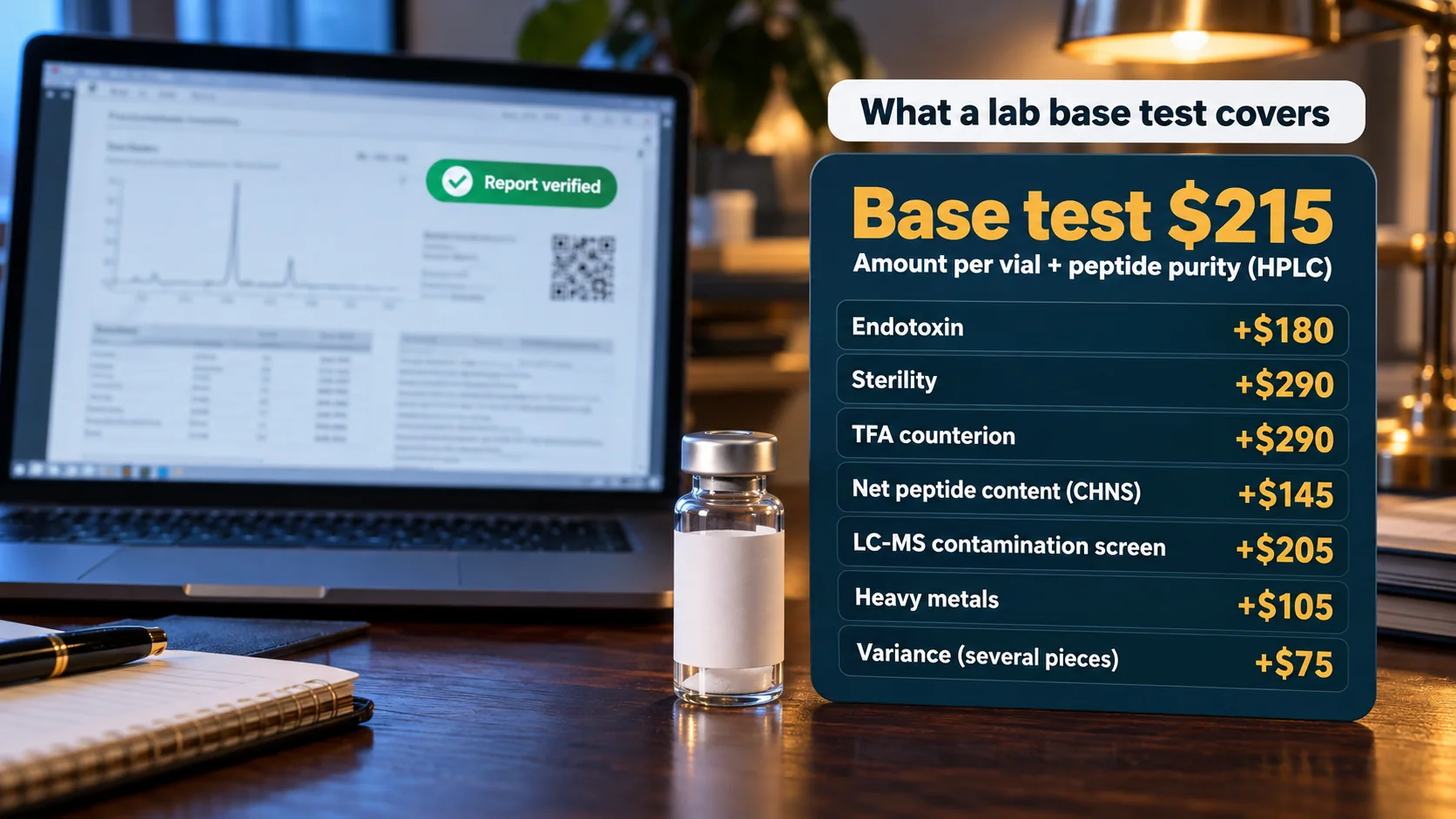
| Test | Price listed October 10, 2026 | What the result answers |
|---|---|---|
| Base peptide test (BPC-157 page) | $215 | Amount per vial and peptide purity by HPLC |
| Common GLP-1 blind test | $360 | Which of semaglutide, tirzepatide or retatrutide is in the vial, plus amount and purity |
| Endotoxin analysis | +$180 | Endotoxin in EU per vial. Janoshik describes values below 1 EU and above 10 EU per vial as estimates, and asks for a separate vial |
| Sterility (TAMC and TYMC) | +$290 | Whether colonies grew after cultivation, reported as PASS or FAIL; at least 14 business days |
| TFA analysis | +$290 | Trifluoroacetic acid in mg per vial |
| CHNS mass report | +$145 | Nitrogen and sulfur content, which Janoshik says is used for net peptide content |
| LC-MS contamination screen | +$205 | Other or degraded peptides, only those on Janoshik’s price list, identification only |
| Heavy metals | +$105 | Arsenic, cadmium, lead and mercury |
| Variance testing | +$75 | Several pieces from one batch compared |
If a line is missing from a report, that report does not show the result. Endotoxin and sterility results appear as separate reports with their own task numbers. Endotoxin and microbial contamination matter in cell-based and other in vitro work because they can confound results, which is why laboratories report them as separate tests.
Janoshik testing cost and turnaround
Prices differ by page. Of the 77 peptide pages listed on October 10, the BPC-157 and ipamorelin tests were $215, the most common price was $450 (42 pages), and the highest was $800. Janoshik also lists a $600 blind peptide screening against about 97 named compounds, a $25 raw-data add-on, and a $50 “Additional report”. The customer pays for shipping to the lab.
Product pages list about seven business days. The home page shows a live average, which read 38 hours from receipt on October 10 and changes from day to day. A rush option at +100% targets results within two business days, and sterility cannot be rushed. Janoshik’s Terms, which exist only in Czech, guarantee delivery within 21 business days of receipt (our translation). In the public non-sterility reports we read that carried both dates, analysis fell a median of three business days after receipt.
What the base test leaves unanswered
A purity percentage is the main-peak share of the chromatogram signal. It does not measure water, counterions or salts. Bachem, a peptide manufacturer, gives a worked example: 5 mg of weighed powder at 85% peptide content and 98.7% purity holds 4.195 mg of the target peptide. Our guide to what 99% purity means covers the arithmetic. MZ Biolabs states on its own COA page that purity testing does not test for activity, sterility or endotoxins, heavy metals, or pH.
How to read a Janoshik report, field by field
A Janoshik report is a single image, about 1,600 by 2,360 pixels, with the lab’s photographs of the received sample below it. The layout was identical on the 55 or so reports we opened, dated from 2024 to October 2026.
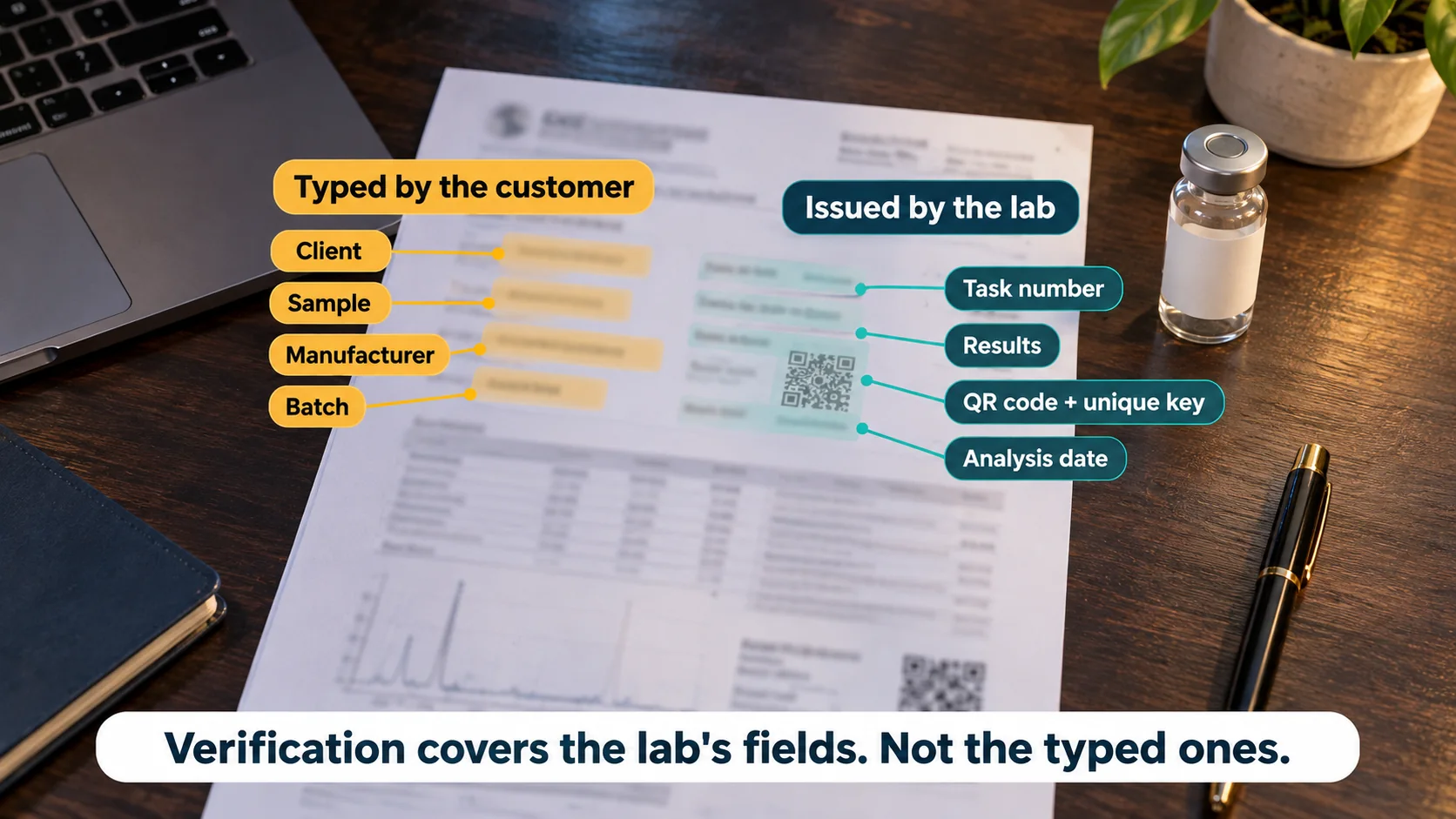
| Field and who fills it | What it tells you | What it does not show |
|---|---|---|
| Task number (lab) | A record exists | Anything about quality |
| Testing ordered, sample received (lab logs receipt) | A package arrived on that date | That it was a typical vial from the seller’s stock. In two reports the order date falls after the receipt date |
| Client (customer, “Anonymous” by default) | The name the customer chose | That the client is the seller or the maker |
| Sample (customer) | The customer’s label, often with marketing text | A label claim. The report never states one |
| Manufacturer (customer) | Whatever was typed | Who made the peptide |
| Batch (customer, editable until the package arrives) | Whatever was typed | That the value ties the report to the vial you hold. Seen values include “/”, “Unknown”, dates, years, color words and lot-style codes |
| Sample description (appears to be lab boilerplate) | Whether photos are attached | The retail packaging, unless the sender included it |
| Tests requested (lab) | The product ordered. Each add-on has its own task number | That an add-on was done because the sample name says so |
| Results (lab) | Measured amount and purity, using the lab’s own compound name | A pass or fail. No verdict is printed, except for sterility |
| QR code and unique key (lab) | Ties the image to Janoshik’s stored copy | That the vial you hold is the tested one |
| Analysis date and signature (lab) | When it was analyzed, with a signature graphic and no named signatory | Accreditation |
Janoshik’s help center and Terms confirm which fields the customer supplies. Clause 4.7 of the Terms says the customer specifies the client name, sample name, manufacturer and batch for the results sheet, and the report-header help article says the batch can be changed until the package arrives.
Not printed on any report we opened:
- the method or instrument
- the detector or wavelength
- the reference standard
- calibration
- measurement uncertainty
- limits of detection or quantification
- a pass or fail on identity, purity or quantity
- any accreditation mark
- the lab’s postal address
- a sentence saying the results apply only to the sample received (that sentence sits in the Terms)
Four things we saw in real reports
- A slash in the batch field. Report #167355, which its client chose to publish, shows a retatrutide sample named “Retatrutide 15mg”, measured at 17.68 mg and 99.594% purity, with the batch field holding a slash and the description reading “Pictures not included.” Our Peptide Sciences guide uses the same report to show purity and quantity answering different questions.
- One result, several names. Janoshik sells an “Additional report” for $50 and describes it as a copy of the main report with different header details. Report #223029 lists “Additional report” under tests requested. On the public list, #223028 and #223029 carry identical dates and results (retatrutide, 20.63 mg, 99.841% purity) with different client names, manufacturer text, batch values and unique keys, and both open on Janoshik’s verification site. Janoshik documents the service, and the pair shows why the header fields are weak evidence of who owns a product.
- Sterility named in the sample field only. On one public report from November 2024 (#53436), the sample field reads “TIRZEPATIDE 30MG | Sterility Test” and the tests-requested box reads “Assessment of a peptide vial or vials”. That report’s results show amount and purity only. Sterility is reported separately under its own task number, and we did not look for one for this sample. Look for the sterility line in the results table.
- Quantity above the label. Among the public GLP-1 reports we could compare with a client-typed label, none measured below the label, and the excess ran from 0.1% to 27.0%. The sample is small and self-selected, and clients pay to publish it. Janoshik does not say whether this reflects overfill, calibration or how labels are counted. Read the mg line next to the purity.
How to verify a Janoshik report
- Find the task number and the unique key. The task number is at the top left, written “#” followed by digits. The key is a 12-character code at the foot, below the sentence “Verify this test at www.janoshik.com/verify/ with the following unique key”. A QR code is printed above the results table.
- Enter both at janoshik.com/verification, or scan the QR code. Janoshik’s help article says both identifiers are required and the key should be typed in capital letters. In our test, the task number alone or a wrong key did not open a report.
- Compare the stored copy with the file you were given. Check the header fields, the dates and every result line. Janoshik says a report that differs from the stored version in any way is not legitimate.
- Treat a cropped file as unverified. You cannot verify a screenshot that is missing the key and QR code, so ask the seller for the full report.
- Compare the report with the product. Verification confirms only Janoshik’s own record. The eight checks below connect the report to the vial.
The public list is not a database of all reports
public.janoshik.com lists reports that clients paid to publish. Janoshik’s help center prices a public report at $85 for two months and a top placement at $120 for seven days. On October 10, 2026 the list held 359 reports, and task numbers on it run past 240,000, so most reports never appear there. Titles, “tested by” and “made by” fields on the list are written by the clients, and the page states that Janoshik does not endorse or have any affiliation with the companies listed.
| A successful verification shows | It does not show |
|---|---|
| Janoshik issued a report with this task number and key | That the vial you hold is the sample that was tested |
| Your copy matches the stored image | That the client, manufacturer and batch fields are true |
| The lab logged a sample on the dates shown | That other batches match this one |
| The listed measurements were reported | That tests not listed were done, or that the lab’s methods are validated |
What Janoshik’s Terms say
Janoshik publishes its Terms and Conditions in Czech only, in 13 pages. In our unofficial translation, where the Czech text governs:
- Clause 10.6: the results sheet speaks only about the sample or aliquot the lab received from the customer.
- Clause 8.7: the lab determines and reports the measured result and has no duty to provide automatic evaluation or comparison with legislation, earlier results or other labs’ results.
- Clause 11.4: Janoshik destroys the sample within 48 hours of the report, so a result cannot be re-analyzed later.
- Clause 6.7: in necessary cases the lab may use a subcontractor for part of a service, and Janoshik remains responsible to the customer for that work. Reports do not say when a subcontractor was used.
Finnrick makes the same structural point in its COA guide: a COA covers the submitted sample, shows no chain of custody, and says nothing about other batches. Finnrick sells testing, so we treat it as an interested source.
Is Janoshik legit? Three questions with three answers
Does the lab exist and issue verifiable reports?
On what we could check, yes: it is a registered company, and verification works on its own site. Bloomberg Businessweek reported on June 17, 2026 that a reporter visited the Czech facility in April and saw LC-MS instruments and a peptide sampling room. Finnrick published 200 results measured at Janoshik between April 14 and September 9, 2025.
Is it accredited, and is it independent of the sellers who use it?
Accreditation is not shown. We found no listing in three directories and no claim on its pages. Janoshik is a separate company from the sellers, and it says it does not recommend suppliers. The seller chooses the vial, pays for the tests and types the batch details. ISO/IEC 17000, the standards vocabulary, describes third-party work as work by a body independent of the provider and with no user interest, and says that an outside body acting for and controlled by the provider is still first-party. Whether a vendor-paid lab meets that test is a judgment the standard leaves open.
Does a seller’s Janoshik report mean the product is good?
It depends on whether the report passes the eight checks below.
Janoshik’s Trustpilot page showed 18 reviews and a 2.9 average on October 10, split between 44% five-star and 44% one-star. Trustpilot does not fact-check reviews, so we cite these unverified opinions only to show what customers raise. Reviewers praise speed, communication and reputation. The criticism most often cites no accreditation, little method detail and fees, and several negative reviews cite slow support or make accusations we could not check. We found no regulator action, court filing or documented Janoshik lab error in the sources we could search. Our tools could not search Reddit, so it is not represented.
Finnrick’s Janoshik page says Janoshik has not yet answered its methodology questionnaire and that no products are currently orderable with the lab through Finnrick. It shows a 33% pass rate for the latest 200 published tests, covering 42 vendors, under its default Purity Focus standard, which requires at least 99.5% purity and a quantity within 35% of the claim. Finnrick’s samples come from three channels (community submissions, vendor-submitted samples and samples Finnrick bought itself), and its Janoshik page does not give the split. The 99.5% purity floor is demanding, and the 200 tests ran between April and September 2025, so the figure says little about Janoshik’s accuracy. The public Janoshik reports we read looked different: of those that gave a purity figure, all but four showed 99.0% or higher. Sellers choose which reports to publish, so selection may explain part of that gap, but we did not grade the public reports under Finnrick’s rule, so we cannot say how much.
A figure circulates that Janoshik found 43% of peptides it tested in 2024 failed to meet label purity claims. The earliest instance we found is an unsourced opening line in a January 14, 2026 article on thepeptidelist.com, and we found no Janoshik publication behind it. Bloomberg reported that about 5% of samples do not pass, without defining “pass”. These figures come from different sources and use different definitions, so none is a Janoshik failure rate.
What “third-party tested” can mean: five levels
We found no US statute, FDA rule or FTC document that defines “third-party tested” for research peptides. It is an advertising claim. The FTC’s advertising substantiation policy says an advertiser needs a reasonable basis for objective claims before making them, and that a claim such as “tests prove” needs at least that level of proof. In one federal case, the owner of Paradigm Peptides was sentenced on July 30, 2026 to 70 months in prison after pleading guilty to introducing unapproved new drugs into interstate commerce with intent to defraud and mislead. The U.S. Attorney’s release says he and his employees falsely said the products were tested, and that he did not test them. CBS reported, citing court filings, that the owner admitted “they forged laboratory certificates.” The release does not use the word “forged”.
The six FDA warning letters we read (one dated March 31 and five dated August 24, 2026) turn on intended use as shown on a website, which testing does not address. Each says that, despite “research use only” labeling, evidence from the website shows the products are intended as drugs for human use. None cites a testing, purity or certificate claim as evidence, and a seller with perfect reports can still receive a letter. This guide is not advice on complying with FDA rules. A seller with questions about those rules should ask a qualified attorney. Our guide on what “research use only” means legally covers the law.
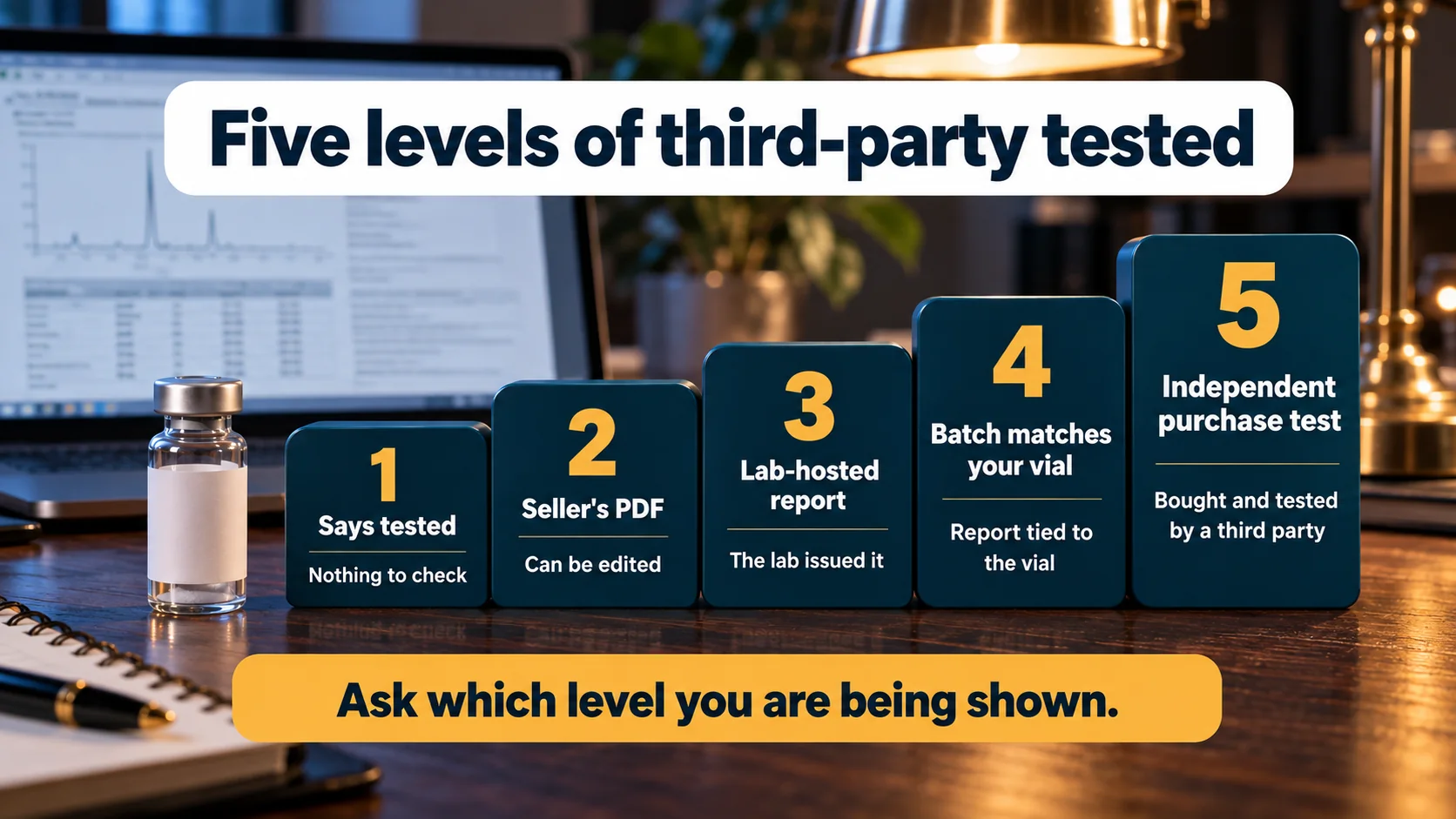
| Level | What it supports | What it does not show |
|---|---|---|
| 1. “Tested”: a sentence from the seller | Nothing you can check | The Justice Department says Paradigm Peptides claimed testing it did not do (release of July 30, 2026) |
| 2. Seller-uploaded report: a PDF or screenshot with no lab-side check | That a document exists | Finnrick said in March 2026 that it has seen multiple doctored COAs. CBS reported on July 2, 2026 that a peptide brand’s website claimed third-party testing, and the lab named on its retatrutide certificate said it had not issued the certificates |
| 3. Lab-hosted, verifiable report on a sample the seller submitted | The lab issued these numbers for a sample it received | That the vial was representative, that it is the one you hold, or that the header is true |
| 4. Batch-linked report: level 3 where the batch printed on the vial matches the report | The tested sample carried the same batch identifier | Other batches, anything after the test date, or that the customer-typed batch value is true |
| 5. Independent purchase test: a third party buys on the open market, keeps chain of custody and tests | What a customer could have received on that purchase | More than one purchase on one date |
Accreditation is a separate question. A body such as A2LA, ANAB or PJLA grants ISO/IEC 17025 accreditation, and it covers a defined scope. PharmLabs in San Diego posts a PJLA certificate (L25-933-R1, ISO/IEC 17025:2017) whose scope lists HPLC testing of ten named peptides in powders and similar materials, and no endotoxin test. We could not cross-check it in PJLA’s directory. Harrens Lab in California holds A2LA accreditation whose two scopes contain no peptide entry. A claim worth relying on names the accrediting body, the certificate number and the scope, for example “accredited to ISO/IEC 17025:2017 by PJLA, certificate L25-933-R1, for the tests listed in its scope”. Our Peptide Sciences guide summarizes the directory searches.
How other labs’ verification compares
These tools confirm that a lab holds a copy of a report. They do not tie a report to a vial. As of October 10, 2026:
| Lab | What you enter | Notes |
|---|---|---|
| Janoshik | Task number and a 12-character unique key, or a QR code | Public form. The key is printed on the report |
| Freedom Diagnostics | A search code, which is the first four characters of the company name plus the accession number, or a company name | Public lookup |
| Chromate | Job number and access code | Public form |
| BTLabs | Report number | The lab’s own portal |
| MZ Biolabs | No lookup form. Certificates open at a readable certificate ID in the lab’s URL, and PDFs carry a QR “proof of authenticity” | No accreditation statement on its public site |
| Krause Analytical | No public lookup. A form that sends an uploaded CoA to the lab | Screenshots cannot be validated, per the form |
| Finnrick | A 7-character certificate ID | A rating company. The Verify page asks visitors to sign in |
Eight checks for a seller’s “Janoshik tested” claim
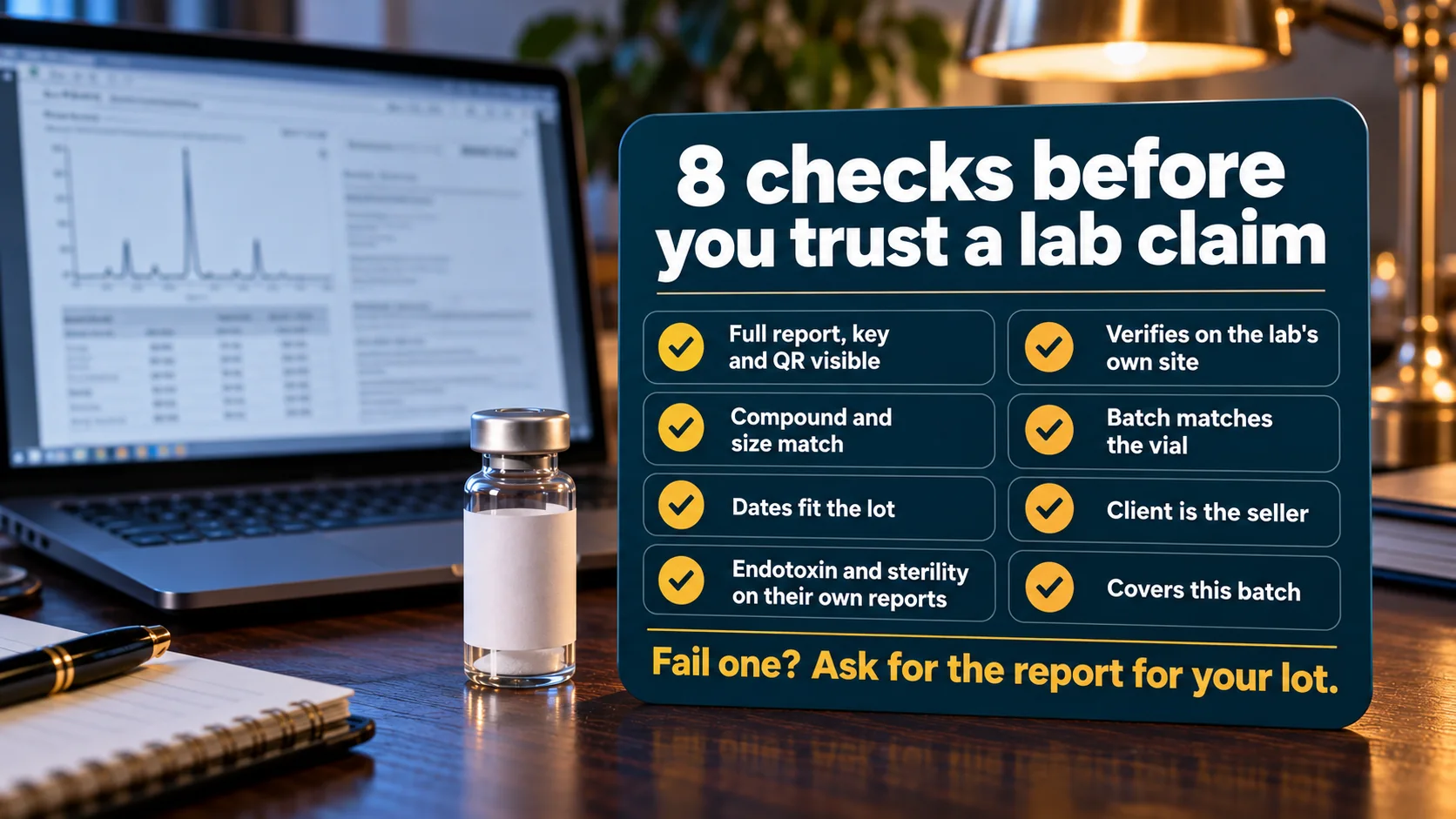
- Full report, key and QR visible. Without them you cannot verify it.
- It verifies on janoshik.com. Open the stored copy and compare it with the seller’s file.
- Compound and size match the product. A 30 mg product needs a 30 mg sample. Blends get an amount per compound and no purity line, per Janoshik’s help center.
- The batch matches the vial. A slash, “Unknown”, a year or a color word ties the report to nothing. A lot code printed on the vial and on the report moves the claim from level 3 to level 4.
- The dates fit. The analysis date should come after the lot was made and close to your purchase date. Janoshik destroys the sample within 48 hours, so an old report cannot be repeated.
- The client is the seller. A different company, “Anonymous” or a wholesaler name needs an explanation.
- The result lines match the claims. If a seller says “sterile” or “endotoxin tested”, look for a separate sterility or endotoxin report with its own task number. A sample name that says so is not evidence.
- It covers this batch. Ask whether every batch is tested or only one, and ask for the report for your lot.
For payment and returns, see our supplier scorecard. For lookalike sites, see our Peptide Sciences guide. For what each test is, see peptide testing explained and what a COA is.
What a second test of a lot can add
One vial is one data point. A second vial from the same lot, or a second laboratory, adds more than the same test repeated, and a report on material you hold says more about that lot than a report on a vial the seller chose. Laboratories set their own sample, ordering and shipping terms, and Janoshik says its report speaks only about what it received. Peptryn does not give shipping, customs or export advice and does not recommend sending any material across a border. Rules on moving laboratory materials differ by country and by material, so ask a qualified adviser before you send anything anywhere. Our peptide testing guide covers what an independent test can and cannot show.
How Peptryn documents its own lots
The laboratory that issues Peptryn’s certificates is MZ Biolabs in Tucson, Arizona. Peptryn.com is the client named on the certificates and pays for the testing. We describe MZ Biolabs as a third-party laboratory and not as independent of Peptryn. No Peptryn certificate comes from Janoshik, and we found no report on Janoshik’s public list that names Peptryn on October 10, 2026.
| Item | What our reports show, as of October 10, 2026 |
|---|---|
| Coverage | 19 certificate pages for 17 products in the COA Library. Several products and sizes have no published report yet |
| What a purity and identity certificate prints | Client, lot, analysis date, HPLC-UV purity, measured quantity per vial, a peak list, expected and measured mass, the analyst’s signature and a QR “proof of authenticity” |
| Lab-hosted copy | All 19 pages link to the lab’s own record for the right lot. The 30 mg retatrutide page’s lab link opened the 10 mg report (lot 2026-06-12) in our October 11 check. It was corrected on October 12, 2026 and now opens the 30 mg lot (2026-08-31) |
| Endotoxin | 15 of the 19 listings have an endotoxin report. Retatrutide 30 mg, KPV 5 mg, KPV 10 mg and tirzepatide 30 mg do not. The endotoxin reports are hosted on peptryn.com. They print no QR code or certificate ID, and we found no lab-hosted copy |
| Sterility, heavy metals | Not on any listing |
| Lot field | A date, with a cap-color note on the three 2026-09-17 reports. The 19 reports carry five distinct lot values. The date 2026-08-05 appears on 11 reports (10 single compounds and the Wolverine blend), so the field reads as a Peptryn date label and not as a manufacturer lot code |
| Measured quantity | Across the 16 single-compound certificates, from 91.4% to 162.6% of the labeled amount, with 14 above the label. The 162.6% is KPV 5 mg, added after our September 26 data report, whose highest value is 136.5%. Purity and quantity are separate numbers on our reports too |
| Not printed | No accreditation statement, measurement uncertainty, reference standard, calibration or limit of quantification. No sample-receipt date, chain-of-custody line or statement that results apply only to the sample received. Identity pages say “Molecular weight confirmed”; purity and quantity carry no pass or fail |
MZ Biolabs identifies each certificate by a readable ID in its URL, with no task number or key, so confirm that the lot printed on the lab’s record matches the lot on the vial you hold. On the five-level ladder, the purity and identity certificates sit at level 3, because the QR code on each PDF opens the lab’s own record. The 15 endotoxin reports sit at level 2. A certificate reaches level 4 only when the lot label on the vial matches the lot on the certificate, so check that before you rely on it, and contact us if it does not match. We published a data report on purity and measured quantity on September 26, 2026. It covers 15 lots and predates the KPV and tirzepatide certificates added in October, so its figures differ from the table above. The COA Library lists every published certificate.
Janoshik testing: common questions
Is Janoshik legit?
Janoshik s.r.o. is a registered Czech company, and its reports can be verified on its own site, which we tested. It calls itself an independent lab, shows no accreditation in the directories we searched, and prints no method detail on its reports. Whether a seller’s Janoshik report means the product is good depends on the report itself: a verifiable key, a batch that matches the vial, and result lines for each test the seller claims.
Where is Janoshik located?
In the Czech Republic. The company register lists its seat in Prague 1, Janoshik’s shipping guide gives the lab’s ZIP code as 252 10, and its reports print no postal address.
How do I verify a Janoshik report?
Enter the task number and the 12-character unique key printed on the report at janoshik.com/verification, or scan the QR code. Janoshik says both are required and the key should be typed in capitals. Compare the stored copy with the file you were given. A match shows that Janoshik issued the report and that your copy is unaltered. It does not show that the vial you hold is the one that was tested.
What is the unique key in Janoshik?
It is a 12-character code of capital letters and digits at the foot of each report, below the sentence that begins “Verify this test at”. With the task number it opens the stored copy. A report cropped to hide the key cannot be verified.
What does “third party tested peptides” mean?
It means a laboratory other than the seller tested a sample. It has no legal definition for research peptides, and it covers everything from a bare claim to an independent purchase test. The five levels above show what each version supports, and the eight checks show how to test a seller’s claim. Our third-party tested peptides guide applies the same ladder to any listing.
Is a Janoshik report the same as a COA?
Janoshik calls it a test report. It records measurements for one sample the lab received, and it does not certify a batch. A seller’s certificate of analysis built on it is only as strong as the link between that sample and the batch you buy, which is why the batch on the vial matters.
How do I read Janoshik test results?
Start with the results table: the compound, the amount in mg and the purity percentage. Then read the header, remembering that client, sample, manufacturer and batch are typed by the customer. Check the dates, and look for separate reports if endotoxin or sterility is claimed. The field table above explains each line.
Can Janoshik test peptides?
Yes. Its catalog listed 77 peptide tests on October 10, 2026, including BPC-157, TB-500, ipamorelin and a blind test for semaglutide, tirzepatide and retatrutide. The base peptide tests list HPLC and report the amount per vial and the peptide purity. It tests samples that customers mail in.
How much does a Janoshik test cost?
On October 10, 2026 the BPC-157 and ipamorelin tests were listed at $215 and the GLP-1 blind test at $360. Across 77 peptide pages, $450 was the most common price and the highest was $800. Add-ons cost extra: endotoxin $180, sterility $290, TFA $290, CHNS $145, LC-MS screening $205, heavy metals $105. The customer pays for shipping. Check the product page for current prices.
How long does Janoshik testing take?
Product pages list about seven business days. The home page shows a live average from receipt, 38 hours on the day we checked. A rush option at +100% targets two business days, sterility takes at least 14 business days, and the Terms guarantee delivery within 21 business days of receipt (our translation). Shipping time comes on top.
Does Janoshik test for endotoxin and sterility?
Yes, as paid add-ons that are reported separately. Janoshik lists endotoxin analysis at +$180 and sterility testing (TAMC and TYMC) at +$290. A base report contains neither, so a seller who shows only the base report has shown neither result.
Is Janoshik ISO 17025 accredited?
We found no listing in the Czech Accreditation Institute database or the A2LA and ANAB directories on October 10, 2026, and Janoshik’s pages make no accreditation claim. We could not search PJLA’s directory, so “not found” is not proof. Accreditation is also specific to a scope of tests.
Does a Janoshik report approve or certify a peptide?
No. It shows measured amounts and purity, plus any add-ons bought, for one sample. Janoshik’s Terms say its laboratory regulation or any test protocol does not by itself give a product approval by any authority. Sterility and endotoxin are separate tests, and no laboratory report establishes that a material is suitable for any particular use.
Which peptide companies use Janoshik?
Janoshik publishes no customer list and says it does not recommend suppliers. Its public list is paid and client-chosen. The way to tell is the report in front of you: the client name, the dates and a successful verification. We do not rank other sellers here.
What is Janoshik’s public list?
public.janoshik.com lists reports that clients paid to publish, at $85 for two months or $120 for a seven-day top placement. It held 359 reports on October 10, 2026. Titles and “tested by” fields are written by the clients. A listing is not an endorsement, and absence from the list is not evidence of anything.
Is Janoshik the same as Finnrick?
No. Janoshik is a laboratory. Finnrick is a commercial testing and rating company that sends samples to partner labs and publishes vendor ratings. It published 200 Janoshik-measured results from 2025 and says no products are currently orderable with that lab.
How do I know if a peptide COA is real?
Look for a verification route on the lab’s own site, such as a key, an ID or a QR code. Open the lab-hosted copy, compare every field, and confirm the compound, size and batch match the product. Be wary of cropped images, screenshots and reports with no batch. Our COA guide lists what a certificate should contain.
Does Peptryn use Janoshik?
No. Every certificate Peptryn publishes was issued by MZ Biolabs in Tucson, Arizona, and we found no report on Janoshik’s public list that names Peptryn on October 10, 2026. Peptryn is not affiliated with Janoshik.
Sources
All pages were read on October 10 and 11, 2026 unless noted. Report numbers refer to Janoshik public reports.
- Janoshik. Verification page. Task number and unique key fields.
- Janoshik. BPC-157 analysis. Method, result format, price, add-ons, minimum sample, turnaround.
- Janoshik. Common GLP-1 peptide blind test; Blind peptide screening; peptide catalog.
- Janoshik. About us; home page.
- Janoshik help center. How can reports be verified; Report header details; Additional services; Public and Premium Top pages; Endotoxin analysis; Sterility results; Understanding purity results; Turnaround; Rush testing; Shipping overview; Supplier recommendations.
- Janoshik. Terms and Conditions (Czech PDF), clauses 4.7, 5.1, 6.7, 8.7, 8.8, 10.6 and 11.4. English renderings are our unofficial translation. Substance use declaration (Czech PDF).
- Janoshik. Public report list, which includes reports #167355, #223028, #223029 and #53436.
- Czech business register (ARES). Janoshik s.r.o., company number 17668727. Czech Accreditation Institute. Accredited bodies database. A2LA. Directory. ANAB. Directory.
- Finnrick. Labs; Janoshik page; How to read a COA; Methodology; Verify. Finnrick sells testing and memberships.
- Bloomberg Businessweek. The Billion-Dollar Peptides Gold Rush (online title “Peptides Fuel a Multibillion-Dollar Startup Race”). June 17, 2026.
- Trustpilot. Janoshik reviews. Unverified reviews.
- thepeptidelist.com. We Sent 10 Peptides to a Lab. 3 Failed. January 14, 2026. Cited only as the earliest instance we found of the 43% figure.
- CBS News. What a Brooklyn bodega reveals about the craze for an experimental weight-loss drug. July 2, 2026. Judge sentences peptide vendor to nearly 6 years in prison. July 30, 2026.
- U.S. Department of Justice, Northern District of Indiana. Sentencing release. July 30, 2026.
- FDA warning letters: Gram Peptides (March 31, 2026); Tex Peptides, Peptide Partners, Royal Peptides, NuScience Peptides and Peak Performance Peptides (August 24, 2026).
- Federal Trade Commission. Policy Statement Regarding Advertising Substantiation. 1984.
- NIST. ISO/IEC 17000 definition of third-party and first-party.
- PharmLabs. PJLA certificate L25-933-R1. Harrens Lab. A2LA directory entry, certificates 4074.01 (Biological) and 4074.02 (Chemical).
- Verification pages: Freedom Diagnostics; Chromate; BTLabs; Krause Analytical; MZ Biolabs certificate page.
- MZ Biolabs. COA testing. Bachem. Quality control of amino acids and peptides and frequently asked questions, the source of the worked example.
- Peptryn. COA Library; Peptide COA data report; Peptide Sciences guide.
Editorial note: Peptryn sells the research peptides discussed on this site for laboratory use only. This guide is informational and is not medical advice. To report an error, use the contact page.
All products on peptryn.com are intended for laboratory research purposes only. They are not drugs, foods, dietary supplements or cosmetics, and they are not for human consumption, self-administration, or veterinary use. You must be 21 or older to buy. The information on this page has not been evaluated by the U.S. Food and Drug Administration and is not intended to diagnose, treat, cure, or prevent any disease. Nothing here should be construed as medical advice.
Related: Klow80 blend: price, lot certificate and buying checks