Best Place to Buy Peptides Online (US, 2026): How to Compare Suppliers
Disclosure: Peptryn sells research peptides, so we have a stake in this topic. This guide scores suppliers on public, checkable criteria, and it scores Peptryn on the same checklist, including where we fall short. No supplier paid to be included, and no competitor is named or ranked here.
The short answer
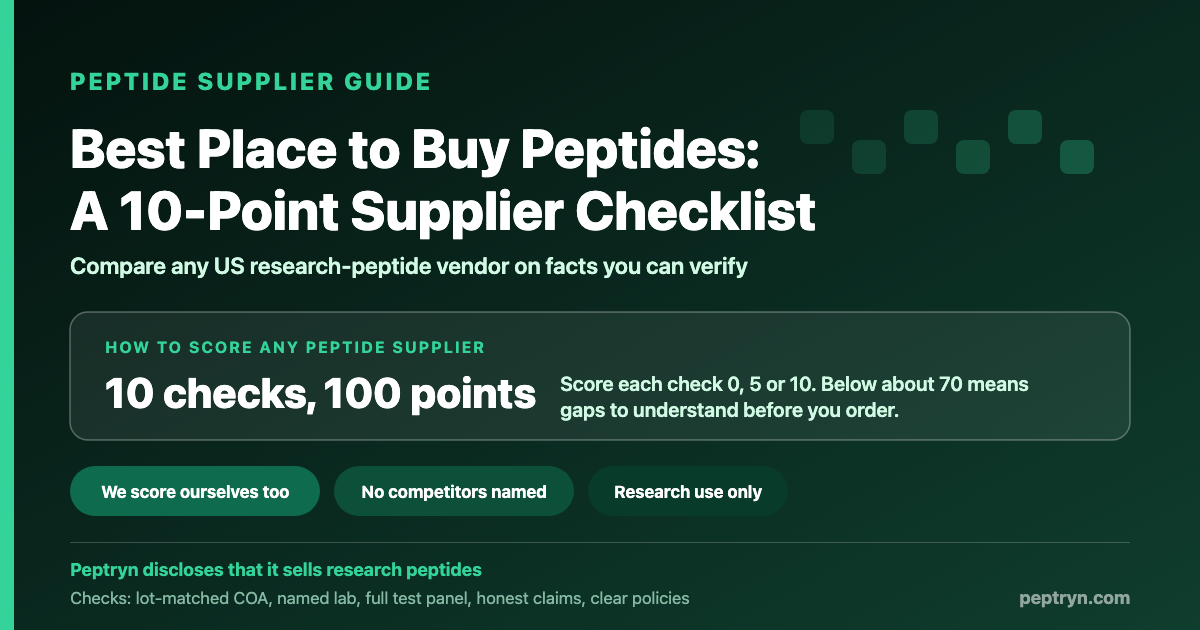
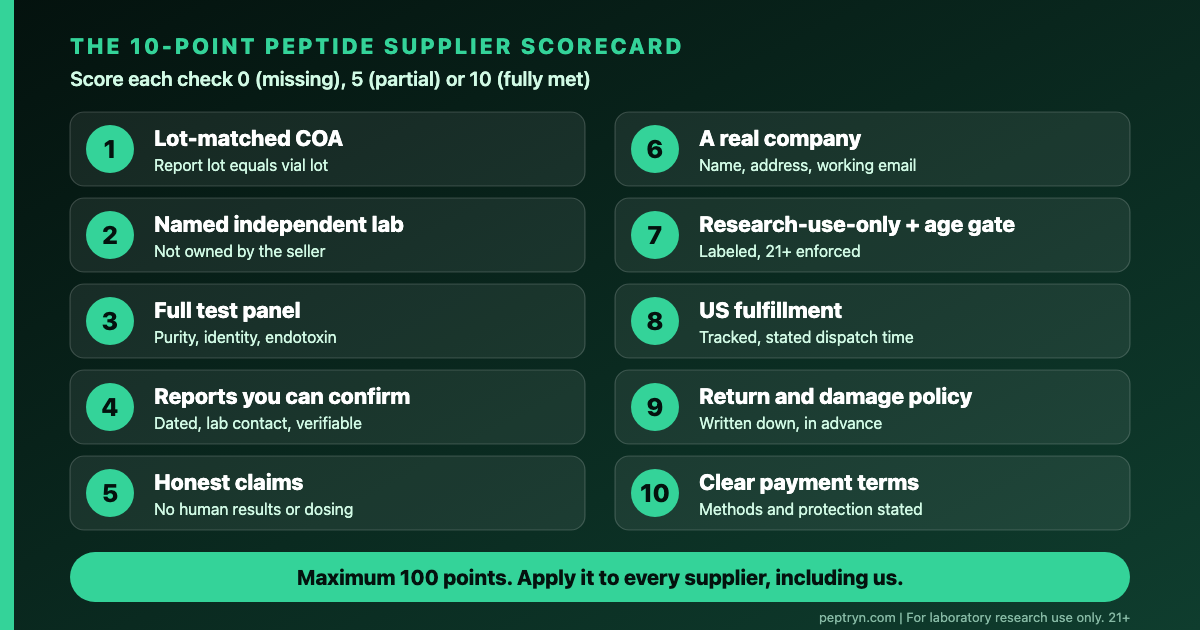
The best place to buy peptides online in the US is the supplier whose claims you can verify. Ranked lists of “the best peptide vendors” are opinions, and many are written by sellers, affiliates or forum accounts with a stake in the result. A checklist works better, because you can run it on any supplier in about ten minutes. Ten checks matter most: a lot-matched certificate of analysis, a named independent lab, a full test panel (purity, identity and endotoxin), reports you can confirm, honest claims, a real company behind the site, research-use-only labeling with an age gate, US fulfillment, clear return and damage policies, and clear payment terms. This guide explains each check, lists the red flags, and shows how Peptryn scores on the same list. All peptides discussed are laboratory research materials, not for human or veterinary use.
Where peptides come from: the supplier types
People searching for “peptide suppliers”, “peptide companies” or “peptide sources” are looking at very different businesses. The right check depends on which type you are dealing with.
| Supplier type | What they sell | Who it is for | What to check |
|---|---|---|---|
| Contract manufacturers (CDMOs) | Custom sequences and bulk peptide, often for drug development | Companies and institutions placing large or custom orders | Quality systems, quotes in writing, minimum order sizes |
| Catalog research-chemical suppliers | Standard peptides in small quantities with documentation | Academic and industry laboratories | Lot-matched COAs, stated purity methods |
| Online research-peptide vendors | Lyophilized research peptides in vials, shipped direct | Independent researchers and small labs | All ten checks below |
| Resellers and drop-shippers | Products bought from another source and relabeled or forwarded | Anyone, though the origin is often unclear | Whose lab tested the lot you receive |
| Licensed pharmacies and clinics | Prescription products dispensed under medical and pharmacy rules | Patients working with a licensed clinician | Outside the scope of this guide |
This guide covers the third row: online vendors that sell research-use-only peptides. Research-use-only materials are not approved for human use. If you have a medical question, speak to a licensed clinician, since no supplier checklist can answer it.
Why a checklist beats a “best peptide vendors” ranking
Three problems affect almost every ranking you will find.
- Conflicts of interest. A vendor ranking its own competitors, or an affiliate earning a commission on each click, has a reason to put a particular name first. The Federal Trade Commission’s Endorsement Guides expect material connections to be disclosed, and many rankings do not do it.
- Claims nobody can check. Statements like “we tested 12 companies” mean little without the lab reports, dates and lot numbers behind them.
- Stale information. Suppliers change labs, prices and policies. A ranking from a few months ago can be wrong today.
Independent test data is the exception. Finnrick, for example, buys or receives samples, sends them to third-party labs and publishes purity and label-accuracy results for a large number of vendors. Its stated policy is not to accept payment to change ratings. If a vendor has a page there, read it. Consider any single data source as one input rather than a verdict.
The 10-point supplier scorecard
Score each check 0 for missing, 5 for partial and 10 for fully met. The maximum is 100. There is no official pass mark, but a supplier that scores below about 70 has gaps you should understand before ordering.
| # | Check | What full marks looks like |
|---|---|---|
| 1 | Lot-matched COA | The report shows the lot number printed on the vial you receive, and each lot has its own report |
| 2 | Named independent lab | The lab is named on the report and is not owned by the seller |
| 3 | Full test panel | Purity by HPLC, identity confirmed (usually by mass spectrometry) and an endotoxin result |
| 4 | Reports you can confirm | Dated reports, the lab’s contact details and a way to verify that the report is genuine |
| 5 | Honest claims | No promises of human results, no dosing schedules, no “medical grade” or “for human use” language |
| 6 | A real company | A named business, a physical address, a working email and a history you can look up |
| 7 | Research-use-only labeling and an age gate | Every product is labeled for laboratory research and the site requires buyers to be 21 or older |
| 8 | US fulfillment | Ships from a US facility with tracking and a stated dispatch time |
| 9 | Clear return and damage policy | The policy is written down, and it says what happens if an order arrives damaged or wrong |
| 10 | Clear payment terms | The site lists the accepted payment methods and tells you what protection, if any, each one gives |
How to run each check
1. Lot-matched COA
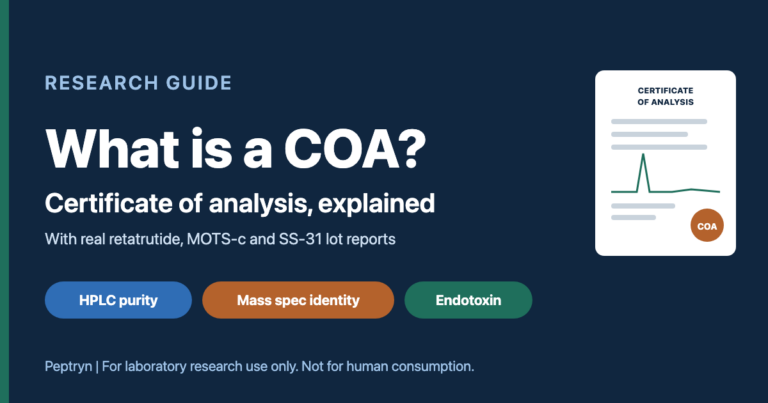
A certificate of analysis is only useful if it describes the material in your hands. Find the lot number on the vial label and look for the same number on the report. A generic report for a product name, with no lot number or the same date on every product, tells you very little. Our guide to what a COA is shows what each field means.
2. Named independent lab
“Third-party tested” is easy to write. Look for the laboratory’s name on the report itself, and search for that lab independently. A lab that has no website, no address or the same name as the seller is a warning sign.
3. Full test panel
A purity percentage alone does not tell you the peptide is the right one. Purity by HPLC measures how much of the signal belongs to the main peak. Identity (usually mass spectrometry) confirms the molecular weight matches the intended sequence, and an endotoxin result covers bacterial contamination. See peptide purity and peptide testing for the details, and how peptides are made for why each impurity type arises.
4. Reports you can confirm
A screenshot of a report can be edited. Better suppliers give the lab’s name and contact details and are willing to say how a buyer can check that a report is genuine. Be cautious about round numbers such as exactly 100 percent purity, and about the same layout, date and values appearing across unrelated products.
5. Honest claims
A research compound has not been shown to do the things a marketing page may imply. A supplier that promises muscle, fat loss, sleep or age-reversal results, prints dosing schedules or says a product is safe for people is asserting something the science does not support. It also puts you at more risk if the regulator takes an interest in the seller. Read our peptide legality guide for the regulatory background.
6. A real company
Look for a named business, a physical address, a support email that answers and some history. Search the business name together with words like “complaints” or “reviews”, and read the results critically, because reviews can be bought and can also be written by competitors.
7. Research-use-only labeling and an age gate
Legitimate research suppliers state the limits of use up front and stop underage buyers at the door. A site that markets to consumers for personal use while carrying a small research-only footer is doing something different from what the label says.
8. US fulfillment
A domestic ship-from address, tracking and a stated dispatch time reduce the risk of customs delays and temperature exposure in transit. Ask where the parcel ships from, not only where the business is registered.
9. Clear return and damage policy
Nobody expects a returns policy for a vial that has been opened, but a clear statement on damaged, missing or incorrect orders is a sign that the business expects to be held accountable. Look for it in writing before you order.
10. Clear payment terms
Payment methods differ in what protection they give you. Card payments usually allow a chargeback dispute. Bank transfers, payment apps and cryptocurrency are often irreversible. Neither is automatically wrong, but the supplier should say which methods it accepts, and you should decide with that in mind.
How to compare peptide prices fairly
Prices are the first thing most buyers compare and the easiest thing to compare badly. Three adjustments make a comparison fair.
- Compare price per milligram, not price per vial. Divide the price by the amount in the vial. A hypothetical 5 mg vial at $50 costs $10.00 per mg, and a hypothetical 10 mg vial at $80 costs $8.00 per mg.
- Add shipping and minimums. A low list price with paid shipping can cost more than a higher price with free shipping over a threshold.
- Compare the same thing. The same compound can be sold as different salt forms, blends or purities, and the vial contents are not always what the headline size suggests. The COA should state what was tested.
If two suppliers are close on price, the one with better documentation is usually the better choice. If one is far cheaper than the rest, use the red-flag list before you order.
A short checklist before you pay
- Open a sample COA and confirm it shows a lot number, a lab name and a full test panel.
- Check that the claims on the product page stay within research use.
- Read the shipping, return and payment terms in full.
- Check that the business publishes a name, address and working email.
- When the order arrives, match the lot number on the vial to the report and keep both.
Red flags when comparing peptide vendors
These are judgment calls based on the checks above, not proof of wrongdoing. Two or three together are a reason to walk away.
- No lot number on the COA, or one report reused across lots
- No lab name, or a lab that cannot be found independently
- Purity figures that are always exactly 100 percent, or nearly identical across unrelated products
- Claims about human results, dosing schedules or “medical grade” material
- No company name, address or working contact channel
- Prices far below the rest of the market with no explanation
- Pressure tactics, countdown timers or “last chance” language
- Reviews that all appeared in a short window, or only on the seller’s own site
- No stated policy for damaged or incorrect orders
How Peptryn scores on the same checklist
We ran the same ten checks on ourselves using what our own site states today. Where we meet a check, the source is a page you can read. Where we do not, we say so.
| # | Check | Our result | What our site says |
|---|---|---|---|
| 1 | Lot-matched COA | Meets | A COA Library organized by product and lot number, and each order includes a COA. Buyers match the lot number on the label to the library |
| 2 | Named independent lab | Meets | Testing is stated to be done per lot by MZ Biolabs, described as an independent third-party laboratory |
| 3 | Full test panel | Meets | Reports list purity, identity and endotoxin results |
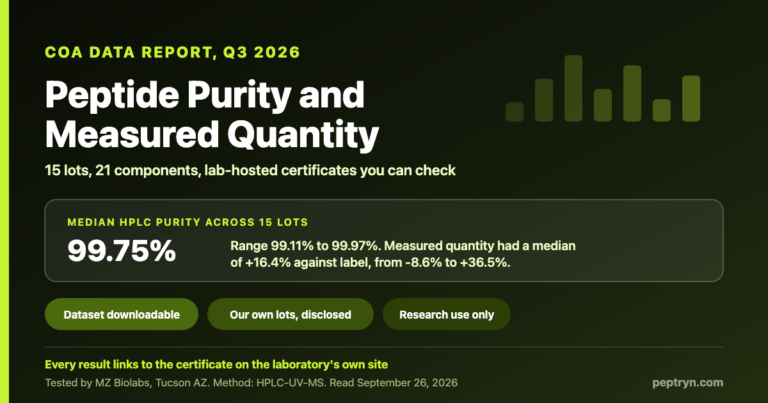
| 4 | Reports you can confirm | Partly | Each published report links to a certificate hosted on the lab’s own site, showing the lot number, analysis date and a QR code. The Retatrutide 30mg report currently links to a sample instead. The page does not yet describe how failed lots are handled |
| 5 | Honest claims | Judge it yourself | Open any product page and check what we claim. Products are sold for laboratory research only |
| 6 | A real company | Partly | A US business address and support email are published. No legal entity name or phone number is stated |
| 7 | Research-use-only and age gate | Meets | Products are labeled for laboratory research only, and buyers must be 21 or older |
| 8 | US fulfillment | Meets | Ships from a US facility, same-day dispatch before the daily cutoff, tracking, plain packaging, and free shipping over $150. No international shipping |
| 9 | Return and damage policy | Gap | Returns are not accepted after shipment. Damaged or incorrect items are handled if you contact us with the order details and photos |
| 10 | Clear payment terms | Meets on clarity, with a caveat | Accepted methods are Zelle, CashApp and USDT (TRC-20), which are stated on the FAQ. Those methods do not give the chargeback protection that cards do |
That is a fair picture: strong on documentation and testing, and weaker on returns and payment protection. If those two matter most to you, weigh them accordingly. See the COA Library, the FAQ and our about page and check every statement against the checklist.
Check the lab results before you order
Lot-level certificates of analysis are public. Orders over $150 ship free, with same-day dispatch from the USA. Research use only. You must be 21 or older.
Are Reddit and forum recommendations reliable?
They are a starting point for questions and a poor source of answers. Threads can be seeded by sellers, code-sharing accounts and affiliates, and a post that says a vendor is “legit” rarely comes with lot numbers or lab reports. Use forums to learn what to ask, then verify with the ten checks. The same goes for lists on blogs and social media: ask who wrote it, whether they disclose a connection and whether the claims come with evidence.
Common questions
What is the best place to buy peptides online?
There is no single best place, because quality varies by lot and suppliers change. The best approach is to choose a supplier that publishes lot-matched reports from a named independent lab, then confirm that the lot number on your vial matches the report.
Who are the best peptide suppliers in the US?
We do not rank competitors. Peptryn is a supplier, so a ranking from us would carry a conflict of interest. Use the ten-point scorecard above and compare any supplier, including us, on the same criteria.
What is the best peptide company?
For a research buyer, the best company is the one that documents each lot, tests with an independent lab, makes no human-use claims and has clear policies. Manufacturers, catalog suppliers and online vendors serve different customers, so compare like with like.
How can I tell if a peptide vendor is legit?
Check for a lot-matched COA, a named independent lab, a full test panel, honest claims, a real business with a contact address, research-use-only labeling and clear policies. Two or three red flags together are a reason to walk away.
Are peptide vendors on Reddit trustworthy?
Not by default. Recommendations can come from sellers, affiliates or accounts sharing discount codes. Use them to generate questions and verify the answers yourself.
What is third-party testing for peptides?
It means an outside laboratory, not the seller, analyzes the material. The report should name the lab, show the lot number and list results such as HPLC purity, identity and endotoxin.
What should a peptide COA include?
The product name, lot number, test date, purity by HPLC, identity confirmation, endotoxin result where tested, and the name of the laboratory. See what is a COA.
Is it legal to buy peptides online in the US?
Research-use-only peptides are sold for laboratory research and are not approved for human use. Regulations differ by compound and use, so read our peptide legality guide and speak to a qualified professional about your situation.
Are cheap peptides a red flag?
Very low prices with no explanation are worth questioning, since purification, testing and shipping all cost money. Price alone does not prove quality either way, which is why the documentation checks matter more.
What is the difference between a peptide manufacturer and a peptide vendor?
A manufacturer synthesizes peptides and usually sells in bulk or to order. A vendor sells finished vials to end customers and may buy from a manufacturer. Ask which one you are buying from and whose lab tests the lot. See peptide synthesis explained.
Do peptide vendors ship internationally?
Some do, and some do not. Peptryn ships within the United States only.
Which payment methods are safest?
Card payments generally allow a chargeback dispute, while bank transfers, payment apps and cryptocurrency are often irreversible. Whatever the method, the supplier should list what it accepts before you order.
How do I check a certificate of analysis?
Match the lot number on the vial to the report, confirm the lab named on it exists, check that the report includes purity, identity and endotoxin, and ask how the lab can verify the report if you have doubts.
Does Peptryn sell peptides for personal use?
No. Peptryn sells research materials for laboratory use only. They are not for human or veterinary use, and buyers must be 21 or older.
Related: What is a COA? · Peptide purity · Peptide testing · Peptide synthesis explained · List of peptides and what they do · Are peptides legal? · Peptide COA data report
Sources
Federal Trade Commission. Guides Concerning the Use of Endorsements and Testimonials in Advertising, 16 CFR Part 255. ftc.gov
Finnrick. Independent peptide testing and vendor ratings, methodology page (accessed September 2026). finnrick.com
Peptryn. COA Library, FAQ, contact and about pages (accessed September 2026). peptryn.com
Stawikowski M, Fields GB. Introduction to peptide synthesis. Current Protocols in Protein Science (PMC3564544). pmc.ncbi.nlm.nih.gov
For laboratory research use only. Not for human or veterinary use, and not a drug, food, dietary supplement or cosmetic. You must be 21 or older to buy.