Finnrick Peptide Testing: How It Works, What It Costs and How Reliable It Is
Research use only. Peptides supplied by Peptryn are sold strictly for in vitro and preclinical laboratory research. They are not approved by the FDA for human or veterinary use, and nothing here is medical advice, a dosing recommendation, or an instruction for self-administration. This guide explains how a testing and rating company works and how to read its data. It does not tell anyone how to use a peptide.
Quick answer: Finnrick peptide testing comes from Finnrick Analytics (finnrick.com), a US testing and rating company for research peptides. It collects samples, mostly mailed in by the public, removes the seller’s name, sends them to commercial partner labs, and publishes each Certificate of Analysis along with a score for each vendor and compound. The core test is HPLC for identity, purity and quantity against the label claim. As listed on October 10, 2026, US residents can register a sample for free testing on a list of 15 products, and paid testing starts at $89 per sample. Finnrick’s database held 11,999 published tests on September 29, 2026. The data is large, but it is not peer reviewed, most samples are not random, and Finnrick sells testing and memberships, so treat it as strong evidence about the samples tested and weaker evidence about any one vial you hold.
Peptryn sells research peptides, so a Finnrick rating of a seller like us could matter to us. We found no Finnrick rating for Peptryn in the pages we could read on October 11, 2026, and Finnrick’s vendor lists load only in part, so check finnrick.com directly. Our own certificates come from MZ Biolabs in Tucson, Arizona. Peptryn is not affiliated with Finnrick.
Key takeaways
- Finnrick is a rater and test broker, not a lab. Its partner labs run the tests, and its scores come from pass or fail rules applied to the lab results.
- Under its Purity Focus standard a sample passes at 99.5% purity or higher with a measured quantity within 35% of the claim. The default standards do not grade endotoxin.
- Recent tests count more, with a half-life of 730.5 days, and vendors with thin histories are pulled toward the peer average. A score is not a simple average of test results.
- Finnrick says most samples are crowdsourced, some are bought by Finnrick and a few come from vendors. About 61% of its published tests were run at one lab, and it publishes no lab-bias figures.
- A Finnrick result describes the sample tested. It does not tie a report to the vial you hold, so lot and batch checks still apply.
Last verified October 11, 2026. Prices, counts and scores are as of October 10, 2026 and change often, so check finnrick.com before you rely on a number. Sources are listed at the end. For laboratory and research use only. Nothing here is medical or legal advice.
What Finnrick is, and what it is not
Finnrick Analytics operates finnrick.com. Its company page says Finnrick does not sell peptides, give medical advice, recommend vendors or accept payment to alter ratings. It does sell things: testing for members of the public, professional testing services for vendors, and a paid membership that adds original lab certificates and stricter scoring standards. Finnrick’s September 15, 2026 post puts the membership at $9.99 a month.
A different site, finnrickdiagnostics.com, appears in search results for Finnrick queries. We did not verify its relationship to Finnrick Analytics, so check that you are on finnrick.com.
| Question | What Finnrick says or shows |
|---|---|
| What is it? | “Independent peptide testing” and public vendor rankings, built from lab results |
| What does it publish? | Each Certificate of Analysis, a test history per vendor and compound, and a rating for each vendor |
| Who runs the tests? | Commercial partner labs. Finnrick anonymizes samples before they reach the lab |
| How big is the dataset? | 11,999 published tests, last updated September 29, 2026 |
| Is it peer reviewed? | We found no peer-reviewed analysis of its data (PubMed search, October 7, 2026) |
| How does it earn money? | Testing fees, vendor services and memberships |
How a Finnrick test works
Finnrick describes this workflow on its product-test page:
- A person registers a sample on finnrick.com and picks a product.
- Finnrick confirms by email and gives shipping instructions. It accepts US shipments only.
- Finnrick processes the sample, anonymizes it, and sends it to a commercial partner lab.
- The lab returns a Certificate of Analysis, and the person receives a link to the results page.
- Results for eligible samples are published, and the vendor’s Finnrick score updates.
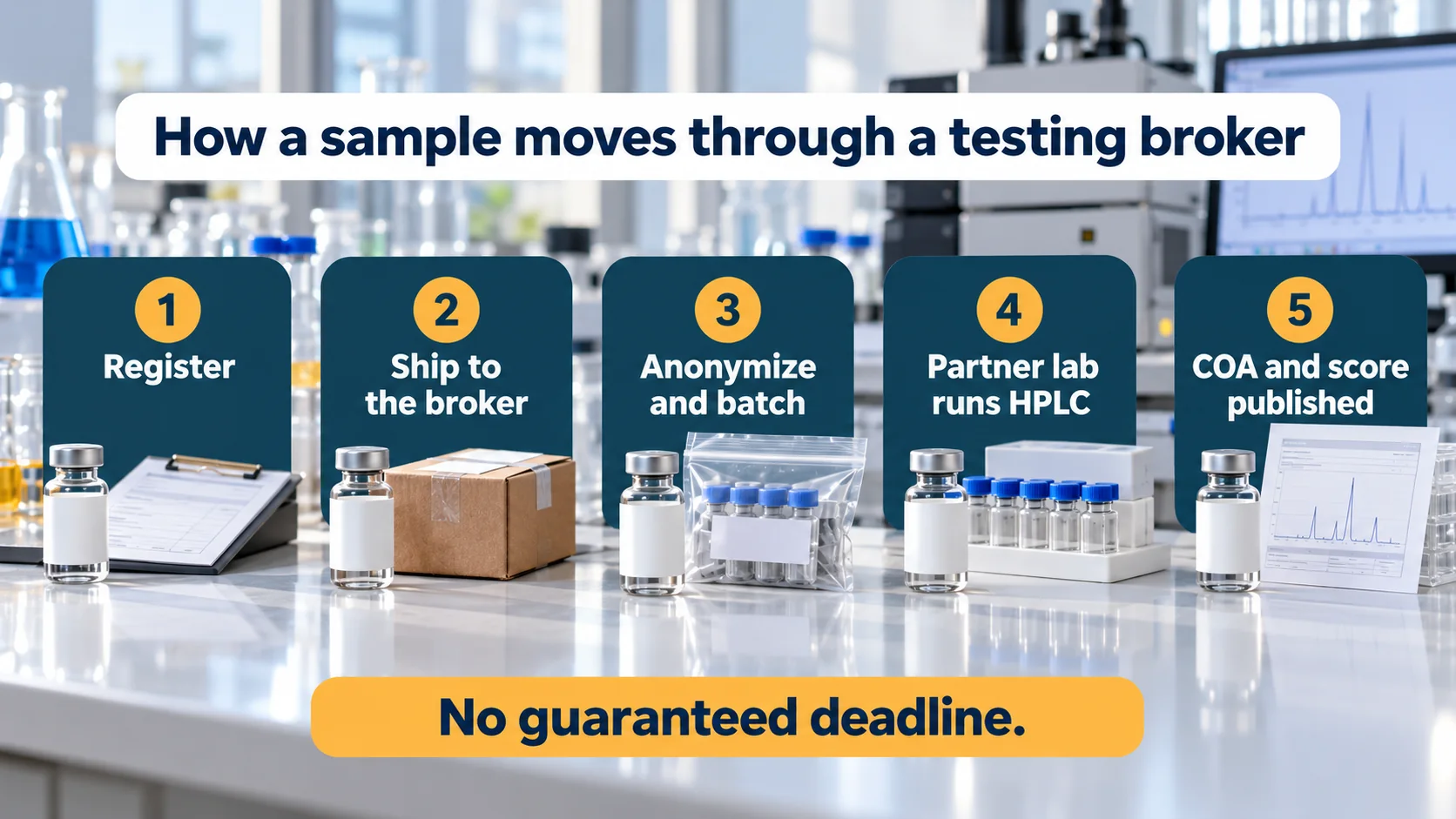
Finnrick does not guarantee a deadline. A recent Trustpilot reviewer reported waiting about 18 days for a free test, which is one anecdote and not a measured turnaround.
Where the samples come from
Finnrick’s product-test page says most samples are crowdsourced from the public, some are bought by Finnrick, and only a few are submitted by vendors. Its COA guide names three channels: public (user-submitted), vendor (paid, vendor-submitted) and Finnrick (bought openly or by mystery shopping). Its company page says vendor-submitted samples are labeled as such and that vendor-supplied COAs do not drive the rankings. The methodology page, however, says Finnrick “sources samples from vendors and sends them to third-party labs”. The pages describe the sources differently, and none gives the split for a given vendor’s score. Free community testing also requires a batch identifier, which means the sender chooses and labels the sample.
The partner labs
Finnrick’s testing-options page lists six partner labs: Krause Analytical, BTLabs, Chromate, Ichor Life Sciences, Harrens Lab and PharmLabs. It has also published results from Janoshik, MZ Biolabs, TrustPointe and Freedom Diagnostics, and the lab pages for Janoshik and MZ Biolabs say no products are currently orderable with them.
| Lab | Published tests on October 10, 2026 |
|---|---|
| Krause Analytical | 7,328 |
| BTLabs | 2,893 |
| Chromate | 681 |
| TrustPointe | 315 |
| Freedom Diagnostics | 225 |
| Janoshik | 200 |
| MZ Biolabs | 179 |
| Ichor Life Sciences | 70 |
| Harrens Lab | 61 |
| PharmLabs | 47 |
Krause accounts for about 61% of the 11,999 tests. That concentration is a limit. A systematic bias at one lab would reach most of the data, which is why Finnrick says it compares overlapping tests across labs. Its lab pages publish pass rates, which range from 14% to 78% on each lab’s latest tests, but those reflect different time windows and sample mixes and are not a ranking of lab accuracy.
What a Finnrick test measures
Every Finnrick sample starts with identity, purity and quantity by HPLC. Purity is the main peak’s share of the signal. Quantity compares the measured amount with the label claim or a batch claim. Finnrick’s own COA guide says HPLC purity does not measure salts, fillers, water, endotoxins or heavy metals, and that HPLC-UV alone does not confirm identity. Our guide to what 99% purity means covers the arithmetic.
Extra tests are paid add-ons: endotoxins, heavy metals, residual solvents and sterility. A sample without an add-on result still counts in the rating, which matters for the next section.
How Finnrick standards and scores work
Finnrick grades each sample pass, fail or incomplete under a chosen standard. A failed identity result fails the sample. Samples missing identity, purity, quantity or labeling information are marked incomplete and do not count toward that standard’s pass rate.
| Standard | Purity | Quantity | Other rules |
|---|---|---|---|
| Purity focus | At least 99.5% | Within 35% of claim | No label requirement. Endotoxin not evaluated |
| Finnrick Standard | At least 99.5% | Within 25% of claim | Label score at least 0.5. Endotoxin not evaluated |
| Purity focus strict (members) | At least 99.8% | Within 35% of claim | No label requirement |
| Super strict (members) | At least 99.8% | Within 15% of claim | Label score at least 2.0 |
| Accuracy focus (members) | At least 98% | Within 20% of claim | Label score at least 0.5. Endotoxin above 40 EU per sample fails, when tested |
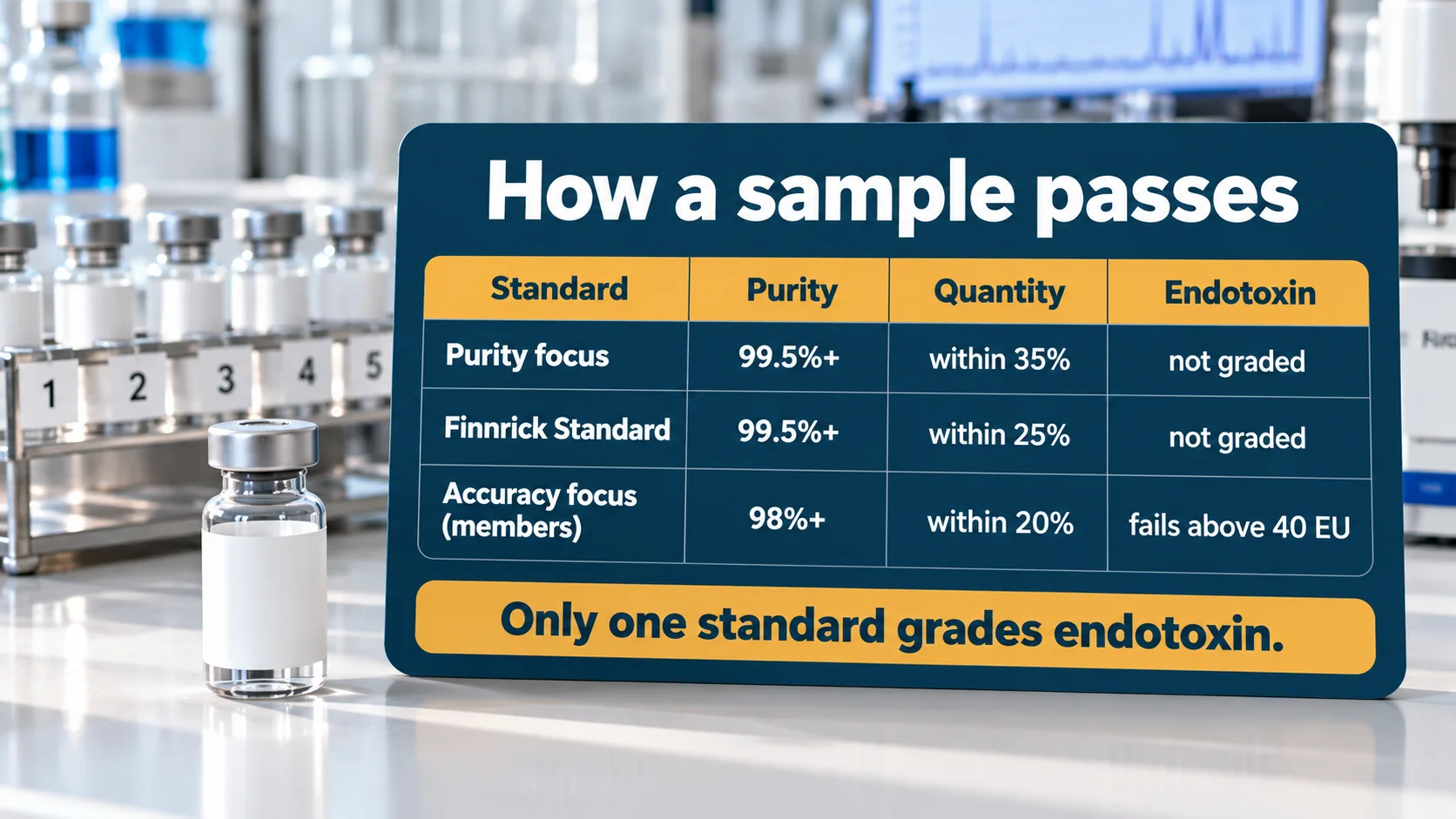
Underfill and overfill both fail when they exceed the range. Accuracy focus is the only standard that grades endotoxin, and a sample without an endotoxin result is still counted. Only a measured result above 40 EU per sample counts against it.
The labeling score
The labeling score runs from 0 to 2 and measures whether a sample can be tied to a batch. A batch identifier printed on the container scores highest. One on a separate physical insert scores less, and a website-only or missing identifier scores zero. Finnrick says information on the vial is strongest because it stays with the product.
From test results to a vendor rating
- Recent tests count more. The evidence half-life is 730.5 days, so a test that old counts about half as much as a new one.
- Thin histories are adjusted. With few classifiable tests, the final rating is pulled toward the peer baseline for that compound, using up to 24 pseudo-samples on mature boards, so one test cannot look more certain than it is.
- Leaderboards use the final rating. Ties are broken by effective sample volume, classifiable count, passing count and total tests.
Finnrick says a vendor cannot negotiate a failure away and that the practical way to recover is to fix the cause and build a newer testing record.
What the published data show
These are the counts and pass rates Finnrick showed on October 10, 2026 for its most-tested compounds, using the Purity focus standard on each compound’s 200 most recent tests.
| Compound | Published tests | Vendors | Pass, fail, incomplete (latest 200) |
|---|---|---|---|
| Retatrutide | 4,367 | 378 | 131, 63, 6 |
| Tirzepatide | 2,744 | 262 | 137, 59, 4 |
| BPC-157 | 900 | 144 | 106, 92, 2 |
| Semaglutide | 373 | 71 | 122, 74, 4 |
By our arithmetic, the failure share among classifiable tests was 32.5% for retatrutide, 30.1% for tirzepatide, 46.5% for BPC-157 and 37.8% for semaglutide. Four limits apply. Most samples are community-submitted and not random. The 99.5% purity floor is demanding. A fail is not the same as unsafe. And the public page does not break out whether a failure came from purity, quantity or identity.
Two other Finnrick findings add context. In a June 9, 2026 post on sermorelin, ipamorelin and tesamorelin, Finnrick concluded that quantity variance is often a bigger issue than purity: for ipamorelin (284 tests, 51 vendors) purity ran from 97.00% to 99.96% while quantity diverged from the claim by up to 69%. In a February 6, 2026 article on 140 endotoxin tests, about 63% showed none, 29% fell below the limit of quantification and nearly 8% were above it. Endotoxin testing is an optional add-on, so that sample is small and not representative.
What Finnrick testing costs
| Option | Price listed October 10, 2026 | Notes |
|---|---|---|
| Free community testing | $0 | A list of 15 products including BPC-157, TB-500, CJC-1295, GHK-Cu and ipamorelin. US only, results published, batch identifier required |
| Paid Basic test for other products | $158 to $248 per sample | The 48 priced products on its product-test page, for example $158 for 5-Amino-1MQ and $238 for HGH |
| Custom order | From $89 per sample | Finnrick says prices vary by product and lab |
| Endotoxins add-on | From +$39 | Custom orders with it start at $178 per sample |
| Heavy metals add-on | From +$119 | Custom orders with it start at $208 per sample |
| Residual solvents add-on | From +$139 | Custom orders with it start at $228 per sample |
| Sterility add-on | From +$229 | Custom orders with it start at $358 per sample |
| Membership | $9.99 a month | Original COAs and the stricter standards, per its September 15, 2026 post |
Is Finnrick reliable?
What is strong
- Scale. 11,999 published tests, with 4,367 for retatrutide alone, make patterns visible that a single report cannot.
- Anonymized samples and several labs. Finnrick says labs do not see the vendor, and it compares overlapping tests.
- Visible failures and corrections. Its Corrections page records lab errors and reissued COAs. Examples include a purity that changed from 79.802% to 99.294% after a review removed a buffer peak, and a quantity entered as 92 mg instead of 9.2 mg. Early entries name labs only by letter.
- Published scoring math. The standards, labeling score and rating formulas are on its methodology page.
What is limited
- Samples are not random. Finnrick describes its sources differently on different pages and does not publish the split behind a given score.
- One lab dominates. About 61% of the tests ran at Krause, and Finnrick publishes no figure for lab bias.
- Default standards ignore endotoxin. A vendor can score well with no endotoxin test.
- Lab accreditation is uneven. PharmLabs posts a PJLA ISO/IEC 17025 certificate whose scope lists HPLC for ten named peptides. In our October 7, 2026 directory searches we found no A2LA or ANAB listing for Krause Analytical or BTLabs. “Not found” is not proof.
- No peer review. We found no peer-reviewed analysis of the dataset.
- Money. Finnrick sells testing, vendor services and memberships. It says no one can pay to change ratings. The business model is a conflict to keep in mind, and we are not alleging misconduct.
- Verification needs an account. Finnrick’s Verify page asks visitors to sign in, and its public COA copies omit the vendor name and batch ID by design.
What users say
Finnrick’s Trustpilot page showed 116 reviews and a 3.9 average on October 10, with 75% five-star and 18% one-star reviews. The profile has been claimed since March 2026, and Trustpilot does not fact-check reviews. Reviewers praise turnaround and clear reports. The complaints cover long waits for free tests, support responses and, in one review, a broken COA link. One reviewer criticizes a partner lab, which we could not verify.
How to use a Finnrick result when comparing sellers
- Treat it as a signal. Check the date window and the number of classifiable tests behind a score.
- Read the standard shown. Purity Focus and the members-only standards give different pass rates for the same samples.
- Ask where the samples came from. Community, purchased and vendor-submitted samples answer different questions.
- Look for an endotoxin result. A missing result is not a pass.
- Match the result to what you hold. A Finnrick result describes the sample it tested, and its public copy leaves out the batch. Compare the lot on the vial you hold with the seller’s own lab-hosted report.
- Combine it with the seller’s report. Our Janoshik report guide gives eight checks for a lab-hosted report, and our supplier scorecard covers payment, returns and lookalike sites.
Finnrick, a lab and a vendor COA compared
| Source | Who chooses the sample | What it tells you |
|---|---|---|
| Finnrick | Mostly the public, some Finnrick purchases, a few vendors | Patterns across many samples, scored under a published standard |
| A lab report, such as Janoshik’s | The customer who orders the test | What one sample contained on the test date |
| A vendor COA | The seller | The seller’s claim about a batch, which is checkable only through the lab’s own site |
Finnrick: common questions
What is Finnrick?
Finnrick, operated by Finnrick Analytics at finnrick.com, is a US testing and rating company for research peptides. It brokers tests at partner labs, anonymizes samples, publishes each Certificate of Analysis, and scores vendors for each compound.
Is Finnrick legit?
Finnrick is an operating company with a large public dataset and published methodology, and it documents its corrections. It also sells testing and memberships, its data is not peer reviewed, and most samples are not random. Whether a Finnrick score means a specific vial is good depends on the lot you hold.
Is Finnrick peptide testing reliable?
It is strong on scale and transparency and limited by sample selection, lab concentration and a default standard that ignores endotoxin. Read a score as evidence about the samples tested, not as a guarantee for your lot.
How much does Finnrick testing cost?
As listed on October 10, 2026, community testing is free for 15 products for US residents. Paid Basic testing runs $158 to $248 per sample for other products, custom orders start at $89, and add-ons start at +$39 for endotoxins. Check finnrick.com for current prices.
Is Finnrick testing really free?
For the listed products, Finnrick charges no testing fee. The conditions are US residency, a batch identifier and publication of the results. Finnrick says it cannot guarantee a turnaround time, and add-ons cost extra.
What is a Finnrick score?
A Finnrick score is a vendor rating for one compound, built from pass or fail results under a chosen standard. Recent tests count more, with a half-life of 730.5 days, and thin histories are pulled toward the peer average.
What does a failed Finnrick test mean?
Under Purity Focus, it means the sample missed at least one rule: purity below 99.5%, quantity more than 35% from the claim, or a failed identity result. A fail does not mean the sample was unsafe, and the public page does not show which rule it missed.
Does Finnrick test for endotoxin?
Yes, as a paid add-on from +$39. Its default standards do not grade endotoxin. Only the members-only Accuracy focus standard fails a sample, and only above 40 EU per sample when a result exists.
Which labs does Finnrick use?
Its testing-options page lists Krause Analytical, BTLabs, Chromate, Ichor Life Sciences, Harrens Lab and PharmLabs. It has also published results from Janoshik, MZ Biolabs, TrustPointe and Freedom Diagnostics.
How long does Finnrick testing take?
Finnrick says it makes a best effort and cannot guarantee a deadline. One recent Trustpilot reviewer reported waiting about 18 days for a free test.
Is Finnrick the same as Janoshik?
No. Janoshik is a laboratory that tests samples customers send. Finnrick is a rating company that sends samples to partner labs. It published 200 Janoshik-measured results from 2025 and says no products are currently orderable with that lab.
Is finnrickdiagnostics.com the same as Finnrick?
We could not verify that. Finnrick Analytics operates finnrick.com, and finnrickdiagnostics.com appears in search results for the same terms. Confirm the domain before you register or pay for anything.
How do I verify a Finnrick COA?
Finnrick’s Verify page takes a 7-character certificate ID and asks visitors to sign in. Its public COAs omit the vendor name and batch ID, so a result tells you about the sample tested and not about the vial you hold.
Does Peptryn use Finnrick?
No. Peptryn’s certificates come from MZ Biolabs in Tucson, Arizona. We found no Finnrick rating for Peptryn in the pages we could read on October 11, 2026, and Peptryn is not affiliated with Finnrick.
Sources
All pages were read on October 10 and 11, 2026 unless noted.
- Finnrick. Home page; Company; Testing and rating methodology; Order a product test; Peptide testing options; Labs; Janoshik lab page; Verify.
- Finnrick. Product pages: tirzepatide, BPC-157, semaglutide. Counts and pass rates on October 10, 2026.
- Finnrick. How to read a certificate of analysis; Why endotoxin testing matters for peptides; Sermorelin vs ipamorelin vs tesamorelin; Two new labs, faster testing; Corrections. Finnrick sells testing and memberships.
- Trustpilot. Finnrick reviews. Unverified reviews.
- PharmLabs. PJLA certificate L25-933-R1. A2LA. Directory. ANAB. Directory, searched October 7, 2026.
- Peptryn. Janoshik peptide testing guide; Peptide Sciences guide; COA Library.
Editorial note: Peptryn sells the research peptides discussed on this site for laboratory use only. This guide is informational and is not medical advice. To report an error, use the contact page.
All products on peptryn.com are intended for laboratory research purposes only. They are not drugs, foods, dietary supplements or cosmetics, and they are not for human consumption, self-administration, or veterinary use. You must be 21 or older to buy. The information on this page has not been evaluated by the U.S. Food and Drug Administration and is not intended to diagnose, treat, cure, or prevent any disease. Nothing here should be construed as medical advice.
Related: Klow80 blend: price, lot certificate and buying checks