Peptide testing: which tests exist and how to judge a lab
Research use only. Peptides supplied by Peptryn are sold strictly for in vitro and preclinical laboratory research. They are not approved by the FDA for human or veterinary use, and nothing here is medical advice. This guide explains analytical testing of peptide materials. It does not tell anyone how to use a peptide.
Quick answer: what is peptide testing?
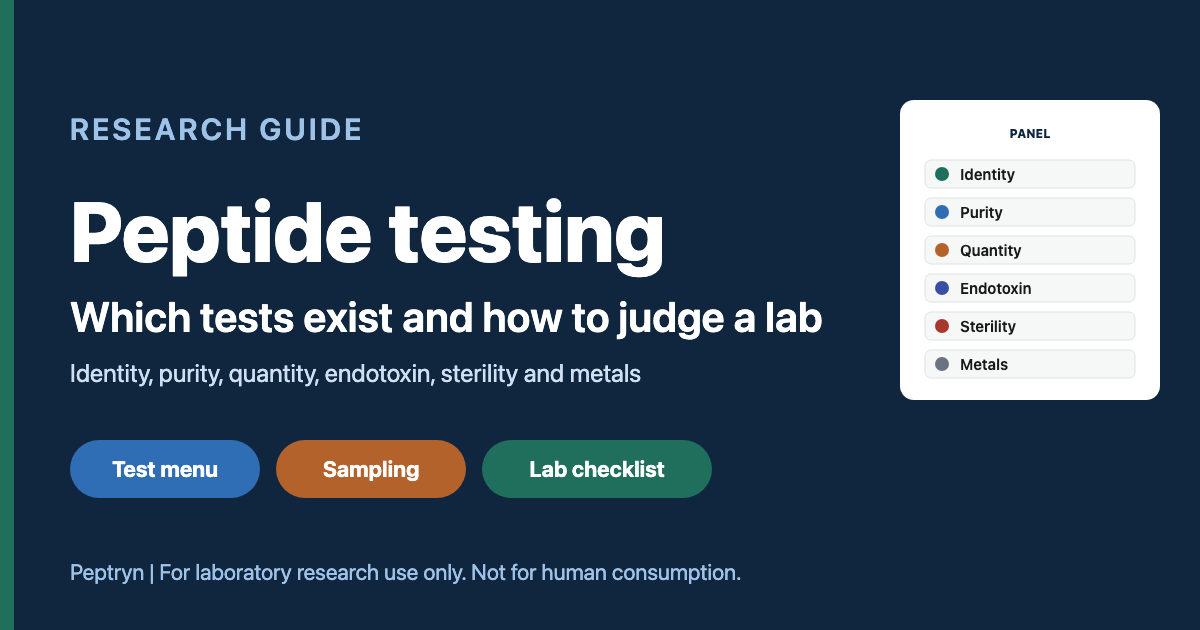
Peptide testing is a set of laboratory analyses run on a sample of a peptide product to find out what it contains and what else it carries. A basic panel checks identity (is it the right molecule), purity (how much of the peptide-related signal is the target), quantity (how much peptide is in the vial) and bacterial endotoxin. Fuller panels add sterility, heavy metals, residual solvents, water and counterion content.
No single test covers safety. Each answers one question about one sample, and the sample may or may not represent the lot you are holding. A result is only as useful as the tests chosen, the lab that ran them and the link between the sample and the vial.
This page is about testing peptide materials. Blood tests that measure peptides in patients, such as natriuretic peptide tests, are clinical laboratory tests and are not covered here.
- The tests in a peptide panel
- What a full panel looks like
- Independent, but independent of whom
- How to judge a testing lab
- Testing a peptide yourself
- What our own COAs show
- Frequently asked questions
- Final take
The tests in a peptide panel
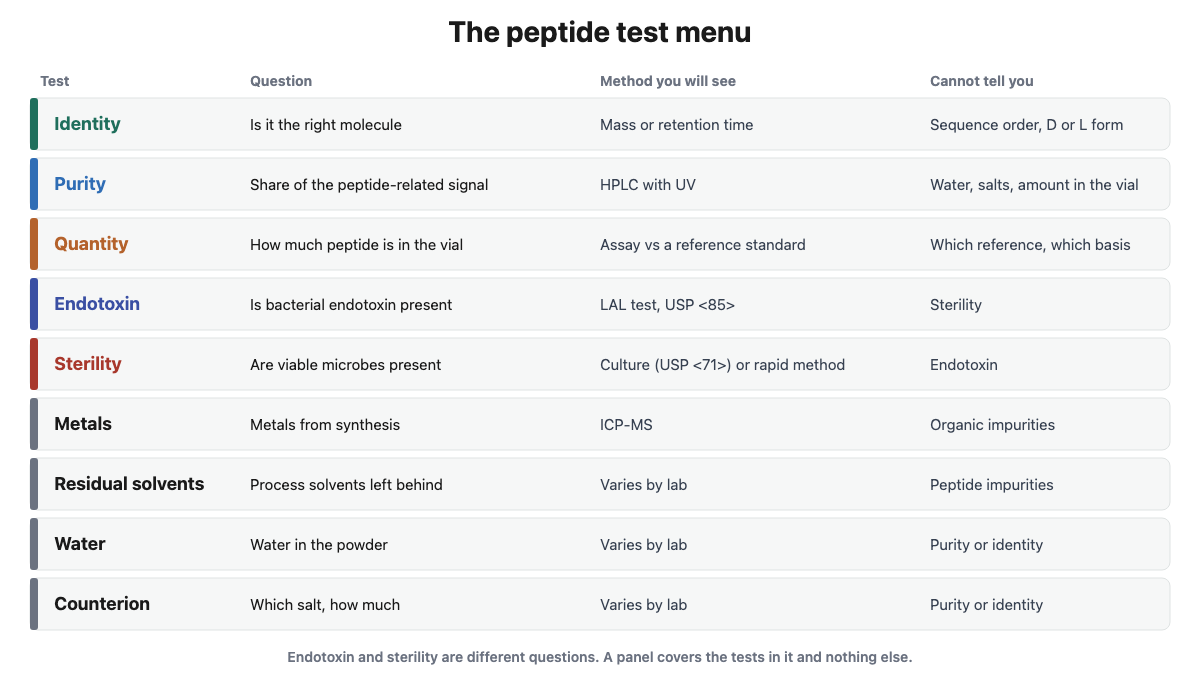
The table lists the tests you will meet, the question each answers and its blind spot.
| Test | Question it answers | Method you will see | What it cannot tell you |
|---|---|---|---|
| Identity | Is the main component the right molecule | LC-MS mass, or retention-time match against a reference standard | Sequence order, or a D-amino acid versus its L form |
| Purity | What share of the peptide-related signal is the target | Reversed-phase HPLC with UV detection | Water, salts and counterions, or the amount in the vial |
| Quantity or content | How much peptide the vial holds | Chromatographic assay against a reference standard, amino acid analysis, qNMR | Which reference was used, or what basis the result is on |
| Endotoxin | Is bacterial endotoxin present, and how much | Limulus amebocyte lysate (LAL) test | Sterility |
| Sterility | Are viable microorganisms present | Culture-based test or a rapid method | Endotoxin, or contaminants that are not viable organisms |
| Heavy metals and elemental impurities | Are metals from synthesis or catalysts present | ICP-MS | Organic impurities |
| Residual solvents | Are process solvents left behind | Varies by lab | Peptide-related impurities |
| Water content | How much of the powder is water | Varies by lab | Purity or identity |
| Counterion | Which salt form, and how much | Varies by lab | Purity or identity |
Identity
Mass spectrometry reports the mass of the main component, and a match to the expected mass is strong evidence against a substitution. Some labs confirm identity by matching HPLC retention time to a certified reference standard instead. Neither tells you the order of the amino acids, and neither separates a D-amino acid from its L form, because the masses are identical. The European Medicines Agency’s peptide guideline describes a separate chiral method for that question, in which the peptide is hydrolyzed in deuterated acid and the amino acids are analyzed by chiral gas chromatography with mass spectrometric detection.
Purity
HPLC peptide testing reports purity as the target peak’s share of the peptide-related peak area. Our peptide purity guide covers what 99% does and does not mean.
Quantity
A quantity result depends on a reference standard. The EMA guideline says an assay should be considered that uses a reference standard, and it devotes a section to how reference standards are qualified and requalified so that their peptide content does not drift. Amino acid analysis, nitrogen analysis and qNMR are alternatives. The same guideline says assay limits by LC are expressed on the counter-ion-free, anhydrous basis. Two labs can report different milligrams for the same vial if they used different references or a different basis, so ask both questions.
Endotoxin testing
Endotoxins are fragments of bacterial cell walls. The LAL test, in its kinetic chromogenic form, is a standard way to measure them, and FDA’s guidance on pyrogen and endotoxin testing discusses the compendial chapter, USP <85> Bacterial Endotoxins Test. A negative result means endotoxin was not detected at that test’s limit.
Sterility
Sterility is a different question. FDA’s current good manufacturing practice rules require appropriate laboratory testing for each batch of a drug product purporting to be sterile or pyrogen-free (21 CFR 211.167). The compendial test, USP <71>, incubates the sample in culture media for 14 days. Rapid methods that detect microbial DNA exist and are not the same test. An endotoxin result does not stand in for either.
Heavy metals, residual solvents, water and counterion
Metals can enter a peptide from catalysts and reagents during synthesis, and ICP-MS is the usual way to measure them. The International Council for Harmonisation publishes guidelines for elemental impurities (Q3D) and residual solvents (Q3C) that set permitted exposure limits for drug products. Piatkowski and colleagues used the Q3D framework to interpret metals found in three products sold as retatrutide. Water and counterion content sit on the European specification list for a synthetic peptide and are seldom printed on research COAs.
What a full panel looks like
One U.S. testing laboratory publishes a Full QC Panel for research-use peptides that makes the menu concrete. It has five analyses: HPLC purity and quantitation, identity confirmation by retention-time matching against certified reference standards, endotoxin by a kinetic chromogenic LAL method under USP <85>, heavy metals by ICP-MS, and a rapid sterility screen by DNA microarray. The lab states a standard turnaround of about one week, a rush option of three business days, a minimum of 10 mg per sample, and a recommendation to send three vials. It also states ISO/IEC 17025 accreditation for activities within its accredited scope.
We cite it as an example of what a panel contains. Other labs offer different bundles, so read the list of analyses and methods.
Independent, but independent of whom
Most disputes about a testing result come down to sampling and independence.
Who chose the sample? A report on a vial the seller picked and sent tells you about that vial. A report on a sealed vial from your own order tells you about the lot you hold. Third-party labs test what they receive.
How many vials? One vial is a sample of one. The lab above recommends three vials, which reflects that vial-to-vial variation exists.
Is the report tied to a lot? A lot number on the report, matched to the lot number on the vial, is the link. A report without one describes an unnamed sample.
Is the lab independent? A lab that sells the peptide it tests, or is paid per favorable result, has a conflict. Ask who pays.
The 2026 preprint by Mendias and Awan, which analyzed 6,441 gray market peptide samples from a public independent testing dataset, reached a limit that applies to any panel: consumer-directed third-party testing improves transparency, but captures only a small fraction of the safety profile relevant to people who use injectable preparations. The paper is a preprint and has not been peer reviewed. For research-use materials the point is narrower and still holds: a passing panel covers the tests in it and nothing else.
How to judge a testing lab
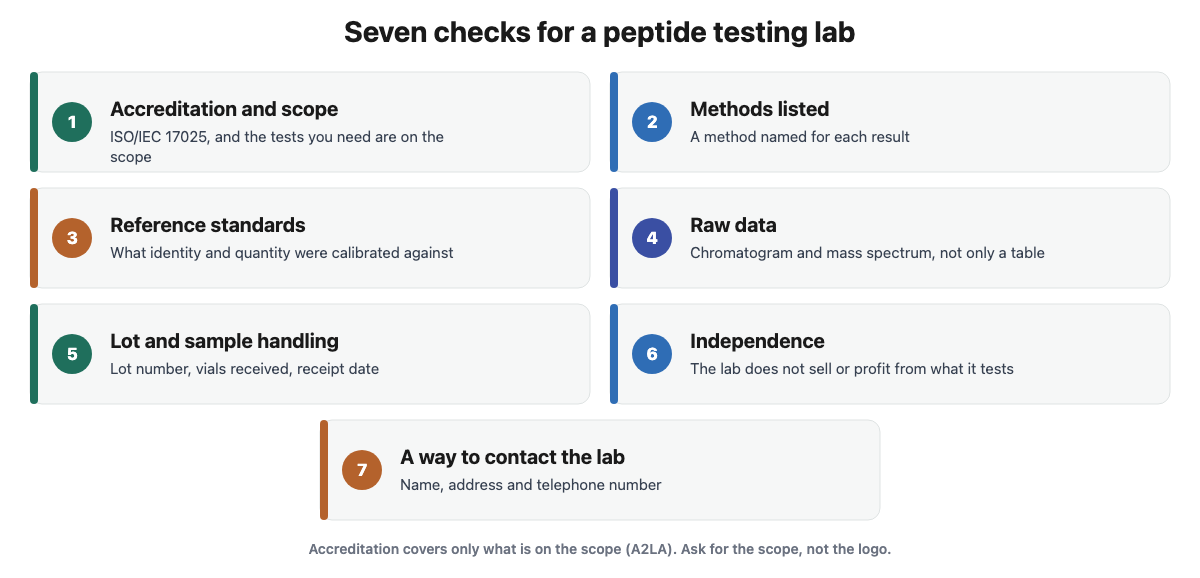
Seven checks cover most peptide testing lab claims.
- Accreditation and scope: ISO/IEC 17025 is the international standard for laboratory competence. A2LA states that capabilities not listed on a lab’s scope of accreditation are not covered by its accreditation. Ask for the scope and check that HPLC purity, mass spectrometry and endotoxin are on it.
- Methods listed: A report should name the method for each result, not only the result.
- Reference standards: Ask what the identity and quantity results were calibrated against.
- Raw data: A chromatogram and a mass spectrum, not only a summary table.
- Lot and sample handling: The report should show the lot number, the number of vials received and the receipt date.
- Independence: The lab should not sell or benefit from the product it tests.
- A way to contact the lab: ICH Q7, the manufacturing guide FDA publishes, expects the name, address and telephone number of the lab that performed the analysis on a reissued certificate.
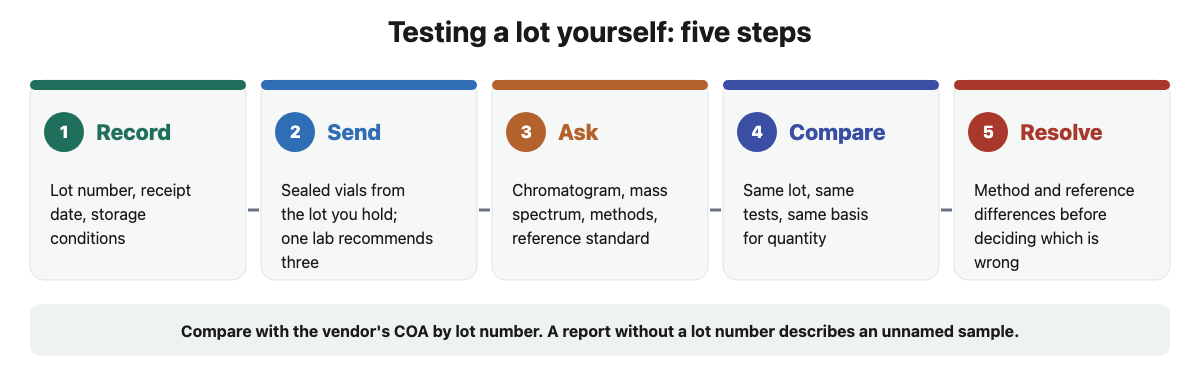
Testing a peptide yourself
Researchers who want to check a vendor’s lot can send a sample to an independent lab.
- Choose the panel. Identity, purity, quantity and endotoxin are the basic four, and the others depend on the question.
- Send sealed vials from the lot you hold, and record the lot number, receipt date and storage conditions. Our post on storage and handling of research peptides covers keeping samples stable in transit.
- Ask for the chromatogram, the mass spectrum and the method list.
- Compare like with like: the same lot, the same tests, the same basis for quantity.
- If two reports disagree, resolve the method and reference-standard differences before you conclude either is wrong.
We do not publish peptide testing costs. They depend on the lab and the panel, and the one turnaround we cite above is that lab’s own statement. We also did not evaluate consumer test kits and make no claim about them.
What our own COAs show
Peptryn’s COA pages state that testing was performed by MZ Biolabs and link to reports on the lab’s own site. For the reports we read in full, the lines shown are identity by mass spectrometry, HPLC purity with a peak table and a measured quantity, and the COA pages show an endotoxin result. We did not see sterility, heavy metals, residual solvents, water or counterion content printed on them. MZ Biolabs’ accreditation scope is not stated on our COA pages, so ask the lab for it.
You can open a lot’s page in the COA library, match the lot number to the lab’s report, and compare it with any independent result you obtain. Our lab results page describes the testing program, and our guide to what a COA is shows where each line sits on a report.
Frequently asked questions
What is peptide testing?
It is a set of laboratory analyses on a peptide sample. A basic panel covers identity, purity, quantity and endotoxin. Fuller panels add sterility, heavy metals, residual solvents, water and counterion content.
What tests should a peptide panel include?
At minimum, identity by mass spectrometry, HPLC purity and quantity, and an endotoxin test. Sterility and metals are added when the question calls for them. One lab’s published full panel has five analyses.
What is third-party peptide testing?
Testing by a laboratory that is neither the seller nor the manufacturer. It matters only if the sample is tied to a lot and the lab is independent of the product.
How long does peptide testing take?
It depends on the lab. The one we cite states about one week as standard and three business days for rush service, counted from receipt.
How much peptide do I need to send?
Requirements vary. The lab we cite states a 10 mg minimum and recommends three vials.
Does a passing test mean a peptide is safe?
No. A panel covers the tests in it. The Mendias and Awan preprint concludes that consumer-directed third-party testing captures only a small fraction of the safety profile relevant to people who use injectable preparations.
Is endotoxin testing the same as sterility testing?
No. Endotoxin testing measures a product of bacteria. Sterility testing looks for viable microorganisms.
Can I test peptides at home?
HPLC and mass spectrometry are laboratory measurements. We did not evaluate consumer test kits and make no claim about them.
How do I know a testing lab is legitimate?
Ask for its ISO/IEC 17025 scope, check that the tests you need are on it, and look for named methods, raw data and a lot-tied report.
Final take
Choose the tests that match the question. Check that the lab is accredited for those tests, that the sample is tied to a lot, and that quantity results say what they were calibrated against.
To compare an independent result with ours, open the lot in the Peptryn COA library. For the legal picture around research peptides, read are peptides legal?.
Editorial note: Peptryn sells the research peptides discussed in this guide for laboratory use only. This guide is informational and is not medical advice. Sources are listed below. To report an error, email [email protected].
Sources
- 21 CFR 211.167, Special testing requirements. ecfr.gov
- U.S. Food and Drug Administration. Pyrogen and Endotoxins Testing: Questions and Answers. fda.gov
- European Medicines Agency. Guideline on the Development and Manufacture of Synthetic Peptides, EMA/CHMP/CVMP/QWP/367182/2025, effective 1 June 2026. ema.europa.eu
- ICH. Q3D(R2) Guideline for Elemental Impurities. database.ich.org
- ICH. Q3C(R9) Guideline for Residual Solvents. database.ich.org
- A2LA. Frequently asked questions (scope of accreditation). a2la.org
- ISO/IEC 17025:2017, General requirements for the competence of testing and calibration laboratories. iso.org
- International Council for Harmonisation. Q7 Good Manufacturing Practice Guide for Active Pharmaceutical Ingredients, section 11.4. fda.gov
- Mendias CL, Awan TM. Evaluation of research grade peptides marketed directly to consumers reveals extensive variability in purity and measured abundance. Preprints.org, 2026 (not peer reviewed). doi.org
- Piatkowski T, Craven A, Cornell S, Ferris J. Composition and labelling accuracy of products sold as retatrutide in Australia. Drug Alcohol Rev, 2026. pmc.ncbi.nlm.nih.gov
- ILS. Peptide QC testing, published Full QC Panel, read September 20, 2026. ils-lab.com
- The Laboratory Outsourcing Network. Sterility testing guide: USP <71>. contractlaboratory.com
- Peptryn COA library and lab results pages, read September 20, 2026, with reports hosted by MZ Biolabs. peptryn.com/coa
All products on peptryn.com are intended for laboratory research purposes only. Not for human consumption, self-administration, or veterinary use. The information on this page has not been evaluated by the U.S. Food and Drug Administration and is not intended to diagnose, treat, cure, or prevent any disease.