Where to Buy KPV Peptide: Price, COA and What to Check Before You Order
Research use only. Peptides supplied by Peptryn are sold strictly for in vitro and preclinical laboratory research. They are not approved by the FDA for human or veterinary use, and nothing here is medical advice, a dosing recommendation, or an instruction for self-administration. This page explains what Peptryn’s KPV listing includes and how to check any KPV seller.
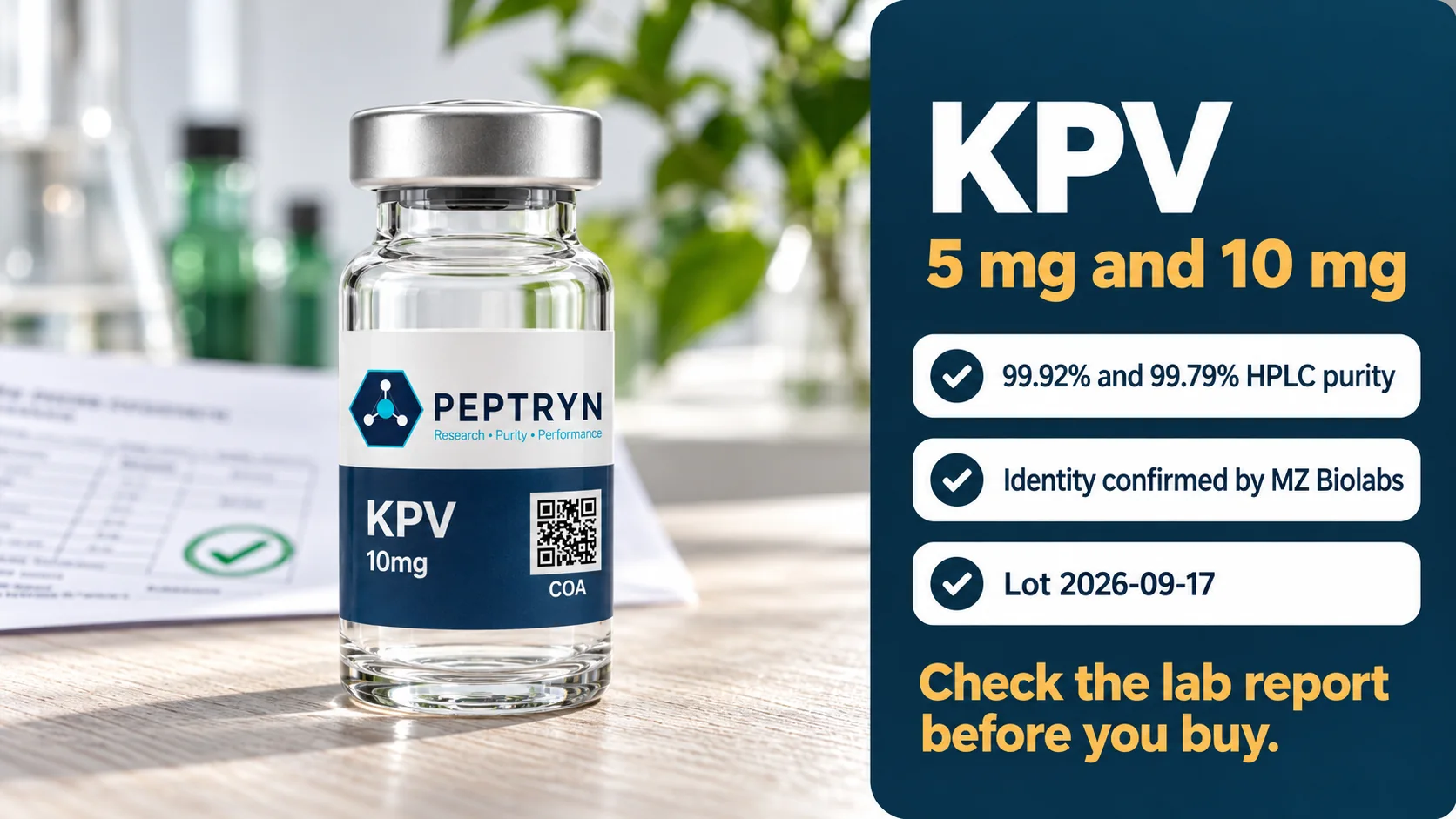
Quick answer: Peptryn sells KPV (Lys-Pro-Val) as a lyophilized research peptide in two sizes: 5 mg for $49.99 and 10 mg for $79.99. Both come from lot 2026-09-17 and were tested by MZ Biolabs, which reports 99.92% HPLC purity for the 5 mg and 99.79% for the 10 mg, with identity confirmed by mass spectrometry. Each certificate links to a report on the lab’s own site. KPV is not an approved drug, no human trial of it has been published, and Peptryn sells it only for laboratory research to buyers who are 21 or older.
This page covers the buying side: what the listing includes, what the certificates show and leave out, and six checks that work on any seller. For the research on KPV itself, read our KPV guide.
Key takeaways
- Peptryn lists KPV at 5 mg ($49.99, $10.00 per mg) and 10 mg ($79.99, $8.00 per mg), both from lot 2026-09-17.
- The certificates report purity and identity. They do not include an endotoxin test or a net peptide content result, so ask before you order if either matters to your work.
- Each certificate carries a QR code to a report hosted on MZ Biolabs’ own site, so you can check the numbers without relying on Peptryn.
- Search results for KPV mix research vials, supplement capsules and clinic pages. Only the first group is a laboratory material.
Last verified October 12, 2026. Prices and lot details are as listed on that date and change with each batch, so check the product page and certificate before you rely on a number. Sources are listed at the end. For laboratory and research use only. Nothing here is medical or legal advice.
What Peptryn’s KPV listing includes
KPV is the tripeptide Lys-Pro-Val, which matches residues 11 to 13 of alpha-melanocyte-stimulating hormone. Its molecular weight is 342.44 Da (C16H30N4O4), and its CAS number is 67727-97-3. Peptryn supplies it as lyophilized powder.
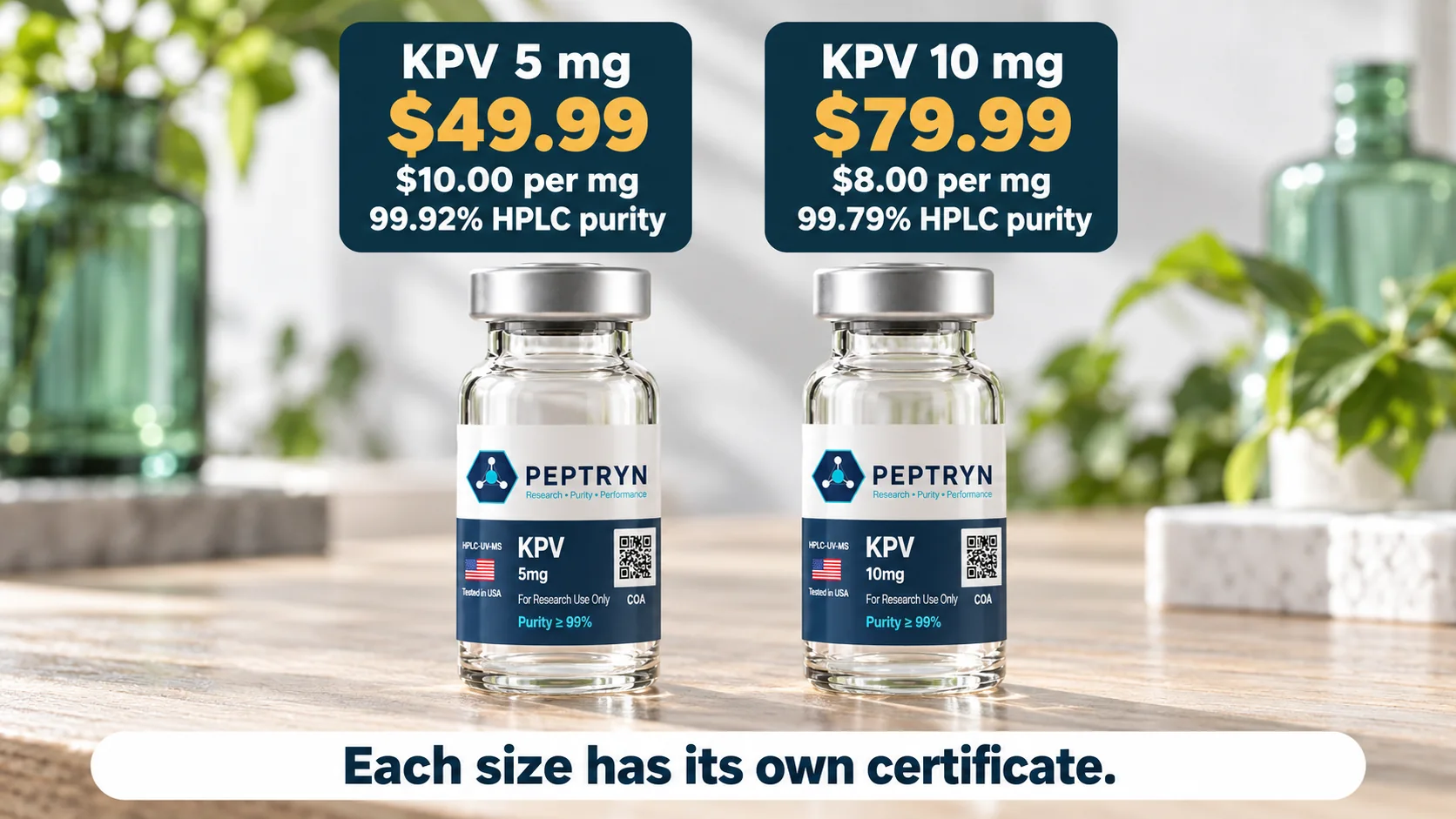
| 5 mg | 10 mg | |
|---|---|---|
| Listed price | $49.99 | $79.99 |
| Price per mg | $10.00 | $8.00 |
| Lot | 2026-09-17 | 2026-09-17 |
| HPLC purity | 99.92% | 99.79% |
| Identity | Confirmed (mass spectrometry) | Confirmed (mass spectrometry) |
| Lab | MZ Biolabs, Tucson, Arizona | MZ Biolabs, Tucson, Arizona |
| Storage | -20 °C, protected from light and repeated freeze-thaw cycles | -20 °C, protected from light and repeated freeze-thaw cycles |
| Certificate | KPV 5 mg COA | KPV 10 mg COA |
Quantity pricing on the product page takes 3% off at 3 to 4 units, 5% at 5 to 9 and 10% at 10 or more. Each size has its own certificate. Peptryn does not give dosing guidance for KPV, because no established dose exists.
What the KPV certificates show, and what they leave out
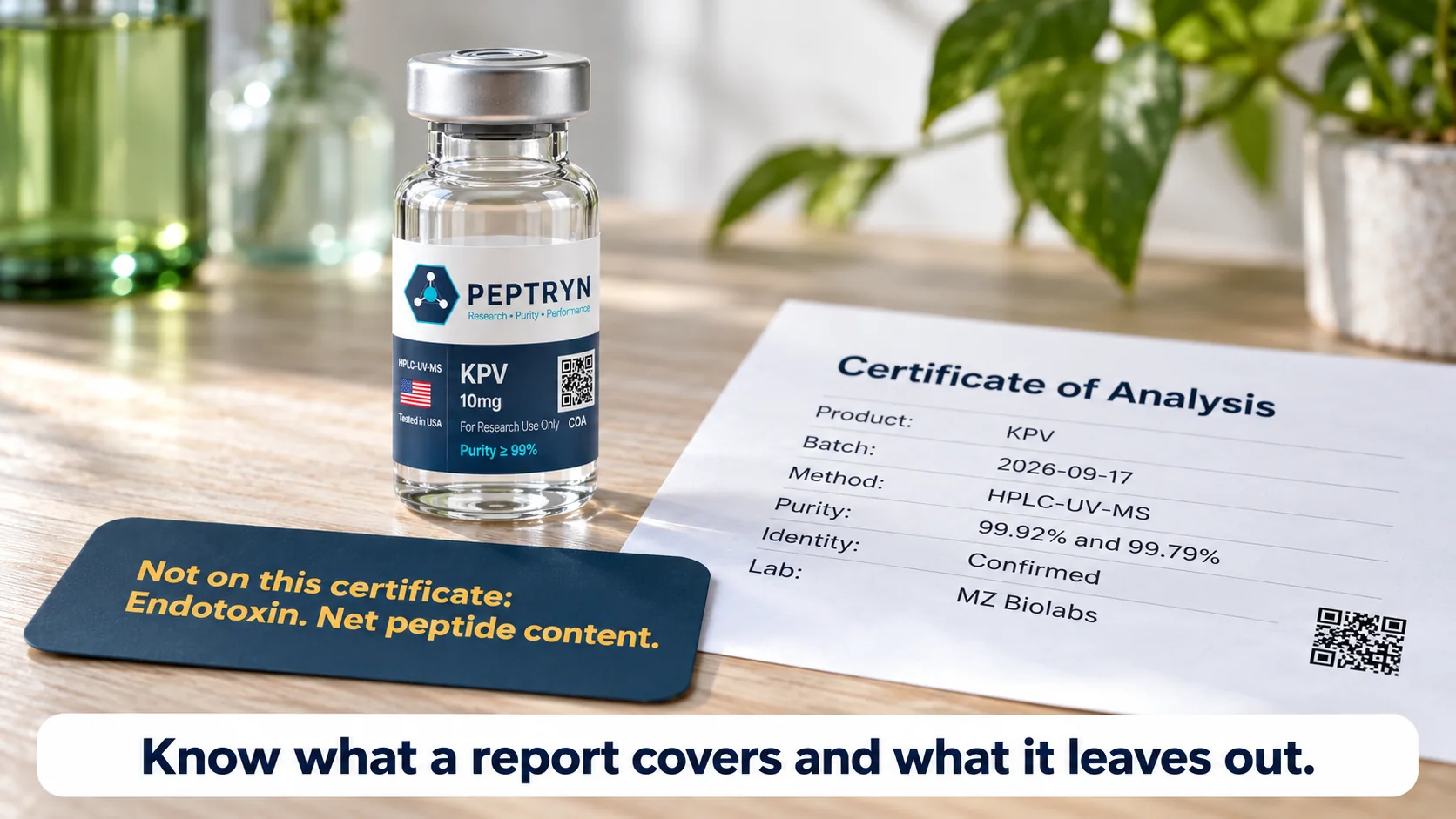
Both certificates name MZ Biolabs as the lab, list the method as HPLC-UV-MS, and report purity and identity for lot 2026-09-17. Each carries a QR code that opens a report hosted on the lab’s own site. Our guide to reading a certificate of analysis walks through the layout of a report like this one.
Two things are not on these certificates:
- Endotoxin. Peptryn’s certificates for several other products include an endotoxin result. The KPV certificates cover HPLC purity and identity only.
- Net peptide content. HPLC purity is the main peak’s share of all detected peaks. It does not say how much KPV is in the vial. Net content comes from a separate analysis.
If either result matters for your work, ask before you order, using the contact page with the product name and lot.
Where to buy KPV peptide: six checks for any seller
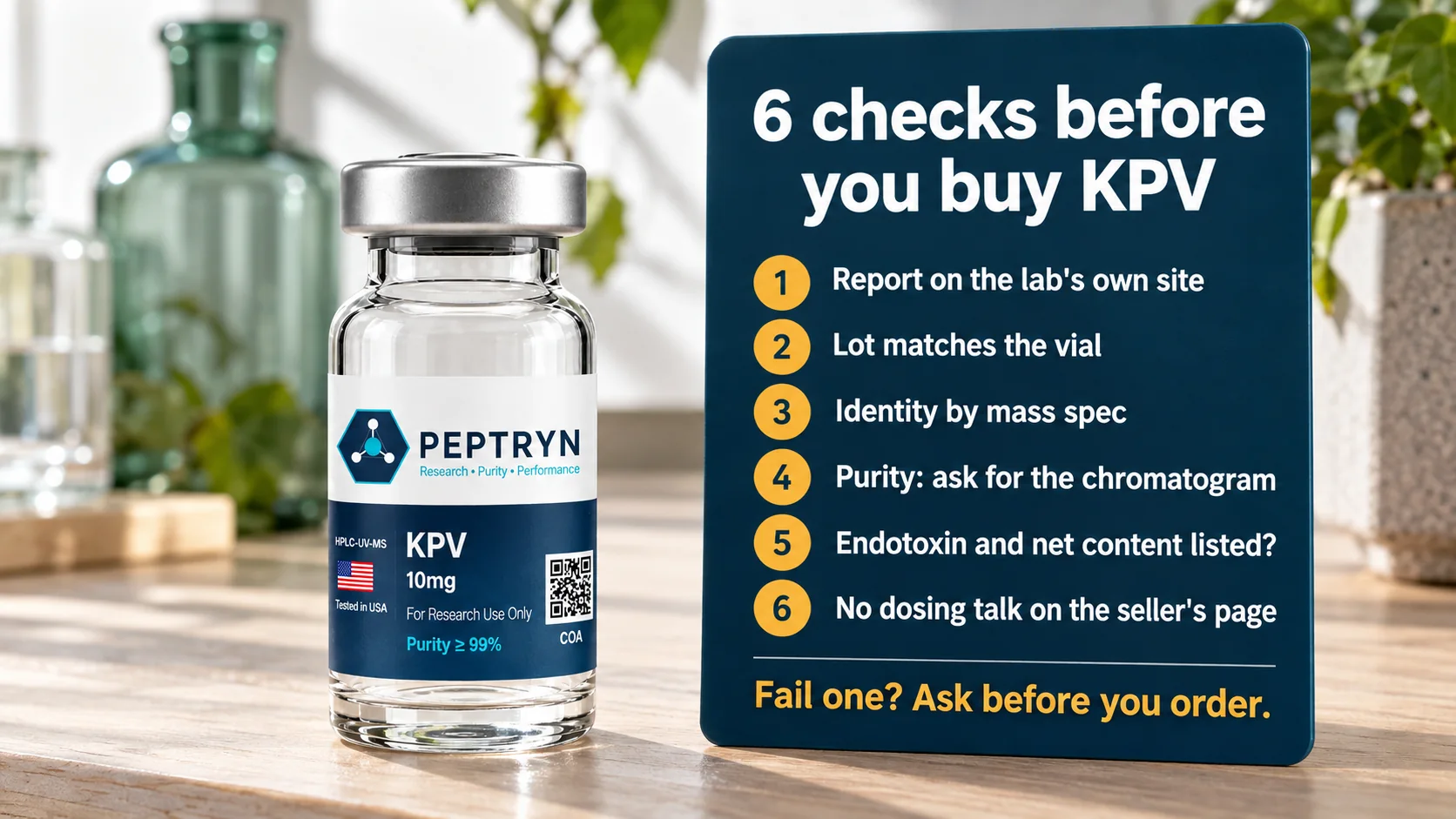
Use these on Peptryn and on everyone else.
- Is the report on the lab’s own site? A certificate the seller designed itself proves little. Look for a named lab and a link or QR code to a report the lab hosts, then open it. Our Janoshik and Finnrick guides cover how independent testing services differ from a seller’s own certificate.
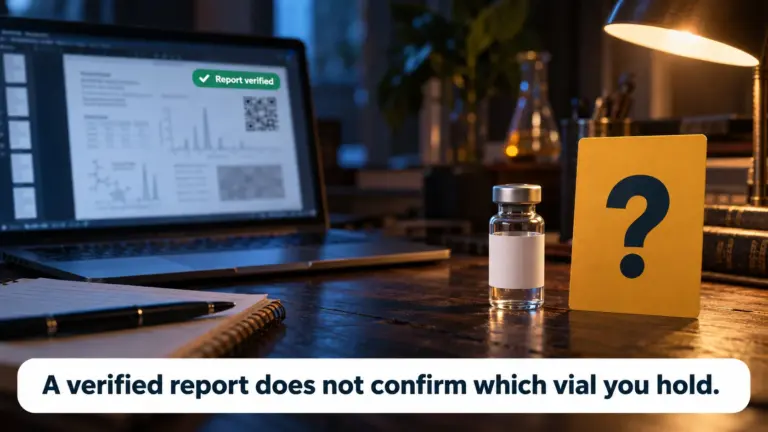
- Does the lot on the report match the lot on the vial? A certificate for another batch, or one with no batch at all, says nothing about the vial you hold. Check that the analysis date fits the lot date.
- Does the report confirm identity by mass spectrometry? The expected mass for KPV is about 342 Da. A purity percentage cannot show that the main peak is KPV.
- What does the purity figure measure? It is an area percentage at one detection wavelength. Ask for the chromatogram as well as the number. Our peptide purity guide explains what a high number can hide.
- Does the report include endotoxin and net content? If it does not, the seller’s label amount and sterility are unverified statements. Ask which tests exist for your lot.
- How does the seller describe use? A research listing gives no dosing schedule, protocol or instructions for use on people. FDA judges intended use from how a product is marketed, so a research label does not offset dosing instructions elsewhere on the page. See are peptides legal? for background.
Why KPV search results look so mixed
A search for “kpv peptide for sale” on October 11, 2026 returned shops selling lyophilized research vials, a capsule supplement from a wellness retailer, and a clinic page about oral KPV. These are different categories with different rules, and the research on KPV covers none of them in people.
Peptryn’s listing is a laboratory material. Peptryn does not sell KPV capsules, creams or protocols, and it does not offer any product for human use.
KPV price: what the listing costs
At the listed prices, the 5 mg vial costs $10.00 per mg and the 10 mg vial $8.00 per mg. Price per mg compares two sellers only when the size and the documentation match. A listing with no lot-matched report is a different product from one with a lab-hosted report, even at the same price per mg.
If you are comparing sellers, line up four things side by side: the lot, the lab that ran the test, whether identity was confirmed by mass spectrometry, and which of endotoxin and net content the report covers.
Where FDA stands on KPV
KPV is not an FDA-approved drug. On April 15, 2026, FDA removed KPV and eleven other peptides from a restricted compounding category because the nominations for them were withdrawn. That removal does not make them eligible for compounding. On July 23, 2026, the Pharmacy Compounding Advisory Committee voted 8 to 6, with one abstention, to recommend KPV for the bulk drug substances list. The vote is advisory, and FDA has not completed rulemaking. Our KPV guide covers the research and the regulatory timeline with sources. The FDA’s meeting page lists the materials.
Common questions
Where can I buy KPV peptide?
Peptryn sells KPV as a lyophilized research peptide in 5 mg ($49.99) and 10 mg ($79.99) sizes on its KPV product page. It is sold only for laboratory research, to buyers who are 21 or older and who confirm qualified research use.
How much does KPV peptide cost?
Peptryn lists KPV at $49.99 for 5 mg, which is $10.00 per mg, and $79.99 for 10 mg, which is $8.00 per mg. Quantity pricing takes 3% off at 3 to 4 units, 5% at 5 to 9 and 10% at 10 or more. Prices change, so check the product page.
Is Peptryn’s KPV third-party tested?
Yes. Lot 2026-09-17 was tested by MZ Biolabs, which reports 99.92% HPLC purity for the 5 mg and 99.79% for the 10 mg, with identity confirmed by mass spectrometry. Each certificate links to a report hosted on the lab’s own site.
Does the KPV certificate include endotoxin or net peptide content?
No. The KPV certificates report HPLC purity and identity. They do not include an endotoxin result or a net peptide content result. Ask through the contact page if you need either for a specific lot.
What is the difference between the 5 mg and 10 mg KPV listings?
The size and the price per mg: $10.00 per mg for the 5 mg vial and $8.00 per mg for the 10 mg vial. Each size has its own certificate from the same lot. Peptryn gives no dosing guidance for either, because no dose has been established.
Is KPV FDA approved?
No. KPV is not an approved drug. In July 2026 an FDA advisory committee voted 8 to 6 to recommend it for a compounding list, which is advice and not approval. No published human clinical trial of KPV was found.
How is KPV stored?
Per the Peptryn product specification, store the lyophilized powder at -20 °C, protected from light and repeated freeze-thaw cycles.
Is KPV the same as the KPV in Klow80?
Klow80 contains 10 mg of KPV alongside BPC-157, TB-500 and GHK-Cu, and it has its own certificate. The standalone KPV listing is a separate product. See the Klow buying guide for the blend.
Related: KPV guide · COA Library · How to read a certificate of analysis · Peptide purity · Klow buying guide · Are peptides legal?
Sources
All pages were read on October 11 and 12, 2026 unless noted.
- Peptryn. KPV product page; KPV 5 mg certificate; KPV 10 mg certificate; COA Library; KPV guide.
- MZ Biolabs. Certificate reports for lot 2026-09-17, linked from the Peptryn certificates above.
- U.S. Food and Drug Administration. July 23-24, 2026: Meeting of the Pharmacy Compounding Advisory Committee.
- Search results for “kpv peptide for sale”, Google US, October 11, 2026.
Editorial note: Peptryn sells the research peptides discussed on this site for laboratory use only. This guide is informational and is not medical advice. To report an error, use the contact page.
All products on peptryn.com are intended for laboratory research purposes only. They are not drugs, foods, dietary supplements or cosmetics, and they are not for human consumption, self-administration, or veterinary use. You must be 21 or older to buy. The information on this page has not been evaluated by the U.S. Food and Drug Administration and is not intended to diagnose, treat, cure, or prevent any disease.