Eloralintide Myths and Facts: 15 Claims Checked Against the Trials (2026)
Research use only. This guide is education, not medical advice. Eloralintide is an investigational drug that no regulator has approved. Peptryn gives no dosing or administration guidance and makes no health claim for any research material.
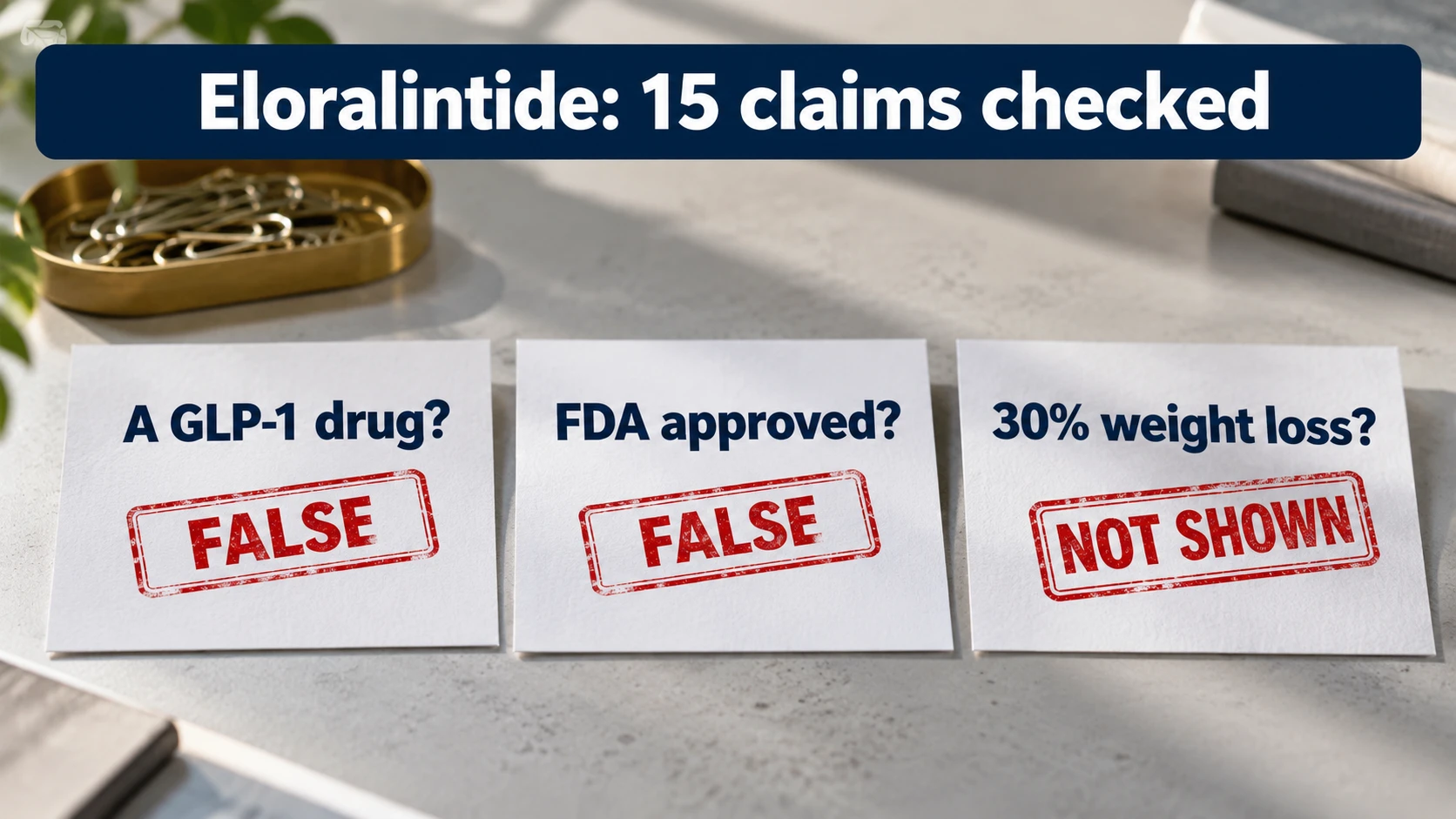
Short answer: Eloralintide attracts a lot of loose claims. Checked against the published trials and registry, most popular statements are false or unproven: it is not a GLP-1 drug, it is not approved, its best verified weight result is about -20% on treatment (not 30%), it does cause nausea and fatigue, it has not been shown to spare muscle in people, it has not been compared head to head with any rival, no one has tested it monthly, and a research vial is not the same product as Lilly’s trial drug. Each claim below gets a verdict, the evidence and a link to the detailed guide.
Key takeaways
- Of 15 common claims, 7 are false, 7 are unproven or unknown, and 1 is partly true.
- The biggest sources of confusion: counting methods for weight change (on-treatment versus all randomized), dose charts written by sellers, and nicknames borrowed from retatrutide.
- The only things measured in people so far come from phase 1, phase 2 and one phase 2b trial. No phase 3 result exists.
- When a claim cites “studies” without a name, treat it as unverified. Real eloralintide data sit in *The Lancet*, two phase 1 papers, Lilly’s EloraTZP release and ClinicalTrials.gov.
Last verified October 15, 2026. Sources are listed at the end. For laboratory and research use only. Nothing here is medical or legal advice.
Contents
- Scorecard
- The 15 claims
- Reviews and Reddit: what online reports can and cannot tell you
- How to spot a bad eloralintide claim
- Common questions
Scorecard
| # | Claim | Verdict |
|---|---|---|
| 1 | Eloralintide is a GLP-1 drug | False |
| 2 | Eloralintide is FDA approved | False |
| 3 | Eloralintide causes 30% weight change | Not shown |
| 4 | Eloralintide has no side effects | False |
| 5 | Eloralintide has no mood effects | Not shown |
| 6 | Eloralintide preserves muscle | Not shown in people |
| 7 | Eloralintide beats retatrutide, tirzepatide and semaglutide | Not shown |
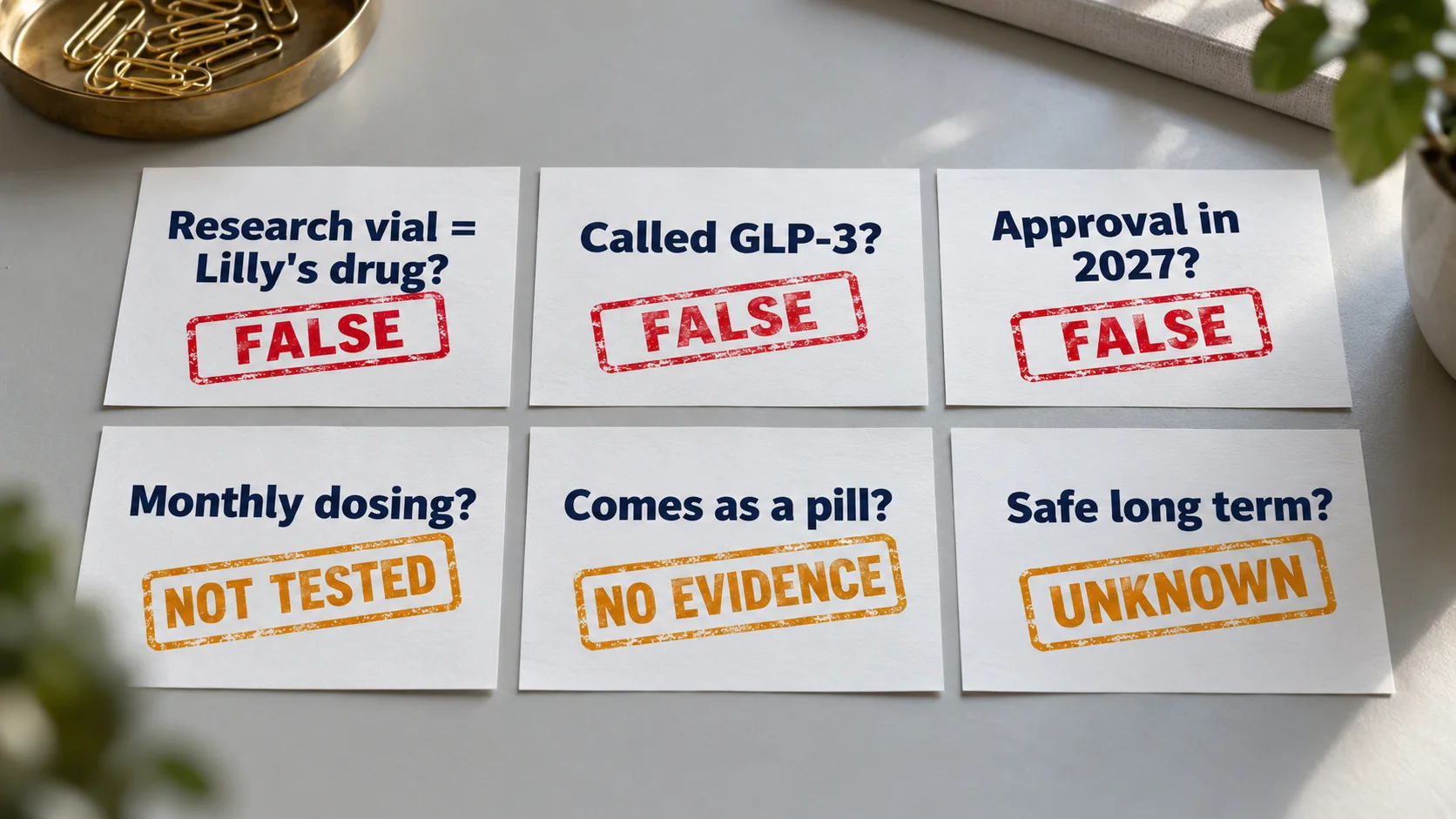
| 8 | Its long half-life means it can be dosed monthly | Not tested |
| 9 | Online dosing charts come from Lilly | False |
| 10 | A research vial is the same as Lilly’s trial drug | False |
| 11 | Eloralintide comes as a pill | No evidence |
| 12 | Eloralintide is “GLP-3” | False |
| 13 | Approval is coming in 2027 | False |
| 14 | Eloralintide is safe in the long term | Unknown |
| 15 | It is legal to buy because it is sold as a “research chemical” | Partly true, and contested |
The 15 claims
1. “Eloralintide is a GLP-1 drug”
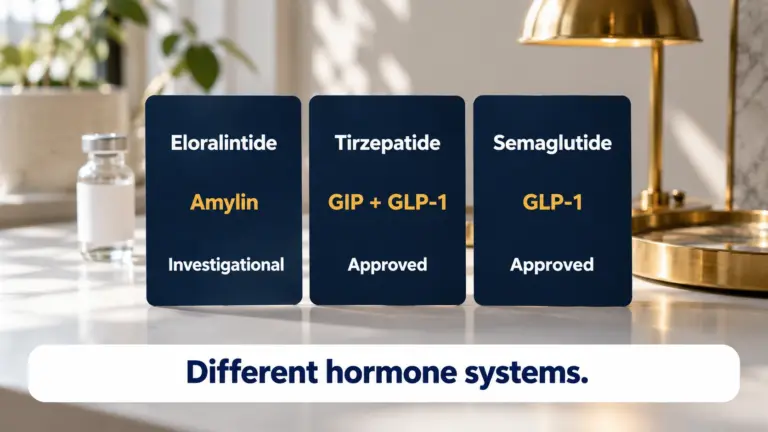
Verdict: False. Eloralintide is a selective amylin receptor agonist. It does not activate the GLP-1 receptor. Semaglutide, tirzepatide and retatrutide are the incretin drugs. Lilly is testing eloralintide with tirzepatide because the two work through different pathways. See how eloralintide works.
2. “Eloralintide is FDA approved”
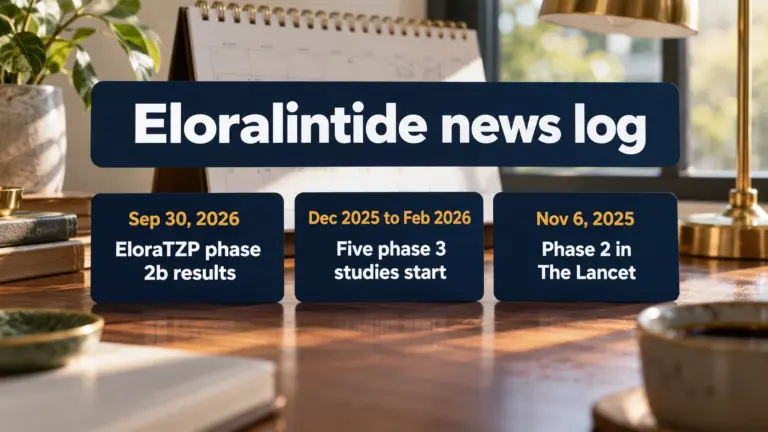
Verdict: False. No regulator has approved it. Five phase 3 ENLIGHTEN studies are enrolling, with estimated primary completion between January and June 2028, and I found no announced filing as of October 15, 2026. See the approval status guide.
3. “Eloralintide causes 30% weight change”
Verdict: Not shown. The best verified results are about -20% at 48 weeks on the 9 mg arms in the phase 2 trial (on treatment) and -23.3% for eloralintide combined with tirzepatide in people with type 2 diabetes. The range for eloralintide alone is -9% to -20%. Nothing near 30% appears in any trial I found. When a page quotes a larger number, check whether it is a different drug (some combination and early-phase molecules have shown 24% or more) or a cherry-picked arm. See the trial results guide.
4. “Eloralintide has no side effects”
Verdict: False. In phase 2, nausea ranged from 11% to 64% by arm (14% on placebo) and fatigue from 0% to 46% (12% on placebo). Any adverse event occurred in 81% against 71% on placebo, and about 10% stopped treatment because of an adverse event. Phase 1b also reported decreased appetite (19.2%), headache (12.3%), diarrhoea (9.6%) and injection site reactions (9.6%). See the side effects guide.
5. “Eloralintide has no mood effects”
Verdict: Not shown. In the 12-week phase 1b study, four participants had mood-related events (three depressed mood and one persistent depressive disorder), all at the 6 mg or 12 mg doses, and the three at 12 mg stopped treatment. The numbers are small, the paper does not claim a causal link and the events resolved in two to four days. A claim of “no mood effects” ignores that record, and the claim of “mood effects” overstates it. Larger trials will show.
6. “Eloralintide preserves muscle”
Verdict: Not shown in people. In obese rats, 86% to 91% of the weight lost at low and middle doses was fat, against 63% for cagrilintide at its test dose, and lean-mass loss was significantly lower with eloralintide. I found no published human body-composition data. A 2026 review lists preferential fat mass loss among the early features, drawing on the same animal findings. Treat it as a hypothesis.
7. “Eloralintide beats retatrutide, tirzepatide and semaglutide”
Verdict: Not shown. No trial compares eloralintide head to head with any of them. Its on-treatment phase 2 result (about -20% at 48 weeks) sits beside retatrutide’s -24.2% at 48 weeks in phase 2, tirzepatide’s -20.9% at 72 weeks and semaglutide’s -14.9% at 68 weeks in phase 3, but those trials differ in length, size, population and analysis method. See eloralintide vs retatrutide and eloralintide vs tirzepatide and semaglutide.
8. “Its long half-life means it can be dosed monthly”
Verdict: Not tested. The half-life is long (12.9 to 15.3 days after a single dose), which is about twice cagrilintide’s. Every trial of eloralintide used once-weekly dosing, and I found no registered study of a longer interval. Monthly amylin analogues are being developed separately (for example, Pfizer’s MET-233i). See the structure and half-life guide.
9. “Online dosing charts come from Lilly”
Verdict: False. Lilly has not published a dosing schedule, and no label exists. Dose charts on vendor and forum pages are written by third parties, usually converting phase 2 trial arms into recommendations. See the dosage guide.
10. “A research vial is the same as Lilly’s trial drug”
Verdict: False. Lilly’s trial supply is made and released under Lilly’s quality system. A vial sold on a website is made by someone else. In our data report, the measured amount in research vials ran from 8.6% below to 36.5% above the label across 21 components, and mass spectrometry confirms weight but not exact structure. A published certificate shows what a lab measured in a sample. It does not show equivalence to Lilly’s product. See what a certificate should show.
11. “Eloralintide comes as a pill”
Verdict: No evidence. The registered studies I read describe once-weekly injections, and I found no oral eloralintide program. Lilly has other obesity drugs in tablet form, and Novo Nordisk’s zenagamtide has a daily tablet, which is one source of the mix-up.
12. “Eloralintide is ‘GLP-3′”
Verdict: False. “GLP-3” is not a real receptor class. The nickname was used for retatrutide and, in the FDA’s August 2026 warning letters, was cited as a code name that sellers used to disguise the real product. Eloralintide is an amylin drug, not a GLP-based one. See our explanation of what “GLP-3” actually means.
13. “Approval is coming in 2027”
Verdict: False. Phase 3 primary completion is estimated for January to June 2028. A filing and a standard FDA review of about 12 months would put a decision in 2029 at the earliest on public schedules (an estimate, not a Lilly date). Retatrutide’s planned filing in the first quarter of 2027 may be the source of the mix-up.
14. “Eloralintide is safe in the long term”
Verdict: Unknown. The longest published exposure is 48 weeks, in a few hundred people. ENLIGHTEN-1 runs to 2030. Questions on lean mass, bone, mood, immune response and weight regain after stopping have no published answers.
15. “It is legal to buy because it is sold as a ‘research chemical'”
Verdict: Partly true, and contested. Selling a compound for laboratory research is lawful in principle, and many sellers rely on that. The FDA’s position is that a “research use only” label does not make a product lawful if it is sold for human use, and in August 2026 Lilly sued six sellers of unapproved retatrutide and the FDA sent warning letters to research-use-only vendors. I found no action that names eloralintide. Whether a given sale is lawful depends on facts a label does not settle. See Are peptides legal?. This is not legal advice.
Reviews and Reddit: what online reports can and cannot tell you
Searches for “eloralintide reddit” rose from about 10 a month in October 2025 to about 590 in September 2026, and searches for “eloralintide reviews” have appeared since July. I could not read Reddit threads (the site blocks the search tool I use), so I have not summarised any, and nothing on this page is drawn from forum posts. What can be said is what kind of evidence a “review” of eloralintide can be.
- There are no prescription users. No regulator has approved eloralintide, so no pharmacy dispenses it and no insurer covers it.
- Trial participants cannot give verified reviews. Participants are blinded, may be on placebo and are bound by study rules, and their results appear only in the sponsor’s data.
- Anyone else is using an unverified product. Reports from people using research vials describe a product whose identity, amount and sterility were never confirmed. In our data report, the measured amount in research vials differed from label by -8.6% to +36.5%.
- Selection and context are missing. Self-reported results leave out who dropped out, what else changed (other drugs, diet, illness) and what the starting weight was, and a placebo effect is possible.
- Sellers write reviews too. Testimonial text on a vendor page is marketing.
- Generated pages copy each other. Affiliate-style pages repeat the same figures, including some that do not match any trial.
A useful check for any claim in a forum or review is to ask for the trial, the number and the counting method. If those are missing, treat the claim as unverified and compare it with the trial results guide and the side effects guide.
How to spot a bad eloralintide claim
- No named study. “Studies show” without a journal, trial name or registry number is a flag.
- A number without a counting method. Ask whether it is on treatment or all randomized, and how long the trial ran.
- A seller wrote it. A page that sells the product has a stake in the claim.
- It sounds like a protocol. Doses, cycles, stacks and volume conversions are not in any published source.
- It borrows another drug’s data. Retatrutide, CagriSema and zenagamtide results are often pasted into eloralintide pages.
- It cites a certificate without a lot. A purity number is not a guarantee of identity or amount.
Common questions
Is eloralintide safe?
Nobody can say yet. Trials report mostly mild to moderate stomach side effects and fatigue, with about 10% stopping treatment, and the record covers 48 weeks at most. It is not approved.
Is eloralintide real?
Yes. It is Eli Lilly’s investigational amylin drug (LY3841136), with a published phase 2 trial in The Lancet, two phase 1 papers and 21 registered studies.
Does eloralintide cause 30% weight change?
Not in any trial I found. The best verified results are about -20% on treatment (phase 2) and -23.3% with tirzepatide in type 2 diabetes.
Is eloralintide a steroid, hormone or stimulant?
It is a synthetic peptide analogue of amylin, a natural hormone. It is not a steroid or a stimulant.
Where does the name eloralintide come from?
It is the US adopted name for the molecule, whose Lilly code is LY3841136. The “-lintide” ending is shared with other amylin analogues such as cagrilintide and pramlintide.
Are there eloralintide reviews?
Not verified ones. Eloralintide is not approved, so there are no prescription users, and trial participants are blinded. Reports from people using unverified research vials cannot be checked for identity, amount or contamination.
What does Reddit say about eloralintide?
I could not read Reddit threads and have not summarised them. Search interest in “eloralintide reddit” grew from about 10 searches a month in October 2025 to about 590 in September 2026. Check any forum claim against the published trials.
Can eloralintide be bought legally?
Only through a clinical trial for human use. Some websites sell it as a research chemical, which is a contested status. See claim 15.
Related: What is eloralintide? · Eloralintide news · Eloralintide side effects · Eloralintide dosage · Eloralintide price · Third-party tested peptides · All eloralintide guides
Sources
All pages read October 14 to 15, 2026.
- Billings LK, et al. Eloralintide phase 2. The Lancet 2025; DOI 10.1016/S0140-6736(25)02155-5; NCT06230523.
- Briere DA, et al. Molecular Metabolism 2025; PMC12640043. Bhattachar S, et al. Diabetes, Obesity and Metabolism 2026; PMC12992164.
- Eli Lilly. EloraTZP phase 2b release, September 30, 2026: PR Newswire.
- ClinicalTrials.gov, eloralintide (LY3841136) records, retrieved October 15, 2026: search.
- Cardiometabolic risk reduction through selective amylin receptor agonism. Cardiology in Review 2026; PubMed 42745233.
- Novel amylin-based therapies network meta-analysis. Endocrinology, Diabetes and Metabolism 2026; PMC13240113.
- NPR. Eli Lilly files six lawsuits against sellers of unapproved retatrutide, August 13, 2026: npr.org. FDA warning letters to online sellers, reported September 2026 by trade press (secondary).
- Peptryn. Peptide COA data report, Q3 2026; Is retatrutide FDA approved?.
Editorial note: Peptryn sells research materials for laboratory use only. This guide is informational and is not medical advice. To report an error, use the contact page.
All products on peptryn.com are intended for laboratory research purposes only. They are not drugs, foods, dietary supplements or cosmetics, and they are not for human consumption, self-administration, or veterinary use. You must be 21 or older to buy. The information on this page has not been evaluated by the U.S. Food and Drug Administration and is not intended to diagnose, treat, cure, or prevent any disease.