Eloralintide Price: Why There Is No Approved Price and What Research Listings Show (October 2026)
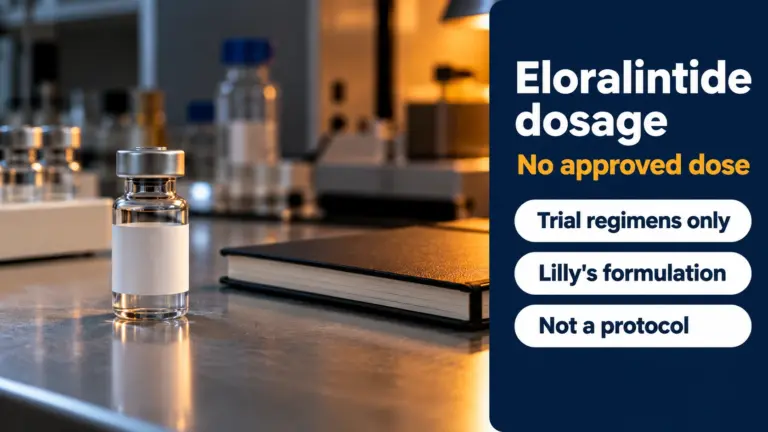
Research use only. This guide is education, not medical advice or a buying recommendation. Eloralintide is an investigational drug that no regulator has approved, and the listings below are third-party websites that describe it as a research material. Peptryn does not list eloralintide, gives no dosing or administration guidance, and sells research materials only for laboratory use to buyers who are 21 or older.
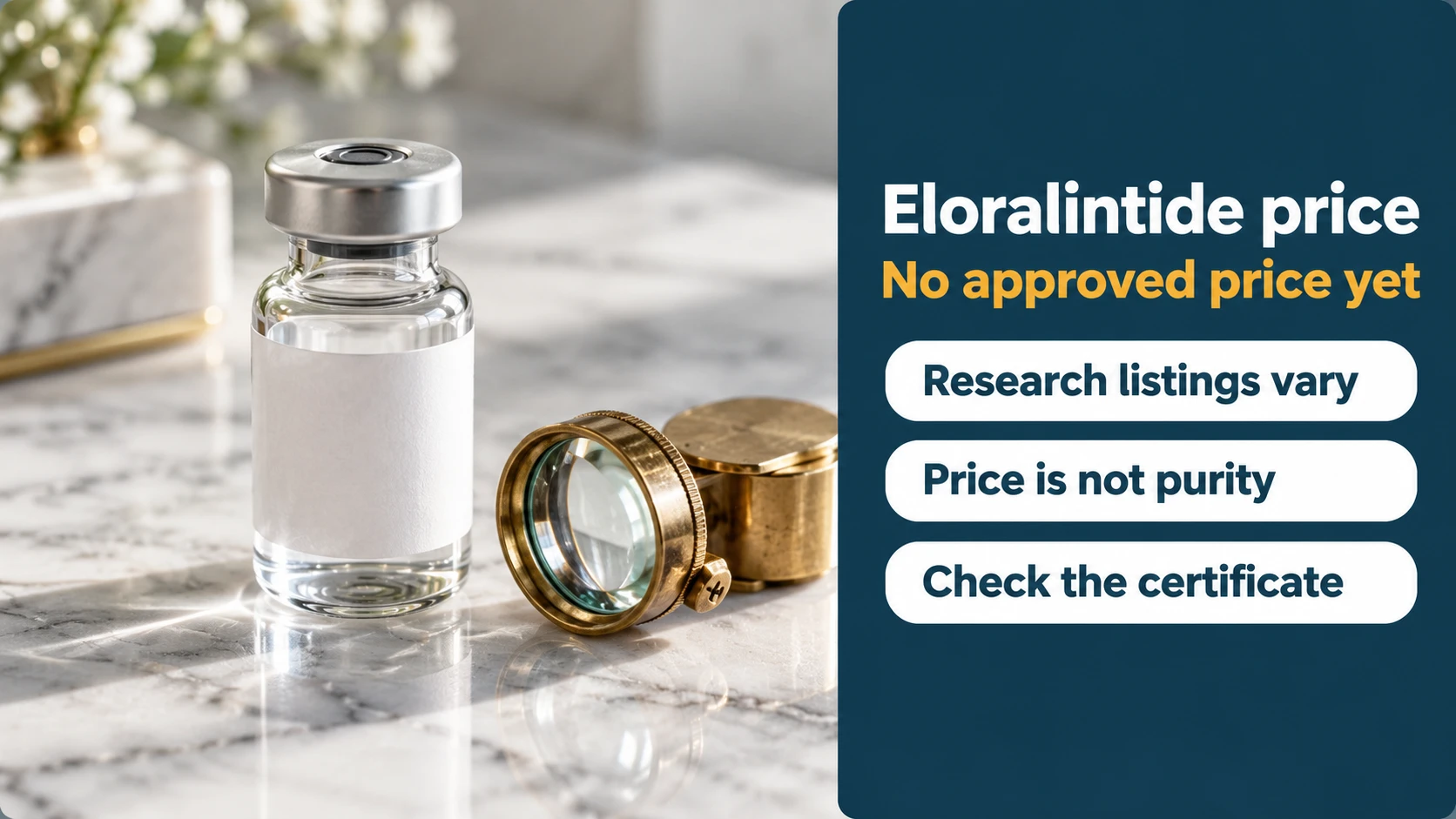
Short answer: Eloralintide has no approved price, because no regulator has approved it and Eli Lilly has not announced one. Websites that list it as a research chemical showed prices from $90.00 for a 10 mg vial to about $279 for a single vial of a listing titled 13 mg, and about $231 (AED 850) for another, on October 15, 2026. Where an amount is stated, that is roughly $9 to $21 per milligram. A listing’s price says nothing about what is in the vial: one seller’s own certificate showed 16.30 mg measured content, and across Peptryn’s own tested lots the measured amount ran from 8.6% below to 36.5% above the label.
Key takeaways
- No Lilly price exists. Any “list price” for a finished eloralintide medicine is speculation.
- Research-listing prices on October 15, 2026: $90.00 and $99.00 for 10 mg vials, about $21 per mg for a catalog listing titled 13 mg, and about $231 for a UAE listing with no stated size.
- Price per milligram only compares sellers when the amount, lot and test results match, and they rarely do.
- Some affiliate-style pages quote ranges up to $799 without linking a real listing. I could not match those figures to any seller.
- Selling or buying an unapproved drug as a “research chemical” is legally contested, and Lilly sued six sellers of unapproved retatrutide in August 2026.
Last verified October 15, 2026. Prices change often and were read from each seller’s own page. Sources are listed at the end. For laboratory and research use only. Nothing here is medical or legal advice.
Contents
- Why there is no approved price
- What research listings showed on October 15, 2026
- Why price per milligram misleads here
- Why the price is not “a cost of treatment”
- The legal context for buyers
- How to compare two eloralintide listings
- Common questions
Why there is no approved price
A price for a medicine exists only after a regulator approves it and a company launches it. Eloralintide is in phase 3 (five ENLIGHTEN studies, estimated primary completion January to June 2028), and no filing has been announced. The earliest approval on public schedules is 2029, so no pharmacy price, insurance listing or manufacturer’s list price exists. Lilly’s prices for its approved drugs vary by product, dose, insurer and program, and nothing about them predicts the price of an unapproved molecule. See the approval status guide.
What research listings showed on October 15, 2026
The sellers below came up on page one of Google US for “eloralintide for sale” and “buy eloralintide peptide” on October 14, 2026. I read price and testing statements from each seller’s own page. I did not buy anything, test anything or verify any claim. Listing a seller here is not an endorsement.
| Seller | Price | Amount on the page | Per mg | Testing statements on the page | Stock |
|---|---|---|---|---|---|
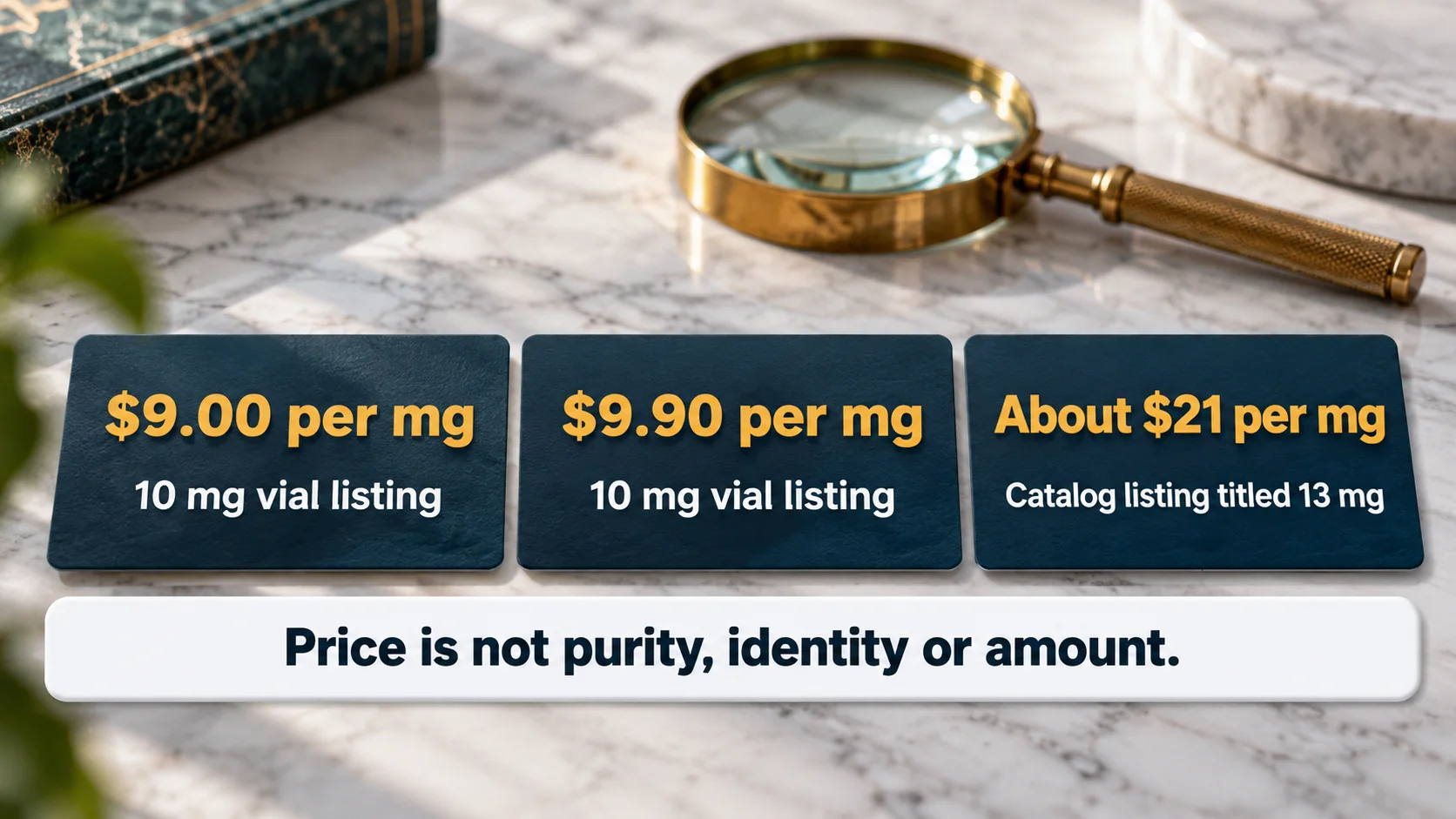
| Goated Peptides | $90.00 | 10 mg vial | $9.00 | “Third party tested,” “COA published,” a 99% purity specification | Add to cart shown |
| Volta Peptides | $99.00 (USD) | 10 mg vial | $9.90 | “>99% HPLC spec,” “Batch COA” | Out of stock |
| AminoStock | From $278.99 | Its search listing is titled “13mg”; the page text I could read does not state a size | About $21.46 if 13 mg | Search title says “99%+ purity, CoA”; the site asks buyers to confirm they are qualified researchers | Not checked |
| NOVA Labs (UAE store) | AED 850 (about $231 at the pegged rate of 3.6725) | Not stated in the page text I read | Not computable | Certificate panel: purity 99.80%, measured content 16.30 mg, test date August 31, 2026, batch NV-ELO10-0718, methods HPLC and LC-MS | In stock per page data |
Other results on page one included a chemical catalog, a reseller with a 10-vial kit, and several affiliate-style pages. One of those pages quotes a range of “$109 to $799” and a “5 mg $358” price point, and I could not tie those figures to a real listing, so I did not use them.
Reading the spread
- Two sellers sit at $9.00 and $9.90 per milligram. Both sell a 10 mg vial and both state a purity specification, with certificates described as available.
- One catalog listing works out to about $21.46 per milligram if the 13 mg in its search title is the vial size, which is about 2.4 times the cheapest.
- The fourth listing, at about $231, states no size in the page text I could read, so its per-milligram figure cannot be computed. It would be $23.14 per milligram if the vial were 10 mg, which is only a guess.
A 2.4-fold difference on a molecule that is hard to make could reflect real differences in quality, differences in markup, or neither. A price cannot tell you which.
Why price per milligram misleads here
- The label amount is not the measured amount. In our September 2026 data report, measured quantity ran from 8.6% below to 36.5% above the label across 21 components in 15 tested products, with a median of 16.4% above. One eloralintide seller’s own certificate lists measured content of 16.30 mg; the page does not state the label amount in the text I read, so the gap cannot be computed here. A vial listed at 10 mg could hold more or less than 10 mg, and “per mg” depends on which.
- Purity is not amount. A 99% purity figure describes the share of the main peak, not how much peptide is in the vial.
- Identity is the first question. Eloralintide has non-coded residues, a thioacetal bridge and a fatty diacid. Mass spectrometry confirms weight and not the exact structure, and no public reference standard exists. A cheap vial that is not the intended molecule is not cheap.
- Testing differs. One seller shows a certificate on the product page, another says certificates exist, and another shows neither in the text I read. The lab, the method, the lot and the date are what make a certificate useful. See what a certificate should show.
- Availability and currency. Prices are in different currencies, stock changes, and sale prices come and go.
A worked illustration
This is arithmetic and not a listing. A vial listed at $120 for 10 mg is $12.00 per labeled milligram. If a lab then measured 8.4 mg, it costs $14.29 per measured milligram. If another lab measured 11.6 mg, it costs $10.34. The same sticker price gives a 38% spread in cost per milligram of peptide, which is more than the difference between many sellers.
Why the price is not “a cost of treatment”
People searching “eloralintide price” often want to know what a course of treatment would cost. A research listing is not that. It is a single laboratory vial of unverified content, sold for laboratory use only, with no dosing information and no medical supervision. It is not a substitute for a medicine, and Peptryn does not suggest using it as one. If you want to know the likely future cost of treatment, the honest answer is that nobody knows. Lilly has not announced a price, and approved obesity drugs have prices that depend on the product, the insurer and the program.
The legal context for buyers
Eloralintide is an unapproved investigational drug. The FDA’s position is that a “research use only” label does not make a product lawful if it is sold for human use. In August 2026 Lilly sued six US sellers of unapproved retatrutide and the FDA sent warning letters to research-use-only vendors. I found no lawsuit or warning letter that names eloralintide as of October 15, 2026, but a seller or buyer of eloralintide faces the same legal theory. See Are peptides legal? and the myths and facts guide. This is not legal advice.
How to compare two eloralintide listings
Line up these before comparing price:
| Check | Why it matters |
|---|---|
| Stated amount per vial | Different amounts make per-milligram comparisons meaningless |
| Lot number and test date | A report must describe the vial you would receive |
| Lab name and method | HPLC purity and mass spectrometry are different results |
| Measured quantity | Label amount is not the amount |
| Endotoxin result | A purity test does not detect it |
| Where the report sits | A report on the lab’s own site beats a PDF on the seller’s server |
| Currency, shipping and stock | Many apparent price gaps are shipping or currency differences |
| Claims | Dosing charts, “pharmaceutical grade” and “same as Lilly’s drug” are red flags |
Common questions
How much does eloralintide cost?
There is no approved price. Research listings on October 15, 2026 ranged from $90.00 for a 10 mg vial to about $279 for a catalog listing and about $231 (AED 850) for another. Those are research-chemical prices, not medicine prices.
What is the price of eloralintide per mg?
On the listings where an amount is stated, $9.00 and $9.90 per labeled milligram for two 10 mg vials and about $21.46 for a catalog listing titled 13 mg. The label amount may not match the measured amount.
Why do eloralintide prices vary so much?
The sources do not say. Differences in what is in the vial, testing, sourcing, shipping and markup are all possible, and none can be verified from a listing.
How much will eloralintide cost when approved?
Nobody knows. Eloralintide is in phase 3, Lilly has not announced a price and approval is unlikely before 2029.
Is eloralintide covered by insurance?
No. It is not approved, so no insurer covers it outside a clinical trial, where the study sponsor supplies the drug.
Is eloralintide cheaper than tirzepatide or semaglutide?
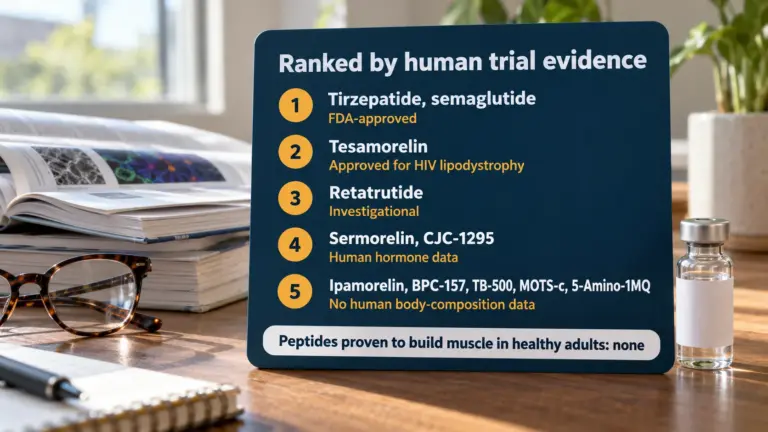
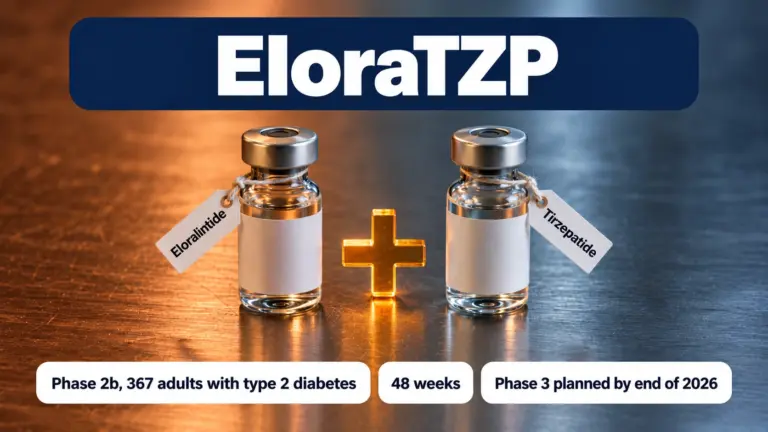
Not comparable. Tirzepatide and semaglutide are approved prescription drugs with their own pricing, and a research vial is neither a prescription product nor a verified equivalent. See eloralintide vs tirzepatide and semaglutide.
Does Peptryn sell eloralintide?
No. Peptryn does not list eloralintide and has no certificate for it. Any future listing would need a lot-matched certificate and legal review first.
Is there a free way to get eloralintide?
Only through a clinical trial, where participants receive the study drug at no cost, may receive placebo, and must meet the study’s criteria. See eloralintide clinical trials.
Related: What is eloralintide? · What a research listing and certificate should show · Eloralintide myths and facts · Eloralintide news · Peptide COA data report · Best place to buy peptides online · All eloralintide guides
Sources
All pages read October 14 to 15, 2026.
- Goated Peptides, Eloralintide product page (price from the page’s product data).
- Volta Peptides, Eloralintide 10mg product page (price and stock status from the page).
- AminoStock, Eloralintide product page (catalog “from” price) and Google search listing titled “Eloralintide 13mg”.
- NOVA Labs (UAE store), Eloralintide product page (price in AED and certificate panel). AED conversion uses the pegged rate of 3.6725 per US dollar.
- Search results for “eloralintide for sale” and “buy eloralintide peptide”, Google US, October 14, 2026.
- Peptryn. Peptide COA data report, Q3 2026, September 26, 2026.
- NPR. Eli Lilly files six lawsuits against sellers of unapproved retatrutide, August 13, 2026: npr.org.
- ClinicalTrials.gov, eloralintide ENLIGHTEN records, retrieved October 15, 2026.
Editorial note: Peptryn sells research materials for laboratory use only. This guide is informational and is not medical advice. To report an error, use the contact page.
All products on peptryn.com are intended for laboratory research purposes only. They are not drugs, foods, dietary supplements or cosmetics, and they are not for human consumption, self-administration, or veterinary use. You must be 21 or older to buy. The information on this page has not been evaluated by the U.S. Food and Drug Administration and is not intended to diagnose, treat, cure, or prevent any disease.