Glutathione 1500 mg for Sale: Price, COA and What the Purity Number Means
Research use only. Glutathione supplied by Peptryn is sold strictly as a laboratory reagent for in vitro and preclinical research. It is not a dietary supplement, it is not approved by the FDA for human or veterinary use, and nothing here is medical advice, a dosing recommendation, or an instruction for self-administration. This page explains what Peptryn’s glutathione listing includes and how to check any glutathione vial.
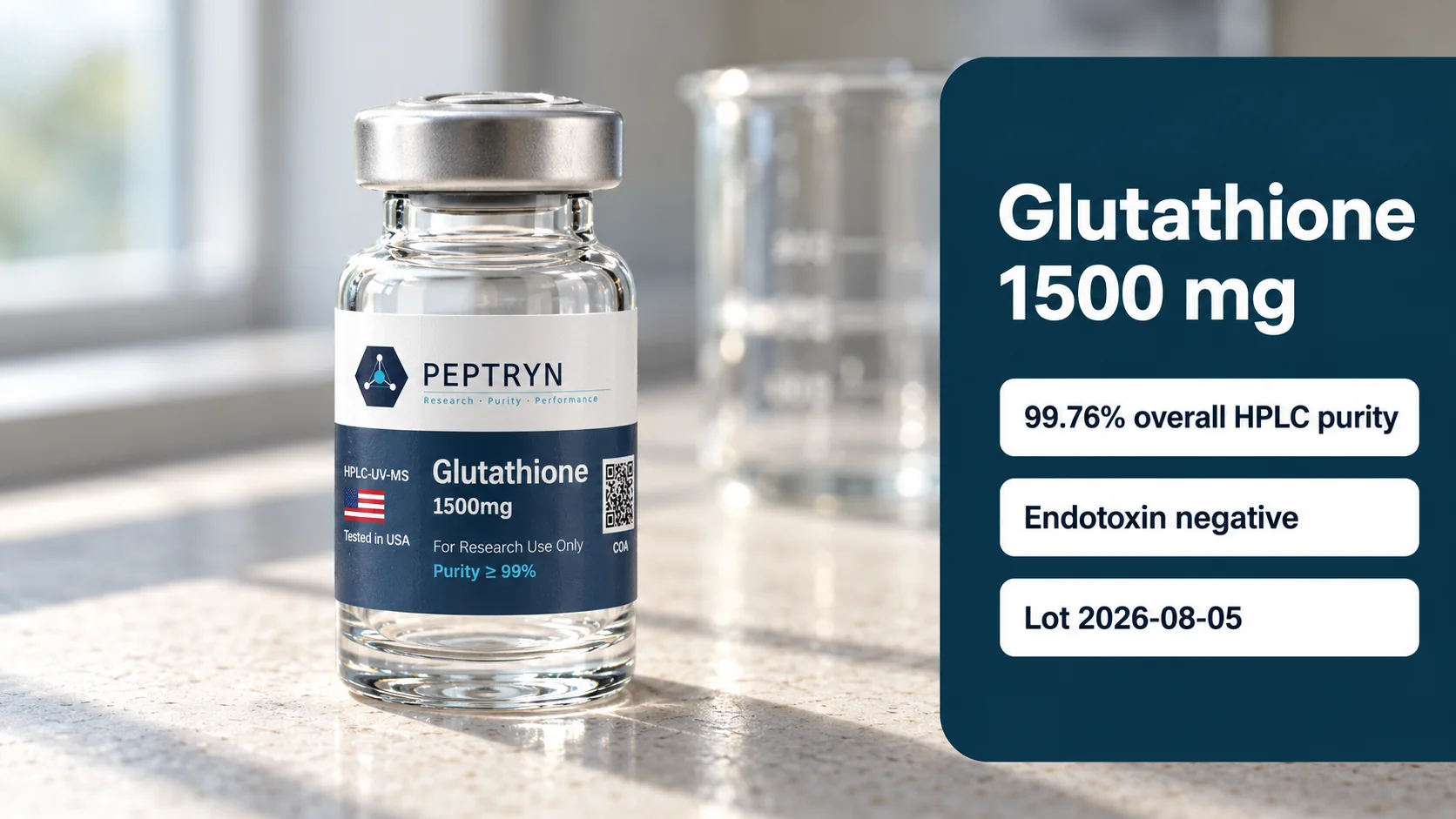
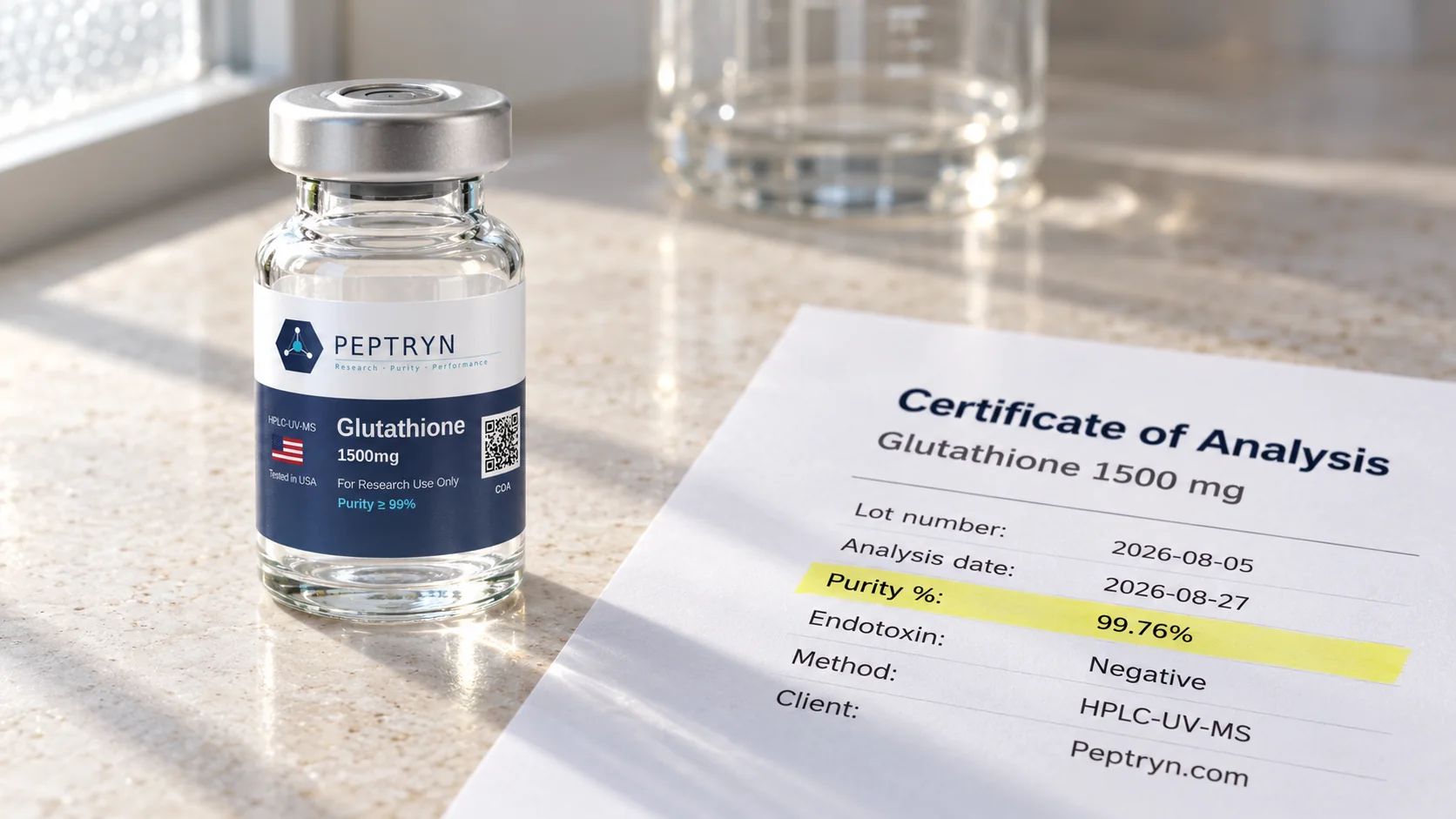
Quick answer: Peptryn sells glutathione as one 1500 mg lyophilized laboratory vial for $79.99, which is about $0.053 per mg. Lot 2026-08-05 reads 99.76% overall HPLC purity with a negative endotoxin result, tested by MZ Biolabs. That headline figure is the glutathione peak (97.85%) plus sodium formate clusters (1.91%) that the lab says point to a sodium salt form, and the lab measured 1571.73 mg in the vial against the 1500 mg label. Peptryn sells it only for laboratory research to buyers who are 21 or older.
This page covers the buying side: the price, how to read the purity number on this lot, and the checks that matter for glutathione. For the research itself, read our glutathione guide.
Key takeaways
- The 1500 mg vial lists at $79.99. Quantity pricing takes 3%, 5% or 10% off.
- Lot 2026-08-05 reads 99.76% overall purity. The glutathione peak alone is 97.85%, and a further 1.91% is sodium formate clusters that indicate a sodium salt form.
- The lab measured 1571.73 mg against the 1500 mg label (+4.8%). The report does not say whether that is free glutathione or the salt, so the figure is one lot from one lab.
- Search results for glutathione mix laboratory reagents with dietary supplements, a clinic injection service and a chemical marketplace. Only the first group is a laboratory material.
Last verified October 15, 2026. Prices and lot details are as listed on that date and change with each batch, so check the product page and certificate before you rely on a number. Sources are listed at the end. For laboratory and research use only. Nothing here is medical or legal advice.
What Peptryn’s glutathione vial includes
| Item | Detail |
|---|---|
| Form and size | Lyophilized powder, 1500 mg |
| Compound | Glutathione (GSH), C10H17N3O6S, 307.32 Da, CAS 70-18-8 |
| Listed price | $79.99 (about $0.053 per mg) |
| Quantity pricing | 3% off at 3 to 4 units ($77.59 each), 5% off at 5 to 9 ($75.99), 10% off at 10 or more ($71.99) |
| Lot | 2026-08-05 |
| Lab analysis date | 2026-08-27 |
| Overall HPLC purity | 99.76% (HPLC-UV-MS) |
| Endotoxin | Negative |
| Lab | MZ Biolabs, Tucson, Arizona |
| Storage | -20 °C, protected from light, moisture and oxygen |
| Certificate | Glutathione 1500 mg COA |
The product page lists the full specification. Peptryn does not give dosing or use guidance for glutathione.
How to read the 99.76% on this lot
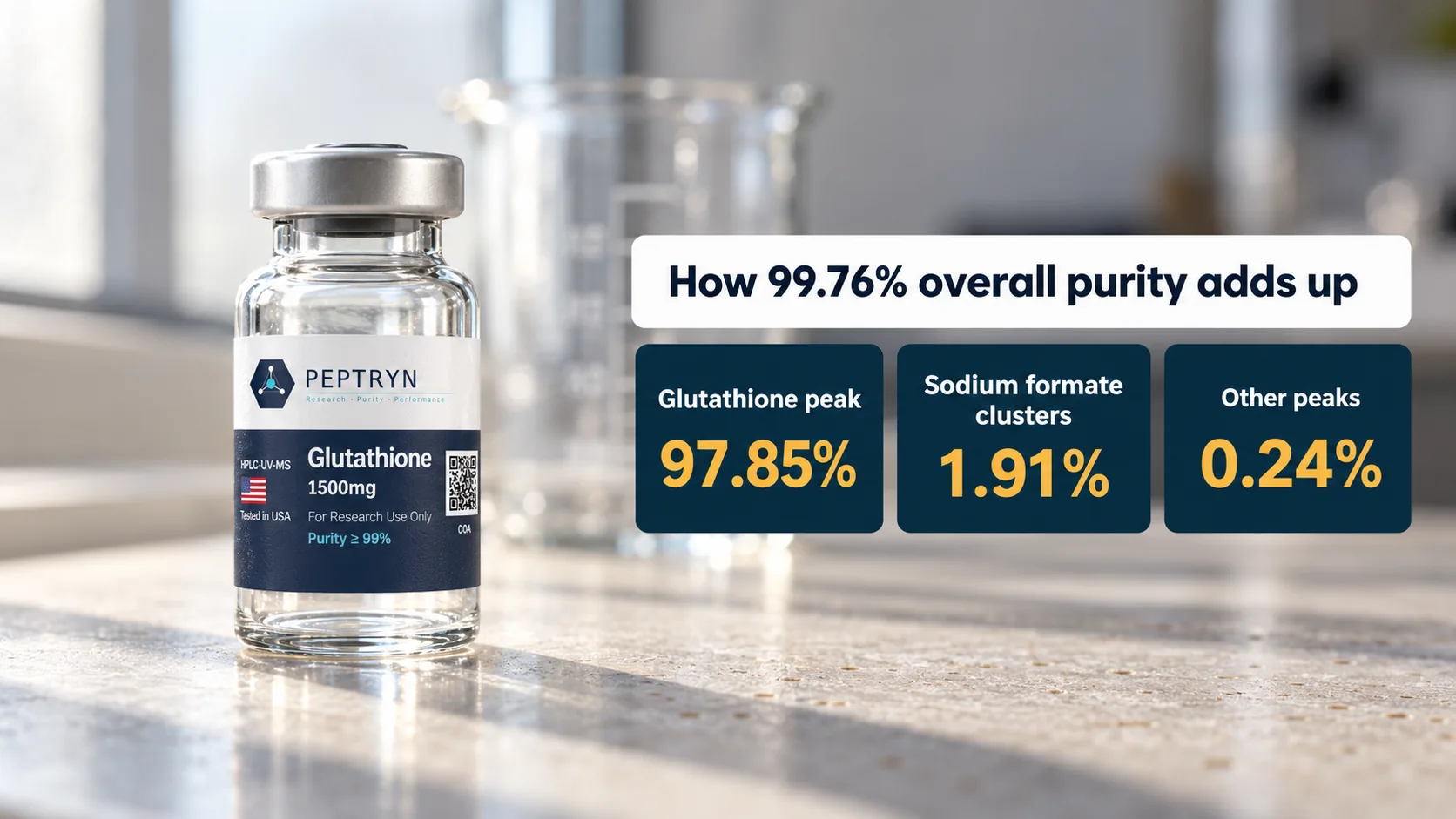
Glutathione is a good example of why a purity percentage needs its peak table. The lab’s report for this lot splits the 99.76% like this:
| Result | Value | What it means |
|---|---|---|
| Overall purity | 99.76% | The glutathione peak plus the sodium formate clusters |
| Glutathione peak alone | 97.85% of area | The figure for the compound itself |
| Sodium formate clusters | 1.91% of area | MZ Biolabs says these form when sodium in the sample meets formic acid in the HPLC solvent, and they indicate the sodium salt form |
| Other peaks | 0.08% and 0.16% | Unidentified minor components |
| Identity | Expected 307.08, measured 307.12 | Matches glutathione (GSH). The oxidized form, GSSG, would appear near 612 Da |
Two lessons follow. First, “purity” depends on what the lab counts as the product, so two sellers’ headline numbers compare only when you know what each lab counted. Second, a salt form changes the molecular weight you should use for any calculation, which is why the salt question matters for research. Our certificate guide shows how to read a peak table.
What the lab measured in the vial
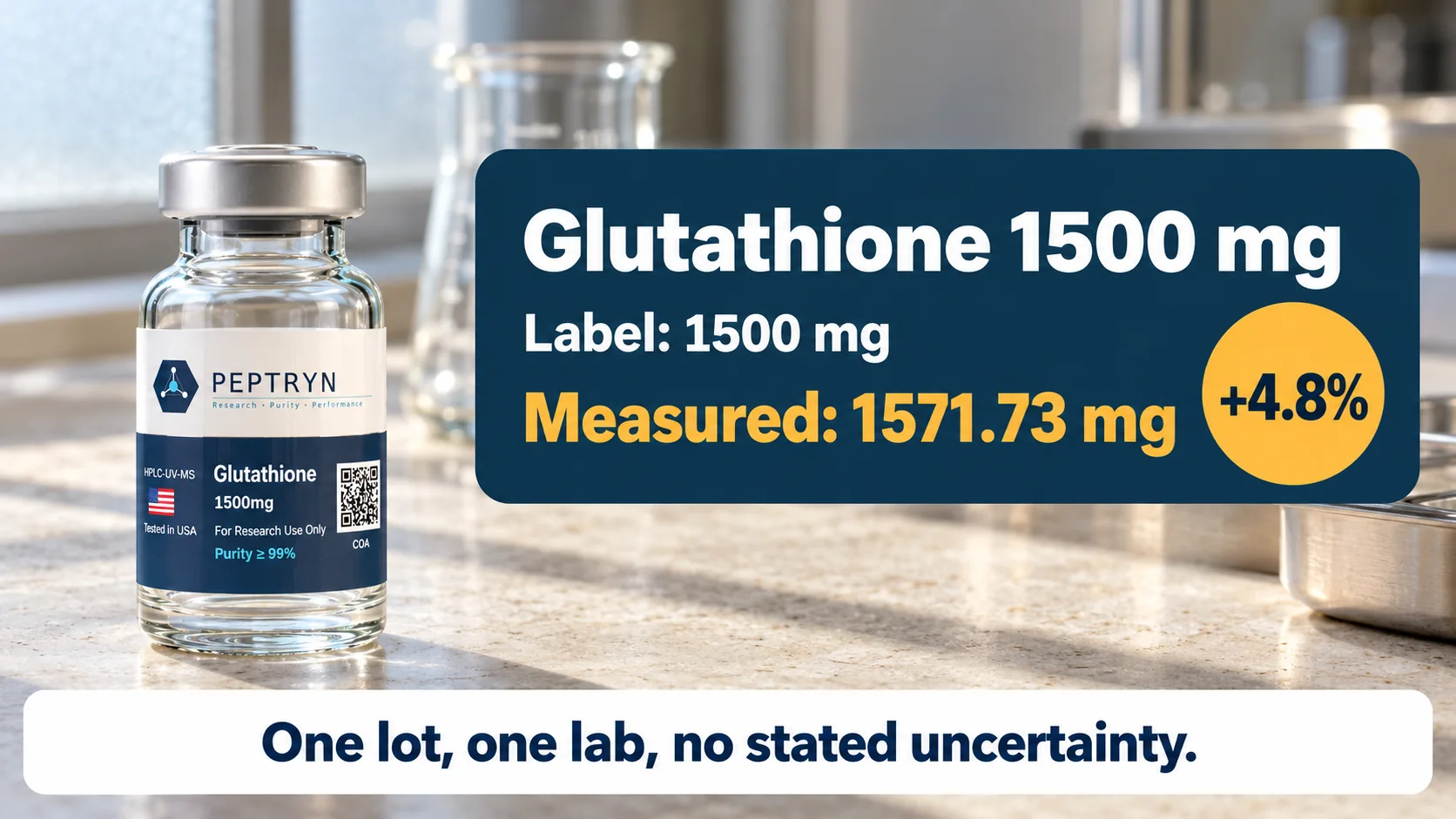
The lab report on the certificate page prints a measured quantity of 1571.73 mg against the 1500 mg label, a difference of +4.8%, and notes that sodium formate clusters indicate the glutathione was the sodium salt form. Our September 2026 data report read the same report. That is one lot from one laboratory without a stated assay uncertainty, and the report does not say whether the quantity counts free glutathione or the salt.
Glutathione price: what to compare
At the listed price, the vial costs about $0.053 per label mg, or about $0.051 per measured mg. Another page-one research listing showed this on October 15, 2026:
| Listing | Size | Price | Per label mg | Testing named on the page |
|---|---|---|---|---|
| Peptryn | 1500 mg | $79.99 | $0.053 | MZ Biolabs, lot 2026-08-05, 99.76% overall |
| Peptide Foundry | 1500 mg | $75.00 | $0.050 | Freedom Diagnostics, lot FO498, 99.08% |
On list price the other listing is about 6% lower. The purity figures are not comparable on their own, because the two labs may count different peaks as the product. Line up these before you compare:
- Size and form. Sellers list 600 mg and 1500 mg vials. Peptryn lists the 1500 mg size.
- Lot and lab. A price with no lot-matched report gives you a number and no verification.
- What the report covers. Purity, identity, endotoxin and quantity are separate results.
- What the seller sells. A laboratory vial is not the same product as a supplement or a clinic service.
Five checks for any glutathione vial
- Does the listing name the form? Glutathione exists as the reduced form (GSH) and the oxidized form (GSSG), and as salts. The identity result should match the form on the label.
- Does the lot match? Compare the lot on your vial with the lot on the report, and check that the analysis date fits the lot date.
- Is the report on the lab’s own site? A link or QR code to the lab’s record beats a PDF that lives only on the seller’s server. Our third-party tested peptides guide sorts these claims into five levels.
- Does endotoxin have its own report? A purity result does not cover it. In 2019 the FDA described adverse events after an injectable was compounded from a glutathione powder marketed for dietary supplements, and its tests found excessive bacterial endotoxin, with some results as high as five times the appropriate limit.
- How does the seller describe use? A research listing promises no skin, detox or anti-aging results and gives no dosing schedule. See are peptides legal? for background.
Why glutathione search results look so mixed
A search for “glutathione peptide for sale” on October 14, 2026 returned dietary supplements on Amazon, GNC and eBay, a chemical marketplace listing, a clinic page selling physician-prescribed injection therapy, and research-peptide shops. These are different things with different rules. Peptryn’s listing is a laboratory reagent. It is not a supplement, a cosmetic or a drug, and Peptryn does not offer it for human use.
Common questions
Where can I buy glutathione for research?
Peptryn sells glutathione as a 1500 mg lyophilized laboratory vial on its glutathione product page. It is sold only for laboratory research, to buyers who are 21 or older and who confirm qualified research use.
How much does glutathione 1500 mg cost?
Peptryn lists the 1500 mg vial at $79.99, about $0.053 per mg. Quantity pricing takes 3% off at 3 to 4 units ($77.59 each), 5% at 5 to 9 ($75.99) and 10% at 10 or more ($71.99). Prices change, so check the product page.
Is Peptryn’s glutathione third-party tested?
Yes. Lot 2026-08-05 was tested by MZ Biolabs, which reports 99.76% overall HPLC purity and a negative endotoxin result. The purity and identity record is on the lab’s own site, and Peptryn is the client that ordered the test.
Why is the glutathione peak 97.85% when the purity says 99.76%?
The 99.76% figure adds the glutathione peak (97.85%) and sodium formate clusters (1.91%) that MZ Biolabs says indicate the sodium salt form. The glutathione peak alone is 97.85% of area, and two unidentified minor peaks make up the remaining 0.24%.
Does the certificate show how much glutathione is in the vial?
Yes. The lab report on the certificate page prints a measured quantity per vial. Our September data report recorded 1571.73 mg against a 1500 mg label (+4.8%) for this lot, and the report does not say whether that is free glutathione or the salt.
Is Peptryn’s glutathione a dietary supplement?
No. It is a laboratory reagent, sold for in vitro and preclinical research only. It is not a supplement, a cosmetic or a drug, and it is not for human or veterinary use.
Is the vial reduced or oxidized glutathione?
The lab’s identity result for this lot is a measured mass of 307.12 against an expected 307.08, which matches reduced glutathione (GSH). The oxidized form, GSSG, would appear near 612 Da.
How is glutathione stored?
Per the Peptryn product specification, store the lyophilized powder at -20 °C, protected from light, moisture and oxygen.
Related: Glutathione guide · COA Library · How to read a certificate of analysis · Third-party tested peptides · Peptide COA data report · Best place to buy peptides online
Sources
All pages were read on October 11 to 15, 2026 unless noted.
- Peptryn. Glutathione product page; Glutathione 1500 mg certificate; Glutathione guide; COA Library; Peptide COA data report, September 26, 2026.
- MZ Biolabs. Certificate report for lot 2026-08-05, linked from the Peptryn certificate above.
- U.S. Food and Drug Administration. FDA highlights concerns with using the dietary ingredient glutathione to compound sterile injectables, June 7, 2019.
- Peptide Foundry. Glutathione 1500mg product page, price, lot and laboratory read October 15, 2026.
- Search results for “glutathione peptide for sale”, Google US, October 14, 2026.
Editorial note: Peptryn sells the research materials discussed on this site for laboratory use only. This guide is informational and is not medical advice. To report an error, use the contact page.
All products on peptryn.com are intended for laboratory research purposes only. They are not drugs, foods, dietary supplements or cosmetics, and they are not for human consumption, self-administration, or veterinary use. You must be 21 or older to buy. The information on this page has not been evaluated by the U.S. Food and Drug Administration and is not intended to diagnose, treat, cure, or prevent any disease.