Copper Peptides (GHK-Cu): What the Evidence Shows for Skin and Hair (2026)
Note: This guide is educational and is not medical advice. Peptryn supplies research-use-only peptides to laboratories, and nothing here suggests using research materials on yourself. Speak to a licensed clinician or dermatologist about any skin or hair concern.
The short answer
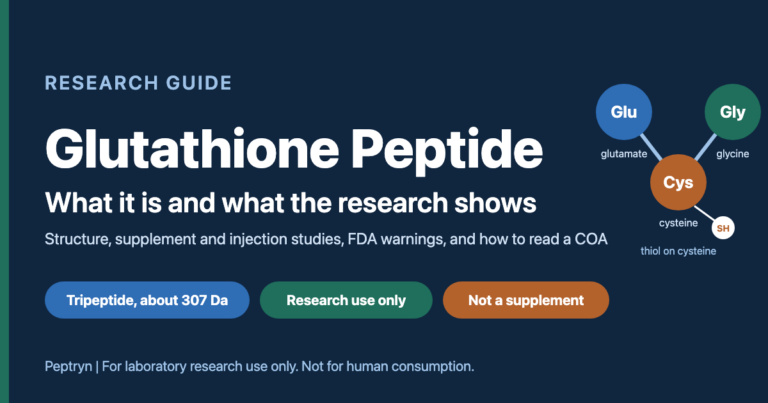
Copper peptides are small peptides bound to a copper ion. The best known is GHK-Cu, made of three amino acids (glycine, histidine and lysine) plus copper. GHK itself occurs naturally in human plasma, saliva and urine, and its levels decline with age. It is sold in serums and creams under names such as “copper tripeptide-1,” and more recently as an injectable that people buy online.
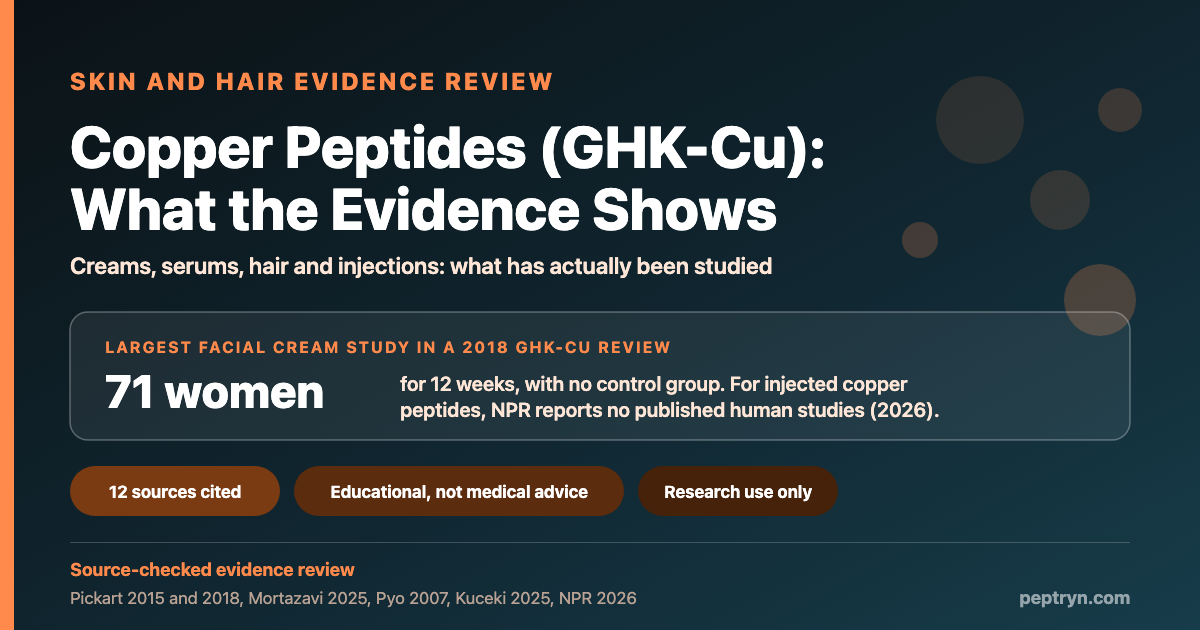
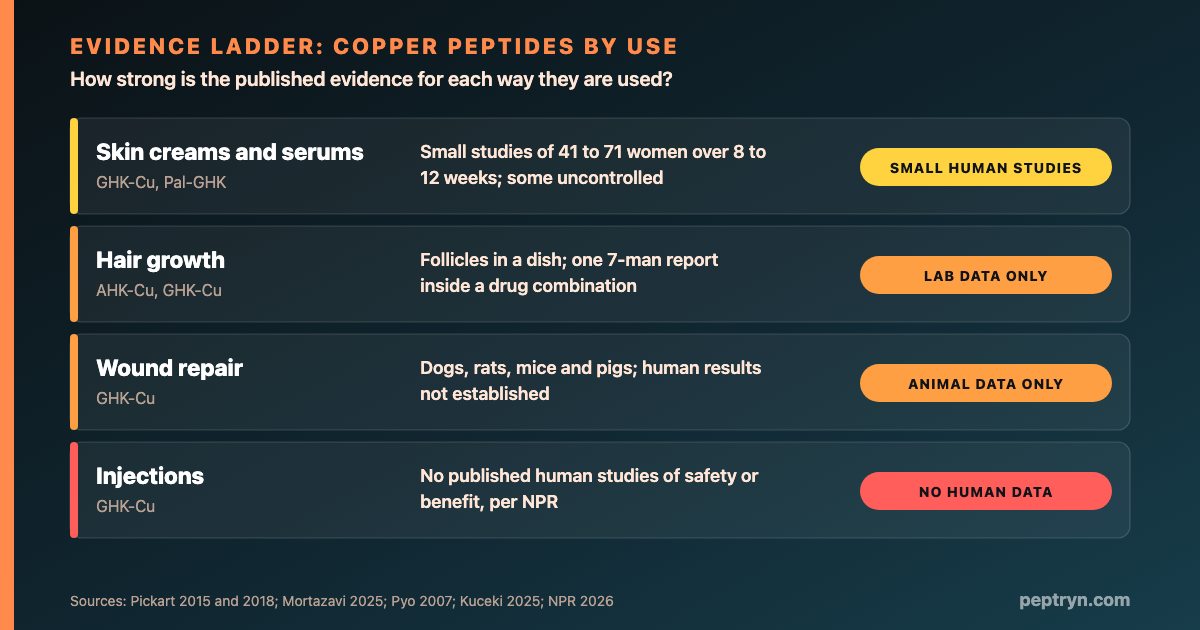
The evidence differs sharply by use. For skin creams and serums there are a handful of small human studies, and reviewers disagree about how much they prove. For hair, the support is mostly laboratory work plus one small uncontrolled report on a drug combination. For injections, NPR reported in September 2026 that no published human studies show they are safe or effective. Put together, copper peptides are a real molecule with a plausible skin role and an evidence base that is thinner than most marketing suggests.
| Use | What has been shown | Evidence | Main gap |
|---|---|---|---|
| Skin creams and serums | Small human studies of 41 to 71 women over 8 to 12 weeks report better skin density and fewer fine lines | Small human studies | Some uncontrolled, small, largely industry funded; how deep the peptide reaches is unclear |
| Hair | A related peptide (AHK-Cu) lengthened human hair follicles in a dish; a 7-man report used it inside a drug combination | Laboratory data | No controlled human trial of copper peptides alone found |
| Wound repair | Faster repair in dogs, rats, mice and pigs, according to a 2015 review | Animal data | Human results not established |
| Injections | Nothing published in people, according to NPR | None | Safety and benefit unknown, and the products are unregulated |
What copper peptides are
A peptide is a short chain of amino acids, and copper peptides are peptides that hold a copper ion. Copper is an essential mineral, and GHK is proposed to work as a copper complex. Several different molecules share the label, which causes confusion on product pages.
| Name | What it is | Where you see it |
|---|---|---|
| GHK | Glycyl-histidyl-lysine, the three-amino-acid peptide without copper | Research papers, some skincare |
| GHK-Cu | GHK bound to copper (INCI name: copper tripeptide-1) | Serums, creams, lab-grade vials |
| AHK-Cu | Alanyl-histidyl-lysine bound to copper | Hair and scalp research and products |
| Pal-GHK | GHK with a fatty acid (palmitoyl) attached to help it cross skin | Anti-wrinkle creams |
For the wider picture of how peptides differ from proteins and from each other, see what are peptides?
What human studies say about copper peptides for skin
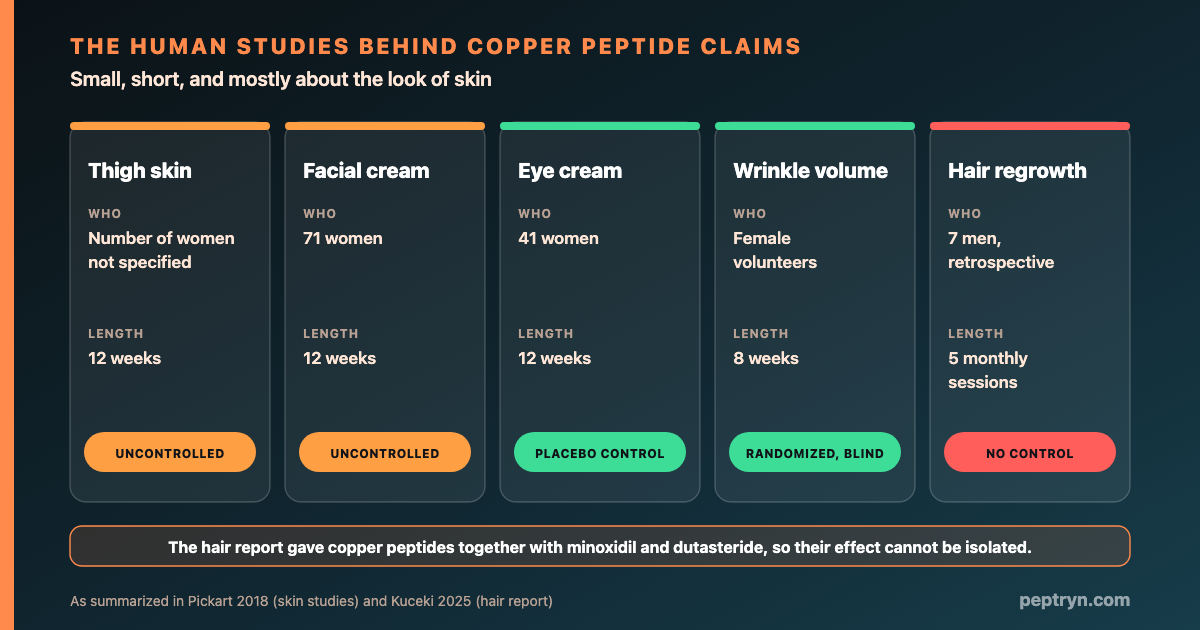
Most skin claims trace back to a small set of studies, summarized in a 2018 review by Loren Pickart, the researcher who first isolated GHK. The table lists what that review reports.
| Study (as summarized) | People | Length | Design | Reported result |
|---|---|---|---|---|
| Thigh skin, Abdulghani et al. | Not specified | 12 weeks | Uncontrolled comparison | Collagen production improved in 70% of women, against 50% with a vitamin C cream and 40% with retinoic acid |
| Facial cream, Leyden et al. | 71 women | 12 weeks | Uncontrolled | Increased skin density and thickness, less laxity, fewer fine lines |
| Eye cream, Leyden et al. | 41 women | 12 weeks | Placebo and vitamin K cream comparators | Fewer lines and wrinkles, increased density and thickness |
| Wrinkle volume, Badenhorst et al. | Female volunteers | 8 weeks | Randomized, double-blind | 31.6% less wrinkle volume than with a Matrixyl 3000 serum, and 55.8% less than with a control serum |
Three cautions apply. First, the studies are small, and two of the four had no control group. NPR describes the human studies as small and largely industry funded. Second, a 2025 review of topical GHK and Pal-GHK concluded that the published information on their skin permeability and effectiveness is insufficient, and noted “a surprising absence of clinical studies” using them, even though cell studies support an anti-wrinkle role. Third, getting a peptide through the outer skin layer is a known problem for cosmetic peptides in general, and a 2025 review names poor permeability as one of their main drawbacks.
A fair reading: a modest improvement in the look of aging skin is plausible, and the studies to date do not tell you how large it is. We found no well-controlled head-to-head trial against established skincare options in the sources reviewed for this guide.
Copper peptides for hair: what is and is not known
Search results for this topic are full of pages saying copper peptides have “real clinical data” or match minoxidil. The primary literature is narrower.
- Laboratory work. In a 2007 study, AHK-Cu, a related copper peptide, stimulated the elongation of human hair follicles kept in culture and increased the growth of dermal papilla cells, the cells that direct follicle growth. That shows a plausible effect in a dish. It does not show one on a scalp.
- One small human report. A 2025 retrospective report in JAAD International described seven men with androgenetic alopecia who had responded poorly to at least a year of standard care. They received five monthly sessions using a tattoo machine to apply a solution of minoxidil, dutasteride and copper peptides. Median regrowth in the top scalp area was 26.5%, and no adverse events were observed. There was no control group, the sample was seven people, and the copper peptide’s contribution cannot be separated from the two drugs.
- Reviews. A 2026 review of short peptides for hair loss and a 2026 review of newer hair-growth approaches both describe peptide approaches as promising. The second notes that differences in study design, dose, delivery method and follow-up limit comparisons between studies.
For androgenetic alopecia, the 2026 review still calls topical minoxidil and oral finasteride the traditional therapies. We could not find a published controlled trial showing that a copper peptide product matches either one. Anyone with hair loss should see a dermatologist, because the cause matters. For the wider picture, see peptides for hair growth.
Injecting copper peptides
Creams and injections are different products with different risks, and the second has no published human evidence. NPR’s September 2026 report on the trend quotes several clinicians:
- Dr. David Goldberg, a cosmetic dermatologist, said injection might offer added benefit because the molecule does not easily penetrate deeper skin when applied topically, but that he would not sleep well until human studies are done.
- Dr. Warren Ladiges of the University of Washington said GHK-Cu looks generally safe from animal research, and that he would not inject it into himself without knowing what it will do.
- Dr. Marisa Garshick pointed out that with unregulated sources, it is always a question whether a product even contains a copper peptide, and that the stakes are higher when injecting.
- Dr. Erik Marks, who works at a wellness clinic, described cases of elevated liver enzymes, elevated copper levels, injection site irritation and infections after people injected products bought online. NPR notes it is unclear whether the peptide, impurities or other undisclosed substances were responsible.
On regulation, GHK-Cu for injection was one of twelve peptides that FDA removed from its compounding “Category 2” list on April 15, 2026. FDA said the removal was because the nominations were withdrawn and that it does not make the substances eligible for compounding. It was not among the seven peptides the advisory committee voted on in July 2026, according to a law firm’s summary. The full timeline is in are peptides safe? Laboratory-grade GHK-Cu sold for research is not a skincare product, and it has not been evaluated for use on or in people.
Things to check before using any copper peptide skincare product
- Which molecule is it? GHK-Cu, AHK-Cu and Pal-GHK are not interchangeable.
- Is it sold as a cosmetic? A serum or cream is a different category from a vial labeled for research use only.
- Does the brand show evidence for its own formula? Results from one study do not carry over to a different concentration or formula.
- Is a medical condition involved? People with Wilson disease or another disorder of copper metabolism should ask a clinician before using any copper-containing product.
- Is it being sold for injection? Skincare products are not designed for that, and the evidence above says there are no human data.
Frequently asked questions
What do copper peptides do for skin?
Small studies reported better skin density, thickness and fewer fine lines after 8 to 12 weeks of use, with important limits on size, design and funding. Reviewers disagree on how strong the clinical evidence is.
Do copper peptides regrow hair?
Not established. Laboratory work on hair follicles is encouraging, and the one small human report combined copper peptides with two drugs, so the peptide’s effect cannot be isolated.
Can you inject copper peptides?
No published human studies show it is safe or effective, and reported problems include irritation, infections and raised liver enzymes. A physician should decide about any injected product.
What is GHK-Cu?
GHK-Cu is the copper complex of GHK, a three-amino-acid peptide found naturally in human plasma, saliva and urine.
Are copper peptides safe?
We did not find a systematic safety review of topical copper peptides. The human skin studies above reported improvements and did not focus on safety. For injections, see the concerns above.
Related: What are peptides? · Are peptides safe? · Are peptides legal? · List of peptides and what they do · What is a COA? · Peptides for hair growth · Peptides for skin
Sources
Pickart L, Vasquez-Soltero JM, Margolina A. GHK peptide as a natural modulator of multiple cellular pathways in skin regeneration. BioMed Research International, 2015 (PMID 26236730). pubmed.ncbi.nlm.nih.gov
Pickart L, Margolina A. Regenerative and protective actions of the GHK-Cu peptide in the light of the new gene data. International Journal of Molecular Sciences, 2018 (PMID 29986520). pmc.ncbi.nlm.nih.gov
Mortazavi SM, Mohammadi Vadoud SA, Moghimi HR. Topically applied GHK as an anti-wrinkle peptide: advantages, problems and prospective. BioImpacts, 2025 (PMID 39963574). pubmed.ncbi.nlm.nih.gov
Pintea A, et al. Review of cosmetic peptides for skin senescence and their delivery limits. Biomolecules, 2025 (PMID 39858482). pubmed.ncbi.nlm.nih.gov
Pyo HK, et al. The effect of tripeptide-copper complex on human hair growth in vitro. Archives of Pharmacal Research, 2007 (PMID 17703734). pubmed.ncbi.nlm.nih.gov
Kuceki G, et al. Enhanced hair regrowth with five monthly sessions of minoxidil-dutasteride-copper peptides tattooing for androgenetic alopecia. JAAD International, 2025 (PMID 40225275). pmc.ncbi.nlm.nih.gov
Fan C, et al. Overview of short peptides for hair loss. Biomedicines, 2026 (PMID 42072405). pubmed.ncbi.nlm.nih.gov
Burshtein J, Burshtein A, Schlesinger T. Emerging pharmacotherapies and regenerative solutions for promoting hair growth for androgenetic alopecia. Frontiers in Pharmacology, 2026 (PMID 41919230). pubmed.ncbi.nlm.nih.gov
Stone W. The copper peptide trend has gone from creams to injections, ahead of the science. NPR, September 7, 2026. npr.org
Frier Levitt. FDA peptide update 2026: removal from the “do not compound” list. frierlevitt.com
McDermott Will & Schulte. Bulk-list bound? PCAC backs majority of peptides in two-day public meeting. mcdermottlaw.com
U.S. Food and Drug Administration. Certain bulk drug substances for use in compounding that may present significant safety risks. fda.gov
For laboratory research use only. Not for human or veterinary use, and not a drug, food, dietary supplement or cosmetic. You must be 21 or older to buy.