Peptide Synthesis Explained: How Peptides Are Made, Step by Step
The short answer
Peptide synthesis is the process of joining amino acids, one at a time, into a chain with a defined sequence. Most research peptides are made by solid-phase peptide synthesis (SPPS). The first amino acid is anchored to a resin, the chain grows one residue at a time from the C-terminus, and the finished peptide is cut off the resin, purified by reverse-phase HPLC, identified by mass spectrometry and freeze-dried into the white powder in the vial. Longer or more complex molecules may instead be made in solution, by a hybrid of both methods, or biologically in yeast or bacteria. Every step can leave impurities behind, so the quality of a peptide depends on how it was made and on how it was tested. This guide walks through each step, shows where impurities come from, and explains how to read a certificate of analysis with the synthesis in mind.
What is peptide synthesis?
A peptide is a short chain of amino acids linked by amide bonds, which are called peptide bonds. By common convention, chains of up to about 50 amino acids are called peptides and longer chains are called proteins. Peptide synthesis means building a chosen chain on purpose: picking the amino acids, fixing their order and forming each bond in turn. Chemically, each bond forms when the carboxyl group of one amino acid reacts with the amino group of the next, releasing a molecule of water.
Peptide synthesis in a laboratory differs from protein synthesis in a cell. A cell’s ribosome reads messenger RNA and builds the chain from the N-terminus to the C-terminus. Chemical synthesis runs in a reaction vessel and builds in the opposite direction, from the C-terminus to the N-terminus (Stawikowski and Fields, Current Protocols in Protein Science).
The main ways peptides are made
Searches for “peptide chemical synthesis” and “how are peptides made” usually mean one of five routes. The table compares them.
| Method | How it works | Where it is used | Main limit |
|---|---|---|---|
| Solid-phase (SPPS) | The chain grows on an insoluble resin, and excess reagents are washed away by filtration between steps | Most research peptides and many drug candidates | Efficiency falls as the chain gets longer. Reliable work is usually limited to about 50 residues |
| Liquid-phase (solution) | Amino acids or fragments are joined in solution, and the intermediate is isolated between steps | Short peptides, fragments and some large-scale routes | More handling per step, so it is slower for long chains |
| Hybrid SPPS and liquid-phase | Fragments are built on resin, then joined in solution | Lilly’s published process for tirzepatide, a 39-residue peptide | Needs extra process development |
| Native chemical ligation | Two unprotected peptide segments are joined selectively through a thioester intermediate | Small proteins beyond the reach of direct SPPS (Dawson and Kent, 1994) | Requires a suitable junction, classically a cysteine |
| Recombinant expression | A gene is expressed in yeast, bacteria or mammalian cells, and the product is purified | Human insulin, and the backbone of semaglutide | Suited to natural amino acids. A chemical step is needed to add non-natural groups |
A short history: Merrifield and the solid support
Before 1963, peptides were built in solution, and every intermediate had to be isolated and purified before the next residue could be added. Bruce Merrifield changed that. He described the synthesis of the tetrapeptide Leu-Ala-Gly-Val on a solid support at a 1962 meeting and published the method in the Journal of the American Chemical Society in July 1963. His original chemistry used a polystyrene resin, Cbz protecting groups, DCC as the coupling reagent and HBr for cleavage. The 1984 Nobel Prize in Chemistry went to Merrifield “for his development of methodology for chemical synthesis on a solid matrix.”
The idea was simple and lasting. If the growing chain is anchored to an insoluble bead, then excess reagents and by-products can be removed by washing and filtration, and no intermediate needs to be isolated.
How solid-phase peptide synthesis works, step by step
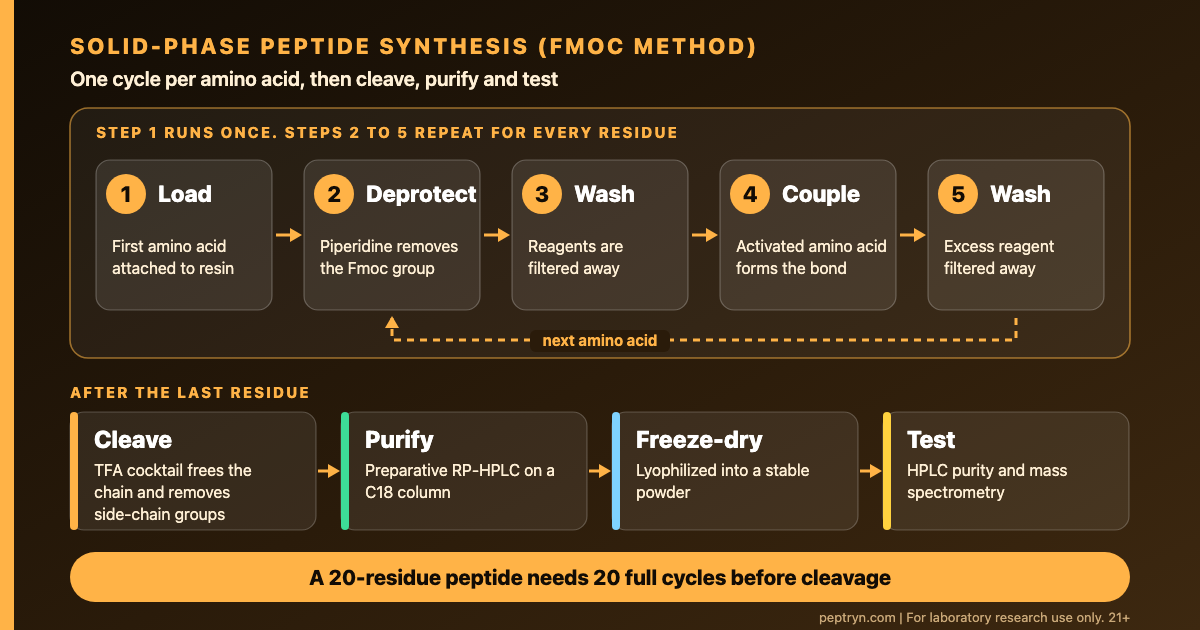
Modern SPPS is mostly automated, but the chemistry is the same cycle repeated once per amino acid. Here is the sequence for the Fmoc method that most laboratories use today.
- Choose a resin and load the first amino acid. The C-terminal amino acid is attached to an insoluble polymer support. Resin choices include polystyrene and PEG-based supports, and the resin type also decides whether the finished peptide ends in a free acid or an amide.
- Remove the temporary protecting group. Each incoming amino acid carries a group on its alpha-amino nitrogen that stops it from reacting with itself. In Fmoc chemistry this is the 9-fluorenylmethoxycarbonyl (Fmoc) group, removed with a base, usually piperidine.
- Wash. Solvent washes remove the deprotection reagents and by-products. Because the peptide is anchored to the resin, none of it is lost.
- Activate and couple the next amino acid. A coupling reagent (common examples are HBTU, PyBOP, or a carbodiimide with HOBt) activates the incoming amino acid so that it forms a peptide bond with the free amine on the chain. Reagents are used in excess to push the reaction toward completion.
- Wash again. Unreacted amino acid and coupling by-products are filtered away.
- Repeat. Steps 2 to 5 run once for every residue in the sequence. A 20-residue peptide needs 20 full cycles.
- Cleave and deprotect. The chain is released from the resin, and the permanent side-chain protecting groups are removed, using a cocktail based on trifluoroacetic acid (TFA) with scavengers. One published example is TFA, phenol, water and triisopropylsilane in an 88:5:5:2 ratio.
- Precipitate the crude peptide. The product is collected as a crude solid. It contains the target peptide along with everything that went slightly wrong during the cycles.
- Purify. Preparative reverse-phase HPLC on a C18 column separates the target from the impurities.
- Freeze-dry (lyophilize). The purified fractions are frozen and dried under vacuum into a stable powder.
- Test. Analytical HPLC gives a purity figure, mass spectrometry confirms that the molecular weight matches the intended sequence, and other tests such as endotoxin may be added. The results go on the certificate of analysis.
Fmoc versus Boc chemistry
Two protecting-group strategies dominate the field. Merrifield’s later work used Boc (tert-butyloxycarbonyl) chemistry, and Fmoc chemistry, introduced by Carpino in 1970, gradually replaced it. A survey run by the Peptide Synthesis Research Committee found that in 1991 about half of participating laboratories used Fmoc and half used Boc, and by 1994 98 percent used Fmoc.
| Feature | Boc chemistry | Fmoc chemistry |
|---|---|---|
| Temporary protecting group | Boc, removed by moderate acid (TFA) | Fmoc, removed by base (piperidine) |
| Side-chain protection | Benzyl-based groups | tert-Butyl-based groups |
| Final cleavage from the resin | Hydrogen fluoride (HF), which needs specialized equipment | TFA-based cocktail |
| Why it is chosen | Still used in some laboratories and for some difficult sequences | Milder conditions and no repeated acid exposure during assembly |
Why longer peptides are harder to make
Every residue needs a deprotection and a coupling, and neither reaction is perfectly complete. The losses compound. The table shows the overall fraction of full-length chain if each cycle is 99, 99.5 or 99.9 percent efficient. It is an arithmetic illustration of the principle, not measured data for any product.
| Efficiency per cycle | 10 residues | 20 residues | 30 residues | 40 residues | 50 residues |
|---|---|---|---|---|---|
| 99% | 90.4% | 81.8% | 74.0% | 66.9% | 60.5% |
| 99.5% | 95.1% | 90.5% | 86.0% | 81.8% | 77.8% |
| 99.9% | 99.0% | 98.0% | 97.0% | 96.1% | 95.1% |
Real chains add a second problem. Some sequences fold or clump on the resin, which blocks access to the growing end. The result is deletion sequences (a residue was skipped) and truncated sequences (the chain stopped early). Peptides longer than about 50 amino acids are hard to make with standard SPPS instruments for these reasons, which is why very long targets are assembled from fragments or made biologically.
What can go wrong: where impurities come from
Peptide purity is a question of process as much as testing. The main impurity types in synthetic peptides are:
- Deletion sequences. A coupling did not finish, so one amino acid is missing from part of the material.
- Truncated sequences. The chain stopped growing before it reached full length.
- Incompletely deprotected peptide. A protecting group survived the cleavage step and stayed on a side chain.
- Racemization. An amino acid flipped to its mirror-image form during activation or coupling, giving a peptide with the same mass but different geometry.
- Oxidation and other side reactions. Sensitive residues such as methionine and cysteine can change during cleavage or storage.
- Process residues. Traces of solvents, scavengers and the counter-ion left over from purification.
Several of these have nearly the same mass as the target, which is why a single test is never enough. A deletion sequence changes the mass and shows up in mass spectrometry, while a racemized product has the same mass and needs a good chromatographic method to separate it. Read more in our guide to peptide purity.
Purification, TFA salts and freeze-drying
Crude peptide is usually purified on a preparative C18 column with a water and acetonitrile gradient. The HPLC buffers commonly contain 0.1 percent TFA, so purified peptides are typically isolated as trifluoroacetate (TFA) salts. Some applications call for an exchange to acetate, which can be done by ion-exchange resin or by a second chromatographic step. Fractions that meet the purity target are pooled and lyophilized.
Two numbers on a report are easy to mix up. HPLC purity is the share of the UV signal that belongs to the main peak. Peptide content is the share of the powder’s weight that is actually peptide, which is lower than 100 percent because the powder also holds water and counter-ions. A vial can have a high HPLC purity and still contain less peptide by weight than its label weight suggests.
Where the peptides in approved drugs come from
Manufacturing route is one place where approved peptide drugs and research materials look different, so it helps to see how the well-known ones are made. The list below describes manufacturing only.
| Peptide | How it is made | Note |
|---|---|---|
| Human insulin | Recombinant DNA in bacteria | The FDA approved Eli Lilly’s Humulin on October 28, 1982, the first recombinant DNA drug marketed for people |
| Semaglutide | Precursor expressed in yeast (Saccharomyces cerevisiae), then chemically acylated | A biological step followed by a chemical step, according to the EMA assessment |
| Tirzepatide | Hybrid of solid-phase and liquid-phase synthesis | 39 amino acids plus a fatty-acid side chain. Lilly published a kilogram-scale GMP process in 2021 |
| Enfuvirtide (Fuzeon) | Chemical synthesis with solution and solid-phase steps | 36 amino acids and a reported 106 manufacturing steps (C&EN, 2005) |
An approved drug is made under regulatory oversight, with a defined process, validated methods and a regulator reviewing the results. A research-use-only material is not approved for human use and is not made under that framework. That gap is why independent testing and a lot-matched certificate of analysis matter so much when you are choosing a supplier.
Peptide synthesis cost, scale and the environment
People who search for “peptide synthesis cost” are usually trying to understand why one peptide is inexpensive and another is not. The main drivers are the same in every case:
- Length. More residues mean more cycles, more chances for a failed coupling and more purification.
- Sequence difficulty. Hydrophobic or aggregation-prone sequences need special handling, and repeated attempts raise the cost.
- Modifications. Fatty-acid chains, cyclization, non-natural amino acids and labels add steps.
- Purity target. Getting from a crude product to a very high purity means discarding many fractions.
- Scale. Milligram batches and kilogram batches use different equipment and different economics.
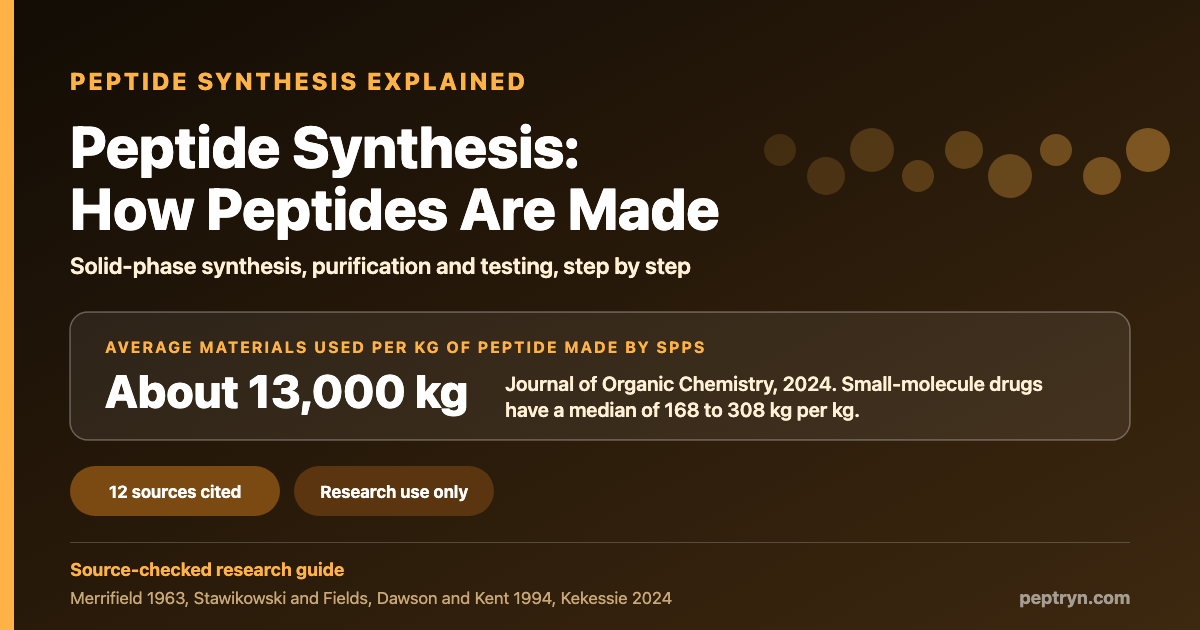
Solvent use is a major part of the cost and the footprint. A 2024 analysis in the Journal of Organic Chemistry put the average process mass intensity of SPPS at about 13,000 (kilograms of input materials per kilogram of peptide), compared with a median of 168 to 308 for small-molecule drugs. The most common SPPS solvent, dimethylformamide (DMF), has been restricted in the European Union since December 12, 2023 because of its reproductive toxicity, which is pushing manufacturers toward alternative solvents.
Can you make peptides at home?
In practice, no. Synthesis needs anhydrous solvents, hazardous reagents (piperidine, TFA and DMF among them), a synthesizer or careful manual glassware, a preparative HPLC system and mass spectrometry to know what you made. A crude product from a home attempt would contain deletion sequences, protecting-group residues and solvent traces, and there would be no way to measure them. Peptide synthesis belongs in a laboratory with the equipment and safety controls to run it. This article describes the process so you can understand it and does not give a working protocol.
How to read a certificate of analysis with synthesis in mind
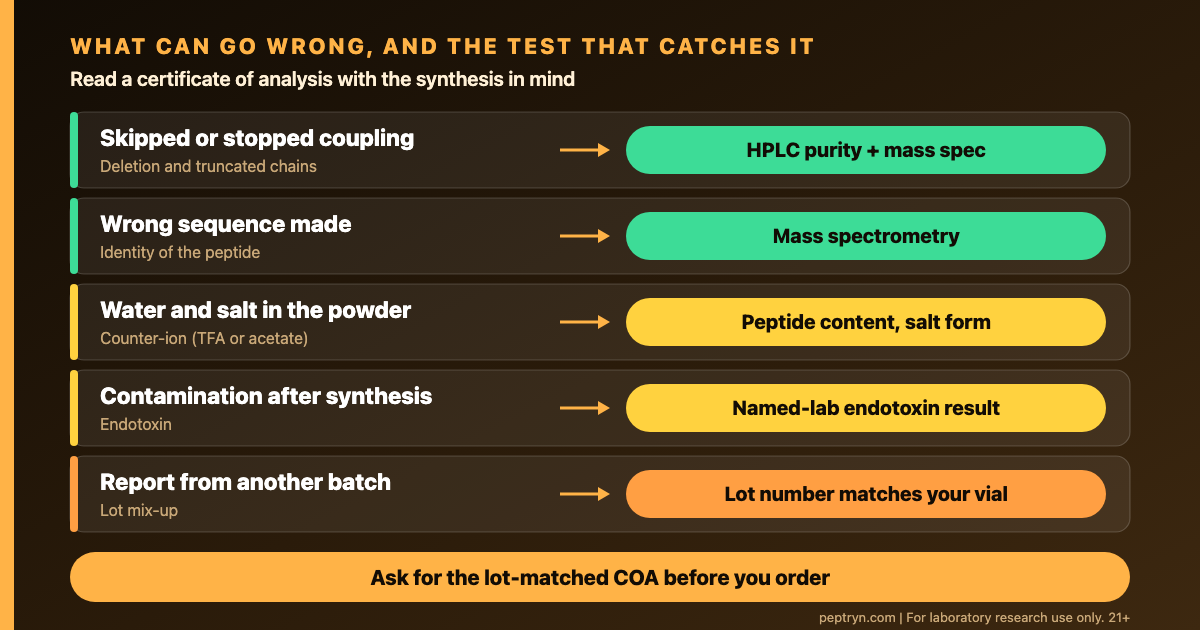
Each step of the process leaves a specific kind of problem, and each test on a COA is aimed at one of them. The table maps them together, and the graphic below summarizes it.
| What can go wrong | Test that catches it | What to look for on the COA |
|---|---|---|
| Deletion or truncated chains | HPLC purity and mass spectrometry | A single dominant HPLC peak, and a measured mass that matches the theoretical mass |
| Wrong sequence or wrong peptide | Mass spectrometry | Measured molecular weight within the method’s tolerance of the expected value |
| Water and counter-ion in the powder | Peptide content and counter-ion analysis | A stated net peptide content or a note on the salt form (TFA or acetate) |
| Microbial contamination after synthesis | Endotoxin test | A stated endotoxin result from a named laboratory |
| Report from a different batch | Lot number match | The lot number on the report equals the lot number on your vial |
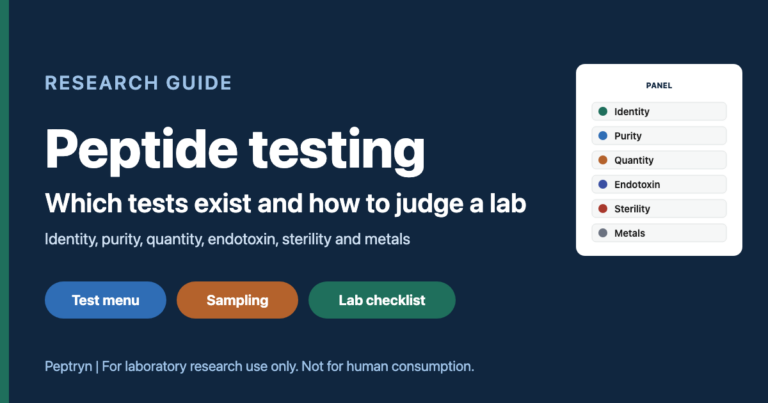
See our guides to what a COA is, peptide purity and peptide testing for a fuller walk-through. Peptryn publishes lot-level certificates of analysis in the COA Library, with independent third-party testing of every batch.
Check the lab results before you order
Lot-level certificates of analysis are public. Orders over $150 ship free, with same-day dispatch from the USA. Research use only. You must be 21 or older.
Does Peptryn offer custom peptide synthesis?
No. Peptryn does not offer a custom peptide synthesis service. It supplies catalog research materials in lyophilized form, each with a lot-level certificate of analysis. If you are looking for a custom sequence, look for a synthesis provider that states its purity methods, publishes sample reports and will quote a purity specification in writing. To see what is already studied, browse the list of peptides and what they do.
Common questions
What is peptide synthesis?
Peptide synthesis is the chemical process of linking amino acids in a chosen order to form a peptide. Each new amino acid is joined to the growing chain through a peptide bond, using protecting groups and coupling reagents to control the reaction.
What is solid-phase peptide synthesis (SPPS)?
SPPS is a method in which the peptide is built on an insoluble resin bead, one amino acid per cycle, from the C-terminus to the N-terminus. Excess reagents are washed away by filtration, and the finished peptide is cleaved from the resin at the end.
Who invented solid-phase peptide synthesis?
Bruce Merrifield introduced it in 1963, when he published the synthesis of the tetrapeptide Leu-Ala-Gly-Val on a solid support. He received the 1984 Nobel Prize in Chemistry for the method.
How are peptides made in a lab?
Most are made by SPPS. The chain is assembled on a resin, cut free with a TFA-based cocktail, purified by reverse-phase HPLC, checked by mass spectrometry and freeze-dried into a powder.
Is peptide synthesis the same as protein synthesis?
No. Protein synthesis in a cell is carried out by ribosomes reading mRNA, from the N-terminus to the C-terminus. Chemical peptide synthesis is done in a reaction vessel and runs from the C-terminus to the N-terminus.
What is the difference between solid-phase and liquid-phase peptide synthesis?
In solid-phase synthesis the chain stays anchored to a resin and reagents are washed away. In liquid-phase synthesis the chain is in solution and the intermediate is isolated between steps. Some large-scale processes combine both.
What is the difference between Fmoc and Boc?
They are two protecting-group strategies. Fmoc is removed with a base such as piperidine and final cleavage uses TFA. Boc is removed with acid and final cleavage typically uses hydrogen fluoride. Fmoc is now the dominant method.
What are coupling reagents in peptide synthesis?
Coupling reagents activate the carboxyl group of the incoming amino acid so that it reacts with the amine on the growing chain. Common examples are carbodiimides with HOBt, HBTU and PyBOP.
How long can a synthetic peptide be?
Standard SPPS is usually reliable up to about 50 amino acids, depending on the sequence. Longer molecules are made from joined fragments, by native chemical ligation or by recombinant expression.
Why are synthetic peptides sold as TFA salts?
The HPLC buffers used for purification normally contain TFA, so the purified peptide picks up trifluoroacetate as its counter-ion. It can be exchanged for acetate when an application requires it.
Are synthetic peptides the same as natural ones?
A synthetic peptide with the correct sequence has the same chemical structure as its natural counterpart. What differs is the impurity profile, because a synthetic product carries traces of its own process, which is why testing matters.
Are peptides made recombinantly or chemically?
Both routes exist. Human insulin is recombinant. Tirzepatide is made by chemical synthesis. Semaglutide combines a yeast-expressed precursor with a chemical modification step.
How much does peptide synthesis cost?
Cost depends on length, sequence difficulty, modifications, purity target and scale. Long, hydrophobic or modified peptides cost more because they need more steps and more purification.
Can I synthesize peptides at home?
Not in a way that produces a research-grade material. The reagents are hazardous, and without preparative HPLC and mass spectrometry there is no way to know what the product contains.
What does a certificate of analysis tell me about how a peptide was made?
It shows the results of the tests that check the outcome of the process: HPLC purity, mass-spectrometry identity, and sometimes peptide content and endotoxin. It does not describe the synthesis route, but a lot-matched report from an independent laboratory tells you whether the batch met its specification.
Related: What is a COA? · Peptide purity · Peptide testing · List of peptides and what they do · Popular peptides · Best place to buy peptides online · Peptide COA data report
Sources
Merrifield RB. Solid phase peptide synthesis. I. The synthesis of a tetrapeptide. Journal of the American Chemical Society, 1963;85(14):2149-2154. doi.org/10.1021/ja00897a025
The Nobel Prize in Chemistry 1984 (R. Bruce Merrifield). NobelPrize.org press release. nobelprize.org
Stawikowski M, Fields GB. Introduction to peptide synthesis. Current Protocols in Protein Science (PMC3564544). pmc.ncbi.nlm.nih.gov
Dawson PE, Muir TW, Clark-Lewis I, Kent SB. Synthesis of proteins by native chemical ligation. Science, 1994;266:776-779. doi.org/10.1126/science.7973629
Hartrampf N, et al. Synthesis of proteins by automated flow chemistry. Science, 2020;368(6494):980-987. doi.org/10.1126/science.abb2491
Kilogram-scale GMP manufacture of tirzepatide using a hybrid SPPS/LPPS approach with continuous manufacturing. Organic Process Research & Development, 2021. doi.org/10.1021/acs.oprd.1c00108
European Medicines Agency. Rybelsus (semaglutide) EPAR, public assessment report. ema.europa.eu
National Museum of American History. Recombinant drugs (Humulin, FDA approval October 1982). americanhistory.si.edu
Roche’s Fuzeon challenge. Chemical & Engineering News, 2005;83(11). cen.acs.org
Kekessie I, et al. Process mass intensity (PMI): a holistic analysis of current peptide manufacturing processes informs sustainability in peptide synthesis. Journal of Organic Chemistry, 2024 (PMC11002941). pmc.ncbi.nlm.nih.gov
Isidro-Llobet A, et al. Sustainability challenges in peptide synthesis and purification: from R&D to production. Journal of Organic Chemistry, 2019;84(8):4615-4628. doi.org/10.1021/acs.joc.8b03001
Sherwood J, et al. N,N-dimethyl formamide European restriction demands solvent substitution in research and development. ChemSusChem, 2024 (PMID 38200662). pubmed.ncbi.nlm.nih.gov
For laboratory research use only. Not for human or veterinary use, and not a drug, food, dietary supplement or cosmetic. You must be 21 or older to buy.